Free email delivery
Please sign up for email delivery in the subscription area to the right.
No salesman will call, at least not from us. Maybe from someone else.
Ballona Freshwater Marsh | Safety Update
[Posted by Chuck Almdale]
We are passing along the following caution to birders and other walkers in the Ballona area.
Hello Birders,
Some of you may be aware that parking, habitat, and safety conditions at the Ballona Freshwater Marsh have deteriorated significantly over the last 8 months or so. I have just been informed that on Tuesday [26 Jan. 2021] a woman who lives in Playa Vista was attacked at the Ballona Freshwater Marsh by three men with knives. She was able to escape and is okay but we don’t know any other details at this time and the men have not been found. The Ballona Wetlands Conservancy is working on measures to increase safety at the marsh. The marsh has not been very safe for some time now, but this confirmed attack pushes us to ask you to not visit the marsh for the time being. Your safety is very important to us. Please spread the word to any other birders that visit the marsh and are not on this email list. If they want to be added to this list for updates, please send me their email address. I will let you know of any new information I receive.
Best wishes during these troubled times,
Neysa Frechette
Manager of Scientific Programs
Friends of Ballona
Lisa Fimiani, long-term board member of Friends of Ballona and maven of all things Ballona, gave me some clarification, which I pass along to you with her consent.
“We have a very serious problem at the Ballona Freshwater Marsh with people who have taken up residence in their RV’s, cars, buses along Jefferson Boulevard; and some of them are not very nice people. The situation has escalated with more and more people crowding into the few parking spots left, so if you go there to bird you basically cannot find a parking spot on Jefferson. We’ve been battling this for over a year, long before the COVID-19 pandemic hit. The City has been absolutely useless in this situation – claiming they cannot force people to move due to COVID-19 restrictions. We’ve tried getting the City to put up NO OVERNIGHT PARKING signs, but the City won’t enforce them. Meanwhile, some of these “service resistant” folks have been cutting bushes and trees down for firewood, snagging wildlife with fishing lines, [going to the bathroom] everywhere, dumping unbelievable amounts of garbage, and basically running roughshod over our beloved Freshwater Marsh. I’m so angry I can barely speak about this, and the Marsh Manager, Edith Read, is beside herself (she’s copied). Her crew has had to deal with this mess, as well as the Ballona Wetlands Conservancy, who have been forced to hire HAZMAT crews and now security to patrol the area.
If you know anyone high up in government who can help, please reach out.”
There you have it. Be careful out there. And if you have any pull, push or twist with local government, feel free to use it.
The Bird Way, by Jennifer Ackerman | Book Review
By Femi Faminu
[Posted by Chuck Almdale]
During a casual conversation about notable books, my mention of a book by Jennifer Ackerman that I was reading at the time was deftly turned by Chuck Almdale into my writing a review of the book.

My introduction to Jennifer Ackerman was through another book of hers, Chance in the House of Fate: A natural history of heredity, which explores the influence of genetics in human behavior and her new book The Bird Way; A new look at how birds talk, work, play, parent, and think is written in a similar meandering yet logical style. Ackerman tackles several topics while seeking an understanding of life from the perspective of the birds themselves, drilling the answers down to the minutia of DNA and then taking a few steps back to view the same question from other angles.
Several of my questions as an amateur birder are addressed, for instance, do female passerines sing? Well, the short answer is, for various reasons, yes and no. And while we’re at it, vocalization is not limited to song, but bird language in both sexes includes calls, mimicry, gongs, whispers, chuckles, trumpeting and caroling at all times of day and night for myriad reasons. Get the picture?
Her answers to an initial question sometimes lead to more questions. Rather than providing simplified answers, Ackerman spends most of the book describing the wonders of Avian life, drawing parallels with humans and explaining how we differ. For instance, why they see colors we cannot and how some have a visual acuity that exceeds ours by such a significant degree that it is difficult to imagine.
Ultimately not all mysteries are solved, because the truth is, we just don’t know how birds perform a lot of the feats they do. I was still left with a deeper sense of wonder and appreciation for our feathered friends. Although we still don’t understand a lot of how or why birds do what they do, this should not reduce our enjoyment of their company, but rather make them appear more wondrous.
Griffon Vulture Saved by Drone
Worth a look – In Israel a drone was used to drop food to Griffon Vulture chick who had lost its mother.
This page is from the Vulture Conservation Foundation.
Chris & Ruth at Malibu Lagoon, 22 January 2021
[Posted by Chuck Almdale]
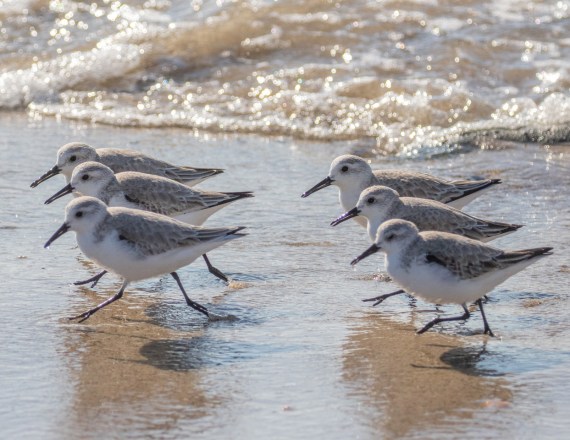
Sanderlings in formation – is revolution in the air? (Chris Tosdevin 2/24/21)
Chris and Ruth Tosdevin have been frequent visitors to Malibu Lagoon for many years, both on their own and on our regular SMBAS birdwalks. This is in addition to their leading (with Ken Wheeland) the birdwalk at Trippet Ranch in Topanga Canyon. Chris (alias “Chris the Brit”) shares a characteristic with nearly every British birder I’ve ever met, anywhere in the world, namely, they’re darned good birders.

Canada Goose in mid-honk (Grace Murayama 1/13/21)
It’s almost annoying. I wonder if it’s something about their school system? They notice things that most of the rest of us miss. Chris and Ruth have been on my last two impromptu “socially distanced birdwalks” at the lagoon, so when I landed in the hospital with a “busted gut” (not the official diagnosis), we asked them to take the monthly census. Birding with them is always a learning experience for me.
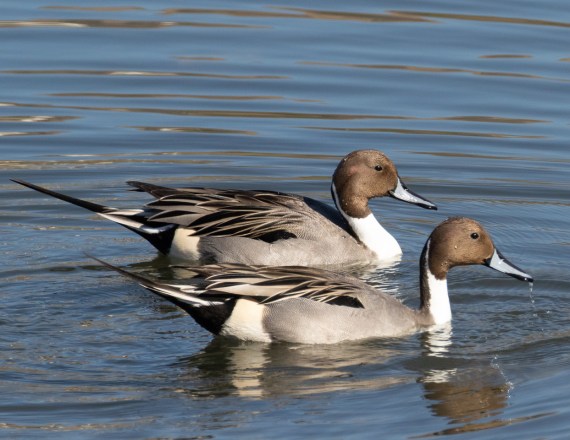
Pintail males (Chris Tosdevin 1/22/21)
In addition to that – of course – Chris is a very good bird photographer, and he has been kind enough to share many photos with us for many months now. Grace Murayama who, along with Larry Loeher, her co-maven of All Things Western Snowy Ploverish, also sends in many excellent shots, some of which follow.

Green-winged Teal male (C. Tosdevin 1/22/21)

A pod, a pouch, a scoop and a squadron of Brown Pelicans under the P.C.H. bridge.
When pelicans fish together, as do White Pelicans, they’re a fleet. (C. Tosdevin 1/24/21)
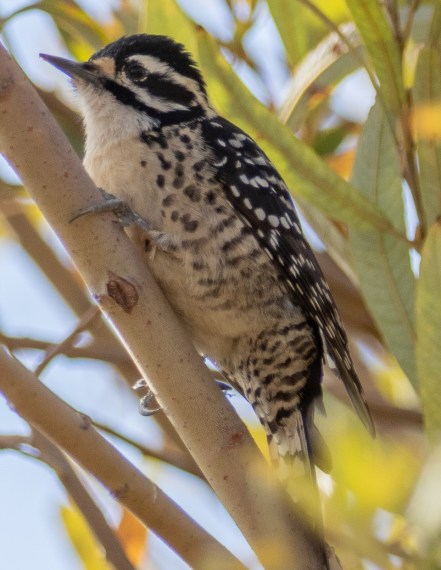
Every so often, Nuttall’s Woodpeckers come down out of the riparian areas upstream
and poke around the trees and large brush down at the lagoon. (C. Tosdevin 1/22/21)

Glaucous-winged Gulls are regular winter visitors to the lagoon.
Most of them are first-winter birds as is this one, but occasional a 2nd-cycle
or even an adult bird shows up. We also get small numbers of Western-Glaucous-winged
hybrids with varying amounts of black in the wing-tips. (C. Tosdevin 1/22/21)

This Turkey Vulture seems to have glommed onto
a really really dead-looking fish (G. Murayama 1/22/21)

Red-breasted Merganser females and young males look identical (to me) at this time of year.
In another month or two the males start to develop their alternate plumage.
(C. Tosdevin 1/22/21)
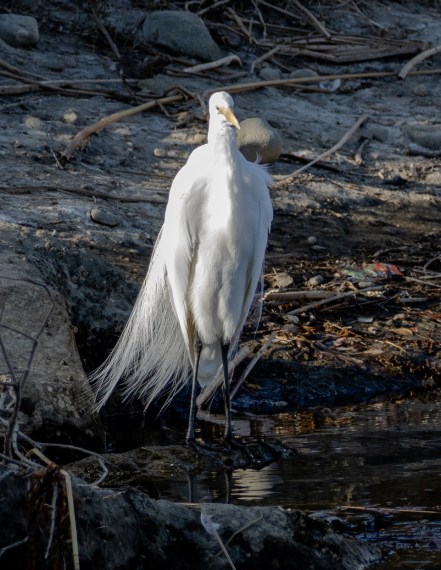
This Great Egret is exceptionally plumy for mid-winter. (C. Tosdevin 1/22/21)
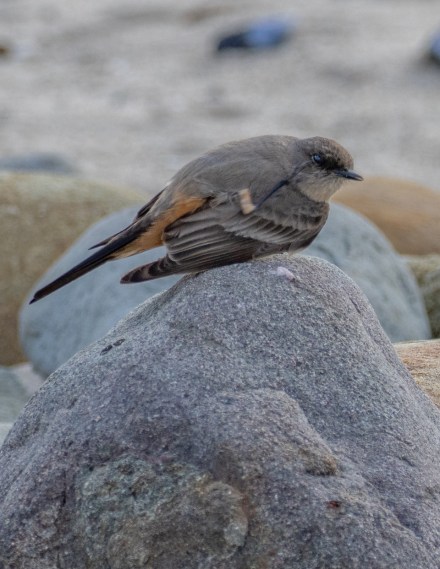
Say’s Phoebe resting on his lookout rock (C. Tosdevin 1/22/21)

Western Snowy Plover g:y/g contemplate the wrack. (G. Murayama 1/22/21)

Marbled Godwit, at 18″ one of our largest sandpipers (C. Tosdevin 1/22/21)
The gulls and terns were apparently off feeding somewhere else, and instead of thousands they totaled only 119 birds.
Birds new for the season: Canada Goose, Nuttall’s Woodpecker.
Many thanks to photographers: Grace Murayama and Chris Tosdevin
The next three SMBAS scheduled field trips: Who knows? Not I.
The next SMBAS program: March 2, Changes in Bird Status in California’s Central Valley, with John Sterling, on ZOOM, 7:30 PM.
The SMBAS 10 a.m. Parent’s & Kids Birdwalk is canceled until further notice due to the near-impossibility of maintained proper masked social distancing with parents and small children.
Links: Unusual birds at Malibu Lagoon
9/23/02 Aerial photo of Malibu Lagoon
Prior checklists:
2019: Jan-June, July-Dec 2020: Jan-July, July-Dec
2018: Jan-June, July-Dec 2017: Jan-June, July-Dec
2016: Jan-June, July-Dec 2015: Jan-May, July-Dec
2014: Jan-July, July-Dec 2013: Jan-June, July-Dec
2012: Jan-June, July -Dec 2011: Jan-June, July-Dec
2010: Jan-June, July-Dec 2009: Jan-June, July-Dec.
The 10-year comparison summaries created during the Lagoon Reconfiguration Project period, despite numerous complaints, remain available on our Lagoon Project Bird Census Page. Very briefly summarized, the results unexpectedly indicate that avian species diversification and numbers improved slightly during the restoration period June’12-June’14.
[Chuck Almdale]
| Malibu Census 2020-21 | 8/26 | 9/24 | 10/21 | 11/23 | 12/22 | 1/22 |
| Temperature | 70-77 | 66-77 | 64-68 | 52-64 | 57-64 | 60-61 |
| Tide Lo/Hi Height | L+2.52 | L+3.05 | L+2.70 | L+2.17 | L+2.15 | L+0.86 |
| Tide Time | 0958 | 1004 | 0634 | 1135 | 1052 | 1223 |
| Snow Goose | 2 | |||||
| (Black) Brant | 1 | |||||
| Canada Goose | 8 | |||||
| Gadwall | 5 | 2 | 2 | 28 | 6 | 8 |
| American Wigeon | 3 | 30 | 26 | 8 | ||
| Mallard | 16 | 14 | 14 | 8 | ||
| Northern Pintail | 2 | 1 | 2 | |||
| Green-winged Teal | 1 | 12 | 8 | 6 | ||
| Surf Scoter | 3 | 13 | ||||
| Bufflehead | 10 | 5 | 6 | |||
| Red-breasted Merganser | 9 | 12 | 1 | |||
| Ruddy Duck | 9 | 35 | 19 | 6 | ||
| Pied-billed Grebe | 3 | 2 | 2 | 3 | 3 | 2 |
| Eared Grebe | 1 | 1 | 5 | |||
| Western Grebe | 6 | 2 | ||||
| Rock Pigeon | 4 | 6 | 10 | 9 | 14 | 3 |
| Mourning Dove | 5 | 4 | 2 | 9 | 2 | |
| Vaux’s Swift | 8 | |||||
| Anna’s Hummingbird | 1 | 2 | ||||
| Allen’s Hummingbird | 1 | 1 | 2 | 2 | ||
| Sora | 1 | |||||
| American Coot | 48 | 118 | 287 | 445 | 110 | |
| Black Oystercatcher | 4 | 2 | ||||
| Black-bellied Plover | 66 | 102 | 91 | 30 | 10 | 25 |
| Snowy Plover | 26 | 27 | 42 | 28 | 22 | 21 |
| Semipalmated Plover | 4 | 8 | 4 | 1 | ||
| Killdeer | 7 | 12 | 1 | 8 | 14 | 20 |
| Whimbrel | 14 | 1 | 3 | 5 | 8 | 8 |
| Marbled Godwit | 3 | 5 | 4 | 8 | 10 | |
| Ruddy Turnstone | 2 | 1 | 6 | 2 | 6 | 1 |
| Sanderling | 39 | 75 | 78 | 25 | 8 | |
| Least Sandpiper | 21 | 12 | 4 | 13 | 6 | |
| Western Sandpiper | 8 | 1 | ||||
| Short-billed Dowitcher | 2 | |||||
| Spotted Sandpiper | 2 | 1 | 2 | 2 | ||
| Willet | 47 | 40 | 5 | 14 | 10 | 12 |
| Greater Yellowlegs | 1 | |||||
| Heermann’s Gull | 10 | 14 | 85 | 43 | 16 | |
| Mew Gull | 2 | |||||
| Ring-billed Gull | 10 | 65 | 15 | |||
| Western Gull | 98 | 90 | 21 | 53 | 34 | 30 |
| California Gull | 17 | 12 | 1 | 535 | 485 | 50 |
| Herring Gull | 1 | 1 | ||||
| Glaucous-winged Gull | 1 | 3 | 3 | |||
| Least Tern | 2 | |||||
| Caspian Tern | 1 | |||||
| Forster’s Tern | 4 | 1 | ||||
| Royal Tern | 11 | 12 | 3 | 5 | ||
| Elegant Tern | 221 | 1 | ||||
| Red-throated Loon | 1 | |||||
| Pacific Loon | 1 | 1 | ||||
| Brandt’s Cormorant | 1 | |||||
| Double-crested Cormorant | 18 | 43 | 16 | 108 | 28 | 85 |
| Pelagic Cormorant | 1 | 1 | 3 | 4 | 1 | |
| Brown Pelican | 8 | 5 | 5 | 206 | 32 | 162 |
| Great Blue Heron | 4 | 3 | 3 | 3 | 3 | 1 |
| Great Egret | 4 | 20 | 1 | 1 | 2 | |
| Snowy Egret | 4 | 2 | 5 | 4 | 23 | 10 |
| Black-crowned Night-Heron | 2 | |||||
| Turkey Vulture | 2 | 2 | 1 | |||
| Osprey | 1 | 1 | 1 | 1 | 1 | |
| Cooper’s Hawk | 1 | 1 | ||||
| Red-tailed Hawk | 1 | |||||
| Belted Kingfisher | 1 | 2 | 1 | 1 | 1 | |
| Nuttall’s Woodpecker | 1 | |||||
| Downy Woodpecker | 1 | |||||
| Black Phoebe | 5 | 4 | 5 | 4 | 6 | 1 |
| Say’s Phoebe | 1 | 2 | 2 | 5 | 1 | |
| Vermilion Flycatcher | 1 | |||||
| Loggerhead Shrike | 1 | |||||
| California Scrub-Jay | 1 | 2 | ||||
| American Crow | 3 | 3 | 4 | 11 | 14 | 6 |
| Tree Swallow | 3 | |||||
| Rough-winged Swallow | 1 | |||||
| Barn Swallow | 20 | |||||
| Bushtit | 50 | 16 | 75 | 30 | 30 | |
| House Wren | 1 | 2 | 1 | |||
| Marsh Wren | 5 | 3 | ||||
| Bewick’s Wren | 2 | |||||
| Blue-gray Gnatcatcher | 5 | 2 | 2 | |||
| Ruby-crowned Kinglet | 2 | |||||
| Wrentit | 1 | |||||
| Western Bluebird | 4 | |||||
| Northern Mockingbird | 1 | 2 | 1 | |||
| European Starling | 27 | 2 | 5 | 85 | 30 | 10 |
| House Finch | 4 | 8 | 4 | 4 | 6 | 4 |
| Lesser Goldfinch | 2 | 2 | 2 | 5 | 6 | |
| Lawrence’s Goldfinch | 15 | |||||
| California Towhee | 1 | 1 | 1 | |||
| Song Sparrow | 4 | 3 | 7 | 12 | 3 | 3 |
| White-crowned Sparrow | 4 | 12 | 4 | |||
| Dark-eyed Junco | 1 | |||||
| Western Meadowlark | 25 | |||||
| Great-tailed Grackle | 2 | 2 | 8 | 3 | ||
| Orange-crowned Warbler | 4 | 2 | 1 | |||
| Common Yellowthroat | 4 | 4 | 5 | 8 | 5 | 1 |
| Yellow Warbler | 2 | |||||
| Yellow-rumped(Aud) Warbler | 10 | 8 | 16 | 6 | ||
| Totals by Type | Aug | Sep | Oct | Nov | Dec | Jan |
| Waterfowl | 22 | 18 | 17 | 125 | 106 | 53 |
| Water Birds – Other | 30 | 99 | 146 | 617 | 518 | 359 |
| Herons, Egrets & Ibis | 14 | 25 | 9 | 7 | 27 | 13 |
| Quail & Raptors | 1 | 0 | 1 | 5 | 3 | 3 |
| Shorebirds | 197 | 248 | 229 | 175 | 127 | 114 |
| Gulls & Terns | 364 | 129 | 22 | 688 | 634 | 119 |
| Doves | 9 | 10 | 12 | 18 | 16 | 3 |
| Other Non-Passerines | 1 | 11 | 2 | 3 | 6 | 2 |
| Passerines | 152 | 79 | 135 | 170 | 126 | 72 |
| Totals Birds | 790 | 619 | 573 | 1808 | 1563 | 738 |
| Total Species | Aug | Sep | Oct | Nov | Dec | Jan |
| Waterfowl | 3 | 3 | 4 | 7 | 10 | 9 |
| Water Birds – Other | 4 | 5 | 7 | 9 | 9 | 4 |
| Herons, Egrets & Ibis | 4 | 3 | 3 | 2 | 3 | 3 |
| Quail & Raptors | 1 | 0 | 1 | 4 | 2 | 3 |
| Shorebirds | 10 | 12 | 9 | 10 | 13 | 11 |
| Gulls & Terns | 8 | 5 | 2 | 8 | 7 | 6 |
| Doves | 2 | 2 | 2 | 2 | 2 | 1 |
| Other Non-Passerines | 1 | 3 | 2 | 2 | 4 | 2 |
| Passerines | 15 | 18 | 18 | 18 | 14 | 11 |
| Totals Species – 98 | 48 | 51 | 48 | 62 | 64 | 50 |
Blog Post Controversy Resolved
Dear Members and Friends;
On January 13th we asked our members and the California Audubon Chapters for their opinions on the controversy resulting from our blog post of November 19th last. We have received responses from both individuals and chapters: some were supportive of our position, some were in the middle, and some were strongly opposed. However, a consistent theme from the chapters that responded was that we would help advance our shared goals if the 11/19 post were taken down. So we have done so.
Thanks to all who responded, and particularly to the chapters’ honest consideration that helped us to reach this decision.
For the Board
Elizabeth Galton, President, SMBAS



 SANTA MONICA BAY AUDUBON SOCIETY BLOG