Free email delivery
Please sign up for email delivery in the subscription area to the right.
No salesman will call, at least not from us. Maybe from someone else.
Webinars from Victor Emanuel Nature Tours (VENT)
We just watched a live webinar from VENT which was very good. It was Raptor Identification 101 with Erik Bruhnke, one of their tour leaders, and it appeared on Sept. 3, 2020 at 11 AM PDT. It covered all the U.S. common raptors and some of the more range-restricted ones. I assume they will make it permanently available on their website as a recording, as they already have two previously shown webinars available.
Cape aMAYzing: The magic of spring & fall birding at Cape May: with Louise Zemaitis & Michael O’Brien
Appreciating Birds & Nature More: with Victor Emanuel
Webinars are about one hour long.
Here’s their Webinar page.
Right after you sign up, they send you a confirmation email.
Log onto your first webinar a few minutes early as it includes downloading a program that lets you view the webinar. We have very slow internet and this took us a few minutes and we missed some of the webinar.
They have another one coming up which should be equally as interesting.
East and West in a New Germany: Birds and Art in Berlin and Brandenburg
By: Rick Wright
Register: Here
Date: Thursday, September 17, 2020
Time: 11:00 am PDT/12:00 pm MDT/1:00 pm CDT/2:00 pm EDT
[Chuck Almdale]
The Energy Innovation and Carbon Dividend Act
The following was sent to us by Marilyn Judson, a very long-time member of SMBAS, so we’re passing it on to you, our alert readers. The SMBAS board has not yet taken any position on this issue.
[Chuck Almdale]
The West Los Angeles chapter of the Citizens Climate Lobby (CCL) hopes to make a short presentation soon at a ZOOM meeting of our Board and/or chapter members on a climate change bill they support: the “Energy Innovation and Carbon Dividend Act” or HR 763. Eighteen other Audubon chapters have already endorsed this bill. Take a look at this funny and insightful video on CCL and HR 763:
The CCL YouTube channel has many additional videos.
HR763 will reduce America’s greenhouse gases (GHG) by 40% in the first 12 years by putting a price on each ton of carbon in fossil fuels, thereby creating a competitive advantage for non-carbon energy sources like solar. The revenue collected will be returned to taxpayers as a monthly dividend, which will help lower-income families to transition to sustainable energy sources like solar. A carbon fee and dividend approach to address global warming has been endorsed by 4 former chairs of the Federal Reserve, 27 Nobel Laureates, and 15 former Chairs of the Council of Economic Advisers
(https://clcouncil.org/economists-statement/).
More details on HR763 are here:
https://citizensclimatelobby.org/energy-innovation-and-carbon-dividend-act/.
Also, CCL has many chapters in L.A. County and elsewhere in Southern California: https://citizensclimatelobby.org/about-ccl/chapters/.
San Fernando Valley Natural History
Local history buffs, heads up!

Sepulveda Basin Wildlife Reserve (from the SFVAS website)
One of our local SoCal Audubon chapters, San Fernando Valley Audubon Society, has two pages of local history. If you’ve ever birded at the Sepulveda Basin Wildlife Reserve, you’ll want to read this. Click the links below.
[Chuck Almdale]
Natural History of the San Fernando Valley
History of Sepulveda Basin Wildlife Reserve and Citizen Involvement
What did the Earth look like 20 – 750 million years ago | Interactive spherical map
Watch the continents move around as the millennia roll by.
Just enter your city and pick your period from 0 – 750 million years ago. The continents move but your city stays marked. Use the ← and → keys to step through time. Link to site.
Sample description: 400 million years ago:
Devonian Period. Life on land becomes more complex as plants develop. Insects diversify and fish develop sturdy fins, which eventually evolve into limbs. The first vertebrates walk on land. Oceans and coral reefs host a diverse range of fish, sharks, sea scorpions, and cephalopods.
You can do two (maybe more) cities simultaneous. Los Angeles and Oslo, Norway were pretty close to one another at one time.
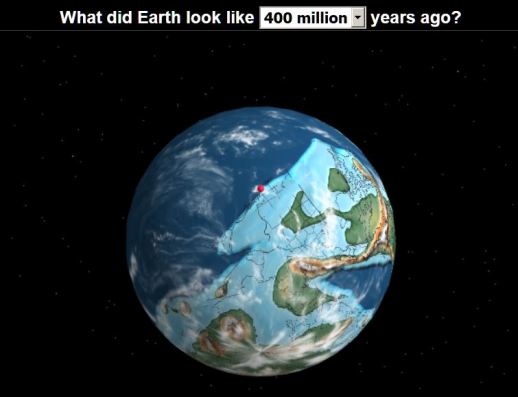
Los Angeles, CA is the red dot near center.
Didn’t know it was that old, did you?
They even clone themselves into a surprising variety of colors to stay hidden in plain sight from predators.
There’s that old cheesy joke: What’s brown and sticky? A stick.
But sometimes it’s not just a stick — but a walking stick. This non-native insect, originally from India, relies on clever camouflage to hide from predators. They’re so skilled at remaining undercover, you may not have noticed that they’ve made themselves right at home in your local park. Some Bay Area researchers are studying the insects’ genetics to learn more about how they are such masters of camouflage.
“I can’t think of any other insect as effective as they are in remaining hidden in plain sight,” said Edward Ramirez, an undergraduate researcher at the University of California, Berkeley who is currently studying the genetics of Indian walking sticks.
“How is this possible? was always the question that came to mind, so I wanted to search for a more clear answer.”
This is another installment of the PBS Deep Look series. If no film or link appears in this email, go to the blog to view it by clicking on the blog title above. If the film stops & starts in an annoying manner, press pause (lower left double bars ||) to let it buffer and get ahead of you. [Chuck Almdale]
[DISCLAIMER: The following is the work and opinion of the author and does not reflect the opinions of any other member of SMBAS either individually or SMBAS as a whole.]
I received fourteen negative and nine positive comments to my essay: The Attack: Common names of birds, eponyms, and the woke. None of the negative criticisms maintained that McCown was a proven racist and/or pro-slaver beyond the uncontested fact that McCown was a Confederate soldier. Most of the criticisms were of my writing style: my inclusion of asides, references to films, links to songs and exploration into philosophy and biology. You can’t please everyone. One critic made a statement which I think is representative of all the critics, and perhaps of all the woke:
Yes, it is an attack on the man and not his work. He was a Confederate soldier. He chose the pro-slavery side. There is no gray area although it is clear to you that there is a gray area and that fighting for the Confederates was a coin toss a man had to make.
I do not agree with that assessment which – to me – uses the informal fallacy of false dilemma and arrives at guilt by association. He discovered three species of birds and documented many others. We have no evidence that he was racist, pro-slavery, or ever owned slaves as did Presidents Washington and Jefferson. Most people agree the war was started about slavery although I know people who still call it the “War of Northern Aggression.” It was declared by the usual political sorts who are always with us, but Southerners joined for many reasons and up to 75% of them did not come from slave-owning households.
The only quote we have from McCown on the war is highly critical of the Confederacy. The Confederate flag he owned was the one he carried as an officer throughout the war, and he gave it away before he died. Why did he join? Family honor? Pressure from relatives? Anti-Union feelings? Tired of soldiering out west and in Florida? We don’t know his mind and it is biased and uninformed to leap to the conclusion he was racist and pro-slavery simply because he was a Confederate soldier.
There are no plans afoot – as far as I can tell – to change the scientific name Rhynchophanes mccownii to anything else. Changing scientific names is a much more rule-bound process than changing common names.
McCown was not just a soldier, and not just a Confederate soldier, he was a multi-faceted human being. From Early Southwest Ornithologists 1528-1900, Dan L Fischer. 2001. The University of Arizona Press, Tuscon. Pages 36-37.
Most of McCown’s specimens were sent to George N. Lawrence (1851), who published his discoveries and observations in the Annals of the Lyceum of Natural History of New York. Among those were seven birds McCown added to our fauna north of the border: Black-bellied Whistling-Duck, Green Kingfisher, Vermilion Flycatcher, Verdin, Cactus Wren, Pyrrhuloxia, and Great-tailed Grackle. McCown also discovered three new species, which Lawrence described in the same paper. Two of them were the plain Olive Sparrow, which was collected in the scrubby thickets near Fort Brown, and the Ash-throated Flycatcher, which was secured between San Antonio and the Rio Grande.
The third discovery, McCown’s Longspur (Calcarius mccownii), an inconspicuous flocking bird of open country that winters south into the central portions of the borderland region, is named in honor of this soldier-ornithologist. Lawrence, in writing its description, included a brief account of McCown’s discovery. “Two specimens were obtained by Capt. McCown on the high prairies of western Texas….they were feeding in company with Shore [Horned] Larks. Although procured late in the spring, they still appear to be in their winter dress; in summer, I have no doubt they assume the gay and ornamented plumage of their congeners.”
McCown’s (1853) only paper written on Texas birds included habits of the Greater Roadrunner. “Often in my wanderings through the chaparrals on the Rio Grande, I observed piles of broken snail shells, and always near some hard substance, such as a bone or hard piece of wood….I made many conjectures as to the probable animal. I never suspected a bird….I heard at times…a sound very similar to that made by some woodpeckers by a rapid beating of their bill upon an old dry tree. This was also a mystery, as I could find no woodpeckers near the place the sound came from. Upon inquiry of a Mexican, I was told that it was the Paisano breaking the snail shells to get at the snail…I was afterwards so fortunate as to see a bird so occupied.
McCown graduated from West Point Military Academy in 1840 and served in the army across the western territories, Texas and Florida until 1861, when he resigned his United States commission and entered Confederate military service. Following the end of the Civil War his life significantly changed. (From Encyclopedia of Arkansas)
Shortly after the end of the war, he moved to Knoxville, Tennessee, where he obtained work as a school teacher. After traveling to Arkansas to visit with his brother George in 1868 at his home in Magnolia, McCown purchased a house in the southeastern section of the town, moving there soon afterward. He quickly became a respected citizen known for his farming and generosity. The former general was known for displaying a number of historic war relics in his home. Over time, he gave away many of these items, including his personal flag carried during the war.
I initially wrote out a point-by-critical point reply to the criticisms, but it became overlong, tedious to write, boring to read, and of little interest to anyone, even the critics. It will not appear anywhere.
Thank you for your attention. Should you wish to write to the American Ornithological Society (AOS) to comment on their decision, their website is here.
I’ll leave you with two quotations I think apropos for our modern times. The first is ancient, yet strangely familiar.
Judge not, that you be not judged. For with what judgment you judge, you will be judged; and with the same measure you use, it will be measured back to you. And why do you look at the speck in your brother’s eye, but do not consider the plank in your own eye? Or how can you say to your brother, ‘Let me remove the speck out of your eye’; and look, a plank is in your own eye? Hypocrite! First remove the plank from your own eye, and then you will see clearly to remove the speck out of your brother’s eye. Matthew 7:1-5 New King James Version
The second is recent, yet springs from the same source.
As far as I can see, cancel culture is mercy’s antithesis. Political correctness has grown to become the unhappiest religion in the world. Its once honourable attempt to reimagine our society in a more equitable way now embodies all the worst aspects that religion has to offer (and none of the beauty) — moral certainty and self-righteousness shorn even of the capacity for redemption. It has become quite literally, bad religion run amuck. The Red Hand Files
[Chuck Almdale]



 SANTA MONICA BAY AUDUBON SOCIETY BLOG