Free email delivery
Please sign up for email delivery in the subscription area to the right.
No salesman will call, at least not from us. Maybe from someone else.
Black-throated Sparrow juvenile at Malibu Lagoon
Black-throated Sparrows almost never appear at Malibu Lagoon.

Black-throated Sparrow, juvenile (Chris Tosdevin 9-13-20)
They’re a desert, chaparral, or rocky slopes bird. Malibu Lagoon may often be deserted, but it’s not a desert.
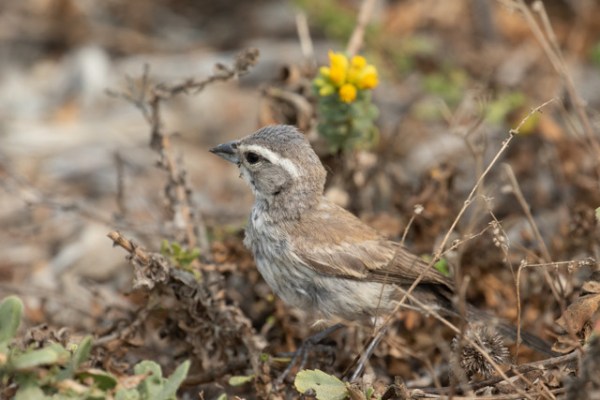
Black-throated Sparrow, juvenile (Chris Tosdevin 9-13-20)
In their adult plumage, they look elegant with a large black bib extending half-way down the breast, black cheeks and even bolder white supercilium and submoustachial stripes. This young bird looks a bit disheveled. We’ve seen them in many places: Antelope Valley, Carrizo Plains, Joshua Tree upper desert area and other dry locals.
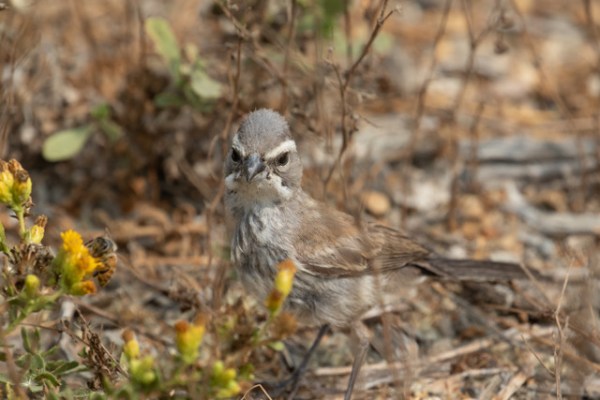
Black-throated Sparrow, juvenile (Chris Tosdevin 9-13-20)
They are extremely well-adapted to dry deserts as they are one of the few birds that don’t have to drink water. They get all they need from their diet of seeds, flowers, and invertebrates, as well as from what is called “water of metabolism” (formed in the body from the oxidation of the hydrogen in foods, especially fats). They can live in dry areas far from water, an ecological niche too difficult for most other birds and mammals except the Kangaroo Rat.

Black-throated Sparrow, juvenile (Chris Tosdevin 9-13-20)
Their breeding range includes east central Washington, Oregon east of the Cascades, all of Nevada, most of Utah, the northern half of Arizona, a thin strip in northern Utah, and southeastern California east of the Sierra, plus a tiny isolated area which is probably the Carrizo Plains. They spend the winter in southeastern California, across southern Arizona and New Mexico, southwestern Texas, and most of Baja California and mainland Mexico.
Chris and Ruth’s bird was undoubtedly on his or her way south. SMBAS’ only other recorded Lagoon sighting was on July 19, 1987, probably a single bird (presence recorded but number not counted).
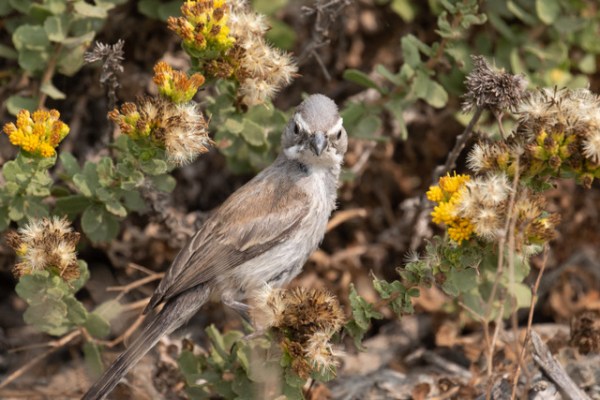
Black-throated Sparrow, juvenile (Chris Tosdevin 9-13-20)
Amphispiza bilineata (Greek amphi “on both sides” + spiza “finch”, Latin bilineata “two-striped”) is a small sparrow, 5 1/2″ long, same as the Chipping Sparrow. They’re not particularly skulky or secretive in their usual habitat, but I think you have to be both skilled and lucky to spot one in the brush around the lagoon where it’s almost totally unexpected.
Just as I was writing this, a report (from Joseph Brooks) came in that two other Black-throated Sparrows were spotted at Solstice Canyon yesterday (9-13-20), a few miles west of the lagoon. For those familiar with Solstice, they were in the vegetated creek bed near the parking lot. Can three birds constitute a fall-out?
Many thanks to Chris Tosdevin for the photos.
[Chuck Almdale]
joseph brooks
sunday 2 solstice creek parking ara
You Wish You Had Mites Like This Hissing Cockroach | Deep Look Video
Not all roaches are filthy. The Madagascar hissing cockroach actually makes a pretty sweet pet, thanks to the hungry mites that serve as its cleaning crew.
As the weather starts to warm and cold days give way to balmier, sunny days, one rite of spring returns every year, just like spring flowers: cockroaches.
Most people run to buy a can of bug spray or to call the exterminator when they see the scurrying little insects in their kitchens or outside their homes.
But not all roaches are pests. Some are pets – like the Madagascar hissing cockroach. They can be bought at pet stores or online for $5 or less. They don’t bite and don’t carry diseases.
They are also much larger than the run-of-the-mill roach, with adults averaging about 3 inches long. They live up to five years. They are slow-moving and mellow – kind of like an old tabby cat. But with antennae. And an appetite for fresh vegetables.
This is another installment of the PBS Deep Look series. If no film or link appears in this email, go to the blog to view it by clicking on the blog title above. If the film stops & starts in an annoying manner, press pause (lower left double bars ||) to let it buffer and get ahead of you. [Chuck Almdale]
Webinars from Victor Emanuel Nature Tours (VENT)
We just watched a live webinar from VENT which was very good. It was Raptor Identification 101 with Erik Bruhnke, one of their tour leaders, and it appeared on Sept. 3, 2020 at 11 AM PDT. It covered all the U.S. common raptors and some of the more range-restricted ones. I assume they will make it permanently available on their website as a recording, as they already have two previously shown webinars available.
Cape aMAYzing: The magic of spring & fall birding at Cape May: with Louise Zemaitis & Michael O’Brien
Appreciating Birds & Nature More: with Victor Emanuel
Webinars are about one hour long.
Here’s their Webinar page.
Right after you sign up, they send you a confirmation email.
Log onto your first webinar a few minutes early as it includes downloading a program that lets you view the webinar. We have very slow internet and this took us a few minutes and we missed some of the webinar.
They have another one coming up which should be equally as interesting.
East and West in a New Germany: Birds and Art in Berlin and Brandenburg
By: Rick Wright
Register: Here
Date: Thursday, September 17, 2020
Time: 11:00 am PDT/12:00 pm MDT/1:00 pm CDT/2:00 pm EDT
[Chuck Almdale]
The Energy Innovation and Carbon Dividend Act
The following was sent to us by Marilyn Judson, a very long-time member of SMBAS, so we’re passing it on to you, our alert readers. The SMBAS board has not yet taken any position on this issue.
[Chuck Almdale]
The West Los Angeles chapter of the Citizens Climate Lobby (CCL) hopes to make a short presentation soon at a ZOOM meeting of our Board and/or chapter members on a climate change bill they support: the “Energy Innovation and Carbon Dividend Act” or HR 763. Eighteen other Audubon chapters have already endorsed this bill. Take a look at this funny and insightful video on CCL and HR 763:
The CCL YouTube channel has many additional videos.
HR763 will reduce America’s greenhouse gases (GHG) by 40% in the first 12 years by putting a price on each ton of carbon in fossil fuels, thereby creating a competitive advantage for non-carbon energy sources like solar. The revenue collected will be returned to taxpayers as a monthly dividend, which will help lower-income families to transition to sustainable energy sources like solar. A carbon fee and dividend approach to address global warming has been endorsed by 4 former chairs of the Federal Reserve, 27 Nobel Laureates, and 15 former Chairs of the Council of Economic Advisers
(https://clcouncil.org/economists-statement/).
More details on HR763 are here:
https://citizensclimatelobby.org/energy-innovation-and-carbon-dividend-act/.
Also, CCL has many chapters in L.A. County and elsewhere in Southern California: https://citizensclimatelobby.org/about-ccl/chapters/.
San Fernando Valley Natural History
Local history buffs, heads up!

Sepulveda Basin Wildlife Reserve (from the SFVAS website)
One of our local SoCal Audubon chapters, San Fernando Valley Audubon Society, has two pages of local history. If you’ve ever birded at the Sepulveda Basin Wildlife Reserve, you’ll want to read this. Click the links below.
[Chuck Almdale]
Natural History of the San Fernando Valley
History of Sepulveda Basin Wildlife Reserve and Citizen Involvement



 SANTA MONICA BAY AUDUBON SOCIETY BLOG