Free email delivery
Please sign up for email delivery in the subscription area to the right.
No salesman will call, at least not from us. Maybe from someone else.
Results of random Covid-19 testing in Indiana
In response to the unending complaints** that we just aren’t carrying enough Covid-19 pandemic information to suit your unquenchable thirst for the grim truth, we offer this synopsis of a recent study, the subject of an article in The Conversation (motto: Academic rigor, journalistic flair), which frequently has well-written articles of great interest (to me, anyway).
[Chuck Almdale]
** (I wish.)
Random testing in Indiana shows COVID-19 is 6 times deadlier than flu, and 2.8% of the state has been infected
By Nir Menachemi, Professor of Health Policy and Management, IUPUI
The Conversation | July 21, 2000
The beginning of the article:
Since day one of the coronavirus pandemic, the U.S. has not had enough tests. Faced with this shortage, medical professionals used what tests they had on people with the worst symptoms or whose occupations put them at high risk for infection. People who were less sick or asymptomatic did not get tested. Because of this, many infected people in the U.S. have not been tested, and much of the information public health officials have about the spread and deadliness of the virus does not provide a complete picture.
Short of testing every person in the U.S., the best way to get accurate data on who and how many people have been infected with the coronavirus is to test randomly.
I am a professor of health policy and management at Indiana University, and random testing is exactly what we did in my state. From April 25 to May 1, our team randomly selected and tested thousands of Indiana residents, no matter if they’d been sick or not. From this testing we were able to get some of the first truly representative data on coronavirus infection rates at a state level.
We found that 2.8% of the state’s population had been infected with SARS–CoV–2. We also found that minority communities – especially Hispanic communities – have been hit much harder by the virus. With this representative data, we were also able to calculate out just how deadly the virus really is.
A summary of the findings:
- Date of Study: April 25 – May 1, 2020
- Study Size: 3600 randomly selected, 900 open testing volunteers
- Population of Indiana, 2020, estimated: 6,732,329
- Test sites: 70 testing stations in cities and towns across Indiana
- Tested with: PCR swabs for current infections, antibody blood test for past infections
- Infections found: 1.7% had active viral infection, 1.1% had antibodies from past infections
- Infection rate: 2.8% with 95% confidence actual rate is between 2% and 3.7%
- Known Indiana Covid-19 cases & deaths 4/29/20: 17,756 cases, 1109 deaths. (Wikipedia)
- Estimated 4/29/20 actual cases vs. known cases: 188,000 vs 17,756, or 10.6 times higher
- Death rate of known cases: 1,109 / 17,756 = 6.25%
- Death rate of estimated cases: 1,109 / 188,000 = 0.58%, or 9% of above death rate
- Death rate of 0.58% is approximately 6 times higher than 0.1% typical flu death rate
- 44% of those who tested positive for active viral infection reported no symptoms
- Infection rates in minority communities are higher; the rate for Hispanics is about 8%. This is likely because Hispanics are more likely to be essential workers and live in extended family structures
- People living with an infected person are 12 times more likely to have the virus than people not living with an infected person
- The low 2.8% overall infection rate combined with the much higher rates for those living with infected people or in extended families indicate that social distancing actually does work.
Some conclusions:
- When authorities focus on testing the symptomatic and don’t do random testing, the actual rate of infection is likely to be 10 times higher than the confirmed (known) rate.
- As of Sunday, 7/26/20, Los Angeles County reported 176,028 cases and 4,375 deaths, for deaths per known case rate of 2.5%. If the deaths per actual cases rate found in the Indiana study of 0.58% is accurate, we have 754,000 cases of infection, but we don’t know who 578,000 of them are.
- Similarly, for 7/26/20, California reported 460,550 cases and 8,445 deaths, for deaths per confirmed case rate of 1.8%. Using the Indiana study death rate of 0.58%, we have 1,456,000 cases of infection and we don’t know who 996,000 of them are.
- 44% of the currently Covid-19 infected have no symptoms. This agrees with the 40% – 50% range reported in many other areas.
- The good news is that Covid-19 is 1/2 to 1/12th as lethal than previously thought. The bad news is that if you are old with preexisting conditions, an essential worker, live in an extended family structure, or avoid masks and social distancing, you’re more likely to sicken and/or die.
- When 2.8% of the population was infected (3 months ago), 97.2% were not, thus there was an enormous pool of waiting-to-be-infected. This pool has shrunk, but it’s still huge. Wave 2.0 could be huge (we’re still in wave 1.5).
- If you don’t live in Los Angeles or California, find out your area numbers and apply the percentages found in the study. The key numbers are: 2.8% overall infection rate, 0.58% actual case death rate, 44% of infected (thus potentially infectious) have no symptoms. Also: read the article.
The Mojave Desert
The Book Shelf
For anyone interested in our local desert, the Mojave (mow-hah-vay, not mo-jave), or who wants to learn about it, this is a good book. I love this desert and spent many happy days-weeks-months exploring it, checking out the birds and flowers, clambering through canyons and across creosote bush flats, while avoiding as best I could the attacks of Jumping Cholla cacti, usually by myself and whatever beat-up car I then owned. This desert deserves to be better known and understood.
There was a long excerpt from the book in the Dec’18-Jan’19 issue of Natural History (from the American Museum of Natural History in New York City), which I really enjoyed, but cannot find a weblink to. So you’ll just have to find that issue or get the book. All the usual suspects carry it, including the Los Angeles Public Library. With this and a good map – I’m not sure I’d rely on GPS – (and food, water, hat, sunblock, etc. etc. etc.) you’ll be ready to hit the trail.
Here’s the blurb from the publishers, The University of Arizona Press.
[Chuck Almdale]
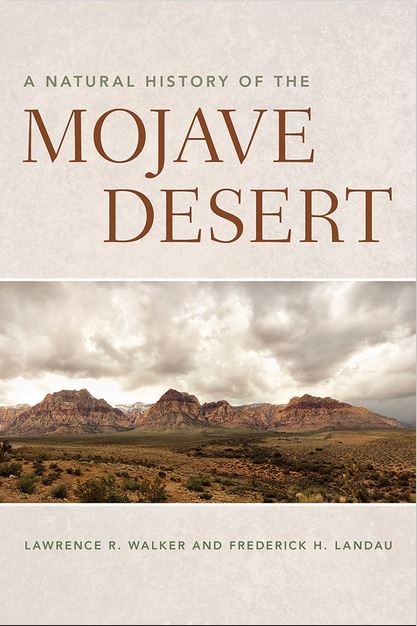
A Natural History of the Mojave Desert
Lawrence R. Walker and Frederick H. Landau
University of Arizona Press. 2018
The Mojave Desert has a rich natural history. Despite being sandwiched between the larger Great Basin and Sonoran Deserts, it has enough mountains, valleys, canyons, and playas for any eager explorer. Ancient and current waterways carve the bajadas and valley bottoms. This diverse topography gives rise to a multitude of habitats for plants and animals, many of which are found nowhere else in the world.
A Natural History of the Mojave Desert explores how a combination of complex geology, varied geography, and changing climate has given rise to intriguing flora and fauna—including almost 3,000 plant species and about 380 terrestrial vertebrate animal species. Of these, one quarter of the plants and one sixth of the animals are endemic.
The authors, who, combined, have spent more than six decades living in and observing the Mojave Desert, offer a scientifically insightful and personally observed understanding of the desert. They invite readers to understand how the Mojave Desert looks, sounds, feels, tastes, and smells. They prompt us to understand how humans have lived in this desert where scant vegetation and water have challenged humans, past and present.
A Natural History of the Mojave Desert provides a lively and informed guide to understanding how life has adapted to the hidden riverbeds, huge salt flats, tiny wetlands, and windswept hills that characterize this iconic desert.
Return of a bird we almost lost
This article comes from China Watch, an advertising supplement to the Los Angeles Times, Sunday, July 26, 2020 edition. This supplement is essentially an advertisement for China and everything it does. Nevertheless, I found it interesting and because it’s unlikely to be able to link to it (as it’s a big ad), I’m reproducing it in its entirety.
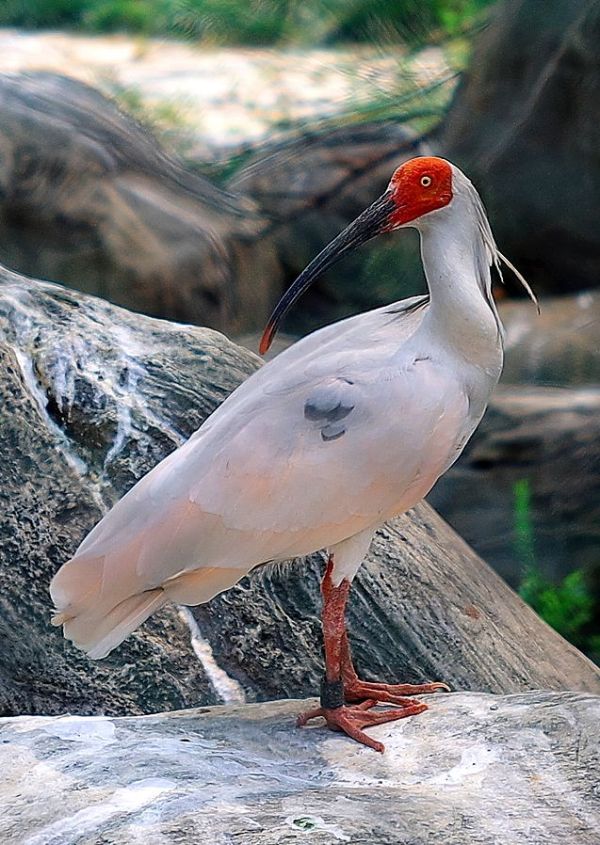
Crested Ibis Nipponia nippon
(Photo: Danielinblue, Sep 3, 2013, Wikipedia)
Return of the bird we almost lost.
By Yang Wanli with contributions from Zhao Xinying
The Crested Ibis, an endangered bird know as the “oriental gem” that was once thought to be extinct is far from it, and now there are 5.000 of them worldwide thanks to many years of conservation efforts, forestry authorities say.
The International Union for Conservation of Nature once designated the Crested Ibis, which many Chinese regard as a token of luck, as critically endangered, there having been only seven known living specimens in the 1980s.
“Strong protection efforts over the decades have helped boost its population,” Dang Shuangren, director of the Shaanxi Forestry and Grassland Administration, said on June 22. :Now thee are more than 5,000 Crested Ibises worldwide. About 4,400 of those are in China, 4,100 in Shaanxi province.”
The administration has published a report that says the habitat of the species has expanded from less than 2 square miles in the 1980s to about 5,800 sq. mi. now.
The bird existed in many regions in the world, including China and Japan. However, its population fell sharply because of human activities.
In 1981 Yangxian county in Shaanxi reported seven wild Crested Ibises, the only wild population in the world at the time. The recent report said the birds can now be seen in six cities and towns along the Qinling Mountains.
“Since the first captive-bred Crested Ibis was successfully released into the wild in 2013, we’ve received reports on the existence of the birds in regions outside of Shaanxi,” Dang said.
As the birds mainly live in the qinling Mountains, Shaanxi has built several natural reserves there since 1965. Since 1999 commercial logging has been banned in the region, and an environmental protection regulation dedicated to the area was adopted in 2007.
Construction of the Xi’an-Chengdu high-speed railway, which began operating in 2017, took into account the protection of the Crested Ibis.
I did a little more research on the bird.
From the Natural History Notebooks of the Canadian Museum of Nature:
The Crested Ibis is one of the rarest of all ibises. It is an endangered species that was once thought to be extinct in the wild.
Crested Ibises stand around 56 cm (22 in.) tall and have a wingspan that reaches 140 cm (55 in.). They are white with black, down-curving beaks and red faces and legs. They have crests that earned them the name, in ancient literature, of Xuan-mu, which means “whirling eyes”, because of the bushiness of the crest and its placement behind the eyes . During breeding season, the crest, head, neck and back are grey.
Tragically, the stunning crests are one reason for the disappearance of this species. The plumes were popular as hat ornaments, and indiscriminate hunting, coupled with habitat loss and agricultural pollution, eventually pushed this species to the brink of extinction.
Crested Ibises forage in wetlands, as well as ploughed fields and rice paddies, for crabs, frogs, small fish, river snails, earthworms and insects such as beetles. Both parents share the job of hatching the three to four eggs that are placed in flimsy twig nests built in tall trees. The removal of trees in their nesting habitat has also been cited as a reason for their decline.
Formerly common in Japan, China, and eastern Russia, by 1981 there were believed to be only five Crested Ibises in the wild, all on Sado Island in Japan. These were captured and placed in the Sado Japanese Crested Ibis Conservation Center with hopes that a captive breeding program might save the species. That same year, a Chinese researcher discovered seven wild Crested Ibises in Yang Xian county, Shaanxi Province, China. This was more than fortunate because the captive Japanese birds failed to produce any young, and eventually they all died. The protected Chinese population began to increase, and in 1990, 25 ibis chicks were captured and placed in a protection and rearing centre. Eventually they began to produce young, and within a decade there were more than 130 Crested Ibises in captivity.
It appears that the Crested Ibis is now on the road to recovery, with the total population of wild and captive birds currently greater than 600. In autumn 2008, 15 captive ibises in Japan’s Yasei Fukki Station were being prepared for release into the wild. In April 2008, a Crested Ibis was sighted on the southern Yangtze River in China—the first to be seen there in fifty years.
And then there’s always good old Wikipedia, the source of the photo at the top. Among their many facts, I found:
They make their nests in pine forests at the tops of trees on hills usually overlooking their habitat. They eat frogs, small fish, and small animals. At one time, they were in Japan, China, Korea, Taiwan, and Russia, but has now disappeared from almost all of its former range. This species is the only member of the genus Nipponia.
BirdLife International’s Data Zone page has interesting information plus a map. Here’s a sample.
Ecology: It breeds in February-June in areas with a combination of tall trees for nesting and roosting and wetlands or agricultural land for feeding. Clutch size is usually 3-4 eggs, and the incubation period is c.28 days. Young birds reach reproductive maturity at 2-4 years. In winter, the main feeding habitats are rice-fields, river banks and reservoirs, mainly close to human settlements, and it appears to tolerate human activities in these areas. In general, the species’s winters below 700 m and moves to higher elevations of up to 1,200 m during the breeding season. Current breeding sites are at 470-1,300 m, but lowland sites may be optimal, as indicated by density-independent population growth, perhaps owing to higher food availability, compared to relatively suboptimal high elevation sites. It feeds on crabs, frogs, small fish (particularly loach), river snails, other molluscs and beetles. On Sado Island, invertebrates were the most common prey, being consumed 70-90% of the time. Seasonal patterns in foraging have been documented, with paddies being important habitat in spring, early summer, autumn and winter, and levees around paddies and grasslands being important in late summer.

Two green areas shows Crested Ibis reserve NE of Chengdu in Sichuan, south central China, just east of Tibet. (BirdLife Int’l Data Zone)
Anamalia has a nice page friendly to young children. Here’s a tidbit.
Habits and Lifestyle: Crested ibises are social birds and are often seen in flocks, however, during the breeding season they become solitary and very territorial. When threatened or defending their nest from intruders ibises will flap their wings, extend their head, stretch-and-snap, and perform pursuit flight displays. These are diurnal (active during the day) birds that spend daylight hours resting, preening or walking and wading along shores searching for prey. Crested ibises are generally silent but if excited they will make a series of ‘gak-gak-gak’ calls. To communicate with each other or before taking off they will emit a low ‘gak’.
National Resources Defense Council has a brief write-up of the Ibis’ endangered status.
What Could Help Save the Endangered Crested Ibis?
Diversity, diversity, diversity.
Jason Bittel | April 13, 2017
[Chuck Almdale]
Why Crickets Just Won’t Shut Up | Deep Look Video
Male crickets play tunes non-stop to woo a mate or keep enemies away. But they’re not playing their song with the body part you’re thinking.
Ask most people about crickets and you’ll probably hear that they’re all pretty much the same: just little insects that jump and chirp.
But there are actually dozens of different species of field crickets in the U.S. And because they look so similar, the most common way scientists tell them apart is by the sounds they make.
“When I hear an evening chorus, all I hear are the different species,” said David Weissman, a research associate in entomology at the California Academy of Sciences in San Francisco.
Weissman has spent the last 45 years working to identify all the species of field crickets west of the Mississippi River. In December, he published his findings in the journal Zootaxa, identifying 35 species of field crickets in the western states, including 17 new species. California alone hosts 12 species. But many closely resemble the others. So even for one of the nation’s top experts, telling them apart isn’t a simple task.
“It turns out song is a good way to differentiate,” Weissman said.
This is another installment of the PBS Deep Look series. If no film or link appears in this email, go to the blog to view it by clicking on the blog title above. If the film stops & starts in an annoying manner, press pause (lower left double bars ||) to let it buffer and get ahead of you. [Chuck Almdale]
The kids should see this… | Bird video collection
Smart videos for kids of all ages.
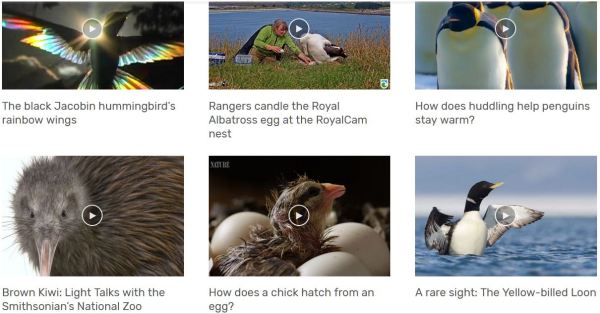
Screen shot of part of page two.
The website is: https://thekidshouldseethis.com/tagged/birds
246 videos about birds. It boggles the mind.
I’ll mention only two videos and supply YouTube links to them because there are two-hundred-and-forty-six videos on this site! You can click the videos below, but we suggest you go direct to “The Kids…” website, as you can watch all 246 videos from there and also read about them. There also other categories of video collections: Science, Tech, Space, Nature, Animals, Food, Music, History, Art, Animation, Do It Yourself.
Really, it boggles the mind. Thanks to Lillian for the link.
[Chuck Almdale]
Gannet life in Newfoundland, Canada
Avalon Peninsula, Newfoundland and Labrador, Canada Cape St Mary’s Ecological Reserve is home to one of only six gannet colonies in North America. This video provides an overview of Northern Gannet behavioral ecology throughout the breeding season and highlights the importance of Newfoundland and Labrador’s Ecological Reserves to the conservation of the species. Time: 9:08
A blue-and-white flycatcher bathes in a Japanese bird bath
“Vigorous bathing of young male Blue-and-White Flycatcher” Today’s Cute Kawaii Visitors. Time: 14:01
If no film or link appears in this email, go to the blog to view it by clicking on the blog title above. If the film stops & starts in an annoying manner, press pause (lower left double bars ||) to let it buffer and get ahead of you. [Chuck Almdale]



 SANTA MONICA BAY AUDUBON SOCIETY BLOG