Free email delivery
Please sign up for email delivery in the subscription area to the right.
No salesman will call, at least not from us. Maybe from someone else.
A dustup over McCown’s Longspur
This article is on a currently controversial topic. Some may find it offensive, but different people may have widely varying reasons for that opinion. SMBAS doesn’t often link to stories like this. Nevertheless, I felt it was worthy of consideration as it definitely pertains to birds and what we name them. If you object to or approve of the content, I suggest you contact the writer, Hannah Tomasy. Look for the “Comments” tab on the right side of this page. Thanks(?) to Ellen for sending me the link. [Chuck Almdale]
A Bird Named for a Confederate General Sparks Calls for Change
McCown’s longspur has launched a renewed reckoning over the troubling histories reflected in taxonomy
Smithsonian Magazine | By Hannah Thomasy, Undark | smithsonianmag.com | July 21, 2020
Across the United States, people are pushing for the removal of Confederate officers’ names from buildings, schools, and army bases, as protests against racial injustice continue in the wake of George Floyd’s death at the hands of Minneapolis police in May.
Something much smaller has also elicited debate over its Confederate name: McCown’s longspur, a bird that lives in the Great Plains and looks a bit like a sparrow. It was named after John Porter McCown, who was involved in forcible relocations of Native Americans during the 1840s, and who left the United States Army to serve as a Confederate general during the Civil War.
How Nature Works: White-winged Crossbill Feeding Technique | Cornell Lab of Ornithology
Take an up-close look at the remarkable physical adaptations White-winged Crossbills use to retrieve seeds hidden inside tightly closed spruce cones.
A film from the Cornell Lab of Ornithology. If no film or link appears in this email, go to the blog to view it by clicking on the blog title above. If the film stops & starts in an annoying manner, press pause (lower left double bars ||) to let it buffer and get ahead of you. The Lab is a member-supported organization; they welcome your membership and support. [Chuck Almdale]
Part three of our impromptu series on hummingbirds.
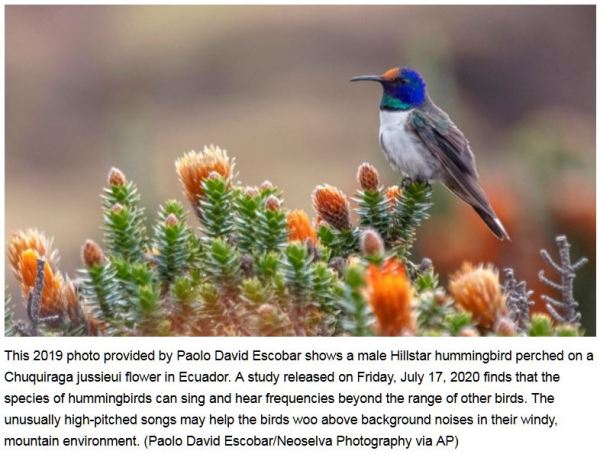
Ecuadorian hummingbirds chirp ultrasonic songs of seduction
Retrieved from CP24.com, Toronto
The Associated Press | Christina Larson | Friday, July 17, 2020
Perched on a flowering shrub on a windy Andean mountainside, the tiny Ecuadorian Hillstar hummingbird chirps songs of seduction that only another bird of its kind can hear. As the male sings, he inflates his throat, causing iridescent throat feathers to glisten princely purple. The female may join in a courtship dance – or chase him off. For the first time, scientists have shown that these hummingbirds can sing and hear in pitches beyond the known range of other birds, according to research published Friday in the journal Science Advances.
More on the CP24 website.
Here’s the original study article from Science Advances, 17 July 2020.
High-frequency hearing in a hummingbird
Authors: F. G. Duque, C. A. Rodriguez-Saltos, S. Uma, I. Nasir, M.F. Monteros, W. Wilczynski, L.L. Carruth.
Science Advances, 17 Jul 2020: Vol. 6, no. 29, eabb9393.
DOI: 10.1126/sciadv.abb9393
The complete study is on the website (possibly for only a short time); here’s the abstract.
Abstract: Some hummingbirds produce unique high-frequency vocalizations. It remains unknown whether these hummingbirds can hear these sounds, which are produced at frequencies beyond the range at which most birds can hear. Here, we show behavioral and neural evidence of high-frequency hearing in a hummingbird, the Ecuadorian Hillstar (Oreotrochilus chimborazo). In the field, hummingbirds responded to playback of high-frequency song with changes in body posture and approaching behavior. We assessed neural activation by inducing ZENK expression in the brain auditory areas in response to the high-frequency song. We found higher ZENK expression in the auditory regions of hummingbirds exposed to the high-frequency song compared to controls, while no difference was observed in the hippocampus between groups. The behavioral and neural responses show that this hummingbird can hear sounds at high frequencies. This is the first evidence of the use of high-frequency vocalizations and high-frequency hearing in conspecific communication in a bird.
[Posted by Chuck Almdale]
Two Hummingbird chicks: hatchlings to fledglings | Video
More on those always entertaining and interesting hummingbirds. This film – “Nature’s Flying Jewels” – comes from Los Angeles area musician-artist, Sheri Watson. Her first-hand documentary of Allen’s Hummingbird chicks begins with the mother’s nest building and follows them to their fledging from the nest and first flights. The video was re-edited from an original version posted in 2012; it corrects some initial mis-information and includes additional educational commentary. Original music by Sheri from her album “Shuniya.” See her additional post-production comments below. Time: 8:18.
If no film or link appears in this email, go to the blog to view it by clicking on the blog title above. If the film stops & starts in an annoying manner, press pause (lower left double bars ||) to let it buffer and get ahead of you.
When I contacted Sheri about her film, she added these following retrospective comments. I include them, with her permission, as an interesting and personal view into the process of creating the film.
This is the first film I ever made; I saw the nest and began taking photographs with a tiny digital elph point and shoot camera, never intending to make a film. When I realized the camera shot motion picture, I started filming them that way. I stood outside on a window ledge for hours and hours capturing the footage. I spoke to a hummingbird rehabber who guided me through what to expect.
I went to the Apple Store almost daily for six weeks to their one-to-one trainings where you can go and work on your projects and get instruction. Sadly, they do not offer that program anymore. I edited the first version in iMovie, which I posted on YouTube and to date has nearly 3 million views. I then went back to the Apple Store and and re-edited it in Final Cut Pro X, which is a more professional editing program, just to learn that program. The music in the film is from my CD called “Shuniya.”
I did learn after posting the original version that I made some errors, so while preparing to enter the film into a film festival a few years later, I used that opportunity to go back in and re-edit the narration, correcting my errors and adding even more educational information. I called this film “Nature’s Flying Jewels,” which is what the Europeans called the hummingbirds when they arrived in South America and saw them for the first time, as hummingbirds only exist in the North and South Americas. I recently posted this updated version on YouTube and this is version that is shared in this blog.
I have made other films if you care to see them. There aren’t any more about birds, but I seem to like to film things that fly: kites, fireflies, and butterflies, so far. You can view these films on my channel: https://www.youtube.com/c/SheriWatson724
Thank you for your support!
Thank you very much, Sheri.
[Chuck Almdale]
Hummingbirds! | CBD aoSHQ Video
Former SMBAS president Adrian sent this to me as a Windows Media file email attachment. Unparalleled cleverness on my part helped to track it down on YouTube. It’s cute and lovable.
If no film or link appears in this email, go to the blog to view it by clicking on the blog title above. If the film stops & starts in an annoying manner, press pause (lower left double bars ||) to let it buffer and get ahead of you. [Chuck Almdale]



 SANTA MONICA BAY AUDUBON SOCIETY BLOG