Free email delivery
Please sign up for email delivery in the subscription area to the right.
No salesman will call, at least not from us. Maybe from someone else.
City in the clouds
Newly discovered.
From the NASA daily photo website

City in the clouds (Photo: Mark Hersch, on NASA website)
Explanation from the NASA website:
How could that city be upside-down? The city, Chicago, was actually perfectly right-side up. The long shadows it projected onto nearby Lake Michigan near sunset, however, when seen in reflection, made the buildings appear inverted. This fascinating, puzzling, yet beautiful image was captured by a photographer in 2014 on an airplane on approach to Chicago’s O’Hare International Airport. The Sun can be seen both above and below the cloud deck, with the latter reflected in the calm lake. As a bonus, if you look really closely — and this is quite a challenge — you can find another airplane in the image, likely also on approach to the same airport.
[Chuck Almdale]
Marmots addendum
Sometimes emails go haywire, don’t work right, and videos that display properly when I create and preview them, don’t appear at all in the email I receive from the blog. Normally I put in a paragraph (see following) which counteracts this problem. With the Marmots posting, I forgot. Here it is.
If no film or link appears in this email, go to the blog to view it by clicking on the blog title above. If the film stops & starts in an annoying manner, press pause (lower left double bars ||) to let it buffer and get ahead of you.
Thanks to Carol Prismon-Reed for this film suggestion. [Chuck Almdale]
Marmots

Yellow-bellied Marmot M. flaviventris in Tuolumne Meadows, Yosemite N.P.
Photo by David Iliff, License: CC BY-SA 3.0
If you’ve done any alpine hiking in North America, Europe or Asia (including the Himalayas) you have undoubtedly seen a marmot. I met my first marmot in California’s eastern Sierras, specifically at Base Camp, altitude 12,000 feet above tree line and below Mt. Whitney. I’d taken my canteen to a nearby stream to get some water – this was during the years before giardia became widespread – and returned to find him halfway into my backpack, snuffling for snacks. Trail mix most likely. I had not been aware that large fat animals this size lived so high up in the mountains. I spent most of that afternoon watching them investigate and invade all the backpacks of hikers who – like me – left them unattended for more than a moment. Another hiker, just as surprised as me, came over and asked, “What is that thing, a giant rat?” “Marmot,” I replied with an air of authority, as if I hadn’t looked it up in my Sierra Natural History book only five minutes earlier.
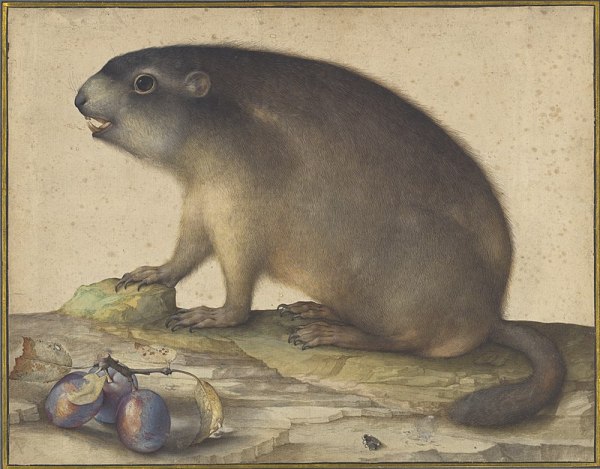
Jacopo Ligozzi, A Marmot with a Branch of Plums, 1605.
NGA 139309, Wikipedia.
According to Wikipedia, the etymology of the term “marmot” is uncertain. It may have arisen from the Gallo-Romance prefix marm-, meaning to mumble or murmur (an example of onomatopoeia). Another possible origin is post-classical Latin, mus montanus, meaning “mountain mouse”. I would not like to meet a mouse this size, scampering alongside the baseboard in my bedroom in the dead of night, or perhaps creeping across my bedcovers, pausing to sniff my breath.
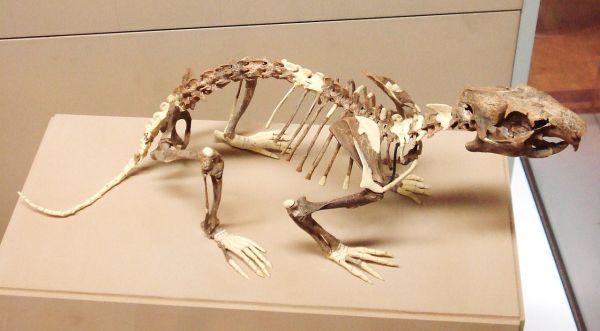
Marmota primigenia fossil. Photo by Ghedoghedo, Aug 2010, Staatliches Museum für Naturkunde Stuttgart; Wikipedia
What is a marmot? It’s essentially a large fat mostly-alpine herbivorous ground squirrel. At last count, there are fifteen species of marmots (read more: Wikipedia). One species, Marmota momax was featured in the film Groundhog Day (also starring Bill Murray.) They are classified in Order Rodentia (rodents), Family Sciuridae (squirrels & allies), Subfamily Xerinae (ground squirrels & allies), Tribe Marmotini (medium-sized ground squirrels), Genus Marmota. There are two subgenera: Marmota with eleven species including Groundhog, Alaska Marmot, and nine species in Eurasia; Petromarmota with four North American species, including Olympic Marmot M. olympus. The film below is about this last species.
If no film or link appears in this email, go to the blog to view it by clicking on the blog title above. If the film stops & starts in an annoying manner, press pause (lower left double bars ||) to let it buffer and get ahead of you.
Thanks to Carol Prismon-Reed for this film suggestion. [Chuck Almdale]
Insects are all over our planet, and you can find these alive today! They’re some of the most dangerous on earth, from the woods, jungles, desert, and rain forest. One things for sure, if you find one – you should definitely run away!
This is an installment of the TheRichest series. If no film or link appears in this email, go to the blog to view it by clicking on the blog title above. If the film stops & starts in an annoying manner, press pause (lower left double bars ||) to let it buffer and get ahead of you. [Chuck Almdale]
Chicks on Display at Malibu Lagoon
A few weeks ago we reported on our two-person trip to Malibu on 5-22-20. Among our sightings were four – maybe as many as six – Canada Goose goslings. Photographer Chris Tosdevin was there a few days earlier and recorded five goslings, plus another very interesting bird. See below. [Chuck Almdale]

Canada goose with five goslings in tow (C. Tosdevin 5-18-20)

Canada goose goslings (C. Tosdevin 5-18-20)
And here’s the “other interesting bird.”

Yes! Killdeer can swim at a very young age (C. Tosdevin 5-18-20)

Killdeer chick wading at lagoon’s edge (C. Tosdevin 5-18-20)
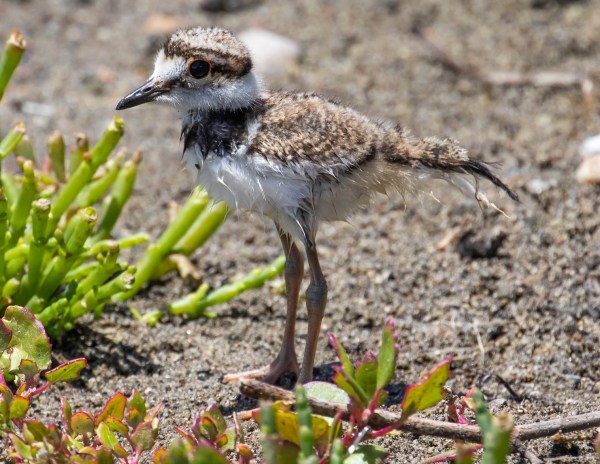
Killdeer chick drying off in the sun (C. Tosdevin 5-18-20)



 SANTA MONICA BAY AUDUBON SOCIETY BLOG