Free email delivery
Please sign up for email delivery in the subscription area to the right.
No salesman will call, at least not from us. Maybe from someone else.
Birds at my window | RM Videos
First we see the Eurasian Eagle-Owl (Bubo bubo) and her – ahem – rather large chicks. From the Netherlands, I think. 5-18-20. 3:16.
And now a Common (Eurasian) Kestrel and her five brown eggs. 6-6-19. 2:17
RM Videos has quite a collection of short films, including many about birds and another many about that perennial favorite, people doing stupid things. If no film or link appears in this email, go to the blog to view it by clicking on the blog title above. If the film stops & starts in an annoying manner, press pause (lower left double bars ||) to let it buffer and get ahead of you. [Chuck Almdale]
The California Science Center, located next door to the Museum of Natural History of Los Angeles County, now has an online tour of Space Shuttle Endeavour.
Tour One takes your around the flight deck, including a sit in the commander’s seat, the middeck and the payload bay. Use your mouse to move your vision around the area. Just click the big arrow and off you go! See if you can find the warp drive switch. More tours to come! [Posted by Chuck Almdale]

Endeavour flight deck forward view
Tour Two: Stand on the wings and explore the aft compartment!
Hey—you’re “standing” on the NASA meatball logo on the left (or port) wing of the ship! There’s another meatball in front of you, on the side of Endeavour. Like all the graphics on Endeavour’s skin, the meatballs are hand-painted! Zoom out to take in the entire view of Endeavour. First, look at the row of black hinges along the bottom of the payload bay door. You’ll count 13 of them starting with the one just above and to the left of the NASA meatball. The hinges toward the front are bigger because the front half of the payload bay doors have deployable radiators that need stronger hinges for support.
From the website:
Right now, space shuttle Endeavour is on exhibit in the Samuel Oschin Pavilion, preparing for its future installation in launch position in the Science Center’s upcoming expansion, the Samuel Oschin Air and Space Center. But while you’re staying safe at home, you can take a peek inside Endeavour‘s flight deck, middeck and payload bay through this unique tour, created by photographer Jon Brack and narrated by Perry Roth-Johnson, PhD, assistant curator of aerospace science here at the California Science Center.
Released to commemorate the anniversary of Endeavour‘s final launch, this is the first of a series of four Inside Endeavour tours that will be released throughout the spring and early summer. You don’t need a VR headset to enjoy these tours, but if you have one, hook it up and try it out. Stay tuned for more views Inside Endeavour!
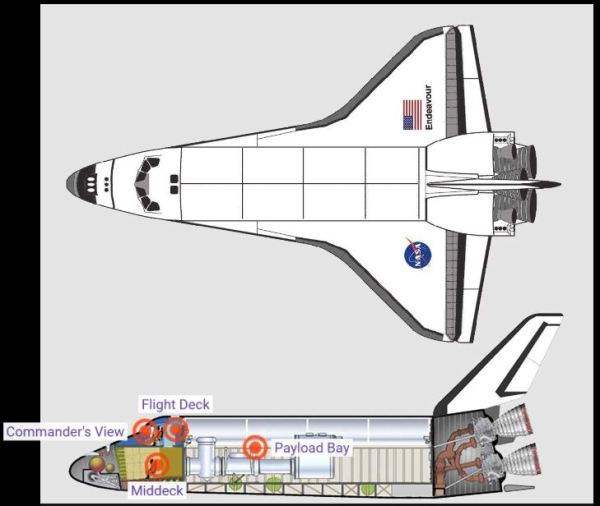
Map of Endeavour tour
Special SpaceX Bonus Videos
Tour from Space: Inside the SpaceX Crew Dragon Spacecraft on Its Way to the Space Station
NASA astronauts Robert Behnken and Douglas Hurley take viewers on a tour of the SpaceX Crew Dragon spacecraft that will take them on a 19-hour-journey to their new home in orbit. 5-30-20. 8:26
Watch Dragon capsule dock to the International Space Station
See NASA Astronauts Robert Behnken and Douglas Hurley dock the Dragon capsule to the International Space Station. 5-31-20. 7:20
SpaceX Crew Dragon ‘Endeavour’ tour: View of Earth and astronaut comforts
See Earth from SpaceX Crew Dragon’s window as NASA astronauts Doug Hurley and Bob Behnken give a 2nd on-orbit tour of the spaceship. Hurley and Behnken also show where some of the cargo, spacesuits and sleepwear is stowed. 5-31-20. 9:08
Steelhead return to Washington Rivers
Outside Online, a production of Outside Magazine, has a large file of short films. Longtime blog reader, Carol Prismon-Reed recently brought to our attention one in particular.
What Dam Removals Can Do for a River
Rising from the Ashes, from Trout Unlimited, follows the scientists studying the summer steelhead resurgence in Washington’s Elwha River. Since the removal of the Elwha Dam in 2011 and the Glines Canyon Dam in 2014, these fish are now free to run from the Pacific Ocean up into the Olympic Peninsula. May 24, 2020.
More videos are listed further down the page.

|
Nature Finds a Way
|
There is more purple to be seen on the peninsula!
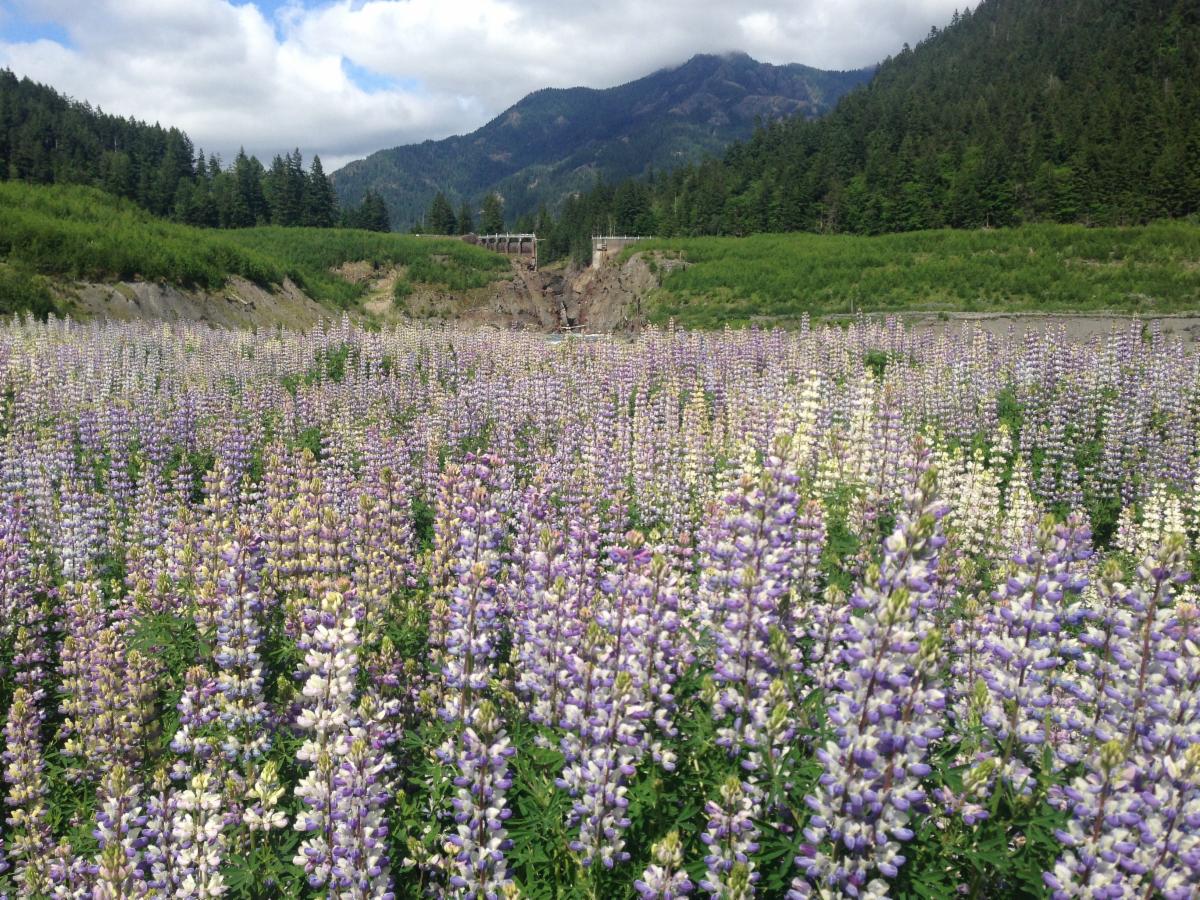
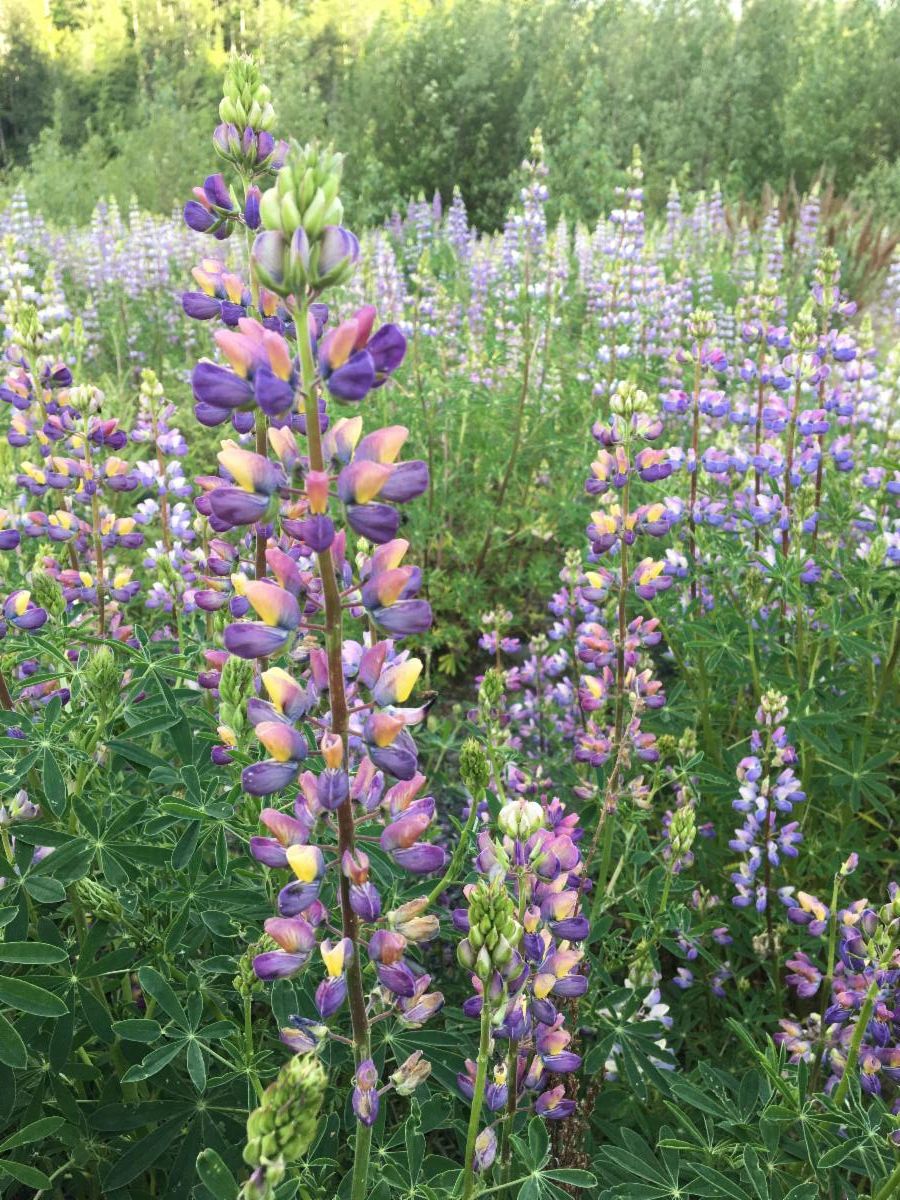
Riverbank lupine (Lupinus rivularis) is in full bloom around the Elwha watershed right now, and its delightful scent and beauty, aren’t even the best parts about it!
As many of you probably know, the Elwha River is the site of the largest dam removal project in the history of the world. The dams were removed (project completed in 2014) because they created a barrier for migrating fish, blocking them from over 70 miles of their historic habitat.
The dams, built in 1911 and 1927, created reservoirs on land that was previously old-growth forest. Removing the dams drained and exposed the gravelly and sediment-filled lakebeds. The land that was underwater for about 100 years, is now on the path to becoming old-growth forest again. Riverbank lupine is a crucial element to that succession.
Riverbank lupine thrives in areas where many other plants struggle. It can colonize disturbed, nutrient-poor soils due to its nitrogen-fixing abilities. Once the plant dies, the nitrogen is released, nourishing and improving the soil for plants to come.
Finding the right species to revegetate the area after draining the lakes was important not only for improving soil quality, but for preventing erosion, lending shade, and creating habitat for birds and small mammals to facilitate seed dispersal.
The National Park Service Elwha Revegetation team sowed riverbank lupine (seeds collected from the Dungeness River watershed), along with many other native species after Lake Mills was drained. Not sure what to expect, they found the riverbank lupine to be the key in the revegetation effort, helping to set the stage for the remarkable resurgence of life in the resilient Elwha watershed.
If you ever get a chance to visit with these plants, give them a big sniff, enjoy their vibrant colors, and remember the role they are playing in one of the greatest conservation success stories of our time.
(Please note: access to the upper lake-bed in the National Park is still closed due to corona virus restrictions. Lower-lake bed is open and also has fabulous lupine blooms!)
Photo Credit: Deanna Butcher
Upper photo (Former Lake Mills May 2017)
Lower photo (Former Lake Aldwell May 2020)
Support the Dungeness River Audubon Center by clicking below!
Dungeness River Audubon Center
 Face
Face  Instagram
 Other video titles on this page include:
Meet California’s Big Tree Hunter
In 1940, the American Forestry Association launched a campaign to locate the largest specimens of American trees. Since then, big-tree enthusiasts like Californian Carl Casey have been on the lookout for what’s defined as champion trees. In this film from director Brian Kelley, alongside the Gathering Growth Foundation, Casey explains what a champion tree is and some strategies he used to find the world’s largest pine tree.
One Man’s Battle Against the Russian Olive
The Russian olive tree is a notorious invasive species around Bears Ears and Grand Staircase–Escalante National Monuments. Since 1999, working along the Escalante River in southern Utah, aging park ranger Bill Wolverton has hacked and chainsawed his way through more than 40 miles of Russian olive trees. Love of Place, from DFS Films, documents his journey to restore his beloved river.
Paragliders Protecting Bearded Vultures
For aerial athletes, it’s not unusual to come across birds while in flight, like the threatened Bearded Vulture (Lammergeier). That’s why French freeflier Pierre Naville and the conservation organization Asters have teamed up with filmmaker Mathieu Le Lay to create this piece and raise awareness about proper flying techniques to mitigate the impact of aerial sports.
Outside’s Adventure page includes titles such as:
The Loneliest Everest Expedition
Amid the COVID-19 pandemic, three Chinese teams reached the top of the world.
We Are in the Middle of an Unprecedented Climate Experiment
The pandemic has shut down the most polluting industries around the world and turned us all into more adaptable consumers. That still isn’t enough.
Poke around on Outside Online. There’s lots of other interesting and useful stuff.
[Chuck Almdale]
Birding while black in NYC Central Park

Photo by David George Haskell
From Forbes article by GrrlScientist (see below)
You’ve probably read about this elsewhere. An Audubon member, Christian Cooper, a man who is black, is birding in New York City’s Central Park Ramble, an area beloved by local birders and where any dog must – by law – be on leash. He encounters a woman who is white with her dog who is not on leash. Problems ensue, to put it mildly.
You don’t to be a member of FaceBook or Twitter to view the next three items items.
The text of conversation preceding video.
The Cooper Central Park video.
May 28 interview with Christian & Melody Cooper on The View.
Following are three discussions of this event you probably haven’t seen. All three stories deserve to be read through to their ends. LZ Granderson’s is – for white birders (for whites in general, really) – merely a harrowing read; for him, it’s his life. [Chuck Almdale]
“How Am I Going to Be Perceived as a Black Man With Binoculars?”: J. Drew Lanham on Christian Cooper and Rules for the Black Birdwatcher
Vanity Fair. By Dan Adler, May 27, 2020
The ecologist and writer discusses the viral Central Park video, and how the hobby is only an escape for some.
In 2013, the writer, ecologist, and birder J. Drew Lanham published his “9 Rules for the Black Birdwatcher” in Orion magazine. “You’ll need the binoculars to pick that tufted duck out of the flock of scaup and ring-necks,” he wrote. “You’ll need the photo ID to convince the cops, FBI, Homeland Security, and the flashlight-toting security guard that you’re not a terrorist or escaped convict.”
Not Everyone Experiences The Joys Of Birding Like Me—A White Woman
Forbes. May 27, 2020
GrrlScientist: Senior Contributor. Evolutionary & behavioural ecologist, ornithologist & science writer
Birding is a wonderful way to get out into nature, to get some exercise and to experience wild birds, but there is a very good reason that few African-Americans engage in this activity. As a former resident of New York City, I birded Central Park for many years. The Ramble was always a highlight; peaceful, serene and often filled with amazing birds if one just sat still long enough to allow them to come to you or to sing.
George Floyd, Central Park, and the familiar terror they inspire
Los Angeles Times, May 28, 2020
LZ Granderson, Columnist
I didn’t feel well Tuesday. My body was tense, my stomach unsettled, the headache I was trying to push past kept pushing back. On most days I choose to be numb. Tuesday, I decided to feel. I recognize for some the video of George Floyd’s fatal encounter with four Minneapolis police officers is shocking. For me, it was not. I may not always choose to feel, but I am always aware. I learned early on that I didn’t have the luxury of not being aware.
Most DANGEROUS Birds On Earth | Secret Truths Video
The scariest, most dangerous birds in the world! From the brutal spurs of graceful waterfowl to the bone-dropping tactics of vultures. We won’t ruin the suspense and tell you who they are. The excited narrator will count you down from number ten to number one.
This is an installment of the Secret Truths series. If no film or link appears in this email, go to the blog to view it by clicking on the blog title above. If the film stops & starts in an annoying manner, press pause (lower left double bars ||) to let it buffer and get ahead of you. [Chuck Almdale]



 SANTA MONICA BAY AUDUBON SOCIETY BLOG