Free email delivery
Please sign up for email delivery in the subscription area to the right.
No salesman will call, at least not from us. Maybe from someone else.
Birding in your Bathrobe
The pandemic has shut down the bird tour companies. Flying is no fun and/or forbidden, no one wants to be quarantined for two weeks when you get to your destination, once there getting around may be impossible, COVID-19 outbreaks may be rampant. Problems, problems.
Time for a bird quiz, I say. Hone those I.D. skills. Refresh your memory of old feathered friends, discover new friends, visit locations familiar or new, local or so remote you’re not sure you’ve actually heard of it.
Here is a collection of websites featuring quizzes, photos, virtual bird tours, actual tour reports, hot spots, fond birding memories, rugged safaris and the infamous second ascent of Rum Doodle. Check them out; they’re all free.
Create a new life list category: Birds Seen While Lounging In Bed With Beverage And Bon Bons Nearby (BSWLIBWBABBN list). [Chuck Almdale]
Official Bird Quizzes
These sites hide the bird name until your analysis (or wild guess) is completed.

Typical Birding Quiz question, multiple-choice style
BirdingQuiz.com – “The best birding quiz on the web”
I can’t vouch for it being “the best” but it’s darn good and it’s completely free.
Extremely flexible yet easy to use, you choose from: 41 countries, state/province, 16 kinds of lists, multiple choice or advanced, photo fade time 1-10 seconds or no fade. It would take you days, weeks, perhaps months to run through all the quizzes and permutations.
************************************
BirdQuiz.net – “A bird identification web site”
Slideshow quizzes, pop quizzes, beginner, intermediate & advanced levels; 18 North American family quizzes, 24 specific location quizzes. Fun and easy to use.
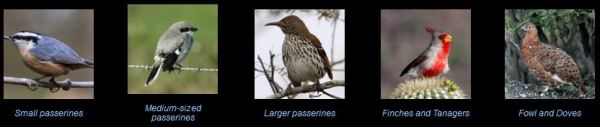
A small portion of the BirdQuiz family options
************************************
Cornell eBird Photo & Sound Quiz
You have to be an eBird member to use this, but that’s free.
Cornell eBird has options other than its famous world-wide listing and search capabilities, among them this quiz. You can make it hard, local, worldwide, a particular date, photo, sound, etc. I think some of the quiz photos are there as a sneaky way to get us to help them identify the bird, as the last one I looked at was a distant photo of a portion of the upperside of an outer wing sticking up from the other side of an ocean wave. No body, no head. At that point I decided to write this comment. Potentially quite challenging.
Bird Tour Companies
These websites have widely varying features in addition to the requisite trip reports and upcoming schedules. They want you to go birding with them! I’ve traveled with some, not with some others, but no recommendations are made here as to the quality of their trips (my experiences have all been good). They just have some quizworthy or otherwise interesting things on their websites. I’ve put them in rough order of (IMHO) quizworthiness, photography and general interest.
Cheepers! Birding on a Budget
Birding tours worldwide
Click Photos from our Tours. Almost 100 photos will appear, each click-linked to a gallery of dozens of photos. This is probably the easiest-to-use tour company photo gallery with an enormous world-wide selection. Ideal for quizzes as the bird names are hidden, revealed by placing your cursor on the photo.

Cheepers! – Each photo leads to dozens more.
************************************
Tropical Birding – Worldwide Birding & Photography Tours
Tours worldwide, not all in the tropics
Virtual Tour videos: Ten so far, 25-45 minutes each, a good look at where the tour goes and what they see, lots of bird photos.
************************************
Field Guides Birding Tours
Tours worldwide
Virtual Tour videos: 3-9 minute slices-of-birding-life. 23 so far, domestic and abroad.
************************************
Victor Emanuel Nature Tours (VENT)
Bird tours worldwide
Virtual Tour videos: 3-9 minute slices-of-birding-life.
Leader’s Messages & Memories: Their favorite birding moments. Steve Hilty’s 5/20/20 missive on Bolivia will blow you away. Listed in rightmost column.
Victor’s Bolivar Peninsula Journal – Sitting out the pandemic on the Texas shore with birds galore.
************************************
Wilderness Travel
Worldwide adventure, nature and (some) birding tours
Videos: Dozens of 2-10 minute YouTube slices-of-touring-life.
************************************
Rockjumper Worldwide Birding Adventures
Bird tours worldwide
Oh the places you’ll go! – Dozens of tour photos
Image of the Month – Stunning bird photography. Click on the photo for a description, and on the year for additional photos. Sign up and get a mouthwatering photo delivered to your inbox monthly.
Support Your Tour Leaders – The pandemic put all their tour leaders out of work. At Rockjumper they’re selling artwork in various sizes for varying amounts. Polar bears, Birds-of-Paradise, Tigers, Trance Dancers, 16 more.

Rockjumper images of the month for Jul-Sep 2019. I.D. on the website.
************************************
Birdquest – “The Ultimate in Birding Tours”
Their news & reports page has hundreds of trip reports (36 pages, 10 per page). Click a report, then click the PDF Tour Report below the title. Zillions of photos.
************************************
Partnership for International Birding (PIB)
Over 100 tours worldwide using local guides.
Choose a region (Africa, Asia, etc.) then a country. The tour information will appear with a few photos, below which there will be a slide show. Put your cursor over the photo and the name appears. While away the hours.
************************************
Wings Birding Tours Worldwide
Birding tours worldwide. Sunbird handles their Old World tours.
Click on their Tour Index, select a region and a tour, scroll to the page bottom and watch the Slide Show. If you don’t look at the captions (or scroll them off-screen) you can ID the birds yourself. Then add them to your BSWLIBWBABBN list. Great fun! And super-cheap.
************************************
Sunbird Tours
The European branch of Wings.
Their website is laid out just like Wings, but they call it the Gallery instead of Slide Show. Rack up some exotic birds!
************************************

You gotta go to Iran to see this bird.
BirdTour Asia
As the name implies, they specialize in Asia from India to Japan. Click Reports, then choose any of the 18 area tabs, and 1 – 20 trip reports will appear. This may be the only company that has been to Iran.
************************************
Cheeseman’s Ecological Tours
Worldwide safari, photography & birding tours
On the main page, select Destinations and an area. Scroll down to the trips and select one. When that opens, scroll down to the Photo Gallery and click that.
************************************
High Lonesome BirdTours
Originally Alaska specialists, but now run bird tours worldwide.
Click Trip Reports, select a report, and click one of the various links that will take you to the report, a PDF file which contains text, photos and the trip list.
************************************
Manakin Nature Tours Colombia
Colombian Specialists
At home page click on Bird Tours, select a tour, click on the photo, and a trip report with a slide show of about ten photos will appear, with additional photos alongside the trip report.
************************************
Rubythroat Birding Tours
Central Asian Specialists
From the main page click Tours, scroll down to a tour and click Learn More, then scroll down to the Photo Gallery. Sometimes the photos are embedded throughout the trip report. On the Trip Reports page, click a photo on the right; photos are embedded throughout the report. Sometimes the birds are identified, sometimes not. But they’re all central Asian, hard to find elsewhere.
************************************
Eagle Eye Tours
Bird, wildlife & photo tours worldwide
I could not locate any significant cache of bird photos but I included them here in case anything changes.
Other Photo Quiz Opportunities
10,000 Birds
Blogs, commentary, trips, equipment, reviews and photos
From the main page right side click Galleries, then scroll down until you see an interesting topic (e.g. Goliath Heron). You’ll see a collection of photos and commentary about the topic bird(s). Not terrific for photo quizzes, but interesting.
************************************

Photo: Joe Pender, from his website
Check that wicked-looking bill
Joe Pender Wildlife Photography
Antarctica? Here you are.
Just scroll down. The region is a given, but the birds are not identified. Just like in real life.
************************************
Wild Side of Matthew
Over a dozen trips, each with many photos, all identified. Great photography. Too bad you’ll never see any of these birds as clearly as in these photos. After seeing these, you’ll either feel challenged to take better photos, or decide to give it up altogether. According to Matthew, the State Bird of Delhi is the House Sparrow.
************************************
Mostly Birding
Don Reid’s Adventurous Birding, Atlasing and Travel in Southern Africa
Don’s chosen territory encompasses Botswana, South Africa, Mozambique, and Zimbabwe. His many bird photos are buried within his many reports. Check in the Categories on left side of screen for: Birds in the Lens, Bird Photography, Birding Events, Birding South Africa, Birding Spots, Birding Trips and Special Birds.
Reprise 19: The Tongva
Editor’s Note: Entry number nineteen in our parade of history is a blog series (link to part one) posting November, 2013, and is our second-most popular blog or page. We gave it a permanent page in September, 2015 due to ever-increasing interest from local readers. It seems to have become the go-to resource for local students doing research on our our local First Americans, with over 100 visits in the last month, despite the fact that all the schools are closed and the students are COVID-sheltering at home. [Chuck Almdale]
**********************************************************************
This was originally a three-part series of articles on the Tongva people by Cindy Hardin, LA Audubon Director of Outdoor Education, including the Ballona Wetlands Education Program, and Jane Beseda, Director at Large, Santa Monica Bay Audubon Society.
-

“Wiyot’s Children,” Gabrielino Indian Village of Sa-angna
Playa del Rey, California, Ballona Wetlands
(Painting: Mary Leighton Thomson)

Part I: The First Americans of Ballona—Origins and Daily Life
The Tongva First Americans, also known as Gabrielinos, who populated the Ballona Wetlands area, arrived from the east when desertification made the formerly lush Great Basin a less hospitable place in which to live. This westward migration occurred between 9,000 BPE (before present era) and 2500 BPE. The Tongva are distantly related to the Comanche and the Hopi Pueblo indigenous populations. Their name means “People of the Earth.”
-
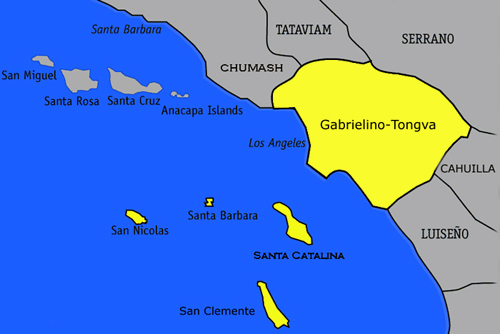
The Tongva inhabited the Greater Los Angeles area as far east as the base of Mount Wilson, 40 miles inland. Their territory was bounded by Malibu to the north and Laguna Beach to the south. They also occupied some of the Channel Islands, including Santa Catalina, San Clemente and San Nicolas. You can still hear their language in place names such as Pacoima, Tujunga, Topanga, Azusa, Cahuenga, and Cucamonga.
The Tongva’s appearance and costume were distinctive. The people were somewhat short and sturdy by European standards. They were also lighter-skinned than the indigenous people further to the south in Mexico and Central America. They had brown or reddish hair, and no baldness. The Tongva washed their hair with urine to kill lice, and this practice might have accounted for their light hair color. Some Spanish explorers wrote of them as the “blonde” people of the area. The women used red ochre, a type of clay that is heavy in iron, as sunscreen.
-

Hair and clothing shown in display of trade goods.
(Photo: Bowers Museum Collection)

Women wore their hair loose and long. The men also wore their hair long, but wound the top part into a bun, fastened with pins of bone or wood. Only the men wore hairpins, as this was done to keep the hair out of their eyes when hunting or fishing.
Women wore knee-length skirts or front-and-back aprons of skins, grasses, shredded bark or strings made from yucca fiber. During the warmer months, men went naked or wore loin cloths, and the children wore no clothing. During cooler months, the Tongva wore garments and wraps of animal skins, often made of rabbit. All went barefoot except when traveling in cactus country or rough mountain areas.
-
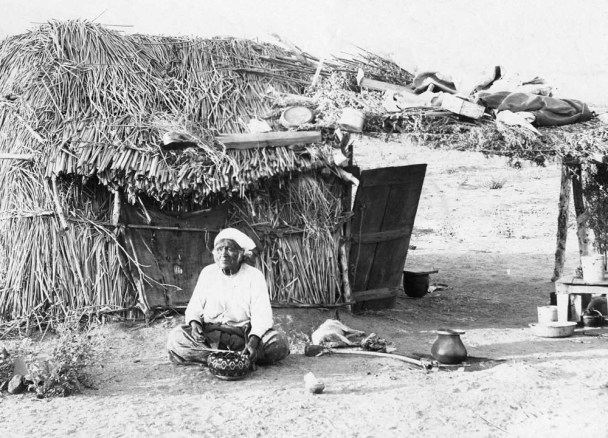
Tongva woman at her shelter covered with tule mats on the banks of Los Angeles River.
(Photo: Bowers Museum Collection)

The Ballona village site of Sa’angna, is formally designated as Area CA-LAN-62. The actual location is believed to have been east of the saltmarsh along the base of the Westchester bluffs in what is now Playa Vista. At that time, Centinela Creek flowed freely and was a source of fresh water for the settlement. The village of about 100 people was approximately 1500 feet long and consisted of several clusters of 4 to 5 houses, or kiiy (pronounced “key”), spaced 15-20 feet apart. (Spelling variants include ki, pronounced “key,” and kich, pronounced “kish.”) These houses, which the Spanish called jacals, served mainly as sleeping quarters for an extended family.
The kiiy were dome-shaped and framed with bent poles. The branches of the Arroyo Willow, which is still abundant at Ballona, were used to make the frame. Tule grass, a type of bulrush found in freshwater habitats, was dried and used to cover the frame. Tules were also dried and woven together to serve as floormats inside the kiiy. A hole at the top of the dwelling let out the smoke from a fireplace in the center of the structure. The replica of a kiiy located at the entrance to Ballona wetlands is much smaller than the actual kiiy used by the Tongva, which were 3 to 4 times larger and served as sleeping quarters for an extended family.
The Tongva were a friendly tribe, paddling out to greet the first Spanish ships with gifts of nuts, berries, acorns, and seafood. Conflict between villages over failure in gift-giving at ceremonies, abduction of women, poaching and trespassing, or hurtful sorcery sometimes resulted in war. But the decision to go to war was taken very seriously, and all members of the community were involved. Most conflicts were resolved by “song fights,” the days-long singing of insulting songs in vile language, accompanied by much stamping and tramping of the ground.
-
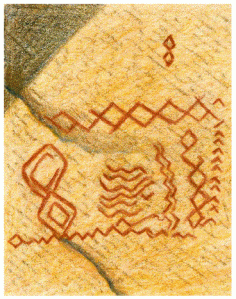
Pictograph.
(Redrawn image by Sue Ann Sinay, after Miller, 199).Tongva pictographs are very rare today, having been destroyed by the development of Greater Los Angeles. There are paintings at a few sites in the San Gabriel Mountains and in the northwestern part of the San Fernando Valley, but none are public. A replica of their rock art is on display at The Southwest Museum.
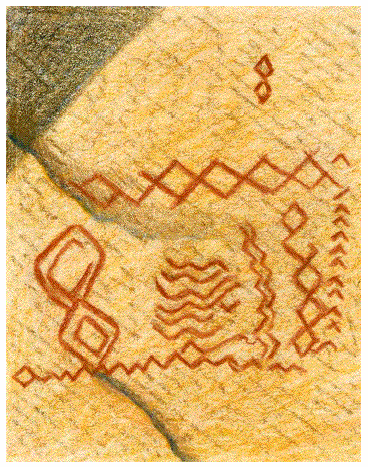
The purpose and function of Tongva pictographs may have been similar to that of the Luiseno, since both have diamond patterns and wavy lines. Luiseno boys and girls painted with red hematite on rocks during their puberty ceremony. During the ceremonies, sand paintings were created to illustrate the Luiseno conception of the universe, the night sky, sacred beings, and the spiritual component of the human personality. At the end of the ceremony, the sand paintings were destroyed, and girls raced to a rock where they painted angular and diamond shaped designs. Perhaps the young Tongva women also painted these symbols during their puberty ceremony.
See references at the end of Part III.
++++++++++++++++++++++++++++++++++++++++++++
Something is growing inside that fruit fly in your kitchen. At dusk, the fly points its wings straight up and dies in a gruesome pose so that a fungus can ooze out and fire hundreds of reproductive spores.
This is another installment of the PBS Deep Look series. If no film or link appears in this email, go to the blog to view it by clicking on the blog title above. If the film stops & starts in an annoying manner, press pause (lower left double bars ||) to let it buffer and get ahead of you. [Chuck Almdale]
Malibu Lagoon Reconfiguration – Six Years On
Last year’s news today!

From the full report
From two local newspaper articles:
In mid-September, 2019, The Bay Foundation and California State Parks released the Malibu Lagoon Restoration and Enhancement Project Final Comprehensive Monitoring Report (Year 6). The data indicates that the restoration project was wholly successful as assessed against project goals and success criteria.
“It’s very gratifying, and we’re very pleased with the results,” Suzanne Goode, natural resource program manager for State Parks, said in an interview.
Links to the articles
The Malibu Times
2013 Malibu Lagoon Restoration Declared a Success
Six years after the $6.6 million controversial project was completed, lagoon health has improved, according to the final report from The Bay Foundation and its partners.
By Jimy Tallal / Special to The Malibu Times, September 27, 2019
Santa Monica Daily Press
Final Comprehensive Monitoring Report of Malibu Lagoon Indicates Proven Success Towards Project Goals
By George Moreno and Julie Du Brow, Special to the Santa Monica Daily Press, September 23, 2019
Links to Original Documents
Final Comprehensive Monitoring Report of Malibu Lagoon Indicates Proven Success Towards Project Goals
Joint Statement of The Bay Foundation and California State Parks
By Julie Du Brow, The Bay Foundation and George Moreno, California State Park
September 18, 2019
PDF file, 3 pages.
Malibu Lagoon Restoration and Enhancement Project Final Comprehensive Monitoring Report (Year 6)
August, 2019. PDF file, 261 pages.
Prepared by: The Bay Foundation (TBF)
Prepared for: State of California, Department of Parks and Recreation
Authors:
Karina Johnston, Science Director, TBF
Melodie Grubbs, Director of Watershed Programs, TBF
Chris Enyart, Watershed Programs Coordinator, TBF
Rosi Dagit, Resource Conservation District of the Santa Monica Mountains (fish)
Dan Cooper, Cooper Ecological Monitoring, Inc. (birds)
Executive Summary (from the full report) 
The Malibu Lagoon Restoration and Enhancement Project was completed on 31 March 2013. This report assesses the post-restoration conditions of Malibu Lagoon across approximately six years of monitoring by evaluating a suite of parameters. An evaluation of post-restoration conditions, through detailed physical, chemical, and biological monitoring components has resulted in several overarching trends. The restoration project has been determined to be wholly successful as assessed against defined project goals, performance standards, and success criteria (Table ES-1) outlined in California Coastal Commission CDP No. 4-07-098 and supporting documentation, including monitoring plans. No supplemental habitat restoration and enhancement plan is recommended for the project.
A clear pattern in the water quality data indicates that lowering the lagoon elevation, creating a wider single main channel directed more towards the incoming tide, orienting channel configurations in line with prevailing wind patterns, and removing the pinch points (i.e.,bridges) led to an increase in circulation both in an open and closed berm lagoon condition. Vertical profile mixing was an additional water quality indicator of a well-functioning post-restoration system. California Rapid Assessment Method (CRAM) surveys were a good indicator of the consistently increasing condition of the post-restoration wetland habitat areas. Each component of the post-restoration monitoring program is summarized, below, along with the 5-year success criteria for each survey type and the criteria evaluation details or results (Table ES-1). Detailed analyses by parameter are in the subsections below the summary table and integrate each set of results and data across survey years. Summary conclusions can be found at the end of the Executive Summary and with additional detail at the end of this report.
When compared to pre-restoration data, post-restoration results show improved water quality, improved circulation, removal of dead zones and excess sedimentation issues, and a diverse native ecosystem resilient to impacts. This report contains detailed results and analyses for each parameter surveyed, including comparisons to pre-restoration data as well as trends across the entire monitoring period to track changes over time. These results show that the site is meeting the overall project goals.
[Posted by Chuck Almdale]
This is our last lagoon trip report before the scheduled start of the reconfiguration process, so we made a few changes to our usual trip report format. We’ve put a bunch of scenery shots in, and the bird list compares the months of May across the past six years. We’ll follow this format until after the project is

North channel view to west towards golf course (L. Johnson 5/27/12)
done; the data should be useful to compare during-project months to prior years. I keep my count numbers as honest as I can; there’s never any attempt to jack any number up or down. My obvious and mostly worthless prediction: count totals and species diversification will drop during the project, then rebound. No prediction how much the change will be. This is like J.P. Morgan’s famous stock market prediction: “The market will fluctuate.”
The slideshow shows what the area looked like today, excepting Jim Kenney’s February scenic photo. The lagoon outlet closed within the past 7 days; lagoon water level had risen so much that Snowy Plover enclosure fenceposts I’d stood next to 8 days earlier were now partially submerged.

Whimbrel on low tide rocks (J. Kenney 5/27/12)
The birds were pretty much what we’d expect for late May: a few migrant shorebirds (Whimbrel, Black-bellied Plover); some nesting birds (Mallard, Black Phoebe, Barn & Cliff Swallow, Northern Mockingbird, House Finch). The egrets are developing a large heronry next to Starbuck’s in the shopping center: Great Blue Heron, Great Egret, Snowy Egret and Black-crowned Night Heron are all nesting there. 15 Heermann’s Gulls had arrived from their breeding grounds on islands near the southern tip of Baja California; they were all 1st-year birds. One Belted Kingfisher perched on dead branches in front of Adamson House. We found a pair of Black Phoebes feeding 4 fledglings near the Adamson Boat House, as well as a female Mallard with 5 fluffy ducklings. No project activity is scheduled for this side of the lagoon. We didn’t see the young Killdeer spotted a month ago: it’ll be full-sized and flying by now, but it won’t yet have adult plumage.
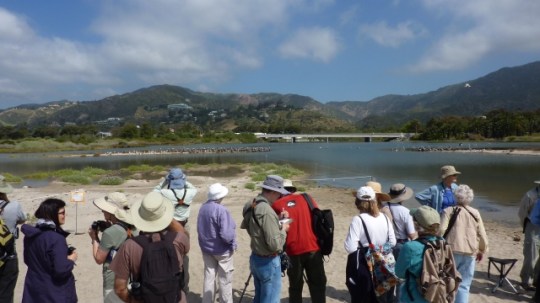
View from beach across lagoon (L. Plauzoles 5/27/12)
Picnic: The usual June chapter picnic is canceled.
Our 10 a.m. Parent’s & Kids Birdwalk is canceled until the lagoon project is completed and the parking lot is again available.
Links: Unusual birds at Malibu Lagoon
Aerial photo of Malibu Lagoon from 9/23/02.
Prior checklists: July-Dec’11, Jan-June’11, July-Dec ’10, Jan-June ’10, Jul-Dec ‘09, and Jan-June ‘09.
Comments on list below: Of 75 total species appearing in May for 2007-12, no more than 62% of them have appeared on any one day, something to keep in mind if you wonder why what is there is much less than what could be there. Species low of 39 in 2010 is 17% below the highs of 47 for 2007, 2008 & 2012, not a huge drop. The 2011 low in total birds of 413 is 66% (787 birds) below the high of 1200 in 2007. Species making up most of this difference: Brown Pelicans – 549, Western Gulls – 109 and Heermann’s Gull – 61 (total of 719 birds, 91% of total difference).
NOTE: Right column averages of less than 1 bird/month are shown in tenths; all other averages are rounded to nearest whole number. [Chuck Almdale]
| Malibu Lagoon Census | 2007 | 2008 | 2009 | 2010 | 2011 | 2012 | |
| May 2007 – 2012 | 5/27 | 5/25 | 5/24 | 5/23 | 5/22 | 5/27 | |
| Temperature | 54-62 | 54-68 | 68-72 | ||||
| Tide Lo/Hi Height | H+3.4 | L+0.1 | H+3.7 | H+3.76 | L-.13 | L+0.38 | Ave. |
| Tide Time | 0742 | 0801 | 1042 | 0638 | 0816 | 0844 | Birds |
| Brant | 4 | 7 | 2 | ||||
| Gadwall | 6 | 8 | 12 | 12 | 3 | 5 | 8 |
| Mallard | 45 | 20 | 20 | 18 | 48 | 32 | 31 |
| Surf Scoter | 9 | 2 | |||||
| Red-breasted Merganser | 1 | 2 | 0.5 | ||||
| Ruddy Duck | 5 | 1 | 2 | 3 | 2 | ||
| Pacific Loon | 1 | 5 | 1 | ||||
| Common Loon | 2 | 0.3 | |||||
| Pied-billed Grebe | 3 | 3 | 2 | 3 | 2 | ||
| Western Grebe | 3 | 1 | 0.7 | ||||
| Brandt’s Cormorant | 5 | 1 | 1 | ||||
| Dble-crested Cormorant | 7 | 5 | 28 | 7 | 46 | 15 | 18 |
| Pelagic Cormorant | 1 | 0.2 | |||||
| Brown Pelican | 630 | 231 | 70 | 124 | 81 | 265 | 234 |
| Great Blue Heron | 5 | 2 | 1 | 2 | 1 | 3 | 2 |
| Great Egret | 3 | 4 | 4 | 2 | 3 | 3 | |
| Snowy Egret | 12 | 9 | 7 | 12 | 3 | 14 | 10 |
| Green Heron | 1 | 0.2 | |||||
| Blk-crwnd Night-Heron | 6 | 10 | 2 | 3 | 4 | ||
| Osprey | 1 | 0.2 | |||||
| Cooper’s Hawk | 1 | 0.2 | |||||
| Red-tailed Hawk | 1 | 1 | 1 | 1 | 0.7 | ||
| Peregrine Falcon | 1 | 0.2 | |||||
| American Coot | 25 | 6 | 32 | 8 | 25 | 30 | 21 |
| Blk-bellied Plover | 3 | 22 | 4 | ||||
| Killdeer | 1 | 1 | 4 | 2 | 3 | 2 | |
| Willet | 3 | 4 | 1 | ||||
| Whimbrel | 4 | 1 | 20 | 4 | |||
| Marbled Godwit | 1 | 0.2 | |||||
| Black Turnstone | 1 | 0.2 | |||||
| Western Sandpiper | 6 | 1 | |||||
| Dunlin | 1 | 0.2 | |||||
| Boneparte’s Gull | 26 | 2 | 1 | 1 | 5 | ||
| Heermann’s Gull | 61 | 1 | 20 | 17 | 15 | 19 | |
| Ring-billed Gull | 5 | 2 | 1 | 2 | 16 | 4 | |
| Western Gull | 119 | 56 | 65 | 68 | 10 | 85 | 67 |
| California Gull | 1 | 95 | 8 | 4 | 18 | ||
| Glaucous-winged Gull | 1 | 1 | 0.3 | ||||
| Caspian Tern | 7 | 61 | 15 | 25 | 4 | 6 | 20 |
| Royal Tern | 2 | 1 | 2 | 5 | 2 | ||
| Elegant Tern | 15 | 23 | 40 | 9 | 12 | 35 | 22 |
| Rock Pigeon | 8 | 2 | 6 | 6 | 8 | 2 | 5 |
| Eur. Collared-Dove | 3 | 1 | 0.7 | ||||
| Mourning Dove | 1 | 4 | 6 | 1 | 2 | 2 | |
| White-throated Swift | 5 | 2 | 1 | ||||
| Anna’s Hummingbird | 6 | 2 | 2 | 1 | 1 | 2 | 2 |
| Allen’s Hummingbird | 4 | 8 | 6 | 4 | 5 | 5 | |
| Belted Kingfisher | 1 | 0.2 | |||||
| Western Wood-Pewee | 2 | 0.3 | |||||
| Pac.Slope Flycatcher | 1 | 0.2 | |||||
| Black Phoebe | 12 | 6 | 12 | 10 | 4 | 13 | 10 |
| American Crow | 8 | 4 | 6 | 4 | 3 | 5 | 5 |
| Common Raven | 1 | 2 | 0.5 | ||||
| Rough-winged Swallow | 6 | 10 | 10 | 1 | 2 | 5 | |
| Violet-green Swallow | 6 | 2 | 1 | 1 | 2 | ||
| Barn Swallow | 12 | 6 | 1 | 8 | 8 | 2 | 6 |
| Cliff Swallow | 55 | 40 | 12 | 12 | 31 | 12 | 27 |
| Oak Titmouse | 1 | 0.2 | |||||
| Bushtit | 4 | 20 | 4 | 4 | 5 | ||
| Bewick’s Wren | 1 | 0.2 | |||||
| Northern Mockingbird | 3 | 5 | 6 | 4 | 2 | 6 | 4 |
| European Starling | 20 | 20 | 2 | 3 | 40 | 45 | 22 |
| Cedar Waxwing | 32 | 5 | |||||
| Common Yellowthroat | 4 | 2 | 2 | 3 | 2 | ||
| Spotted Towhee | 1 | 2 | 0.5 | ||||
| California Towhee | 1 | 1 | 5 | 1 | 1 | 2 | |
| Song Sparrow | 10 | 2 | 8 | 10 | 4 | 12 | 8 |
| Red-winged Blackbird | 20 | 6 | 4 | 2 | 10 | 7 | |
| Brewer’s Blackbird | 2 | 0.3 | |||||
| Great-tailed Grackle | 1 | 4 | 16 | 2 | 4 | ||
| Brown-headed Cowbird | 2 | 1 | 3 | 1 | 1 | ||
| Hooded Oriole | 4 | 1 | 1 | 1 | |||
| Bullock’s Oriole | 2 | 1 | 1 | 0.7 | |||
| House Finch | 10 | 3 | 8 | 6 | 8 | 8 | 7 |
| Lesser Goldfinch | 2 | 1 | 2 | 4 | 2 | ||
| Totals by Type | 5/27 | 5/25 | 5/24 | 5/23 | 5/22 | 5/27 | Ave. |
| Waterfowl | 57 | 38 | 38 | 37 | 51 | 42 | 44 |
| Water Birds-Other | 668 | 252 | 132 | 148 | 152 | 313 | 278 |
| Herons, Egrets | 26 | 25 | 13 | 16 | 6 | 23 | 18 |
| Quail & Raptors | 1 | 1 | 1 | 1 | 3 | 1 | |
| Shorebirds | 10 | 1 | 5 | 5 | 5 | 51 | 13 |
| Gulls & Terns | 235 | 148 | 144 | 216 | 51 | 151 | 158 |
| Doves | 12 | 2 | 10 | 12 | 9 | 5 | 8 |
| Other Non-Pass. | 15 | 4 | 10 | 7 | 5 | 8 | 8 |
| Passerines | 176 | 139 | 79 | 106 | 131 | 127 | 126 |
| Totals Birds | 1200 | 610 | 432 | 548 | 413 | 720 | 654 |
| Total Species | 5/27 | 5/25 | 5/24 | 5/23 | 5/22 | 5/27 | Ave. |
| Waterfowl | 4 | 4 | 4 | 3 | 2 | 4 | 4 |
| Water Birds-Other | 5 | 6 | 5 | 7 | 3 | 4 | 5 |
| Herons, Egrets | 4 | 4 | 4 | 3 | 3 | 4 | 4 |
| Quail & Raptors | 1 | 1 | 1 | 1 | 3 | 0 | 1 |
| Shorebirds | 3 | 1 | 2 | 2 | 2 | 6 | 3 |
| Gulls & Terns | 7 | 9 | 7 | 6 | 6 | 7 | 7 |
| Doves | 3 | 1 | 2 | 2 | 2 | 3 | 2 |
| Other Non-Pass. | 3 | 2 | 2 | 2 | 2 | 3 | 2 |
| Passerines | 17 | 19 | 16 | 19 | 16 | 16 | 17 |
| Totals Species – 75 |
47 | 47 | 43 | 45 | 39 | 47 | 45 |



 SANTA MONICA BAY AUDUBON SOCIETY BLOG