Free email delivery
Please sign up for email delivery in the subscription area to the right.
No salesman will call, at least not from us. Maybe from someone else.
Editor’s Note: Entry number thirteen in our tenth anniversary honor roll was originally posted 4-1-13 and is thirteenth in overall popularity. It was the fourth installment in our SMBAS Monograph Series – Spring Quarter, and brought unwelcome news to the tickers and twitchers of the world. [Chuck Almdale]
***********************************************************
In the past 30 years, about 1300 new avian species have been added to the world’s birdlist. Some were entirely new to science. Collectors in the Amazon basin continually turn up new antbirds, tapaculos and tyrant flycatchers, for example, but new species keep trickling in from all the world’s under-explored areas. However, the majority of new bird species are the result of “splitting” – raising already known and described subspecies up to full species status. This comes about from additional research: sometimes field studies, sometimes DNA analysis, sometimes both.

Feathered dinosaur, also known as Secretary-bird
“Lumping” occurs when new research shows -or appears to show – that one or more birds with full species status are more properly considered as subspecies of a variable species. Several decades ago the Red-shafted, Yellow-shafted and Gilded Flickers of North America were “lumped” into the single Northern Flicker (Colaptes auratus) when found freely interbreeding in areas where their ranges overlapped. A few years later, the Gilded Flicker (Colaptes chrysoides) was “re-split” from the Northern Flicker, based on even newer research. Decades earlier, the Spotted and Eastern Towhees had each been “good” species; again, research found them interbreeding and they were lumped into the Rufous-sided Towhee (Pipilo erythrophthalmus), only to be re-split in 1995 back into Spotted (Pipilo maculatus) and Eastern Towhees (P. erythrophthalmus).
And so the pendulum swings: splitting to lumping to splitting, with a preponderance of the latter over the past half-century. But it now swings back to lumping, and with a vengeance utterly unexpected.
Recently, researchers in molecular genetics at the Carl von Linné Conservatory of Biological Systematics at Uppsala University in Sweden have admitted to an enormous, decades-long error. “We found a glitch in analysis program we used many decades,” says conservatory head Dr. Thorbald Thorbaldson. “Simple, but bringing a catastrophe. Several people resigned. One man became reindeer herder with the Lapps. Not seen since.”

Artist’s rendition of the typical bird
Simply put, a decimal place was off by three orders of magnitude. DNA samples with a reported variance of – say – 2.7%, were actually only 0.0027% at variance. Dr. Thorbaldson: “Samples we thought quite different, indicating great evolutionary separation, are – well – not so different after all! Mildly speaking. With birds, it turns out there are far fewer “good species” and far more subspecies than we thought.”
How few? Sit down and hold your breath. Keep holding. Now read on.
“Careful reanalysis, ” reports Dr. Thorbaldson, “indicates there are probably 10 species of birds, with approximately 24,000 subspecies. Give or take a few, of course.”
Ten species? TEN? It makes you want to hang up your binoculars, take off your Tilley and anorak, crawl back into bed and pull the blanket up over your head for a long, long while. Maybe forever.
The name of the ten species needed simplification, resulting in a certain uniformity. They are, alphabetically, with English translations of the scientific name in parentheses:
Hoopoe – Upupa omnimodia (universal hoopoe)
Sapayoa – Sapayoa incertaesedis (uncertain origin sapayoa)
Secretary-bird – Venator terrafirma (solid-ground hunter)
The Budgie – Primosittacus familiaris (social first-parrot)
The Chicken – Gallus assus (roasted chicken)
The Cuckoo – Cuculus horacustodis (time-keeper cuckoo)
The Duck – Anas mundus (world duck)
The Peep – Charadrius tibicinus (piper waterbird)
The Railbird – Erepus palus (marsh creeper)
The Songbird – Passerina cantata (sparrow-like singer)
Many of the water birds – penguins, cormorants, tubenoses, and auks for example – were discovered to not be birds at all, but long-scaled fish. Similarly, swifts and hummingbirds are actually insects, most closely related to damselflies. The Secretary-bird (pictured above), which as anyone can see looks like a feathered dinosaur, turned out to be ancestral to all the hawks, falcons, owls, nightjars and such. The Hoopoe holds a similar position for many egret and stork-like birds. Finally, that long-term ornithological bugaboo, the Sapayoa (a small manakin-like bird ranging from southern Panama to northwestern Ecuador) is still of indecipherable lineage. “We’re pretty sure it is a bird…at least some of us are,” explains Dr. Thorbaldson, “but, as always, it seems completely unrelated to anything else. We don’t know what it is, and frankly we’re (expletive deleted) tired of looking at it.”
For a quick look at how the birds used to be organized, take a look at this chart, courtesy of the University of Sheffield. [If you find Crows, Jays or Ravens on the chart, please let me know, because I couldn’t.]
Those who found this article plausible, should also read:
2012: Canyonland Roadrunner Captured on Film
2011: New Hummingbird Species Discovered in Los Angeles County!
2010: The Western Roof-Owl: Bird of Mystery
[Chuck Almdale, on behalf of Club 401]
Birds of the World | Discover them all
Birds of the World is Cornell’s latest masterpiece of crowdsourced information on birds. John Fitzpatrick, Director of Cornell Lab of Ornithology, explains it best in this introductory video:
You have available to you now the world’s most comprehensive, detailed, authoritative, and accessible resource on the biology and plumages and behaviors of every species of bird in the world. It’s basically bird diversity at your fingertips. Birds of the World is more than just a publication. It’s actually a means of bringing the entire global community of birders and scientists and media contributors together on behalf of birds. Birds of the World will continue to evolve as new information is published and as our expanding network of contributors adds new information and multimedia to keep the resource accurate, complete, and alive!
Birds of the World (BOW) includes more than 10,700 species accounts, detailed family overviews, intelligent range maps, color illustrations, audio, photos, and videos. You can subscribe now with a 10% introductory discount, offered until 6/30/20. To help you decide, BOW is offering free previews of nine species. The annual subscription price is a bargain at about $1 per week.
You may wonder why you should pay for the BOW subscription when you can use Cornell’s free Bird Guide found in the site All About Birds. First, note that the Bird Guide (Guide) covers only 600+ North American species, as compared to BOW’s 10,000+ worldwide species.
Let’s walk through a comparison of the two products for the Heermann’s Gull, a species found on many of our local beaches, and one that is included in the BOW free preview. The Guide is in a student-friendly format and is much more condensed than BOW. For example, the Guide’s “Basic Description” is 81 words, compared to BOW’s “Introduction” at 633 words

Heermann’s Gull Larus heermanni | © Blake Matheson | Monterey, California, United States | 21 Jan 2019 | Macaulay Library ML140585271 | eBird S51903759 | TheCornellLab
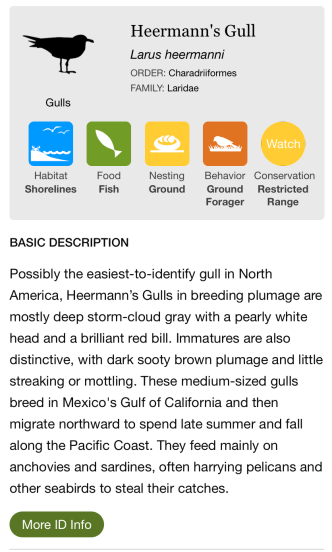
In the Guide, each species is described in five sections: Habitat, Food, Nesting, Behavior, and Conservation. It also includes a section of Cool Facts. Did you know that Heermann’s Gulls frequently steal food from Brown Pelicans, with adults stealing from adult pelicans, and immature gulls stealing from immature pelicans. The word for this is “kleptoparasitism.”
BOW includes up to 19 sections for each species: Appearance, Systematics, Distribution, Habitat, Movements and Migration, Diet and Foraging, Sounds and Vocal Behavior, Behavior, Breeding, Demography and Populations, Conservation and Management, Priorities for Future Research, Acknowledgements, About the Authors, Multimedia, and Tables and Appendices, Revision History, and References. In a deep dive into Tables and Appendices, you will find such gems as phonetic renditions of 15 types of calls in Table 2, some of which are shown here…


In BOW under the Diet and Foraging tab, you will find this photo of a Heermann’s diving for food and an explanation of the behavior. To obtain food below water while swimming, it jumps up and then dives down into water in a jump plunge. When flying, it plunges into the water in pursuit of a fish in a surface plunge.
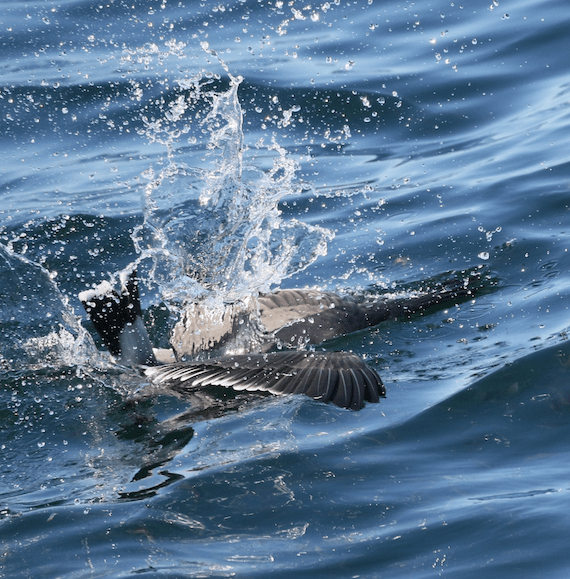
Heermann’s Gull jump plunge | © Charlotte Byers | Snohomish, Washington, United States | 13 Oct 2018 | Macaulay Library ML 118712161 | eBird S49167876 | TheCornellLab
Under the Sounds and Vocal Behavior > Vocalizations tab in the left column, you will find a link to video of a Heermann’s Gull calling (Macaulay Library 465956). It’s worth clicking over to see the video. Wait for it…the action starts at about 0:20 in the video.
If you’re planning a trip to Madagascar, you can learn all about the Blue Vanga before you go.
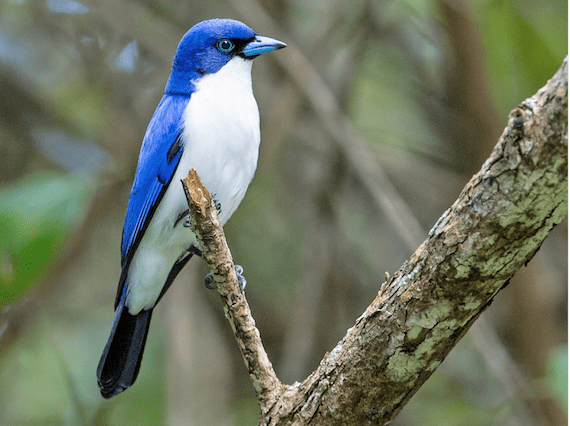
Blue Vanga (Madagascar) Cyanolanius madagascarinus madagascarinus | © Nick Athanas | Andasibe-Mantadia NP, Taomasina, Madagascar | 8 Nov 2015 | Macaulay Library ML213092401 | eBird S53167131 | TheCornellLab
Or, if you’re in Panama and you spot the infamously secretive Rufous-vented Ground-Cuckoo, you’ll have all of the information about it at your fingertips.

Rufous-vented Ground-cuckoo Neomorphus geoffroyi | © Ronald Messemaker | Valle de Anton, Coclé Panama |6 Nov 2011 | Macaulay Library ML193822081 | eBird S62424458 | TheCornellLab
Are you convinced that Birds of the World is the perfect gift to yourself? Subscribe here.
[Jane Beseda]
California Statewide COVID-19 Opening Plan
A rundown of the governor’s plan, and what one expert thinks of it.
This is considerably shortened from the full story in Los Angeles Times, May 4 which has useful charts, by Rong-Gong Lin II.
NOTE:
For a crash course in COVID-19 epidemiology, read the Tomas Pueyo blog series.
For an in-depth look at the history and structure of the SARS-CoV-2 virus, read the Dr. Jay Gralla blog series.
Expert is Dr. Robert Kim-Farley: Medical epidemiologist and infectious-disease expert at the UCLA Fielding School of Public Health; former senior official for the Los Angeles County Department of Public Health, the U.S. Centers for Disease Control and Prevention, and the World Health Organization; 2004 to 2018, he was Los Angeles County’s director of the Division of Communicable Disease Control and Prevention.
Stage 1: Continue with the stay-at-home order
We’ve been in Stage 1 since March 19. State health officer Dr. Sonia Angell says California hospitalization rates for COVID-19 are stable so we can now begin talking about reopening the state. Some regions are already loosening local orders. California has had over 55,000 COVID-19 cases and 2,200 deaths. L.A. County deaths are 55% (1200) of the total.
Expert forecast: By the end of May or mid-June, Kim-Farley expects new cases to decline in locales where effective physical-distancing measures have been followed. There will probably be enough capacity to offer tests for the virus and antibodies to meet the demand.
Stage 2: Gradual opening of lower-risk workplaces
Opening up with new restrictions:
- Retail, with adaptations, like offering curbside pickup
- Factories, such as those that manufacture toys, clothing and furniture
- Offices, where telecommuting is not possible, but with modifications to lower risk
- Modified school and child-care programs reopen
Expert forecast: California will probably be headed to Stage 2 in mid-June through the month of July, depending on the status of the pandemic.
Governor Newsom said some initial parts of Stage 2 would begin as soon as Friday, such as allowing curbside pickup at nonessential stores that had been ordered shut, including bookstores, clothing stores, music stores, toy stores, florists, sporting goods retailers. Factories that supply those businesses also would be allowed to resume. More-detailed guidelines on the businesses that could reopen will released Thursday.
Other parts of Stage 2 are still on hold — offices, shopping malls, and seated dining at restaurants are still ordered shut.
Stage 3: Opening of higher-risk workplaces
There will need to be much more modification to these workplaces to make them safer, state health officer Angell said last week. “We need to know much more about the movement of disease to be able to make data-informed decisions about what’s safe for folks,” Angell said.
- Hair and nail salons
- Gyms
- Movie theaters
- Sports without live audiences
- Churches
- Weddings
Expert forecast: Stage 3 may occur around August or September — late summer or early fall. Social-distancing measures — like wearing face coverings and limiting the number of people inside a store — will likely continue.
Stage 4: Full opening
The full end of the stay-at-home order, allowing the resumption of:
- Sports with live audiences
- Convention centers
- Concerts
Expert forecast: Probably not until middle or latter part of 2021. Dr. Anthony Fauci, director of the National Institute of Allergy and Infectious Diseases, has said that, even under the most optimistic scenarios, it will take 12 to 18 months for a vaccine to become available.
[Posted by Chuck Almdale]
Giant Malaysian leaf insects stay still – very still – on their host plants to avoid hungry predators. But as they grow up, they can’t get lazy with their camouflage. They change – and even dance – to blend in with the ever-shifting foliage.
This is another installment of the PBS Deep Look series. If no film or link appears in this email, go to the blog to view it by clicking on the blog title above. If the film stops & starts in an annoying manner, press pause (lower left double bars ||) to let it buffer and get ahead of you. [Chuck Almdale]
Reprise 12: Bird & Marine Mammal Rescue
Editor’s Note: Entry number twelve in our tenth anniversary tour, unlike the prior reprise postings, was never a blog (i.e. emailed to readers). It is a public service information page created in 2010, accessible only by visiting the blog, yet is our third most popular page or blog. A permanent page on our website has the advantage of longevity, but lacking a blog posting, it has a disadvantage in that only blogsite visitors will know it exists. Now, with this posting, it has the best of both worlds. [Chuck Almdale]
****************************************************
BIRDS
People frequently contact us concerning oiled, wounded and sick birds. These are the bird rescue operations in our area of which we are aware. If you know of others, please let us know and we will add them to this list. All of these organizations are non-profit, need donations and frequently solicit volunteers.
California Wildlife Center
In the Malibu area, CWC is the closest place to call.
Emergency Hotline Number: (310) 458-WILD [9453]
Same phone number for all wildlife emergencies
An interactive recording will get you to the correct department.
If no one answers, it is because all CWC personnel are currently busy with feeding or emergency procedures. Please leave a message. They will return your call as soon as possible.
Website: http://www.cawildlife.org/
PO Box 2022
Malibu, CA 90265
Fax: (818) 222-2685
Email Contacts:
Administration, donation & media: admin@cawildlife.org
Volunteer Inquiries: volunteer@cawildlife.org
International Bird Rescue:
Website: http://www.bird-rescue.org/
San Pedro Office:
Phone: 310-514-2573
Fax: 310-514-8219
3601 South Gaffey Street
San Pedro, Ca. 90731
South Bay Wildlife Rehab
Website: http://www.sbwr.org/
26363 Silver Spur Rd., Rancho Palos Verdes, California 90275
Phone: 310-378-9921 Fax: 310-378-0969
Email: info@sbwr.org
Huntington Beach Wetlands and Wildlife Care Center
21900 Pacific Coast Highway, Huntington Beach, CA 92646
Phone: 714-374-5587
Project Wildlife
San Diego Humane Society Project Wildlife
Website: https://www.sdhumane.org/programs/project-wildlife/
Pilar & Chuck Bahde Wildlife Center
5433 Gaines Street
San Diego, CA 92110
Phone: 619-225-9453
Hours: 9:00a.m. – 5:00p.m.
Open: 7 days a week (except Thanksgiving, Christmas & New Year’s Day)
Drop-off area: Open 24/7 and there is dedicated parking in front of the building.
MARINE MAMMAL RESCUE
Don’t touch! Do no pick up, pour water on or feed the animal. They are wild animals and can bite. They are also easily stressed by humans.
Do not return the animal to the water. Seals and sea lions temporarily “haul-out” on land to rest. Harbor seal mothers often leave their pups ashore while they’re feeding at sea. A beached whale, dolphin, or porpoise should be reported immediately.
Give the animal its space. Maintain a distance of at least 50 feet. Keep people and dogs away.
Call WildRescue’s California 24-hour hotline: 866.WILD.911
or consult this list. When calling, it’s important that you be able to identify your location and provide details of the animal and its condition.
****************************
California Wildlife Center
Same organization as listed above
Marine mammal rescue from Santa Monica to Ventura; native wildlife rehabilitation.
Phone: 310-458-WILD (9453)
Online: http://www.cawildlife.org/
Marine Mammal Care
Pinniped (fin-footed mammals) rehab in L.A.
Serves all Los Angeles County Beaches
3601 South Gaffey Street #8
San Pedro, CA. 90731
Phone: 310-548-5677
Online: https://mmccla.org/more-about-us
Marine Animal Rescue Specialists
Response Area: Pacific Palisades to Long Beach & Catalina Island
Phone: 800- 39-WHALE (9-4253)
Online: http://www.marspecialists.org/
Pacific Marine Mammal Center
Pinniped rescue and rehab in Orange County
20612 Laguna Canyon Road
Laguna Beach, CA, 92651
Phone: 949-494-3050
Online: pacificmmc.org
Contact: Info@pacificmmc.org
[Chuck Almdale]



 SANTA MONICA BAY AUDUBON SOCIETY BLOG