Free email delivery
Please sign up for email delivery in the subscription area to the right.
No salesman will call, at least not from us. Maybe from someone else.
He Hears Music in the Quietest Place on Earth—Can You? | National Geographic’s Short Film Showcase
Acoustic ecologist Gordon Hempton has spent the past 35 years recording natural soundscapes. His work has taken him around the world and into some of the least densely populated places.
Good for soothing jangled nerves. Headphones will enhance.
This is an installment of the National Geographic Short Film showcase. If no film or link appears in this email, go to the blog to view it by clicking on the blog title above. If the film stops & starts in an annoying manner, press pause (lower left double bars ||) to let it buffer and get ahead of you. Thanks to Jane Beseda for this. [Chuck Almdale]
Cornell Lab Bird Cams
From Cornell Lab of Ornithology – All About Birds:
The Cornell Lab Bird Cams connects viewers worldwide to the diverse and intimate world of birds. We work to make watching an active experience, sparking awareness and inspiration that can lead to conservation, education, and engagement with birds.

Our viewers tell us that watching the cams is a life changing experience: an unprecedented learning experience that they liken to virtual field trips or field biology in their living room. We’re excited to continue sharing and learning with the community as we watch the world of birds together.
Cornell currently has fifteen different bird cams in operation including: Barred Owls, Bermuda Petrels, Cornell Feeder Watch, Panama Fruit Feeders, Northern Royal Albatross, West Texas Feeders, American Kestrels, California Condor, Lance-tailed Manakins.
Link to all cams (from which you then pick)
This is the real world, unedited. Things may not happen at the rate you wish.
[Chuck Almdale]
Reprise 8: Sexual Dimorphism Reversal and Polyandry – Part I
Editor’s Note: Entry number eight in our tenth anniversary retrospective is twelfth in popularity, and is a three-part series, originally run July 19-21, 2016. Links to parts two and three are at the end. My interest in the subject was sparked by seeing the polyandrous Eurasian Dotterels on their breeding grounds in northern Norway, and the ensuing discussion. [Chuck Almdale]
Sometimes it’s the exception that proves the rule.
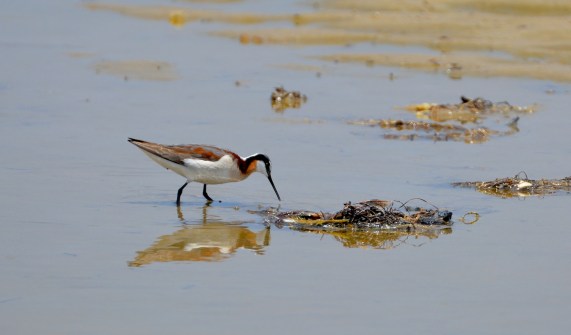
Female Wilson’s Phalarope, Malibu Lagoon, Ca.
(Grace Murayama, June 6, 2016)
Beginning birders soon notice that in many species, the male and female look different from each other. This divergence in appearance linked to sex appears in both birds and mammals. In mammals, for example, male lions have large manes that females totally lack, gorilla males are larger than females, male deer annually grow and shed their large antlers, and, of course, human males and females differ in body size and shape.

Irish Elk Group (Tabitha Paterson, TwilightBeasts)
Irish Elk size comparison (prehistoric-wildlife.com)
This distinct difference in features between genders is commonly called sexual dimorphism, or sometimes sexual bimorphism (two forms). The single-form alternative is sexual monomorphism (one form).
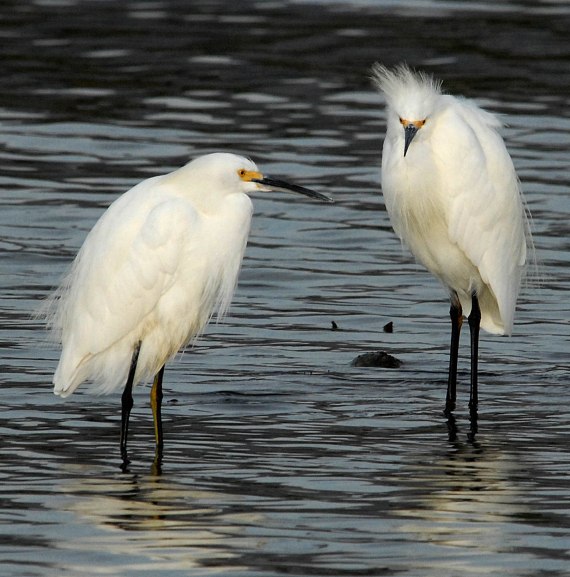
Sexual monomorphism in Snowy Egrets, Malibu Lagoon, Ca.
(Jim Kenney, November 2006)
Some examples of sexual monomorphism commonly seen in California are: geese, swans, loons, grebes, cormorants, pelicans, most herons and egrets, vultures, most sandpipers, gulls, terns, alcids, typical owls, swifts, corvids, chickadees, thrashers, some warblers, and most sparrows.
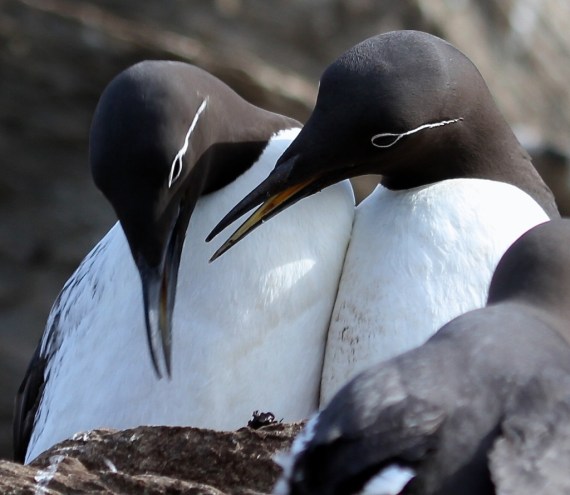
Common Murre (bridled variety), an alcid, exhibit sexual monomorphism.
Hornoya, Norway. (Joyce Waterman, May 30, 2016)
In California, readily seen examples of sexual dimorphism are: ducks, quail, grouse, phalaropes, hummingbirds, kingfisher, woodpeckers, gnatcatchers, most warblers, tanagers, blackbirds and orioles, finches, House Sparrow.

Hooded Mergansers exhibit sexual dimorphism; male front, female behind
(Jim Kenney, February 17, 2011)
Field guides generally show if a species is monomorphic or dimorphic. This is done with little male & female signs (♂♀), for dimorphism. If it says either “adult” or nothing, it’s monomorphic.
The reasons why a species is one or the other are complex. Dissertations and books have been- and still are being – written on the subject.
Four important factors to help understand sexual morphism:
Operational Sex Ratio (OSR): The ratio of the numbers of sexually receptive males to females.
Potential Reproductive Rate (PRR): The offspring production per unit of time each sex would achieve if unlimited mates were available.
Minimum Time Investment (MTI): The shortest amount of time either sex must contribute to produce a fertilized egg.
Parental Time Investment (PTI): The amount of time either sex contributes to parental duties.
For the purposes of this discussion, we’ll use the following definitions:
Breeding duties: All reproduction-related behaviors from courting, mating and egg-laying, through nest-building, incubation of eggs and feeding, protection and education of the young.
Nesting duties: Those activities listed above except mating and egg-laying.
Theoretically, the male and female can have the same MTI, and for many animals that is true. But in birds, because females must produce the large fertilized egg with a protective shell, white and yolk, while the males contributes only tiny sperm, the female’s MTI is always larger. Therefore, if either sex begins to make a larger parental time investment (PTI) than the other, as often happens in evolution, it is almost always the female. This greater (MTI+PTI) investment drives the evolution of the female’s greater choosiness in mate selection, picking – as best she can – the most fit male available. Female choosiness in turn causes males to compete in numerous ways for breeding opportunities. Such competition between males sets up the evolution of variations in ability to sing, gather food, build a nest, fight battles, and especially to display plumage.
[Article: Operational sex ratios & roles, dimorphism, monomorphism]

Allen’s Hummingbird shows extreme sexual dimorphism; female left, male right (Jim Kenney: female September 4, 2009, male January 9, 2007)
Thus it is the female selection of attractive, healthy, large or strong characteristics that shapes the male’s appearance and so produces sexual dimorphism. Because males cannot take on the female’s large initial time investment in egg-laying, males evolve in other ways: nest building, bringing food to the female, territory protection, and predator distraction. His overall parental time and energy investment in these activities may exceed the female’s combined egg production and parental time investment. Further, by performing such necessary duties, the female can concentrate on incubation, etc. Thus a sexual division of labor appears – different roles for females and males.
What does this division of labor have to do with monomorphism and dimorphism? In summary the “rule” which I alluded to at the beginning is:
Greater equality in breeding duties means greater similarity in appearance.
Eggs are always produced by females. In monomorphic species everything else is shared as equally as possible: site-selection, nest-building, incubation of eggs, territory defense, protection, feeding and education of the young. In sexually dimorphic species, duties of nesting and parenting diverge between sexes, with the manner and amount varying widely between species.
This brings up the second part of the “rule”:
The lesser the similarity in appearance, the lesser the involvement in breeding duties by the male, who is the more colorful bird.
When sexual dimorphism is extreme, the male may do nothing beyond inseminating the female. She then performs all the duties of nest-building, incubation of eggs and protection, feeding and education of the young, etc., with no assistance from the male. The avian families of Pheasants, Hummingbirds, Cotingas, Manakins, Birds-of-Paradise and Bowerbirds are filled with such species.
In Part II, we discuss the topics of double-clutching, sexual dimorphism reversal, sexual size dimorphism reversal and polyandry, with illustrative cases.
In Part III, we introduce those polyandrous species that display sexual dimorphism reversal.
[Chuck Almdale]
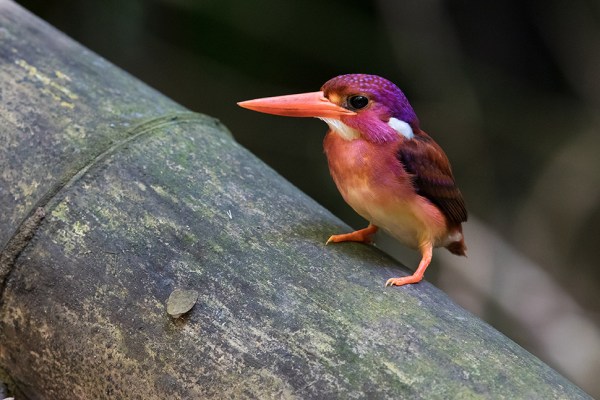
All eight photos by: Miguel De Leon | Article by: Mario Alvaro Limos | Esquire – Mar 13, 2020
From the article:
This bird has eluded scientists for the last 130 years
The South Philippine Dwarf Kingfisher (Ceyx mindanensis) was first described 130 years ago during the Steere Expedition to the Philippines in 1890. The bird is the tiniest species of forest kingfisher in the Philippines, and is characterized by its striking plumage of metallic lilac, orange, and bright blue spots.
Link to article and more photos
Article distributed by The Western Foundation of Vertebrate Zoology
The Western Foundation of Vertebrate Zoology would like to share with you articles and information that we hope will help lift your spirits during these difficult times.
Our best to you, and your loved ones!
Of the world’s 118 species of kingfisher, 85 of them live in Asia and Australasia. North and South America combined have a whopping total of 7 species. Even the diminutive Solomon Islands in the southwest Pacific have 8 species. If you want to see spectacular kingfishers like this one, you have to travel.
[Chuck Almdale]

The three islands of Wake Atoll: Wake, Wilkes & Peale (Courtesy of DVIDS)
Wake Island is part of a coral atoll deep in the western Pacific Ocean, and may be the oldest and northernmost living atoll in the world.
View the film: https://www.ktva.com/story/42018002/inside-the-gates-the-strategic-importance-of-wake-island
(From the KTVA page by Scott Gross)
Located more than 3,500 miles from Joint Base Elmendorf–Richardson and more than 2,200 miles away from Honolulu, Hawaii, the island supports Missile Defense Agency test activities and serves as a trans-Pacific refueling stop for military aircraft, convenient because of its location, says natural resource program manager for the 611th Civil Engineer Squadron (CES) Dillon Paul Brown.
“Wake is very significant because of its cultural history,” Brown said. “It was one of the first areas attacked during World War II, and so it’s a national historic landmark.”
Brown is one of two natural resource managers with the 611th CES. He and Joel Helm have worked to ensure the airmen on the island are protected from seabirds.
“There are no nearby islands, so we have colonial nesting seabird species, at different times of the year at Wake will congregate in large masses,” Helm said. “Not just hundreds but thousands.”
For an island in the middle of the Pacific, the Wake atoll has a respectable birdlist:
- U.S. Fish & Wildlife service lists 31 species
- Avibase lists 52 species, of which twelve are rare/accidental, one is introduced, and one is endemic.
The endemic bird is the flightless Wake Island Rail, previously resident on Wake and Wilkes (but not Peale) Islands, but has not been seen since 1944 and classified extinct. Here’s a selection of articles about this small bird and the island, both victims of World War II.
- Wikipedia – Flightless & fearless, nine inches long with a four-inch wingspan
- Scientific American – Memorializing the Wake Island Rail: An Extinction Caused by War
- BioOne Complete – The Extinct Wake Island Rail Gallirallus wakensis: A Comprehensive Species Account Based on Museum Specimens and Archival Records. Paper abstract, behind a subscription paywall
- Field Guide to Extinct Birds: Lovely artwork, brief description, a work of art with many pictured birds, rather than a traditional field guide, by Sarah Nicholls
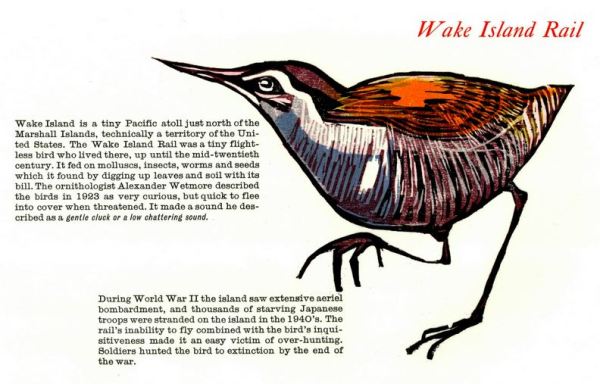
Wake Island Rail by Sarah Nicholls



 SANTA MONICA BAY AUDUBON SOCIETY BLOG