Free email delivery
Please sign up for email delivery in the subscription area to the right.
No salesman will call, at least not from us. Maybe from someone else.
Snowy Plovers on Film

Over the decades, many members of Santa Monica Bay Audubon Society have been intimately involved with the threatened Western Snowy Plovers (WSP) on our beaches, largely because the plovers have historically maintained six winter roosting locations within our chapter area. Extremely faithful to their roosting locations, WSPs are rarely found farther than 200 meters from their roost, usually forage within 50 meters, and spend half their time resting or arguing within the array of tiny scrapes that constitute the roost.
But many other Audubon Chapters and other organizations are just as -or more! – involved with these birds. Some of them make films. Here are a few.
———————————————————————–
Ventura Audubon Society (Link to twelve short films)
With titles like “WSP6 Rearranging on the Nest,” “What We Do,” and “Snowy Plover Territory Fight” these twelve films, none over 3:06 long, is a great look at the birds, up close and personal. “What We Do” includes nesting endangered Least Terns as well. Cynthia Hartley produced all these great little films.

———————————————————————–
Western Snowy Plover Nest Predation
Produced in January 2003 by Jack Fancher for the U.S. Fish & Wildlife Service. Length: 7:46
The eggs of the WSPs nesting at Bolsa Chica in Orange County were heavily predated by local American Crows, until the ME (mini-exclosure or metallic exclosure) was developed for them. This simple and easily erected cage-like structure keeps crows and hawks out, but doesn’t hamper the plovers at all.
Jack Fancher writes:
The Western Snowy Plover (Threatened with extinction) lays eggs in an obscure nest scrape in the sand or dirt, relying on cryptic coloration to evade predation. At Bolsa Chica, snowy plovers nested on dried out salt pans and dried out mud flats. The area is surrounded by urban areas that sustain large numbers of crows and ravens that spill over into the Bolsa Chica area. The loss of snowy plover eggs to corvid predation before the.eggs could hatch was greatly reducing plover reproductive success. A mini-exclosure (ME) was deployed over nests that kept the crows away from the plover nests but allowed the incubating plovers to come and go from the nest without constraint. The ME looks like a cage, but is virtually invisible to the snowy plover within just a few seconds of placement. Plover egg losses are greatly reduced as a result of ME placement.
———————————————————————–
With Monitoring Limited, Someone Drove Through a Snowy Plover Nesting Site
National Audubon Society article by Alastair Bland, published 4-1-20
Due to pandemic-related restrictions, vulnerable shorebirds may have to rely on the kindness of strangers this breeding season.
Link to article
Documenting the harassment of WSPs on Ormond Beach, in Ventura County, California, nesting area featured in the Ventura Audubon Society films above.
[Chuck Almdale]
How to Stop Overthinking Everything | PBS BrainCraft Video
Vanessa Says:
“Overthinking” is often reported as being a bad habit and is frequently used interchangeably with rumination. But overthinking isn’t necessarily bad and rumination is just one type of overthinking. Overthinking is an umbrella term for lots of different thought processes – beneficial things like emotional processing, problem solving, mind wandering and then not-so-beneficial things like rumination and worry. This video includes some tips (starting at 3:26) for how to stop rumination or just overthinking in general – I overthink a lot and while it’s not ruminating and may have some problem-solving benefits, I still find it limits my focus.
This is an installment of the PBS – BrainCraft series created by Vanessa Hill. If no film or link appears in this email, go to the blog to view it by clicking on the blog title above. If the film stops & starts in an annoying manner, press pause (lower left double bars ||) to let it buffer and get ahead of you. [Chuck Almdale]
Editor’s Note: This is entry number seven in our tenth anniversary greatest hits parade, is sixteenth in popularity, and for reasons unknown was the most popular of our 46 postings on full moons, solstices and equinoxes. I suppose that of their ilk one of them had to have the highest viewership. These reports were very popular with our Wiccan and astronomy buff followers. [Chuck Almdale]
Here’s another update from SMBAS Blog on that large, disc-shaped, shining object which has frequently and mysteriously appeared in our nighttime sky this year (known to many as the moon).

The Moon as seen from Earth (T. Hinnebusch 2/14/14)
April 15, 12:42 a.m. PDT — Full Pink Moon. The grass pink or wild ground phlox is one of the earliest widespread flowers of spring. Other names were the Full Sprouting Grass Moon, the Egg Moon, and —among coastal tribes —the Full Fish Moon, when the shad come upstream to spawn. In 2014 this is also the Paschal Full Moon; the first full moon of the spring season.
The first Sunday following the Paschal Moon is Easter Sunday, which indeed will be observed five days later on Sunday, April 20. This full moon will also undergo a total lunar eclipse for which we have a ringside seat, as it occurs in the early morning hours. Totality will last almost 78 minutes. [Photos of a Total Lunar Eclipse] The next lunar eclipse will be 8 October, 2014.
The next significant full moon will occur on May 14, 12:16 p.m. PDT. Keep an eye on this spot for late-breaking news on this unprecedented event.
Have a nice moon photo? Send it to us at: misclists [AT] verizon [DOT] net, along with name to credit and time/location of photo.
This information comes to you courtesy of: http://www.space.com/24262-weird-full-moon-names-2014-explained.html written by Joe Rao. Joe Rao serves as an instructor and guest lecturer at New York’s Hayden Planetarium. He writes about astronomy for Natural History magazine, the Farmer’s Almanac and other publications, and he is also an on-camera meteorologist for News 12 Westchester, N.Y.
But that’s waaay too long to type in, and besides, you don’t need to go there because SMBAS has done the work for you!
[Chuck Almdale]
SARS-CoV-2 Animated Videos
Here are five videos I find useful, informative and even amusing. I learned from each of them, including exactly why it’s extremely useful to wash your hands: soap dissolves the fatty external coat of the virus and the genetic RNA inside dissipates harmlessly. [Chuck Almdale]
*************************************************
The Science Behind the Coronavirus, Series I – 33 min 14 sec
I find these two videos by Dr. Patrick Soon-Shiong, executive chairman of the Los Angeles Times, extremely refreshing. In these days of tedious, seemingly endless and sometimes mind-bogglingly stupid, useless and excruciatingly annoying foam from the mouths of a few Washingtonian politicians, it is wonderful to remind oneself that there are still intelligent, well-spoken, informed, rational, science-based, non-narcissistic professionals willing to share their expertise with the public. Grab your favorite beverage, settle back, and prepare yourself to be treated like a rational human being for a change. Their description:
Dr. Patrick Soon-Shiong, offers an overview of this special series, The Science Behind the Coronavirus. In this introduction, Soon-Shiong (MD, MBBCh, MSc, FRCS (C), FACS) proposes that understanding how the virus infects our bodies and strategies toward treatment can help us allay our anxiety about it. Soon-Shiong is a surgeon and scientist who has spent his career studying the human immune system to fight cancer and infectious diseases. He is also the chairman and CEO of NantWorks and the owner of or investor in a number of companies, including ImmunityBio and NantKwest which are currently researching immunotherapies for COVID-19.
The Science Behind the Coronavirus, Series II – 1 hr 24 min 53 sec
You’re not doing anything else as important as informing yourself. From their description:
In this second installment of our “The Science Behind the Coronavirus” series, Dr. Patrick Soon-Shiong continues his examination of the ways the scientific community is taking up the battle against COVID-19. Dr. Soon-Shiong begins his presentation with a warning: The virus is continuing to mutate and is here to stay. But, he adds, there is hope. Over an introduction and six parts, Soon-Shiong explains how scientists around the world are considering treating patients suffering from stages of COVID-19. Finally, he breaks down the medical concepts researchers are pondering as they search for a vaccine.
Our World In Data – 8 min 34 sec.
OWID teamed up with Kurzgesagt to make a video about the COVID-19 pandemic, and it’s jam-packed with information. If you have not heard about “cytokine storm,” an immune system over-response which is probably the most lethal thing about COVID-19, you need to watch this. They write:
This video now was produced incredibly fast. Virologists and epidemiologists were very responsive and fast in their feedback so that we could ensure that the science is correct and the Kurzgesagt team then worked day and night to produce the video. It was published 3.5 days ago and already has now [March 23, 2020] more than 13 million views. We hope providing information in this form helps spread helpful information on how to address the latest coronavirus outbreak. And we hope you enjoy the video!
Watch it on their site or click the YouTube link below.
Global COVID-19 Prevention is a short 2:30 video from Stanford Medicine. Wordless and textless, it can get its message across to any non-blind person on this planet whatever their age or language. They say:
This short animated video from Stanford Medicine illustrates how the novel coronavirus — the virus that causes the respiratory disease COVID-19 — is transmitted among people and how transmission can be prevented.
The Coronavirus Outbreak Explained Through 3D Medical Animation
This 6:09 long video has wonderful animation. I particularly liked the scene where the SARS-CoV-2 novel coronavirus’ spike glycopretein hooks up to the target cell’s Angiotensin Converting Enzyme 2 (ACE-2) receptor, endocytosis then brings the virus into the cell, the virus’ single-stranded RNA then takes over the cell’s machinery including the endoplasmic reticulum to generate new complete viral bodies which the cell’s golgi bodies cooperatively carry back to the cell’s inner surface where exocytosis moves them out of the cell and on their way to infect the rest of your body.
This animation was used by Dr. Patrick Soon-Shiong in his films above. We will probably be hearing much more about the ACE-2 receptor in coming weeks and months.
Scientific Animations has this to say about their video:
This 3D medical animation explains what a pandemic is, rates of infection and ways to protect against infections. It also delves into the biology and mechanism of action (MoA) that coronavirus uses to infect and destroy human cells. Though the exact MoA for this coronavirus is not known.
Just Another Day on Aerosol Earth | NASA Website Photo
Just Another Day on Aerosol Earth
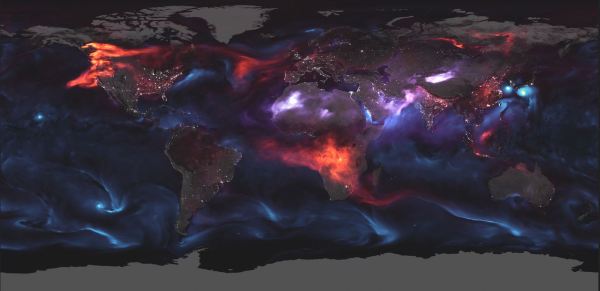
Model Visualization Credit: NASA Earth Observatory, GEOS FP, Joshua Stevens
Explanation from NASA: It was just another day on aerosol Earth. For August 23, 2018, the identification and distribution of aerosols in the Earth’s atmosphere is shown in this dramatic, planet-wide digital visualization. Produced in real time, the Goddard Earth Observing System Forward Processing (GEOS FP) model relies on a combination of Earth-observing satellite and ground-based data to calculate the presence of types of aerosols, tiny solid particles and liquid droplets, as they circulate above the entire planet. This August 23rd model shows black carbon particles in red from combustion processes, like smoke from the fires in the United States and Canada, spreading across large stretches of North America and Africa. Sea salt aerosols are in blue, swirling above threatening typhoons near South Korea and Japan, and the hurricane looming near Hawaii. Dust shown in purple hues is blowing over African and Asian deserts. The location of cities and towns can be found from the concentrations of lights based on satellite image data of the Earth at night.
Link to Photo on NASA Site
I use the NASA page as my web home page, so my first view is always something from NASA, continually changing, continually stunning, always beautiful.
[Chuck Almdale]



 SANTA MONICA BAY AUDUBON SOCIETY BLOG