Free email delivery
Please sign up for email delivery in the subscription area to the right.
No salesman will call, at least not from us. Maybe from someone else.
SARS-CoV-2 Animated Videos
Here are five videos I find useful, informative and even amusing. I learned from each of them, including exactly why it’s extremely useful to wash your hands: soap dissolves the fatty external coat of the virus and the genetic RNA inside dissipates harmlessly. [Chuck Almdale]
*************************************************
The Science Behind the Coronavirus, Series I – 33 min 14 sec
I find these two videos by Dr. Patrick Soon-Shiong, executive chairman of the Los Angeles Times, extremely refreshing. In these days of tedious, seemingly endless and sometimes mind-bogglingly stupid, useless and excruciatingly annoying foam from the mouths of a few Washingtonian politicians, it is wonderful to remind oneself that there are still intelligent, well-spoken, informed, rational, science-based, non-narcissistic professionals willing to share their expertise with the public. Grab your favorite beverage, settle back, and prepare yourself to be treated like a rational human being for a change. Their description:
Dr. Patrick Soon-Shiong, offers an overview of this special series, The Science Behind the Coronavirus. In this introduction, Soon-Shiong (MD, MBBCh, MSc, FRCS (C), FACS) proposes that understanding how the virus infects our bodies and strategies toward treatment can help us allay our anxiety about it. Soon-Shiong is a surgeon and scientist who has spent his career studying the human immune system to fight cancer and infectious diseases. He is also the chairman and CEO of NantWorks and the owner of or investor in a number of companies, including ImmunityBio and NantKwest which are currently researching immunotherapies for COVID-19.
The Science Behind the Coronavirus, Series II – 1 hr 24 min 53 sec
You’re not doing anything else as important as informing yourself. From their description:
In this second installment of our “The Science Behind the Coronavirus” series, Dr. Patrick Soon-Shiong continues his examination of the ways the scientific community is taking up the battle against COVID-19. Dr. Soon-Shiong begins his presentation with a warning: The virus is continuing to mutate and is here to stay. But, he adds, there is hope. Over an introduction and six parts, Soon-Shiong explains how scientists around the world are considering treating patients suffering from stages of COVID-19. Finally, he breaks down the medical concepts researchers are pondering as they search for a vaccine.
Our World In Data – 8 min 34 sec.
OWID teamed up with Kurzgesagt to make a video about the COVID-19 pandemic, and it’s jam-packed with information. If you have not heard about “cytokine storm,” an immune system over-response which is probably the most lethal thing about COVID-19, you need to watch this. They write:
This video now was produced incredibly fast. Virologists and epidemiologists were very responsive and fast in their feedback so that we could ensure that the science is correct and the Kurzgesagt team then worked day and night to produce the video. It was published 3.5 days ago and already has now [March 23, 2020] more than 13 million views. We hope providing information in this form helps spread helpful information on how to address the latest coronavirus outbreak. And we hope you enjoy the video!
Watch it on their site or click the YouTube link below.
Global COVID-19 Prevention is a short 2:30 video from Stanford Medicine. Wordless and textless, it can get its message across to any non-blind person on this planet whatever their age or language. They say:
This short animated video from Stanford Medicine illustrates how the novel coronavirus — the virus that causes the respiratory disease COVID-19 — is transmitted among people and how transmission can be prevented.
The Coronavirus Outbreak Explained Through 3D Medical Animation
This 6:09 long video has wonderful animation. I particularly liked the scene where the SARS-CoV-2 novel coronavirus’ spike glycopretein hooks up to the target cell’s Angiotensin Converting Enzyme 2 (ACE-2) receptor, endocytosis then brings the virus into the cell, the virus’ single-stranded RNA then takes over the cell’s machinery including the endoplasmic reticulum to generate new complete viral bodies which the cell’s golgi bodies cooperatively carry back to the cell’s inner surface where exocytosis moves them out of the cell and on their way to infect the rest of your body.
This animation was used by Dr. Patrick Soon-Shiong in his films above. We will probably be hearing much more about the ACE-2 receptor in coming weeks and months.
Scientific Animations has this to say about their video:
This 3D medical animation explains what a pandemic is, rates of infection and ways to protect against infections. It also delves into the biology and mechanism of action (MoA) that coronavirus uses to infect and destroy human cells. Though the exact MoA for this coronavirus is not known.
Just Another Day on Aerosol Earth | NASA Website Photo
Just Another Day on Aerosol Earth
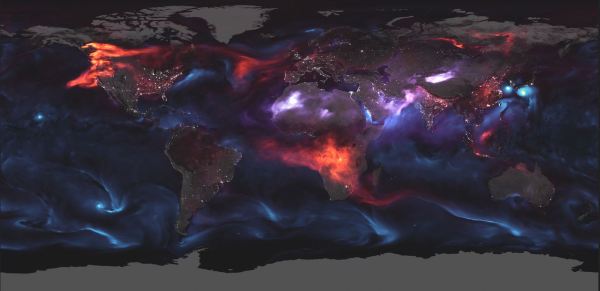
Model Visualization Credit: NASA Earth Observatory, GEOS FP, Joshua Stevens
Explanation from NASA: It was just another day on aerosol Earth. For August 23, 2018, the identification and distribution of aerosols in the Earth’s atmosphere is shown in this dramatic, planet-wide digital visualization. Produced in real time, the Goddard Earth Observing System Forward Processing (GEOS FP) model relies on a combination of Earth-observing satellite and ground-based data to calculate the presence of types of aerosols, tiny solid particles and liquid droplets, as they circulate above the entire planet. This August 23rd model shows black carbon particles in red from combustion processes, like smoke from the fires in the United States and Canada, spreading across large stretches of North America and Africa. Sea salt aerosols are in blue, swirling above threatening typhoons near South Korea and Japan, and the hurricane looming near Hawaii. Dust shown in purple hues is blowing over African and Asian deserts. The location of cities and towns can be found from the concentrations of lights based on satellite image data of the Earth at night.
Link to Photo on NASA Site
I use the NASA page as my web home page, so my first view is always something from NASA, continually changing, continually stunning, always beautiful.
[Chuck Almdale]
Reprise 6: Flying Drones in Malibu is Illegal…
Editor’s Note: Entry number six in our tenth anniversary greatest hits parade was originally posted September 15, 2018, and is ninth in popularity, probably because a lot of people want to fly their new toys in Malibu, but thought to check if it was actually legal. It seems appropriate to post this immediately after the drone hummingbird blog.
…and has been for a while.
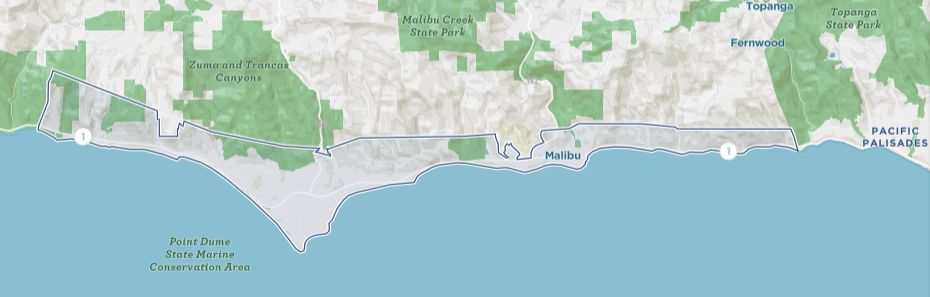
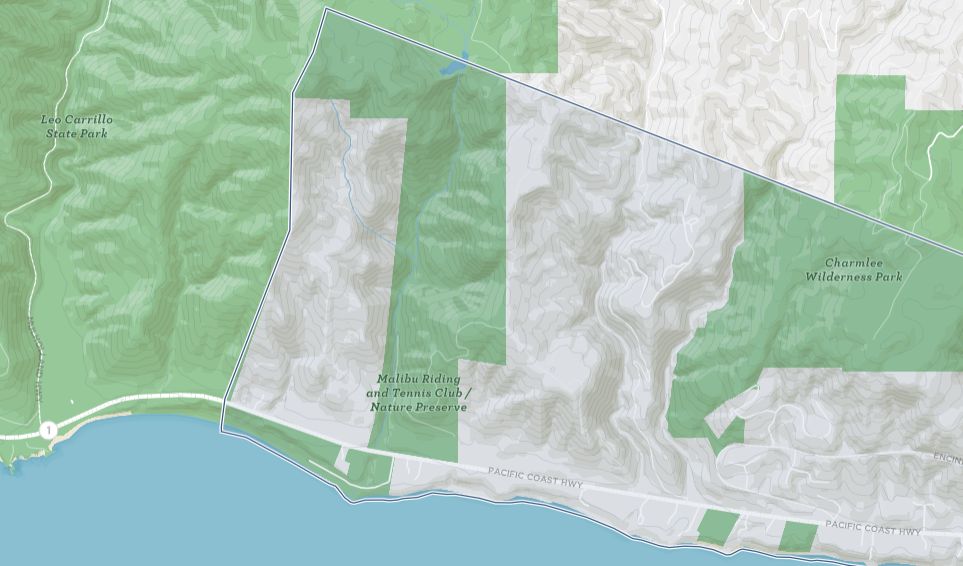
Blue (Malibu residential) and green (State Parks) areas are the local drone no-fly zone. hivemapper.com
Most drone pilots probably know this. After all, illegal areas are discussed in the leading drone publications – Rotor Drone and Drone Magazine. They publish links to maps showing where drones are legal and where they are not. That’s how we found the map shown above.
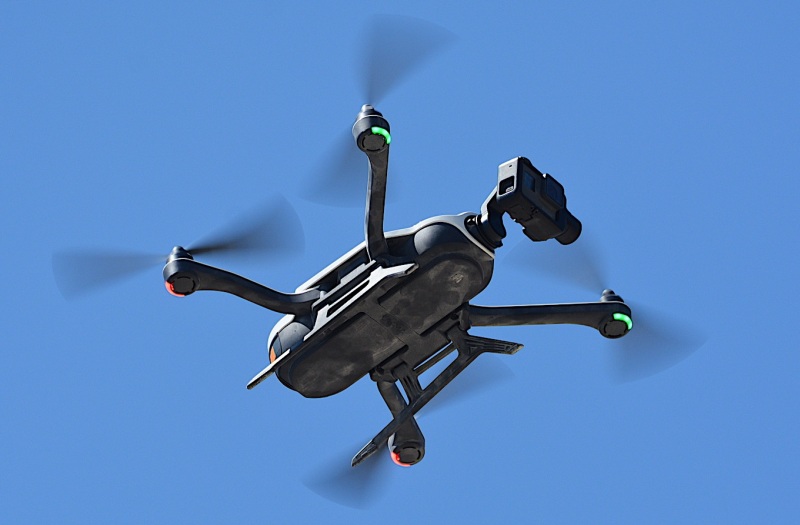
Drone at Malibu Lagoon (SMBAS 8-31-18)
But for the few drone pilots who don’t know, here’s a tip: they’re illegal in California State Parks. Anyone observing drones flying in any State Park should immediately call the State Parks dispatch operator (Sercom) at 951-443-2969.
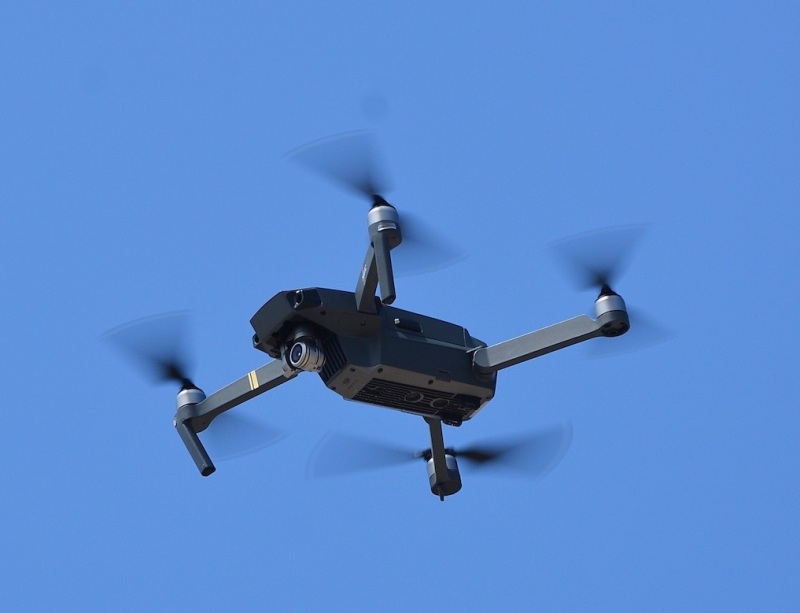
Drone at Malibu Lagoon (SMBAS Sep 7 2018)
They’re also illegal along the Malibu Coastline, between Pacific Coast Highway and the ocean, from:
- Eastern end: Western edge of Topanga State Park, just west of Topanga Cyn. Blvd.

Close-up of the east end of the (blue) drone no-fly zone.
- Western end: Eastern edge of Leo Carillo State Park, just east of Mullholland Blvd.

Close-up of the west end of the (blue) drone no-fly zone.
- and well inland of PCH (see the first map)
- and the state parks.

Here’s a map of the middle area, showing Malibu Lagoon and Surfrider Beach (all no-fly zones).
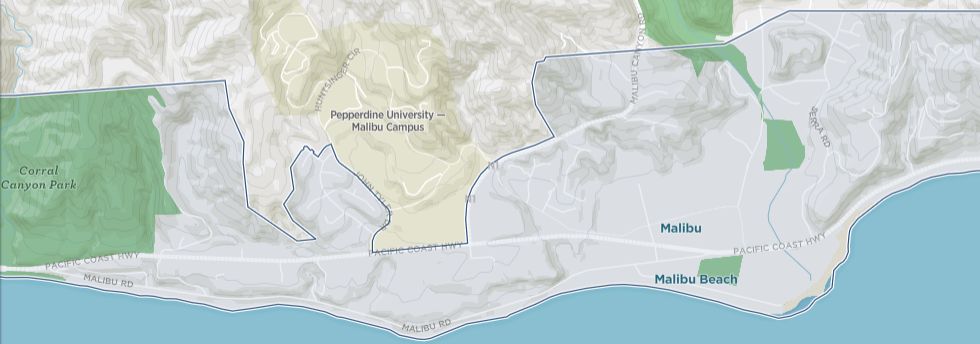
Close-up of the middle chunk of the (blue) drone no-fly zone.
The local movie stars and millionaires don’t want drone operators flying camera-carrying aircraft over their pools and patios any more than the rest of us, and they are undeniably pestered and snooped-at more than the rest of us. Fortunately for them, they were able to influence the passing of legislation making it illegal.
When a drone flies anywhere near the local roosting Snowy Plovers, they perceive the drone as a predator hawk or falcon and panic. [‘Roosting’ means resting or sleeping on the sand between high-tide feeding periods.] They’re trying to sleep. Imagine a lion walking into into your bedroom and staring down at you while you were trying to sleep in bed. You too might become alarmed, even panicked.
An SMBAS member who happened to witness the August 31 incident described it as follows:
Fastest flushing I’ve ever seen. The group flew, split up, some came back and landed for a few seconds, others flew over the ocean, carved figure 8’s over the surf zone, then split up, some flew to the east, some flew over the lagoon, some landed again inside the exclosure for a few seconds and then flew again.

Snowy Plovers disturbed by drone at Malibu Lagoon (SMBAS 8-31-18)
We’re posting this here because lately some drone pilots have been flying their drones within the residential area no-drone area of Malibu and simultaneously within the no-drone Malibu Lagoon State Park, and simultaneously illegally swooping it over the local population of state- and federally-listed threatened Snowy Plovers (one of only seven roosting colonies in Los Angeles County and one of only two breeding areas in Los Angeles County) and startling them into flight.

Snowy Plover resting in shade, Malibu Lagoon (L. Loeher 8-17-18)
This is not a good idea. You never know what some people are (or aren’t) thinking, but I know the State Parks people take a dim view of people startling this threatened species awake and spooking them into flight.
Anyone who sees a drone flying anywhere within the State Parks or the Malibu no-fly zone should immediately contact the local authorities. The State Parks dispatch operator (Sercom) is at 951-443-2969. We don’t know if the City of Malibu has a separate number for zones, but their non-emergency police/sheriff phone number is 310-456-6652 or 818-878-1808.
In fairness, State Parks needs to do more to let people know where drones are forbidden. As Malibu Lagoon and Surfrider beach are extremely popular – some two million people-visits per year – they could start right here and post prominent NO DRONES ALLOWED signs at the several beach entrances. The City of Malibu could post signs at their city borders.
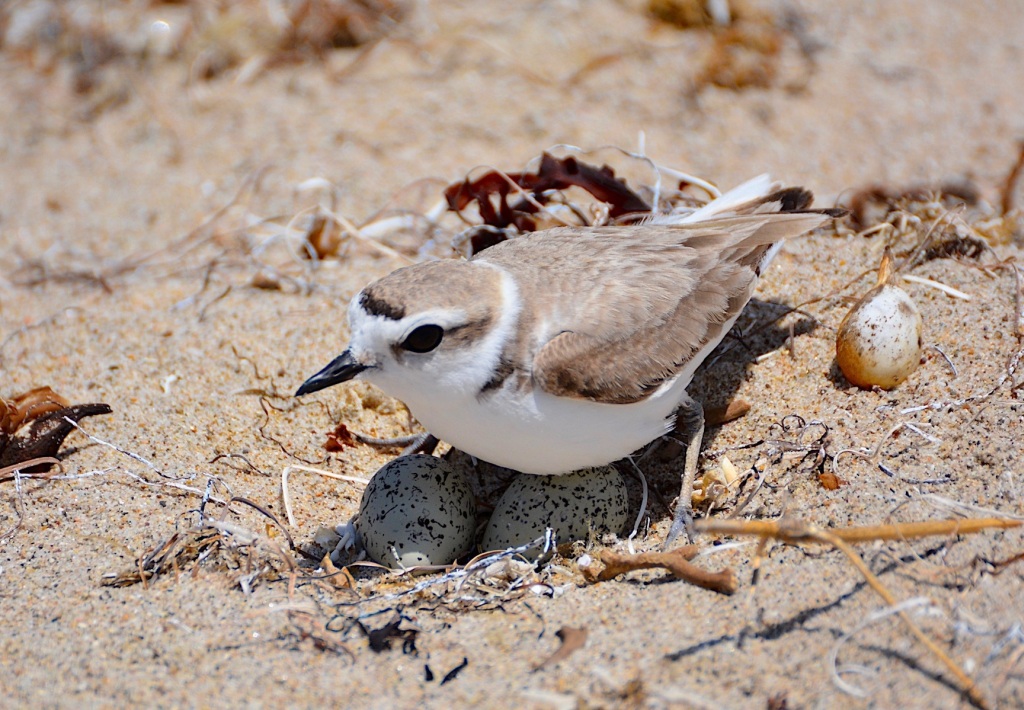
Snowy Plover mother in nest with 2 eggs, Malibu Lagoon (G. Murayama 6-1-18
We now have Western Snowy Plovers at Malibu Lagoon year around. Breeding season runs from late March – early July, although locally it seems to begin in April. Winter roosting season is the entire rest of the year. At last count (Sep 8 2018) there were 35 Western Snowy Plovers roosting on the beach. We have had as many as 80 birds at a time, and – except for the few birds staying to nest – they all leave by the end of April.

Snowy Plover mated pair near their egg at Malibu Lagoon (G. Murayama 6-29-18)
They’re very small, they’re very hard to see due to their cryptic plumage which looks just like the sand they’re resting on, and they’re only about 2500 of them in the entire world (the population of Snowy Plovers which nest in the U.S. interior and winters on the Gulf and Mexican coasts, may be a separate species and are not included).
That’s why Western Snowy Plovers are state and federally listed as threatened and that’s why there is a fence around their nesting/roosting area. That’s why we’re posting this blog, and that’s why Santa Monica Bay Aububon Society really hopes that people will keep themselves, their children and their dogs outside the protective fence. Nearly everyone does so – there are always a few who don’t – and we have been very pleased that the beach-goers have been extremely cooperative to date. If you are concerned about our planet and the non-human animals who share it with you, please continue to show your concern right here, in your own neighborhood.
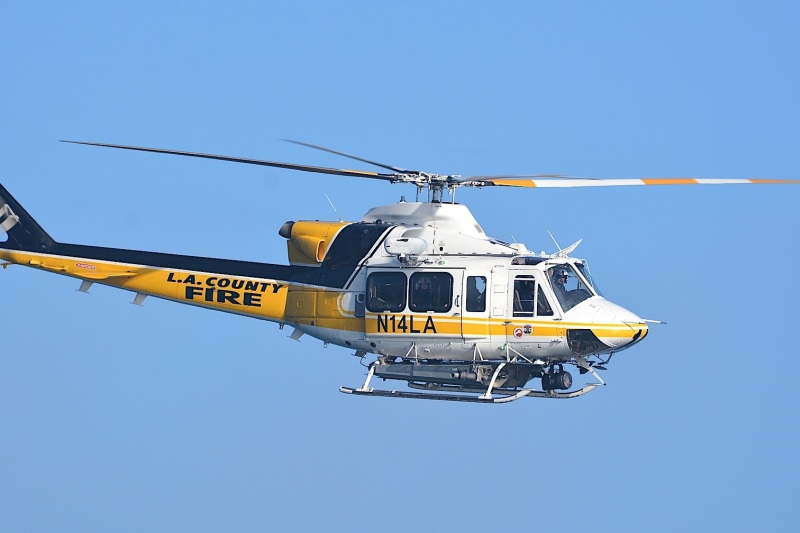
L.A. County Fire Dept. Helicopter flying extremely low over Malibu (SMBAS Sep. 8 2018)
And, while we’re on the subject of hovering vehicles, we don’t understand why the L.A. County Fire Dept. helicopter pilots feel they need to fly so close to the ground and ocean. Are they gawking at the girls? Volunteers on the beach observing the Snowy Plovers have long been advised: “You should note all helicopters flying below 600 ft. (~10x the height of the houses), note the description and tail number, photos are a plus.”
We hope they stop before they behead any paddleboarders.
[Chuck Almdale]
Some biological structures are so small that scientists can’t see them with even the most powerful microscopes. That’s where molecular animator and TED Fellow Janet Iwasa gets creative. Explore vast, unseen molecular worlds as she shares mesmerizing animations that imagine how they might work.
This is the first TED Talk we’ve posted. Most of them are long; this is only six minutes. Animations begin at about two minutes in, but the talk is interesting throughout, and makes me wonder just how many such animations are available on the web. If no film or link appears in this email, go to the blog to view it by clicking on the blog title above. If the film stops & starts in an annoying manner, press pause (lower left double bars ||) to let it buffer and get ahead of you. [Chuck Almdale]
Kidnapper ants raid other ant species’ colonies, abduct their young and take them back to their nest. When the enslaved babies grow up, the kidnappers trick them into serving their captors – hunting, cleaning the nest, even chewing up their food for them.
This is another installment of the PBS Deep Look series. If no film or link appears in this email, go to the blog to view it by clicking on the blog title above. If the film stops & starts in an annoying manner, press pause (lower left double bars ||) to let it buffer and get ahead of you. [Chuck Almdale]



 SANTA MONICA BAY AUDUBON SOCIETY BLOG