Free email delivery
Please sign up for email delivery in the subscription area to the right.
No salesman will call, at least not from us. Maybe from someone else.
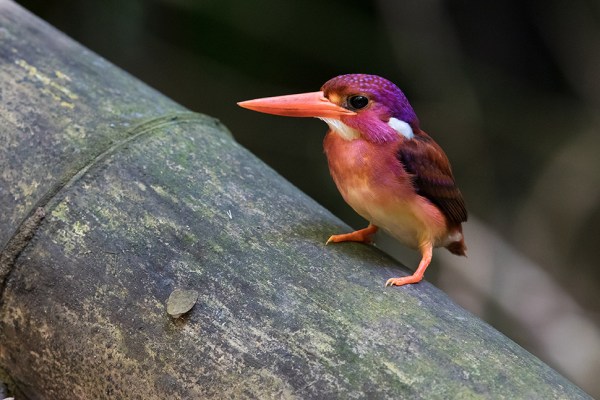
All eight photos by: Miguel De Leon | Article by: Mario Alvaro Limos | Esquire – Mar 13, 2020
From the article:
This bird has eluded scientists for the last 130 years
The South Philippine Dwarf Kingfisher (Ceyx mindanensis) was first described 130 years ago during the Steere Expedition to the Philippines in 1890. The bird is the tiniest species of forest kingfisher in the Philippines, and is characterized by its striking plumage of metallic lilac, orange, and bright blue spots.
Link to article and more photos
Article distributed by The Western Foundation of Vertebrate Zoology
The Western Foundation of Vertebrate Zoology would like to share with you articles and information that we hope will help lift your spirits during these difficult times.
Our best to you, and your loved ones!
Of the world’s 118 species of kingfisher, 85 of them live in Asia and Australasia. North and South America combined have a whopping total of 7 species. Even the diminutive Solomon Islands in the southwest Pacific have 8 species. If you want to see spectacular kingfishers like this one, you have to travel.
[Chuck Almdale]

The three islands of Wake Atoll: Wake, Wilkes & Peale (Courtesy of DVIDS)
Wake Island is part of a coral atoll deep in the western Pacific Ocean, and may be the oldest and northernmost living atoll in the world.
View the film: https://www.ktva.com/story/42018002/inside-the-gates-the-strategic-importance-of-wake-island
(From the KTVA page by Scott Gross)
Located more than 3,500 miles from Joint Base Elmendorf–Richardson and more than 2,200 miles away from Honolulu, Hawaii, the island supports Missile Defense Agency test activities and serves as a trans-Pacific refueling stop for military aircraft, convenient because of its location, says natural resource program manager for the 611th Civil Engineer Squadron (CES) Dillon Paul Brown.
“Wake is very significant because of its cultural history,” Brown said. “It was one of the first areas attacked during World War II, and so it’s a national historic landmark.”
Brown is one of two natural resource managers with the 611th CES. He and Joel Helm have worked to ensure the airmen on the island are protected from seabirds.
“There are no nearby islands, so we have colonial nesting seabird species, at different times of the year at Wake will congregate in large masses,” Helm said. “Not just hundreds but thousands.”
For an island in the middle of the Pacific, the Wake atoll has a respectable birdlist:
- U.S. Fish & Wildlife service lists 31 species
- Avibase lists 52 species, of which twelve are rare/accidental, one is introduced, and one is endemic.
The endemic bird is the flightless Wake Island Rail, previously resident on Wake and Wilkes (but not Peale) Islands, but has not been seen since 1944 and classified extinct. Here’s a selection of articles about this small bird and the island, both victims of World War II.
- Wikipedia – Flightless & fearless, nine inches long with a four-inch wingspan
- Scientific American – Memorializing the Wake Island Rail: An Extinction Caused by War
- BioOne Complete – The Extinct Wake Island Rail Gallirallus wakensis: A Comprehensive Species Account Based on Museum Specimens and Archival Records. Paper abstract, behind a subscription paywall
- Field Guide to Extinct Birds: Lovely artwork, brief description, a work of art with many pictured birds, rather than a traditional field guide, by Sarah Nicholls
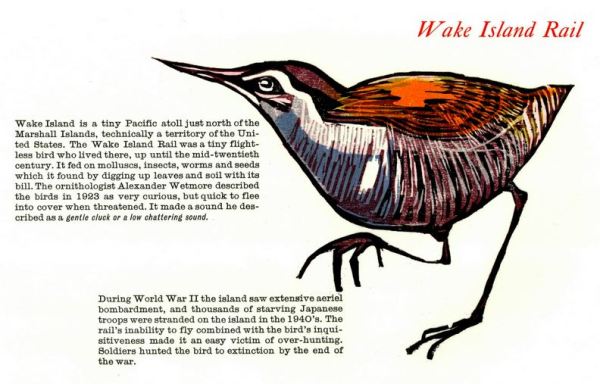
Wake Island Rail by Sarah Nicholls
Snowy Plovers on Film

Over the decades, many members of Santa Monica Bay Audubon Society have been intimately involved with the threatened Western Snowy Plovers (WSP) on our beaches, largely because the plovers have historically maintained six winter roosting locations within our chapter area. Extremely faithful to their roosting locations, WSPs are rarely found farther than 200 meters from their roost, usually forage within 50 meters, and spend half their time resting or arguing within the array of tiny scrapes that constitute the roost.
But many other Audubon Chapters and other organizations are just as -or more! – involved with these birds. Some of them make films. Here are a few.
———————————————————————–
Ventura Audubon Society (Link to twelve short films)
With titles like “WSP6 Rearranging on the Nest,” “What We Do,” and “Snowy Plover Territory Fight” these twelve films, none over 3:06 long, is a great look at the birds, up close and personal. “What We Do” includes nesting endangered Least Terns as well. Cynthia Hartley produced all these great little films.

———————————————————————–
Western Snowy Plover Nest Predation
Produced in January 2003 by Jack Fancher for the U.S. Fish & Wildlife Service. Length: 7:46
The eggs of the WSPs nesting at Bolsa Chica in Orange County were heavily predated by local American Crows, until the ME (mini-exclosure or metallic exclosure) was developed for them. This simple and easily erected cage-like structure keeps crows and hawks out, but doesn’t hamper the plovers at all.
Jack Fancher writes:
The Western Snowy Plover (Threatened with extinction) lays eggs in an obscure nest scrape in the sand or dirt, relying on cryptic coloration to evade predation. At Bolsa Chica, snowy plovers nested on dried out salt pans and dried out mud flats. The area is surrounded by urban areas that sustain large numbers of crows and ravens that spill over into the Bolsa Chica area. The loss of snowy plover eggs to corvid predation before the.eggs could hatch was greatly reducing plover reproductive success. A mini-exclosure (ME) was deployed over nests that kept the crows away from the plover nests but allowed the incubating plovers to come and go from the nest without constraint. The ME looks like a cage, but is virtually invisible to the snowy plover within just a few seconds of placement. Plover egg losses are greatly reduced as a result of ME placement.
———————————————————————–
With Monitoring Limited, Someone Drove Through a Snowy Plover Nesting Site
National Audubon Society article by Alastair Bland, published 4-1-20
Due to pandemic-related restrictions, vulnerable shorebirds may have to rely on the kindness of strangers this breeding season.
Link to article
Documenting the harassment of WSPs on Ormond Beach, in Ventura County, California, nesting area featured in the Ventura Audubon Society films above.
[Chuck Almdale]
How to Stop Overthinking Everything | PBS BrainCraft Video
Vanessa Says:
“Overthinking” is often reported as being a bad habit and is frequently used interchangeably with rumination. But overthinking isn’t necessarily bad and rumination is just one type of overthinking. Overthinking is an umbrella term for lots of different thought processes – beneficial things like emotional processing, problem solving, mind wandering and then not-so-beneficial things like rumination and worry. This video includes some tips (starting at 3:26) for how to stop rumination or just overthinking in general – I overthink a lot and while it’s not ruminating and may have some problem-solving benefits, I still find it limits my focus.
This is an installment of the PBS – BrainCraft series created by Vanessa Hill. If no film or link appears in this email, go to the blog to view it by clicking on the blog title above. If the film stops & starts in an annoying manner, press pause (lower left double bars ||) to let it buffer and get ahead of you. [Chuck Almdale]
Editor’s Note: This is entry number seven in our tenth anniversary greatest hits parade, is sixteenth in popularity, and for reasons unknown was the most popular of our 46 postings on full moons, solstices and equinoxes. I suppose that of their ilk one of them had to have the highest viewership. These reports were very popular with our Wiccan and astronomy buff followers. [Chuck Almdale]
Here’s another update from SMBAS Blog on that large, disc-shaped, shining object which has frequently and mysteriously appeared in our nighttime sky this year (known to many as the moon).

The Moon as seen from Earth (T. Hinnebusch 2/14/14)
April 15, 12:42 a.m. PDT — Full Pink Moon. The grass pink or wild ground phlox is one of the earliest widespread flowers of spring. Other names were the Full Sprouting Grass Moon, the Egg Moon, and —among coastal tribes —the Full Fish Moon, when the shad come upstream to spawn. In 2014 this is also the Paschal Full Moon; the first full moon of the spring season.
The first Sunday following the Paschal Moon is Easter Sunday, which indeed will be observed five days later on Sunday, April 20. This full moon will also undergo a total lunar eclipse for which we have a ringside seat, as it occurs in the early morning hours. Totality will last almost 78 minutes. [Photos of a Total Lunar Eclipse] The next lunar eclipse will be 8 October, 2014.
The next significant full moon will occur on May 14, 12:16 p.m. PDT. Keep an eye on this spot for late-breaking news on this unprecedented event.
Have a nice moon photo? Send it to us at: misclists [AT] verizon [DOT] net, along with name to credit and time/location of photo.
This information comes to you courtesy of: http://www.space.com/24262-weird-full-moon-names-2014-explained.html written by Joe Rao. Joe Rao serves as an instructor and guest lecturer at New York’s Hayden Planetarium. He writes about astronomy for Natural History magazine, the Farmer’s Almanac and other publications, and he is also an on-camera meteorologist for News 12 Westchester, N.Y.
But that’s waaay too long to type in, and besides, you don’t need to go there because SMBAS has done the work for you!
[Chuck Almdale]



 SANTA MONICA BAY AUDUBON SOCIETY BLOG