Free email delivery
Please sign up for email delivery in the subscription area to the right.
No salesman will call, at least not from us. Maybe from someone else.
Climate change is THE existential question that humanity is facing. But are we too late? Has climate change reached the point of no return? Are we doomed?
**What’s the state of climate change right now?**
Since around 1880, the average global temperature of the earth has increased by 1 degree Celsius, or 1.8 degrees Fahrenheit. That increase is due almost entirely to humans burning fossil fuels, mostly from 1950 on. That might not sound like a big increase, but it is. It means sea level rise, shrinking polar ice caps, and increased extreme weather events like heat waves and monsoons.
That’s why a hundred and ninety-plus countries signed onto the Paris Climate Agreement. The goal is to limit the temperature increase to 1.5 degrees Celsius — or 2.7 degrees Fahrenheit — by the end of this century. Many scientists say that staying under 1.5 puts us near the upper limit of what’s tolerable. We’ll have droughts, sea level rise, and extreme weather, but chances are we can manage it.
**What does climate change look like in the future?**
That’s why we have the IPCC. The IPCC is part of the United Nations, and it stands for the Intergovernmental Panel on Climate Change. It’s been the world’s top authority on climate science for the last 30 years. Thousands of climate scientists from around the world volunteer their time to analyze and summarize the latest and best climate science. According to these experts, if we keep burning fossil fuels like we are today, then we’re blowing past 1.5 degrees of warming by 2100. We’ll almost definitely hit 2 degrees, and might even reach 3 or even 4 degrees. That means longer and more intense heat waves. And stronger hurricanes and dangerous flooding.
**How do we get climate change under control?**
Let’s start with transportation. 95% of the vehicles on the planet burn fossil fuels. They’re responsible for almost ⅓ of all greenhouse gas emissions worldwide! It might sound like a pipe-dream to replace those gas-guzzlers with electric vehicles, but it might not be. In the last decade and a half electric vehicles that don’t have any pollution out of the tailpipe went from a dream to commonplace in places like California, China, Norway.
ABOVE THE NOISE is a show that cuts through the hype and takes a deeper look at the science behind controversial and trending topics in the news. Hosted by Myles Bess and Shirin Ghaffary.
This series is aimed at teens, but after viewing a few episodes, I’m sure that most adults will benefit from it as well. Let us know what you think.
This is another installment of KQED’s Above the Noise series. If no film or link appears in this email, go to the blog to view it by clicking on the blog title above. If the film stops & starts in an annoying manner, press pause (lower left double bars ||) to let it buffer and get ahead of you. [Chuck Almdale]
Editor’s Note: Entry number nine in our tenth anniversary exercise in total recall was originally posted May 2, 2010, is nineteenth in overall popularity but first in field trip report popularity. We still try to run camping trips to Butterbredt twice a year – Springtime and Halloween – but don’t always succeed. I posted it, but Mary wrote it.
***********************************************************

Indian Paintbrush (G.Bando 5/10)
Great weather was the rule, although powerful, gusty winds on Highway 14 challenged control of my Dolphin RV on Friday evening. Three of us were en route to Sageland, in preparation for our Saturday morning meeting with the rest of our group at Butterbredt Spring.
Next morning, warmly dressed, we drove up and down through a frosty Butterbredt Canyon in Roxie’s 4WD hybrid Ford. We chose that route partly to test the road – which is often messed up by motorcycles and tricky to drive –but also to catch migrants. It was a hasty journey, but we heard unmistakable songs of Western Meadowlarks, briefly glimpsed a Mountain Quail scurrying up the hill, had a great look at a male Scott’s Oriole on a Joshua Tree, a Western Kingbird and a briefly perched Cooper’s Hawk. Approaching the spring, we saw large groups of migrants passing westward along the canyon’s sides and ridge, too quickly to count or even guess their names.

Western Kingbird (G.Bando 5/10)
We three – my daughter Roxane, my neighbor Linda Cady (retired Jr. High science teacher who loved camping with her students, is a nature enthusiast and new to birding) and I – met the rest of our group waiting at the Spring: Jean Garrett, Gloria Bando and Chris Lord. We later joined Keith Axelson at his Sageland Ranch where we camped and had dinner, including a cake to celebrate his 85th birthday on this trip, which he inaugurated many years ago. Many birders honor Keith as primarily responsible for establishing Butterbredt Spring as a premier birding destination and Sanctuary, supported by Santa Monica Bay Audubon.
8:15 a.m. is a little late to catch all the migrants, but we immediately found many species of birds. A beautiful male and female Black-throated Grey Warbler, Lesser Goldfinches, Chipping Sparrows, Dark-eyed Juncos, Wilson’s Warblers dripping off willow branches, male and female Black-headed Grosbeaks, Yellow-rumped Warblers in eye-popping breeding plumage and White-crowned Sparrows to list a few. Mourning Doves and House Finches were numerous. California Towhees, Bewick’s Wrens, House Wrens and Rock Wrens were all singing. Long-eared Owls and Roadrunners were absent, but maybe next year! Floral bonuses included: deep pink Beavertail Cactus on the slopes, many yellows, especially brilliant Biglow’s Coreopsis, Golden Bush, and other yellow composites. Purple Chia was also common, and deep blue, fragrant Bush Lupine warranted numerous pictures.
An interesting variety of difficult-to-identify lizards were a frequent distraction: we think they included a yellowish Southern Alligator Lizard, a Common Leopard Lizard, a Western Skink, a Whiptail and numerous Fence Lizards. I hesitate to speculate on butterflies, but American Ladies and small Blues were common.

Common Leopard Lizard. Cryptic, isn’t it? (G.Bando 5/10)
While walking back up-canyon, Jean spotted a House Finch, seeming secure in its nest built in a very prickly cholla cactus. An Ash-throated Flycatcher perched and called. Hammond’s Flycatcher’s were in the Spring’s cottonwoods and along the trail. A couple of Loggerhead Shrikes sat on trailside Joshua trees. California and Mt. Quail and Chukar lurked and chattered in the shrubbery. The call of a male Mt. Quail tantalizingly, and invisibly, echoed down the canyon.
To our surprise we found both an out-of-place Acorn Woodpecker on a cottonwood tree in the desert canyon, and an excellent look at Green-tailed Towhee. Even more surprising was a Yellow-breasted Chat foraging low in trailside bushes and the base of willows beyond the large cottonwood. It was uncharacteristically silent, but willing to be seen!
Exploring independently around the spring, Chris found a MacGillivray’s Warbler, both Cassin’s and Warbling Vireos, and a Costa’s Hummingbird. We joined him and saw Hermit Thrushes working the ground and three Great Horned Owls in the trees. A Black-throated Sparrow was viewed singing.
Chris needed to leave early, so after lunch he took Jawbone Road to Sageland Ranch to say hi to Keith. Our two remaining vehicles tackled the sandy track back up Butterbredt Canon in hopes of eagles and other rarities. Jean, expertly driving her non-4WD car, managed the challenge. We saw Common Ravens and Red-tailed Hawks, but no Pinyon Jays or Golden Eagles by the time we exited onto Kelso Valley Rd. The pond and creek at Tunnel Well, which occasionally harbors Wilson’s Snipes, didn’t, but we added more Ruby-crowned Kinglets, Red-winged Blackbirds, a Killdeer and Spotted Towhee.
Welcomed at Sageland, we set up camp, explored the local canyon, relaxed and enjoyed observing the numerous nesting bird families as we added to our sightings. Of the dozens of wintering Pine Siskins, seven remained to swarm Keith’s finch feeders. Three nest boxes held active Western Bluebird families. One of the male bluebirds pounded a window periodically, as it had been doing for some weeks. A pair of Say’s Phoebes tended their nest under an eve. A pair of Phainopeplas displayed in the tree tops and an American Kestrel pair, nesting in the large box on the water tank, entertained us, with the male bringing lizards to feed his mate and spell her on egg duty. They eat a lot of lizards! At sundown, Kingbirds twittered as they settled to sleep in the trees, and groups of quail fluttered and chattered as they found their night’s roosts.
The Western Scrub-Jays patronized other feeders while small flocks of California Quails cleaned up below; the chipmunks vacuumed their share despite Keith’s black kitty watching for a chance to grab one.
The admirable Saki has learned never to make a move on a bird! He is probably one of the world’s few well-trained cats. Occasionally, a handsome little male Costa’s hummer with brilliant magenta georgette came to sip at the nectar feeder but, unfortunately, male or female Scott’s Orioles chose not to appear. A male Bullock’s Oriole did visit in the trees. Nuttall’s Woodpeckers, male and female, drummed to mark territory and find insects. More unique were the pair of Hairy Woodpeckers seen foraging in the grounds. I must mention the California Thrasher pouring out song up on the hillside, along with Bewick’s Wrens, and an Oak Titmouse sounding off. Morning calls included the unmistakable coo of a Eurasian Collared Dove, which has found its way to Keith’s land, and, of course, European Starlings.

Baby Blue Eyes on sandy soil (G.Bando 5/10)
Keith had prepared, mowed clear paths, cut away overgrown branches, improved the trail in his canyon for our safety and convenience. The stream flows continuously. It is an idyllic place. We were able to add Song Sparrow, Western Wood Pewee, Orange-crowned Warbler, Brewer’s Sparrow to our lists, if they had not been seen before, along with a debated empidonax flycatcher.
Townsend’s Warblers and a Plumbeous Vireo were seen later. At night, Western Screech-Owls gave their little warbling contact calls to prove their presence in a hollow cottonwood limb, where we hope they are raising a family. Also distant Great Horned Owls hooted under the ever brilliant desert starry sky.
On Sunday morning a pair of Ash-throated Flycatchers entertained us by continually examining the empty, for rent, nest boxes, bringing material with obvious thoughts of setting up housekeeping.
We we then hiked through fences and brush to Dove Spring Rd., admiring the flowers and checking Joshua Tree nest holes.

House Finch nest in Cholla cactus – Watch that first step when leaving! (G.Bando 5/10)
We found a pair of Cactus Wrens with a nest in progress in their favorite nesting location, a cholla cactus. We saw Western Kingbirds with similar intentions. Occasionally we needed to dodge roaring motorcycles (the only sour note in Paradise). Sadly, their idea of “fun” doesn’t merely miss the wonder of their surroundings but often defies all laws protecting that environment. Fortunately, the Friends of Jawbone Canyon, the BLM, and the SCA organization of young volunteers (which SMBAS supports financially), have made huge improvements in blocking and obliterating their illegal trails.
We also found a House Finch nest in a cholla. Theirs is an open-bowl nest unlike the Cactus Wren’s nest which is a roughly globe-shaped nest with a side entrance, always well-buried among the extremely thorny cholla branches. Incidentally, a cholla location did not save a wren nest last season when a bear came along, tore the nest and birds out of the cholla and devoured them!
As we hiked we could hear the melodic songs of distant Scott’s Orioles and the ever elusive Mt. Quail calling. We can be glad those are so cautious. Hunting season will test their survival strategies.
Most of our participants needed to head back to Los Angeles in the afternoon, but took with them, I believe, memories of a beautiful experience. I thank them, as does Keith, for joining us and making the outing a success.
I often think how very fortunate we are to have this tradition and connection to the real, wild world, where there is escape from the insanity, the violence, the unending consumerism, commercialism, and banal entertainments which currently dominate human society and destroy Nature. There, in the desert wilderness, one can escape to a haven of sanity, quiet, where all living things – animal, plant, and even the earth itself – are allowed to exist in peace, work out destiny, and, you can hear the birds sing!
All this peace may be gone at some point, of course, under the groaning rumble of wind turbines on the ridges (ask someone who lives near one; they are not as ecologically benign as touted.) Or when development creeps south along the valley road. But for now, we are greatly privileged. I am sorry some, who wanted to come, could not make it after all this year. Perhaps they and others will join us on another occasion. My species count may not be altogether complete. But it I will add it to almost 30 years of memorable Butterbredt Spring spring trips! Thanks, Keith, for having made them possible. [Mary Prismon]
| Butterbredt Trip List | May 1-2, 2010 |
| Chukar | Western Bluebird |
| Mountain Quail | Hermit Thrush |
| California Quail | Northern Mockingbird |
| Cooper’s Hawk | California Thrasher |
| Red-tailed Hawk | European Starling |
| American Kestrel | Phainopepla |
| Killdeer | Orange-crowned Warbler |
| Eurasian Collared Dove | Yellow-rumped Warbler |
| Mourning Dove | Black-throated Grey Warbler |
| Western Screech-Owl | Townsend’s Warbler |
| Great Horned Owl | MacGillivray’s Warbler |
| Costa’s Hummingbird | Wilson’s Warbler |
| Acorn Woodpecker | Yellow-breasted Chat |
| Nuttall’s Woodpecker | Green-tailed Towhee |
| Hairy Woodpecker | Spotted Towhee. |
| Western Wood Pewee | California Towhee |
| Hammond’s Flycatcher | Chipping Sparrow |
| Say’s Phoebe | Brewer’s Sparrow |
| Ash-throated Flycatcher | Black-throated Sparrow |
| Western Kingbird | Song Sparrow |
| Loggerhead Shrike | White-crowned Sparrow |
| Plumbeous Vireo | Dark-eyed Junco |
| Cassin’s Vireo | Black-headed Grosbeak |
| Warbling Vireo | Red-winged Blackbird |
| Western Scrub Jay | Western Meadowlark |
| Common Raven | Brewers Blackbird |
| Oak Titmouse | Bullock’s Oriole |
| Cactus Wren | Scott’s Oriole |
| Rock Wren | House Finch |
| Bewick’s Wren | Pine Siskin |
| House Wren | Lesser Goldfinch |
| Ruby-crowned Kinglet | 63 Species |
He Hears Music in the Quietest Place on Earth—Can You? | National Geographic’s Short Film Showcase
Acoustic ecologist Gordon Hempton has spent the past 35 years recording natural soundscapes. His work has taken him around the world and into some of the least densely populated places.
Good for soothing jangled nerves. Headphones will enhance.
This is an installment of the National Geographic Short Film showcase. If no film or link appears in this email, go to the blog to view it by clicking on the blog title above. If the film stops & starts in an annoying manner, press pause (lower left double bars ||) to let it buffer and get ahead of you. Thanks to Jane Beseda for this. [Chuck Almdale]
Cornell Lab Bird Cams
From Cornell Lab of Ornithology – All About Birds:
The Cornell Lab Bird Cams connects viewers worldwide to the diverse and intimate world of birds. We work to make watching an active experience, sparking awareness and inspiration that can lead to conservation, education, and engagement with birds.

Our viewers tell us that watching the cams is a life changing experience: an unprecedented learning experience that they liken to virtual field trips or field biology in their living room. We’re excited to continue sharing and learning with the community as we watch the world of birds together.
Cornell currently has fifteen different bird cams in operation including: Barred Owls, Bermuda Petrels, Cornell Feeder Watch, Panama Fruit Feeders, Northern Royal Albatross, West Texas Feeders, American Kestrels, California Condor, Lance-tailed Manakins.
Link to all cams (from which you then pick)
This is the real world, unedited. Things may not happen at the rate you wish.
[Chuck Almdale]
Reprise 8: Sexual Dimorphism Reversal and Polyandry – Part I
Editor’s Note: Entry number eight in our tenth anniversary retrospective is twelfth in popularity, and is a three-part series, originally run July 19-21, 2016. Links to parts two and three are at the end. My interest in the subject was sparked by seeing the polyandrous Eurasian Dotterels on their breeding grounds in northern Norway, and the ensuing discussion. [Chuck Almdale]
Sometimes it’s the exception that proves the rule.
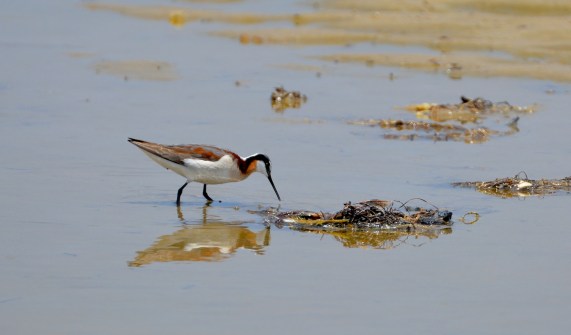
Female Wilson’s Phalarope, Malibu Lagoon, Ca.
(Grace Murayama, June 6, 2016)
Beginning birders soon notice that in many species, the male and female look different from each other. This divergence in appearance linked to sex appears in both birds and mammals. In mammals, for example, male lions have large manes that females totally lack, gorilla males are larger than females, male deer annually grow and shed their large antlers, and, of course, human males and females differ in body size and shape.

Irish Elk Group (Tabitha Paterson, TwilightBeasts)
Irish Elk size comparison (prehistoric-wildlife.com)
This distinct difference in features between genders is commonly called sexual dimorphism, or sometimes sexual bimorphism (two forms). The single-form alternative is sexual monomorphism (one form).
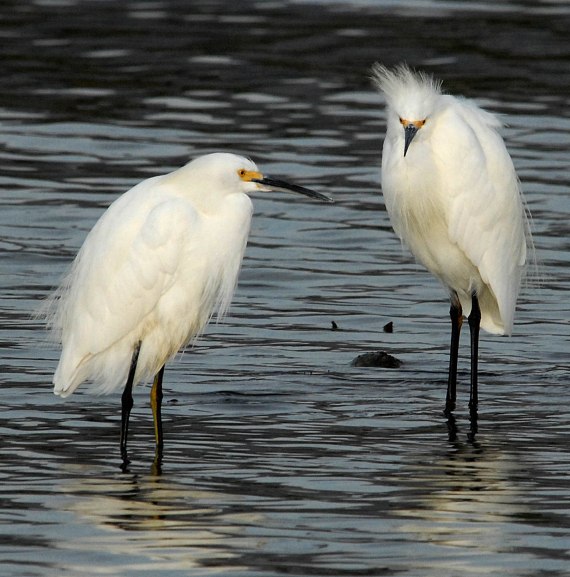
Sexual monomorphism in Snowy Egrets, Malibu Lagoon, Ca.
(Jim Kenney, November 2006)
Some examples of sexual monomorphism commonly seen in California are: geese, swans, loons, grebes, cormorants, pelicans, most herons and egrets, vultures, most sandpipers, gulls, terns, alcids, typical owls, swifts, corvids, chickadees, thrashers, some warblers, and most sparrows.
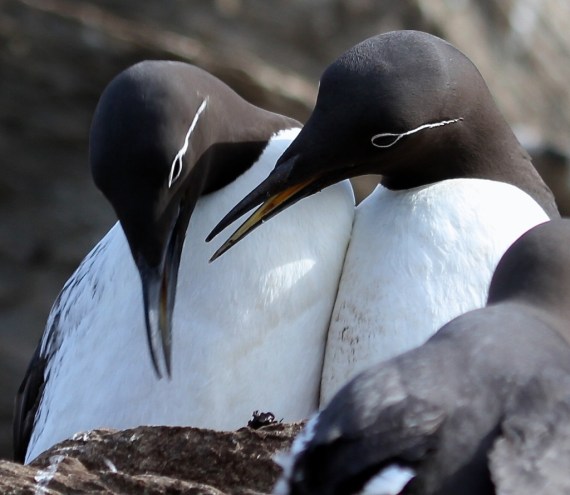
Common Murre (bridled variety), an alcid, exhibit sexual monomorphism.
Hornoya, Norway. (Joyce Waterman, May 30, 2016)
In California, readily seen examples of sexual dimorphism are: ducks, quail, grouse, phalaropes, hummingbirds, kingfisher, woodpeckers, gnatcatchers, most warblers, tanagers, blackbirds and orioles, finches, House Sparrow.

Hooded Mergansers exhibit sexual dimorphism; male front, female behind
(Jim Kenney, February 17, 2011)
Field guides generally show if a species is monomorphic or dimorphic. This is done with little male & female signs (♂♀), for dimorphism. If it says either “adult” or nothing, it’s monomorphic.
The reasons why a species is one or the other are complex. Dissertations and books have been- and still are being – written on the subject.
Four important factors to help understand sexual morphism:
Operational Sex Ratio (OSR): The ratio of the numbers of sexually receptive males to females.
Potential Reproductive Rate (PRR): The offspring production per unit of time each sex would achieve if unlimited mates were available.
Minimum Time Investment (MTI): The shortest amount of time either sex must contribute to produce a fertilized egg.
Parental Time Investment (PTI): The amount of time either sex contributes to parental duties.
For the purposes of this discussion, we’ll use the following definitions:
Breeding duties: All reproduction-related behaviors from courting, mating and egg-laying, through nest-building, incubation of eggs and feeding, protection and education of the young.
Nesting duties: Those activities listed above except mating and egg-laying.
Theoretically, the male and female can have the same MTI, and for many animals that is true. But in birds, because females must produce the large fertilized egg with a protective shell, white and yolk, while the males contributes only tiny sperm, the female’s MTI is always larger. Therefore, if either sex begins to make a larger parental time investment (PTI) than the other, as often happens in evolution, it is almost always the female. This greater (MTI+PTI) investment drives the evolution of the female’s greater choosiness in mate selection, picking – as best she can – the most fit male available. Female choosiness in turn causes males to compete in numerous ways for breeding opportunities. Such competition between males sets up the evolution of variations in ability to sing, gather food, build a nest, fight battles, and especially to display plumage.
[Article: Operational sex ratios & roles, dimorphism, monomorphism]

Allen’s Hummingbird shows extreme sexual dimorphism; female left, male right (Jim Kenney: female September 4, 2009, male January 9, 2007)
Thus it is the female selection of attractive, healthy, large or strong characteristics that shapes the male’s appearance and so produces sexual dimorphism. Because males cannot take on the female’s large initial time investment in egg-laying, males evolve in other ways: nest building, bringing food to the female, territory protection, and predator distraction. His overall parental time and energy investment in these activities may exceed the female’s combined egg production and parental time investment. Further, by performing such necessary duties, the female can concentrate on incubation, etc. Thus a sexual division of labor appears – different roles for females and males.
What does this division of labor have to do with monomorphism and dimorphism? In summary the “rule” which I alluded to at the beginning is:
Greater equality in breeding duties means greater similarity in appearance.
Eggs are always produced by females. In monomorphic species everything else is shared as equally as possible: site-selection, nest-building, incubation of eggs, territory defense, protection, feeding and education of the young. In sexually dimorphic species, duties of nesting and parenting diverge between sexes, with the manner and amount varying widely between species.
This brings up the second part of the “rule”:
The lesser the similarity in appearance, the lesser the involvement in breeding duties by the male, who is the more colorful bird.
When sexual dimorphism is extreme, the male may do nothing beyond inseminating the female. She then performs all the duties of nest-building, incubation of eggs and protection, feeding and education of the young, etc., with no assistance from the male. The avian families of Pheasants, Hummingbirds, Cotingas, Manakins, Birds-of-Paradise and Bowerbirds are filled with such species.
In Part II, we discuss the topics of double-clutching, sexual dimorphism reversal, sexual size dimorphism reversal and polyandry, with illustrative cases.
In Part III, we introduce those polyandrous species that display sexual dimorphism reversal.
[Chuck Almdale]



 SANTA MONICA BAY AUDUBON SOCIETY BLOG