Free email delivery
Please sign up for email delivery in the subscription area to the right.
No salesman will call, at least not from us. Maybe from someone else.
Reprise 12: Bird & Marine Mammal Rescue
Editor’s Note: Entry number twelve in our tenth anniversary tour, unlike the prior reprise postings, was never a blog (i.e. emailed to readers). It is a public service information page created in 2010, accessible only by visiting the blog, yet is our third most popular page or blog. A permanent page on our website has the advantage of longevity, but lacking a blog posting, it has a disadvantage in that only blogsite visitors will know it exists. Now, with this posting, it has the best of both worlds. [Chuck Almdale]
****************************************************
BIRDS
People frequently contact us concerning oiled, wounded and sick birds. These are the bird rescue operations in our area of which we are aware. If you know of others, please let us know and we will add them to this list. All of these organizations are non-profit, need donations and frequently solicit volunteers.
California Wildlife Center
In the Malibu area, CWC is the closest place to call.
Emergency Hotline Number: (310) 458-WILD [9453]
Same phone number for all wildlife emergencies
An interactive recording will get you to the correct department.
If no one answers, it is because all CWC personnel are currently busy with feeding or emergency procedures. Please leave a message. They will return your call as soon as possible.
Website: http://www.cawildlife.org/
PO Box 2022
Malibu, CA 90265
Fax: (818) 222-2685
Email Contacts:
Administration, donation & media: admin@cawildlife.org
Volunteer Inquiries: volunteer@cawildlife.org
International Bird Rescue:
Website: http://www.bird-rescue.org/
San Pedro Office:
Phone: 310-514-2573
Fax: 310-514-8219
3601 South Gaffey Street
San Pedro, Ca. 90731
South Bay Wildlife Rehab
Website: http://www.sbwr.org/
26363 Silver Spur Rd., Rancho Palos Verdes, California 90275
Phone: 310-378-9921 Fax: 310-378-0969
Email: info@sbwr.org
Huntington Beach Wetlands and Wildlife Care Center
21900 Pacific Coast Highway, Huntington Beach, CA 92646
Phone: 714-374-5587
Project Wildlife
San Diego Humane Society Project Wildlife
Website: https://www.sdhumane.org/programs/project-wildlife/
Pilar & Chuck Bahde Wildlife Center
5433 Gaines Street
San Diego, CA 92110
Phone: 619-225-9453
Hours: 9:00a.m. – 5:00p.m.
Open: 7 days a week (except Thanksgiving, Christmas & New Year’s Day)
Drop-off area: Open 24/7 and there is dedicated parking in front of the building.
MARINE MAMMAL RESCUE
Don’t touch! Do no pick up, pour water on or feed the animal. They are wild animals and can bite. They are also easily stressed by humans.
Do not return the animal to the water. Seals and sea lions temporarily “haul-out” on land to rest. Harbor seal mothers often leave their pups ashore while they’re feeding at sea. A beached whale, dolphin, or porpoise should be reported immediately.
Give the animal its space. Maintain a distance of at least 50 feet. Keep people and dogs away.
Call WildRescue’s California 24-hour hotline: 866.WILD.911
or consult this list. When calling, it’s important that you be able to identify your location and provide details of the animal and its condition.
****************************
California Wildlife Center
Same organization as listed above
Marine mammal rescue from Santa Monica to Ventura; native wildlife rehabilitation.
Phone: 310-458-WILD (9453)
Online: http://www.cawildlife.org/
Marine Mammal Care
Pinniped (fin-footed mammals) rehab in L.A.
Serves all Los Angeles County Beaches
3601 South Gaffey Street #8
San Pedro, CA. 90731
Phone: 310-548-5677
Online: https://mmccla.org/more-about-us
Marine Animal Rescue Specialists
Response Area: Pacific Palisades to Long Beach & Catalina Island
Phone: 800- 39-WHALE (9-4253)
Online: http://www.marspecialists.org/
Pacific Marine Mammal Center
Pinniped rescue and rehab in Orange County
20612 Laguna Canyon Road
Laguna Beach, CA, 92651
Phone: 949-494-3050
Online: pacificmmc.org
Contact: Info@pacificmmc.org
[Chuck Almdale]
Editor’s Note: Entry number eleven in our tenth anniversary blog tour ran March 19, 2019 and is eighth in popularity. I found it on BirdChat (National Birding Hotline Cooperative) to which I subscribe and recommend, and loved it. Author Eran Tomer gave me permission to reprint it, I added some formatting and photos, and it was an instant hit. [Chuck Almdale]
****************************************************
You may be surprised to learn that there are not one, but four different checklists of all the birds in the world.
As you will read below, out of a current total 11,524 extant and recently extinct species, the four lists agree on 9,968 (86.5%) of them, leaving 1556 species considered by some but not by others to be “good” species. You may think, “So what?” but if you’ve seen (or think you’ve seen) Hoary Redpoll, Franklin’s Grouse or Thayer’s Gull, read on.
Birders interested in classification, nomenclature, systematics, status, distribution, world birding, or the ticking off of lifers will find this food for thought. We all use checklists, even if only in our own backyard, and these checklists are based on something. This article delves into that something.
This also gives us a glimpse into the inner processes of science, which very often begin with the observation and naming of “things” and then attempts to organize those “things” into a coherent system. This can get messy at times as scientists do research, present their discoveries, argue their views and disagreements inevitably arise. It is misleading to think that “Science says…” as if “science” were a monolithic entity with a single and unified voice. Science is many people, many voices, perpetually changing and growing. Most importantly, it is inherently self-correcting because every scientist has a horde of other scientists peeking over their shoulder, looking for errors upon which they can pounce. This is human nature, inquisitive and acquisitive, organized for our common good.
This article first appeared on the excellent, informative and entertaining listserve BIRDCHAT as a three-part email essay. I liked it very much and – having received permission from the author – hope to widen it’s audience. Near its end there are fourteen species mentioned which are treated uniquely by one or another of the four checklists. I have added photos of these particular species, alongside their more commonly accepted classification. [Chuck Almdale]
For the original PDF file, without photos, click Avian Taxonomies Compared.
Avian Taxonomies Compared
By Eran Tomer
February 2019
Email: erantomer@gmail.com
Recently one of my projects prompted me to compare the four major ornithological taxonomies:
- Clements/eBird
- BirdLife International/Handbook of the Birds of the World (BirdLife/HBW)
- International Ornithological Committee / Union (IOC)
- Howard & Moore
I thought I’d share the highlights, especially since I couldn’t find similar information on the Web. First the facts & figures, then the overall conclusions.
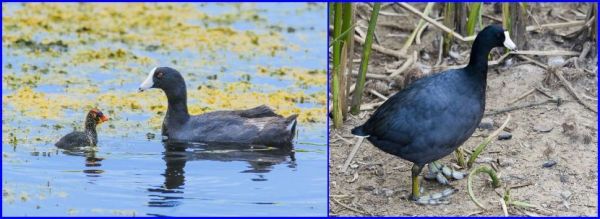
Only Howard & Moore still split Caribbean Coot from American Coot.
Left: Caribbean Coot – Fulica caribaea (Mario Espinosa – eBird)
Right: American Coot – F. americana (Mike Baird – Wikipedia)
Facts and Figures
As of this writing, the four taxonomies list 11,524 bird forms among them. 162 of these have become extinct over the past five centuries. Thus if all forms were recognized as full species, we’d have 11,362 today. No taxonomic authority recognizes all of these:
- BirdLife – 11,126 species
- IOC – 10,896 (230 fewer than BirdLife)
- Clements – 10,585 (541 fewer than Birdlife, 311 fewer than IOC)
- Howard & Moore – 10,175 (951 fewer than BirdLife, 721 fewer than IOC, 410 fewer than Clements)
Currently 9,968 species, 86.5% of the 11,524 total, are recognized by all four authorities though some decisions are still contestable and changing. Scientific and English names mostly match across lists but some vary. So the prevailing taxonomic disarray is actually limited. The status of only 1556 possible species, or 13.5% of the total, is debated:
- 496 species, or 4.3% of the total, are recognized by three taxonomic authorities.
- 362 species, or 3.14%, are recognized by two authorities.
- 698 species, or 6.1%, are recognized by a single authority only.
These breakdowns vary among taxonomies:
- BirdLife: 89.6% of species shared with all others; 5.6% shared with one or two other lists; 4.8% unique to itself.
- Clements: 94.2% of species shared with all others, 5.6% with 1-2 other lists, 0.21% unique to itself.
- IOC: 91.5% of species shared with all others, 7.4% with 1-2 other lists, 1.13% unique to itself.
- Howard & Moore: 98% of species shared with all others, 1.8% with 1-2 other lists, 0.2% unique to itself.
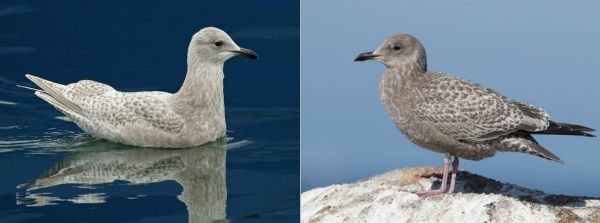
Only Howard & Moore still split Thayer’s Gull from Iceland Gull.
Left: 1st year Iceland Gull – Larus glaucoides (Luke Seitz -Macaulay Library)
Right: 1st Year Thayer’s Gull – L. thayeri (Brian Sullivan Macaulay Library)
Both from AllAboutBirds.com
So most authorities accept Howard & Moore species, but not vice versa. BirdLife recognizes numerous species that all others don’t. IOC recognizes many species rejected by two authorities but accepted by one other authority. Clements accepts many species recognized by two or three other authorities; fewer recognized by only one other authority; and very few that no one else recognizes (same for Howard & Moore).
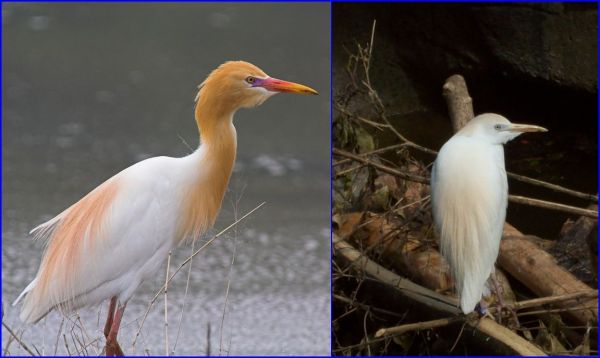
Only the IOC recognizes the split of the Cattle Egret into Eastern and Western species.
Left: Eastern Cattle Egret – Bubulcus coromandus (Su Neko)
Right: Western Cattle Egret – B. ibis (HoodedWarbler12) Both: Wikipedia
Of the 698 species recognized by a single authority:
- 532 occur only on BirdLife’s list (this organization assesses species differently from the rest; see below).
- 123 occur only on IOC.
- 22 occur only on Clements.
- 21 occur only on Howard & Moore.
Of the 496 species recognized by three of the four authorities:
- 490 are recognized by IOC
- 427 by BirdLife
- 420 by Clements
- 151 by Howard & Moore
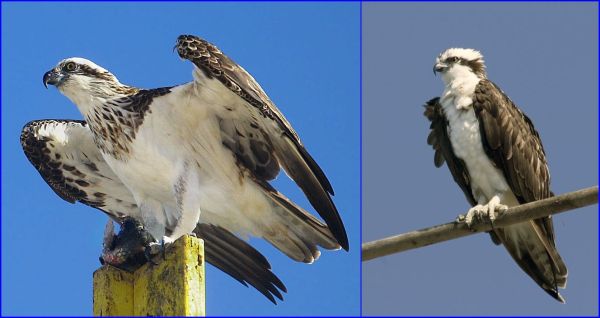
Only the IOC recognizes the split of the Osprey into Eastern and Western species.
Left: Eastern Osprey – Pandion cristatus (Psylexic)
Right: Western Osprey – P. haliaetus (Mike Baird) Both: Wikipedia
Thus the top three share most of these species, while Howard & Moore doesn’t recognize them. Another perspective:
- 6 species are recognized by everyone except IOC.
- 69 species are recognized by everyone except BirdLife.
- 76 species are recognized by everyone except Clements.
- 345 species are recognized by everyone except Howard & Moore.
IOC readily accepts splits while Howard & Moore is far more reserved than others about this. BirdLife and Clements are intermediate.
This trend continues with the 362 species recognized by two authorities and rejected by the other two:
- 315 of these are recognized by IOC.
- 199 by BirdLife.
- 175 by Clements
- 35 by Howard & Moore.
- 160 species are recognized by BirdLife and IOC, not Clements or Howard & Moore.
- 149 species are recognized Clements and IOC, not BirdLife or Howard & Moore.
- 21 species are recognized by BirdLife and Howard & Moore, not Clements or IOC.
- 18 species are recognized by BirdLife and Clements, not IOC or Howard & Moore.
- 8 species are recognized by Clements and Howard & Moore, not BirdLife or IOC.
- 6 species are recognized by IOC and Howard & Moore, not Clements or BirdLife.
Again, most of these 2-lists-only species are ‘shared’ among IOC (especially), Clements and BirdLife.
Another pairwise comparison: which taxonomies are most similar? Clements and IOC are closest with 96.2% of their species overlapping, yet this is asymmetrical. IOC recognizes 365 species that Clements doesn’t, while Clements recognizes only 54 species that IOC doesn’t. That’s because the IOC list is 311 species longer overall than Clements, and more likely to accept splits. So the overlap zone covers most of Clements but less of IOC.
BirdLife and Howard & Moore are least similar with 89.7% of species overlapping. The imbalance here is even more striking because the BirdLife list is 951 species longer than Howard & Moore. The two authorities also differ much in approach and methodology. BirdLife recognizes 1055 species that Howard & Moore doesn’t, vs. 104 species recognized by Howard & Moore but not BirdLife.
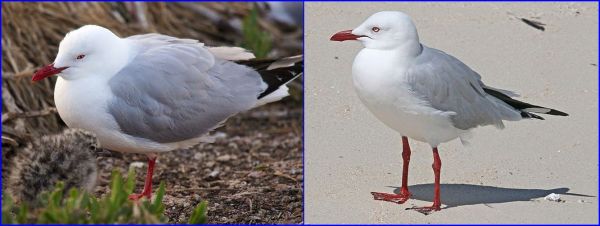
Only Clements/eBird still recognizes the split of New Zealand’s Red-billed Gull from the Silver Gull.
Red-billed Gull & chick – Chroicocephalus scopulinus (Jorg Hempel – Wikipedia)
Right: Silver Gull – C. novaehollandae (Joseph C Boone – Wikipedia)
The other four pair combinations are intermediate between these. BirdLife and IOC are most ‘balanced’ since they are of similar length and don’t recognize many of each other’s species. BirdLife recognizes 577 species that IOC doesn’t while IOC recognizes 347 species that BirdLife doesn’t.
IOC recognizes most species that Clements (especially) and BirdLife do: IOC and BirdLife recognize 10,549 species between them; IOC and Clements recognize 10,531. BirdLife and Clements together, without IOC, recognize 10,337 species between them – about 200 fewer. All combinations with Howard & Moore are lower but follow the same pattern: 10,119 species with HM+IOC, 10,071 with HM+BirdLife, 10,051 with HM+Clements.

Only Clements/eBird does not recognize the split between the Red-tailed and Kurdish Wheatears.
Left: Red-tailed Wheatear – Oenanthe chrysopygia (Pekka Fagel via Kuwait Birds)
Right: Kurdish Wheatear O. xanthoprymna (Christoph Moning – Macaulay Library via eBird)
Conclusions
These are the highlights so I’ll stop here with the figures (which go on). Finally, in plain English, how do the ornithological taxonomic authorities compare overall? A reminder first: they all agree on the decisive majority of species.
Howard & Moore is decidedly the most conservative and traditional taxonomy. It doesn’t recognize many lumps and splits that others do. The species it does recognize are widely accepted. Hence it is less contestable and more stable than the rest in an age of taxonomic turmoil. It serves as an unofficial benchmark. If Howard & Moore recognizes a species, in all likelihood it is well-defined and taxonomically “solid”, not a debatable split.
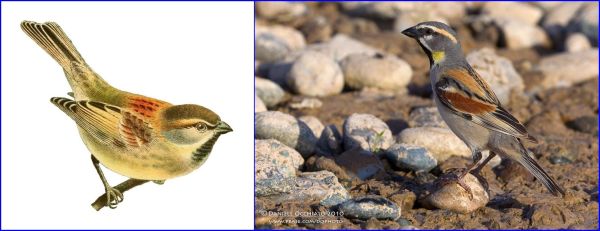
Afghan Sparrow is currently recognized only by Howard & Moore.
Left: Afghan Sparrow – Passer yatii John Gerrard Keulemans
Right: Dead Sea Sparrow – P. moabiticus (Danielle Occhiato)
This authority still accepts a few species that others don’t recognize, or that others have split or lumped. For example, currently it is the only taxonomy that accepts Thayer’s Gull, Caribbean Coot and Afghan Sparrow as full species. Website: https://www.howardandmoore.org/
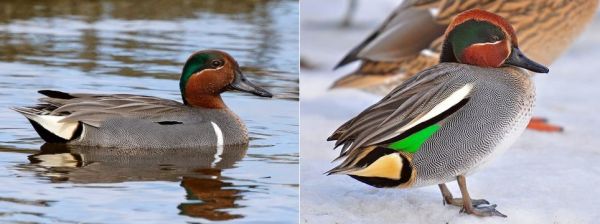
Only IOC recognized the split of Green-winged from Common (or Eurasian) Teal.
Left: Green-winged Teal – Anas carolinensis (Jeff Stacey – Macaulay Library)
Right: Common (or Eurasian) Teal – A. crecca (Guido Bennen – Maucaulay Library)
Both: AllAboutBirds.com
Conversely, IOC is the most liberal taxonomy. It accepts a very large proportion of proposed splits, including many that some others reject and quite a few that no one else recognizes. For example, currently it is the only taxonomy that splits the Palearctic’s Common Teal (Anas crecca) from the New World’s Green-winged Teal (Anas carolinensis). It is also the only one that splits both Osprey and Cattle Egret each into two species. Only six species are recognized by all authorities save IOC, e.g. Taiwan Thrush.
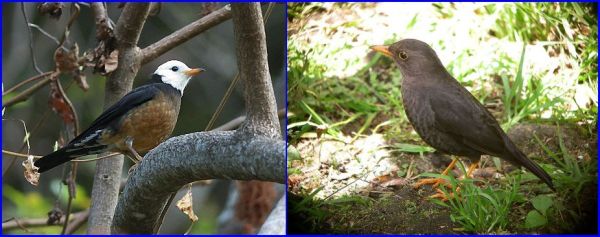
The Taiwan Thrush is one of only six species recognized by all authorities except the IOC.
Left: Taiwan Thrush – Turdus niveiceps (Alnus – Wikipedia)
Right: Island Thrush – T. poliocephalus carbonarius (Mark A Harper – Wikipedia)
Yet some of the species that only IOC recognizes are distinctive and this may be important for certain purposes. E.g. it splits Lava Heron from Green / Striated Heron.
Website: https://www.worldbirdnames.org/
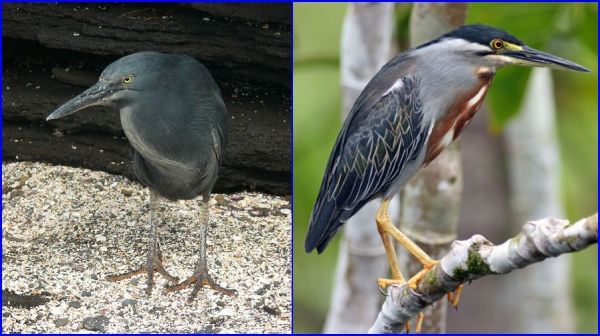
Only the IOC splits the Galapagos’ Lava Heron from the widespread Striated Heron.
Left: Lava Heron – Butorides sundevalli (Victor W. Fazio III – Flickriver)
Right: Striated Heron – B. striata striata (David Disher – eBird)
Clements / eBird is intermediate. It recognizes many of the splits and species that IOC does, and far more than Howard & Moore. It is said to adhere to North and South American ornithological societies’ checklists (AOS/AOU and SACC) more closely than the other taxonomies. However, it is circumspect about recognizing numerous (probably controversial) splits that IOC accepts, or BirdLife’s independent methodology. It is evidently more inclined to accept species that at least two other taxonomies recognize.
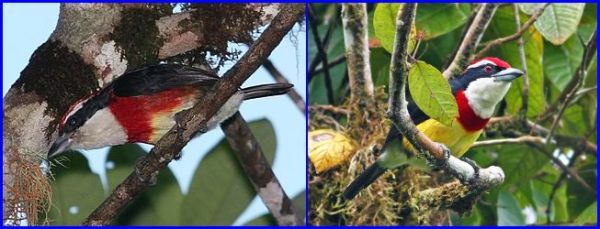
Only Clements/eBird does not recognize the split of Sira Barbet from the Scarlet-banded Barbet.
Left: Sira Barbet – Capito fitzpatricki (Michael G. Harvey – Wikipedia)
Right: Scarlet-banded Barbet – C. wallacei (Andrew Spencer – Macaulay Library eBird)
Nevertheless, currently it doesn’t accept some species that everyone else does, e.g. Red-tailed Wheatear and… Sira Barbet (Capito fitzpatricki, named for the Cornell Lab’s director – manager of the Clements taxonomy). It also rejects various extinct species that other taxonomies accept. Only a few species are recognized by Clements alone, e.g. Red-billed Gull and Margelanic Whitethroat.

Only Clements/eBird accepts splitting the Margelanic from the widespread Lesser Whitethroat.
Left: Margelanic Whitethroat – Sylvia margelanica (Vincent Wang – Macaulay Library via eBird)
Right: Lesser Whitethroat – S. curruca (Dhaval Vargiya – Wikimedia via Wikipedia )
It is a robust taxonomy, more mainstream / standard and less contentious than the others. A natural choice for eBird. Website: http://www.birds.cornell.edu/clementschecklist/
Birdlife / HBW is unique. It used to be very conservative taxonomically until a few years ago, when BirdLife adopted and adapted a new species assessment method. It systematically scores visual, vocal, geographic and other differences among various forms, and assigns a full species rank to those whose score exceeds a certain threshold. It also accounts for genetic differences. This method is disputed scientifically but eminently pragmatic. BirdLife also manages its taxonomy differently from the other authorities. Hence it is idiosyncratic and not as comparable to the rest.
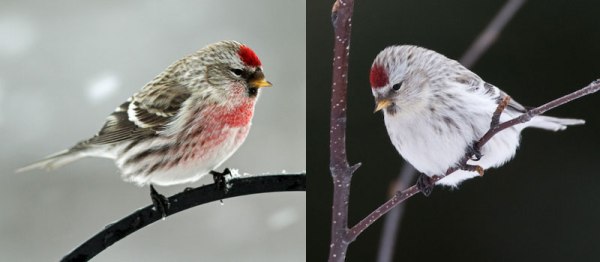
Only Birdlife/HBW lumps Hoary and Common Redpolls.
Left: Common Redpoll – Acanthis flammea (Sharon Watson via Birdshare)
Right: Hoary Redpoll – A. hornemanni (Chris Wood) Both: All About Birds
BirdLife’s list is the longest and contains the most species recognized by no one else. This is due less to acceptance of proposed splits and mostly to BirdLife’s own methodology. It is slightly more split-liberal than Clements as concerns most species. It differs from Howard & Moore about as much as Clements does. However, it rejects many splits that Clements and IOC accept.
So overall, BirdLife doesn’t recognize many species / splits that others do but its own splits are likewise unrecognized by others. For example, it is currently the only authority that lumps Common and Hoary Redpolls but splits Franklin’s Grouse from Spruce Grouse.
BirdLife taxonomy relies more on visual, vocal and behavioral differences to define species than other authorities, and less on genetic differences (which it still considers). This is useful to various ends, e.g. conservation and birding. Website: http://datazone.birdlife.org/species/taxonomy
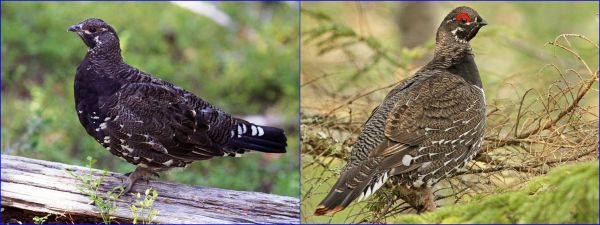
Only Birdlife/HBW splits Franklin’s Grouse from the widespread Spruce Grouse.
Left: Franklin’s Grouse – Falcipennis franklinii (Alex Lamoreaux – Macaulay Library)
Right: Spruce Grouse – F. canadensis (Luke Seitz – Macaulay Library)
Both: All About Birds
With all taxonomies, subjective conventions ultimately determine what types and magnitudes of differences suffice to define a given form as a species. Therefore each authority has strengths and weaknesses.
However, the existence of multiple, independent taxonomies (and nomenclatures) engenders decentralization, non-standardization and disorganization. These undermine the very goals of biological classification and constitute a major challenge to ornithology, conservation and birding. Fortunately the problem is recognized and efforts have been undertaken to mitigate it.
I’d like to thank the International Ornithological Committee (IOC) for providing the file with the raw data used in the analysis.
About the author:
Email: erantomer@gmail.com
This inspiring footage of birds and wildlife celebrates the Cornell Lab of Ornithology’s long-standing tradition of documenting and sharing information about the natural world. Thanks to you, that tradition continues. We hope you’ll keep watching, listening, and exploring with us to improve the understanding and protection of birds and biodiversity.
A film from the Cornell Lab of Ornithology. If no film or link appears in this email, go to the blog to view it by clicking on the blog title above. If the film stops & starts in an annoying manner, press pause (lower left double bars ||) to let it buffer and get ahead of you. The Lab is a member-supported organization; they welcome your membership and support. [Chuck Almdale]
Reprise 10: Canyonland Roadrunner Captured on Film
Editor’s Note: Entry number ten in our tenth anniversary march of time was originally posted 4-1-12 and is fourteenth in overall popularity. It was the eagerly-awaited third installment in our SMBAS Monograph Series – Spring Quarter.
***********************************************************
While the official consensus of the western American ornithological community is that there is only one form of Geococcyx californianus, the Greater Roadrunner, there have long been whispers in back corridors of biological institutions scattered across the western states that the systematics of this species are more complex than officially recognized, even – it was hinted – that evidence of this complexity had been suppressed by mysterious persons with sinister motives. This suspicion was strengthened recently when the unique and until-now elusive central New Mexican form was captured on newly-developed high-speed film equipment. Close examination of this footage by specialists in Geococcyx revealed a bird quite unlike the form familiar to Americans from California to Oklahoma. Leading roadrunner specialist, Dr. Thaddeus “kook” Kookaburra, BS, MS., PhD, LSMFT, avers it is a new species altogether. “Well,” said Dr. Kookaburra, located in his laboratory at Central Texas University – Midland: “We will of course make our final determination after a full DNA analysis has been completed, but just look at it, for cryin’ out loud! It’s completely different! Any idiot can see that!” he said, laughing loudly. Calming down, he added, “In my humble scientific opinion of course. We’re calling it the ‘Canyonland Roadrunner’.”

Widespread nominate form of Greater Roadrunner – Geococcyx californianus. (G.Commeau photo)
Numerous Morphological Differences
One frame of the film sequence is reproduced below. A cursory comparison of the two forms reveals certain morphological differences. In the new bird (G. c. sp. nov.) overall plumage is a plain, unstreaked gray to blue-gray. Crown feathers extend into a dark, long and flowing crest. Eyes are located at the front of the head, rather than the side, presumably producing improved frontal binocular vision while impairing peripheral vision. The bill is thick and upcurved, giving the bird a permanent amused expression. The neck is extremely elongated and slender, resembling that of an egret more than the nominate G.californianus. Wings are stunted, extending only slightly past the base of the tail; primaries are so weak and abbreviated that the bird must be flightless, and indeed, has never been seen to leave the ground, except when suddenly accelerating or making a U-turn. The tail is long and flowing, unlike the stiffened retrices of the nominate form. The body is extremely small. The legs are very long, especially the tarsometatarsi; again, they resemble those of an egret rather than the typical roadrunner. The feet are disproportionately large and thick.
Taxonomic Problems, Classification Uncertain
According to Dr. Kookaburra, this bird presents several taxonomic problems, causing it’s classification to remain far from certain.
Plumage – Nominate form is dark brown above with whitish edging on the back feathers, lighter brown below, cryptic plumage in its brushy, rocky habitat. The Canyonland form is gray with gray-blue wings and crest. In brush it would be easily seen by predators; on highways it blends in well with the gray pavement. Dust clouds kicked up by its large feet are often the only indication of its presence.
Long Crest feathers – Do they serve a function other than sexual attraction for a prospective mate?
Cervical Vertebrae – How many are there? Until an actual specimen is obtained – a difficult endeavor – this cannot be determined.
Digestive System – The torso is so small, one wonders how it can contain a system capable of digesting anything, yet it must contain systems for respiration, circulation and reproduction as well.
Feet – Bioengineers quickly see the problem of having large, fleshy, weighty feet on the ends of long, thin legs; every step tends to throw the creature off balance. It’s incredible speed demonstrates that somehow evolution overcame this problem. The feet may be quite light, like foam rubber, and serve as insulation from the hot, stony surfaces prevalent in its habitat. If so, this is a unique adaptation.
Voice: The nominate roadrunner call is a series of 5-10 soft “coos”, much like that of many other members of Cuculiformes, as well as many Columbiformes species. The call of G. c. sp. nov. (G.accelleratii-incredulus if full species status is accepted) is radically different: a two-note call, described variably as “meep meep,” “beep beep” or “bweep bweep;” the tone resembles that of the horn of a very small car.
The problem of the cervical vertebrae and several other important morphological and behavioral differences has led some ornithologists, particularly Dr. Kookaburra, to maintain this to be not just a new species, not just a new avian Family, but a unique and monotypic Order, tentatively called “Rapidiaviiformes,” or “fast-bird-form.”

Rare photo of “Canyonland” Roadrunner in motion. (tentatively G.c.accelleratii-incredulus)
Not Significantly Different, says Expert
Leading spokesman for the the opposing viewpoint is Dr. William C. Oyote, Vice President in charge of Pursuit Vehicle Research at Acme Industries, and world-renowned expert on G.californianus. We met at his research facility at Acme Industries Plaza, located on the outskirts of Albuquerque, NM. Dr. Oyote, who prefers the sobriquet “Dr. Willie” [pronounced ‘Wiley’ locally], was elegantly dressed in a long fur jacket and pants, despite the 110° temperature outside. I asked about the origin of his odd name. “First American,” he replied. “My people go back a long, long way in these parts. We honor all those who call it home, including roadrunners. Especially roadrunners,” he added, with a wide, toothy grin.
“I have studied this high-speed footage in detail,” he mused, ” and frankly, I don’t see anything warranting species status. Those who speak of elevation to new family or even order status are – in a word – cuckoo. I grew up in this region of New Mexico, as I said, and in my younger years became well acquainted with this species in general and this local morph in particular. And that’s all it is: a regional color morph with a few insignificant phenotypical variations, well within the general range of variation for this species. They’re fast and they look slightly odd, but that’s all. Their apparent preference for highways is an illusion: people often see them there because that’s where people usually are. I call that “the streetlight effect.” Like most cuckoos, these birds are not very bright, and they elude easy capture only because of their speed. Their flavor is rather delicate: a delightful blend of Western Fence Lizard, sage and southern-slope cactus fruit. This bird needs no special protection; they take care of themselves quite well, and there’s plenty of them out there, if you know where to look.”
The complete film – first ever for this interesting bird – was removed from YouTube by evildoers (They who shall not be named), but alternate footage of a later sighting can be found here: http://www.youtube.com/watch?v=KJJW7EF5aVk
Warning: This film contains scenes some viewers may find disturbing. Natural selection in action is often not pretty to see.
Those who found this article plausible, should also read:
2011: New Hummingbird Species Discovered in Los Angeles County!
2010: The Western Roof-Owl: Bird of Mystery
[Chuck Almdale]
[Editor’s Note: We’ve cancelled the April 26th field trip to Malibu Lagoon due to Coronavirus sequestering. This trip report, originally posted April 24, 2016, is a reminder of what we’re missing.]
**************************************************
The creaking calls of the large flock of Elegant Terns nearly drowned out the sounds of traffic from Pacific Coast Highway, and a few of the thirty birders present wondered if such numbers were unusual. Well, yes – and no. Forty years ago they were uncommon north of San Diego and, once or twice a year, you might see a few birds at the lagoon.

Elegant Terns in flight, Pepperdine University in distance (R. Ehler 4/24/16)
On 10-21-79, I found three Elegants on my very first Malibu Lagoon census. Twenty-two years later, on 3-25-01, they finally hit double digits with 10 whole birds. Only two years later, on 4-27-03, they hit triple digits at 250 birds. Then 700 birds on 4-26-09, and a whopping 3,100 birds on 4-26-15. To date, we’ve seen 12,423 terns of all species at the lagoon, of which 79% (9,795) have been Elegant. And 67% (6,585) of those were in April. Today’s count of 1,800 Elegant Terns is unusual, but considering the progression over time, not unexpected.

One of three islands covered with Elegant Terns – a thirteen photo panorama
(C. Bragg 4/24/16)
Elegant Terns have long nested primarily on Isla Rasa in Mexico’s Sea of Cortez, but in May 1959, 31 pairs were found nesting in the salt works area of southern San Diego Bay. They began nesting at Bolsa Chica in Orange County in 1987, and in Los Angeles Harbor in 1988. Post-breeding, in late summer and fall, they migrate up the coast as far as northern California, with irregular appearances as far north as southwest Washington. All these migrants spend the winter in Mexico, but, as made apparent by their appearances at the lagoon, they do a lot of springtime moving around before settling down to breed. Since 1979, our lagoon records show the following winter totals: Nov. 16 birds, Dec. 0, Jan. 1, Feb. 1, Mar. 391. The single bird(s) recorded Jan & Feb 2010 could have been a misidentified Royal Tern, a wintering species which was present on both dates.
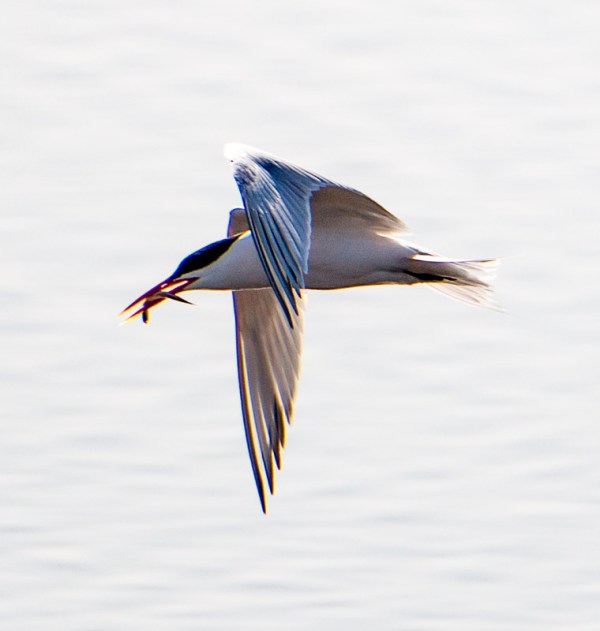
Lucky tern, unlucky fish (R. Juncosa 4/24/16)
We don’t get a lot of Black-necked Stilts at the lagoon: 29 total birds in 7 sightings, including today’s 19 birds. Ray Juncosa captured them with some very interesting effects of lighting. Stilts, along with Avocets, are in their own family, Recurvirostridae (Latin – bent backwards bill). Our stilt ranges from the U.S. to the West Indies, Peru & Brazil, plus Hawaii, where it used to be considered a separate species, the Hawaiian Stilt. The five other Stilt species and ranges are: Black-winged – Eurasia & Africa; Pied – Indonesia to New Zealand; the critically endangered Black – South Island of New Zealand; White-backed – so. South America; Banded – Australia.

Black-necked Stilts, a study (R. Juncosa 4/24/16)
The “semipalmated” foot is partially webbed between the toes. The Semipalmated Plover is a regular Spring & Fall migrant visitor at the lagoon, but no one ever actually sees the webbing. Of the “stints” or “peeps” in the Calidris genus, two are also semipalmated – the Western (Calidris mauri) (Greek – “a gray speckled sandpiper” + mauri [Ernesto Mauri, Italian naturalist]) and the aptly named Semipalmated Sandpiper (C. pusilla) ( Latin – very small).
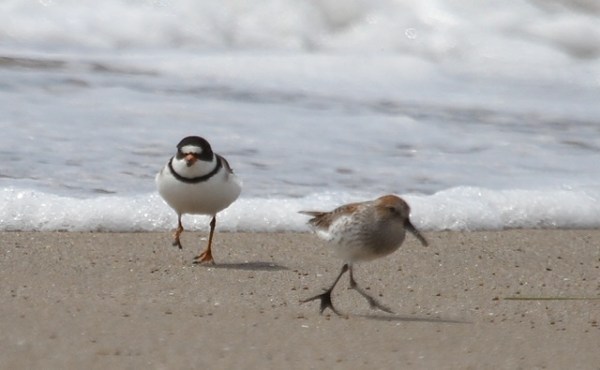
Somehow the semipalmated foot moved from the Semipalmated Plover (left) to the Western Sandpiper (J. Waterman 4/24/16)
I could find nothing in book or on web about differences in webbing between the Western and Semipalmated Sandpipers (SeSa), so I checked with Kimball Garrett of the L.A. Co. Museum of Natural History. He replied, in short, “No difference.” “Then why,” you (dear reader) may inquire, “is one called semipalmated and the other isn’t?” The answer, I believe, is (as with “unusual” Elegant Tern presence) time-dependent. The SeSa was first described in 1766 by Linnaeus himself, based on a specimen from Santo Domingo, which he named Tringa (changed much later to Calidris) pusilla. The Western was described a century later in 1857, from a specimen from South Carolina. [Many Westerns winter on the SE U.S. coast.] The name Semipalmated was already taken, so Western it became.
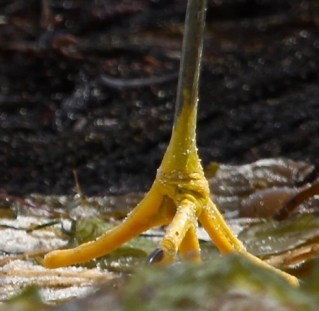
If you don’t know what this is, come birding with us. No, it’s not a plover or sandpiper foot.
(J. Waterman 4/24/16)
So what about the rarely seen webbed feet of the Semipalmated Plover (Charadrius semipalmatus)? I’ll spare you the gruesome details and say simply that it has visible – but short – webbing between all three toes. The very similar Ringed Plover (C. hiaticula) of Eurasia & Africa has visible webbing between middle and outer toe, and nearly invisible webbing between middle and inner toe. 10,000 Birds gives a great description, but the pictures of feet aren’t so hot. [Beware (!!) of Google Images – I’ve seen many misidentifications there.]
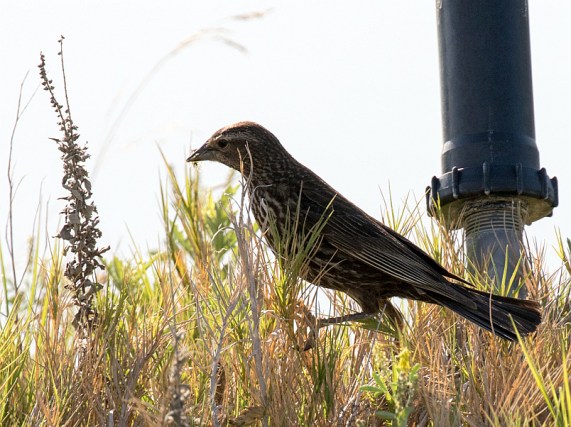
Many people mistake the female Red-winged Blackbird for a sparrow
(R. Ehler 4/24/16)
We didn’t have any Snowy Plovers; probably all have left for their various breeding grounds farther north. Grace Murayama snapped this nice photo of an adult Snowy on 4/13.

The last Snowy Plover of Springtime (G. Murayama 4/13/16)
Bonaparte’s Gull is another species whose lagoon presence has changed significantly over the years. We used to get them in large numbers: 3-15-80 1,600 birds, 11-29-80 530, 12-12-82 1,095. Our last triple-digit count was 632 birds on 1-8-83, shortly after the first lagoon reconfiguration in late 1982. Since then, out of 180 census days, their numbers have reached double-digits only 6 times out of 62 sightings. I don’t know if their overall population has plummeted, or they just didn’t like the new (in 1983) lagoon and stopped coming.
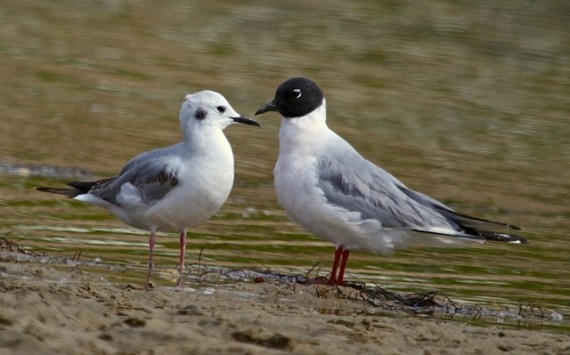
Bonaparte’s Gull – basic & alternate plumages (J. Waterman 4/24/16)
Birds new for the season were: Black-necked Stilt, Semipalmated Plover, Common Murre (by Malibu Pier), Belted Kingfisher, Violet-green Swallow, Black-headed Grosbeak, Red-winged Blackbird, Western Meadowlark, Brewer’s Blackbird, and Brown-headed Cowbird.

The foremast is about 170 ft high on this giganto-yacht moored off Malibu Pier
(G. Murayama 4/13/16)
As always, many thanks to our photographers: Chuck Bragg, Randy Ehler, Ray Juncosa, Grace Murayama and Joyce Waterman.
*Cotillion of Elegant Terns is the official collective noun for this species.
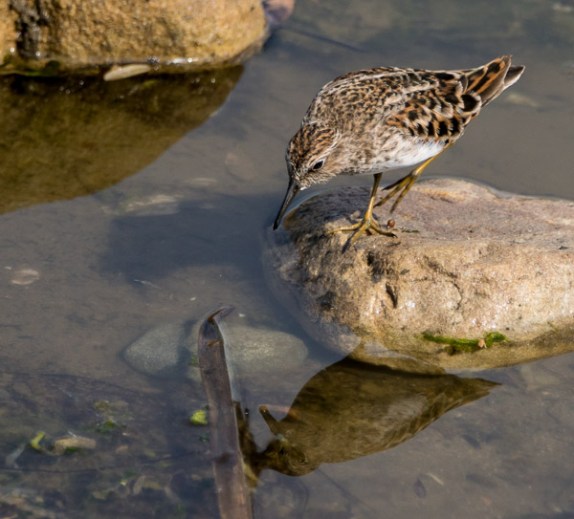
Least Sandpiper, like Narcissus, admires his own reflection (C. Bragg 4/24/16)
Our next four scheduled field trips: To be announced, 14 May; Malibu Lagoon 8:30 & 10am, 22 May; Mt. Piños, 11-12 June 8am; Malibu Lagoon 8:30 & 10am, 26 Jun.

American Robins infrequent the lagoon
(R. Ehler 4/24/16)
Our next program: Grunion, Tuesday, 3 May, 7:30 pm, at [note location change] Chris Reed Park, 1133 7th St., NE corner of 7th and Wilshire Blvd. in Santa Monica.
NOTE: Our 10 a.m. Parent’s & Kids Birdwalk meets at the shaded viewing area. Watch for Willie the Weasel. He’ll be watching for you and your big floppy feet.
Links: Unusual birds at Malibu Lagoon
9/23/02 Aerial photo of Malibu Lagoon
Prior checklists:
2015: Jan-May, July-Dec 2014: Jan-July, July-Dec
2013: Jan-June, July-Dec 2012: Jan-June, July-Dec
2011: Jan-June, July-Dec 2010: Jan-June, July-Dec
2009: Jan-June, July-Dec
The 10-year comparison summaries created during the project period, despite numerous complaints, remain available on our Lagoon Project Bird Census Page. Very briefly summarized, the results unexpectedly indicate that avian species diversification and numbers improved slightly during the period Jun’12-June’14. [Chuck Almdale]
| Malibu Census 2016 | 11/22 | 12/27 | 1/24 | 2/28 | 3/27 | 4/24 |
| Temperature | 64-80 | 48-61 | 48-64 | 57-70 | 55-65 | 60-67 |
| Tide Lo/Hi Height | L+0.24 | H+6.07 | H+5.90 | L+1.38 | H+3.43 | H+3.63 |
| Tide Time | 1241 | 0945 | 0855 | 0654 | 1228 | 1143 |
| Brant | 3 | 2 | ||||
| Canada Goose | 11 | 7 | ||||
| Gadwall | 4 | 13 | 3 | 20 | 14 | 4 |
| American Wigeon | 2 | 10 | 16 | 10 | ||
| Mallard | 25 | 2 | 15 | 22 | 16 | 18 |
| Northern Shoveler | 8 | 2 | 16 | 12 | 14 | |
| Northern Pintail | 2 | 4 | ||||
| Green-winged Teal | 11 | 8 | 8 | |||
| Lesser Scaup | 5 | |||||
| Surf Scoter | 1 | 2 | 17 | 16 | ||
| Bufflehead | 4 | 1 | 2 | 2 | ||
| Hooded Merganser | 2 | |||||
| Red-brstd Merganser | 2 | 17 | 3 | 3 | 2 | |
| Ruddy Duck | 110 | 1 | 10 | |||
| Red-throated Loon | 1 | 2 | ||||
| Pacific Loon | 2 | 1 | 2 | |||
| Common Loon | 2 | 1 | 1 | |||
| Pied-billed Grebe | 3 | 2 | 3 | 8 | 3 | |
| Horned Grebe | 1 | 1 | ||||
| Eared Grebe | 10 | 2 | 2 | 5 | 2 | |
| Western Grebe | 15 | 4 | 1 | 1 | ||
| Blk-vented Shearwater | 1 | |||||
| Brandt’s Cormorant | 2 | 1 | 4 | 2 | ||
| Dble-crstd Cormorant | 45 | 15 | 24 | 19 | 6 | 23 |
| Pelagic Cormorant | 2 | 1 | 2 | |||
| Brown Pelican | 11 | 10 | 30 | 43 | 28 | 77 |
| Great Blue Heron | 3 | 2 | 3 | 4 | 3 | |
| Great Egret | 1 | 2 | 2 | 1 | 5 | 2 |
| Snowy Egret | 8 | 30 | 21 | 7 | 7 | 4 |
| Blk-crwnd N-Heron | 1 | |||||
| Osprey | 1 | 1 | 1 | 3 | 1 | |
| Cooper’s Hawk | 1 | 1 | ||||
| Red-shouldered Hawk | 1 | |||||
| Red-tailed Hawk | 1 | |||||
| Sora | 1 | 2 | ||||
| American Coot | 60 | 10 | 40 | 65 | 53 | 4 |
| Black-necked Stilt | 19 | |||||
| Blk-bellied Plover | 33 | 30 | 12 | 32 | 8 | 20 |
| Snowy Plover | 28 | 12 | 4 | 3 | ||
| Semipalmated Plover | 8 | |||||
| Killdeer | 4 | 14 | 2 | 4 | 3 | 2 |
| Spotted Sandpiper | 2 | 5 | 1 | 1 | 1 | |
| Greater Yellowlegs | 1 | |||||
| Willet | 18 | 13 | 8 | 8 | 12 | 10 |
| Whimbrel | 5 | 1 | 3 | 4 | 21 | 2 |
| Marbled Godwit | 8 | 11 | 13 | 22 | 15 | 6 |
| Ruddy Turnstone | 9 | 2 | 5 | 1 | ||
| Surfbird | 1 | |||||
| Sanderling | 6 | |||||
| Least Sandpiper | 4 | 13 | 7 | |||
| Western Sandpiper | 4 | 35 | 1 | |||
| Long-billed Dowitcher | 2 | 2 | ||||
| Common Murre | 1 | 3 | ||||
| Bonaparte’s Gull | 2 | 1 | 3 | |||
| Heermann’s Gull | 11 | 4 | 1 | 2 | ||
| Mew Gull | 1 | |||||
| Ring-billed Gull | 95 | 60 | 30 | 90 | 15 | 1 |
| Western Gull | 140 | 80 | 13 | 160 | 45 | 60 |
| California Gull | 1430 | 620 | 400 | 650 | 130 | 15 |
| Thayer’s Gull | 1 | |||||
| Glaucous-wingd Gull | 1 | 1 | 4 | 1 | ||
| Caspian Tern | 3 | 19 | ||||
| Forster’s Tern | 3 | |||||
| Royal Tern | 23 | 11 | 25 | 31 | 18 | 2 |
| Elegant Tern | 5 | 1800 | ||||
| Rock Pigeon | 20 | 2 | 2 | 6 | 6 | 6 |
| Mourning Dove | 1 | 2 | 2 | 2 | 1 | |
| Anna’s Hummingbird | 2 | 3 | 1 | 2 | 1 | |
| Allen’s Hummingbird | 5 | 2 | 3 | 3 | 4 | 4 |
| Belted Kingfisher | 1 | 1 | ||||
| American Kestrel | 1 | 1 | ||||
| Merlin | 1 | |||||
| Peregrine Falcon | 1 | |||||
| Nanday Parakeet | 8 | 2 | ||||
| Black Phoebe | 10 | 12 | 3 | 8 | 6 | 4 |
| Say’s Phoebe | 1 | 2 | 1 | 1 | ||
| Cassin’s Kingbird | 1 | |||||
| Western Scrub-Jay | 1 | |||||
| American Crow | 3 | 1 | 6 | 23 | 6 | 4 |
| Common Raven | 1 | 1 | ||||
| Violet-green Swallow | 1 | |||||
| Rough-wingd Swallow | 10 | 10 | ||||
| Cliff Swallow | 1 | 6 | ||||
| Barn Swallow | 6 | 4 | ||||
| Oak Titmouse | 1 | 1 | ||||
| Bushtit | 28 | 40 | 4 | 5 | 4 | |
| House Wren | 2 | 1 | 1 | |||
| Marsh Wren | 1 | |||||
| Bewick’s Wren | 1 | 1 | ||||
| Blue-gray Gnatcatcher | 9 | 3 | ||||
| Ruby-crowned Kinglet | 10 | 6 | 1 | |||
| Western Bluebird | 1 | |||||
| Hermit Thrush | 1 | 3 | 1 | |||
| American Robin | 2 | 1 | ||||
| Northern Mockingbird | 6 | 2 | 1 | 3 | 4 | 6 |
| European Starling | 21 | 10 | 110 | 90 | 1 | 2 |
| Ornge-crwnd Warbler | 5 | |||||
| Common Yellowthroat | 7 | 1 | 1 | 5 | 5 | |
| Yellow-rumpd Warbler | 40 | 40 | 9 | |||
| Townsend’s Warbler | 1 | |||||
| Spotted Towhee | 2 | 1 | ||||
| California Towhee | 1 | 1 | 2 | 5 | 3 | |
| Savannah Sparrow | 1 | |||||
| Song Sparrow | 3 | 6 | 3 | 3 | 12 | 14 |
| Lincoln’s Sparrow | 1 | |||||
| White-crwnd Sparrow | 4 | 15 | 20 | 5 | 5 | |
| Black-headed Grosbeak | 1 | |||||
| Red-winged Blackbird | 5 | |||||
| Western Meadowlark | 5 | 4 | 2 | |||
| Brewer’s Blackbird | 6 | |||||
| Great-tailed Grackle | 4 | 3 | 2 | 1 | 9 | 3 |
| Brwn-headed Cowbird | 2 | |||||
| Hooded Oriole | 1 | |||||
| House Finch | 4 | 3 | 1 | 6 | 21 | 16 |
| Lesser Goldfinch | 1 | |||||
| Totals by Type | Nov | Dec | Jan | Feb | Mar | Apr |
| Waterfowl | 169 | 58 | 61 | 118 | 74 | 22 |
| Water Birds – Other | 152 | 48 | 104 | 146 | 100 | 106 |
| Herons, Egrets & Ibis | 13 | 34 | 26 | 12 | 15 | 6 |
| Quail & Raptors | 2 | 4 | 2 | 4 | 2 | 1 |
| Shorebirds | 113 | 83 | 50 | 86 | 113 | 76 |
| Gulls & Terns | 1703 | 775 | 472 | 939 | 219 | 1903 |
| Doves | 21 | 2 | 4 | 8 | 8 | 7 |
| Other Non-Passerines | 7 | 6 | 4 | 13 | 7 | 5 |
| Passerines | 164 | 156 | 150 | 168 | 105 | 95 |
| Totals Birds | 2344 | 1166 | 873 | 1494 | 643 | 2221 |
| Total Species | Nov | Dec | Jan | Feb | Mar | Apr |
| Waterfowl | 10 | 10 | 8 | 11 | 7 | 2 |
| Water Birds – Other | 11 | 9 | 9 | 10 | 9 | 4 |
| Herons, Egrets & Ibis | 4 | 3 | 3 | 3 | 3 | 2 |
| Quail & Raptors | 2 | 4 | 2 | 2 | 2 | 1 |
| Shorebirds | 9 | 10 | 6 | 10 | 11 | 10 |
| Gulls & Terns | 7 | 7 | 5 | 9 | 8 | 8 |
| Doves | 2 | 1 | 2 | 2 | 2 | 2 |
| Other Non-Passerines | 2 | 3 | 2 | 3 | 3 | 2 |
| Passerines | 20 | 21 | 12 | 19 | 22 | 20 |
| Totals Species | 67 | 68 | 49 | 69 | 67 | 51 |



 SANTA MONICA BAY AUDUBON SOCIETY BLOG