Free email delivery
Please sign up for email delivery in the subscription area to the right.
No salesman will call, at least not from us. Maybe from someone else.
COVID-19: history and science explained – A Blog Link
An alert reader sent me a link to this blog, describing it as “about our new favorite virus, explaining the history and science of the pandemic in language anyone should understand.” They were exactly right.
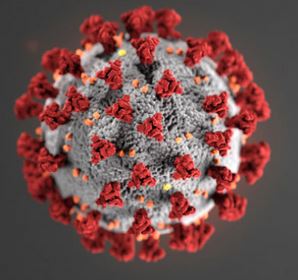
0.3 Microns. So small you can’t see it.
And despite all I’ve read over the past month about the novel coronavirus, I learned a lot. I recommend this series to everyone.
Link to the entire series: https://covid19thescienceexplained.wordpress.com/the-blog-from-the-beginning/
Dr. Jay Gralla, the blog’s author, is Emeritus Professor of Biochemistry at UCLA. He has done research at Yale, Harvard, The Pasteur Institute, MIT and of course at UCLA.
There are currently eight parts. We’ll post links to them here such as those below as they arrive, but you can subscribe directly on Dr. Gralla’s blog. Read them. Know your foe. It’s an eye-opening experience. [Chuck Almdale]
1. COVID-19: Where it all began
Bats were near the top of the list of animals for sale at the Wuhan wet food market. In the English translation of the alphabetical offering they come just after badgers and just before beavers. It was the beginning of Winter and the days were beginning to cool, but the dense crowds no doubt kept it fairly warm in the narrow aisles. Customers passed cages with live animals, skinned animals hanging from hooks, some un-skinned ones dead on the floor.
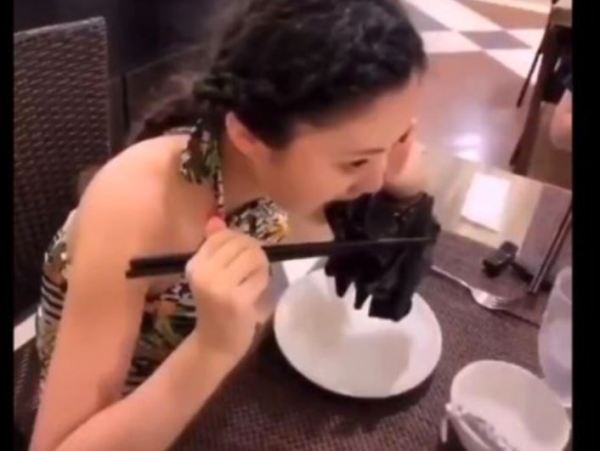
Nothing like a good bat to round out the day [From the blog]
So, the virus looks like it came from bats. But here’s the conundrum – bat viruses stay in bats and human viruses stay in humans and rarely the twain shall meet. In fact, even a huge dose of bat corona virus couldn’t easily infect a person. So what’s going on? To understand what happened in the Wuhan market we first need to understand why viruses don’t easily move from one type of animal to another (scientists call this “host range”).
3. A mutant is born
A lot of what we know about coronaviruses comes from experience with the SARS epidemic of 2003. The Chinese government tried to suppress knowledge of that epidemic and in a sense the world was lucky; that coronavirus was not as infectious as the one causing Covid-19. Indeed, their initial response to Covid-19 was also denial. But this new coronavirus was just too dangerous to keep hidden for long.
4. The mutant takes over cells and multiplies
After the Wuhan market was shut down, legions of health inspectors, clad in white protective suits, looking as if they had just landed on the moon, scurried around the dirty corridors. They swabbed pretty much everywhere, floors, walls, abandoned tables and cages, wherever there was a surface. They wore respirators and probably didn’t take them off until the samples were safely tucked away, to be shipped to the lab. 35 samples, all from different locations around the market, tested positive for the new coronavirus.
5. The virus spreads, and mutates again
In early Winter the virus left Wuhan in cars and trains, carrying infected people to visit far-flung relatives in China. It left on short flights bound for warm holiday spots in Asia and on long-haul flights to the U.S., Europe and the Middle East. It made its way to cruise ships that stopped in those places, the close confines helping the virus spread. Everywhere it went it encountered little resistance. The world had never seen this virus before and humans had no immunity.
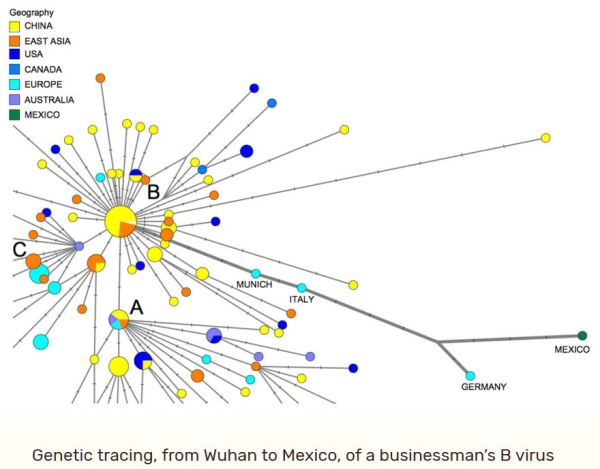
[From the blog]
6. The virus is here and we are not ready
During the last week in February, when thousands had already died of Covid-19 overseas, the President appeared to be unconcerned. His administration had disbanded the White House office that was supposed to warn about incoming epidemics and to prepare for them. On the 24th, speaking from the White House in Washington DC, he said “the coronavirus is very much under control in the USA”. On the 26th, the same day that 2 people died in the other Washington, he said the number of cases “within a couple of days is going down to close to zero.”
7. Covid-19 vs. your immune system: the first few days
During the deadly 1918 flu pandemic the hospitals filled up with young people. Soldiers, having survived the horrors of trench warfare, were laid out, lifeless, on gurneys in hallways. Their sweethearts were there too, girls and young women in their prime. Who was missing? Old people. But in the morgues holding victims of the 2020 Covid-19 pandemic, nearly everyone is old. No young children, few in the prime of life.

Killer cell (bottom) attacking unhealthy cell (above) [From the blog]
8. Antibodies try to come to the rescue
The two Foreign Service officers were brolly-carrying, buttoned-up, career diplomats, not health experts. Who knows what they thought upon disembarking in Shanghai, an 11-hour flight from London. They had been sent by Boris Johnson, the increasingly desperate British Prime Minister. Johnson, like his role model Trump, had mostly dismissed the dangers of Covid-19. But now the epidemic was spreading and it was not only the loyal opposition that was screaming for tests. The Cabinet was instructed to find test kits and fast.
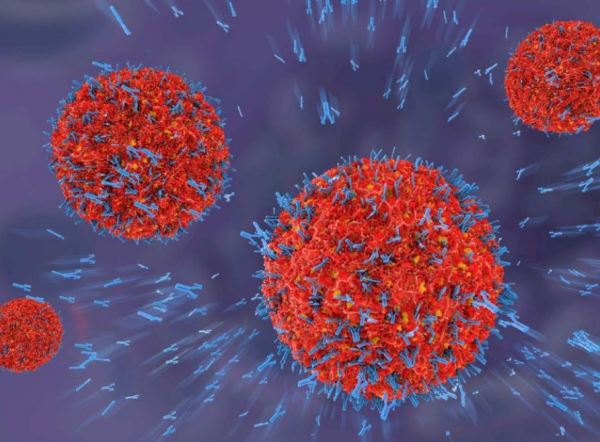
Antibodies – the small Y-shapes – attacking viruses [From the blog]
9. The race for Covid-19 vaccines
Until nearly the 20thcentury 1 in 4 infants didn’t reach their first birthday and 1 in 2 never reached adulthood. In parts of Asia, even today, some infants are not named until they are 100 days old. In a ritual cave near Dunhuang, China, for centuries newborns were passed through 4 symbolic gates, each representing a disease. For hundreds of years country doctors had carried small pouches to help children pass the most fearsome of these gates. The pouches contained a powder that only became a useful medicine after being held close to the doctor’s body for a month. Used too soon, or not kept near the warmth of the doctor’s body, the powder might kill the child. Held too long, the medicine wouldn’t work. After a month the powder was ready to be placed on a twig, which in turn went into the child’s nose.
10. Will there be a cure? Or at least a treatment?
In Iran, the imams told them to drink toxic methanol and many did. In India it was cow urine, drunk in parties organized by clerics. A U.S. televangelist touted the curative powers of colloidal silver and sold plenty of it. In the UK, people toppled 5G cell phone towers in the belief that their radiation spread the virus. In Kashmir it was the poplar trees that were toppled, their pollen taking the blame. Our president counseled ingesting bleach and thankfully nobody listened. Political leaders everywhere had their cures – fasting in Brazil, tea in Venezuela, and herbs pretty much everywhere. Clerics of all stripes assured the faithful that god would protect them if they came to worship. When people are frightened it’s hard to think straight.
11. FAQs and updates on Covid-19 science
A number of readers have asked questions and so here I will try to answer some of them. I will also give brief science updates where a bit more has become clear during the last month.
Q: I want to be careful. Do we know anything more about how the virus spreads?
Q: I hear that some people are getting hit much harder than others. What’s going on?
Q: Anything new on the science? Vaccines, drugs, tests?

[From the blog]
Hawks’ Forbidden Love Results in a Rare Hybrid
She was a common black hawk. He was a red-shouldered hawk. They weren’t in the same genus, let alone the same species, and they normally don’t even live in the same part of the continent. But in a strange twist of fate, none of that mattered: It was love at first screech.
Read all about it: Hawks’ Forbidden Love Results in a Rare Hybrid, by Jake Buehler.

The hybrid nestling (Photo: Stan Moore)
[Editor’s Note: We’ve cancelled the April 11 field trip to Sycamore Canyon due to Coronavirus sequestering. This trip report, originally posted March 20, 2012, is a reminder of what we’re missing.]
**************************************************
Today’s reporter is trip participant Mary Lou Newmark . Photos are courtesy of her friend, Mark Farber. Mary Lou is a multifaceted person: writer, poet, playwright, actor, musician, composer and photographer. Several of her photos graced our Paramount to Malibu Hike, 4/9/11 report. I don’t know how she has time for birding. See what else Mary Lou is up to and check out her stunning, electric-green electric violin on her website: http://www.greenangelmusic.com/

Dark-eyed Junco by the picnic tables. (Mark Farber 3/10/12)
Our adventure began at the wash near the parking lot where we spotted several small birds. My first attempts to emulate my fellow birder’s binocular positions were in vain. I had much better luck when I looked for bird flight movement with the naked eye and guessed where the bird might be perched in the bushes. When I did get a bright green finch in my binos it was quite a pleasant shock! Our small, but intrepid group made its way through the campgrounds, seeing birds on the ground and near water faucets. Butterflies accompanied us as we moseyed along. Little kids rode their bicycles between the campers and dads doused the last of their breakfast barbecues. High in the trees above the camp activity was a hawk’s nest with the parent bird sitting inside. Other than occasionally giving us a warning stare, she was content to let us watch and attempt to take pictures. She was wearing red, but whether on her shoulders or tail, I don’t recall.
Once we left the redolence of the campground behind, the trail beckoned us festooned with an arch and official looking people with bottled water. I was very impressed by the reception the SMBAS was getting and thought we might be joined by a celebrity birder. Thinking I heard banjo music, I looked for Steve Martin, but the hospitality was actually for runners participating in a race. Sure enough we did see several bedraggled runners limping past us to the finish line. One of our group shouted encouraging words to them. Between the runners, boy scout troops and cyclists, the birds and we birders had some trouble staying in touch. The cyclists had a particular habit of sneaking up behind us unannounced. Despite our inquiries, we never did determine what happened to the owner of the rider-less bicycle being led by another cyclist. Maybe it had something to do with the aerial battle between the crow and hawk we witnessed further up the trail…? Some mysteries will never be solved.Later on we heard the drumming of a woodpecker. Vigorous discussion broke out over whether it was a “nuttall’s” or a “ladder-back.” How far down did the red neck feathers go? There was much debate; bird books came out! With mother and daughter on opposite sides, additional sightings did not resolve the issue completely.
Apparently, due to the dry winter we have been experiencing, there were not as many nests in the canyon as in previous years. I close with a photo of the black-hooded parakeets that loudly serenaded us on our journey and frequently posed for photo ops. This is Malibu after all.
[Mary Lou Newmark, Novice Birder in the Field]

Black-hooded Parakeet trio. (Mark Farber 3/10/12)
Poppy Hour at Theodore Payne
A message from our friends at Theodore Payne
|

An up-close look at the territorial displays and breeding behavior of the Red-winged Blackbird.
Learn more about Red-winged Blackbirds on All About Birds: https://www.allaboutbirds.org/guide/Red-winged_Blackbird/id
A film from the Cornell Lab of Ornithology. If no film or link appears in this email, go to the blog to view it by clicking on the blog title above. If the film stops & starts in an annoying manner, press pause (lower left double bars ||) to let it buffer and get ahead of you. The Lab is a member-supported organization; they welcome your membership and support. [Chuck Almdale]



 SANTA MONICA BAY AUDUBON SOCIETY BLOG