Free email delivery
Please sign up for email delivery in the subscription area to the right.
No salesman will call, at least not from us. Maybe from someone else.
[Editor’s Note: We’ve cancelled the April 11 field trip to Sycamore Canyon due to Coronavirus sequestering. This trip report, originally posted March 20, 2012, is a reminder of what we’re missing.]
**************************************************
Today’s reporter is trip participant Mary Lou Newmark . Photos are courtesy of her friend, Mark Farber. Mary Lou is a multifaceted person: writer, poet, playwright, actor, musician, composer and photographer. Several of her photos graced our Paramount to Malibu Hike, 4/9/11 report. I don’t know how she has time for birding. See what else Mary Lou is up to and check out her stunning, electric-green electric violin on her website: http://www.greenangelmusic.com/

Dark-eyed Junco by the picnic tables. (Mark Farber 3/10/12)
Our adventure began at the wash near the parking lot where we spotted several small birds. My first attempts to emulate my fellow birder’s binocular positions were in vain. I had much better luck when I looked for bird flight movement with the naked eye and guessed where the bird might be perched in the bushes. When I did get a bright green finch in my binos it was quite a pleasant shock! Our small, but intrepid group made its way through the campgrounds, seeing birds on the ground and near water faucets. Butterflies accompanied us as we moseyed along. Little kids rode their bicycles between the campers and dads doused the last of their breakfast barbecues. High in the trees above the camp activity was a hawk’s nest with the parent bird sitting inside. Other than occasionally giving us a warning stare, she was content to let us watch and attempt to take pictures. She was wearing red, but whether on her shoulders or tail, I don’t recall.
Once we left the redolence of the campground behind, the trail beckoned us festooned with an arch and official looking people with bottled water. I was very impressed by the reception the SMBAS was getting and thought we might be joined by a celebrity birder. Thinking I heard banjo music, I looked for Steve Martin, but the hospitality was actually for runners participating in a race. Sure enough we did see several bedraggled runners limping past us to the finish line. One of our group shouted encouraging words to them. Between the runners, boy scout troops and cyclists, the birds and we birders had some trouble staying in touch. The cyclists had a particular habit of sneaking up behind us unannounced. Despite our inquiries, we never did determine what happened to the owner of the rider-less bicycle being led by another cyclist. Maybe it had something to do with the aerial battle between the crow and hawk we witnessed further up the trail…? Some mysteries will never be solved.Later on we heard the drumming of a woodpecker. Vigorous discussion broke out over whether it was a “nuttall’s” or a “ladder-back.” How far down did the red neck feathers go? There was much debate; bird books came out! With mother and daughter on opposite sides, additional sightings did not resolve the issue completely.
Apparently, due to the dry winter we have been experiencing, there were not as many nests in the canyon as in previous years. I close with a photo of the black-hooded parakeets that loudly serenaded us on our journey and frequently posed for photo ops. This is Malibu after all.
[Mary Lou Newmark, Novice Birder in the Field]

Black-hooded Parakeet trio. (Mark Farber 3/10/12)
Poppy Hour at Theodore Payne
A message from our friends at Theodore Payne
|

An up-close look at the territorial displays and breeding behavior of the Red-winged Blackbird.
Learn more about Red-winged Blackbirds on All About Birds: https://www.allaboutbirds.org/guide/Red-winged_Blackbird/id
A film from the Cornell Lab of Ornithology. If no film or link appears in this email, go to the blog to view it by clicking on the blog title above. If the film stops & starts in an annoying manner, press pause (lower left double bars ||) to let it buffer and get ahead of you. The Lab is a member-supported organization; they welcome your membership and support. [Chuck Almdale]
Reprise 4: Kestrel Photoshow
Editor’s Note: Entry number four in our tenth anniversary trip down memory lane was originally posted July 7, 2013, and is fifteenth in popularity. Our readership then was about 1/8th, or maybe 1/16th what it is now, and – for us – went viral with over 1100 hits. [Please stop laughing.] This Kestrel nest box project is still in operation with the participation of (mostly) the same people.
Go to the blog to see all 21 pictures in the slideshow. For the most part the photos are self-explanatory.
With two exceptions, the photos were taken on June 17, 2013. Two nests were involved, with significant age differences between the two groups of nestlings.
Kestrel Team Leader, Don McCartney, provided the following comment on Kestrel chick meals, which sheds light on some of the pictures.
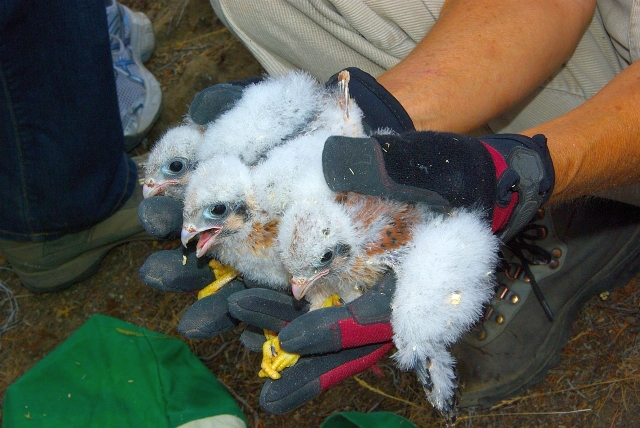
Quite a handful – now I know why the parents build nests
(Don & Diana Roberts 6/17/13)
We have documented some of the rather amazing eating habits of nestling Kestrels. One photo, taken in Wisconsin in 2005, shows an approximately 18-day old female slooowly devouring a snake. Another photo shows a little glutton on the Crooked River Ranch, who was being retrieved for banding from its nestbox by volunteer Marilynne Keyser. Several photos show close-ups of the bird as it devours a western fence lizard. It’s too bad that we didn’t have the time to check on the progress of the nestling/lizard situation a day or two later.
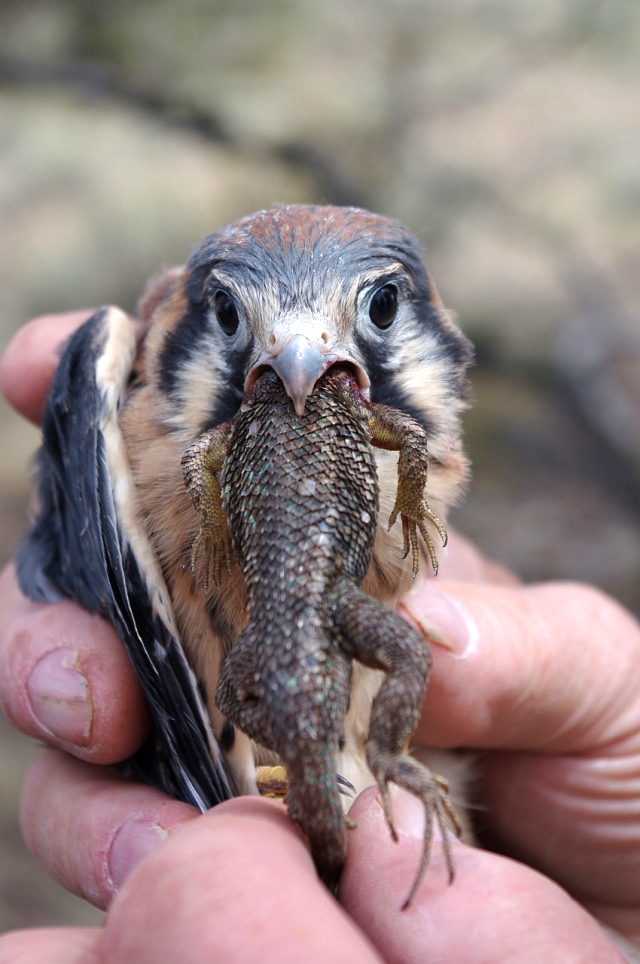
It’s a western fence lizard
(Don & Diana Roberts 6/17/13)
How do they do this? Once the chicks reach a certain size, the adults drop the intact reptile in the box rather than tearing them to pieces. Specialized mouth parts, including the median ridge, keep the prey progressing inward while allowing the nestling to breathe. It is very often interesting to check the remains of prey in the boxes to discover the animals on which the Kestrels have been dining.
*****************
Photographers Don & Diana Roberts live in the small town of Prineville, northeast of Bend, Oregon, just east of the central Cascade Mountains. Don is a professional fly fisherman, photographer and writer; Diana is an avid birder and photographer, as is Marilynne Keyser, the intrepid bird-handler in many of the photos. The fellow in the straw hat and holding the ID booklet is Don McCartney; when Jim Anderson isn’t checking wings and ringing the legs of birds, he’s resting in his portable lawn chair. [Chuck Almdale]
Reprise 3: Malibu Lagoon Fish Life
Editor’s Note: Entry number three in our tenth-year “blasts from the past” celebration, originally posted July 6, 2014, and number twenty on our popularity list. The mullets continued to “go forth and multiply” in the lagoon. Then August, 2018 arrived (read about it). Extreme temperatures continued for weeks, the shallow lagoon became overheated. Even the ocean was exceptionally warm and an oceanic “blob” of hot water extended northward from Baja California to Santa Barbara. Lagoon waters rose to 84°F., ten degrees above the survival point of the mullet. Warm waters lose dissolved oxygen. Fish rose to the surface, gulping air. Within a week, they died en masse. Over four thousand mullet dead were collected and counted by emergency workers. The dead dismayed beach-goers; most of us were stunned to discover that the lagoon held so many fish. The mullet are recovering, jumping again in fewer numbers, but our delight is tempered by the knowledge of what may happen again. [Chuck Almdale]
************************************************************

Striped Mullet (Wikipedia)
According to Wikipedia, Striped Mullet goes by many names, including: Black mullet (Cuba, US), Bully mullet (Australia, Vietnam), Callifaver mullet (Cuba, Netherlands Antilles, US), Common grey mullet (UK), Common mullet (Cuba, Netherlands Antilles, US), Flathead grey mullet (India, Philippines, UK), Flathead mullet (Europe, FAO, UN), Grey mullet (Thailand, Turkey, Australia, Taiwan, Cuba, Fiji, Hong Kong, Mauritius, Netherlands Antilles, New Zealand, Spain, Tonga, UK, US, Mediterranean, Egypt), Hardgut mullet (Australia), Mangrove mullet (Australia), and Sea mullet (Australia, Fiji, Papua New Guinea, UK).
Decades ago, British and American bird mavens decided to agree on English names for all the world’s birds. They’ve made much progress, with some exceptions such as when the bird Americans knew as Common Gallinule was renamed Common Moorhen to satisfy British intransigence (recently rectified), whereupon some American birders pointed out that we don’t have moors, they’re not all hens, and they’re not all that common. LAAS’s Western Tanager newsletter, highlighting this problem of multiple nomenclature once ran an article, by Kimball Garrett & Jon Dunn, detailing how to differentiate between three then-widespread egrets: Common, Great and American. [It was an April first issue in I forget which year.]
Fish lovers have made no such progress, as any piscivore should know. Surely you are aware that Chilean sea bass was previously known as Patagonian toothfish; the name change was a marketing decision – sea bass sounded far more scrumptious than toothfish, and anyway, no real red-blooded American knows where Patagonia is. [The friendly sales people at REI will gladly direct you towards their clothing racks.]
Which brings us around to the mullet many have seen leaping friskily from Malibu Lagoon in recent months. The New England Aquarium says they are also called jumping mullet or jumping jack (take that, Wikipedia!) because of this behavior. I couldn’t find out if this is a courting display, a feeding behavior, an attempt to shake off parasites or a recreational activity. [Anyone out there know?]
If you haven’t personally witnessed this phenomenon, check out the Dance of the Striped Mullet slideshow on Bob Purvey’s EcoMalibu website.
EcoMalibu also has a video page of forty different films pertaining to Malibu Lagoon and the reconfiguration project. The following is a list of short underwater films taken near the water monitoring stations (those posts with vertical depth gauges) ; you’ll be surprised at how much life is swimming around down there. This list, along with many other delights, is on our permanent Malibu Lagoon Project page. [Chuck Almdale]
1. Aug. 7, 2013 Length 1:48 minutes “Life Below the Surface”
2. Aug. 12, 2013 Length 9:20 minutes “Malibu Lagoon Aquarium”
3. Sep. 9, 2013 Length 4:55 minutes “Malibu Lagoon Aquarium III”
4. Sep. 30, 2013 Length 1:47 minutes “Shrimpfest”
5. Oct. 2, 2013 Length 2:42 minutes “Malibu Lagoon Aquarium IV”
6. Oct. 22, 2013 Length 8:31 minutes “Fish, Fish, Fish”
7. Nov. 4, 2013 Length 0:57 minutes “The Big Fish”
8. Apr. 30, 2014 Length 3:36 minutes “Lagoon Crustaceans”
9. Jun. 18, 2014 Length 3:49 minutes “Aquarium & Aviary”
10. Jun. 25, 2014 Length 2:21 minutes “Got Fish? Malibu Lagoon Does”
11. Jun. 25, 2014 Length 2:08 minutes “Shrimpfest II”
12. Jul. 7, 2014 Length 1:56 minutes “Mullet Adult School”



 SANTA MONICA BAY AUDUBON SOCIETY BLOG