Free email delivery
Please sign up for email delivery in the subscription area to the right.
No salesman will call, at least not from us. Maybe from someone else.
COVID-19: The Tomas Pueyo Blog Series

0.3 Microns. So small you can’t see it.
These blogs have been viewed by over 60 million people and translated into over 40 languages.
Information-rich, not dumbed down. You will know what “The Hammer” and “The Dance” are, why we are currently exiting The Hammer stage and entering The Dance, what it it takes to get to the dance and – eventually – through it, and why we shouldn’t rush it. Very highly recommended, and thanks to Ray Juncosa for sending it to me. [Chuck Almdale]
Important Coronavirus Articles by Tomas Pueyo, with more coming. (Buzzfeed article on Pueyo)
How Bad is the Coronavirus? March 1, 2020. 14 minute read
And what you can do to curb its spread.
https://medium.com/@tomaspueyo/what-you-can-do-to-curb-the-coronavirus-9f878d5982f2
Summary of the article: The world is slowly realizing the true dimension of the coronavirus, but it’s reacting slowly. Here’s a summary (as of March 1, 2020) of everything we know that’s relevant and what we can do to protect ourselves and our communities.
***************************************************************
***************************************************************
Coronavirus: Why You Must Act Now. March 10, 2020. 27 minute read.
Part one of three.
https://medium.com/@tomaspueyo/coronavirus-act-today-or-people-will-die-f4d3d9cd99ca
Summary of the article: Politicians, Community Leaders and Business Leaders: What Should You Do and When?
We all should have read this two months ago. Cases and deaths have risen since then, but the charts and analysis are still valid. Not dumbed-down.
***************************************************************
Coronavirus: The Hammer and the Dance. March 19, 2020. 29 minute read.
Part two of three.
https://medium.com/@tomaspueyo/coronavirus-the-hammer-and-the-dance-be9337092b56
Summary of the article: Strong coronavirus measures today should only last a few weeks, there shouldn’t be a big peak of infections afterwards, and it can all be done for a reasonable cost to society, saving millions of lives along the way. If we don’t take these measures, tens of millions will be infected, many will die, along with anybody else that requires intensive care, because the healthcare system will have collapsed.
Some charts from this article are at the bottom of this page.
***************************************************************
Coronavirus: Out of Many, One. April 1, 2020. 29 minute read.
Part three of three.
https://medium.com/@tomaspueyo/coronavirus-out-of-many-one-36b886af37e9
Summary: It makes political and economic sense for the US to suppress the coronavirus. For that, states and the federal government each have their own roles that they need to adjust.
***************************************************************
***************************************************************
Coronavirus: Learning How to Dance. April 20, 2020. 19 minute read.
Part 1: A Dancing Masterclass, or What We Can Learn from Countries Around the World
https://medium.com/@tomaspueyo/coronavirus-out-of-many-one-36b886af37e9
Summary: The first three articles have been viewed by over 60 million people and translated into over 40 languages. Since then, the number of confirmed coronavirus cases has grown twentyfold, from 125,000 to over 2.5 million. Billions of people around the world are under the Hammer: Their governments have implemented heavy social distancing measures to quench the spread of the virus. Most did the right thing: The Hammer was the right decision. It bought us time to reduce the epidemic and to figure out what to do during the next phase, the Dance, in which we relax the harsh social distancing measures in a careful way to avoid a second outbreak. But the Hammer is hard. Millions have lost their jobs, their income, their savings, their businesses, their freedom. The world needs answers: When is this over? When do we relax these measures and go back to the new normal? What will it take? What will life be like?
***************************************************************
Coronavirus: The Basic Dance Steps Everybody Can Follow. April 23, 2020. 18 minute read.
Part 2 of Coronavirus: Learning How to Dance
https://medium.com/@tomaspueyo/coronavirus-the-basic-dance-steps-everybody-can-follow-b3d216daa343
Summary: Any country can follow a series of measures that are very cheap and can dramatically reduce the epidemic: mandate wearing home-made masks, apply physical distancing and hygiene everywhere, and educate the public.
***************************************************************
Coronavirus: How to Do Testing and Contact Tracing. April 28, 2020. 39 minute read.
Part 3 of Coronavirus: Learning How to Dance
https://medium.com/@tomaspueyo/coronavirus-how-to-do-testing-and-contact-tracing-bde85b64072e
Summary: We can reopen the economy again if we do a few things right, including testing and contact tracing. We need to test all people with symptoms and their contacts, which means at most 3% of our tests should turn out positive. We need to identify as many infected as possible, and 70% to 90% of their contacts, to isolate or quarantine them. If we do all of that really fast (within a day or so), it might be enough to control the epidemic. We should hire lots of people to do that, and also use technology. The technology has some privacy tradeoffs, but they are really reasonable. Most of the bluetooth contact tracing apps built today are amazing pieces of technology that will be useless unless they get some fundamental changes.
***************************************************************
Coronavirus: Isolations and Quarantines – Not yet published as of May 14, 2020
Part 4 of Coronavirus: Learning How to Dance
***************************************************************
Coronavirus: Prevent Seeding and Spreading. May 12, 2020. 31 minute read.
Part 5 of Coronavirus: Learning How to Dance
https://medium.com/@tomaspueyo/coronavirus-prevent-seeding-and-spreading-e84ed405e37d
Summary: In this section of the article we cover the importance of continuing to limit travel and social gatherings. We touch on the idea of opening travel in less infected areas while isolating areas of higher risk. This section also reviews the impact large social gatherings can have and the importance of preventing the spread at home.
***************************************************************
Coronavirus: Putting it All Together – Not yet published as of May 14, 2020
Part 6 of Coronavirus: Learning How to Dance
Summary: We will give specific recommendations on each, including a warning: Most countries are not approaching the Dance well. If they continue their current path, they will end up like Singapore.
***************************************************************
***************************************************************
Should We Reopen Churches? May 12, 2020. 31 minute read.
https://medium.com/@tomaspueyo/should-we-reopen-churches-38428619a174
Summary: The Coronavirus loves churches. They are its perfect breeding ground: confined environments where lots of people gather for a long time to talk, sing, and touch each other. That’s why temples across the world have closed and masses are conducted online. Yet in the United States, there’s been a debate. Some states have closed churches, while the President asked them to reopen them. The debate is necessary. Churches are important for the spiritual and social lives of many people. It’s essential to try opening them back up as soon as possible.
***************************************************************
Coronavirus: Should We Aim for Herd Immunity Like Sweden. June 9, 2020. 32 minute read.
And what can countries like the U.S. or Netherlands learn from it?
https://medium.com/@tomaspueyo/coronavirus-prevent-seeding-and-spreading-e84ed405e37d
Summary: Sweden has famously followed a different coronavirus strategy than most of the rest of the Developed world: Let the virus run loose, curb it enough to make sure it doesn’t overwhelm the healthcare system like in Hubei, Italy or Spain, but don’t try to eliminate it. They think stopping it completely is impossible. The natural consequence is that most citizens get infected, and that eventually slows down the epidemic. That’s why, in short, people call that strategy “Herd Immunity”. The other strategy is the Hammer and the Dance: Aggressively attack the coronavirus by locking down the economy. Once curbed, jump into the Dance by replacing the aggressive lockdown with cheap and intelligent measures to control the virus. Some countries and states, such as the Netherlands and the UK, or US states like Texas and Georgia, have implemented measures in between the two strategies. So which strategy is best?
***************************************************************
Coronavirus: How to Reopen Travel Safely. June 25, 2020. 11 minute read.
Which citizens should countries allow in? Under what conditions?
https://medium.com/@tomaspueyo/coronavirus-how-to-reopen-travel-safely-f5951dfe06f0
Summary: The current plans to reopen EU countries are too blunt. Citizens from different countries are either blocked or fully allowed to travel. This will result in new outbreaks. Instead, there should be tiers of countries based on best guesses on prevalence and value per visitor. Within that, higher value visitors such as those owning a home should be treated differently. There is no excuse for lack of PCR tests. European countries with special situations, such as Sweden, Portugal or the UK should be treated separately.
Some chart snip excerpts from article two, Coronavirus: The Hammer and the Dance.
All charts are sharper on the original blog.
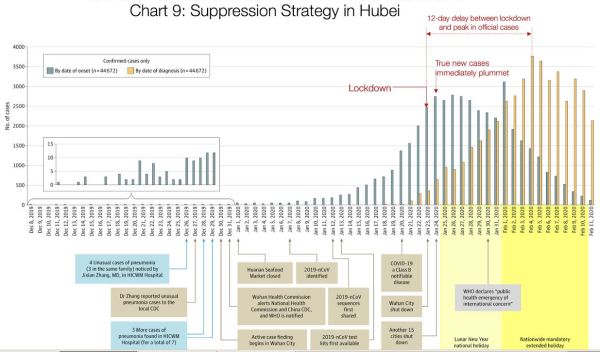
Above chart 9: Chinese authorities were able to determine, through after-the-fact interviews, just when actual cases (blue-gray bars) began, as opposed to known cases (orange bars). Actual cases began to drop within two days after lockdown, but known cases continued to rise.

Above chart 3: The cost of doing nothing is catastrophic.
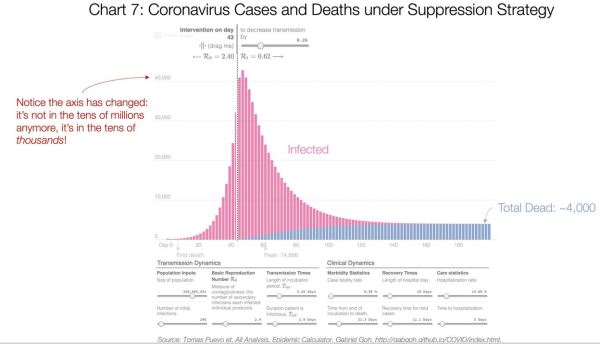
Above chart 7: Under suppression (not just mitigation) death rates plummet.

Above chart 13: “Hammering” the virus through suppression for 3-7 weeks, should be followed by “The Dance,” keeping the transmission rate at one transmission per infected person rather than the 2.4 and higher we previously saw.
Once the Hammer is in place and the outbreak is controlled, the Dance phase begins.

Above chart 14: About 50% (or perhaps 45%) of transmissions occur before the infected person has any symptoms.

Above chart 15: What our authorities need to know and need to do to get the contagion rate below one rate per infected person.
The Superb Lyrebird – Song Breakdown | Bird Kind Video
The Superb Lyrebird (Menura novaehollandiae) is the arguably the finest songster in the world. Famed for its ability to imitate almost any sound it hears, the Lyrebird has been incorporating the calls of other birds long before adding chainsaws and cameras to its repertoire. In this 7 minute clip taken in Dhurug National Park NSW (Australia), we break down the amazing variety of bird calls a single lyrebird can replicate in its song.
List of species imitated in this recording: Grey Butcherbird Laughing Kookaburra Yellow-faced Honeyeater Australian King Parrot Pied Currawong Little Wattlebird Satin Bowerbird Eastern Whipbird Lewin’s Honeyeater Noisy Friarbird Crimson Rosella Grey Shrikethrush Noisy Miner White-eared Honeyeater Yellow-tailed Black Cockatoo.
This is an installment of the Bird Kind series. If no film or link appears in this email, go to the blog to view it by clicking on the blog title above. If the film stops & starts in an annoying manner, press pause (lower left double bars ||) to let it buffer and get ahead of you. [Chuck Almdale]
Reprise 2: Snowy Plover likely to be Split from Kentish Plover ( & other hot news flashes) – Revisited
Editor’s Note: Entry number two in our trip down memory lane was originally posted 12-4-10, and is number ten on our all-time popularity list. The prediction that the AOU would split this species came true in 2011. People still read this posting, most recently in January, 2020.
The International Ornithological Congress has recognized the split between our New World Snowy Plover (Charadrius nivosus) and the Old World Kentish Plover (Charadrius alexandrinus), and it seems likely that the American Ornithological Union (AOU) will do the same. If they do, the US Fish and Wildlife Service will most likely also recognize this split. Here’s the write-up submitted to the AOU.
****************************************************************

Long term lagoon resident, Snowy Plover NO:WW (C.Almdale)
2010-A-1 N&MA Classification Committee p. 145-146
Separate Snowy Plover Charadrius nivosus from Kentish Plover C. alexandrinus
Description of the problem:
Despite their distinct geographic distributions, Palaearctic and Nearctic populations of Snowy Plover Charadius alexandrinus are currently considered to be a single species. Snowy Plovers in America were first described as Aegialitis nivosa by Cassin in 1858 (cited by Oberholser 1922), but the differences in adult plumage to Eastern Snowy Plovers were not deemed to be consistent enough to warrant full species status (Oberholser 1922).
New information:
Genetic differences between Eurasian and American populations of Snowy Plovers are substantial (Küpper et al. 2009). Mitochondrial DNA sequences of ND3 and ATPase differ by more than 6% between American and Eurasian populations. Φst values for North American and Eurasian populations are large (all population comparisons ≥ 0.95). Autosomal and sex chromosomal markers show distinct alleles for Eurasian and American Snowy Plovers. Fst values based on microsatellite analyses are above 0.25 for all population comparisons between Eurasian and North American Snowy Plovers. The American and Eurasian Snowy Plovers are more genetically differentiated than the Eurasian Snowy Plovers and African White-fronted Plovers C. marginatus (described by Vieillot 1818).
Genetic differences are also reflected in morphological and behavioural differences. Eurasian Snowy Plovers are larger than American Snowy Plovers. There are also differences in chick plumage and male advertisement calls (Küpper et al. 2009).
The North American subspecies nivosus, tenuirostris and occidentalis show genetic structuring, but mitochondrial sequence differences between subspecies are comparatively low (< 1%, Funk et al. 2007).
Recommendations:
1. Split Kentish Plover from Snowy Plover and adopt ‘Kentish Plover’ for Palaearctic populations
2. Change scientific name of Snowy Plover to Charadrius nivosus (Cassin 1858) with three subspecies: C. nivosus nivosus (currently C. alexandrinus nivosus), C. nivosus tenuirostris (currently C. alexandrinus nivosus) and C. nivosus occidentalis (currently C. alexandrinus occidentalis)
3. Keep scientific name Charadrius alexandrinus (Linneaus 1758) for Kentish Plover
Literature cited:
Funk, W. C., T. D. Mullins, and S. M. Haig. 2007. Conservation genetics of snowy plovers (Charadrius alexandrinus) in the Western Hemisphere: population genetic structure and delineation of subspecies. Conservation Genetics 8:1287-1309.
Küpper, C., J. Augustin, A. Kosztolányi, J. Figuerola, T. Burke, and T. Székely. 2009. Kentish versus Snowy Plover: Phenotypic and genetic analyses of Charadrius alexandrinus reveal divergence of Eurasian and American subspecies. Auk 126:839−852.
Linnaeus, C. 1758. Systema naturae per regna tria naturae :secundum classes, ordines, genera, species, cum characteribus, differentiis, synonymis, locis. 10th edition
Oberholser, H. C. 1922. Notes on North American birds. XI. Auk 39:72-78.
Vielliot, J. 1818. Ornithologie.
Submitted by:
Clemens Küpper, Department of Biology and Biochemistry, University of Bath, Bath, BA2 7AY, UK
Tamás Székely, Department of Biology and Biochemistry, University of Bath, Bath, BA2 7AY, UK
Terry Burke, Department of Animal and Plant Sciences, University of Sheffield, S10 2TN
Date of proposal: 23 Dec 2009
*********************************************
This link takes you to PDF file “Proposal 2010-A“, you can read the AOU document from which the above was extracted. Some of the other items of interest under consideration by the AOU and discussed in this document are:
1). Split Mountain Chickadee Poecile gambeli into two species:
A). Gambel’s Chickadee P. gambeli including subspecies P.g. gambeli, P.g. grinelli, P.g. inyoensis, P.g. wasatchensis.
B). Bailey’s Chickadee Poecile baileyae – the coastal California, Sierra Nevada, and Cascade populations, including subspecies: P.b. baileyae, P.b. abbreviatus, P.b. atratus.
2). Split the Common Moorhen (or Gallinule) Gallinula chloropus into:
A). Old World species Common Moorhen Gallinula chloropus
B). New World species Common Gallinule Gallinula galeata. An alternative English name suggested is Laughing Gallinule due to its distinctive call.
3). Split Yellow-rumped Warbler Dendroica coronata into two, three, or four species. You read that right! This one is really up in the air. If any of the proposed splits are accepted, our local subspecies D.c. auduboni will again be classified a full species, D.auduboni, probably again known as Audubon’s Warbler (the name which some of us have never stopped using).
4). Farther afield, yet fascinating to bird-geeks like me, the Sapayoa Sapayoa aenigma may get its own monotypic family, Sapayoidae. The species name aenigma (enigma) is extremely apt, as this little bird of Central Panama to extreme NW Ecuador continues to bamboozle ornithologists. Depending on which organization or ornithologist is talking, it’s a Mannakin, or a Tyrant Flycatcher, or in it’s own family, or a Broadbill, or even an Asity (a small family of 4 species endemic to Madagascar). Twenty years ago, Sibley & Monroe classified it incertae sedis (“uncertain position” or “We don’t know what the heck it is!”), and many Central/South American field guides still classify it as such. The Broadbill classification seems very odd to me, as the 15 recognized species of Broadbills are all Old World species, found in various tropical localities from Sierra Leone in west Africa to the central Philippine Islands. To be some sort of Broadbill would mean that the Sapayoa has somehow maintained it’s existence and integrity as a species for at least 52 million years, which seems extraordinary. I suspect that the dust will not soon settle on where the Sapayoa belongs on the evolutionary tree of birds. Don Roberson of Monterey, Ca., has a nice picture and write-up of this bird’s story on his website Birds Families of the World. [Chuck Almdale]
Reprise 1: The Western Roof-Owl: Bird of Mystery
Editor’s Note: SMBAS has published over one thousand postings and twenty-two pages in slightly over ten years. In recognition of that fact and as sort of a birthday celebration, we’ve decided to revisit a small number of our reader’s favorite blog postings and pages. Readers who have joined us recently will find many of these new to them, and our long-term readers can revisit old favorites. Plus you get to see some permanent pages which you probably didn’t know we had.
The following selection, number seventeen on our all-time popularity chart, was originally published 4-1-10, and was the initial installment in our SMBAS Springtime Monograph Series, now five articles long.
SMBAS Monograph Series Paper #1: The Western Roof-Owl

Western Roof Owl in typical roosting posture (A.Non 2/10)
The Western Roof-Owl, Bubo pneumatikus (WRO), is in many regards unique among the owls of the world. Most owls are nocturnal predators which roost during the day in hard-to-see locations, deep in foliage, high in trees or cliff holes or on rafters in dark barns, in order to avoid detection by their justifiably annoyed prey. At night such owls are often heard calling and occasionally seen pursuing their prey: small mammals, especially rodents, and small songbirds.
In contradistinction, the WRO eschews dark and hidden perches and does its daytime roosting right out in the open, usually on peaks or edges of roofs, its preferred perch, occasionally also on large antennas and fence posts. This atypical behavior causes it to be perhaps the most commonly seen owl in Western North America, although it is not the most abundant.
This peculiar roosting behavior permits the easy observation of its most recognizable and remarkable behavioral characteristic – complete immobility. Once it has chosen its diurnal roosting spot, it never moves: neither broiling desert summer sun nor freezing winter mountain storm can cause this bird to do so much as blink an eye. Many species of small birds – potential nocturnal prey for the WFO, one presumes – notice this lack of movement and actually seek out its company. European Starlings and Rock Pigeons are often observed to perch right on the WRO’s head, sometimes for hours. It is conjectured that such birds are attempting to demonstrate friendship with this large predator, perhaps in order to impress their friends or frighten away potential rivals, but no one knows for sure. [This possibility provides an intriguing subject for a Ph.D. thesis in Avian Ethology.]
The Western Roof Owl – or at least the most intensively studied local subspecies B.p.immobilus – is about the size, shape and coloration of its more infrequently seen congener, the Great Horned Owl Bubo virginianus. In fact, the best way to separate these two species is by roosting location and behavior. If you see it roosting immobile on a roof, it is most likely the WRO. If you can’t see it, it’s the Great Horned Owl.
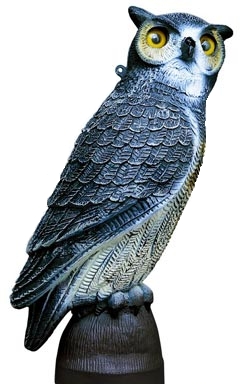
Right-looking behavioral morph (function of the tiny feather-curl at nape of neck is unknown)
So secretive and little-known is the nesting and feeding behavior of the WRO that there is not a single recorded observation of the bird leaving or arriving at its roosting site. One millisecond they are not there, the next millisecond they are, never to move until they again vanish, unseen.
Researchers conjecture that they hunt only on moonless cloud-covered nights. In utter pitch-black skies, no living creature ever sees them in flight, and their prey die never knowing what hit them. If true, this would go far to explain the lack of fear they elicit from potential prey species at their roosting sites.
If these conjectures are correct, such behavior necessitates certain physiological characteristics. They must have exceptional hearing as does the Barn Owl which can locate a vole rustling in the grass at 100 meters in complete darkness. [Bizarrely, no researcher has ever been able to detect any external auditory canal on the WRO. However, unless the owl can detect body heat in the infra-red, they must have excellent hearing. This is another excellent subject for an enterprising Ph.D. candidate.] They must be able to catch great numbers of prey during their infrequent hunting expeditions, as it may be a long wait until the next suitably pitch-black night occurs. This explains why they are not found north of the Arctic Circle where the sun may not set for months. Their digestive systems must be extremely efficient in order to extract every calorie of energy from each morsel of whatever it is that they eat. This would explain the complete lack of regurgitated pellets around their roost sites: there are no pellets as they digest everything – fur, feather, bone, gristle, shell, skin. It would also explain why they never move: they are conserving energy in order to insure survival through what may be a very long fast. It should be noted that their apparent sleep must actually an exceptionally deep form of torpor, a form of near-suspended animation also used by hummingbirds at night and by the Common Poorwill during the winter. The WRO’s torpor is so deep that no medical equipment can detect any heartbeat, breathing or thermoregulatory activity.
Needless to say, nothing is known of their breeding biology. No nest has ever been found, no downy or juvenile bird has ever been seen. They simply appear, full size and in adult plumage. Neither has any sign of molting ever been detected.
The Western Roof Owl has yet one more unique feature: it is the only avian species known to have behavioral morphs. Many species have color morphs: dark-phase and light-phase Red-tailed Hawks for instance. Such color morphs do not indicate subspecies status, they are simply a coloration variation that the individual possesses throughout its life. As far as researchers can tell, the straight-ahead and the right-looking forms are lifelong and invariant behavioral morphs.
All-in-all, the Western Roof Owl is one of our most interesting local species. Its easy visibility when roosting recommends it to any diligent observer of birds. The difficulties one encounters in actually witnessing it doing anything only make the eventual documentation of its mysterious behavior that much more rewarding a pursuit.
[Charles V. Almdale]
If you found this article plausible, you may be interested in the other monographs in our springtime series:
2011: New Hummingbird Species Discovered in Los Angeles County
2012: Canyonlands Roadrunner Captured on Film
2013: Birders Take Their Lumps with their Splits
Up Your Game and Be a Better Birder
“I will see you, and I’ll seize you, and I’ll squeeze you til you squirt.”
“What’s that,” you say? That’s a Warbling Vireo talking to the insects it’s about to eat for breakfast. Learn this mnemonic and a host of other skills in The Cornell Lab of Ornithology’s online Bird Academy series of courses. Now is a perfect time to jumpstart your birding skills. Then, just walk out your door, look, listen, and be present in nature to boost your immune system and elevate your mood.

Warbling Vireo (Western) by V.J. Anderson – Own work
Did you Know: Shakespeare wrote King Lear while quarantined from the plague.
With these courses, you can start at your level, go at your own pace, and access them whenever you want. In addition to courses for a fee, they offer free videos, learning games, and open lectures. The courses include videos of behavior, photos, easy-to-remember tips, bird song recordings, and much more. If you are an educator or professional and need to earn Continuing Education Units, you can purchase a CEU Add-on for each qualifying course.Need more convincing? Watch this video from the intro to “How to Identify Birdsongs.”
It’s easy to scan through a course overview before signing up to make sure it is right for you. For example, the “How to Identify Bird Songs” course uses a unique approach to teach you how to listen to bird songs in their natural soundscapes. You can even try a free sample lesson before enrolling. Once you learn the fundamentals, you can supplement what you’ve learned by using Cornell’s free Merlin app on your smart phone when you are in the field. You step through Merlin’s filters to narrow down the possible birds by date, location, size, color, and behavior to get a short list of the most likely candidates. Pick a bird, and then click on the “Sounds” icon to hear a selection of songs and calls.

The “Warbler Identification” course includes 12 lessons that cover all 51 warblers across the U.S. and Canada. They can be tricky to identify because they flit by in a flash of color, but you’ll find the help you’ve been looking for in this class. In addition to a step-by-step process for identification, the photos and audio recordings are a great help. Many of the pictures were taken from angles that are the way you actually spot the birds in the field, but are seldom seen in the field guides. There are pictures of their vents and bottoms of tails taken from directly below. Warblers have adorable little bums.
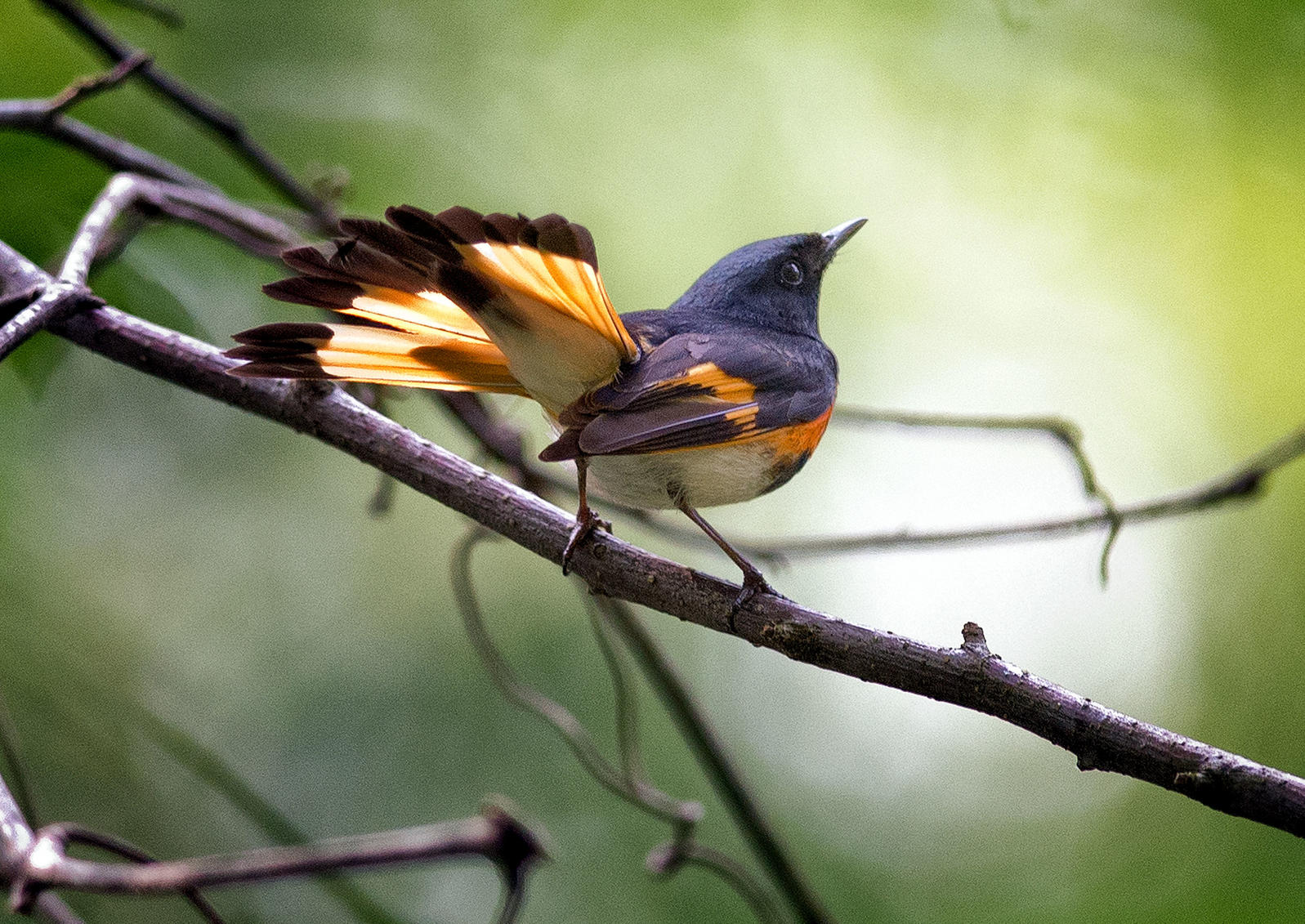
American Redstart. Photo Tom Warren/Audubon Photography Awards
To get a speed-learning preview of this bottom-up trick for ID’ing warblers, check out Nicholas Lund’s Audubon article “Birdist Rule #59: Learn to Identify Warblers From Below.”

The “eBird Essentials” course is free. Now, that’s a bargain. The eBird app, which is also free, will help you discover tools to find birds wherever you go, and gain confidence in submitting your sightings. You’ll get expert tips for using eBird and joining the global community of birders.
There is even a course on “Nature Journaling and Field Sketching.” The enticing course description says, “Whether you’re looking for a creative spark for your artistic expression, a way to develop your observational skills, or an immersive and mindful journey through nature, this course will guide you with friendly art instruction and engaging practice sessions that will help you make the most out of your journaling.”
Bird identification is a challenge, which makes it a great hobby for a lifetime. There is always something new to learn. But there are tips and tricks that will make it easier. As Cornell’s Kevin McGowan says, “All male dabbling ducks can be distinguished by the arrangement of their white patches alone.” Did you know that?

Bufflehead by Liron Gertsman | Macaulay Library

Common Goldeneye by Greg Schneider
To put this info on waterfowl right at your fingertips, the Lab of Ornithology has teamed up with Waterford Press to publish “Where’s the White?” This series of three laminated foldout pocket guides focuses on picking out patterns of white and dark. You can order here for $7.95 each.

Cornell Waterfowl “The Basics” foldout
Now, you’re sold on taking a course, right? Then jump right in! Be sure to get out in the field right away and start using what you learned to keep it from slipping away. Even with parks and beaches closed temporarily, look for new discoveries right in you own neighborhood patch.
[Jane Beseda]



 SANTA MONICA BAY AUDUBON SOCIETY BLOG