Free email delivery
Please sign up for email delivery in the subscription area to the right.
No salesman will call, at least not from us. Maybe from someone else.
How to deal with uncertainty a little bit better. Vanessa explores a more personal style of storytelling. There are definitely fewer facts in here, but she hopes the conversational approach to talking about studies is more entertaining and memorable for you. What is life if not a big experiment?
This is an installment of the PBS – BrainCraft series created by Vanessa Hill. If no film or link appears in this email, go to the blog to view it by clicking on the blog title above. If the film stops & starts in an annoying manner, press pause (lower left double bars ||) to let it buffer and get ahead of you. [Chuck Almdale]
A Message from the Audubon Rockies Regional Office
Our Federal Administration in Washington, DC continues its
relentless attacks on all things environmental. [Chuck Almdale – Ed.]
Hello California Chapter leaders and members,
My name is Daly Edmunds and I’m the Policy and Outreach Director for Audubon Rockies, a regional office of National Audubon Society (WY, CO, UT). I’ve reached out to your chapter in previous years, in efforts to organize chapters around issues to protect Greater Sage-grouse. While many parts of our country are shutting down in response to COVID-19, the Department of Interior is continuing its efforts to weaken important protections for Greater Sage-grouse. While we’ve shifted our personal and work lives around at Audubon, we’re still fighting hard for birds and could use your help!
Yesterday, we circulated an action alert to all National Audubon Society members across the country. I’m hoping that your chapter will help Greater Sage-grouse (as their populations continue to decline across the range, including in California) and the sagebrush ecosystem … hence my email to you. I’ve also included some educational resources at the bottom of this email, which I hope you’ll find useful.
I’m reaching out to you because the Department of Interior/Bureau of Land Management is planning to make decisions that impact sage-grouse in California – notably in northeastern CA, where there are sage-grouse populations that are considered part of the western population (along with sage-grouse in nearby NV). This is separate from the Bi-State population.
REQUEST:
- Due to a court-order, BLM has re-opened up its public comment opportunity around their federal resource management plans for sage-grouse … deadline is April 6. Please consider share this link to Audubon Grouse Action Alert with your members – via email and/or social media channels, encouraging them to speak-up for sage-grouse protections and balanced management of our public lands.
Background: What Happened
In 2015, after years of work by a wide range of stakeholders in your state —states, ranchers, conservationists, industry, scientists, and federal agencies— sound conservation plans were adopted by the BLM. The 2015 plans included strong science-based protections for the bird’s most important habitat and assurances that there would be limits to the amount of habitat damaged, which were the foundation for the U.S. Fish and Wildlife Service’s finding that the species did not warrant federal protection under the Endangered Species Act. These plans also ensure sustainable economic growth for communities across the West.
Between 2017 and 2019, the Department of the Interior systematically attacked these popular bi-partisan plans. In March 2019, the 2015 plans were formally amended, resulting in weakened protections in important sage-grouse habitats in the BLM plans. In October 2019, a U.S. District Court judge in Boise granted a preliminary injunction blocking the implementation of BLM’s changes to the 2015 sage-grouse conservation plans. The federal court found that the federal administration failed to consider how sage-grouse would be impacted by the BLM’s changes to the 2015 conservation plans. The BLM’s 2019 changes permitted expanded drilling, mining, grazing and other activities on sensitive sage-grouse habitat in ID, WY, UT, CO, NV, CA and OR. In the court’s words, the impact of the changes to the 2015 plans “was to substantially reduce protections for sage grouse without any explanation that the reductions were justified by, say, changes in habitat, improvement in population numbers, or revisions to the best science.” Additionally, the court ruled “the record shows that the 2019 Plan Amendments were designed to open up more land to oil, gas, and mineral extraction as soon as possible.”
Now What…
In late February 2020, the BLM – under guise of responding to the federal court’s concerns – has opened up another public comment period. But in fact, BLM is proposing more of the same. BLM continues to disregard science and undermine needed protections for important sage-grouse habitat. We need strong conservation actions – those that were agreed to in 2015, which respects the years of work that went into developing the plans … not only in California, but elsewhere too.
You can help by weighing in with the BLM, as they are asking for public comments. Tell BLM to maintain Greater Sage-Grouse protections. The deadline to comment is Friday, April 6. We are joining our conservation partners – who have fought together for years for balanced management of our public lands – to make sure the BLM hears loud and clear from the public that they should honor their 2015 commitment to protect important sage-grouse habitat.
EDUCATIONAL RESOURCES RE: SAGEBRUSH ECOSYSTEM: Either you’re homebound with kids yourselves (and are struggling!) or know of others who are (and are struggling!!). This is an opportunity for the Audubon network to help our neighbors, while building a connection/appreciation for the natural world. Here are some resources that you are welcome to share on your chapter’s social media sites, webpages, and newsletters. And if you have resources to share with us, please do so!!
- Sagebrush steppe habitat flashcards (click here to download): You’ll find plants, the animals that eat the plants, the animals that eat those animals, and then the clean-up crews that recycle the living matter to make it available to start the cycle again.
- Rockie’s Sagebrush Adventures! This online illustrated book follows a Burrowing Owl and her friends as they discover what life in the sagebrush is all about.
- Sagebrush Ecosystem Poster and Lesson Plan (click here to download):Through this free lesson plan and poster, students will discover the plants and animals of the sagebrush ecosystem. Students can take it further by researching a habitat and creating a poster depicting the plants and animals that live there. Students will then draw parallels between the habitats, what animals need to survive, and their place the food web.
Thank you for all you each do for birds, our natural world, and for our communities.
I sincerely hope you’re doing well during these uncertain times, and while you’re trying to stay sane at home, perhaps finding joy in some unexpected places! Please know that this email comes to you with encouraging thoughts and hope for improved conditions for everyone.
Warmest regards from Colorado,
Daly
——
Daly Edmunds
Policy and Outreach Director
c: 307.760.7342
Audubon Rockies (WY, CO, UT)
215 West Oak Street, Suite 2C
Fort Collins, CO 80521
https://rockies.audubon.org/
Eleven COVID-19 Information Sites
Interesting, useful and (mostly) daily updated sites, in no particular order.
As the novel Coronavirus outbreak will be one of the major events of the first half of this century, we’ll post about it from time to time when we find something interesting and useful while trying to avoid stupidity, insanity and baloney.
[Chuck Almdale]
How Much Do You Really Know About Coronavirus?
Should you wear a face mask? Can you catch the virus from your dog? Put your Covid-19 knowledge to the test.
By Jason Gale
A Quiz. Eleven Questions.
Not updated daily
New York Times: The Lost Month: How A Failure to Test Blinded the U.S. to Covid-19
By Michael D. Shear, Abby Goodnough, Sheila Kaplan, Sheri Fink, Katie Thomas and
Our World In Data – Coronavirus Disease (COVID-19) Statistics and Research
by Max Roser, Hannah Ritchie and Esteban Ortiz-Ospina
Extensive discussion and visualizations (some interactive)
Updated daily
Our World In Data – Coronavirus Disease (COVID-19) The Data
by Max Roser and Hannah Ritchie
More than 40 visualizations on the pandemic
Link corrected 3/29/19
Updated daily
European Center for Disease Prevention and Control
An Agency of the European Union
Updated daily
California Department of Public Health:
Ages and genders of confirmed cases, hospitalizations of confirmed & suspected cases, fatalities.
https://www.cdph.ca.gov/Programs/CID/DCDC/Pages/Immunization/ncov2019.aspx
Los Angeles County COVID-19 Dashboard:
Known cases, deaths & recovered for Local Cities, County, State, USA & World
https://lacounty.maps.arcgis.com/apps/opsdashboard/index.html?utm_content=&utm_medium=email&utm_name=&utm_source=govdelivery&utm_term=#/3db641e60de9451fa70e69dd5dadbce4
Johns Hopkins COVID-19 Dashboard
Numbers for world, all nations, U.S. States & Counties. Charts, news & information. Lots to look at.
https://coronavirus.jhu.edu/map.html
Centers for Disease Control & Prevention (CVC) COVID-19 page:
U.S. and states numbers. I think the Johns Hopkins site is better.
https://www.cdc.gov/coronavirus/2019-ncov/cases-updates/cases-in-us.html
Mapping the Coronavirus Outbreak Across the World
Bloomberg News
Updated daily (probably)
Tracking the Spread of the Coronavirus Outbreak in the U.S.
Bloomberg News
Updated daily (probably)
Either Bloomberg Site above will list many additional articles.
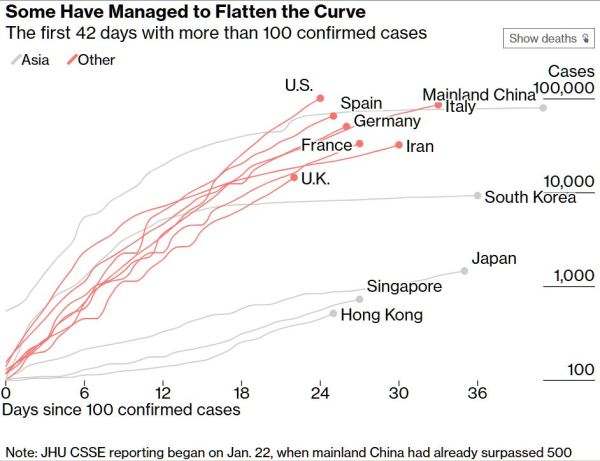
According to this chart the U.S. is now worse than China and got there more rapidly than Italy and Spain.
Bloomberg News – Mapping the Coronavirus Outbreak Across the World
Native Plant Garden Tours by Theodore Payne Foundation
Today’s Garden Tour has already started, but better late than never, I always say (if I get around to it).
However, there’s another one tomorrow. Read about it here.
Longtime SMBAS member, native plant maven/activist and sometime Snowy Plover census-taker Connie Day alerted me today to the garden tour and the fact that her home is (or by the time you get this, was) on the tour. So you can’t visit it yourself, and the live tour is over, but you can see some photos of her yard here. Plus another twenty-one homes. See what others are doing with their native plants. Get inspired!

The Day garden on the Garden Tour 3-28-20
Most birders in the Los Angeles area have become aware (or soon will) that native plants are extremely important for our native birds. As the dictum goes:
Native plants attract native insects; native insects attract native birds.
I don’t know who first said that, but I’ll credit it to Margaret Huffman, longtime SMBAS and California Native Plant Society member, who was the first to say it to me.
Theodore Paine has a plethora of native plants for reasonable prices. Due to the novel Coronavirus outbreak and ensuing zombie apocalypse, they adapted to the situation (far faster than our federal administration branch) with a new plan. Want plants? Call them up (818-768-1802 ext 25), place your order, pay the bill and they’ll assign you a time slot and your very own parking spot to come and pick up your new friends. Instructions and list of plants are here.
We love our native California plants in our yard. They grow, they leaf out and flower, they look bright and beautiful, they need far, far, far less water than did our boring – and now a distant memory – lawn with the bottomless thirst, the insects and lizards love them, we get Praying Mantis’ of all sizes, Painted Ladies and other butterflies, busy busy native (stingless) bees, and all sorts of interesting bugs and birds.
Stuck at home? Plant some native plants.
[Chuck Almdale]
California State Park Closures due to COVID-19
Effective immediately, State Parks has temporarily closed vehicular traffic to parks experiencing high visitation. In Los Angeles County as of Thursday, March 27, 2020, the following parks are included.
This list on the State Parks website is dynamic and will be updated regularly.
Please check their site for updates. [Chuck Almdale]
- Baldwin Hills Scenic Overlook
- El Matador State Beach (SB)
- Leo Carrillo State Park SP
- Los Angeles SHP
- Malibu Creek SP
- Malibu Lagoon SB
- Malibu Pier and parking area were closed on 3/24/2020 to vehicular traffic and pier closed to pedestrian traffic at the western most point of concession restaurant. Restaurant remains open with “To-Go” Services.
- Point Dume SB
- Robert H. Meyer Memorial SB
- Topanga SP
- Will Rogers SHP
UPDATE: CHANGES IN PARKS AMID COVID-19
To All, we wanted to reach out to keep you up-to-date on the recent soft closures in state parks. At this time, many parks are still open, and we encourage people to be safe when visiting. As a reminder, we have put together a list of how to navigate outdoor spaces in the time of COVID-19.
Here’s the latest on state parks:
- Parks that are experiencing high visitation are temporarily closed to vehicular traffic. See the list of parks that are affected.
- High public-use indoor facilities � including museums, visitor centers, and cafés � have been closed until further notice.
- All campgrounds across the state have been closed until further notice. All current reservation holders affected by the temporary closures have received a notification from ReserveCalifornia regarding their cancellation and refunds will be provided.
This information is subject to change, and we will continue to provide updates on park closures and ways to experience your state parks safely.
Stay healthy and safe, California State Parks Foundation
P.S. For updates and recommendations around COVID-19 please follow the Center for Disease Control (CDC). Please remember to follow the CDC’s recommendations around prevention and treatment.
California State Parks Foundation is an independent, member-supported nonprofit dedicated to protecting and preserving the California state park system, for the benefit of all.
California State Parks Foundation
33 New Montgomery St #520
San Francisco, CA 94105
(415)-262-4400info@calparks.org
Copyright © 2020 California State Parks Foundation
All rights reserved





 SANTA MONICA BAY AUDUBON SOCIETY BLOG