Free email delivery
Please sign up for email delivery in the subscription area to the right.
No salesman will call, at least not from us. Maybe from someone else.
Ovenbird Movie at L.A. River
[Posted by Chuck Almdale]
Local birder James Hecht posted this very nice film on LACoBirds@groups.io bird alert listserve yesterday.
The Ovenbird, found a few days ago by Jeff Boyd, showed itself well with best viewing from the bench area along the greenbelt trail just opposite the corner of DeForest and 27st along the LA River. It popped out for the second time after 2 PM and stayed out in the open long enough for me to obtain some videos under good lighting conditions.
Click the photo below to go to the video on Flickr. You can then click the big arrows at the right to see additional photos of the bird, an additional and longer video, and then other good-looking birds photographed by James. Good film and photos of a Very Good Bird! Of what bird does it walking style remind you?

President’s Annual Appeal reminder for 2025
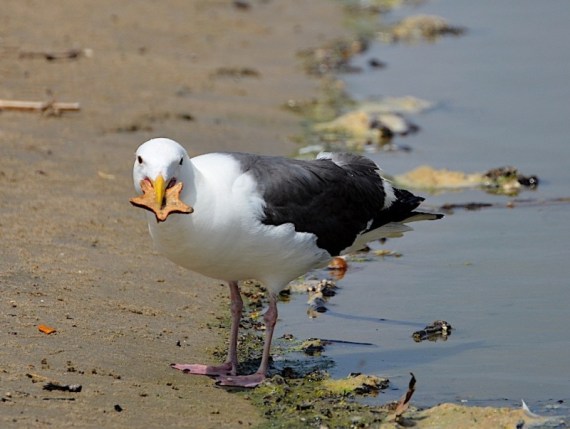
(Photo: Grace Murayama 7-23-17)
We are asking you to consider giving us your support this year. Remember, this is our only fund raising effort. We don’t pester you weekly, monthly, or throughout the year. Your help allows our all-volunteer group to accomplish our mission “to be a center for wildlife education, habitat protection, and conservation issues that involve birds.”
These efforts are of increasing importance in view of the past decreasing support for environmental issues coming from the Federal Administration.
You can DONATE four different ways:
- With the self-addressed envelope enclosed with the annual appeal letter (sent to those already on our membership rolls)
- Send a check to our mailing address: SMBAS, PO Box 35, Pacific Palisades, CA 90272
- With PayPal using the PayPal Widget located on the right side bar of the blog
- With a Credit Card using the same PayPal Widget located on the right side bar of the blog. You do not have to join PayPal to donate, just have your credit card “standing by.”
Please take a moment and make a donation today.
We continue our strong backing of all things birds, habitat, native plants, the environment and conservation through education, field trips, bird monitoring, speakers and grants to students and conservation groups.
Please take a minute to read the annual appeal letter below and see what we have been doing this year.
Thank you,
Jean Garrett
President
Link to our online 2025-26 Calendar of Field Trips and Programs
Dear Friend of SMBAS, November 6, 2025
As we write this letter, we are acutely aware of the consequences of the Palisades Fire for many of our members, neighbors, and friends. We hope for their recovery and continuing interest in nature in general and especially in birds. Most of you know, this is our only financial appeal of the year. As an all-volunteer chapter our expenses are low, but our activities are frequent and with great local impact. Our members have supported us over the decades and we hope you will help us continue in our mission.
This year we are welcoming several new members – five and counting – to the Board of SMBAS. As time progresses, you’ll probably see a gradual change in our activities and outreach that corresponds to a younger population on the board. We’re also looking forward to next year as Santa Monica Bay Audubon Society celebrates its 50th Anniversary.
We are approaching the end of the year along with the holiday season and hope it gives you the opportunity to celebrate. Please remember that local birding is at its best for the next six months, so we hope to see you on a field trip in the near future.
Please join us and encourage your friends to do so. Our activities are all free and most have no attendance limit. If you’re experienced or want to start joining our leadership, we welcome co-leaders. Just get in touch with the leader listed on the blog announcement.
Jean Garrett, President SMBAS
Your support helps these activities and services to continue:
- The Blog: In addition to advance announcements and follow-up reports of all our activities, our blog has frequent interesting articles on birds, nature and science in general. There are occasional longer series on subjects like avian taxonomy and polyandry. The blog also has permanent pages on special topics: Animal rescue information, Western Snowy Plovers, 80 L.A. Co. Birding Areas, Malibu Lagoon, Calendar, Grant Applications, The Tongva, Birds in the Bible, Locating Birds for Others, Zoom Recordings. When you give that www.smbas.org address to your friends and acquaintances, make sure you encourage them to explore the multiple links on our site. It’s a treasury of history, local knowledge and bird lore!
- Malibu Lagoon monthly bird walks: (4th Sunday–not the last), we welcome new and experienced birders at 8:30 and ‘Kids and Parents’ at 10 am.
- Field Trips: Held October—June to nearby destinations, usually on the 2nd Saturday of the month. Currently scheduled: 13 Dec: Back Bay Newport; 14 Feb: Madrona Marsh; 14 Mar: Sepulveda Basin. Remember to check smbas.org for updates and adjustments!
- Evening Programs: October through December and February through May, an online program on scientific, travel, or conservation topics. Please check smbas.org for our next program. Sign up on the blog to receive all announcements in your inbox.
- Your funding helps support:
- Endowments with Santa Monica College Foundation and Loyola Marymount University supply scholarship aid to biology or ecology students.
- Grants up to $600 to students at local colleges and universities for research on local species and environments. We would love to expand the number of awards as the costs for students keeps ballooning.
- Funding for bus transportation for inner city children to visit and explore Ballona Saltwater Lagoon. The number of buses we pay for depends on our annual fundraising.
- Sponsorship of student summer internship with Student Conservation Association.
- Staffing the Annual Coastal Cleanup station at Malibu Lagoon State Beach for Heal the Bay, [held on the 3rd Saturday of September.]
- Our conservation activities include: Regular monitoring of our beloved Western Snowy Plovers, monitoring and encouraging the Bay Foundation’s Dune Restoration program on local beaches, special letter-writing and appearances before local and national organizations to develop influence. We alert our readers to letter-writing campaigns in conjunction with other organizations to oppose or support legislation.
Please check the blog www.smbasblog.com for changes and updates.
[posted by Chuck Almdale]
L.A. Parrots are world famous | The Guardian
[Posted by Chuck Almdale, submitted by Lu Plauzoles]
Yes, even in Great Britain where the natives have other things to think about – like their weather and some pesky neighbors to the east – they have heard of our many many parrots. Link to article
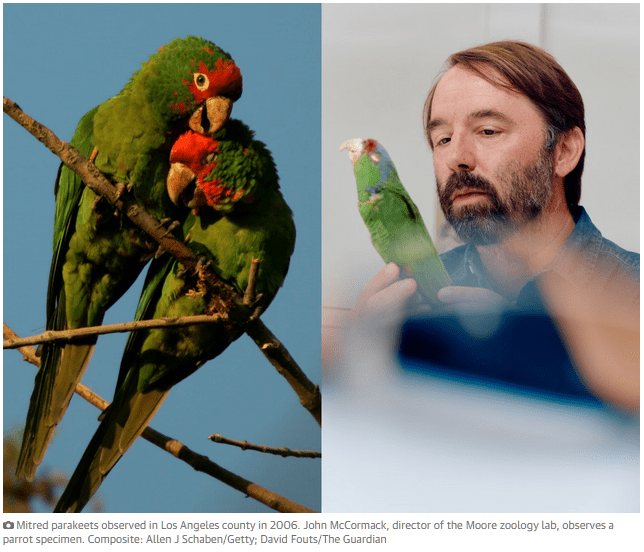
These parrots came to Los Angeles as pets – then went wild. Now scientists are unlocking their mysteries.
Once escapees from the pet trade, Los Angeles’s feral parrots have become a vibrant part of city life, and could even aid conservation in their native homelands. The Moore Laboratory at Occidental College gets involved.
by Katharine Gammon, in L.A. 15 Nov 2025
Have you seen our parrots? Want to? Contact your local Audubon Society chapter. The parrots on our chapter’s field trips are mostly Nanday Parakeets and Yellow-chevroned Parakeets. The mother-lode of SoCal parrots is in Pasadena and the western San Gabriel Valley.
Back Bay Newport field trip reminder: Sat. 13 December, 8:00 AM
Reservations please.
Starting location is same as last year (see below)
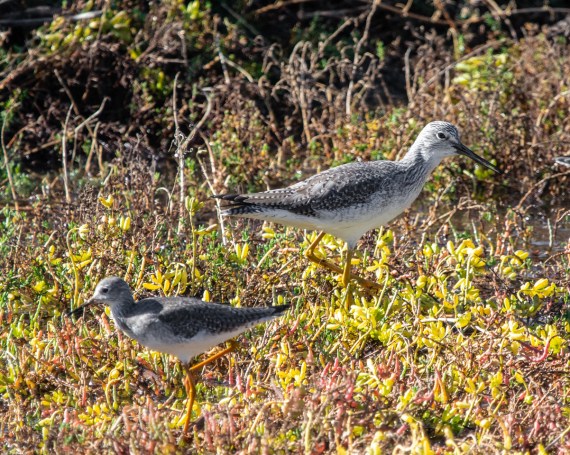
Lesser (L) & Greater (R) Yellowlegs on the pickleweed
(R. Juncosa, Upper Newport Bay 12-8-18)
[Posted by Chuck Almdale]
Back Bay Newport (Upper Newport Bay) can provide great birding, and we generally see over 60 species. It’s a bit of a drive for us (see below) and we ask for reservations [contact Chuck] to make sure people are coming. In the past we’ve gone at the highest weekend tide we could find, but last year we missed both rails and shorebirds, so we’re changing tactics. This year, on Saturday Dec. 13 the high tide will be 4.91 ft @ 0451 and low of +1.32 ft @ 1142, and we hope this intermediate-to-low water level will give us more shorebirds. This isn’t optimal for flushing rails from the reeds, but we will of course look for them anyway. By the time we get to the upper end of the bay, there should be plenty of exposed tidal flats. [No promises!]
We should see plenty of waterbirds, shorebirds, bushbirds, treebirds, pondbirds, reedbirds, mudflatbirds, sandislandbirds, skybirds and the always-to-be-desired whatnots. [AKA ducks, grebes, waders, sandpipers, gulls, terns and skimmers on the bay and shore, raptors overhead and things in the brush, not necessarily in that order.] I saw my lifer Short-eared Owl here, decades ago, standing on a post among the reeds, and thereafter made the common newbee mistake of expecting to see it on the same post year after year. [To be honest I still check that post.] We had a Bald Eagle a couple years in a row, albeit at a distance (upward). You never know what will be around. We may also search for the endangered California Gnatcatcher at a particular location along the route.

We’ll have lunch (so bring one!) probably at nearby birdy San Joaquin freshwater marsh, and those who wish can do more birding there. In 2017 we saw a Red-throated Pipit here, a Very Good Bird, and Virginia Rails show up, plus White Pelicans and more whatnots. The staff keeps a list of recent sightings outside the bookshop door which we always check, AND if you’re looking for a particular bird book (say…Field Guide to Galapagos Birds) they might have it. You could call them: 949-378-6501.

Family guide: We mostly stand around near our cars gawking at the birds, then drive to the next spot and stand around and gawk some more. We don’t walk a whole lot. At San Joaquin Marsh after lunch it’s all walking. As yet it’s too far in advance to make weather predictions. Bring layers, leave them in your car and you’ll never be far from them. Telescopes, if you have one, are Good To Have. It’s a wide bay.
For future reference: Link to tide chart
The high tides of this winter will be Dec 2 – 7, peaking on 12/5 at +7.18 ft. at 0821.
Link to December 2024 report.
Driving Time: 50-60 minutes – 48 miles. While there are gas stations in the area (primarily right where you get off the freeway) you could get hung up there pumping gas by the ounce while everyone else drives on to the next birding spot to find that über-rarity (or even mega-tick) which then of course flies away just before you arrive. Don’t let this happen to you! [I’ve actually seen this happen. Ask me about the Ivory Gull.] Gas up in advance.
Carpooling Drivers & Riders: If you’re willing to drive others or ride with others, include your contact info, approx. location and drive/ride preference in your reservation to me, and I’ll circulate it to any others similarly interested. If you’re riding, the polite birderly thing is to get yourself to the driver’s starting location rather than try to get them to drive to your house to pick you up. They’re already in for a 2-4 hour drive time for the trip. And riders should inquire of drivers about their face-masking requirements & cost-sharing, if any.
Reservations: contact Chuck Almdale
Meeting time: 8 am, Saturday 13 December, 2025. Get there early and find the rails and snipes!
Questions & Reservation: Contact Chuck, no later than Thursday 5 PM 11 December. email misclists [AT] verizon [DOT] net
Food: Bring munchies & liquids and/or lunch. No services next to the bay.
Directions: From the Santa Monica Fwy (I-10)Take San Diego Fwy (I-405) 43 miles south to CA-73. CA-73 south for 2.3 miles [Do not get onto I-55 Costa Mesa Fwy], take exit 15 for JAMBOREE RD and continue on SE BRISTOL ST. about 0.5 mile to JAMBOREE RD. and turn right. Continue south on JAMBOREE 3.1 miles to BACK BAY DR., turn right and continue on BACK BAY Dr. 0.4 miles to the start of MOUNTAINS TO SEA TRAIL HEAD ride/bike one-way road. Continue about 0.1 mile on the ride/bike road to first dirt parking area on left next to the bay. We’ll meet here. Write down these directions and look at the map linked to below!!! Don’t get lost. If you’re significantly late and we’re not at the meeting spot, continue on the ride/bike 15 MPH road. It’s one-way for miles and we’ll be somewhere along it.
Birding Note: Nelson’s Sparrow has been seen by me several times in the past along this first stretch on either side of the road in the reedy areas before the dirt parking area. Worth a look.
Coffee/Bathroom Needs: If you need either before the 8am start, exit CA-73 at Campus Dr./Irvine Ave, the last exit before Jamboree Rd. Continue from exit ramp onto SE Bristol Rd. which has fast food restaurants with bathrooms along the right side. Then continue on Bristol to Jamboree Rd. and to the meeting spot. There are porta-potties on the ride/bike road, but not right at the beginning.
If you get there early, there’s good birding!! right where you’re parked. It doesn’t hurt to get there early and find all the birds for the rest of us, not to mention the one’s that will disappear before we arrive.
Meet at 8:00 a.m. in the parking lot. Leader: Chuck Almdale.
Map to Meeting Place: Back Bay Newport – SE meeting area
Use + and – to zoom in or out, left click and mouse drag to reposition the map.
Directions to lunch @ San Joaquin Marsh
We’ll finish birding Back Bay near the corner of the Mountains-to-the-Sea Trail and EASTBLUFF DRIVE. East on EASTBLUFF DR. and cross JAMBOREE RD. where the road becomes UNIVERSITY DR. Continue under Fwy. #73 and about 1 mile more to CAMPUS DR. Turn left on Campus Dr. & across the creek to the first right, RIPARIAN DRIVE. Turn right & continue north about 1/2 mile to the entrance of SAN JOAQUIN Marsh (home of Sea & Sage Audubon). Turn left and down the little hill to the parking lot. You’ll pass the bookstore on your right and the picnic tables are just beyond the bathroom block. If the parking lot is full, go back up the little hill and park in the large dirt lot below you on the other side, then schlep your lunch over to the picnic tables.
[Chuck Almdale]

(Elyse Jankowski 12-15-24)
California King Tides Dec 4-6 & Jan 2-3 | Photo Op
[Posted by Chuck Almdale]
The California Coastal Commission runs an King Tides Project every year. They explain:
The California King Tides Project helps us visualize future sea level by observing the highest tides of today. You can help by taking and sharing photos of the shoreline during King Tides to create a record of changes to our coast and estuaries.
If you’re interested follow the top link.
Here’s a link to the CCC map of locations and high tide times:
https://www.coastal.ca.gov/kingtides/participate.html#tidemap
Here’s their times for Santa Monica Pier (good for the entire bay):
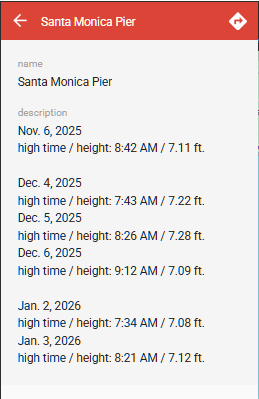
Meanwhile…more locally…if you just happen to be on the shore around Santa Monica Bay, especially by Malibu Lagoon, and get some good photos of the inundations, I’d love to post them.
Please include: Whom to credit, location, time, any other interesting stuff.
Contact me, Chuck Almdale, at 818-894-2541 or pollist [AT] verizon [dot] net

Speaking of “Snap the Shore, See the Future”: According to an article I posted over four years ago, beginning next year (2026) we are scheduled for a permanent 4-inch rise in sea level over the next 9.3 years, due to a combination of lunar orbital fluctuations (precession of the moon’s orbital nodes) and continuing (as in it’s been tracked for years) sea level rise due to global warming, glacier and ice cap melting and warming sea water expansion. The next such period will begin 18.6 years after this coming one begins. Next year. Read the article. If your house sticks out over the beach, mark the supporting posts – like you mark your children’s heights on a door frame – and note the change.
And don’t get sucked out to sea by the king tide wave backflow.



 SANTA MONICA BAY AUDUBON SOCIETY BLOG