Free email delivery
Please sign up for email delivery in the subscription area to the right.
No salesman will call, at least not from us. Maybe from someone else.
Alfalfa leafcutting bees are way better at pollinating alfalfa flowers than honeybees. They don’t mind getting thwacked in the face by the spring-loaded blooms. And that’s good, because hungry cows depend on their hard work to make milk.
This is another installment of the PBS Deep Look series. If no film or link appears in this email, go to the blog to view it by clicking on the blog title above. If the film stops & starts in an annoying manner, press pause (lower left double bars ||) to let it buffer and get ahead of you. [Chuck Almdale]
Malibu Marbled Godwits
Malibu Lagoon has hosted many sandpipers over the years. Of the world’s ninety-six species of sandpiper, SMBAS has recorded twenty-six at the lagoon, from the diminutive Least Sandpiper to the Long-billed Curlew. Among them is the very showy and reliable Marble Godwit. They are one of our favorites – not only because they are easy to identify with their large size, warm brown plumage, long dark legs and upcurved two-tone bill – but because their feeding behavior and interactions are interesting and fun to watch and they are not overly shy of humans.

Marbled Godwit (Chris Tosdevin 2-23-20 Malibu Lagoon)
Many people think of sandpipers as those little birds that run back and forth with the lapping of the waves. That bird is likely the 8″ Sanderling. But sandpipers come in many sizes, from the 5.5″ Least Sandpiper to the 25″ Far Eastern Curlew. Birders call the smallest sandpipers – those 9″ and under – “peeps,” because that’s what they all sound like: “peep peep peep.” But whatever the size or name, they’re all members of the Sandpiper family Scolopacidae.
Marbled Godwit is the largest of the world’s four species of Godwit. At 18″ from tip of bill to tip of tail, this sandpiper is second in size only to curlews, of which the 23″ Long-billed Curlew is the only one common in the lower forty-eight states.

Dragging the wing tip (Chris Tosdevin 2-23-20 Malibu Lagoon)
Marbled Godwits winter along our Atlantic, Gulf and Pacific coasts. For their May to August breeding season, they migrate to the short-grass prairie region of North and South Dakota, northeastern Montana, southeastern Alberta, southern Saskatchewan and southwestern Manitoba.
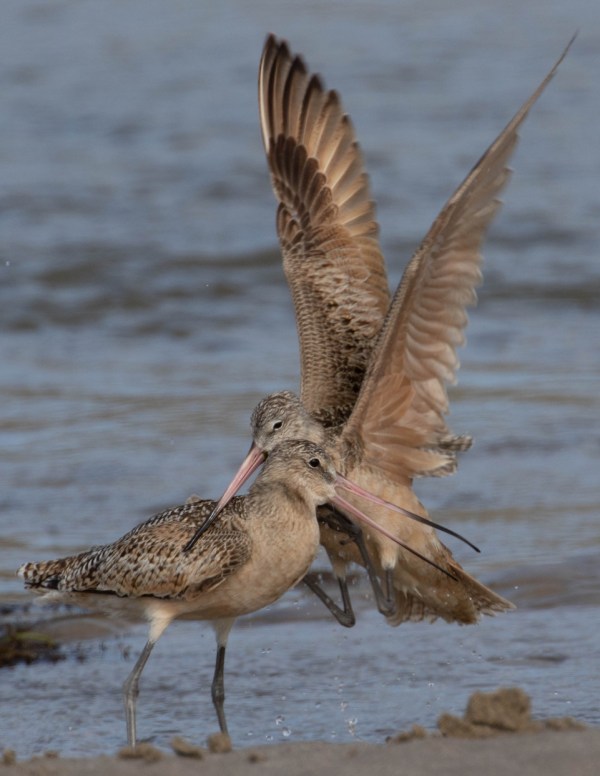
Notice the tip of the lower bird’s upper bill
(Chris Tosdevin 2-23-20 Malibu Lagoon)
They have one brood per breeding season, incubating their clutch of 3 to 5 brown-spotted buff or olive eggs for 23 to 26 days. The nest is a shallow depression in the ground, often lined with soft grasses and lichen. As with nearly all ground-nesting birds, the young are precocial, born down-covered, eyes open and able to walk. After only one day in the nest they are ready to follow their parents in foraging for small fish and invertebrates of all sorts. At about three weeks of age they are ready to fly. [All About Birds]

Check the tip now. Flexible. (Chris Tosdevin 2-23-20 Malibu Lagoon)
There are four godwit species.
Black-tailed Limosa limosa, length 14.2-17.3″, (one) wing 6.6-9.4″, bill 2.9-3.9″; Old World, breeding France to China and Kamchatka Peninsula, wintering sub-Saharan Africa to India and Australia.
Hudsonian Limosa haemastica, length 14.6-16.5″, (one) wing 7.9-9.0″, bill 2.5-3.8″; New World, breeding w. Alaska to Hudson Bay, wintering s. South America.

Marbled Godwits (Grace Murayama 2-28-20 Malibu Lagoon)
Bar-tailed Limosa lapponica, length 14.6-16.1″, (one) wing 7.5-9.1″, bill 3.0-4.3″; Old World + w. Alaska, breeding high Arctic Norway to w. Alaska, wintering England to sub-Saharan Africa to India, China, Australia and New Zealand.
Marbled Godwit Limosa fedoa, length 16.5-18.9″, (one) wing 8.1-10.0″, bill 3.2-4.8″; New World, breeding range given above.
Black-tailed is rare in North America (occurring yearly in very low numbers), Bar-tailed breeds in w. Alaska in small numbers, Hudsonian is uncommon outside its central flyway breeding and migration range, Marbled is common on all coasts in winter.
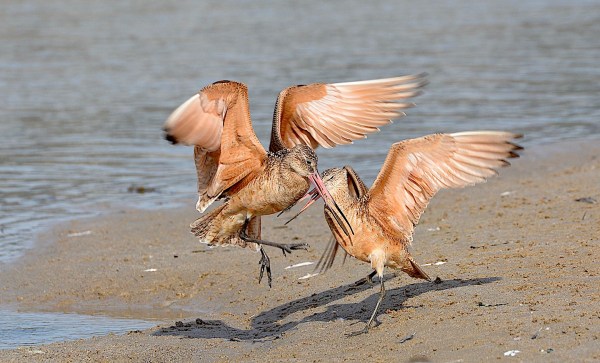
Meet and greet? (Grace Murayama 2-28-20 Malibu Lagoon)
Etymology: Scolopacidae: Latin scolopax, “the woodcock or snipe,” Latin -aceus, “resembling,” -idae suffix indicating family; thus the avian family resembling the woodcock or snipe. Godwit: origin uncertain. May be from Anglo-Saxon god, “good”; Anglo-Saxon whita, “animal,” “bird,” and more literally “good eating,” although Elliot Coues says this is too easy to be true. Limosa: Brisson. Latin limosa, “muddy,” from the habitat.
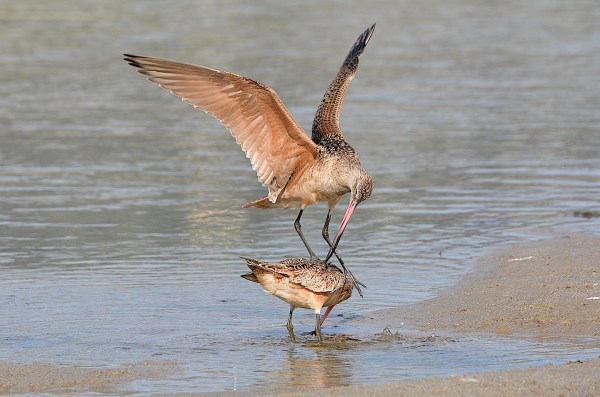
Perhaps a bit more than just friendly (Grace Murayama 2-28-20 Malibu Lagoon)
Etymology: L. fedoa (Linnaeus): origin unknown. Coues says, “The word goes back to Turner (1544) ‘Anglorum goduuittam, sive fedoam,’ and has been variously applied to godwits and some other birds before and since Linnaeus named this species Scolopax fedoa in 1758.” Newton regards it as a Latinized form of some English name of the European godwit, “now apparently lost beyond recovery.” Compare to the local Venetian (Italian) name vetola for a godwit. [Dictionary of American Bird Names, Choate; Dictionary of Scientific Bird Names, Jobling.]

One good poke deserves another (Grace Murayama 2-28-20 Malibu Lagoon)
Here’s a good mnemonic for beginning birders: The curlew’s bill “curls low.” The godwit’s bill curves up to God (or at least upwards towards where our gods have long been purported to reside).
At Malibu Lagoon, we have sighted Marbled Godwits 172 times out of 274 visits, or 63% of the time, with a total of 1964 individual birds. There are no sightings at all for June, only four occurrences (33 birds) for May and three (10 birds) for July, but all other months have sighting occurrences in the double digits. Our highest one-day count was 135 for November 26, 2017. They are reliable visitors, always a joy to see. [Chuck Almdale]
How can aggressive, predatory, and cannibalistic birds coexist in crowded breeding colonies? Explore the lives and territorial interactions of Herring and Great Black-backed gulls in a breeding colony on Maine’s Appledore Island.
A film from the Cornell Lab of Ornithology. If no film or link appears in this email, go to the blog to view it by clicking on the blog title above. If the film stops & starts in an annoying manner, press pause (lower left double bars ||) to let it buffer and get ahead of you. The Lab is a member-supported organization; they welcome your membership and support. [Chuck Almdale]
We here at SMBAS Blogsite Central are utterly certain that you simply aren’t getting enough information on all things COVID-19, so we voted democratically and decided to assign extra staff in order to help keep you informed on what you need to know.
Actually, the blog title is somewhat misleading. It doesn’t matter whether you’re a birder or not.
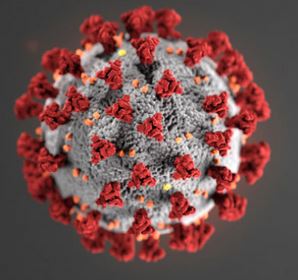
0.3 Microns. So small you can’t see it.
This blog contains nothing that you can’t find by going to this site:
https://ourworldindata.org/coronavirus
The information there come directly from the World Health Organization (WHO) and is updated daily. A few of their many interesting charts – some interactive – are shown below. Explanations and commentary are adapted – mostly shortened – from their website. We apologize for any blurriness of charts, the result of “snipping” screenshots. They are clear on the website https://ourworldindata.org/coronavirus.
Our World In Data has a great deal of information on many topics other than Corona virus, including: carbon footprints, 1918 Spanish Flu, population, safe sources of energy, cancer, less meat vs. “sustainable” meat. This is a site well worth your while.
[Chuck Almdale]
Growth: Country by country view
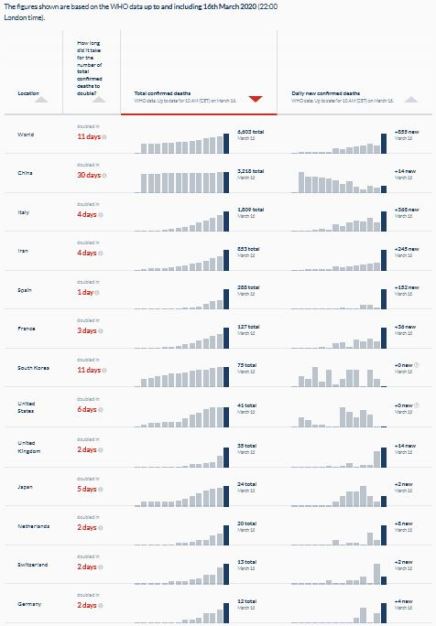
How long did it take for the number of confirmed deaths to double?
The table below also shows how the total number of confirmed deaths, and the number of daily new confirmed deaths has changed over the last 14 days. China seems to be dropping. On-line you can sort the table by any of the columns by clicking on the column header.
Screenshot – ourworldindata.org/coronavirus
Current COVID-19 test coverage estimates
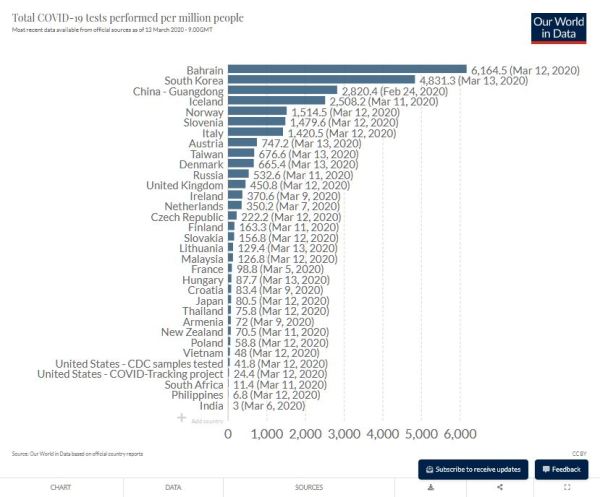
These are the most recent official estimates of tests we have been able to find as of 13 March 2020, 09.00 GMT. Note that the estimates refer to different dates for each country, as indicated in the brackets.
The chart below shows the number of tests relative to the size of the population: it is the number of total COVID-19 tests per million people. Available data shows that South Korea has done many more tests than any other country. This suggests that the number of confirmed cases in Korea is closer to the total number of cases than in other countries. It is therefore particularly encouraging to see that the number of daily confirmed cases in South Korea has decreased – here you find our chart that shows the decline of confirmed new cases in South Korea. The fact that South Korea has managed to expand testing so quickly shows that it is possible. Because testing is crucial it is important that in the coming days other countries follow.
The US, on the other hand, has experienced big problems rolling out their testing strategy and according to the US Centers for Disease Control and Prevention, only a total number of 13,624 samples had been tested by 12 March, 2020. The total number of tests conducted in South Korea up to the same date was nearly 18-times larger. The low test coverage of the US is even starker if we look relative to the large population of the country. We see many smaller countries have been able to conduct more tests per million people.
[NB. Two estimates provided for the US. The estimate labelled “US – CDC samples tested” is from the Centers for Disease Control and Prevention, and refers to the number of tests conducted, not the number of individuals tested. The COVID Tracking Project tracks the cumulative number of people tested in the US by tallying individual state reporting. We report these figures under the label “US – COVID Tracking Project”]
Screenshot – ourworldindata.org/coronavirus
Early data from China suggests that the elderly are most at risk
Understanding who within a population is most at risk is crucial in an outbreak. Understanding the relative risk to different sections of a population allows us to focus on the most vulnerable, and improve the allocation of health resources to those who need them most.
The Chinese Center for Disease Control and Prevention has published an analysis of recorded cases and deaths in China for the period until February 11th 2020 which provides a breakdown of all known cases, deaths and the CFR by specific demographics (age, sex, preexisting condition etc.).
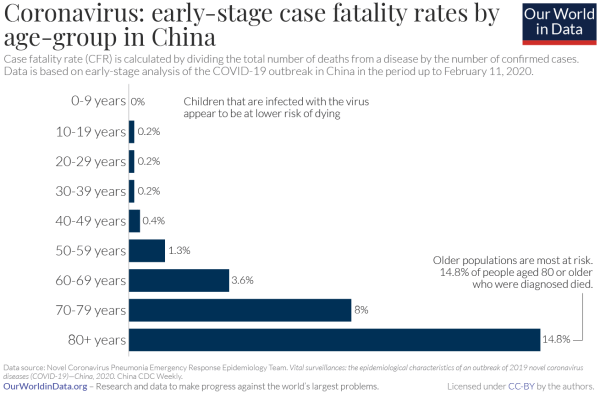
A breakdown of the CFR by age group is shown in the visualization below. It shows very large differences of the CFR by age.
For many infectious diseases young children are most at risk. We see this for malaria: the majority of malarial deaths (57% globally) are in children under five years of age. The same was true for the largest pandemic in recorded history: During the ‘Spanish flu’ in 1918 it was primarily children and young adults who died from the pandemic (we write more about this in the article here).
For the COVID-19 cases in China the opposite seems to be true, at least based on the information available at the time of writing. The elderly are at the greatest risk of dying if infected with this virus. Based on the data from China – shown in the visualization – 14.8% of those who are 80 years and older who were infected by COVID-19 died as a result. As explained above, these figures represent the share of people diagnosed as having the disease who die from it. This does not represent the share of people in the entire population who die from it.
The case fatality rate for children is much lower. There were no reported deaths in children under 10 years old; 0.2% of those aged 10 to 19 years who were diagnosed with COVID-19 died from it according to the early Chinese data.
One possible reason why the elderly might be most at risk is that they are also those who are most likely to have underlying health conditions such as cardiovascular diseases, respiratory diseases or diabetes.
ourworldindata.org/coronavirus
The symptoms of COVID-19
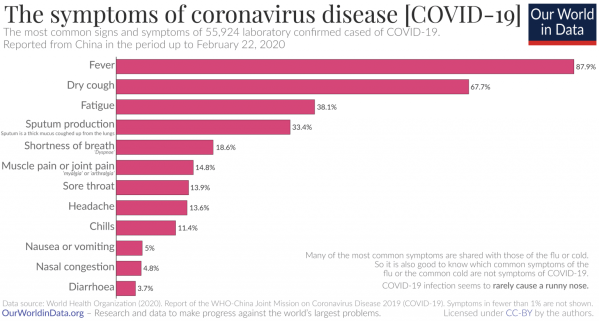
The WHO described the symptoms of 55,924 laboratory confirmed cases of COVID-19 in China in the period up to February 20. The visualization below shows this data.
It is most crucial to know the common symptoms: fever and a dry cough. As the visualization shows, close to 90% of cases had a fever and two-thirds had a dry cough. The third most common symptom was fatigue. Almost 40% of cases suffered from it. ‘Sputum production’ was experienced by every third person. Sputum is not saliva. It is a thick mucus which is coughed up from the lungs (see here).
Of the 55,924 cases fewer than 1-in-5 (18.6%) experienced shortness of breath (‘dyspnoea’). An earlier study, reported that a much higher share (55%) of cases suffered from dyspnoea, but this was based on a much smaller number of cases (835 patients). Many of the most common symptoms are shared with those of the common flu or cold. So it is also good to know which common symptoms of the common flu or the common cold are not symptoms of COVID-19. COVID-19 infection seems to rarely cause a runny nose.
ourworldindata.org/coronavirus
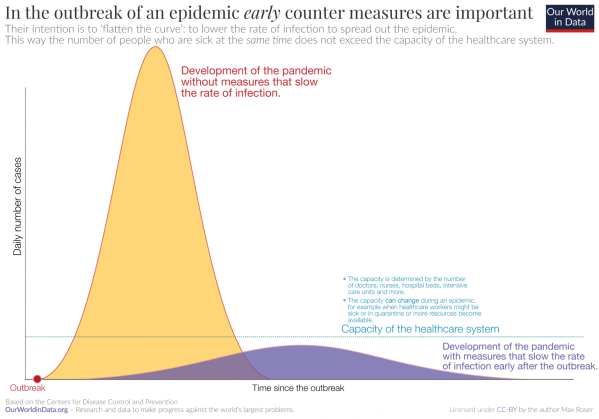
‘Flattening the curve’
Early counter-measures are important in an epidemic. Their intention is to lower the rate of infection so that the epidemic is spread out over time such that the peak demand on the healthcare system is lower.
Containment measures are intended to avoid an outbreak trajectory in which a large number of people get sick at the same time. This is what the visualization shows.
This is the reason that limiting the magnitude of peak incidence of an outbreak is important. Health systems can care for more patients across an outbreak when the number of cases is spread out over a long period rather than condensed in a very short period.
What such counter measures to the pandemic attempt to avoid is that the number of patients at one point in time is so large that health systems fail to provide the required care for some patients
ourworldindata.org/coronavirus
Early data from China suggests that those with underlying health conditions are at a higher risk
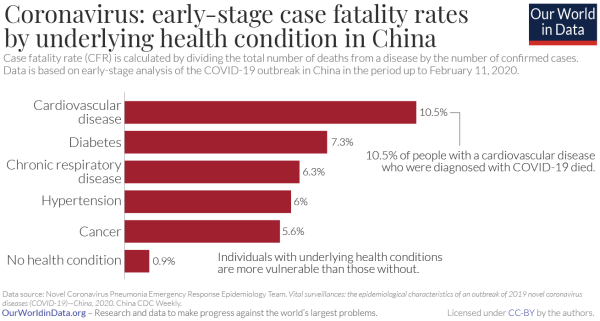
The visualization below shows the case fatality rate for populations within China based on their health status or underlying health condition.
The researchers found that the case fatality rate (CFR) for those with an underlying health condition is much higher than for those without. More than 10% of those diagnosed with COVID-19 who already had a cardiovascular disease, died as a result of the virus. Diabetes, chronic respiratory diseases, hypertension, and cancer were all risk factors as well, as we see in the chart.
The CFR was 0.9% for those without a preexisting health condition.
Three charts above we saw that the elderly are most at risk of dying from COVID-19. This might be partly explained by the fact that they are also most likely to have underlying health conditions such as cardiovascular disease, respiratory disease and diabetes; these health conditions make it more difficult to recover from the COVID-19 infection.
ourworldindata.org/coronavirus
How do case fatality rates (CFR) from COVID-19 compare to those of the seasonal flu?
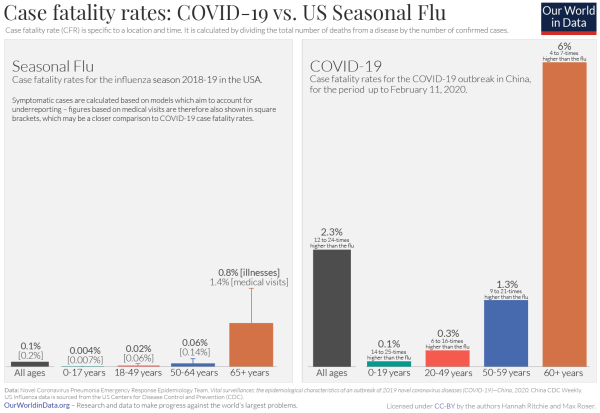
Comparing the CFR during the outbreak of COVID-19 in China with the CFR of the US seasonal flu in 2018-19.
The case fatality rate of the seasonal flu in the US is around 0.1% to 0.2%, while the case fatality rate for COVID-19, measured in the cited study, was 2.3%.
As calculated above, the global CFR for COVID-19 continues to change over time, and the global average CFR based on the WHO data is 3.4% (as of 9th March 2020). While the CFR for COVID-19 is much higher than the CFR of the seasonal flu the two diseases are similar in the profile of the fatality rate by age: elderly populations have higher case fatality rates. However, the CFR of COVID-19 is much higher for all age groups, including young people. On top of each bar we have indicated how much higher the CFR for COVID-19 is for each age group.
ourworldindata.org/coronavirus
Not every topic warrants a “both sides” approach. Some viewpoints are simply not backed by empirical evidence or are based on false information. And journalists have to be careful not to present them as legit debates. If they do, they are creating a “false equivalence.”
**What is false equivalence?
It’s when you set up two opposing sides of an argument, and make it look like they hold equal weight, when really, they don’t. And presenting both of these views as valid is a logical fallacy, or a “false equivalence.”
**Why do false equivalences happen in journalism?
When news is breaking, journalists are often faced with making decisions quickly, without much time for fact-checking. Propagandists — people who want to use the media to spread a particular cause or belief — often take advantage of the chaos of breaking news to spread rumors and conspiracy theories. They often create false social media accounts, and then use other false accounts to comments and like a post. Even trained journalists can fall for false posts when they are shared widely by real-looking accounts on places like Twitter or Facebook. False equivalences also happen when news outlets will invite two opposing “sides” on an issue to debate one another, but one side doesn’t rely on solid evidence to back their argument. Both sides are given equal air time and equal weight — creating a false impression of equivalence. The false argument will often spread on social media before it can be de-bunked.
** What role do social media companies play in spreading misinformation?
This is a hotly debated question, and companies like Facebook distribute more information than any other institution in history. While they are constantly changing their policies and algorithms in an attempt to slow down the spread of fake posts from dubious sources, they have yet to develop a consistent or effective way to combat the spread of misinformation on their platforms.
** What can I do to avoid falling for false equivalence?
Be skeptical — just because someone is on TV, or appears in a social media post doesn’t always mean that they are legitimate experts on a topic. Always check the sources they are citing. Are they citing research from well-regarded academic or journalistic institutions? Do their websites look legit? And check your own biases. Are you being critical of the information you’re consuming, or are you looking for something to prove what you already believe? Challenge yourself by reading an opposing point of view and analyzing their arguments.
ABOVE THE NOISE is a show that cuts through the hype and takes a deeper look at the science behind controversial and trending topics in the news. Hosted by Myles Bess and Shirin Ghaffary.
This series is aimed at teens, but after viewing a few episodes, I’m sure that most adults will benefit from it as well. Let us know what you think.
This is another installment of KQED’s Above the Noise series. If no film or link appears in this email, go to the blog to view it by clicking on the blog title above. If the film stops & starts in an annoying manner, press pause (lower left double bars ||) to let it buffer and get ahead of you. [Chuck Almdale]



 SANTA MONICA BAY AUDUBON SOCIETY BLOG