Free email delivery
Please sign up for email delivery in the subscription area to the right.
No salesman will call, at least not from us. Maybe from someone else.
Eleven COVID-19 Information Sites
Interesting, useful and (mostly) daily updated sites, in no particular order.
As the novel Coronavirus outbreak will be one of the major events of the first half of this century, we’ll post about it from time to time when we find something interesting and useful while trying to avoid stupidity, insanity and baloney.
[Chuck Almdale]
How Much Do You Really Know About Coronavirus?
Should you wear a face mask? Can you catch the virus from your dog? Put your Covid-19 knowledge to the test.
By Jason Gale
A Quiz. Eleven Questions.
Not updated daily
New York Times: The Lost Month: How A Failure to Test Blinded the U.S. to Covid-19
By Michael D. Shear, Abby Goodnough, Sheila Kaplan, Sheri Fink, Katie Thomas and
Our World In Data – Coronavirus Disease (COVID-19) Statistics and Research
by Max Roser, Hannah Ritchie and Esteban Ortiz-Ospina
Extensive discussion and visualizations (some interactive)
Updated daily
Our World In Data – Coronavirus Disease (COVID-19) The Data
by Max Roser and Hannah Ritchie
More than 40 visualizations on the pandemic
Link corrected 3/29/19
Updated daily
European Center for Disease Prevention and Control
An Agency of the European Union
Updated daily
California Department of Public Health:
Ages and genders of confirmed cases, hospitalizations of confirmed & suspected cases, fatalities.
https://www.cdph.ca.gov/Programs/CID/DCDC/Pages/Immunization/ncov2019.aspx
Los Angeles County COVID-19 Dashboard:
Known cases, deaths & recovered for Local Cities, County, State, USA & World
https://lacounty.maps.arcgis.com/apps/opsdashboard/index.html?utm_content=&utm_medium=email&utm_name=&utm_source=govdelivery&utm_term=#/3db641e60de9451fa70e69dd5dadbce4
Johns Hopkins COVID-19 Dashboard
Numbers for world, all nations, U.S. States & Counties. Charts, news & information. Lots to look at.
https://coronavirus.jhu.edu/map.html
Centers for Disease Control & Prevention (CVC) COVID-19 page:
U.S. and states numbers. I think the Johns Hopkins site is better.
https://www.cdc.gov/coronavirus/2019-ncov/cases-updates/cases-in-us.html
Mapping the Coronavirus Outbreak Across the World
Bloomberg News
Updated daily (probably)
Tracking the Spread of the Coronavirus Outbreak in the U.S.
Bloomberg News
Updated daily (probably)
Either Bloomberg Site above will list many additional articles.
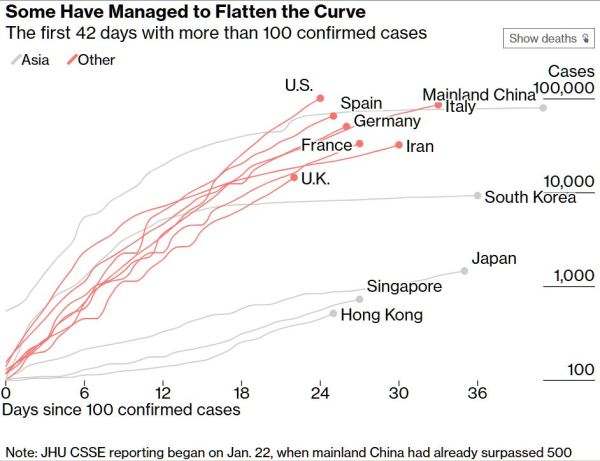
According to this chart the U.S. is now worse than China and got there more rapidly than Italy and Spain.
Bloomberg News – Mapping the Coronavirus Outbreak Across the World
Native Plant Garden Tours by Theodore Payne Foundation
Today’s Garden Tour has already started, but better late than never, I always say (if I get around to it).
However, there’s another one tomorrow. Read about it here.
Longtime SMBAS member, native plant maven/activist and sometime Snowy Plover census-taker Connie Day alerted me today to the garden tour and the fact that her home is (or by the time you get this, was) on the tour. So you can’t visit it yourself, and the live tour is over, but you can see some photos of her yard here. Plus another twenty-one homes. See what others are doing with their native plants. Get inspired!

The Day garden on the Garden Tour 3-28-20
Most birders in the Los Angeles area have become aware (or soon will) that native plants are extremely important for our native birds. As the dictum goes:
Native plants attract native insects; native insects attract native birds.
I don’t know who first said that, but I’ll credit it to Margaret Huffman, longtime SMBAS and California Native Plant Society member, who was the first to say it to me.
Theodore Paine has a plethora of native plants for reasonable prices. Due to the novel Coronavirus outbreak and ensuing zombie apocalypse, they adapted to the situation (far faster than our federal administration branch) with a new plan. Want plants? Call them up (818-768-1802 ext 25), place your order, pay the bill and they’ll assign you a time slot and your very own parking spot to come and pick up your new friends. Instructions and list of plants are here.
We love our native California plants in our yard. They grow, they leaf out and flower, they look bright and beautiful, they need far, far, far less water than did our boring – and now a distant memory – lawn with the bottomless thirst, the insects and lizards love them, we get Praying Mantis’ of all sizes, Painted Ladies and other butterflies, busy busy native (stingless) bees, and all sorts of interesting bugs and birds.
Stuck at home? Plant some native plants.
[Chuck Almdale]
California State Park Closures due to COVID-19
Effective immediately, State Parks has temporarily closed vehicular traffic to parks experiencing high visitation. In Los Angeles County as of Thursday, March 27, 2020, the following parks are included.
This list on the State Parks website is dynamic and will be updated regularly.
Please check their site for updates. [Chuck Almdale]
- Baldwin Hills Scenic Overlook
- El Matador State Beach (SB)
- Leo Carrillo State Park SP
- Los Angeles SHP
- Malibu Creek SP
- Malibu Lagoon SB
- Malibu Pier and parking area were closed on 3/24/2020 to vehicular traffic and pier closed to pedestrian traffic at the western most point of concession restaurant. Restaurant remains open with “To-Go” Services.
- Point Dume SB
- Robert H. Meyer Memorial SB
- Topanga SP
- Will Rogers SHP
UPDATE: CHANGES IN PARKS AMID COVID-19
To All, we wanted to reach out to keep you up-to-date on the recent soft closures in state parks. At this time, many parks are still open, and we encourage people to be safe when visiting. As a reminder, we have put together a list of how to navigate outdoor spaces in the time of COVID-19.
Here’s the latest on state parks:
- Parks that are experiencing high visitation are temporarily closed to vehicular traffic. See the list of parks that are affected.
- High public-use indoor facilities � including museums, visitor centers, and cafés � have been closed until further notice.
- All campgrounds across the state have been closed until further notice. All current reservation holders affected by the temporary closures have received a notification from ReserveCalifornia regarding their cancellation and refunds will be provided.
This information is subject to change, and we will continue to provide updates on park closures and ways to experience your state parks safely.
Stay healthy and safe, California State Parks Foundation
P.S. For updates and recommendations around COVID-19 please follow the Center for Disease Control (CDC). Please remember to follow the CDC’s recommendations around prevention and treatment.
California State Parks Foundation is an independent, member-supported nonprofit dedicated to protecting and preserving the California state park system, for the benefit of all.
California State Parks Foundation
33 New Montgomery St #520
San Francisco, CA 94105
(415)-262-4400info@calparks.org
Copyright © 2020 California State Parks Foundation
All rights reserved


Report from the Field
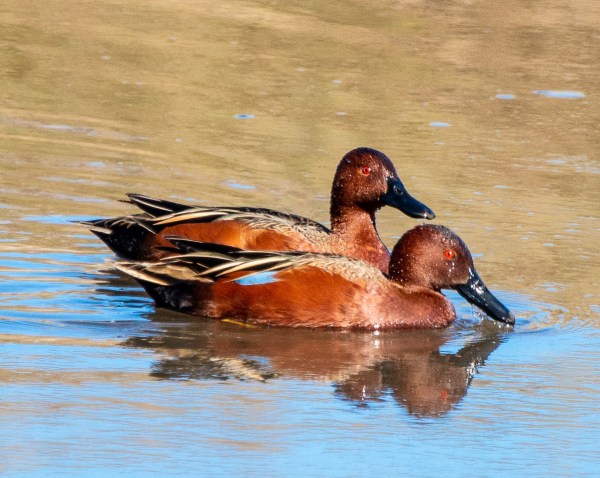
Cinnamon Teal have baby-blue secondary wing feathers and (look closely) olive-green feathers on their back (Ray Juncosa 2-24-19)
SMBAS canceled the regular monthly walk for Sunday, 22 March, due to the shelter-at-home order from California Governor Newson. No group meetings, stay six feet away from everyone else. This is impossible at Malibu due to the often-narrow paths, not to mention people wanting to look through the telescope. But conscientious individuals can still go out and get some birding in. Our president, Liz Galton, files this report. (Chuck Almdale, Ed.)
I wanted to tell you, before it all gets lost in the mists of history, that Jean and I did go to the Lagoon on Sunday. The morning was gorgeous — of course it rained heavily in the afternoon, but no sign of that while we were there.

Ring-billed Gull finds a strawberry (Grace Murayama 3-19-20 Malibu Lagoon)
We were there from nine to eleven, about. We didn’t count birds, but there were at least ten Cinnamon Teal pairs, shining in the sun. Not too many other ducks. Some Shovelers and Gadwall in the channel. Oh yes and Green-winged Teal. Seven Canada Geese too — noisy. A few Snowy Egrets, in couples. Lots of Cormorants, with double crests. Quite a few Killdeer, running around on the various shores, and between the path and the lagoon. A smattering of other shorebirds, Whimbrels, Godwits, Willets. I saw only one Black-bellied Plover.
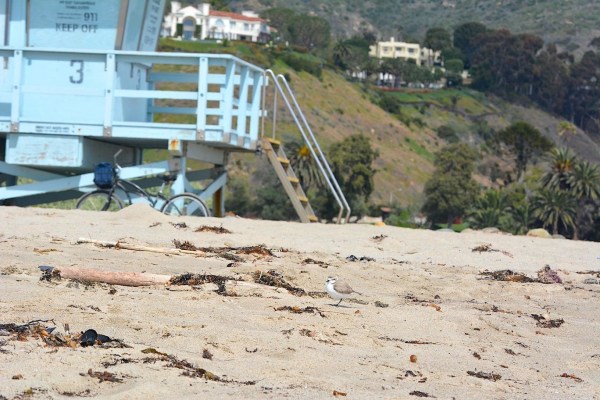
A lonely Snowy Plover by the westernmost lifeguard station on the beach
(Grace Murayama 3-19-20 Malibu Lagoon)

Snowy Plover checks out the photographer sneaking up behind them
(Grace Murayama 3-19-20 Malibu Lagoon)
I counted eighteen Snowy Plovers, but I think there were more, because when someone went by, they jumped up and scattered and it looked like more. A complement of gulls sleeping. Three terns — Jean said two Royals and one Elegant. The Royals were dressed to kill. Very smart black hairdos. The Pelicans were also in their Sunday Best, all except one, who may have been a juvenile. Our Osprey came and landed just fine on his usual perch, but could not fold his one wing properly; it seemed injured.

The Osprey claims a fish (Grace Murayama 3-19-20 Malibu Lagoon)
Some Sparrows, Song and White-crowned; Jean saw a Gnatcatcher. Other than the usual Crows and Rock Doves, I think that was it.
We had a lovely morning.
I hope everyone is both well and reasonably happy.
[Liz Galton]
Southern California has fourteen Audubon Chapters, each with their own membership areas, interests and activities. Pomona Valley Audubon Society (PVAS) is located about fifty miles east of Santa Monica and we don’t bump into each other very often. When I ran across their newsletter report on this Burrowing Owl project, I was very impressed and wanted to share it with our SMBAS members and readership, in the hope that it might spark similar projects elsewhere. Suzanne Thompson kindly supplied the photos and the following report, which is also on their blog. A small group can accomplish a lot when they put their minds to it. [Chuck Almdale, Ed.]
Burrowing Owls are small owls that use underground burrows for nest sites and shelter. These appealing birds have bullet-shaped bodies and long legs, giving the appearance of an owl popsicle, and engage in amusing antics such as turning their heads almost upside down to get a good look at birders who are trying to look at them. They are often out in daylight and thus are easier to observe than the rest of the owl clan.
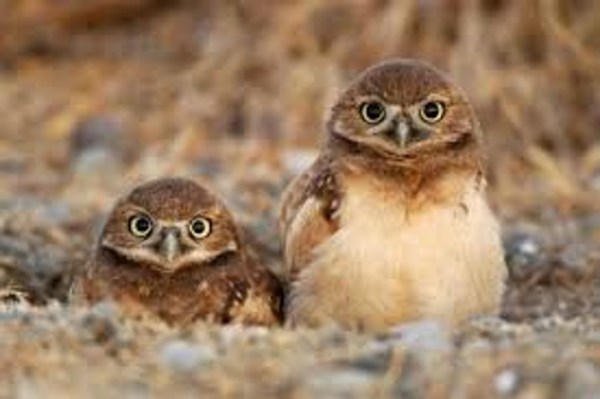
1. Burrowing Owls
At one time these owls were very common in California and, even as recently as 10 years ago, they were a common sight in the Chino and Ontario areas of the Pomona Valley. However, loss of habitat, the use of pesticides, and the killing of burrow-excavating ground squirrels have drastically reduced their numbers.

2. Eyes and Ears
Our Eyes and Ears on Burrowing Owls Project focuses on four areas in Chino and Ontario where there are still active nesting grounds for the owls: The goal is to maintain a healthy, viable breeding population of Burrowing Owls in the PVAS area. Each of the four nesting sites is critical because it currently supports or has the potential to support a significant number of active burrows. The areas are close enough for owls to travel between them, thereby promoting genetic diversity.

3. The Preserve Sign
A major focus has been the Burrowing Owl Preserve in Chino, a 24-acre site that was established about ten years ago to mitigate for the loss of owl habitat due to development. Owls nested in the artificial burrows initially but eventually the artificial burrows fell into disrepair and were no longer used. PVAS has established a collaborative relationship with the homeowners’ association that is responsible for the preserve.

4. Los Osos High School group
The restoration plan included the installation of eight new artificial burrows, weeding to remove invasive weeds, and the sowing of California native wildflower seeds. The work started in the fall of 2019 when high school students built the wooden burrow boxes in their shop class using the San Diego Zoo Research Institute plans for an improved burrow. PVAS members, along with college and high school students, got together for several weeding parties at the preserve to remove extensive stands of tumbleweed and other weeds. Replacing invasive weeds with native plants should attract more insects and lizards, thereby improving forage for the owls.
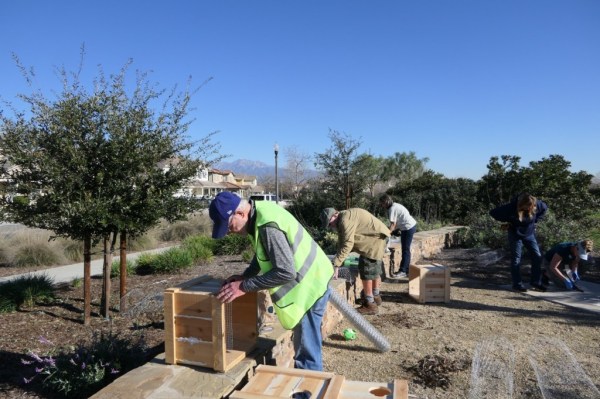
5. Finishing the boxes

6. Weeding the Slope
Over 55 volunteers attended the two burrow installation days in late January. Some volunteers completed the burrows, securing buckets to the lids so the burrows could be accessed for cleaning or banding, and adding hardware cloth, legs, and tubing. Others worked on weeding or removing brush.

7. A fully assembled nesting box and tube tunnels
A fully assembled box has two entrances and nineteen feet of tubing. The first three feet of tubing at the entrance is larger in diameter to create an “anti-predator patio.” This allows one or more owls to quickly run into the burrow if a predator appears. The narrower tubing closer to the box should stop predators from continuing down the tube and into the nest.

8. A mini-excavator from Southern California Edison

9A. Digging the trench and laying the tubing
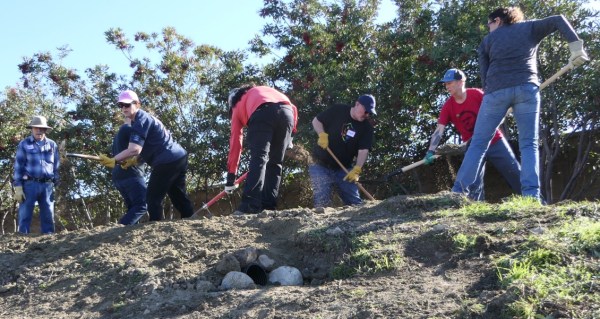
9B. Filling the trench, nest entrance below
Southern California Edison volunteers brought and operated a mini-excavator to dig most of the trenches. The excavator crew finished their work by early afternoon and teams of volunteers began covering the boxes and tubing with poultry netting and hand filling the trenches.

10. Digging by hand #1
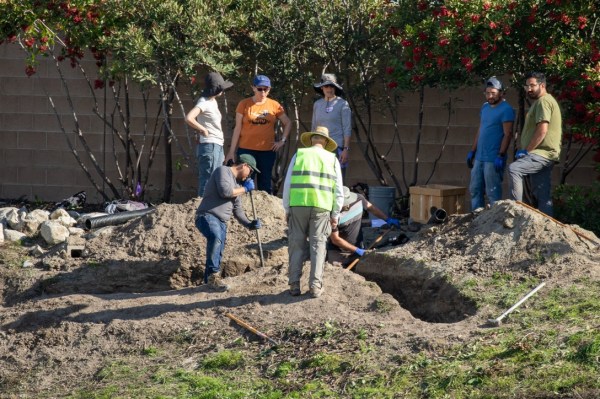
11. Digging by hand #2
The mini-excavator could not handle the very steep slope at the last installation site, so a crew of 10 volunteers hand dug those trenches in hard, compacted soil. After a day and half of hard work with shovels and pickaxes, the hand-dug trenches were finished, and the burrows and tubing were installed.

12. Burrow entrance
When the burrows are installed, all that shows above ground are the burrow entrances, two for each burrow.
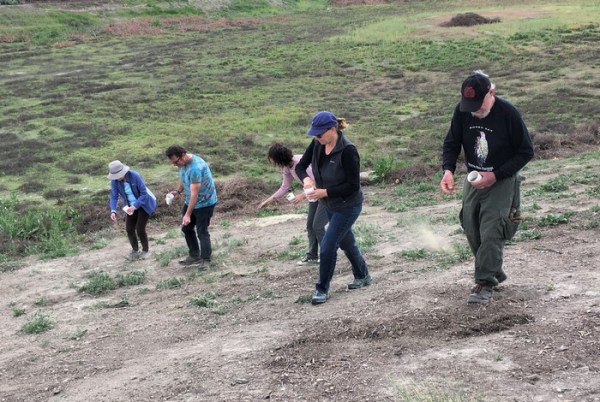
13. Seeding
In February, we waited anxiously for rain so the native plant seeds could be sowed. Finally, in early March, when some substantial rain was forecast, the seeds were spread and lightly worked into the ground.

14. Future Tenants
The future holds more weeding and seeding, the installation of low perches for the owls, and, we hope, Burrowing Owls moving into their new digs.
Above Text: Suzanne Thompson
Photo Credits: Carol Coy, Kim Dillbeck, Sherry Schmidt, Suzanne Thompson
Information contact: Suzanne Thompson, Chair, PVAS Eyes and Ears on Burrowing Owls



 SANTA MONICA BAY AUDUBON SOCIETY BLOG