Free email delivery
Please sign up for email delivery in the subscription area to the right.
No salesman will call, at least not from us. Maybe from someone else.
We here at SMBAS Blogsite Central are utterly certain that you simply aren’t getting enough information on all things COVID-19, so we voted democratically and decided to assign extra staff in order to help keep you informed on what you need to know.
Actually, the blog title is somewhat misleading. It doesn’t matter whether you’re a birder or not.
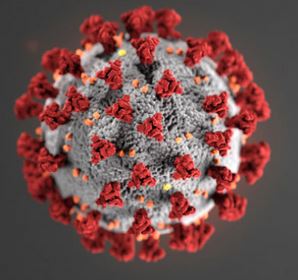
0.3 Microns. So small you can’t see it.
This blog contains nothing that you can’t find by going to this site:
https://ourworldindata.org/coronavirus
The information there come directly from the World Health Organization (WHO) and is updated daily. A few of their many interesting charts – some interactive – are shown below. Explanations and commentary are adapted – mostly shortened – from their website. We apologize for any blurriness of charts, the result of “snipping” screenshots. They are clear on the website https://ourworldindata.org/coronavirus.
Our World In Data has a great deal of information on many topics other than Corona virus, including: carbon footprints, 1918 Spanish Flu, population, safe sources of energy, cancer, less meat vs. “sustainable” meat. This is a site well worth your while.
[Chuck Almdale]
Growth: Country by country view
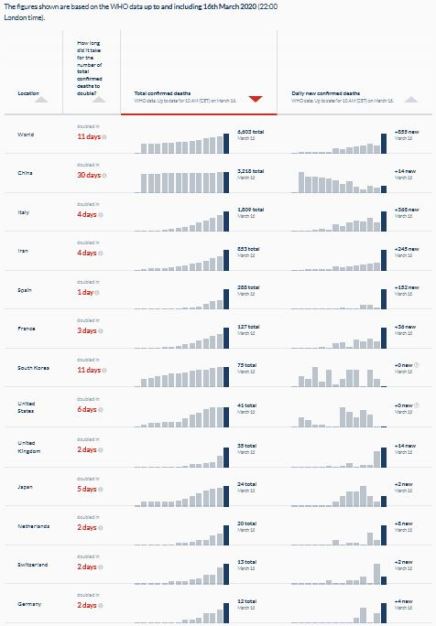
How long did it take for the number of confirmed deaths to double?
The table below also shows how the total number of confirmed deaths, and the number of daily new confirmed deaths has changed over the last 14 days. China seems to be dropping. On-line you can sort the table by any of the columns by clicking on the column header.
Screenshot – ourworldindata.org/coronavirus
Current COVID-19 test coverage estimates
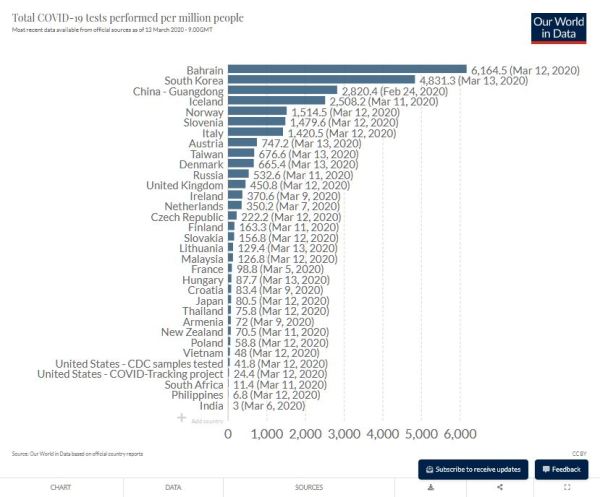
These are the most recent official estimates of tests we have been able to find as of 13 March 2020, 09.00 GMT. Note that the estimates refer to different dates for each country, as indicated in the brackets.
The chart below shows the number of tests relative to the size of the population: it is the number of total COVID-19 tests per million people. Available data shows that South Korea has done many more tests than any other country. This suggests that the number of confirmed cases in Korea is closer to the total number of cases than in other countries. It is therefore particularly encouraging to see that the number of daily confirmed cases in South Korea has decreased – here you find our chart that shows the decline of confirmed new cases in South Korea. The fact that South Korea has managed to expand testing so quickly shows that it is possible. Because testing is crucial it is important that in the coming days other countries follow.
The US, on the other hand, has experienced big problems rolling out their testing strategy and according to the US Centers for Disease Control and Prevention, only a total number of 13,624 samples had been tested by 12 March, 2020. The total number of tests conducted in South Korea up to the same date was nearly 18-times larger. The low test coverage of the US is even starker if we look relative to the large population of the country. We see many smaller countries have been able to conduct more tests per million people.
[NB. Two estimates provided for the US. The estimate labelled “US – CDC samples tested” is from the Centers for Disease Control and Prevention, and refers to the number of tests conducted, not the number of individuals tested. The COVID Tracking Project tracks the cumulative number of people tested in the US by tallying individual state reporting. We report these figures under the label “US – COVID Tracking Project”]
Screenshot – ourworldindata.org/coronavirus
Early data from China suggests that the elderly are most at risk
Understanding who within a population is most at risk is crucial in an outbreak. Understanding the relative risk to different sections of a population allows us to focus on the most vulnerable, and improve the allocation of health resources to those who need them most.
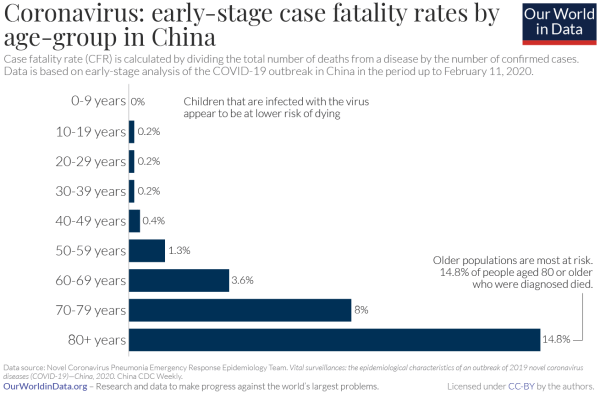
The Chinese Center for Disease Control and Prevention has published an analysis of recorded cases and deaths in China for the period until February 11th 2020 which provides a breakdown of all known cases, deaths and the CFR by specific demographics (age, sex, preexisting condition etc.).
A breakdown of the CFR by age group is shown in the visualization below. It shows very large differences of the CFR by age.
For many infectious diseases young children are most at risk. We see this for malaria: the majority of malarial deaths (57% globally) are in children under five years of age. The same was true for the largest pandemic in recorded history: During the ‘Spanish flu’ in 1918 it was primarily children and young adults who died from the pandemic (we write more about this in the article here).
For the COVID-19 cases in China the opposite seems to be true, at least based on the information available at the time of writing. The elderly are at the greatest risk of dying if infected with this virus. Based on the data from China – shown in the visualization – 14.8% of those who are 80 years and older who were infected by COVID-19 died as a result. As explained above, these figures represent the share of people diagnosed as having the disease who die from it. This does not represent the share of people in the entire population who die from it.
The case fatality rate for children is much lower. There were no reported deaths in children under 10 years old; 0.2% of those aged 10 to 19 years who were diagnosed with COVID-19 died from it according to the early Chinese data.
One possible reason why the elderly might be most at risk is that they are also those who are most likely to have underlying health conditions such as cardiovascular diseases, respiratory diseases or diabetes.
ourworldindata.org/coronavirus
The symptoms of COVID-19
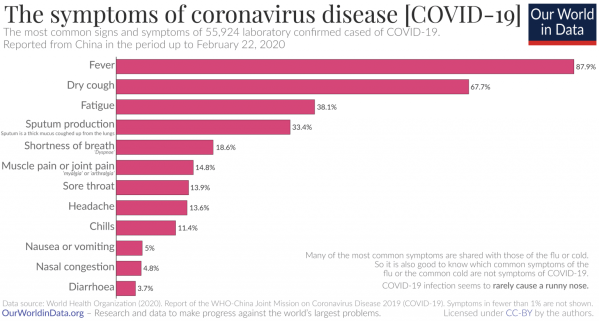
The WHO described the symptoms of 55,924 laboratory confirmed cases of COVID-19 in China in the period up to February 20. The visualization below shows this data.
It is most crucial to know the common symptoms: fever and a dry cough. As the visualization shows, close to 90% of cases had a fever and two-thirds had a dry cough. The third most common symptom was fatigue. Almost 40% of cases suffered from it. ‘Sputum production’ was experienced by every third person. Sputum is not saliva. It is a thick mucus which is coughed up from the lungs (see here).
Of the 55,924 cases fewer than 1-in-5 (18.6%) experienced shortness of breath (‘dyspnoea’). An earlier study, reported that a much higher share (55%) of cases suffered from dyspnoea, but this was based on a much smaller number of cases (835 patients). Many of the most common symptoms are shared with those of the common flu or cold. So it is also good to know which common symptoms of the common flu or the common cold are not symptoms of COVID-19. COVID-19 infection seems to rarely cause a runny nose.
ourworldindata.org/coronavirus
‘Flattening the curve’
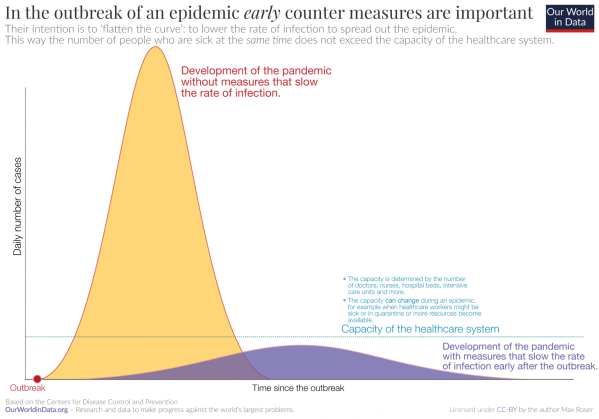
Early counter-measures are important in an epidemic. Their intention is to lower the rate of infection so that the epidemic is spread out over time such that the peak demand on the healthcare system is lower.
Containment measures are intended to avoid an outbreak trajectory in which a large number of people get sick at the same time. This is what the visualization shows.
This is the reason that limiting the magnitude of peak incidence of an outbreak is important. Health systems can care for more patients across an outbreak when the number of cases is spread out over a long period rather than condensed in a very short period.
What such counter measures to the pandemic attempt to avoid is that the number of patients at one point in time is so large that health systems fail to provide the required care for some patients
ourworldindata.org/coronavirus
Early data from China suggests that those with underlying health conditions are at a higher risk
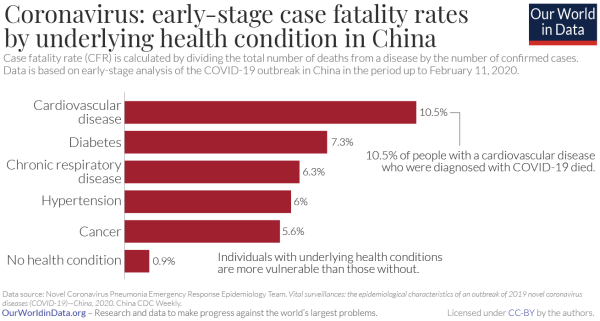
The visualization below shows the case fatality rate for populations within China based on their health status or underlying health condition.
The researchers found that the case fatality rate (CFR) for those with an underlying health condition is much higher than for those without. More than 10% of those diagnosed with COVID-19 who already had a cardiovascular disease, died as a result of the virus. Diabetes, chronic respiratory diseases, hypertension, and cancer were all risk factors as well, as we see in the chart.
The CFR was 0.9% for those without a preexisting health condition.
Three charts above we saw that the elderly are most at risk of dying from COVID-19. This might be partly explained by the fact that they are also most likely to have underlying health conditions such as cardiovascular disease, respiratory disease and diabetes; these health conditions make it more difficult to recover from the COVID-19 infection.
ourworldindata.org/coronavirus
How do case fatality rates (CFR) from COVID-19 compare to those of the seasonal flu?
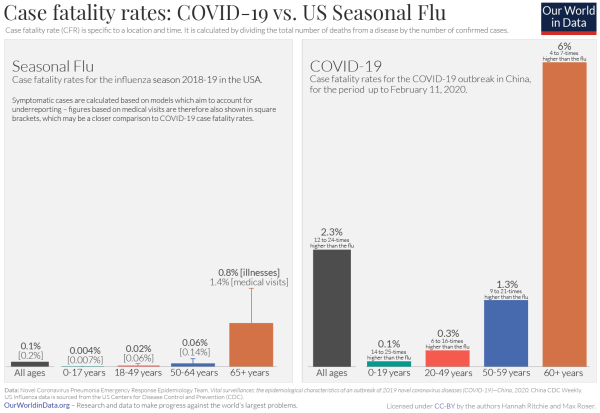
Comparing the CFR during the outbreak of COVID-19 in China with the CFR of the US seasonal flu in 2018-19.
The case fatality rate of the seasonal flu in the US is around 0.1% to 0.2%, while the case fatality rate for COVID-19, measured in the cited study, was 2.3%.
As calculated above, the global CFR for COVID-19 continues to change over time, and the global average CFR based on the WHO data is 3.4% (as of 9th March 2020). While the CFR for COVID-19 is much higher than the CFR of the seasonal flu the two diseases are similar in the profile of the fatality rate by age: elderly populations have higher case fatality rates. However, the CFR of COVID-19 is much higher for all age groups, including young people. On top of each bar we have indicated how much higher the CFR for COVID-19 is for each age group.
ourworldindata.org/coronavirus
Not every topic warrants a “both sides” approach. Some viewpoints are simply not backed by empirical evidence or are based on false information. And journalists have to be careful not to present them as legit debates. If they do, they are creating a “false equivalence.”
**What is false equivalence?
It’s when you set up two opposing sides of an argument, and make it look like they hold equal weight, when really, they don’t. And presenting both of these views as valid is a logical fallacy, or a “false equivalence.”
**Why do false equivalences happen in journalism?
When news is breaking, journalists are often faced with making decisions quickly, without much time for fact-checking. Propagandists — people who want to use the media to spread a particular cause or belief — often take advantage of the chaos of breaking news to spread rumors and conspiracy theories. They often create false social media accounts, and then use other false accounts to comments and like a post. Even trained journalists can fall for false posts when they are shared widely by real-looking accounts on places like Twitter or Facebook. False equivalences also happen when news outlets will invite two opposing “sides” on an issue to debate one another, but one side doesn’t rely on solid evidence to back their argument. Both sides are given equal air time and equal weight — creating a false impression of equivalence. The false argument will often spread on social media before it can be de-bunked.
** What role do social media companies play in spreading misinformation?
This is a hotly debated question, and companies like Facebook distribute more information than any other institution in history. While they are constantly changing their policies and algorithms in an attempt to slow down the spread of fake posts from dubious sources, they have yet to develop a consistent or effective way to combat the spread of misinformation on their platforms.
** What can I do to avoid falling for false equivalence?
Be skeptical — just because someone is on TV, or appears in a social media post doesn’t always mean that they are legitimate experts on a topic. Always check the sources they are citing. Are they citing research from well-regarded academic or journalistic institutions? Do their websites look legit? And check your own biases. Are you being critical of the information you’re consuming, or are you looking for something to prove what you already believe? Challenge yourself by reading an opposing point of view and analyzing their arguments.
ABOVE THE NOISE is a show that cuts through the hype and takes a deeper look at the science behind controversial and trending topics in the news. Hosted by Myles Bess and Shirin Ghaffary.
This series is aimed at teens, but after viewing a few episodes, I’m sure that most adults will benefit from it as well. Let us know what you think.
This is another installment of KQED’s Above the Noise series. If no film or link appears in this email, go to the blog to view it by clicking on the blog title above. If the film stops & starts in an annoying manner, press pause (lower left double bars ||) to let it buffer and get ahead of you. [Chuck Almdale]
Oystercatchers at Malibu Lagoon (and nearby)
Oystercatchers have become almost regular visitors to Malibu Lagoon in recent months. This is – in and of itself – unusual, but perhaps even more unusual are some of the individual oystercatchers themselves.
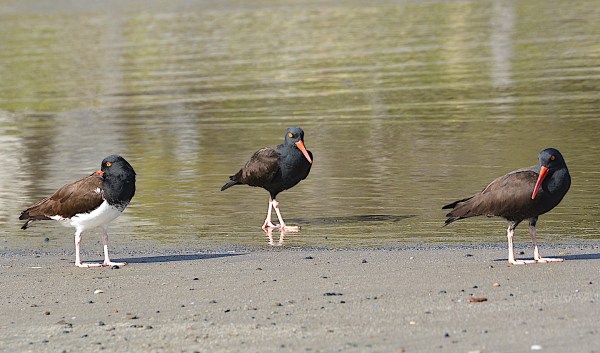
Three Oystercatchers (Grace Murayama 2-28-20 Malibu Lagoon)
Surfrider Beach and Malibu Lagoon do not have permanently exposed rocks, tide pools or stony jetties, the primary habitat for Black Oystercatcher. Yet Black Oystercatchers do visit from time to time. Occasionally we get an oystercatcher – perhaps not always the same individual – who looks like an American Oystercatcher, with white belly, breast, thighs, undertail coverts and perhaps a white band in the wings and across the top of the tail. Birders eager to tick off a new bird for the area, or for their life list, may tend to call it an American Oystercatcher, and look no further. But there’s a problem with that.
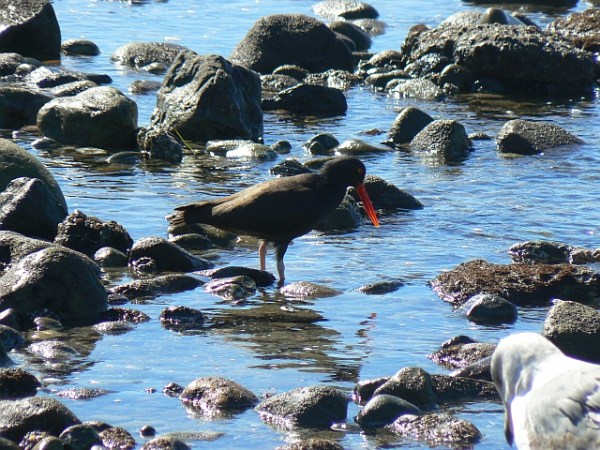
Black Oystercatcher f (Lu Plauzoles 2-27-11 Surfrider Beach)
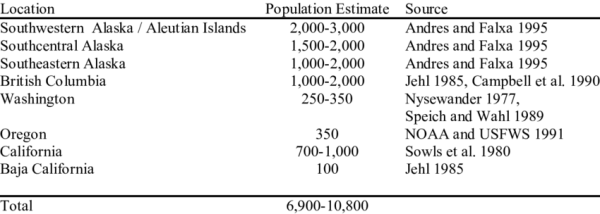
Rangewide population estimates number of individuals for Black Oystercatchers
Figure by Brad A. Andres, ResearchGate.com
Ranges Overlap: American Oystercatchers (Haematopus palliatus) are found on the eastern seaboard of the Americas from southern Maine to central Argentina and on the western seaboard from southern Chile to (roughly) Santa Barbara County, including the shores of Baja California and the Sea of Cortez (Gulf of California). Black Oystercatchers (Haematopus bachmani or H. bachmani) are found only on our west coast from the Aleutians to mid-way down the west coast of Baja California. These two oystercatcher species breeding ranges overlap on the west coast of Baja (see maps below). The American Oystercatchers breeding on Baja California and around the Sea of Cortez are of the Haematopus palliatus frazari subspecies (H. p. frazari.)
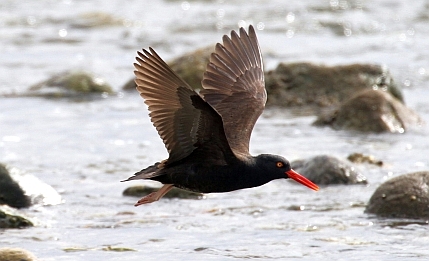
Black Oystercatcher (Randy Ehler 3-23-14 Surfrider Beach)
So far, so good. Complicating the issue is the fact that H. p. frazari (American) and H. bachmani (Black) breed with each other in their west Baja California common breeding area, they produce hybrids, H. p. frazari itself looks a lot like such a hybrid, and both the hybrids and H. p. frazari fly up to Southern California. SoCal birders are having a difficult time telling them apart.

Distribution of Black and American Oystercatchers
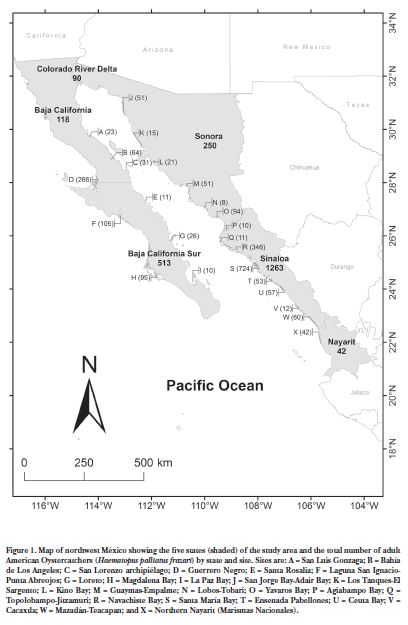
Breeding area of American Oystercatcher H. p. frazari (Baja Pub-Articulo-3618)
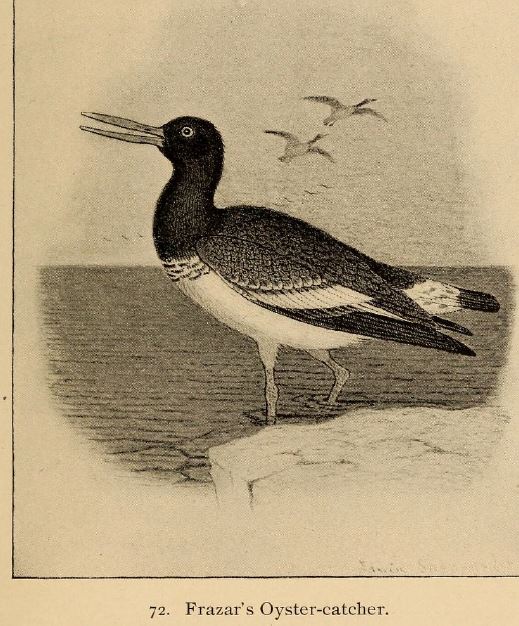
North American Shore Birds by Daniel Giraud Elliot, 1895.
biodiversitylibrary.org
Link to complete (downloadable) PDF article on Frazar’s Oyster-catcher from the above book.
H. p. frazari (American Oystercatcher) breeding on the shores of the Sea of Cortez do not interbreed with H. bachmani (Black Oystercatcher). Only H. p. frazari breeding on the west coast of Baja California, within the southern portion of the H. bachmani breeding range, have the opportunity to breed with H. bachmani. It is possible, but uncertain, if the nominate American Oystercatcher H. p. palliatus will occasionally fly across Mexico from the Gulf of Mexico and visit SoCal. (See photo below.)
SoCal can therefore get:
- (possibly) nominate American Oystercatcher H. p. palliatus from the Gulf of Mexico
- “clean” individuals of American “Frazar’s” Oystercatcher H. p. frazari from the Sea of Cortez
- hybrid Haematopus palliatus x bachmani from Baja California west coast
- Black Oystercatcher H. bachmani from its Baja to Alaska range
Simple, eh?
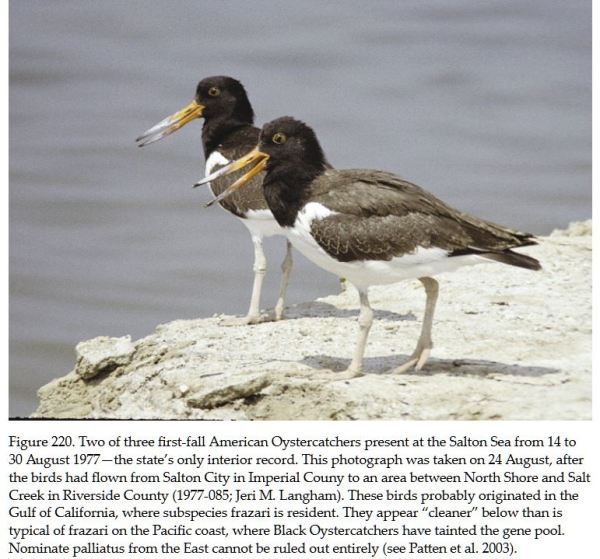
American Oystercatcher at the Salton Sea Aug. 14-30, 1977.
(WFOPublications.com Figures Tab)
Not so fast. Here’s a comment from an article on the Rare Birds of California (WFOPublications.org) website about American Oystercatchers in California:
Roberson (1993) noted that three different people assigned scores of 26, 27, and 29 to the 1863 specimen—values at the upper end of Jehl’s hybrid range (10–29). Jehl himself scored the specimen a 27, exemplifying the predicament faced by anyone attempting to judge the acceptability of borderline individuals.
[The WFO article also has a lengthy table of American Oystercatcher and/or hybrid sightings, and two photos (one hybrid; two American Oystercatchers, reproduced above). Read the article and check the photos.]
“Seagull Steve,” in his excellent posting Americanish Oystercatchers: Hybrids vs. frazari, has a similar comment when discussing the bird below.
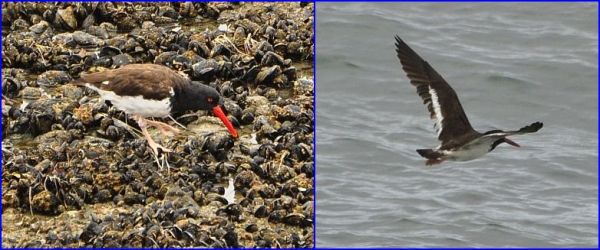
American (or hybrid) Oystercatcher bird B (Seagull Steve)
Scoring Bird B very conservatively (using other photos as well), the Jehl Scale gives it a 31. That’s a pure American Oystercatcher right there, despite the suspiciously narrow wing stripe and narrow tail band infused with dark feathering. At least, that’s what Jehl thinks it is. Me? I’m not convinced. I have no doubt that many birders (including good ones) would tick this as an American, but I personally feel like there are too many Black Oystercatcher genes getting expressed.
Even with the Jehl Scale in hand it’s not as straightforward as one might hope. I recommend that you read Steve’s entire posting. It’s well illustrated and succinct.
“Jehl,” refers to Joseph R. Jehl, Jr. Jehl did field research on American Oystercatchers breeding on the Mexican west coast and published his results in 1985 (Hybridization and Evolution of Oystercatchers on the Pacific Coast of Baja California. Joseph R. Jehl, Jr. Ornithological Monographs, No. 36, Neotropical Ornithology (1985), pp. 484-504). This paper is widely cited but is currently behind a paywall. [See abstract at the bottom of this posting, following the Jehl Scale.] He created a 42-point scale, now known as the “Jehl Scale,” to help differentiate the various oystercatchers. The complete scale is near the bottom of this posting. The scale certainly helps, but as the WFO citation and Seagull Steve’s comment above note, it is difficult for two observers to arrive at the same Jehl Scale score on simultaneous observations of the same bird.
You can print or download your own Jehl Scale and start separating these birds as uncertainly as do the experts. There are two options: either one page or two pages which you can print doublesided.
Oh, I almost forgot – there’s another complication. The Jehl scale lists ten plumage areas to look at: Upper Tail Coverts, Tail, Chest, Belly, Under Tail Coverts, Thighs, Greater Secondary Coverts, Extent of Primary Wing Stripe, Underwing Coverts, and Axillars.
Don’t count on being able to see them all. Perhaps the best you can is to end up with a partial score such as 17 out of 26 or 28 out of 38, instead of 31 out of the perfect world 42.
Following is a collection of frazari and/or hybrid photos taken at Malibu Lagoon/Surfrider Beach, plus one at nearby Las Flores Beach. Give it a go and rate them yourselves. I’ll give you my ratings below each. Most are incomplete; “skip” represents areas I couldn’t see. (Use my ratings for comparison purposes only; reliability unlikely.) I’ve also included some Haematopial factoids for your edification.
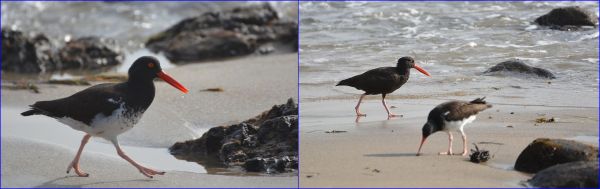
Bird #1 (Grace Murayama 12-9-15 Surfrider Beach)
Bird #1 12-9-15: Overall – 17 of 26. Upper Tail Coverts – skip, Tail – 0, Chest – 3, Belly – 6, Under Tail Coverts – 2, Thighs – 4, Greater Secondary Coverts – 2, Extent of Primary Wing Stripe – skip, Underwing Coverts – skip, and Axillars – skip.
Factoid #1 – Etymology. Haemotopus: Linnaeus. Greek haima “blood”; Greek pous “foot”; hence blood-red foot. H. backmani Audubon: after Audubon’s friend Reverend John Bachman 1790-1874. Audubon’s two sons married Bachman’s daughters. Also namesake of Bachman’s Warbler. Oystercatcher: Elliot Coues said, “Oyster-opener would be a better name, as oysters do not run fast,” a sentiment echoed by most other ornithologists familiar with the family. Name attributed to Mark Catesby, 1731.

Bird #2 (Bill Crowe 4-2-19 Surfrider Beach, eBird.com)
Bird #2 4-2-19: Overall – 19 of 26. Upper Tail Coverts – skip, Tail – 0, Chest – 3, Belly – 6, Under Tail Coverts – 4, Thighs – 4, Greater Secondary Coverts – 2, Extent of Primary Wing Stripe – skip, Underwing Coverts – skip, and Axillars – skip.
Factoid #2 – Etymology. H. palliatus Temminck: Latin palliatus “wearing a cloak” from the dark feathering of the back. H. p. frazari: citation from Brewster, 1888, for the collector of the first three specimens from the Baja California shore of the Sea of Cortez, north of La Paz.
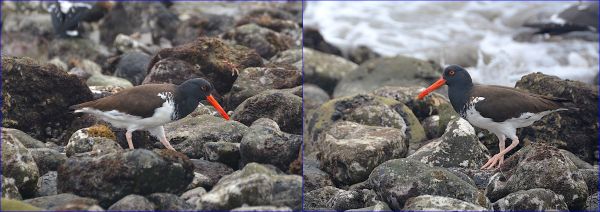
Bird #3 (Grace Murayama 1-20-20 Surfrider Beach)
Bird #3 1-20-20: Overall – 17 of 26. Upper Tail Coverts – skip, Tail – 0, Chest – 3, Belly – 6, Under Tail Coverts – 2, Thighs – 4, Greater Secondary Coverts – 2, Extent of Primary Wing Stripe – skip, Underwing Coverts – skip, and Axillars – skip.
Factoid #3 – American Oystercatcher food & foraging. Coastal habitats including sand or shell beaches, dunes, salt marshes, marsh islands, mudflats, and dredge spoil islands made of sand or gravel. During migration and winter, they are found feeding in mud, salt flats or shellfish beaches exposed by the tide. They feeds almost exclusively on shellfish and other marine invertebrates. Oysters are a staple of their diet, as their name suggests, but they also eat mussels, clams, limpets, sea urchins, starfish, crabs, and worms. In general, they use their bills to catch shellfish. [Wikipedia]
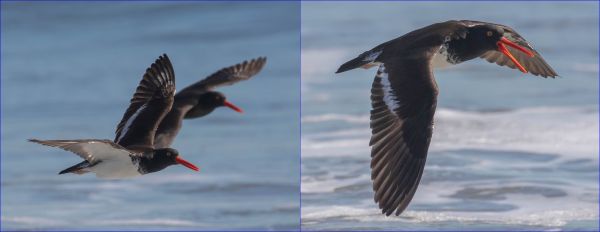
Bird #4 (Chris Tosdevin 2-01-20 Surfrider Beach)
Bird #4 2-01-20: Overall – 29 of 42. Upper Tail Coverts – 1, Tail – 0, Chest – 3, Belly – 6, Under Tail Coverts – 3, Thighs – 4, Greater Secondary Coverts – 3, Extent of Primary Wing Stripe – 2, Underwing Coverts – 3, and Axillars – 4.
Factoid #4 – Black Oystercatcher food & foraging. Restricted in its range, never straying far from shores, in particular favoring rocky shorelines. Perhaps seen mostly on coastal stretches which have quieter embayments, such as jetty protected areas. Forages in the intertidal zone, feeding on marine invertebrates, particularly molluscs such as mussels, limpets and chitons. It also take crabs, isopods and barnacles. It hunts through the intertidal area, searching for food visually, often so close to the water’s edge it has to fly up to avoid crashing surf. It uses its strong bill to dislodge food and pry shells open. [Wikipedia]
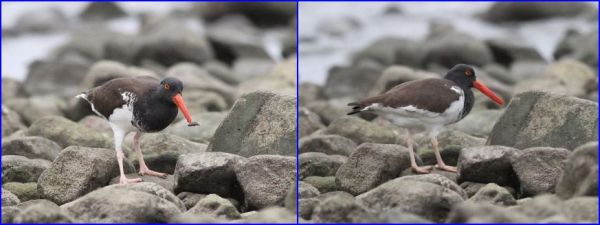
Bird #5 (Ryan Terrill 1-20-20 Surfrider Beach, eBird.com)
Bird #5 1-20-20: Overall – 20 of 30. Upper Tail Coverts – 1, Tail – 2, Chest – 2, Belly – 5, Under Tail Coverts – 4, Thighs – 4, Greater Secondary Coverts – 2, Extent of Primary Wing Stripe – skip, Underwing Coverts – skip, and Axillars – skip.
Factoid #5 – Word Hyphenation progression. In English, the progression is from a phrase or two separate words, to a hyphenated word, to a single word. Examples: Road of rails, Rail road, Rail-road, Railroad; Catcher of oysters, Oyster catcher, Oyster-catcher, Oystercatcher. [LonelyPlanet.com]
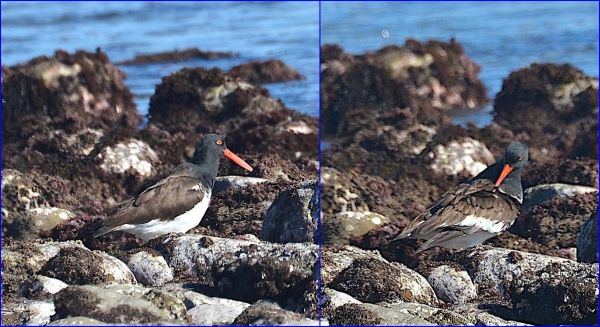
Bird #6 (Grace Murayama 2-07-20 Surfrider Beach)
Bird #6 2-07-20: Overall – 22 of 26. Upper Tail Coverts – skip, Tail – 1, Chest – 3, Belly – 6, Under Tail Coverts – 4, Thighs – 4, Greater Secondary Coverts – 4, Extent of Primary Wing Stripe – skip, Underwing Coverts – skip, and Axillars – skip.
Factoid #6 – Family Systematics. There are four world bird checklists: International Ornithological Committee / Union (IOC), Clements/eBird, Howard & Moore (H&M), and Handbook of Birds of the World (HBW). Each of them handles the species of the Oystercatcher family Haematopodidae differently. IOC and Clements list the same twelve species within the Oystercatcher family Haematopodidae, although in different sequences. H&M has the same twelve in the same sequence as IOC, but adds the Ibisbill. HBW lists only ten species.
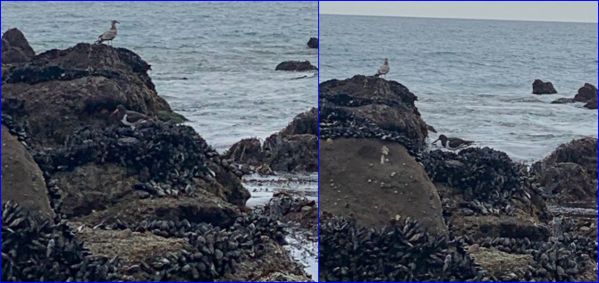
Bird #7 (David Youmans’ friend 2-09-20 Las Flores Beach)
Bird #7 2-09-20: Overall – 23 of 26. Upper Tail Coverts – 3, Tail – 3, Chest – 4, Belly – 6, Under Tail Coverts – skip, Thighs – 4, Greater Secondary Coverts – 3, Extent of Primary Wing Stripe – skip, Underwing Coverts – skip, and Axillars – skip.
Factoid #6 – Species & Ranges. The twelve species in the IOC order and their ranges are: Magellanic Oystercatcher, Haematopus leucopodus, sc. Chile to Falkland Is.; Blackish O., H. ater, n. Peru to Falkland Is., winters to Uruguay; Black O., H. bachmani, w. Aleutians to c. Baja Calif. & Los Coronados Is.; American O., H. palliatus, coasts & is. of N&S America, West Indies, Galapagos Is.; Canary Island O., H. meadewaldoi, Canary Is. extinct 1950; African O., H. moquini, coasts of s. Africa; Eurasian O., H. ostralegus, Iceland to e. Kamchatka Peninsula, winters to s. China & Africa; South Island O., H. finschi, highlands of South I. (New Zealand), winters to North I.; Pied O., H. longirostris, coastal Australia, Tasmania and s. New Guinea; Variable O., H. unicolor, coasts and is. of New Zealand; Chatham O., H. chathamensis, Chatham Is. e. of New Zealand; Sooty O., H. fuliginosus, coasts and is. of Australia-Tasmania.
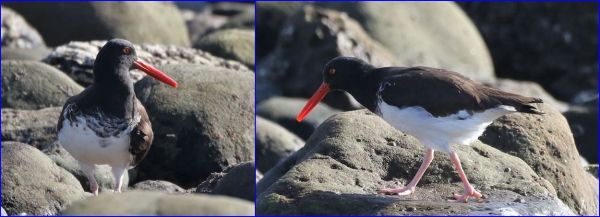
Bird #8 (Steve Hampton 2-15-20 Surfrider Beach, eBird.com)
Bird #8 2-15-20: Overall – 20 of 30. Upper Tail Coverts – 1, Tail – 1, Chest – 3, Belly – 6, Under Tail Coverts – 3, Thighs – 4, Greater Secondary Coverts -2, Extent of Primary Wing Stripe – skip, Underwing Coverts – skip, and Axillars – skip.
Factoid #8 – Checklist exceptions. The IOC lists the twelve oystercatcher species in the sequence given in Factoid #6 above. Clements’ sequence starts with the final three IOC species, then the preceding three, then the initial six. Howard & Moore uses the IOC sequence but at the end adds Ibisbill Ibidorhyncha struthersii, a long-legged long-billed bird restricted to stony areas of Himalayan mountain streams; the other three checklists put Ibisbill in its own monotypic family Ibidorhynchidae. Handbook of Birds of the World uses the IOC sequence, but considers Black Oystercatcher H. bachmani as a subspecies of Blackish O. H. ater of s. S. America, and South Island O. H. finschi as a subspecies of Eurasian O. H. ostralegus of Eurasia.
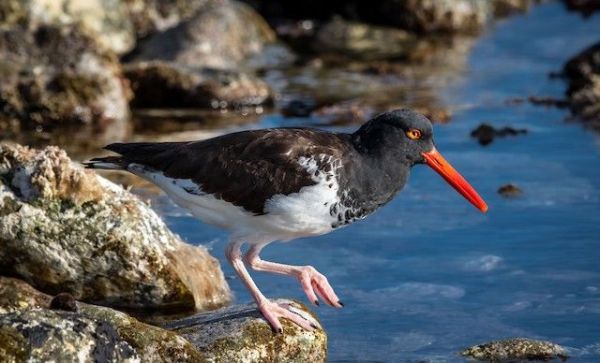
Bird #9 (William Box 2-24-20 Surfrider Beach ebird.com)
Bird #9 2-24-20: Overall – 20 of 30. Upper Tail Coverts – 1, Tail – 1, Chest – 3, Belly – 6, Under Tail Coverts – 3, Thighs – 4, Greater Secondary Coverts – 2, Extent of Primary Wing Stripe – skip, Underwing Coverts – skip, and Axillars – skip.
Factoid #9 – Species Distribution Pecularity. Five of the twelve species live only in Australia, New Zealand and nearby islands, a large diversity for a relatively small area. Four species inhabit only the Americas. One species covers all of Eurasia, one has southern Africa, and one species, now extinct, lived only in the Canary Islands off the NW coast of Africa.
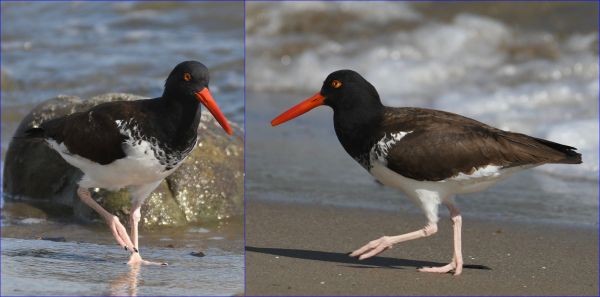
Bird #10 (William Tyrer 2-28-20 Surfrider Beach, eBird.com)
Bird #10 2-28-20: Overall – 18 of 26. Upper Tail Coverts – skip, Tail – 0, Chest – 3, Belly – 6, Under Tail Coverts – 3, Thighs – 4, Greater Secondary Coverts – 2, Extent of Primary Wing Stripe – skip, Underwing Coverts – skip, and Axillars – skip.
Some of the photos above are certainly of the same bird, but I’ll leave it to you to draw your own conclusions on that. My overall vote is a firm uncertainty.
Following the Jehl Scale below, at the bottom of this posting, is the abstract for Jehl’s 1985 paper Hybridization and Evolution of Oystercatchers on the Pacific Coast of Baja California.
[Chuck Almdale]
You can print or download your own Jehl Scale and start separating these birds as uncertainly as do the experts. There are two options: either one page or two pages which you can print doublesided.
| Jehl Scale – Score Total as Follows | |
| 0 – 9: Characteristic of Black Oystercatchers | |
| 10 – 29: Characteristic of Hybrids | |
| 30 – 38: Characteristic of American Oystercatchers | |
| Jehl | |
| Scale | Upper Tail Coverts |
| 0 | Black, as in bachmani |
| 1 | Black, a few white mottling |
| 2 | Nearly equally black and white |
| 3 | White, a few black mottlings |
| 4 | White, as in palliatus |
| Tail | |
| 0 | Black, as in bachmani |
| 1 | Mainly black, trace of white at base of vanes |
| 2 | Basal quarter of rectrices white |
| 3 | Basal third of rectrices white |
| 4 | Basal half of rectrices white, as in palliatus |
| Chest | |
| 0 | Black with black chest band extending smoothly onto midbelly, as in bachmani |
| 1 | Black chest band extending onto upper third of belly |
| 2 | Black chest band extending onto upper quarter of belly |
| 3 | Black chest band bordered by ragged edge on upper breast |
| 4 | Black chest band sharply delimited from white of upper chest, as in palliatus |
| Belly | |
| 0 | Blackish, as in bachmani |
| 1 | Blackish, with traces of white on a few feathers |
| 2 | Blackish, white area around crissum |
| 3 | 3/4 black, 1/4 white |
| 4 | Nearly equal black and white |
| 5 | 3/4 white, 1/4 black |
| 6 | Entirely white, as in palliatus |
| Under tail coverts | |
| 0 | Entirely black, as in bachmani |
| 1 | Mainly black with slight white mottling |
| 2 | Nearly equally black and white |
| 3 | Mainly white |
| 4 | Entirely white, as in palliatus |
| Thighs | |
| 0 | Entirely black, as in bachmani |
| 1 | Black with grayish underdown, NOT noticeable externally (skin) |
| 2 | Puffs of grayish down noticeable |
| 3 | Mainly white |
| 4 | Entirely white, as in palliatus |
| Greater Secondary Coverts (width of white edging in folded wing) | |
| 0 | White lacking, as in bachmani |
| 1 | Less than 2 mm |
| 2 | 2-5 mm |
| 3 | 6-15 mm |
| 4 | More than 15 mm |
| Extent of white wing stripe | |
| 0 | Lacking, as in bachmani |
| 1 | White markings confined to inner half of secondaries |
| 2 | White markings extend to outer secondaries but not to primaries |
| 3 | White present on some or all of inner five primaries |
| 4 | White present on a least one of primaries 6-10 |
| Underwing Coverts | |
| 0 | Entirely black, as in bachmani |
| 1 | Mainly black, some white mottling |
| 2 | Nearly equally black and white |
| 3 | Mainly white |
| 4 | White, as in palliatus |
| Axillars | |
| 0 | Black, as in bachmani |
| 1 | Mainly black, some white mottling |
| 2 | Nearly equally black and white |
| 3 | Mainly white |
| 4 | White, as in palliatus |
_______________________________________________________________________________________________
Hybridization and Evolution of Oystercatchers on the Pacific Coast of Baja California
Joseph R. Jehl, Jr.
Ornithological Monographs
No. 36, Neotropical Ornithology (1985), pp. 484-504
https://www.jstor.org/stable/pdf/40168300.pdf?seq=1
ABSTRACT
The ranges of the Black Oystercatcher (Haematopus bachmani) and the American Oystercatcher (Haematopus palliatus frazari) overlap for approximately 480 km along the Pacific coast of Baja California. Phenotypes are variable, especially in coloration, and hybridization has long been known. Yet, at most localities parental morphs predominate, hybrids are uncommon, and assortative mating occurs when possible. The historical record is sufficiently detailed to allow demonstration of changes in the hybrid zone. At the turn of the century–or whenever they were first studied–most populations were composed largely of parental morphs. After intensive collecting, resulting in the virtual extermination of some populations, recolonization occurred from both north and south. The reconstituted populations differed from the original ones, and by the 1920s and 1930s the frequency of hybridization was high. Recently, however, many populations have returned to their original composition. The prevalence of parental forms, a demonstration of assortative mating, and the resumption of stability in the zone of hybridization after a period of dynamic change, all show that there is selection against hybridization in this zone of secondary contact and that the two forms are specifically distinct. The nature of the selective forces remains to be determined.
Canceled! Sepulveda Basin Sat., 14 March, 2020
No, not because of novel coronavirus Covid-19 and the ongoing zombie apocalypse.
But because of rain.
Both Woodley Avenue & Woodley Park were closed today.
Closure expected tomorrow as well.
Hey! It is a rain catchment basin!
Sometimes the water rises so high that only the street sign tops still show.
Sorry!
[Chuck Almdale – Trip Leader]

Dawn at the Sepulveda Wildlife Reserve (Joe Doherty)
Unfortunately, we get there a bit later, when we get there at all.
Despite cancellations and postponments elsewhere, this trip will go as scheduled
unless it’s actually raining at 8 AM start time.
The grass and crushed granite pathway will likely be damp. Use appropriate footwear.
Dawn at the Sepulveda Wildlife Reserve (Joe Doherty)
Unfortunately, we get there a bit later.
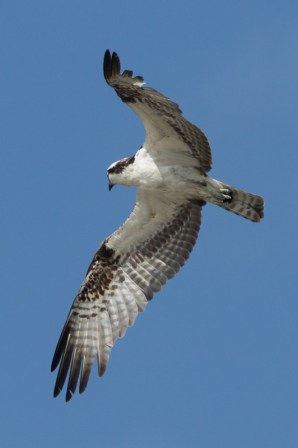
The Osprey has his own pondside platform (C.Bragg)
Only 15 minutes from Santa Monica, Chuck Almdale will show us around one of San Fernando Valley’s best birding spots, where – unless it’s become a giant lake from any recent rainfall – we’ll check the fields, pond, riparian areas and Los Angeles River for migrants and wintering birds. If we’re not too pokey we’ll make it over to Lake Balboa for Ross’s Goose and whatever else may be around. Expect ducks, raptors, herons, hummingbirds, woodpeckers, thrushes, flycatchers, wrens, corvids, kinglets, warblers, sparrows, blackbirds, finches and more. The whole kit and the caboodle!
Family Guide: 1-2 miles easy walking on level crushed granite path. Dress in layers, bring water & snack, wear footwear suitable for possibly damp paths.
Directions: SAN DIEGO FWY (I-405) north over the hill and past #101 Fwy to first exit at BURBANK BLVD. Go west (left) to WOODLEY AVE. Turn north (right) on WOODLEY AVE. to sign on right for WILDLIFE RESERVE AREA. Drive east, continue past the small traffic circle and meet at the last parking lot on the left. Bathrooms nearby. Arrive early and find the parakeets, Chipping Sparrows, Pine Siskins and maybe an immature Bald Eagle!
Meet at 8 a.m. at the parking lot
Leader: Chuck Almdale email: misclists@verizon.net
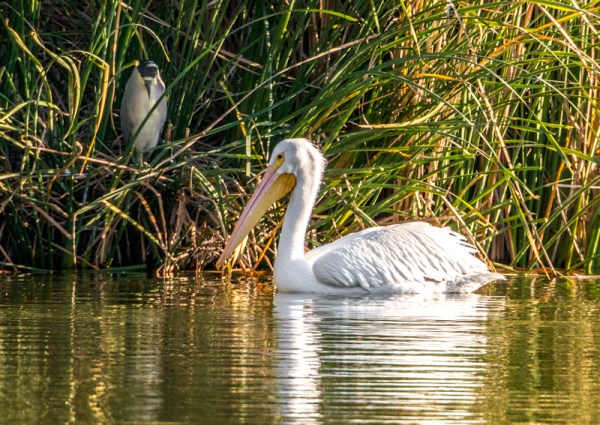
American White Pelican & Black-crowned Night-Heron (Ray Juncosa 12/12/15)



 SANTA MONICA BAY AUDUBON SOCIETY BLOG