Free email delivery
Please sign up for email delivery in the subscription area to the right.
No salesman will call, at least not from us. Maybe from someone else.
Why Women’s Voices Are Getting Deeper | PBS BrainCraft Video
This video dives into why women’s voices are getting deeper, a phenomenon that spans research in 1950s Australia to the 2012 Election in the U.S. Our perception of certain features of other people’s voices can lead us to behave in some strange and powerful ways – like voting for people who sound like they have more integrity.
This is an installment of the PBS – BrainCraft series created by Vanessa Hill. If no film or link appears in this email, go to the blog to view it by clicking on the blog title above. If the film stops & starts in an annoying manner, press pause (lower left double bars ||) to let it buffer and get ahead of you. [Chuck Almdale]
Peregrine falcons catch other birds mid-flight by diving at more than 200 mph. To do it, they need some high-precision gear: special eyesight, talons and aerodynamics that can’t be beat.
This is another installment of the PBS Deep Look series. If no film or link appears in this email, go to the blog to view it by clicking on the blog title above. If the film stops & starts in an annoying manner, press pause (lower left double bars ||) to let it buffer and get ahead of you. [Chuck Almdale]
Birds of the Mississippi River Delta | Cornell Lab of Ornithology
John Fitzpatrick, Director of the Cornell Lab of Ornithology, takes us on a bird-tour of the Mississippi River Delta. The Louisiana wetlands that they call home are fast disappearing.
A film from the Cornell Lab of Ornithology. If no film or link appears in this email, go to the blog to view it by clicking on the blog title above. If the film stops & starts in an annoying manner, press pause (lower left double bars ||) to let it buffer and get ahead of you. The Lab is a member-supported organization; they welcome your membership and support. [Chuck Almdale]
The Scientific Names of Birds
If you’ve ever wondered about the meaning, origin, or language of origin of a bird name, you need this book. If you write about birds and use their scientific names, you need this book. If you have an inquiring mind and the National Inquirer just isn’t doing it for you any more, you need this book.
 The Details: The Helm Dictionary of Scientific Bird Names: From Aalge to Zusii. Jobling, James A., London, 2010. Christopher Helm, an imprint of A&C Black Publishers Ltd. 432 pages.

Reduced by 41% from the perfectly clear and legible PDF file.
I’ve had this book for at least ten years, maybe twenty, which is possible as my copy was published in 1991 by Oxford University Press. I’ve referred to it hundreds of times. This newer edition is 432 pages, 47% longer than the 293 pages of my edition, so a lot was added.
The introductory section was expanded and now contains a short glossary in addition to comments on codes of nomenclature, priority of names, homonyms, gender, grammar, abbreviations and symbols. The bibliography is seven pages longer.
The actual dictionary section is 132 pages (52%) longer. I won’t even attempt to figure out what was added, but I know that a lot of new species and name changes occurred in the twenty years between these two editions.
The book is available at the usual on-line places. You know their names. Price ranges from $50-75, depending on bookstore and condition of the book.
Now here’s the mysterious part to me. You can also download a PDF copy of the book, all 432 pages plus title pages and the colorful cover for nothing. That’s right. Nothing. The link above leads you to a PDF file on a website called Cite Seer X, which may (or may not) be a product of the Pennsylvania State University College of Information Services and Technology. Whatever. Perhaps the author decided to make the book available for free as it was out-of-print and he didn’t feel like writing a new edition.
The address is: http://citeseerx.ist.psu.edu/viewdoc/download?doi=10.1.1.695.7104&rep=rep1&type=pdf

Reduced by 41% from the perfectly clear and legible PDF file.
Or you can click the link in the paragraph above.
Same difference.
A great companion to this book focuses exclusively on American birds, and is aptly titled: The Dictionary of American Bird Names, Revised Edition. Choate, Ernest A. Harvard and Boston, MA, 1985. The Harvard Common Press. 226 pages.
The dictionary of this book is divided into two sections: Common (English) Names and Scientific Names. The other book gives you only the Scientific name information.
From The Dictionary of American Bird Names:
Dunlin. AS dunn, “dark”; -lin (having dropped a terminal g), the diminutive suffix, giving us “the little dark one” for the bird in the breeding plumage. Formerly Red-backed Sandpiper. [Note: AS = Anglo-Saxon, circa 450-1200.]
Calidris. Merrem. Gr. calidris, “a gray speckled sandpiper.” The genera Crocethia, Eurentes, and Erolia are now merged in Calidris (1973). C. alpina (Linnaeus): DUNLIN or RED-BACKED SANDPIPER; L. alpina, “alpine,” for its breeding in an alpine-like climate which may be on the Arctic tundra as well as in the mountains. [Note: Merrem and Linnaeus created the scientific names to which they are attached. Gr. = Greek. L. = Latin.]
An Appendix gives short biographies of all the people for whom birds were named. For example, Anna’s Hummingbird was named for Anna, Duchess of Rivoli (1806-1896); wife of Prince Victor Massena, son of Marshal André Massena, Duc de Rivoli and Prince d’Essling, a marshal of France under Napoleon. John James Audubon met her in Paris in 1828 and was impressed by her beauty and charm. The type specimen of this bird was in the Duc’s collection, but in 1846 was acquired by the Academy of Natural Sciences of Philadelphia in 1846.
Now, don’t you feel better for knowing that?
There’s also a bibliography and a glossary of English bird names with their associated scientific names.
The American book is now 35 years old and may be hard to find. Buy one if you see it.
[Chuck Almdale]
California’s flightless duck Chendytes and our coastal lagoons, with Professor David Jacobs – Evening Meeting Reminder: Tuesday, 3 March, 7:30 p.m.
What is natural on our California Coast? How did the human-caused extinction of the flightless duck Chendytes lawi* change the ecology of our coast? What is the history of our small coastal lagoons, such as Malibu Lagoon: their hydrologic function, their endangered species, their potential for restoration?
It is well-known from the La Brea Tar Pits that not very long ago there were many different organisms in Los Angeles that are now gone, and consequently that there was a very different ecology. What is less well-known is that human activity significantly impacted the marine realm over these last few millennia, changing the players in our local Marine fauna. David will develop arguments relating to this theme centered around the extinction – about three thousand years ago – of California’s large flightless marine duck, Chendytes lawi.
We will then focus on the intriguing nature and function of our understudied coastal lagoons, which provide critical habitat for local endangered species. Even the smallest of these systems provide services and merit our attention, and there are many opportunities to mitigate human impacts on these systems.
David Jacobs is a UCLA professor with a background in biology and geology. He and members of his lab are interested in recent geologic, climate and anthropogenic processes and their influence on coastal landscape and biological evolution. Much of this work seeks to understand the past in order to better preserve our environment and biodiversity. At UCLA Dave is a member of the Ecology and Evolutionary Biology Department, the Earth Planetary and Space Science Department, and The Institute of the Environment and Sustainability.
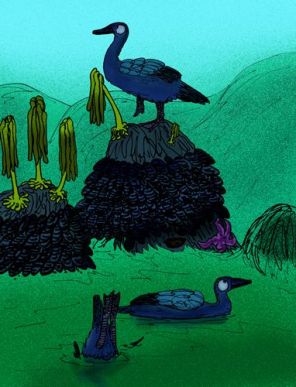
Flightless Sea Duck Chendytes lawi
(Apokryltaros at English Wikipedia)
*The flightless sea duck Chendytes lawi, originally thought to be related to mergansers but now recognized as related to the Anas genus of dabbling ducks (Mallard, etc.), disappeared about 2500 years ago. The duck had lived on the channel islands as early as 11,000 years ago and on the mainland 8,500 years ago. Humans exploited it for over 8000 years and eventually caused its extinction. This lengthy period of human exploitation has important implications concerning other North American Pleistocene megafauna extinctions. (From the abstract of a PNAS 2008 paper.) Also: Wikipedia article.
Article: Mitogenomics supports an unexpected taxonomic relationship for the extinct diving duck Chendytes lawi and definitively places the extinct Labrador Duck. Buckner, J.C.; Ellingson, R.; Gold, D.A.; Jones, T.L.; Jacobs, D.K.
Our meetings are at Christine Emerson Reed Park, 1133 7th Street. (between 7th St. & Lincoln Blvd., California Ave. & Wilshire Blvd.), Santa Monica. Previously known as Lincoln Park. If coming from outside Santa Monica, exit the #10 Fwy at Lincoln Blvd., turn north and drive 5 blocks north to Wilshire Blvd.
Meeting Room: Mid-park in Joslyn Hall, accessible from Lincoln Blvd, California Ave. and 7th St. Its glass wall faces north towards St. Monica Church on California St. If you’re walking from Lincoln Blvd., it’s located directly behind (west) of the large Miles Playhouse building. Not accessible directly from Wilshire Blvd.
Meetings begin at 7:30 sharp with a little business, and then our main presentation. Refreshments are served afterward. Please leave your coyote at home, however much they whine to come.
Parking: The entire block between Wilshire Blvd. and California Ave, 7th St. and Lincoln Blvd., on the sides closest to the park, is metered. $2/hour meter enforcement (except on Wilshire) ends at 6PM, so free parking for the meeting! However, the local natives are engaged in a survival-of-the-fittest scramble for free parking, so the after-6pm free parking spaces disappear quickly. We suggest that you arrive no later than 7:15 pm.
If all those spaces are filled, we found free parking as follows:
California Ave. between 6th and 7th
9th St. north of Wilshire Blvd.
10th St. north of California Ave.
Washington Ave. (next street north of and parallel to California)
If that fails, go south of Wilshire, not north of the park, as resident-only permit parking zones abound to the north. The east side of Lincoln Blvd. across from the park is by permit parking only. Spaces are more available on 7th St. or Lincoln south of Wilshire. Some of those are “until 9PM” meters also. You may need a flashlight to read & operate the meter. Wherever you park, please read parking signs carefully and avoid a big fat $40+ parking ticket. [Chuck Almdale]



 SANTA MONICA BAY AUDUBON SOCIETY BLOG