Free email delivery
Please sign up for email delivery in the subscription area to the right.
No salesman will call, at least not from us. Maybe from someone else.
Can You Follow This Beat? | PBS BrainCraft Video
Does the beat always beat you? Why some people can’t hear music.
This is an installment of the PBS – BrainCraft series created by Vanessa Hill. If no film or link appears in this email, go to the blog to view it by clicking on the blog title above. If the film stops & starts in an annoying manner, press pause (lower left double bars ||) to let it buffer and get ahead of you. [Chuck Almdale]
The Return of The Bride of the Son of the Far Side
For those who remember Gary Larson and his cartoon panel The Far Side, good news!
It’s baaaaaack.
Sort of. It’s online, at https://www.thefarside.com/ The first installment hit yesterday, Tuesday Dec. 17. It’s not in the newspapers or in books.
For those who are too young to know either Larson or the strip, now you can introduce yourself to what was considered by many at the time to be the best cartoon strip (panel, really) in America. The facts:
- It ran for only 15 years, from 1980 to 1995.
- In that time it went from a couple of papers to millions of readers and millions of books sold.
- This was all before computers, the internet and social media invaded every nanosecond of our lives.
- It was very science-oriented. Lots of animals, biologists, rocket scientists, amoebas, aliens and strange cows.
- It’s still difficult to find a scientist’s or professor’s office door that doesn’t have one of his cartoons taped to it.
- It’s now 24 years since Larson quit.
- Why did he quit? Largely because he got tired of everyone stealing his work and making money off it. Or as he puts it: “…when I slowly started realizing I had a second publisher and distributor of my work, known as Anyone With a Scanner & Associates...”
- Why is he back? Better equipment for better computer cartooning. Maybe this platform will help him to convince people to stop stealing his stuff. (Good luck with that!) And, despite the Russians hacking everything in sight and apparently itching to dig their fingers into his cartoon captions, he thinks there’s better security these days. (Yeah. Right.)
- The site will run a few of his oldies each day, but new items may start appearing.
I’d normally rip off one of his cartoons and plaster it here, for your entertainment and delectation, but I’ll restrain myself out of respect for Larson’s expressed wishes.
Don’t miss his explanatory letter.
[Chuck Almdale]
Every birder has binoculars, but not every birder knows or understands how to get the best results from them. In this article, I’ll be covering how to set up your binoculars, how to hold them, and how to wear them for optimal performance.
[NOTE: This is part II of an irregularly continuing series by long-time SoCal birder, professional guide, and optics specialist Steve Sosensky. Part I – Binoculars: What Are All the New Features and What Do They Mean to Me? – appeared last July.]
Setup
The first step in binocular setup is the initial positioning of the eyecups. Most modern binoculars have eyecups on the eyepieces that adjust up and down to get your eyes the proper distance from the eyepieces. Any bird-worthy binocular will have eyecups that twist up with click stops (detents) between fully up and fully down. If you don’t wear eyeglasses while birding, even if you wear contact lenses, start with the eyecups fully extended.

Eyecups fully extended when you don’t wear glasses
Eyeglass wearers should start with the eyecups all the way down. We’ll cover adjustments in a bit.
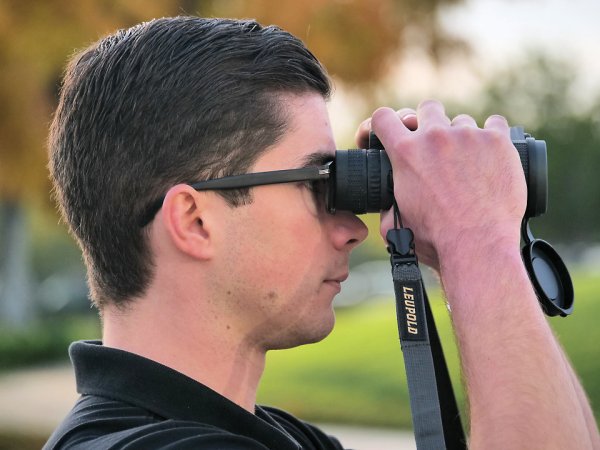
Eyecups fully down if you wear glasses
The next step is setting the interpupillary distance (IPD) to accommodate the distance between your eyes. To do this, look through the binoculars and adjust the distance between the eyepieces until you see one circle. Real binocular views don’t look like the figure 8 you see in the movies or on TV. If your eyes are very close together or very far apart, you should get your IPD measured before you buy your binoculars so you know what to look for in the binocular specification to determine whether the binocular will fit you.
Once you’ve set the IPD, it is time to adjust the diopter setting. Most people have eyes that focus differently between their left and their right. Eyeglasses correct for this difference, so eyeglass wearers should be able to leave the diopter setting at 0. If you wear glasses and both eyes do not focus individually with the diopter set to 0, the diopter setting may be off. Call 1-949-360-6789 or email us for help in testing this.
Diopter controls can be a ring on the right eyepiece or a control on or under the focus knob. In either location, there can be a mechanism that allows the control to lock in place, so it doesn’t change accidentally. Locate your diopter control and determine how it operates. Non-locking diopter controls will be very stiff. You may need to use a fair amount of force to move it.
Set the diopter to its neutral position. Close your right eye or cover the right objective lens and use the focus wheel to focus the binocular for your left eye. It is always best to focus on some text on a flat surface so you can tell when the focus is perfect. Then, without moving your feet or your posture, close your left eye or cover the left objective and focus for your right eye using the diopter control. Set the diopter lock if you have one or notice the position of the dial so you know how to reset it if it moves.
Holding Your Binocular
Holding your binoculars steady is critical to spotting and following birds efficiently. Many birders choose lower powered binoculars because they don’t think they can keep their binoculars from jiggling. In my experience, it’s their holding technique that needs alteration. Unfortunately, binocular manufacturers compound the problem by building in thumb rests that encourage improper technique.
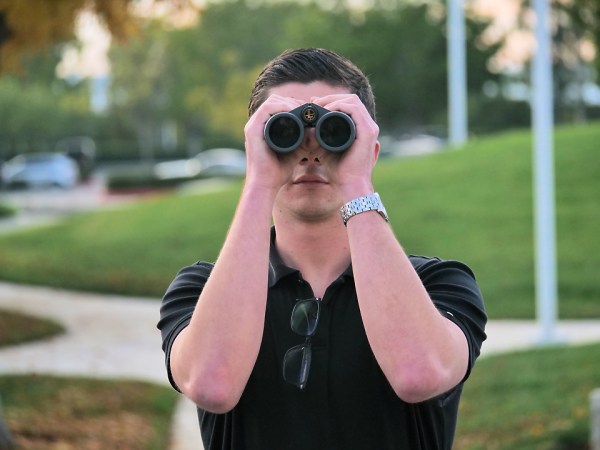
Supporting the binoculars on balls of the thumbs and heels of the palms
Most people hold binoculars with their elbows out to the sides and only their thumbs underneath the barrels. This posture gives very little support as the thumbs act as fulcrums for the binoculars to teeter on. A much more solid posture is to cock your wrists so that the binocular tubes rest on the heels of the thumbs and the heels of the palms. This creates a platform that is much more stable. It also brings the elbows into your sides for two more contact points to support your arms.
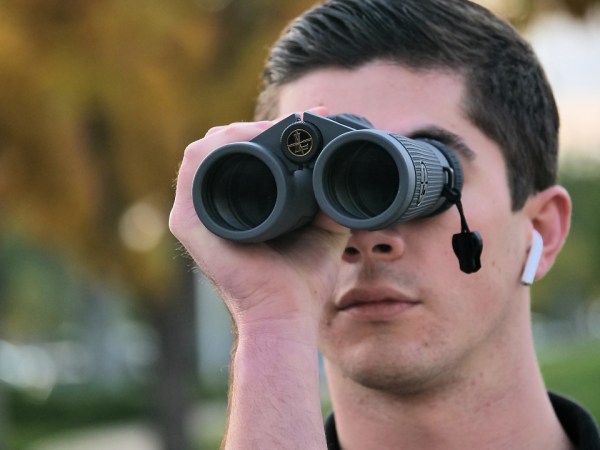
Support – One-handed, necessary at times
When viewing for a long time without a tripod, there are two more helpful techniques.
In the ballcap technique, grip the binocular as described above, then hook your middle fingers over the brim of a cap or hat. This further supports your arms as they tire.
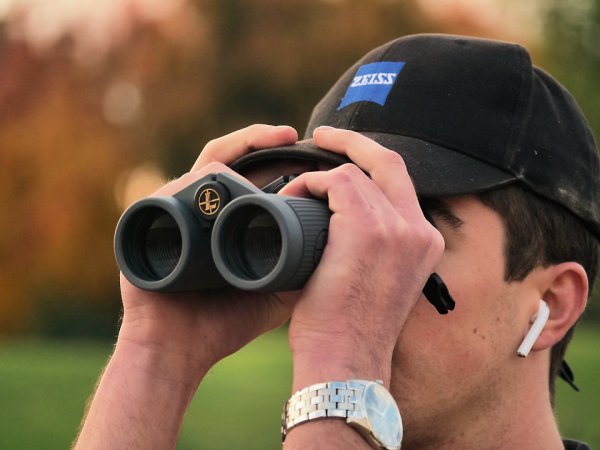
Stability – Ballcap technique
In the rifle sling technique, you wrap a long binocular strap or harness around your arms above the elbows and pull your elbows outward until the strap becomes taut across your chest. This technique is taught by the professionals in Nikon School as a way to hand hold long lenses when you need to be mobile.
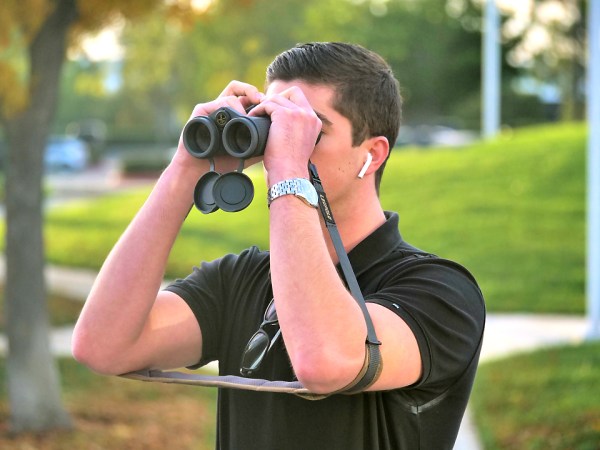
Stability – Rifle sling technique
Wearing Your Binocular
Beginning birders usually wear their binoculars using the neck strap that comes with the binocular. The problem is that even with a wide neoprene neck strap, the weight of the binocular is concentrated on the back of the neck, which gets tiring after as little as a couple of hours in the field. These days, more and more birders are wearing a binocular harness.
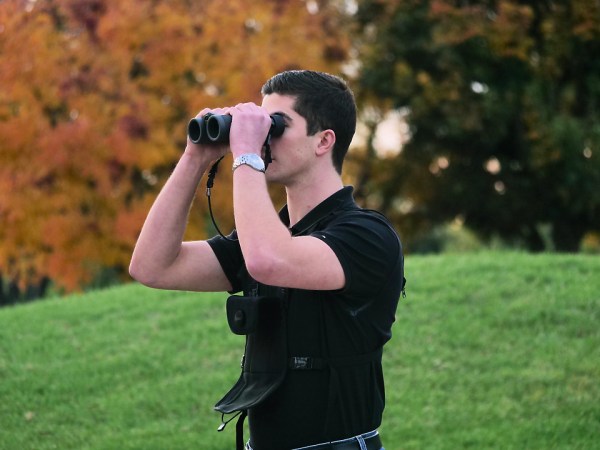
Binocular harness – in use
In most cases, a binocular harness is made of a leather patch that anchors two adjustable elastic straps between the wearer’s shoulder blades. Each strap has a plastic snap hook that slides along the strap enabling the binocular to be lifted into place. The basic harness has advantages over the neck strap in that the weight of the binocular is distributed over both shoulders rather than the back of the neck, and that it keeps the binocular closer to your body if you fall, run, or ride in a car on a bumpy road. You’re also less likely to put the binocular down and leave it somewhere.
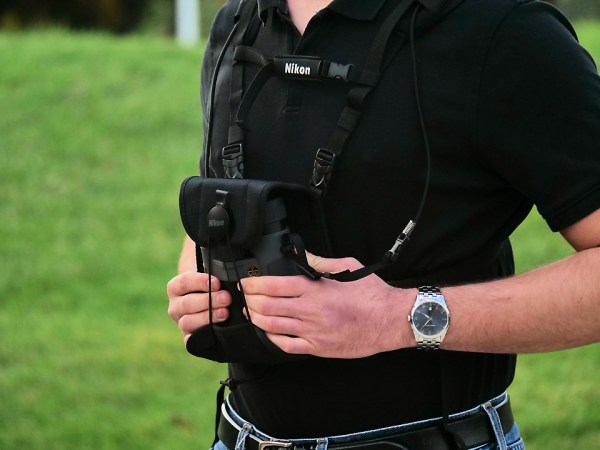
Binocular harness – closed for protection
Recently, more elaborate harnesses have been introduced. Some include a case that completely encloses the binocular, others are more open, yet still cover the binocular’s lenses, eliminating the need for objective lens covers and rainguards. Our current favorite is the Nikon Trex Exo Carry System. It is an open case style that has a hard flap above the eyepieces that keeps rain and debris from filling up the eyecups, and a flexible flap with an adjustable bungee cord latch to protect the objective lenses. This harness keeps the binocular well protected, yet ready for rapid deployment.
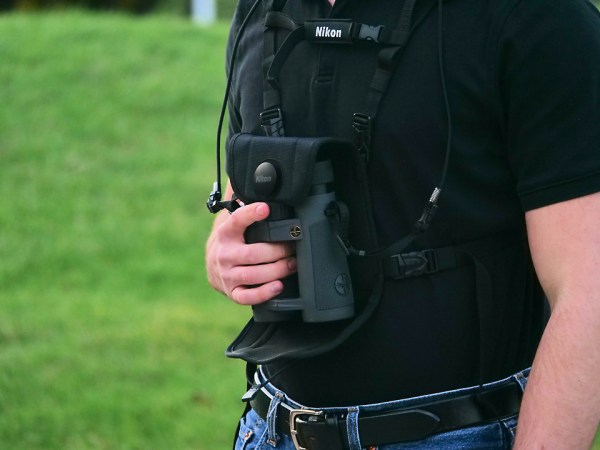
Binocular harness – unlatched & ready for use
Conclusion
These are the tips and tricks we’ve learned over the years that make nature observation more productive and less stressful. And, since we’re never too old to learn, we invite you to share other techniques that work for you.
[Steve Sosensky]
www.optics4birding.com
These Face Mites Really Grow on You | Deep Look Video
Yep, you probably have Demodex mites living on your face. These tiny arachnids feast on sebum, the greasy oil in your pores. But should you be worried about your eight-legged guests?
This is another installment of the PBS Deep Look series. If no film or link appears in this email, go to the blog to view it by clicking on the blog title above. If the film stops & starts in an annoying manner, press pause (lower left double bars ||) to let it buffer and get ahead of you. [Chuck Almdale]
The flyer below is correct.
Saturday Dec. 14 10am at Stunt Ranch
in the Santa Monica Mountains
The BioBlitz leaders and volunteers are assembling once again, this time in our local mountains. They welcome additional volunteers like you. See the flyer below.
Here’s what they say about themselves:
CALeDNA is a community-science program dedicated to mapping out and monitoring biodiversity across the entire state of California using environmental DNA (eDNA)— DNA shed by organisms as small as microbes and as large as whales! Join us this Saturday, December 14th at Stunt Ranch (1201 Stunt Road in Calabasas) for our last fall 2019 BioBlitzes. Here, we’ll collect soil samples with eDNA and try to identify as many species as possible with field guides, naturalists, and of course iNaturalist. All ages are welcome, no experience required! Our BioBlitz starts at 10AM and we welcome all birders, Audubon members and any others interested in citizen science.
You can read more about our program at www.ucedna.com and sign up for FREE at data.ucedna.com/events/
Questions? Email them at mnmunguiaramos@ucdavis.edu with the subject “CALeDNA Stunt Ranch BioBlitz 2019.” Looking forward to seeing all you volunteers this Sunday!”




 SANTA MONICA BAY AUDUBON SOCIETY BLOG