Free email delivery
Please sign up for email delivery in the subscription area to the right.
No salesman will call, at least not from us. Maybe from someone else.
The display of the Magnificent Riflebird shows how important minute details can be. The male abruptly fans one wing and then the next, using footwork to keep the female directly in front of him, where he can control what she sees. Interestingly, females may participate as well. Eventually the performance subsides into a nearly motionless pose as the male waits for the female’s decision. Filmed and photographed by Tim Laman, Ed Scholes, Eric Liner and Benjamin Clock.
There are currently seventy-two short films in the entire Birds-of-Paradise Project playlist, ranging from 26 seconds to 8:29. In the upcoming weeks, we will present some of our favorites.
A film from the Cornell Lab of Ornithology. If no film or link appears in this email, go to the blog to view it by clicking on the blog title above. If the film stops & starts in an annoying manner, press pause (lower left double bars ||) to let it buffer and get ahead of you. The lab is a membership-supported organization; your membership is welcome. [Chuck Almdale]
Three-way-hybrid American Wood Warbler Found in Pennsylvania
Please note that this is not an April Fool’s Day report.
I’ll say only than the hybrid’s mother seems to be a “Brewsters” Warbler, which is itself a hybrid between Blue-winged (Vermivora cyanoptera) and Golden-winged (Vermivora chrysoptera) Warblers. The father is a third species of warbler. Get out your field guide and read the fascinating article, including many photos, by GrrlScientist.
[Chuck Almdale]
Ballona Freshwater Marsh: 3 November, 2018

Cinnamon Teal male (Ray Juncosa, Ballona FWM, 11-3-18
Did you know or did you remember that years ago what is now the Freshwater Marsh was a weedy field and a center of contention among land owners in Playa del Vista, developers and advocates of the Ballona Wetlands?
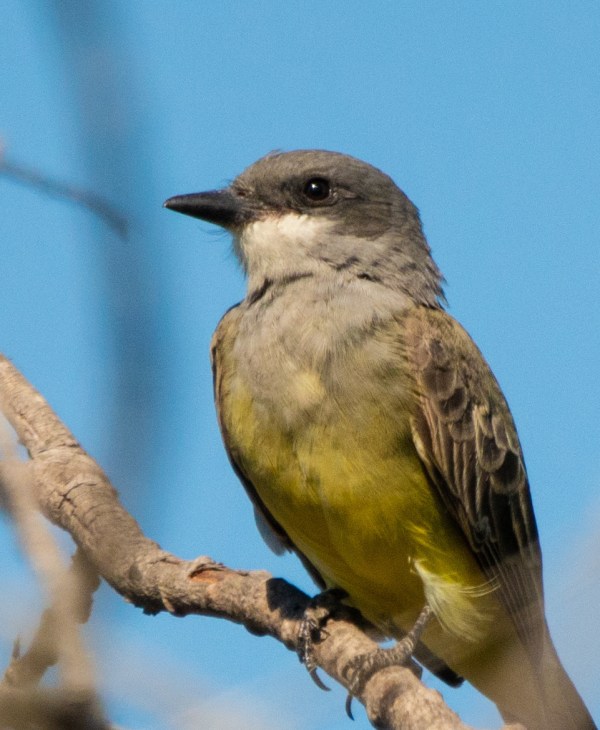
Cassin’s Kingbird with his or her white chin
(Ray Juncosa, Ballona FWM, 11-3-18
It was completed as the Freshwater Marsh in February of 2003 and wow! Look at it now!
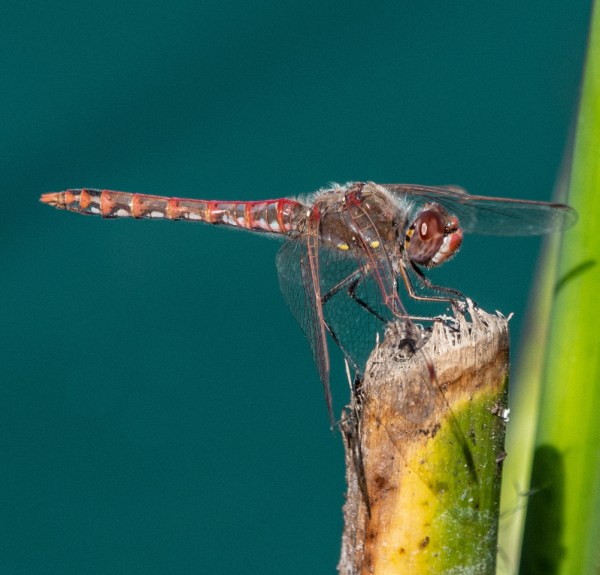
A tiny dragon momentarily perches (AKA Variegated Meadowhawk – Sympetrum corruptum) (Ray Juncosa, Ballona FWM, 11-3-18)
Our annual “stroll” around the marsh in lovely sunny weather was marked by seeing 47 different species – a far bigger number than seen in 2002.

Greater Yellowlegs (Ray Juncosa, Ballona FWM, 11-3-18

Yellow-rumped Warbler, Audubon’s subspecies (Ray Juncosa, Ballona FWM, 11-3-18
The group was quite interactive – everyone found something wonderful to show to the rest of us. One highlight was a Virginia Rail skulking in the reeds.

Virginia Rail caught mid-skulk (Ray Juncosa, Ballona FWM, 11-3-18
Another was a selection of Kingbirds – the expected Cassin’s and Western and a Tropical! There were discussions about a Yellowlegs (Greater or Lesser) and Dowitchers (Short-billed or Long-billed) – which and why.

Long-billed Dowitcher (Ray Juncosa, Ballona FWM, 11-3-18
A grand day and a grand group. [Ellen Vahan]
| Ballona FreshWater Marsh | November 3, 2018 |
| American Wigeon | Belted Kingfisher |
| Mallard | Northern Flicker |
| Cinnamon Teal | American Kestrel |
| Northern Shoveler | Black Phoebe |
| Green-winged Teal | Say’s Phoebe |
| Ruddy Duck | Tropical Kingbird |
| Pied-billed Grebe | Cassin’s Kingbird |
| Western Grebe | Western Kingbird |
| Great Blue Heron | Bushtit |
| Great Egret | House Wren |
| Snowy Egret | Blue-gray Gnatcatcher |
| Green Heron | Ruby-crowned Kinglet |
| Black-crowned Night-Heron | Hermit Thrush |
| Turkey Vulture | Northern Mockingbird |
| Osprey | Orange-crowned Warbler |
| White-tailed Kite | Common Yellowthroat |
| Red-tailed Hawk | Yellow-rumped Warbler |
| Virginia Rail | CaliforniaTowhee |
| Sora (Heard only) | Savannah Sparrow |
| American Coot | Song Sparrow |
| Greater Yellowlegs | White-crowned Sparrow |
| Long-billed Dowitcher | Red-winged Blackbird |
| Mourning Dove | Great-tailed Grackle |
| Anna’s Hummingbird | |
| Allen’s Hummingbird | Total: 48 species |
Birding Warblers | Cornell Lab of Ornithology
To help celebrate the annual arrival of spring migrants, Jessie Barry and Chris Wood from the Cornell Lab of Ornithology share their warbler-watching tips. Join Chris and Jessie as they explore a wood-lot in Rochester, New York. Click here to see the map and a full list of everything they saw.
A film from the Cornell Lab of Ornithology. If no film or link appears in this email, go to the blog to view it by clicking on the blog title above. If the film stops & starts in an annoying manner, press pause (lower left double bars ||) to let it buffer and get ahead of you. The Lab is a member-supported organization; they welcome your membership and support. [Chuck Almdale]



 SANTA MONICA BAY AUDUBON SOCIETY BLOG