Free email delivery
Please sign up for email delivery in the subscription area to the right.
No salesman will call, at least not from us. Maybe from someone else.
Cone Snails have an arsenal of tools and weapons under their pretty shells. These reef-dwelling hunters nab their prey in microseconds, then slowly eat them alive.
This is another installment of the PBS Deep Look series; this installment is adapted from the “It’s OK to be Smart” series. If no film or link appears in this email, go to the blog to view it by clicking on the blog title above. If the film stops & starts in an annoying manner, press pause (lower left double bars ||) to let it buffer and get ahead of you. [Chuck Almdale]
A new species? The Vogelkop Superb Bird-of-Paradise | Cornell / National Geographic
Sometimes a new species is hiding in plain sight…meet the Vogelkop Superb Bird-of-Paradise. Learn more about how the distinct song, dance and courtship appearance of the Vogelkop Superb Bird-of-Paradise confirms its new species status in our scientific paper: https://peerj.com/articles/4621
There are currently seventy-two short films in the entire Birds-of-Paradise Project playlist, ranging from 26 seconds to 8:29. In the upcoming weeks, we will present some of our favorites.
A film from the Cornell Lab of Ornithology. If no film or link appears in this email, go to the blog to view it by clicking on the blog title above. If the film stops & starts in an annoying manner, press pause (lower left double bars ||) to let it buffer and get ahead of you. [Chuck Almdale]
The Surprising Reason We Eat Spicy Food | PBS Science Video
People who live near the equator use more spices per recipe than people who live far from the equator. But that isn’t for the reason you think. Spices and other plant ingredients have special powers that make them a truly magical superfood!
This is an installment of the PBS – It’s OK to be Smart series. If no film or link appears in this email, go to the blog to view it by clicking on the blog title above. If the film stops & starts in an annoying manner, press pause (lower left double bars ||) to let it buffer and get ahead of you. [Chuck Almdale]
Through the Lens: Yellow-billed Loon | Cornell Lab of Ornithology
The Yellow-billed Loon is the largest and most spectacular of the world’s five loon species. It breeds around the globe in arctic and sub-arctic tundra lakes and is the northern counterpart to the Common Loon. Watch this rare video shot by The Lab’s Gerrit Vyn of a mated pair calling and foraging just after arriving on the partially frozen breeding grounds in Chukotka, Russia.
A film from the Cornell Lab of Ornithology. If no film or link appears in this email, go to the blog to view it by clicking on the blog title above. If the film stops & starts in an annoying manner, press pause (lower left double bars ||) to let it buffer and get ahead of you. The Lab is a member-supported organization; they welcome your membership and support. [Chuck Almdale]
Huntington Central Park – A Little Rain: Oct. 13, 2018 Field Trip
A rare rainy day seemed an inauspicious time for a bird walk, but five of us were willing to dampen our shoes and get rain spots on our binoculars. In spite of the concurrent Boy Scout Jamboree, which spread over even more of the park than last year and was very noisy, we saw quite a good number of birds.

White-faced Ibis (Ray Juncosa)
Fortunately, “bird whisperer” Chris Lord was along, and found and identified most of the birds. Much of the water was covered with green algae, which may have kept the ducks away. Most of what was swimming were American Coots, but there were Mallards, plus a few Gadwalls and American Wigeons. Egrets and herons were well represented, including a beautiful Green Heron, and one White-faced Ibis seemed to find a lot to eat. Seven peeps, too far away to identify, were pecking in the shallow water. A Belted Kingfisher swooped around.

Yellow-rumped Warbler (Ray Juncosa)
Warblers were mostly of the Yellow-rumped persuasion, but we also found Orange-crowned and Townsend’s Warblers and Common Yellowthroats. Raptors showed up also: a Cooper’s Hawk blended perfectly into a tree; we had also a Kestrel and a Red-shouldered Hawk. A pair of Northern Flickers, whom we heard early on, finally showed up on the ground between some dense trees.
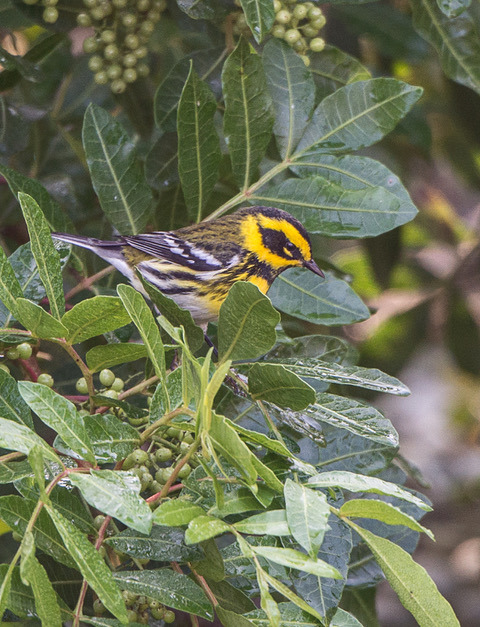
Townsend’s Warbler (Ray Juncosa)
Happily, the Scaly-breasted Munia, beautiful and well adapted immigrants, and a good reason for birding this park, were found early on. The flower garden boasted a few Hummingbirds, including Anna’s and Allen’s.

Hermit Thrust (Ray Juncosa)
A few Hermit Thrushes skulked in the undergrowth. All in all, 42 species was more than we thought we would see! [Elizabeth Galton]

Adult Red-shouldered Hawk in fine form (Ray Juncosa)
| Huntington Central Park | Bird List – Oct. 13, 2018 |
| Egyptian Goose | Black Phoebe |
| Gadwall | American Crow |
| American Wigeon | Common Raven |
| Double-crested Cormorant | Bushtit |
| Great Egret | House Wren |
| Snowy Egret | Blue-gray Gnatcatcher |
| Great Blue Heron | Hermit Thrush |
| Green Heron | American Robin |
| Black-crowned Night-Heron | Black-throated Gray Warbler |
| White-faced Ibis | Orange-crowned Warbler |
| Cooper’s Hawk | Townsend’s Warbler |
| Red-shouldered Hawk | Yellow-rumped Warbler |
| American Kestrel | Common Yellowthroat |
| American Coot | California Towhee |
| Peeps (too far to ID) | Song Sparrow |
| Anna’s Hummingbird | White-crowned Sparrow |
| Allen’s Hummingbird | Western Tanager |
| Belted Kingfisher | Brewer’s Blackbird |
| Downy Woodpecker | House Finch |
| Northern Flicker | Lesser Goldfinch |
| Pacific-slope Flycatcher | Scaly-breasted Munia |
| Compiled by Jean Garrett | Total Species – 42 |



 SANTA MONICA BAY AUDUBON SOCIETY BLOG