Free email delivery
Please sign up for email delivery in the subscription area to the right.
No salesman will call, at least not from us. Maybe from someone else.
Flying Drones in Malibu is Illegal…
…and has been for a while.
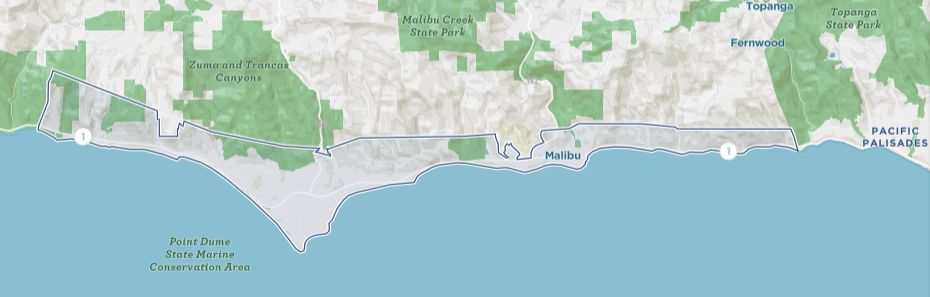
Blue (Malibu residential) and green (State Parks) areas are the local drone no-fly zone. hivemapper.com
Most drone pilots probably know this. After all, illegal areas are discussed in the leading drone publications – Rotor Drone and Drone Magazine. They publish links to maps showing where drones are legal and where they are not. That’s how we found the map shown above.
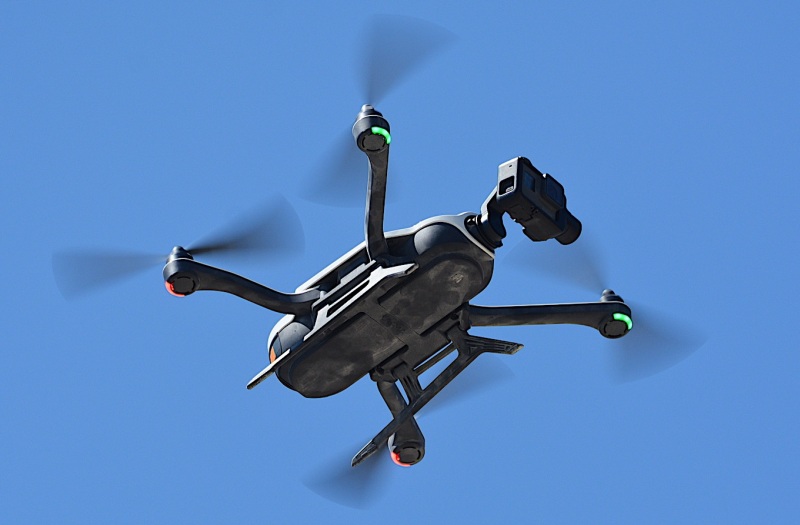
Drone at Malibu Lagoon (SMBAS 8-31-18)
Link to the hivemapper.com map.
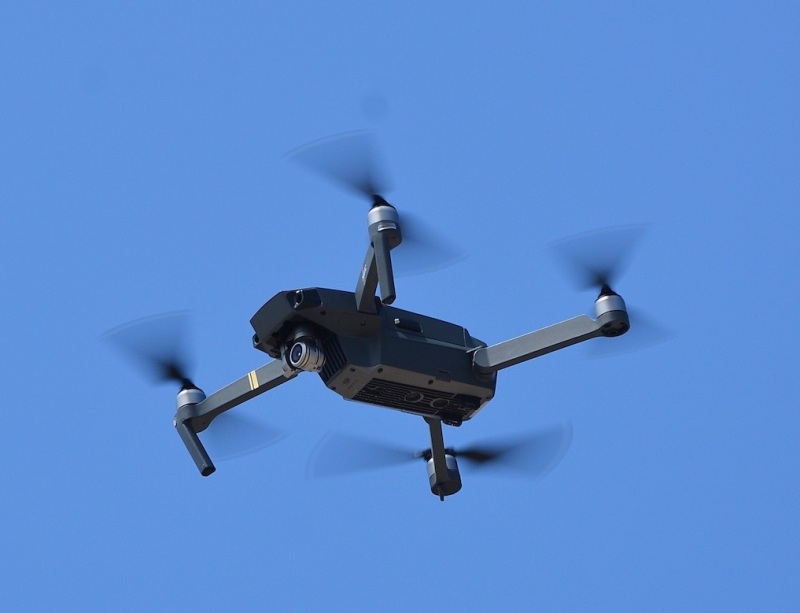
Drone at Malibu Lagoon (SMBAS Sep 7 2018)
But for the few drone pilots who don’t know, here’s a tip: they’re illegal in California State Parks. Anyone observing drones flying in any State Park should immediately call the State Parks dispatch operator (Sercom) at 951-443-2969.
They’re also illegal along the Malibu Coastline, between Pacific Coast Highway and the ocean, from:
- Eastern end: Western edge of Topanga State Park, just west of Topanga Cyn. Blvd.

Close-up of the east end of the (blue) drone no-fly zone.
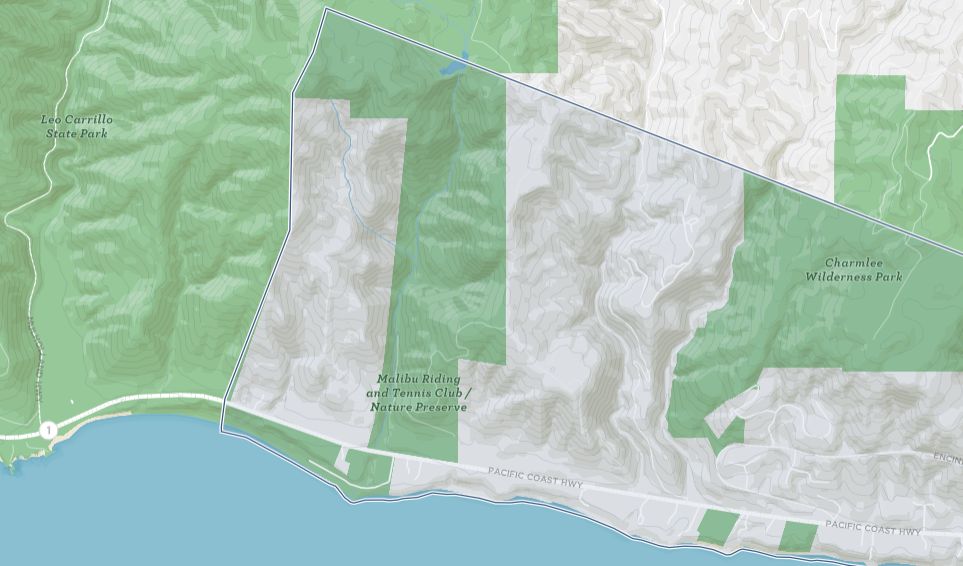
- Western end: Eastern edge of Leo Carillo State Park, just east of Mullholland Blvd.

Close-up of the west end of the (blue) drone no-fly zone.
- and well inland of PCH (see the first map)
- and the state parks.

Here’s a map of the middle area, showing Malibu Lagoon and Surfrider Beach (all no-fly zones).
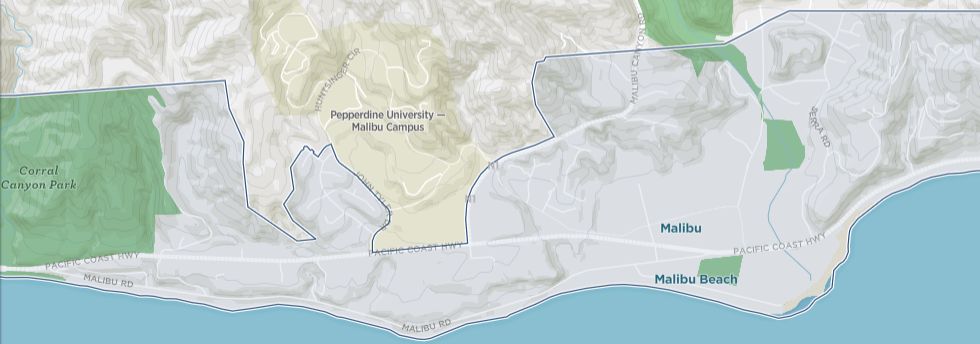
Close-up of the middle chunk of the (blue) drone no-fly zone.
The local movie stars and millionaires don’t want drone operators flying camera-carrying aircraft over their pools and patios any more than the rest of us, and they are undeniably pestered and snooped-at more than the rest of us. Fortunately for them, they were able to influence the passing of legislation making it illegal.
When a drone flies anywhere near the local roosting Snowy Plovers, they perceive the drone as a predator hawk or falcon and panic. [‘Roosting’ means resting or sleeping on the sand between high-tide feeding periods.] They’re trying to sleep. Imagine a lion walking into into your bedroom and staring down at you while you were trying to sleep in bed. You too might become alarmed, even panicked.
An SMBAS member who happened to witness the August 31 incident described it as follows:
Fastest flushing I’ve ever seen. The group flew, split up, some came back and landed for a few seconds, others flew over the ocean, carved figure 8’s over the surf zone, then split up, some flew to the east, some flew over the lagoon, some landed again inside the exclosure for a few seconds and then flew again.

Snowy Plovers disturbed by drone at Malibu Lagoon (SMBAS 8-31-18)
We’re posting this here because lately some drone pilots have been flying their drones within the residential area no-drone area of Malibu and simultaneously within the no-drone Malibu Lagoon State Park, and simultaneously illegally swooping it over the local population of state- and federally-listed threatened Snowy Plovers (one of only seven roosting colonies in Los Angeles County and one of only two breeding areas in Los Angeles County) and startling them into flight.

Snowy Plover resting in shade, Malibu Lagoon (L. Loeher 8-17-18)
This is not a good idea. You never know what some people are (or aren’t) thinking, but I know the State Parks people take a dim view of people startling this threatened species awake and spooking them into flight.
Anyone who sees a drone flying anywhere within the State Parks or the Malibu no-fly zone should immediately contact the local authorities. The State Parks dispatch operator (Sercom) is at 951-443-2969. We don’t know if the City of Malibu has a separate number for zones, but their non-emergency police/sheriff phone number is 310-456-6652 or 818-878-1808.
In fairness, State Parks needs to do more to let people know where drones are forbidden. As Malibu Lagoon and Surfrider beach are extremely popular – some two million people-visits per year – they could start right here and post prominent NO DRONES ALLOWED signs at the several beach entrances. The City of Malibu could post signs at their city borders.
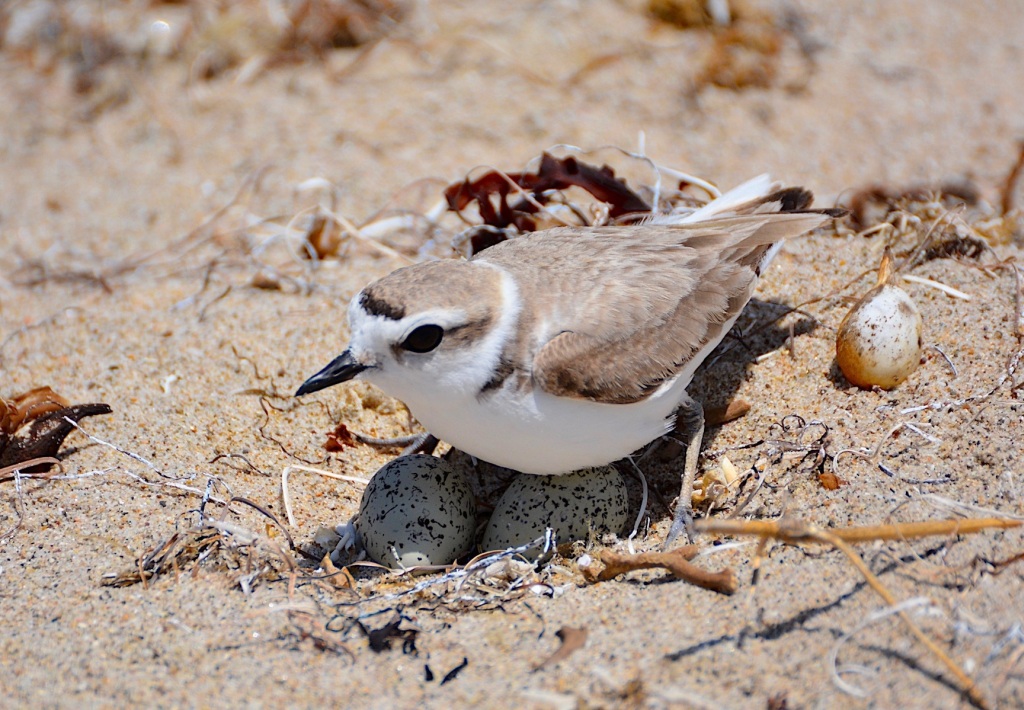
Snowy Plover mother in nest with 2 eggs, Malibu Lagoon (G. Murayama 6-1-18
We now have Western Snowy Plovers at Malibu Lagoon year around. Breeding season runs from late March – early July, although locally it seems to begin in April. Winter roosting season is the entire rest of the year. At last count (Sep 8 2018) there were 35 Western Snowy Plovers roosting on the beach. We have had as many as 80 birds at a time, and – except for the few birds staying to nest – they all leave by the end of April.

Snowy Plover mated pair near their egg at Malibu Lagoon (G. Murayama 6-29-18)
They’re very small, they’re very hard to see due to their cryptic plumage which looks just like the sand they’re resting on, and they’re only about 2500 of them in the entire world (the population of Snowy Plovers which nest in the U.S. interior and winters on the Gulf and Mexican coasts, may be a separate species and are not included).
That’s why Western Snowy Plovers are state and federally listed as threatened and that’s why there is a fence around their nesting/roosting area. That’s why we’re posting this blog, and that’s why Santa Monica Bay Aububon Society really hopes that people will keep themselves, their children and their dogs outside the protective fence. Nearly everyone does so – there are always a few who don’t – and we have been very pleased that the beach-goers have been extremely cooperative to date. If you are concerned about our planet and the non-human animals who share it with you, please continue to show your concern right here, in your own neighborhood.
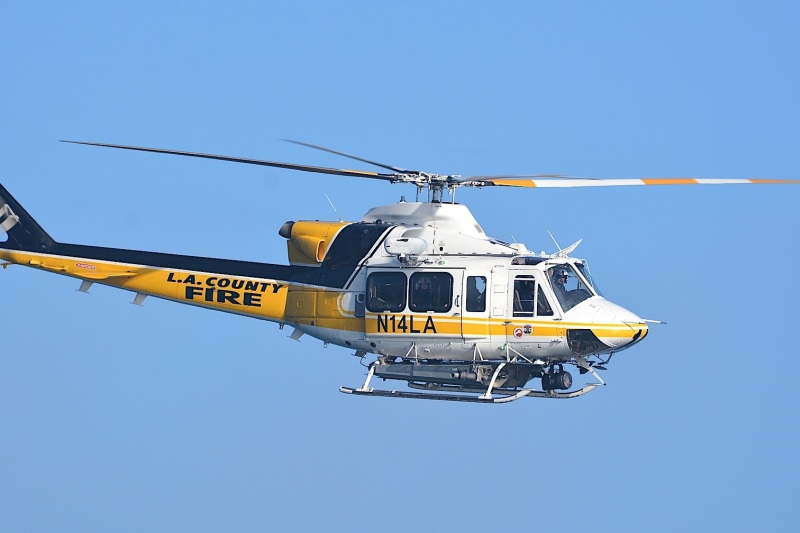
L.A. County Fire Dept. Helicopter flying extremely low over Malibu (SMBAS Sep. 8 2018)
And, while we’re on the subject of hovering vehicles, we don’t understand why the L.A. County Fire Dept. helicopter pilots feel they need to fly so close to the ground and ocean. Are they gawking at the girls? Volunteers on the beach observing the Snowy Plovers have long been advised: “You should note all helicopters flying below 600 ft. (~10x the height of the houses), note the description and tail number, photos are a plus.”
We hope they stop before they behead any paddleboarders. [Chuck Almdale]
Why Do We Itch? | PBS Science Video
It’s one of the most annoying sensations our bodies can feel, but does anything feel better than when you scratch an itch? Ok, maybe *some* things. But itching and scratching are up there. How does this weird sensation work? And what is itching for?
This is an installment of the PBS – It’s OK to be Smart series. If no film or link appears in this email, go to the blog to view it by clicking on the blog title above. If the film stops & starts in an annoying manner, press pause (lower left double bars ||) to let it buffer and get ahead of you. [Chuck Almdale]
Tracking Backyard Birds | Cornell Lab of Ornithology
The same technology used to locate lost pets is now being used to track common backyard birds. Scientists and students at the Cornell Lab have collected data on hundreds of thousands of feeder visits so far by Black-capped Chickadees and other birds. Tiny tags weighing less than one-tenth of a gram are attached to the birds’ legs and are detected each time the birds visit specially-rigged feeders. Watch this in which David Bonter describes the radio frequency identification (RFID) technique and what we can learn by keeping track of who’s coming to dinner.
A film from the Cornell Lab of Ornithology. If no film or link appears in this email, go to the blog to view it by clicking on the blog title above. If the film stops & starts in an annoying manner, press pause (lower left double bars ||) to let it buffer and get ahead of you. The Lab is a member-supported organization; they welcome your membership and support. [Chuck Almdale]
Upside-Down Catfish Doesn’t Care What You Think | Deep Look Video
You might suppose this catfish is sick, or just confused. But swimming belly-up actually helps it camouflage and breathe better than its right-side-up cousins.
This is another installment of the PBS Deep Look series; this installment is adapted from the “It’s OK to be Smart” series. If no film or link appears in this email, go to the blog to view it by clicking on the blog title above. If the film stops & starts in an annoying manner, press pause (lower left double bars ||) to let it buffer and get ahead of you. [Chuck Almdale]
World Shorebirds Day Reminder: 5 – 11 September, 2018
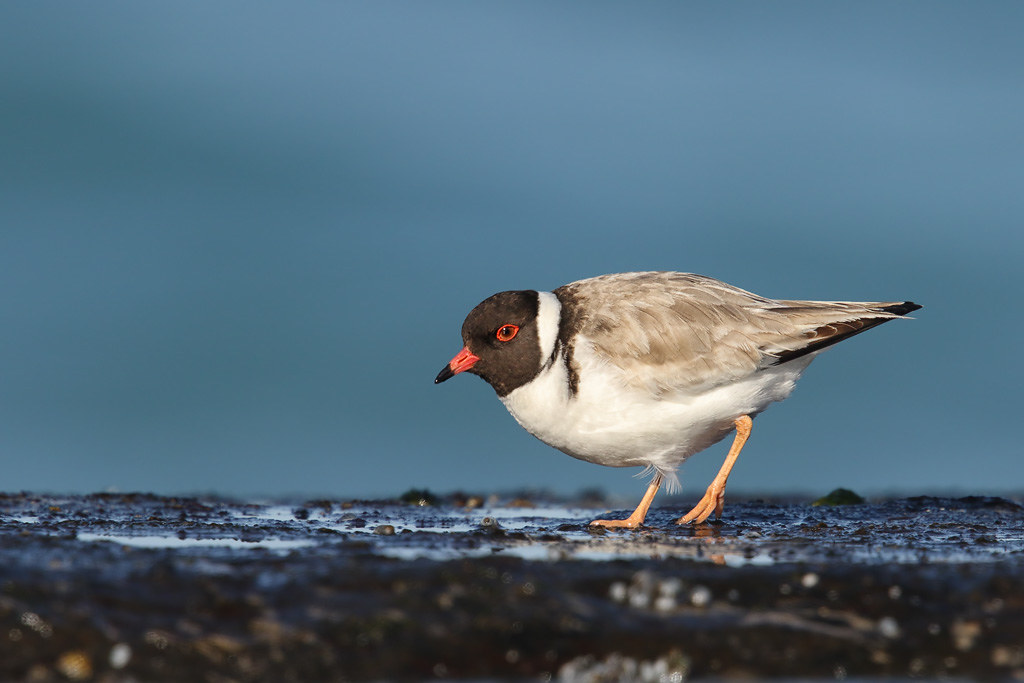
Hooded Plover, the ‘Shorebird of the Year’ in 2017, on the rock shelf next to Racecourse Beach at Ulladulla, Australia. © Leo Berzins
Here’s a message from one of our farther-flung SMBAS Blog readers,
Gyorgy Szimuly, from his home in Milton Keynes, United Kingdom.
********************************************************
The 4th World Shorebirds Day is here, right now, and we’d be delighted to see you in the field this weekend. If you feel the Global Shorebird Counting Program is an initiative worthy of your support, please register your counting location. Please find more details and important links on our blogsite.
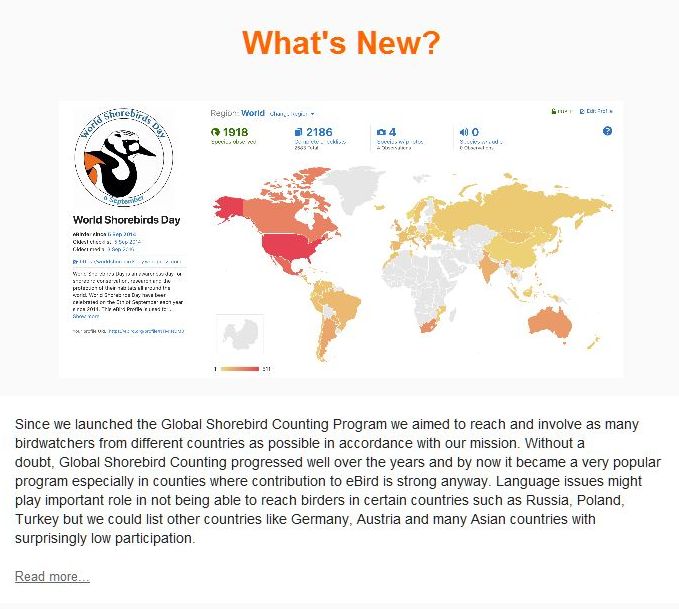
Read more about it here.
Download or view the poster-like announcement PDF file.
Gyorgy Szimuly
Milton Keynes, United Kingdom
Website: https://worldshorebirdsday.wordpress.com
[Posted by: Chuck Almdale]



 SANTA MONICA BAY AUDUBON SOCIETY BLOG