Free email delivery
Please sign up for email delivery in the subscription area to the right.
No salesman will call, at least not from us. Maybe from someone else.
Upside-Down Catfish Doesn’t Care What You Think | Deep Look Video
You might suppose this catfish is sick, or just confused. But swimming belly-up actually helps it camouflage and breathe better than its right-side-up cousins.
This is another installment of the PBS Deep Look series; this installment is adapted from the “It’s OK to be Smart” series. If no film or link appears in this email, go to the blog to view it by clicking on the blog title above. If the film stops & starts in an annoying manner, press pause (lower left double bars ||) to let it buffer and get ahead of you. [Chuck Almdale]
World Shorebirds Day Reminder: 5 – 11 September, 2018
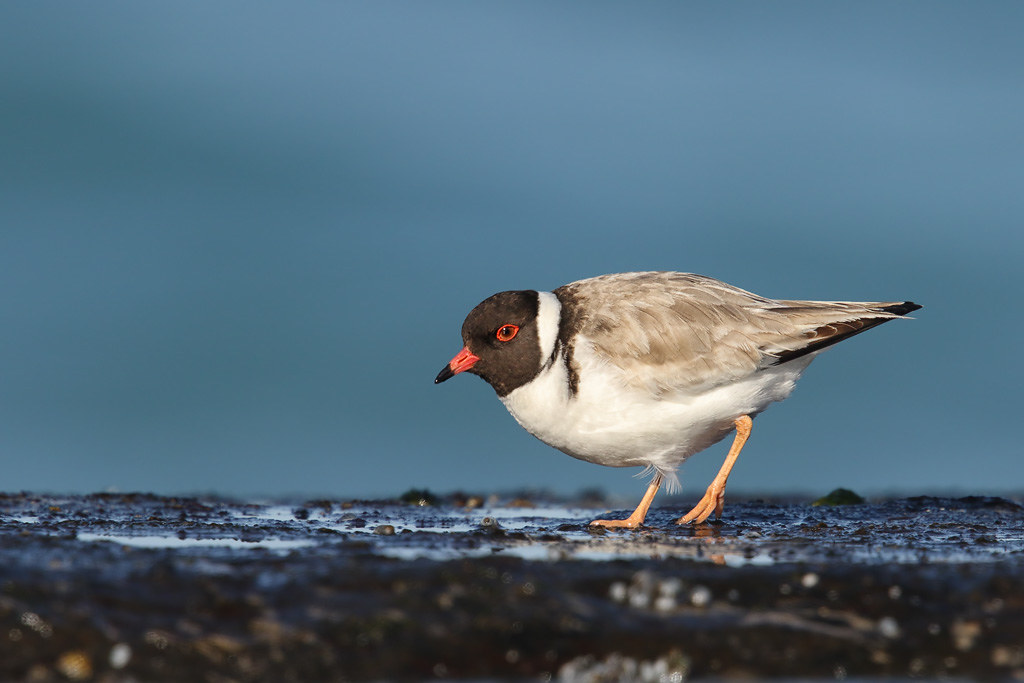
Hooded Plover, the ‘Shorebird of the Year’ in 2017, on the rock shelf next to Racecourse Beach at Ulladulla, Australia. © Leo Berzins
Here’s a message from one of our farther-flung SMBAS Blog readers,
Gyorgy Szimuly, from his home in Milton Keynes, United Kingdom.
********************************************************
The 4th World Shorebirds Day is here, right now, and we’d be delighted to see you in the field this weekend. If you feel the Global Shorebird Counting Program is an initiative worthy of your support, please register your counting location. Please find more details and important links on our blogsite.
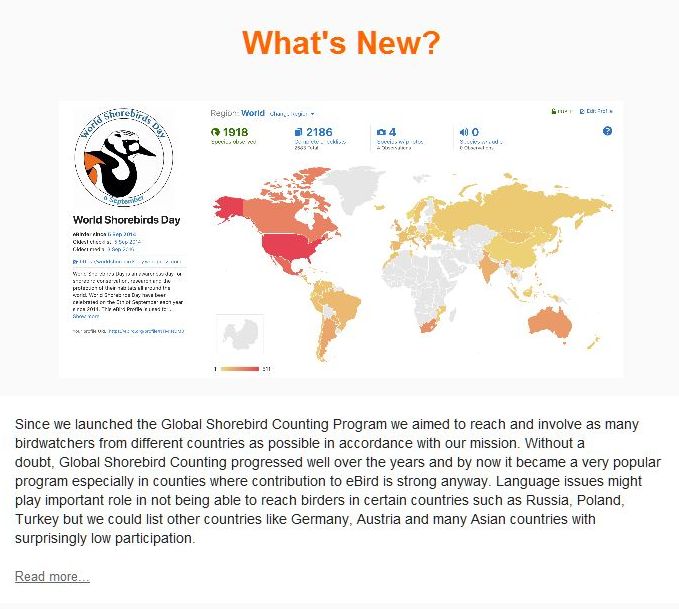
Read more about it here.
Download or view the poster-like announcement PDF file.
Gyorgy Szimuly
Milton Keynes, United Kingdom
Website: https://worldshorebirdsday.wordpress.com
[Posted by: Chuck Almdale]
Mullet & birds at Malibu Lagoon, 26 August, 2018
Because we have readers all over the U.S. and in over 100 countries, it’s partially for you, our far-flung readership, that today I go well beyond our typical report of the birds we saw. The event described below is very likely only one of the negative impacts of climate change which we will be experiencing with increasing frequency as we proceed towards an uncertain – and possibly very uncomfortable – future for humankind. You may want to spread the news. Some aren’t listening. If this sort of event hasn’t happened near you, wait. And don’t be shocked! shocked! when it does. Unfortunately for those with children and grandchildren whom you cherish, it will be those very offspring who will bear the brunt of the future we now create, along with all the other lifeforms who share our planet, of course. It won’t be you; you’ll be safely gone; it will be your gift left for your children to endure.
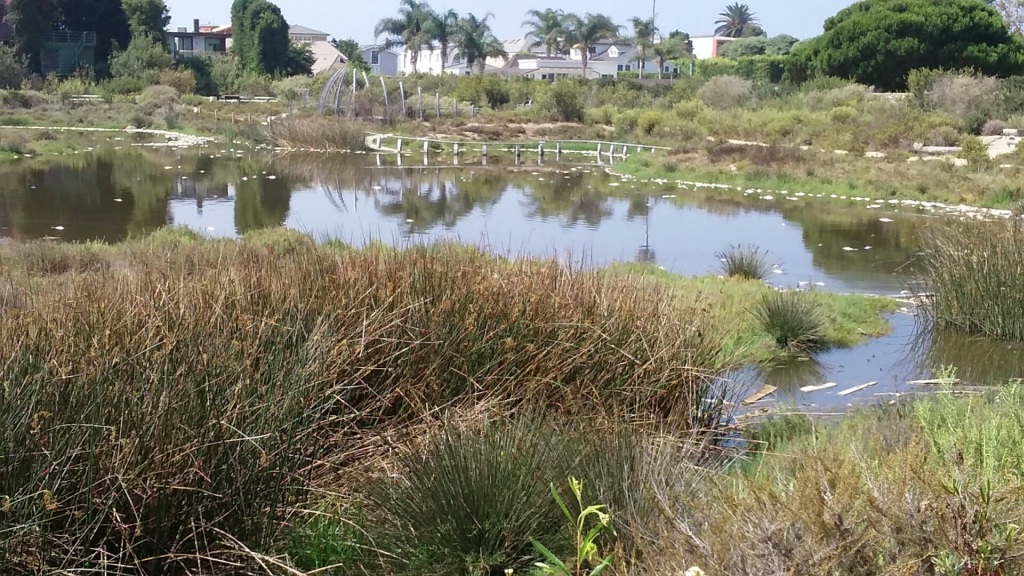
The white dots are dead Striped Mullet; view of the Malibu Lagoon west end channel. (Lu Plauzoles 8-26-18)
I’m very sad to report this, but last week and into this week, there was a major die-off of our much-loved Striped Mullet in Malibu Lagoon. We’ll have additional separate reports on this event, so I’m won’t go into great detail here, but will give you a few details.
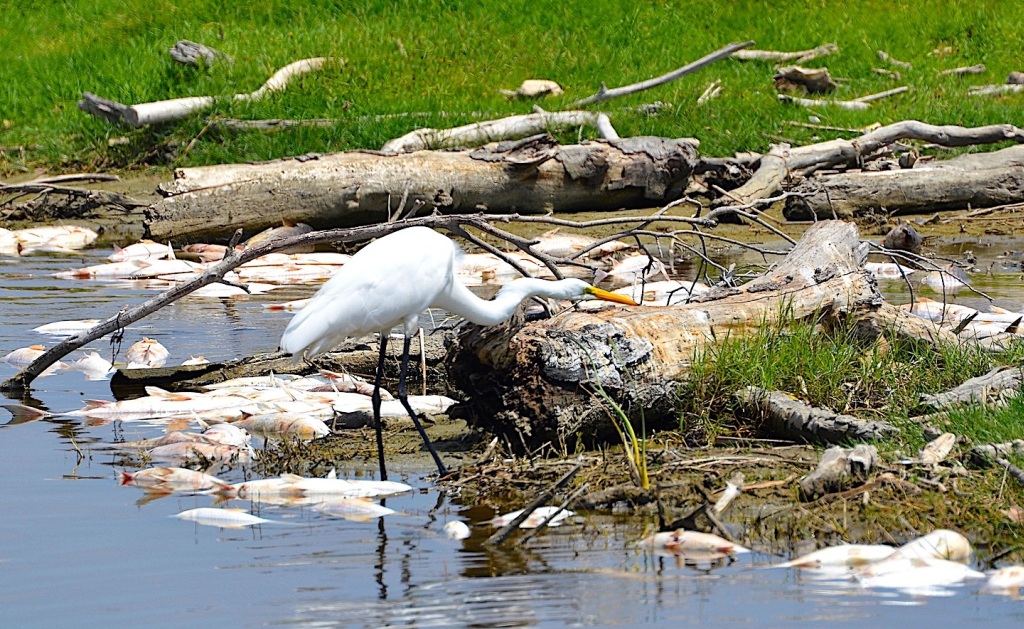
Great Egret & dead Striped Mullet on Friday (G. Murayama 8-24-18)
Dead fish in Malibu Lagoon were first reported on Monday August 20. By 8/22 “over a hundred” dead fish were seen. They turned out to be the Jumping Mullet (Mugil cephalus) (or Mullet: Bully, Common, Common, Flathead, Gray, Flathead Gray, Hardgut, Jumping, Mangrove, Poddy, River, Sand, Sea, Striped) who have entertained us for years with their above-water antics. One of the surprises was just how many of these fish – thousands – had taken up residence in the lagoon and channel since the 2012-13 reconfiguration, and – until now – were doing fine.
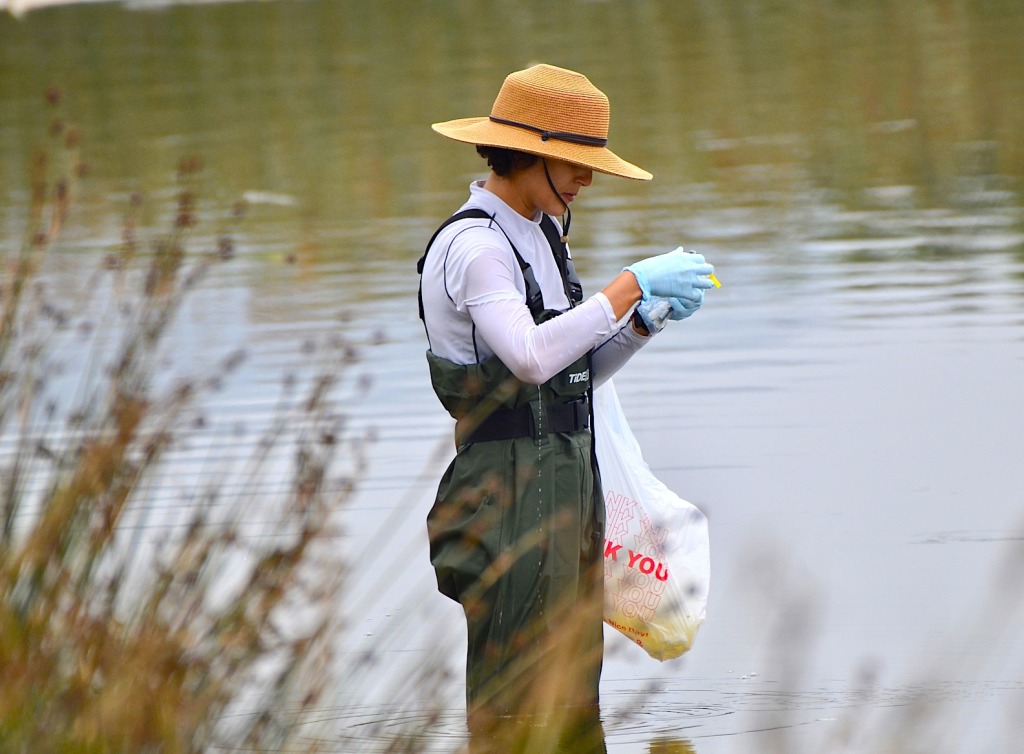
Rachel Turba collects water samples (L. Loeher 8-26-18)
Some tests were taken that day: dissolved oxygen was 3-5 milligrams per liter, described as “… isn’t great, but also isn’t below the critical thresholds.” Water temperature was high: about 28°C (83-84°F). This was not good, as according to FishBase the maximum temperature limit for Mugil cephalus is 24°C (75°F). Many other mullet were still jumping frequently in the lagoon. Mullet were seen “roiling the water” as far as ½ mile up Malibu Creek.
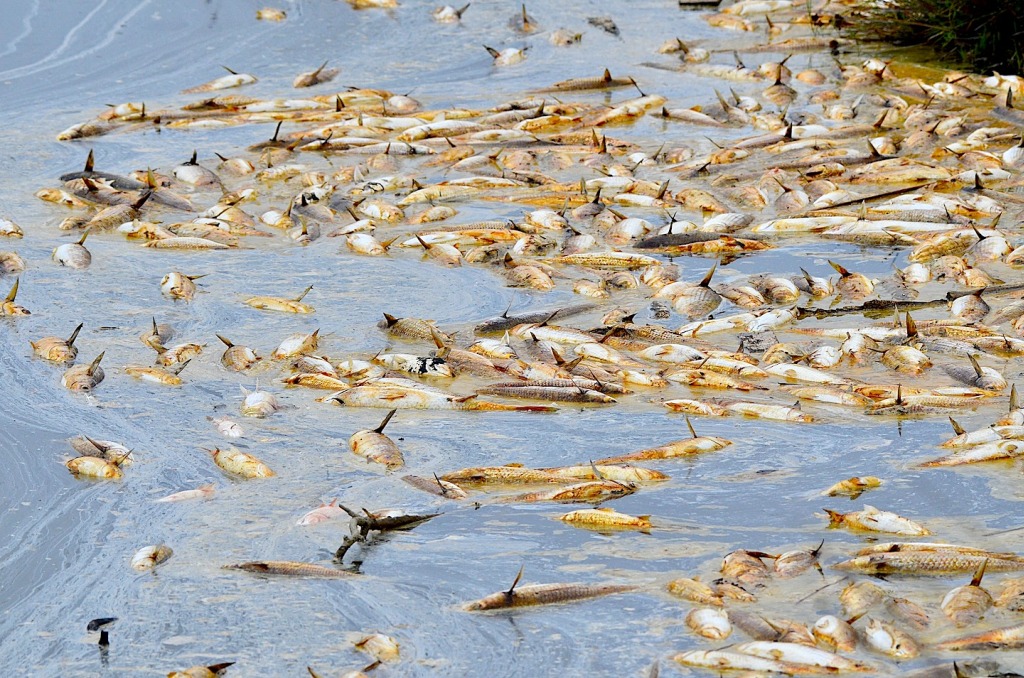
Somewhere over 200 dead mullet in this photo, Malibu Lagoon
(L. Loeher 8-26-18
By Friday 8/24, the dead were estimated at 2000-3000 fish, throughout the lagoon and channel and well up Malibu Creek. On Sunday 8/26, bird walk day, the dead mullet probably approached 4000; many were in the 18-19” length (see photo below), but some were as large as 36”, stunning some biologists. Small dead Silverside fish were found of genus Menidia or Atherinops. A pale waxy/oily substance lay on the water surface (see photo above) around the fish which was later determined to be an lipid exudation from the decomposing fish. Our Sunday birding group saw a few mullet swimming sluggishly at the surface. Dead fish were stinking in the hot sun. Because very few scavengers came to eat the dead fish, State Parks personnel began removing them on Monday 8/27.

Mullet necropsy, typical Malibu Lagoon 19-inch fish, nothing negative discovered (Karina Johnston, Bay Foundation – 8-24-18)
Several dozen researchers, biologists, local college biology professors, State Parks personnel, Calif. Dept. of Fish & Wildlife personnel and others are now involved in figuring out what caused the problem and how to create a reporting and communication protocol so that such events can be reported more quickly and professional biologists can jump on such problems. Although some of the interested parties – including myself – think that the high water temperature is the likely primary culprit, nothing has yet been ruled out.
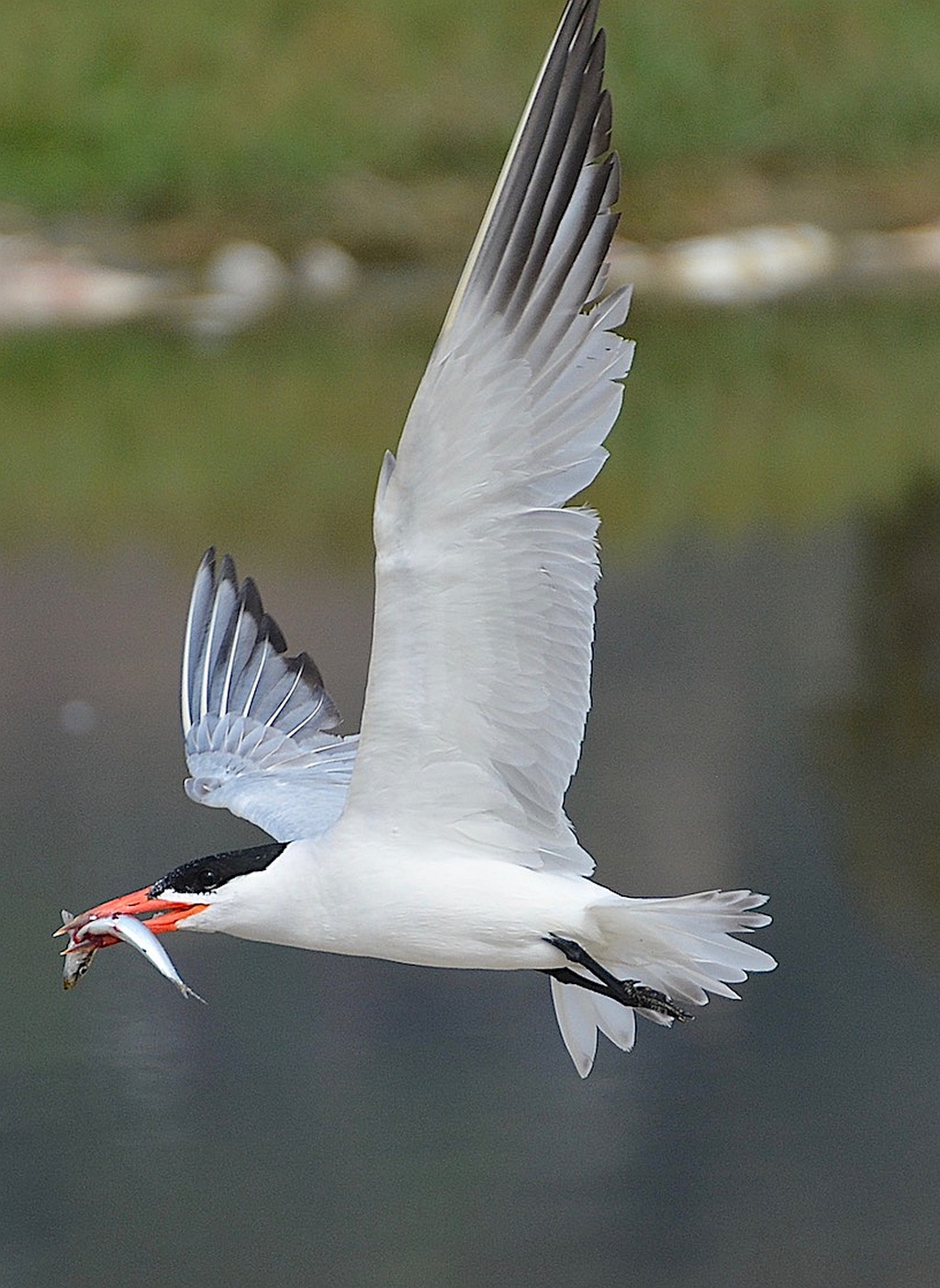
Caspian Tern with an edible fish (G. Murayama 8-26-18)
Necropsies have and will continue to be done, organ samples have been and will be sent for testing. Possible factors include: temperature, oxygen, harmful algal bloom, micro-habitat anoxic condition, pesticides (especially pyrethroids), bacteria, fungus, parasites, unknown chemicals. A similar die-off occurred a month ago at Ormond Beach in Ventura County. Such lagoon die-offs are not unusual along the Southern and Baja California coastlines.
Birds were not plentiful, especially birds swimming in lagoon and channel: six ducks and one lonely coot was it. Some terns, mostly Caspian, flew over the lagoon and dove on the smaller fish – probably Top Smelt – near the surface. All the other gulls, terns, pelicans, cormorants and shorebirds stayed on the sandy beach and lagoon shoreline. A few Western Gulls tore at the more recently deceased mullet, but most of the dead were left alone to rot and stink.

Barn Swallow with bug (R. Juncosa 8-26-18)
Barn Swallows have been breeding at the lagoon for many years. After the young have left the nest, they line up on a leaning reed stem, or in this case a cable, and wait to be fed. Mmmmm, bugs!

Barn Swallows (R. Juncosa 8-26-18)
Here’s a view of Surfrider Beach, looking west towards the Malibu Colony residential area. The lagoon is located to the right; surfers dot the waves to the left.
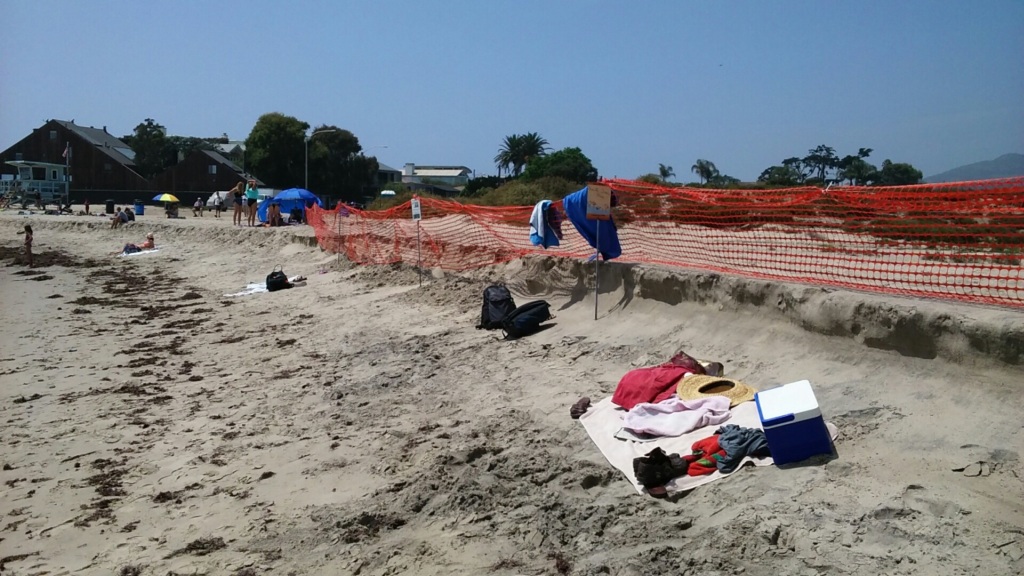
Surf has eaten the beach right up to the Snowy Plover enclosure fence
(G. Murayama 8-24-18)
The recent surf and high tides had considerably eroded the beach, leaving a 3-foot berm drop-off in the sand, and the Snowy Plover enclosure fence is close to falling over. Beach walkers, who have been excellent at staying out of the enclosure until now, were beginning to enter the enclosure due to the complete lack of beach at high tide outside the fence.
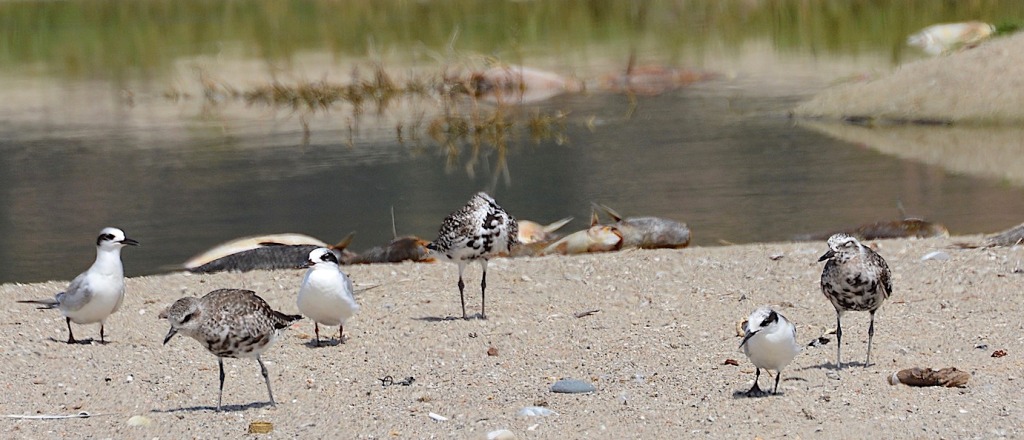
Forster’s Terns and molting Black-bellied Plovers (G. Murayama 8-26-16)
We had a good assortment of terns: no Least, but Caspian, Royal, Elegant and a few Forster’s were present. Good numbers of Whimbrel and Black-bellied Plovers rested on the sand in all stages of molting. Snowy Plovers numbered 33, but no banded birds were spotted.

Western Snowy Plover (L. Loeher 8-26-18)
Another event – perhaps also related to climate change – occurred several weeks ago. A young Magnificent Frigatebird was photographed flying over the lagoon. Larry Loeher was there with Grace Murayama, doing their usual Snowy Plover count when the bird “approached from the direction of Malibu Canyon inland, circled the lagoon once, and flew off inland,” never to be seen again. This species is very uncommon in SoCal, but we should say that one was sight several weeks earlier a few miles up the coast at Point Dumé. There are only five species in their family Fregatidae, and they are nearly worldwide in tropical waters. They have many unusual characteristics, which you can read about here, here and here. I’ll just mention that they are the most aerially buoyant bird in the world, as they have the largest wing surface area to body weight ratio of all birds. This makes them wonderful fliers. We’ve also seen various booby species along the coast, some as far north as Monterey Bay near San Francisco. The tropics are on their way to us, whether we want them or not.

Ho hum – Just another young Magnificent Frigatebird crusing o’er the lagoon (Larry Loeher, 8-10-18)
Finally, as if it wasn’t bad enough that climate change is (probably) killing off our beloved Jumping Mullet, it appears we’re being invaded by mutant shorebirds, possibly the result of atomic tests at Bikini Atoll. Look closely at the photo below.
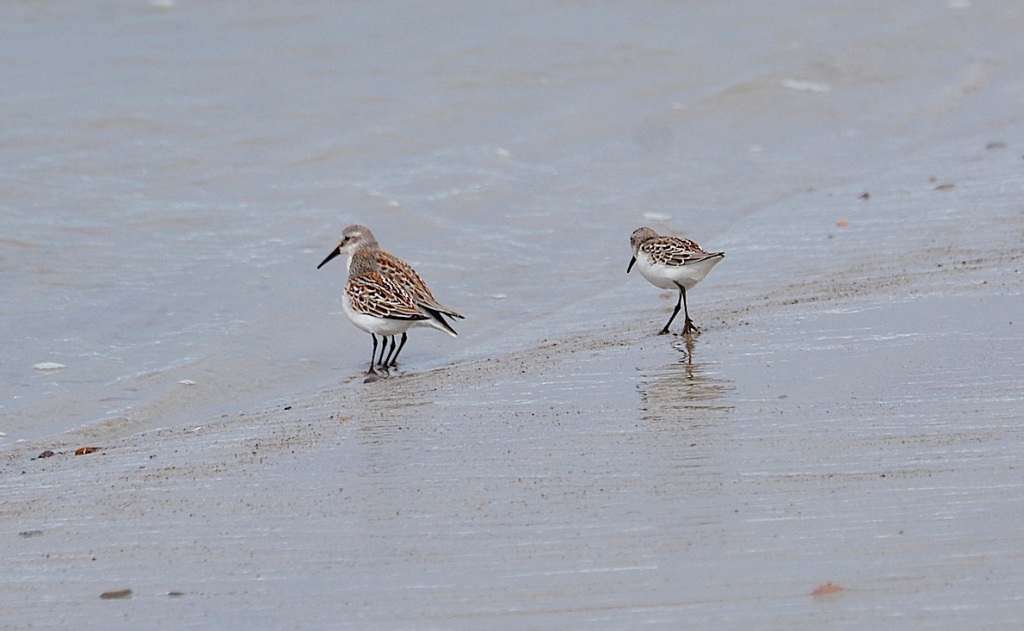
The dreaded Four-legged Sandpipers are now invading our shores
(G. Murayama, Zuma Beach, 8-17-18)
Birds new for the season were: Black-necked Stilt, Marbled Godwit, Ruddy Turnstone, Red-necked Phalarope, Forster’s Tern, Pelagic Cormorant, Turkey Vulture, Bewick’s Wren.
Many thanks to our photographers: Ray Juncosa, Larry Loeher, Grace Murayama, & Lu Plauzoles.
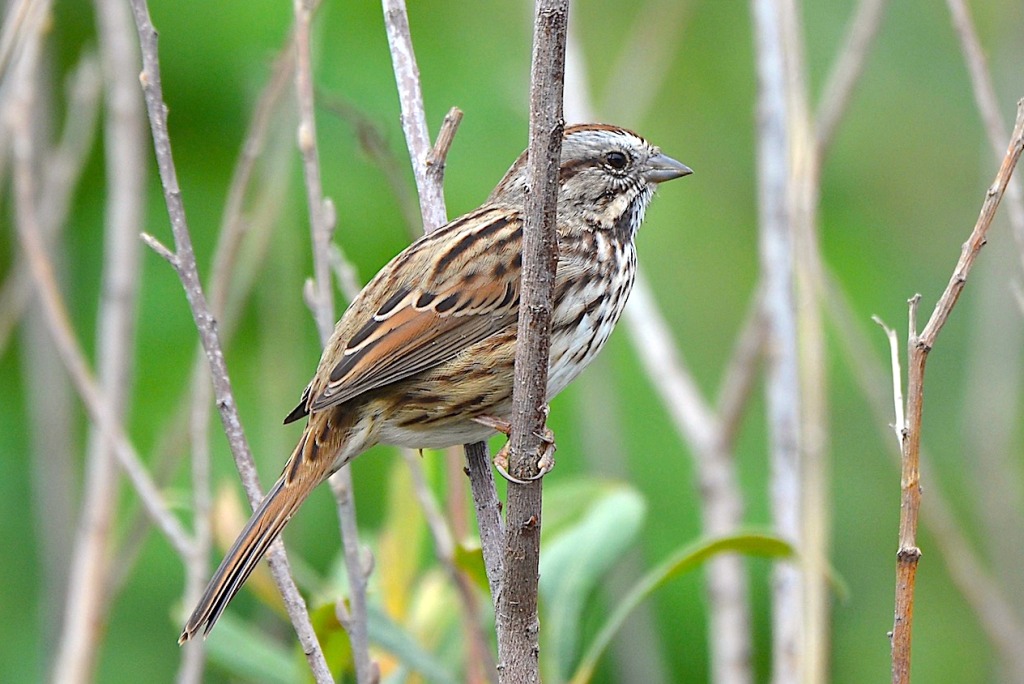
Song Sparrow (L. Loeher 8-26-16)
Our next three scheduled field trips: Lower Los Angeles River, 7am, 8 September; Malibu Lagoon Coastal Cleanup 9am, 15 September; Malibu Lagoon 8:30 & 10am, 23 September.
Our next program: Luke Tiller will present “Tails from the Platform: Hawks, Hawkwatchers and Hawkwatching”: Tuesday, 2 October, 7:30 p.m., Chris Reed Park, 1133 7th St., NE corner of 7th and Wilshire Blvd. in Santa Monica.
NOTE: Our 10 a.m. Parent’s & Kids Birdwalk meets at the shaded viewpoint just south of the parking area. Watch for Willie the Weasel. He’ll be watching for you and your big floppy feet.
Links: Unusual birds at Malibu Lagoon
9/23/02 Aerial photo of Malibu Lagoon
Prior checklists:
2017: Jan-June, July-Dec 2018: Jan-June
2016: Jan-June, July-Dec 2015: Jan-May, July-Dec
2014: Jan-July, July-Dec 2013: Jan-June, July-Dec
2012: Jan-June, July -Dec 2011: Jan-June, July-Dec
2010: Jan-June, July-Dec 2009: Jan-June, July-Dec.
The 10-year comparison summaries created during the project period, despite numerous complaints, remain available on our Lagoon Project Bird Census Page. Very briefly summarized, the results unexpectedly indicate that avian species diversification and numbers improved slightly during the period Jun’12-June’14.
Many thanks to Lillian Johnson for her contributions to the checklist below. [Chuck Almdale]
| Malibu Census 2018 | 3/25 | 4/22 | 5/27 | 6/24 | 7/22 | 8/26 |
| Temperature | 55-62 | 63-67 | 61-66 | 62-68 | 70-79 | 72-76 |
| Tide Lo/Hi Height | L-.16 | L-.15 | H+3.86 | H+3.50 | H+3.31 | H+4.36 |
| Tide Time | 1213 | 1028 | 0912 | 0826 | 0733 | 1030 |
| Northern Shoveler | 2 | |||||
| Gadwall | 12 | 5 | 12 | 4 | 15 | |
| American Wigeon | 8 | |||||
| Mallard | 12 | 4 | 15 | 12 | 12 | 6 |
| Northern Pintail | 1 | |||||
| Green-winged Teal | 6 | |||||
| Bufflehead | 1 | |||||
| Red-breasted Merganser | 6 | |||||
| Ruddy Duck | 4 | |||||
| Pied-billed Grebe | 1 | 2 | ||||
| Western Grebe | 25 | |||||
| Rock Pigeon | 10 | 1 | 3 | 2 | 6 | 30 |
| Eurasian Collared-Dove | 1 | 2 | ||||
| Mourning Dove | 4 | 1 | 2 | 2 | ||
| Anna’s Hummingbird | 1 | 1 | ||||
| Allen’s Hummingbird | 2 | 3 | 1 | 2 | ||
| American Coot | 75 | 2 | 4 | 1 | 1 | |
| Black-necked Stilt | 1 | |||||
| Black-bellied Plover | 10 | 9 | 1 | 17 | 125 | |
| Snowy Plover | 12 | 9 | 3 | 4 | 9 | 33 |
| Semipalmated Plover | 4 | |||||
| Killdeer | 12 | 7 | 4 | 8 | 8 | 4 |
| Whimbrel | 9 | 3 | 6 | 3 | 113 | 39 |
| Marbled Godwit | 7 | 30 | 3 | |||
| Ruddy Turnstone | 1 | 6 | ||||
| Sanderling | 20 | 45 | 7 | 3 | ||
| Least Sandpiper | 1 | 12 | ||||
| Western Sandpiper | 10 | 4 | ||||
| Willet | 6 | 6 | 4 | 18 | 2 | |
| Red-necked Phalarope | 1 | |||||
| Bonaparte’s Gull | 2 | |||||
| Heermann’s Gull | 3 | 1 | 5 | 28 | 8 | |
| Ring-billed Gull | 10 | 1 | ||||
| Western Gull | 120 | 18 | 112 | 75 | 95 | 85 |
| California Gull | 20 | 4 | 2 | 4 | ||
| Glaucous-winged Gull | 3 | |||||
| Least Tern | 9 | 2 | ||||
| Caspian Tern | 2 | 8 | 11 | 4 | 1 | 15 |
| Forster’s Tern | 2 | 3 | ||||
| Royal Tern | 17 | 2 | 1 | 6 | ||
| Elegant Tern | 3 | 30 | 130 | 4 | 11 | 48 |
| Black Skimmer | 1 | |||||
| Pacific Loon | 3 | |||||
| Brandt’s Cormorant | 1 | 1 | 7 | |||
| Double-crested Cormorant | 27 | 18 | 15 | 7 | 16 | 15 |
| Pelagic Cormorant | 3 | 1 | ||||
| Brown Pelican | 37 | 32 | 68 | 5 | 5 | 7 |
| Great Blue Heron | 2 | 1 | 1 | 2 | 3 | 3 |
| Great Egret | 2 | 3 | 3 | 3 | 4 | |
| Snowy Egret | 6 | 1 | 4 | 5 | 10 | 25 |
| Green Heron | 1 | |||||
| Black-crowned Night-Heron | 4 | 2 | 1 | |||
| Turkey Vulture | 1 | 4 | 5 | |||
| Osprey | 1 | |||||
| Red-tailed Hawk | 1 | |||||
| Peregrine Falcon | 1 | |||||
| Nanday Parakeet | 4 | |||||
| Black Phoebe | 4 | 1 | 2 | 3 | 3 | |
| Cassin’s Kingbird | 1 | |||||
| Western Kingbird | 2 | |||||
| American Crow | 4 | 2 | 2 | 4 | 4 | 2 |
| Common Raven | 2 | |||||
| Tree Swallow | 3 | |||||
| Violet-green Swallow | 6 | 2 | ||||
| Rough-winged Swallow | 3 | 5 | 1 | 4 | ||
| Cliff Swallow | 5 | 8 | 1 | 3 | ||
| Barn Swallow | 15 | 4 | 10 | 15 | 25 | 16 |
| Bushtit | 6 | 1 | 20 | 27 | 60 | 30 |
| Marsh Wren | 2 | |||||
| Bewick’s Wren | 1 | |||||
| Blue-gray Gnatcatcher | 2 | |||||
| Western Bluebird | 1 | |||||
| American Robin | 1 | |||||
| Northern Mockingbird | 3 | 2 | 2 | 2 | 2 | |
| European Starling | 23 | 13 | ||||
| House Finch | 24 | 4 | 5 | 8 | 6 | |
| Lesser Goldfinch | 2 | |||||
| Spotted Towhee | 2 | |||||
| California Towhee | 1 | 2 | 1 | |||
| Savannah Sparrow | 2 | 1 | ||||
| Song Sparrow | 2 | 10 | 5 | 5 | 2 | 6 |
| White-crowned Sparrow | 28 | |||||
| Dark-eyed Junco | 2 | |||||
| Hooded Oriole | 4 | |||||
| Red-winged Blackbird | 15 | 1 | 7 | 30 | ||
| Brown-headed Cowbird | 2 | 2 | ||||
| Brewer’s Blackbird | 1 | |||||
| Great-tailed Grackle | 15 | 4 | 4 | 3 | 4 | 7 |
| Orange-crowned Warbler | 3 | 1 | ||||
| Common Yellowthroat | 2 | 1 | ||||
| Yellow-rumped(Aud) Warbler | 12 | |||||
| Wilson’s Warbler | 1 | |||||
| Totals by Type | Mar | Apr | May | Jun | Jul | Aug |
| Waterfowl | 52 | 9 | 27 | 16 | 27 | 6 |
| Water Birds – Other | 172 | 52 | 88 | 21 | 22 | 24 |
| Herons, Egrets & Ibis | 14 | 4 | 9 | 10 | 17 | 32 |
| Quail & Raptors | 2 | 0 | 5 | 1 | 0 | 5 |
| Shorebirds | 88 | 90 | 56 | 41 | 149 | 215 |
| Gulls & Terns | 179 | 57 | 269 | 95 | 137 | 169 |
| Doves | 15 | 3 | 4 | 4 | 8 | 30 |
| Other Non-Passerines | 6 | 3 | 1 | 1 | 1 | 2 |
| Passerines | 189 | 37 | 66 | 69 | 161 | 75 |
| Totals Birds | 717 | 255 | 525 | 258 | 522 | 558 |
| Total Species | Mar | Apr | May | Jun | Jul | Aug |
| Waterfowl | 9 | 2 | 2 | 2 | 2 | 1 |
| Water Birds – Other | 8 | 3 | 4 | 4 | 3 | 4 |
| Herons, Egrets & Ibis | 4 | 3 | 4 | 3 | 4 | 3 |
| Quail & Raptors | 2 | 0 | 2 | 1 | 0 | 1 |
| Shorebirds | 10 | 8 | 6 | 6 | 5 | 9 |
| Gulls & Terns | 9 | 4 | 8 | 7 | 5 | 7 |
| Doves | 3 | 2 | 2 | 2 | 2 | 1 |
| Other Non-Passerines | 2 | 1 | 1 | 1 | 1 | 1 |
| Passerines | 27 | 15 | 12 | 11 | 15 | 9 |
| Totals Species | 74 | 38 | 41 | 37 | 37 | 36 |
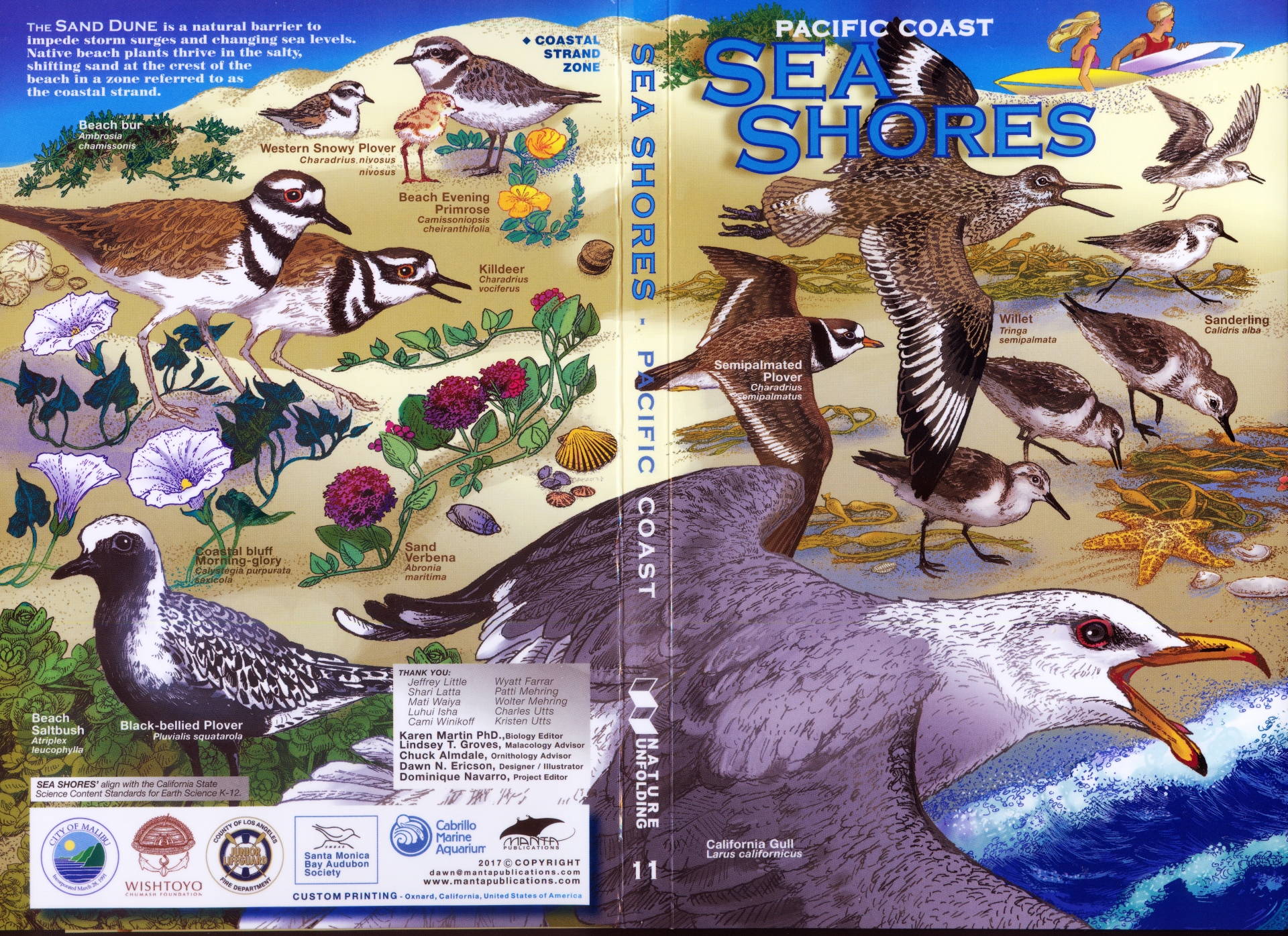
Pacific Coast Sea Shores science guide – front & back covers
Click photo to enlarge
On June 15, 2018, the City of Los Angeles, Los Angeles Fire Department’s Lifeguard Division – Junior Lifeguard Program began their 2018 season. The workshop included a presentation by Pepperdine Professor of Biology Karen Martin. Martin presented a slide show and a hands-on grunion fish hatchling demonstration, during which the Jr. Lifeguards watched tiny hatchlings take their first swim in small lab containers.
Each Junior Lifeguard also received a free copy of the Pacific Coast SEA SHORES science guide, created by Dawn Ericson of Manta Publications. Professor Martin wrote the text for the science guide. Our Santa Monica Bay Audubon Society contributed funding for this project and helped with the ornithological aspects. The science guide is a high-quality eight-page laminate which can be used in the field, and discusses birds, fish, invertebrates, kelp, tides and ecological zones.
Each Junior Lifeguard series lasts five weeks, and the enrollees get to keep the science guides and other materials after they finish. Participants are in three age groups: 9-11, 12-13 and 14-17 years old, with depth and format of instruction dependent upon the age and skill level of group. The program also includes instruction in water safety, swimming, body surfing, paddling, surfing, physical conditioning, competition skills, first aid, CPR and rescue techniques. The Junior Lifeguard program began fifty years ago with 150 enrollees. For 2018, it has grown to over 4,300 Junior Lifeguards enrolled. The second summer session ended August 17, but they’ll be doing it again next year.
For additional information visit:
Junior Lifeguard program slide show
Information and sign-up forms
Los Angeles County Junior Lifeguard page
Manta Publications blog on the science guide
[Chuck Almdale]

Pacific Coast Sea Shores science guide – seashores, kelp, ecological zones & tides – Click photo to enlarge
Display feathers are highly evolved versions of a basic feather. They no longer have the standard structure of a central quill and a vane made of tiny interlocking barbs. They’ve evolved into fluffy plumes or stiff wires, some with hard ornaments or tabs. These radical changes, and the muscles that let the bird move them, serve no purpose other than to improve the male’s chances during courtship. The Cornell Lab’s Ed Scholes explains. Filmed and photographed by Tim Laman.
There are currently seventy-two short films in the entire Birds-of-Paradise Project playlist, ranging from 26 seconds to 8:29. In the upcoming weeks, we will present some of our favorites.
A film from the Cornell Lab of Ornithology. If no film or link appears in this email, go to the blog to view it by clicking on the blog title above. If the film stops & starts in an annoying manner, press pause (lower left double bars ||) to let it buffer and get ahead of you. [Chuck Almdale]



 SANTA MONICA BAY AUDUBON SOCIETY BLOG