Free email delivery
Please sign up for email delivery in the subscription area to the right.
No salesman will call, at least not from us. Maybe from someone else.
A Salp Washed Up…

Salp – front end with “horns” at right (Lu Plauzoles Malibu Surfrider Beach 3-25-18)
This now defunct object found on the beach at Malibu Lagoon (aka Surfrider beach) is not a jellyfish. It is not a sea hare either. We consulted Tara Crow, former Programs Manager at Heal the Bay’s Santa Monica Pier Aquarium and she revealed the identity of our rather rare participant in the SM Bay Audubon monthly walk on March 25th. It is a …salp.
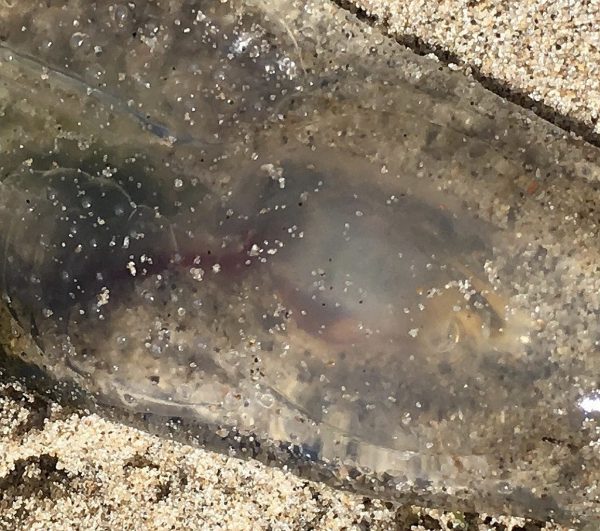
Salp closeup – organs visible through translucent body
(Lu Plauzoles Malibu Surfrider Beach 3-25-18)
There is a prize for the birder who can prove they previously knew the existence of that word, and that creature! According to Ms. Crow, they are not as common as jellyfish, sea hare, or the (in)famous Gumboot chiton; all of which tend to wash up on the shore more often than our critter. The salp’s proper name is the rather scandalous (most unfortunate) Thetys vagina. But the salp used that name before human anatomists.

Salp chain (Frierson, Oregon Dept. of Fish & Wildlife 11-15-12 8253212250)
Tara continues:
“They are crazy cool organisms on so many levels. One of the most amazing things is they have the first evidence of a notochord during development. The notochord is what turns into the spinal column on vertebrates. Of course, those guys instead went a totally different direction and turned into giant floating colonial blobs. Giant is relative, of course. We estimated this was 25-30 centimeters, or between 10 and 12 inches long and approximately four inches across. Many of the salps are apparently smaller, but often congregate in the thousands.”

Gumboot chiton Cryptochiton stelleri topside
(Jerry Kirkhart 12-12-08 wikicommons)
What makes this discussion doubly interesting for us birders, however, is the lateral mention of the Gumboot chiton, which is a rock scouring creature that some have described as a sea-meatloaf. Its proper name is Cryptochiton stelleri.

Gumboot chiton Cryptochiton stelleri underside
Note three-handed gumboot holder
(Professor Douglas Eernisse 2-27-06 wikicommons)
It turns out the Gumboot chiton is another of the species discovered and named by Steller who spent a short time on the Alaskan Coast while on Bering’s expedition. We California birders often see the bright blue Steller’s Jay at elevation and in a few spots northward along the coast. (I don’t recall seeing the chiton.)

Steller’s Jay, San Gabriel Mtns. (C. Almdale 6-7-10)

Georg Wilhelm Steller himself
(Courtesy University of Tyumen, The Center of Russian-German Cooperation of Georg Wilhelm Steller)
From Wikipedia: The Latin name Cryptochiton stelleri means Steller’s hidden chiton. “Steller” is in honor of the 18th-century German zoologist Georg Wilhelm Steller, who first described many species of the northern Pacific seashore.
So…as it turns out, again. It’s all about the birds!
[Lucian Plauzoles, arranged by C. Almdale]
Interactive California Earthquake Hazard Zone Map
Wondering if you live near an earthquake fault? An avalanche area? A liquefaction zone?
Now you can find out from the State of California Department of Conservation.
I don’t think the research is complete. It doesn’t show the Northridge Fault (which broke in 1994) for example, and the liquefaction zone around that fault seems incomplete. Large areas, in fact, are color-coded white for “Areas not evaluated for liquefaction or landslides.” So just because you live on flat land with no nearby fault marked, don’t assume you’re free from danger.
But it’s a work-in-progress and interesting to look at. If a danger is indicated, it’s probably accurate. If no danger is indicated, you’re probably looking at an “Area not [yet] evaluated for liquefaction or landslides.”
The screen shot below is based on the address 1000 Wilshire Blvd., the small dark dot in lower left of picture. Green areas are liquefaction, yellow are fault zones, broken lines are approximately located faults. Right half of the screen is the legend, which disappears with a button click to leave a full-screen map. Map includes all of California.
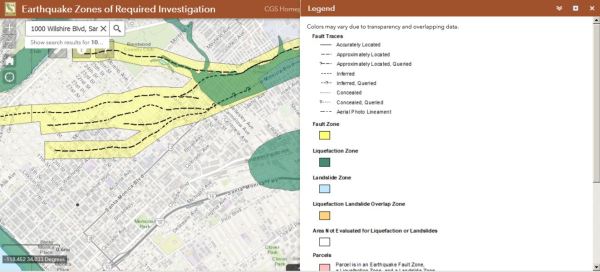
Santa Monica Earthquake, Liquefaction & Avalanche areas (4/2/18 screenshot)
In 1994 we lived at 1533 11th St. in Santa Monica. The map does not indicate that this in a liquefaction or earthquake fault zone. Yet the 1994 Northridge quake gave us quite a shaking. All the dishes leaped from the cupboards, bookshelves collapsed and the TV set rolled freely across the floor. Sleep for that night had ended.
Brief instructions.
1. Go to the website http://www.conservation.ca.gov/cgs/Pages/SH_EQZ_App.aspx
2. Click the button “Launch EQ Zapp” and wait a few minutes for it to fully load the map.
3. You can move the map around and zoom in/out with your mouse and mouse scroll wheel.
4. Enter an address into the box titled “Esri World Geocoder.” A drop down menu will probably appear to make the typing easier.
5. The map will zoom in and your desired location will be in the screen center. Click the “X” on the “Search Result” label to make it disappear. A dot will remain on the location.
6. Use your mouse and scroll wheel to move around and zoom in/out to see what’s around.
7. When colors appear (yellow, dark green-blue, aqua, peach, pink), click the legend (three horizontal bars in upper right corner). An explanation of all the colors and lines will appear.
8. Click the down arrows in upper right corner to shrink the legend.
9. Start all over by typing in a different address.
Live dangerously, but have fun, kids!
[Chuck Almdale]
Spring is in the air, and for Valentine’s day we visit herpetology to learn about amorous alligator lizards from Dr. Greg Pauly. At this time of year, their wild and somewhat brutal mating behavior is on display, and we are interested in your photo observations of this local lover. Look around under bushes and in leaf litter, and if you spot a pair (or a trio!), send the photo to nature@nhm.org, or submit to the RASCals project at www.inaturalist.org/projects/rascals
This comes from the Natural History Museum of Los Angeles County. If no film or link appears in this email, go to the blog to view it by clicking on the blog title above. If the film stops & starts in an annoying manner, press pause (lower left double bars ||) to let it buffer and get ahead of you. [Chuck Almdale]
Malibu Lagoon hosts extremely rare Asian bird
The Ehler’s Sandhopper-Warbler, Harenadsultim ehleri, a rarely-glimpsed member of the little-known central Asian family of Sandhopper-Warblers, was photographed recently at Malibu Lagoon by the same team of ornithologists who first discovered the bird in its native habitat, and for whom it is named.

Breeding grounds of Harenadsultim ehleri, northern Gobi Desert, south central Mongolia
Despite the preferred mode of locomotion as implied by the name, the bird is capable of sustained flight over long distances. Its normal migration takes it from its breeding grounds in central Mongolia to the interior desert of Western Australia.

Approximate wintering grounds of Harenadsultim ehleri in Central Western Australia
The exact migratory route is unknown, but is conjectured to lead through southward through China and Indochina to Indonesia, then eastward through Indonesia to the Australian mainland, where it gravitates to a remote area in the arid central western desert. This route would necessitate numerous short and several long flights over water.
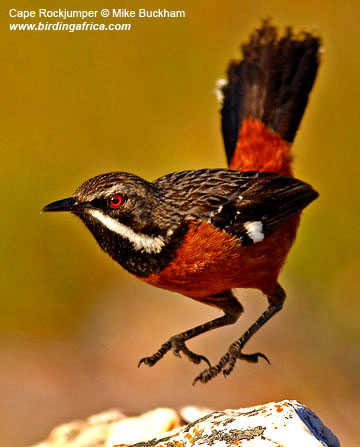
Cape Rockjumper,Chaetops frenatus. Not at all the same bird. (Mike Buckham BirdingAfrica.com)
The bird sighted at Malibu must have flown east across the Bering Strait, but – it is believed – otherwise could have hopped its way east and southward along the sandy shores of the Pacific Northwest and down to Southern California.
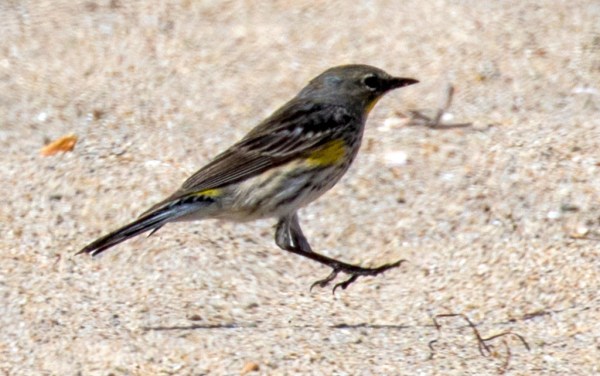
Hareanadsultim ehleri – Ehler’s Sandhopper-Warbler – on the move at Malibu Surfrider Beach (photo: R. Ehler 3-25-18)
Adventurers, explorers, scientists and all-around bon vivants Drs. Randy & Polly Ehler originally discovered and documented this elusive species in the Gobi Desert of Southern Mongolia. The bird has been sighted only once on its presumed regular wintering grounds in the Australian desert.
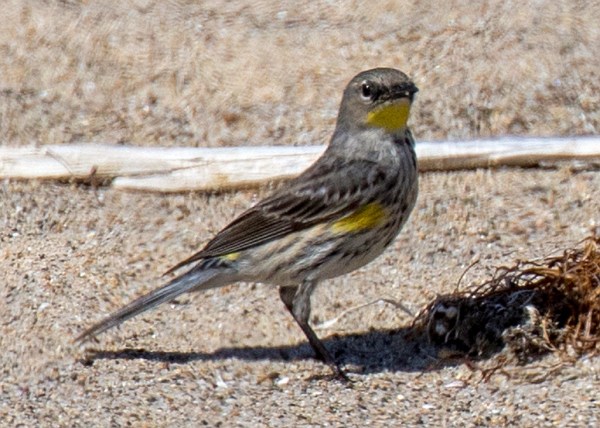
Hareanadsultim ehleri momentarily at rest
(photo: R. Ehler 3-25-18, Malibu Surfrider Beach)
LATE-BREAKING ALERT !
Several days after our original publication on 1 April, 2018, we received notification of another sighting of Ehler’s Sandhopper-Warbler. This sighting was on 1 April, 2018, but several hundred miles farther north and quite likely was a different bird. Well-known international birder, Don Roberson, was out doing some morning birding at a local patch, – the Iris Canyon vicinity of the Monterey MPC campus in Monterey, CA, to be exact – when he spotted and photographed what he naturally assumed at the time to be a typical Yellow-rumped Warbler, well on its way into alternate (breeding) plumage. Alerted by our announcement of the presence of the Ehler’s Sandhopper-Warbler in Southern California, he reexamined his photograph, and discovered it to be the Ehler’s. This second sighting supports Dr. Ehler’s conjecture (see below) that the birds may have been wintering in North America for a very long time, their presence unsuspected until now, due to their exceptionally close resemblance to the unrelated and very common Yellow-rumped Warblers.
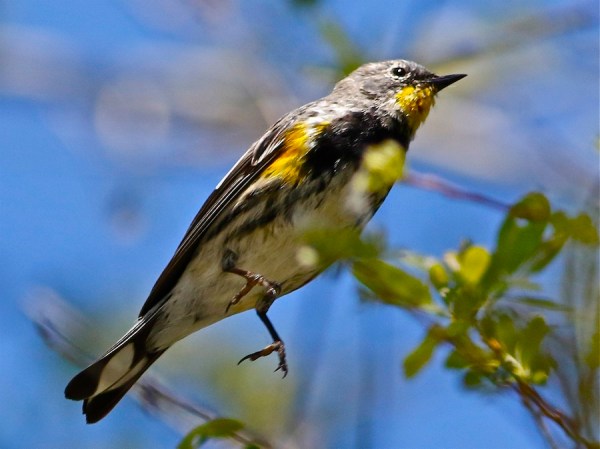
Another sighting of Ehler’s Sandhopper-Warbler in Monterey, CA, this time hopping over both a large bush and the photographer. (Don Roberson 4-1-18)
The photo is included in Roberson’s eBird checklist for that day (not yet corrected to include Ehler’s Sandhopper-Warbler). In his communication with us, Roberson commented:
I read your article with interest. Just yesterday I photographed what I thought was a Yellow-rumped Warbler but I wonder if I misidentified the Ehler’s Sandhopper-Warbler? Please note that subject in question is clearly hopping — without spreading its wings — except this hop was much higher — well over my head — and might suggest a means to hopping from canopy to canopy across North America. Just a hypothesis, of course, as you guys are on the cutting edge of science here.
Roberson has long been fascinated by the entire spectrum of the families of birds of the world, and has assembled his photographs and discussions into an extremely attractive and informative website*, Creagrus @ Monterey Bay, deserving of the attention of any birder similarly inclined. I didn’t see Sandhopper-Warblers among the avian families listed, so this sighting will give him something to catch up on. Many thanks to Don Roberson for his alert attention to detail!
* Note: The lovely Swallow-tailed Gull Creagrus furcatus is endemic to the Galapagos Islands and is the sole species in its genus.
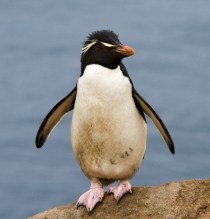
Rockhopper Penguin, Gorfou sauteur, Antartica (Samuel Blanc 12-21-07 wikicommons)
Renowned Ornithologist Dr. Leotard Skynyrd, of Miskatonic University in Arkham, Mass. confirmed the once-in-a-lifetime nature of the sighting. “It’s an extremely long way for an six-inch bird to hop, and well away from the presumed route to its normal winter destination. As far as I know, this species has never previously appeared in North America. In fact, I’ve never heard of this species at all. It’s completely new to me.”
Dr. Ehler said of his namesake: “Despite the close resemblance to our locally common Setophaga coronata auduboni, the habits of the bird are quite different. In its native treeless Mongolian desert, it feeds on small invertebrates found on salt-tolerant shrubs in the Ephedra genus of Ephedraceae, plants not too dissimilar from our own Mormon Tea Ephedra
Sand Hopper, Talitrus saltator, Bornholm Is., Baltic Sea (Arhold Paul 7-7-06 Wikicommons)
nevadensis of western America, except that the stimulating effect of the plant’s leaves is enormously greater than that of our local plant. Invertebrates feeding on the plant ingest the ephedrine alkaloids, which are then passed on to the bird which feeds on them. We believe that the birds cannot stand still because of all the ephedrine in their diet. They are quite literally “hopped up.”
H. ehleri do not build nests, rather laying their eggs directly on the sand in the shade of an ephedra bush. The eggs are then covered with 1-3 inches of

American Bird Grasshopper, Schistocerca americana, Green Swamp, Florida, 6-29-08 (birdphotos.com)
sand. The chicks hatch 25-30 days later, depending on ambient weather and the warmth of the sun-heated sand. Highly precocious, the 2-4 chicks immediately move into the shady bush and begin gleaning for insects feeding on the leaves and stems. How they find their way to Australia after maturation is unknown.
Dr. Ehler adds: “For all we know, they may have been coming to North America for a very long time, but were previously unnoticed due to their strong

Common Bush Hopper male, Ampittia dioscorides, Kadavoor, Kerala, India
(Jeevan Jose 10-2-11)
resemblance to the local race of Yellow-rumped Warblers. Although it is currently presumed that they normally winter in the Australian desert, this presumption is based entirely on that single sighting. With this new sighting here in North America, we have to consider the possibility that North America is the preferred and usual wintering location, and the Australian winter locale was the aberration, or even a misidentification, as unlikely as that may seem.
Starting from the unusual behavior of this

Candy-striped Leaf Hopper, Graphocephala coccinea (Bruce Marlin 6-15-05)
little-known avian family, some zoologists and taxonomists have gone so far as to call into question the current phylogeny, asking themselves whether a complete re-sequencing needs to be considered. Dr. Skynyrd comments: “Some are conjecturing that the family of “Hoppers” be created, and animals that share the unusual preference of locomotion by hopping be classified to it. This seems extremely premature to me. Much more research needs to be done before such a radical reconfiguration is made. But if the reclassifications are done, the new family would contain only hoppers, not jumpers. Despite superficial similarities between hopping and jumping, entirely different musculoskeletal structures are involved.”
We look forward to these exciting possibilities in avian nomenclature and classification. Congratulations to the Ehlers for their revolutionary discoveries.
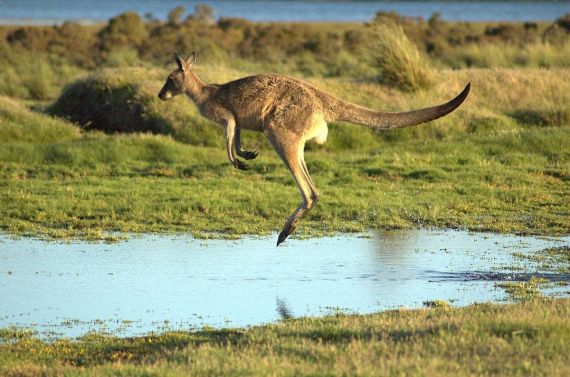
Forester Kangaroo in mid-hop, Narawntapu Park, Tasmania
(PanBK at the English language Wikipedia, Dec 05)

Attha Hoppers courting rituals frequently consist of numerous participants involved in simultaneous courting, akin to the mating behavior of squid.
(The Medestrian.com)
The above species member of the proposed family of Hoppers has numerous songs utilized only during courting.
Those who found this article plausible, should also read:
2013: Birders Take Their Lumps With Their Splits
2012: Canyonland Roadrunner Captured on Film
2011: New Hummingbird Species Discovered in Los Angeles County!
2010: The Western Roof-Owl: Bird of Mystery
[Chuck Almdale — 1 April, 2018]
Twelve-wired Bird-of-Paradise: What Are the Wires For? | Cornell / National Geographic
This video captures the progression of courtship. It begins with a male doing a practice display on his own. When a female appears, he puts his technique into action, climbing his display pole and brushing her with his wiry display feathers. The female continues to show interest but eventually leaves—an example of the extreme degree of selectivity females use in choosing their mates.
There are currently seventy-two short films in the entire Birds-of-Paradise Project playlist, ranging from 26 seconds to 8:29. In the upcoming weeks, we will present some of our favorites.
A film from the Cornell Lab of Ornithology. If no film or link appears in this email, go to the blog to view it by clicking on the blog title above. If the film stops & starts in an annoying manner, press pause (lower left double bars ||) to let it buffer and get ahead of you. [Chuck Almdale]



 SANTA MONICA BAY AUDUBON SOCIETY BLOG