Free email delivery
Please sign up for email delivery in the subscription area to the right.
No salesman will call, at least not from us. Maybe from someone else.
For Pacific Mole Crabs It’s Dig or Die | Deep Look Video
Pacific mole crabs, also known as sand crabs, make their living just under the surface of the sand, where they’re safe from breaking waves and hungry birds. Some very special physics help them dig with astonishing speed.
This is another installment of the PBS Deep Look series; this installment is adapted from the “It’s OK to be Smart” series. If no film or link appears in this email, go to the blog to view it by clicking on the blog title above. If the film stops & starts in an annoying manner, press pause (lower left double bars ||) to let it buffer and get ahead of you.
After viewing this video, follow the new link which will appear over to “It’s OK to be Smart” for even more fascinating information on slime molds. [Chuck Almdale]
Online Resource: Bird Skulls at SkullSite.org
As with feathers, we frequently find bird skulls and other bones on the ground. A moderately-experienced birder should be able to figure out what phylogenetic order or family of birds it belongs to, but getting down to species can be tough, or impossible, without a big collection of bones to which you can refer.
Here’s where SkullSite.org http://skullsite.com/ steps in.
With over 1600 species of birds on display, you’ll have a chance of identifying that skull, assuming you don’t get distracted by all the other interesting things they offer, such as the Order & Family Overview and How to Clean a Skull (essential information in today’s hurly-burly world).
Even if you’re not trying to identify a particular skull, the site is easy to navigate, informative and fun.
There’s a small selection (more to come!) of 3-D views of complete skeletons. These you can rotate through 360°.

Two views of Parrot Crossbill (Loxia pytyopsittacus) skeleton
There’s another small selection of 3-D skulls.
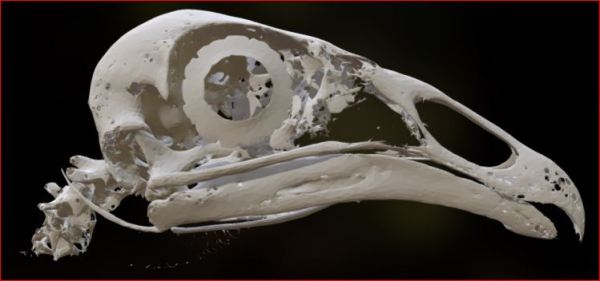
Coragyps atratus (Black Vulture)
These can be rotated to any angle (not just 360°) and zoomed in. The view below is downward from above the vulture’s left eye socket. You can download these skulls onto your 3-D printer (What! You don’t have one? Maybe your local school does.) to create your very own plastic skull replica.

Zoomed-in view from above Black Vulture’s left eye socket.
Skull searches can be done in various ways: common or scientific name, bill length (7 options), bill type (10 options), or by narrowing down through the phylogeny tree.
This last option may be the easiest for most people if they’re looking for a particular species. For example, you get to to American Crow via Passerformes > Corviidae, then scroll down to Corvus brachyrhynchos (American Crow). Each intermediate step lists all or most of the kinds of birds one might find. Click on the bird’s name and a secondary page appears with additional information such as dimensions), links and views of the skull(s) from different angles.
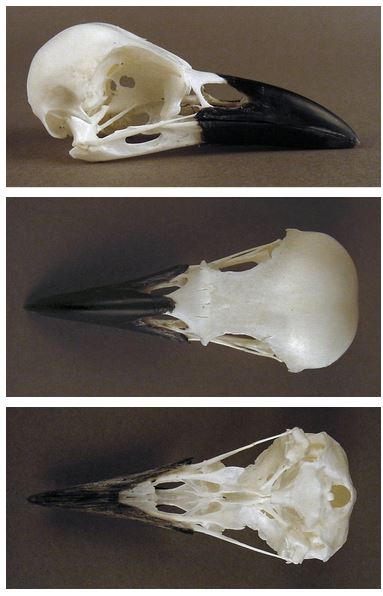
Corvus brachyrhynchos (American Crow) three views of the skull
One caveat: the museum is located in the Netherlands, so they are certainly not biased towards birds found only in North America.
I’ll leave you with one more skull view set, this time of the Sora (Porzana carolina) such as the one we spotted during our Malibu Lagoon bird walk in February. I hope you check out the site, which is an ever-growing work-in-progress, and enjoy what you see. [Chuck Almdale]

Porzana carolina (Sora) skull views
Online Resource: The Feather Atlas
Found a feather you can’t identify?
OK, maybe you can’t identify any feather, beyond saying, “It’s quite likely to be from a bird.” No matter.
Go to the Feather Atlas at: http://www.fws.gov/lab/featheratlas/index.php.
Keep in mind that the Migratory Bird Treaty Act makes it illegal to possess any feather, even if you found it by the roadside. Exceptions do exist for legally hunted waterfowl and other migratory “gamebirds.” (I suppose “gamebird” refers to wild chicken-like birds such as pheasant, grouse, quail, or ptarmigan, not to the denizens of darkened gambling casinos.)
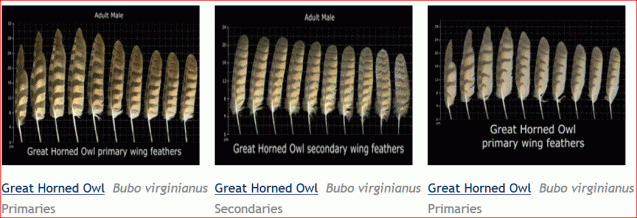
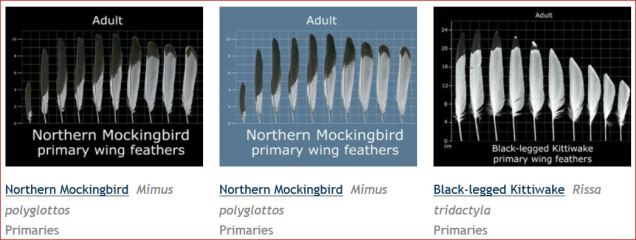
There you will find umpteen thousand photos of feathers. You can search through them by basic patterns – mottled, spotted, barred, dark tip, colorful iridescence, etc. Then add basic color – brown, white, black & white, green, etc. It then takes you to the similar feathers. All feathers displayed are flight feathers from wing or tail. There are no little body feathers. Top (or outer) sides are displayed as they have the important patterns; occasionally an underside is displayed.
Feathers displayed are all from the right side of the body, which you can tell because if they curve, they curve clockwise from base to tip (see photos below). If your feather curves counter-clockwise, it’s from the left side. The feathers are displayed against a scale measured in centimeters – essential information. If your 20-centimeter feather looks just like one that’s 14-centimeter, it’s not a match. Keep looking. Depending on what you’re looking for, you might get only a few similar feathers, or many hundreds.
Here’s some samples.
From “Barred” + “Brown”
From “Dark Tip” + “Black & White”
For those of us who don’t happen to have a large collection of stuffed and expertly-identified birds stashed in the back room, this can be a handy tool. So far, it’s U.S. birds only.
There’s tons of other information on the site. Have fun! [Chuck Almdale]
What a Tooth Reveals About Autism | PBS BrainCraft Video
About one percent of all people have Autism Spectrum Disorder, and their brain neurons can have fewer synapses, discovered by tinkering with tooth pulp cells. Drugs can be developed to make the neurons develop more synapses.
This is an installment of the PBS – BrainCraft series. If no film or link appears in this email, go to the blog to view it by clicking on the blog title above. If the film stops & starts in an annoying manner, press pause (lower left double bars ||) to let it buffer and get ahead of you. [Chuck Almdale]
With rows of Dr. Seuss-like flowers hidden deep inside, the corpse flower plays dead to lure some unusual pollinators.
This is another installment of the PBS Deep Look series; this installment is adapted from the “It’s OK to be Smart” series. If no film or link appears in this email, go to the blog to view it by clicking on the blog title above. If the film stops & starts in an annoying manner, press pause (lower left double bars ||) to let it buffer and get ahead of you.
After viewing this video, follow the new link which will appear over to “It’s OK to be Smart” for even more fascinating information on slime molds. [Chuck Almdale]



 SANTA MONICA BAY AUDUBON SOCIETY BLOG