Free email delivery
Please sign up for email delivery in the subscription area to the right.
No salesman will call, at least not from us. Maybe from someone else.
Winter’s Icy Blasts Chills Birds and Birders Alike: Malibu Lagoon, 25 February, 2018
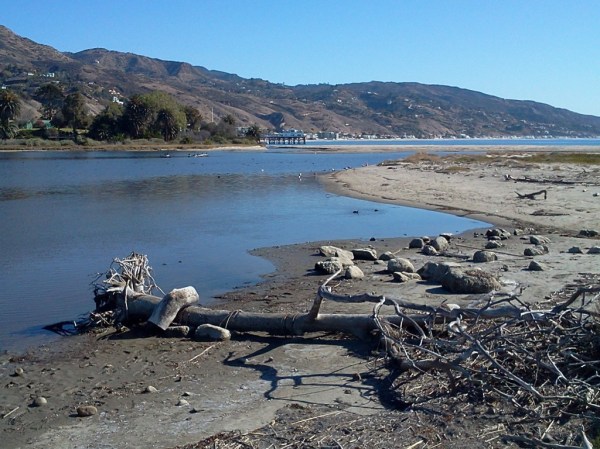
Looking eastward along south edge of lagoon, Malibu Pier in distance
(L. Johnson 2-25-18)
No more of this nonsense about nice weather! Unlike January when temperatures spent far too much time above 80°, February was relatively normal for the season of Mudslide (our equivalent of Winter). We even had several inches of rain during the days following our walk, depending on where you lived, of course. Coastal ranges, such as our Santa Monica Mountains, might get 4” of rain, while downtown L.A. gets ½”. So it goes. On Birdwalk Sunday temperatures ranged 55-62°F, 8:30 AM to 11 AM. The locals braced for this plunge into the icebox by wearing the usual earflapped hats, down jacket over down vest over flannel shirt over thermal T-shirt, thermal pants and mukluk-style furry boots. You know, the bare minimum for inclement weather of this magnitude.
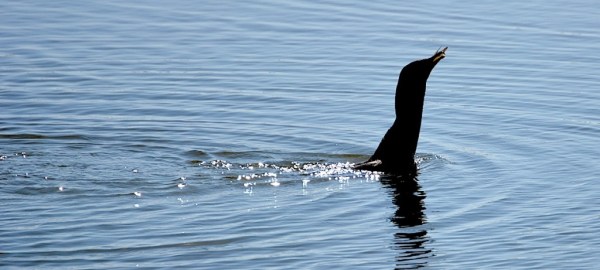
Double-crested Cormorant struggles to swallow a fish (G. Murayama 2-25-18)
It seemed the ducks knew the horrors weather had in store for us, as only 40 were present, down from January’s 109. Coots, cormorants and gulls dropped as well. In fact, we had only 54% of January’s total (see numbers in chart below). Total species present was also down.
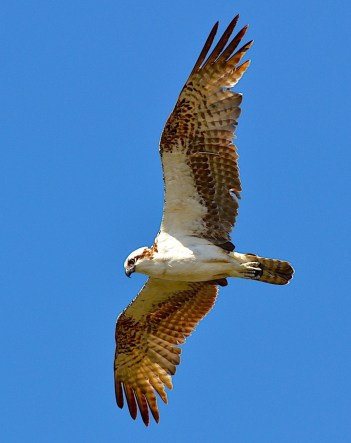
Osprey (Larry Loeher 2-25-18)
The Osprey was there and is now on the verge of becoming an expected resident. It was spotted, in fact, carrying what looked like sticks (aka nesting material!) towards the Malibu Colony a bit to the west of the lagoon. Tall trees of eucalyptus and cypress are fairly common in the Malibu area. Considering the number of jumping mullet we see, the lagoon could probably support an Osprey pair through the nesting season. The only problem might be the lagoon breaches following rainstorms, which take a lot of water and undoubtedly some fish out of the lagoon and channels.
The Belding’s race of Savannah Sparrow used to be regular at the lagoon when we had pickleweed, as this subspecies reportedly will not nest where this plant is absent. Pickleweed has returned around much of the lagoon, and very occasionally a Belding’s Sparrow appears. The photo below was enlarged to the point of blurriness, but you can make out the bright yellow lores, bold breast stripes, dark fore-cap, dark line behind the eye and dark stripes on brown back. And for those wondering, the little reddish stem-ends where the plant concentrates salt are edible and do taste like pickles, even when they’re coated with dust. Don’t tell anyone I said so. But then, I love to eat durian (“The King of Fruits!” wrote Alfred Russel Wallace, co-formulator with Charles Darwin of the Theory of Evolution), so what do I know?
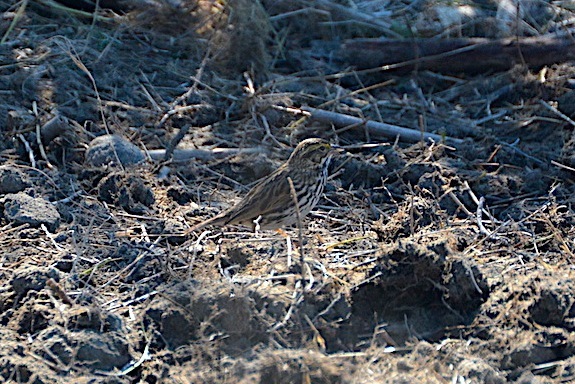
Belding’s Savannah Sparrow at edge of the brush (G. Murayama 2-25-18)
I didn’t put it on the list but we probably had a Sage Thrasher. Muriel Kotin heard an unfamiliar thrasher-song emanating from the brush around the parking lot, and Grace Murayama saw what looked like a “small roadrunner” shoot across the footpath to the beach. I’m guessing it was a Sage Thrasher: they’ve been widely reported around the area in all sorts of habitats over the past few weeks, a highly unusual event; while California Thrashers live just a bit inland, we’ve seen them at the lagoon only four times in 338 visits.
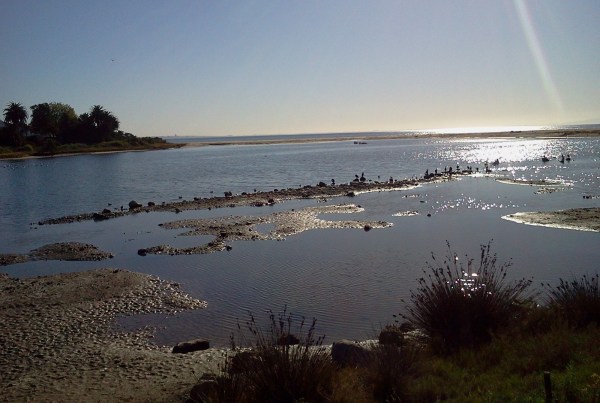
View from near PCH bridge towards southeast across Malibu lagoon
(Lillian Johnson 2-25-18)
Far more certain was the Sora, spotted by many and photo’d as it ran across the mudflat at the east end of the north channel, scooting from one patch of reeds to another.
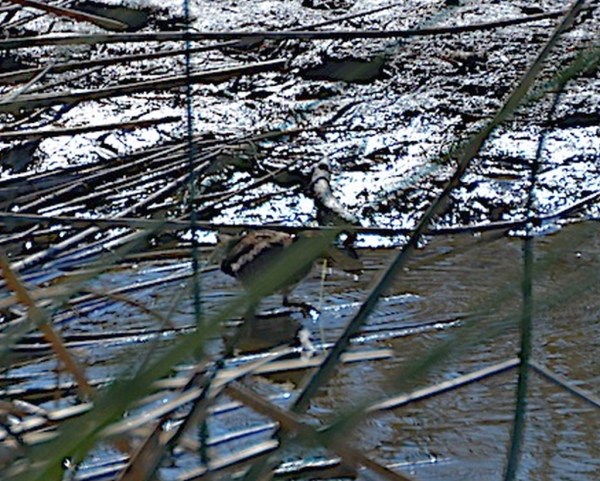
The Sora hoofs it towards the reeds (G. Murayama 2-25-18)
Before the June 2012 lagoon reconfiguration began, Sora were nearly year-round residents, but they left when their reedy habitat disappeared. Reeds slowly reappeared – completely unassisted by humans as far as I know – and migrating Soras stayed briefly during Nov-Dec 2015 and Oct. 2016. The reed beds continue to expand, and in a few more years the Soras may become more frequent and numerous.

Great Egret stalks a lizard in the parking lot
(Grace. Murayama 2-25-18)
Marsh Wrens, another reed obligate, have been slightly speedier about reintroducing themselves. There were 1-2 present Sep-Nov 2015, three years after the reconfiguration, singletons present Nov-Dec 2016, 2 in Sep. 2017, and 1-3 birds present Nov. 2017 through Feb. 2018.
Chapter board members, photographers, and Snowy Plover aficionados Larry Loeher and Grace Murayama patiently watched and re-re-re-recounted the wintering colony of these birds, and finally settled on 34 birds. One banded bird was seen. The birds were feisty, chasing one another from (human) footprint to footprint.
We found a Merlin – a small falcon – cleverly hiding on the tiptop of a cypress tree. It didn’t seem to be doing anything except resting. A couple passed by pushing a baby carriage. As they appeared curious as to why all these peculiar-looking people were staring intently at the top of a tree, I suggested they look through my telescope to see the bird. “Like a Peregrine Falcon, but smaller.” I offered. Always helpful, I added, “It’s called a Merlin, like Merlin the Magician.”
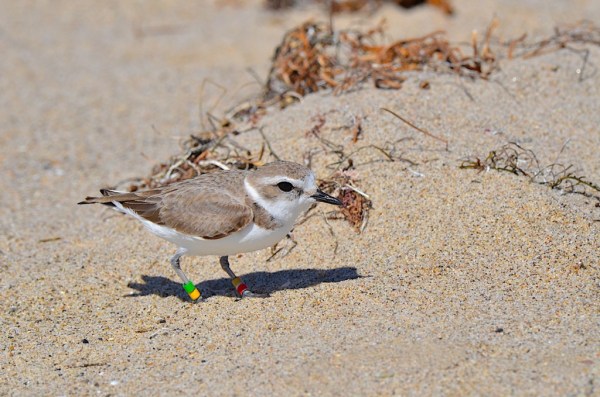
Snowy Plover banded NR-GY in 2017 at Vandenberg AFB (L. Loeher 2-25-18)
By 11 AM the tide was far out and several rocky reefs were exposed, attracting the gulls and larger shorebirds. Except for several small groups of Willets and Marbled Godwits who dropped into the lagoon, nearly all the birds were on the rocks. The Ruddy Turnstones, for example, were working the sea-washed rocks beyond the gull flocks, and the Royal Terns were strewn widely along the stony shore. While the birds were few, the kids on the family walk enjoyed the tide pools; one young man found an octopus with tentacles at least a foot long!!
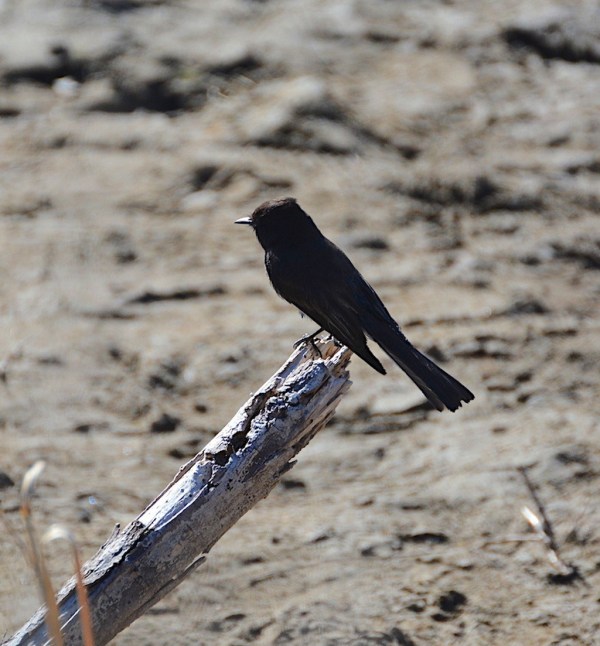
Black Phoebe shagging flies on the beach (G. Murayama 2-25-18)
Among the various passerines present, the Oak Titmouse was in the picnic area foliage near the colony, the Blue-gray Gnatcatchers were clustered into a group visiting the brush near the beach end of the footpath, and the White-crowned Sparrows and Yellow-rumped Warblers were all over the place. At trip’s end, as we were clambering into our car to leave, four Nanday Parakeets flew noisily by, heading towards the beach.
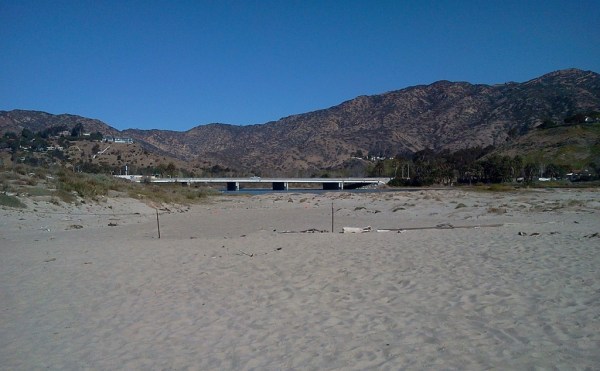
Looking north towards the PCH bridge, lots of sand between ocean and lagoon
(L. Johnson 2-25-18)
Birds new for the season were: Sora, Pelagic Cormorant, Nanday Parakeet, Oak Titmouse, Savannah Sparrow
Many thanks to our photographers: Lillian Johnson, Larry Loeher & Grace Murayama.
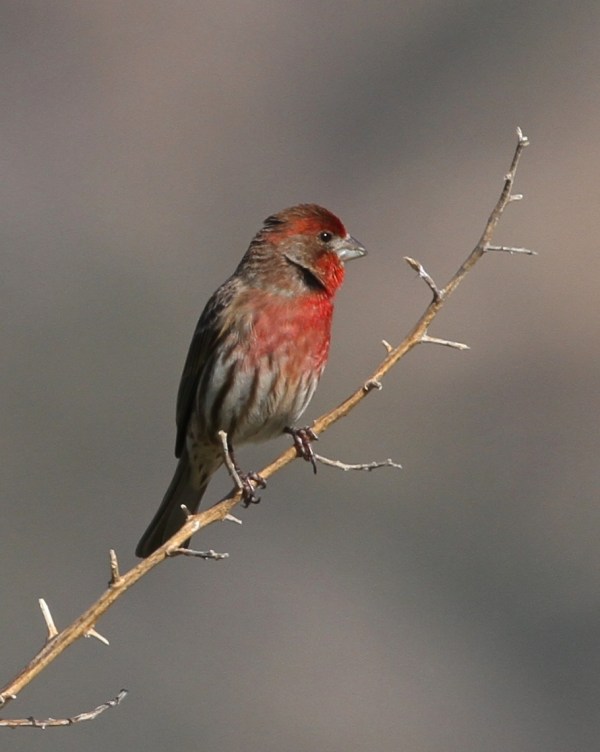
Male House Finch
(J. Waterman 1-28-18)
Our next three scheduled field trips: Sepulveda Basin, 8:30am 10 March; Malibu Lagoon 8:30 & 10am, 25 March; Malibu Creek State Park, 8am, 14 April.
Our next program: The Natural History of Santa Cruz Island, with Larry Loeher – Evening Meeting: Tuesday, Mar. 6, 7:30 p.m., Chris Reed Park, 1133 7th St., NE corner of 7th and Wilshire Blvd. in Santa Monica.
NOTE: Our 10 a.m. Parent’s & Kids Birdwalk meets at the shaded viewpoint just south of the parking area. Watch for Willie the Weasel. He’ll be watching for you and your big floppy feet.
Links: Unusual birds at Malibu Lagoon
9/23/02 Aerial photo of Malibu Lagoon
Prior checklists:
2017: Jan-June, July-Dec
2016: Jan-June, July-Dec 2015: Jan-May, July-Dec
2014: Jan-July, July-Dec 2013: Jan-June, July-Dec
2012: Jan-June, July -Dec 2011: Jan-June, July-Dec
2010: Jan-June, July-Dec 2009: Jan-June, July-Dec.
The 10-year comparison summaries created during the project period, despite numerous complaints, remain available on our Lagoon Project Bird Census Page. Very briefly summarized, the results unexpectedly indicate that avian species diversification and numbers improved slightly during the period Jun’12-June’14.
Many thanks to Lillian Johnson, Allen & Muriel Kotin, Grace Murayama, and Chris Tosdevin for their contributions to the checklist below. [Chuck Almdale]
| Malibu Census 2017-18 | 9/24 | 10/22 | 11/26 | 12/24 | 1/28 | 2/25 |
| Temperature | 68-75 | 72-82 | 56-63 | 57-68 | 67-76 | 55-62 |
| Tide Lo/Hi Height | L+1.86 | H+5.38 | L+2.94 | L+2.8 | H+5.99 | H+5.21 |
| Tide Time | 0559 | 1050 | 0946 | 0654 | 0609 | 0459 |
| Canada Goose | 1 | |||||
| Cinnamon Teal | 1 | |||||
| Gadwall | 1 | 1 | 5 | 30 | 8 | |
| American Wigeon | 1 | 3 | 15 | 36 | 4 | |
| Mallard | 27 | 15 | 2 | 22 | 12 | 6 |
| Northern Pintail | 1 | 3 | ||||
| Green-winged Teal | 6 | 1 | ||||
| Surf Scoter | 2 | 2 | ||||
| Bufflehead | 1 | 6 | 8 | |||
| Red-breasted Merganser | 4 | 8 | 3 | 4 | ||
| Ruddy Duck | 4 | 2 | 13 | 9 | ||
| Pied-billed Grebe | 3 | 5 | 8 | 5 | 1 | 2 |
| Eared Grebe | 1 | 2 | ||||
| Western Grebe | 9 | 15 | 5 | |||
| Clark’s Grebe | 2 | 2 | 1 | |||
| Rock Pigeon | 5 | 6 | 10 | 6 | 8 | 8 |
| Mourning Dove | 2 | 2 | 2 | 2 | 2 | |
| Vaux’s Swift | 40 | |||||
| Anna’s Hummingbird | 1 | 1 | 1 | 1 | ||
| Allen’s Hummingbird | 6 | 2 | 1 | 3 | 5 | 1 |
| Sora | 1 | |||||
| American Coot | 62 | 140 | 60 | 72 | 125 | 85 |
| American Avocet | 1 | |||||
| Black-bellied Plover | 89 | 135 | 115 | 28 | 22 | 25 |
| Snowy Plover | 34 | 25 | 31 | 35 | 19 | 34 |
| Semipalmated Plover | 1 | |||||
| Killdeer | 8 | 10 | 4 | 3 | 4 | 10 |
| Whimbrel | 54 | 45 | 36 | 10 | 8 | 13 |
| Marbled Godwit | 45 | 80 | 135 | 57 | 18 | 30 |
| Ruddy Turnstone | 7 | 6 | 11 | 12 | 1 | 6 |
| Sanderling | 7 | 10 | 13 | 11 | 30 | 20 |
| Baird’s Sandpiper | 3 | |||||
| Least Sandpiper | 4 | 3 | 10 | 6 | 1 | 3 |
| Western Sandpiper | 2 | 1 | ||||
| Spotted Sandpiper | 4 | |||||
| Willet | 55 | 120 | 85 | 11 | 9 | 14 |
| Bonaparte’s Gull | 1 | |||||
| Heermann’s Gull | 11 | 64 | 5 | 4 | 5 | |
| Mew Gull | 1 | 1 | ||||
| Ring-billed Gull | 1 | 4 | 25 | 42 | 35 | 70 |
| Western Gull | 96 | 145 | 105 | 97 | 95 | 92 |
| California Gull | 98 | 385 | 560 | 1550 | 550 | |
| Herring Gull | 1 | 2 | ||||
| Glaucous-winged Gull | 2 | 5 | ||||
| Caspian Tern | 1 | |||||
| Royal Tern | 52 | 47 | 4 | 21 | 12 | 15 |
| Elegant Tern | 4 | |||||
| Pacific Loon | 1 | 1 | 1 | |||
| Common Loon | 4 | |||||
| Brandt’s Cormorant | 1 | 2 | 2 | 2 | ||
| Double-crested Cormorant | 36 | 45 | 32 | 32 | 73 | 37 |
| Pelagic Cormorant | 1 | 2 | ||||
| American White Pelican | 2 | |||||
| Brown Pelican | 17 | 17 | 45 | 5 | 6 | 14 |
| Great Blue Heron | 5 | 4 | 8 | 5 | 2 | 1 |
| Great Egret | 3 | 8 | 1 | 1 | 3 | |
| Snowy Egret | 10 | 4 | 8 | 18 | 8 | 8 |
| Cattle Egret | 5 | |||||
| Green Heron | 3 | 2 | 2 | |||
| Black-crowned Night-Heron | 2 | 1 | 1 | 3 | ||
| Turkey Vulture | 1 | |||||
| Osprey | 1 | 1 | 2 | 1 | ||
| Cooper’s Hawk | 1 | |||||
| Red-tailed Hawk | 1 | |||||
| Belted Kingfisher | 1 | |||||
| Nuttall’s Woodpecker | 1 | |||||
| American Kestrel | 1 | |||||
| Merlin | 1 | 1 | ||||
| Peregrine Falcon | 2 | |||||
| Nanday Parakeet | 4 | |||||
| Black Phoebe | 5 | 6 | 3 | 4 | 3 | 1 |
| Say’s Phoebe | 2 | 2 | 4 | 3 | 3 | 3 |
| Cassin’s Kingbird | 1 | |||||
| Western Kingbird | 1 | |||||
| American Crow | 6 | 5 | 5 | 4 | 3 | 5 |
| Rough-winged Swallow | 2 | |||||
| Barn Swallow | 1 | |||||
| Oak Titmouse | 1 | 1 | ||||
| Bushtit | 1 | 15 | 48 | 10 | 20 | 35 |
| House Wren | 1 | 1 | ||||
| Marsh Wren | 2 | 3 | 1 | 1 | 2 | |
| Bewick’s Wren | 3 | 2 | 4 | 3 | 3 | 2 |
| Blue-gray Gnatcatcher | 15 | 7 | 8 | 6 | ||
| Ruby-crowned Kinglet | 4 | 1 | 3 | |||
| Northern Mockingbird | 2 | 2 | 1 | 2 | 2 | 1 |
| European Starling | 25 | 8 | 50 | 15 | 10 | |
| American Pipit | 4 | |||||
| House Finch | 8 | 16 | 40 | 41 | 20 | 8 |
| Lesser Goldfinch | 2 | 1 | 1 | 8 | ||
| Spotted Towhee | 1 | |||||
| California Towhee | 1 | 2 | 1 | 2 | ||
| Brewer’s Sparrow | 1 | |||||
| Savannah Sparrow | 8 | 1 | ||||
| Song Sparrow | 3 | 4 | 2 | 9 | 4 | 5 |
| White-crowned Sparrow | 20 | 45 | 27 | 8 | 25 | |
| Golden-crowned Sparrow | 1 | |||||
| Dark-eyed Junco | 1 | |||||
| Western Meadowlark | 1 | 3 | 3 | 2 | 2 | 4 |
| Red-winged Blackbird | 6 | |||||
| Brewer’s Blackbird | 1 | |||||
| Great-tailed Grackle | 3 | 6 | 12 | 6 | 1 | 2 |
| Orange-crowned Warbler | 5 | 2 | 1 | 1 | 2 | 1 |
| Nashville Warbler | 1 | |||||
| Common Yellowthroat | 8 | 5 | 9 | 5 | 2 | 4 |
| Yellow Warbler | 2 | |||||
| Yellow-rumped(Aud) Warbler | 12 | 3 | 12 | 12 | 20 | |
| Wilson’s Warbler | 1 | |||||
| Totals by Type | Sep | Oct | Nov | Dec | Jan | Feb |
| Waterfowl | 27 | 19 | 14 | 58 | 109 | 40 |
| Water Birds – Other | 118 | 223 | 164 | 126 | 211 | 142 |
| Herons, Egrets & Ibis | 23 | 19 | 25 | 26 | 11 | 12 |
| Quail & Raptors | 1 | 0 | 0 | 4 | 6 | 2 |
| Shorebirds | 314 | 434 | 441 | 173 | 112 | 155 |
| Gulls & Terns | 161 | 363 | 524 | 729 | 1704 | 727 |
| Doves | 7 | 8 | 12 | 8 | 8 | 10 |
| Other Non-Passerines | 47 | 3 | 1 | 5 | 6 | 6 |
| Passerines | 86 | 115 | 211 | 194 | 121 | 146 |
| Totals Birds | 784 | 1184 | 1392 | 1323 | 2288 | 1240 |
| Total Species | Sep | Oct | Nov | Dec | Jan | Feb |
| Waterfowl | 1 | 5 | 5 | 8 | 9 | 7 |
| Water Birds – Other | 4 | 10 | 7 | 8 | 8 | 7 |
| Herons, Egrets & Ibis | 5 | 5 | 6 | 3 | 3 | 3 |
| Quail & Raptors | 1 | 0 | 0 | 4 | 4 | 2 |
| Shorebirds | 14 | 9 | 10 | 9 | 9 | 9 |
| Gulls & Terns | 5 | 7 | 5 | 9 | 7 | 4 |
| Doves | 2 | 2 | 2 | 2 | 1 | 2 |
| Other Non-Passerines | 3 | 2 | 1 | 3 | 2 | 3 |
| Passerines | 24 | 19 | 19 | 22 | 22 | 21 |
| Totals Species – 107 | 59 | 59 | 55 | 68 | 65 | 58 |
The tremendously long tails of male Ribbon-tailed Astrapias don’t help them survive, in fact they get in the way. Males sometimes have to pause to untangle their tails before they can fly away—not a survival advantage. But the tails do help them attract females. And by carefully choosing their mates, the females determine which males’ genes—and what kinds of tails—survive to the next generation. Filmed and photographed by Tim Laman.
There are currently seventy-two short films in the entire Birds-of-Paradise Project playlist, ranging from 26 seconds to 8:29. In the upcoming weeks, we will present some of our favorites.
A film from the Cornell Lab of Ornithology. If no film or link appears in this email, go to the blog to view it by clicking on the blog title above. If the film stops & starts in an annoying manner, press pause (lower left double bars ||) to let it buffer and get ahead of you. [Chuck Almdale]
Tattooing is known from human cultures throughout history, and at NHMLA, our scientists are part of this tradition. In this episode, we visit with NHMLA staff who have memorialized their favorite animals on their skin, and hear their tattoo stories. Fish, lizards, mollusks and insects adorn NHMLA staffers, and each tattoo shows their dedication to their disciplines. Tattoo the exhibit runs at NHMLA through April 15, 2018.
This comes from the Natural History Museum of Los Angeles County. If no film or link appears in this email, go to the blog to view it by clicking on the blog title above. If the film stops & starts in an annoying manner, press pause (lower left double bars ||) to let it buffer and get ahead of you. [Chuck Almdale]
The Nature of Memory | PBS Brain Craft
Forgot to remember to forget something? If you couldn’t remember what once was, would you be here now? Who are you, anyway? What happens with your memory changes, or someone implants false memories? Presented by Vanessa Hill.
This is an installment of the PBS – BrainCraft series. If no film or link appears in this email, go to the blog to view it by clicking on the blog title above. If the film stops & starts in an annoying manner, press pause (lower left double bars ||) to let it buffer and get ahead of you. [Chuck Almdale]
The Good Life, The Sustainable Life
Today’s Los Angeles Times Science File article is “Keep up ‘good life’? It will take work,” written by Karen Kaplan who authors many of their science file articles. (LAT Weds. 2-14-18, pg 14)
Yes, it will take work to ‘keep up the good life,’ and none of the 150 countries studied have gotten there yet.
The ‘good life’ consists of eleven factors: Life Satisfaction, Healthy Life Expectancy, Nutrition, Sanitation, Income, Access to Energy, Sanitation, Social Support, Democratic Quality, Equality, Employment.
The ‘sustainable life’ consists of seven factors: CO2 emissions, phosphorus, nitrogen, blue water, land-use change, ecological footprint, material footprint.
Netherlands and Swaziland, their graphs depicted below, are respectively one of the best and one of the worst. Netherlands fulfills all eleven good life factors (blue inner circle), but falls short on six of seven sustainability factors (green outer rings). Swaziland falls well short on all eleven good life factors, doing best on Social Support. It falls short on five of seven sustainability factors.
Basically, the more blue the better, the less green the better.
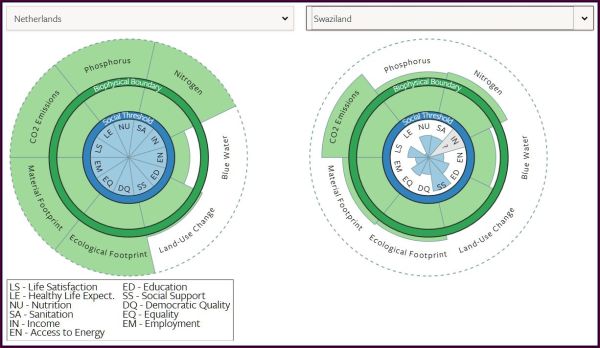
U.S.A. and Germany are not so dissimilar.
U.S.A: Good life 9 of 11; Sustainability 1 of 7
Germany: Good life 11 of 11; Sustainability 2 of 7
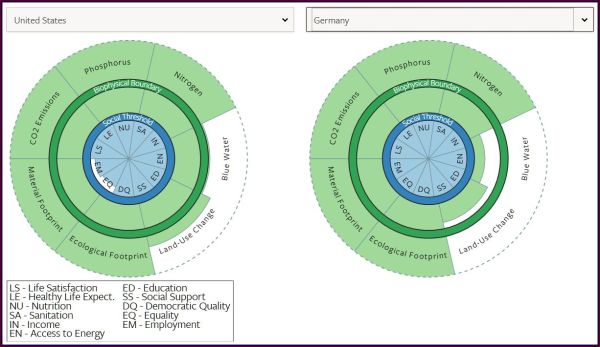
Additional detail is available, such as this for U.S.A. and Germany. It’s easier to read on their website.
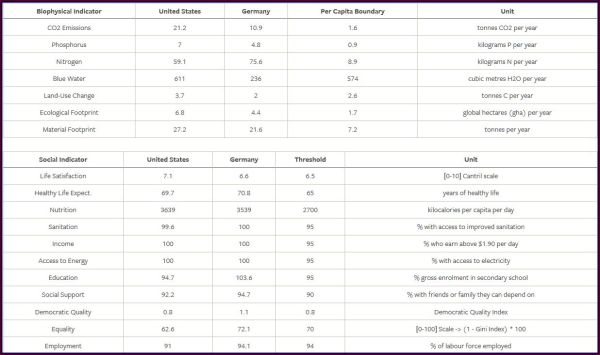
Check it out. There are other goodies on the site: world maps, scenarios to explore, discussions.
Perhaps instead of holding the fabulously expensive, once-ever-four-years Olympics, we could intentionally invest and take pride in a ‘Good & Sustainable Life’ Olympics. If your country wins this competition, every citizen within your borders really wins something of life-sustaining value which will likely last their lifetime, not just a shiny metal medal on a ribbon, suitable for hanging around one person’s neck for one day, and one day only.
[Chuck Almdale]



 SANTA MONICA BAY AUDUBON SOCIETY BLOG