Free email delivery
Please sign up for email delivery in the subscription area to the right.
No salesman will call, at least not from us. Maybe from someone else.
Cranes, Quail, Doves, Verdin, Towhees: Salton Sea & Imperial Valley 9-11 February, 2018
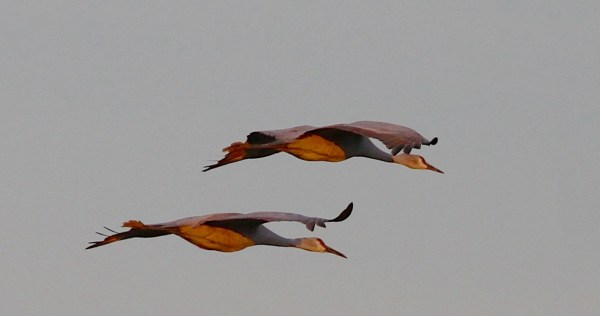
Sandhill Cranes at dusk, Dogwood Road (Joyce Waterman 2-10-18)
Other than blowing a tire Friday night en route to Christine’s (Fine Mexican Dining), it was a good trip. From this event we learned five things: median strips in Brawley are invisible; compact spare tires are inferior to full-sized, but far better than no spare and an air pump; Walmart may advertise that their auto repair door “opens at 7am” but repairs don’t start until 8am; leave room for the jack’s crank when parking next to the curb; good leverage outranks shear body strength. One large and helpful local saw me struggling, pitiful and disheveled, crouched on the curb in the flickering neon light. “Hey buddy, let me help,” and took over the cranking job. But over several minutes of straining he failed to move it, and while walking away, muttered to his wife, “that guy’s stronger than he looks; I couldn’t budge that thing.”
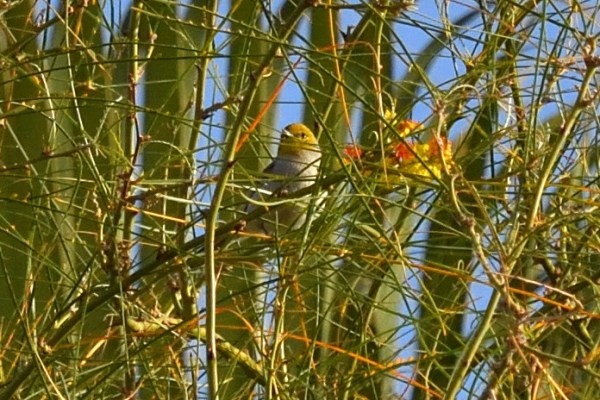
Verdin in Palo Verde tree (Jerry Ewing 2-10-18)
Roadside vegetation at the Whister Unit sign-in spot on Davis Road has recovered a bit since the management’s scorched-earth policy of three years ago, but still sparse with fewer birds. Recent rains had washed out several bridges, and we couldn’t get through on either Davis or English Roads. We found a workaround.
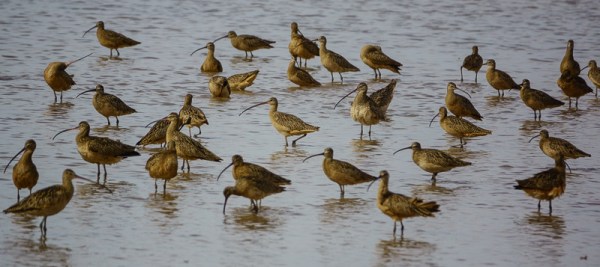
Long-billed Curlews, English Road (Chuck Bragg 2-10-18)
After a futile Crissal Thrasher search on Noffsinger Road, we found a good selection of waterfowl and shorebirds in an impoundment around the corner on English Road, including a large mixed flock of plastic geese. A Peregrine Falcon was in territorial mode, diving repeatedly on a Turkey Vulture. The attacks apparently forced the TV to the ground, but he managed to take flight and get away, despite a few more Peregrine stoops. We guessed that the falcon had knocked a bird down which the TV then tried to move in on, but the falcon maintained ownership. Vultures normally stick to dead things for food, and therefore don’t compete with raptors who kill their own prey.
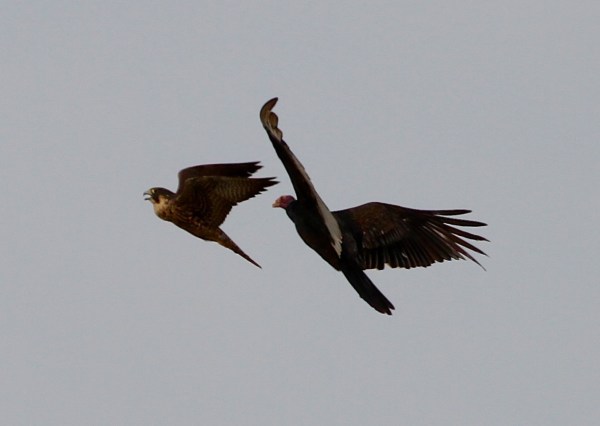
Peregrine Falcon & Turkey Vulture, Whister Unit (Joyce Waterman 2-10-18)
We managed to locate the American Redstart wintering since October at the NE corner of the Imperial Irrigation District’s managed wetlands, but only two people were in the right spot at the right microsecond to see it. The pair of Burrowing Owls on Sinclair Rd., which we’d found on Friday, were probably hiding in their hole during the noonday heat.

Burrowing Owl – out on Friday, hiding on Saturday
(Joyce Waterman 2-10-18)
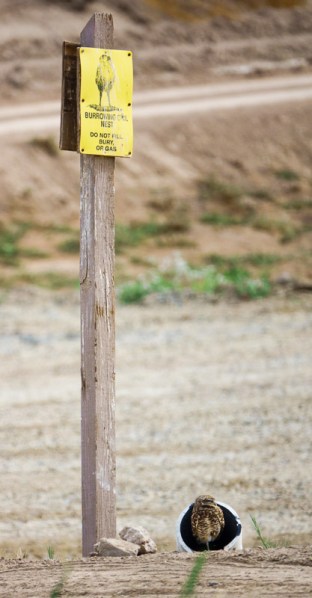
Burrowing Owl, sign & tube
(Chuck Bragg 2-10-18)
Fortunately, the owl at the Park HQ stayed alert at his burrow-tube mouth, and everyone had excellent looks. Likewise, the Gambel’s Quail, Abert’s Towhees and Common Ground Doves were busy seed-scarfing at the feeders. Life birds for many.
Eurasian Collared-Doves have proliferated in Imperial Valley. About ten years ago I was very excited to find one, near Nyland. They had been spreading at lightning speed across the U.S. from their southern Florida starting point – some say the Bahamas – and this was my first California sighting. Now they’re everywhere in the valley, often in groups of 5-20 birds. Concurrently, Mourning Doves seem to have taken a big hit. See the comparative trip lists below.
Similarly, as the sea retreats and salinity of the remaining water increases, the fish are dying out and several avian species have dwindled almost to the vanishing point, notably White Pelicans and Eared Grebes. The grebes used to coat the water in vast rafts, while coordinated flocks of thousands of pelicans soared. If you listened closely, you could hear the wind ruffling their flight feathers. Where are they all now? My guess (or hope) is they’ve continued farther south to the open water of the Sea of Cortez. If not there, they’re vanishing before our eyes.
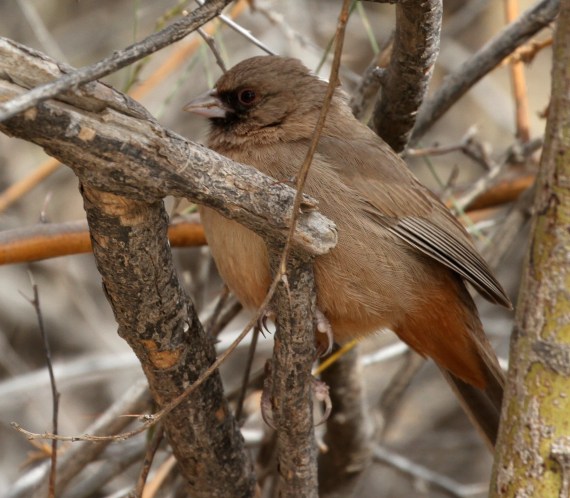
Abert’s Towhee, Park HQ seed feeder (Joyce Waterman 2-10-18)
On Garst Road towards Red Hill Marina we found many Snow Geese and Cinnamon Teal in the roadside ponds. The north end of Garst keeps getting longer as the sea retreats, and tall reeds now surround the area where once was only open water a few years ago.
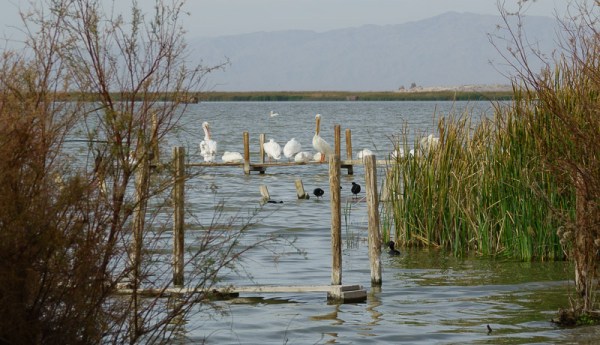
White Pelicans on the Salton Sea, north end of Garst Road (Chuck Bragg 2-10-18)
Marsh wrens sang everywhere although we saw only a few, and a Sora called from hiding. On the sea, what little we could see of it, were a few White Pelicans and Double-crested Cormorants, a single Forster’s Tern perched on a pole, and a spotless Spotted Sandpiper prowled the edges. This bird’s butt-bobbing behavior led to a brief discussion about the effect of tail/head wagging/bobbing on a bird’s ability to perceive depth.
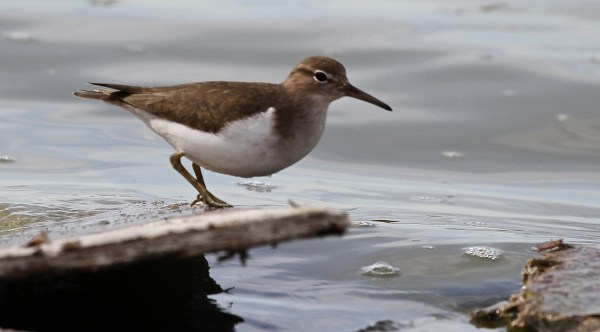
Spotted Sandpiper, Salton Sea, north end of Garst Road (Joyce Waterman 2-10-18)
Slowly driving past the enormous Brant Ranch cattle feed lot on Brant Rd. brought us zero Yellow-headed and Tricolored Blackbirds. At least 90% of the blackbirds we’d seen there at 8:45 AM had gone elsewhere.

Common Ground Dove, Park HQ seed feeder (Joyce Waterman 2-10-18)
Eddins & Sperry Rds., just west of downtown Calipatria, is a well-known hangout for small doves: Ground, Inca and Ruddy Ground Dove. A diligent search yielded only a single Inca Dove in the former pig farm, and few of the birders felt up to walking over to see it. Another property owner came out to greet us when her dog started howling. This beast was blind and sixteen years old and staggered sideways more than walked forward, but it still possessed a strong voice. She show us a photo which Bob Miller, field guide author and local birder extraordinaire, had given her of two of her Ruddy Ground Doves, and then told us of the tour buses which stop to disgorge hordes of dove-hungry birders. She also lamented the gun-toting dove hunters who like to shoot up or remove her “no-trespassing” and “children present” signs.
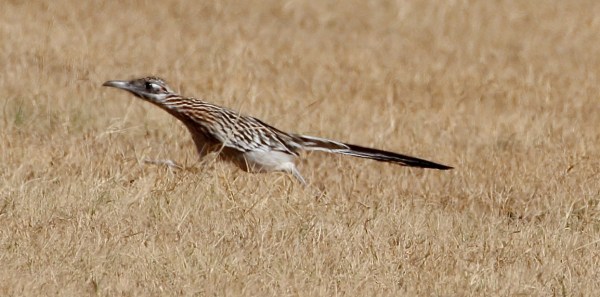
One of a pair of jousting Greater Roadrunners, English Road (Joyce Waterman 2-10-18)
A couple of birders peeled off at this point to retreat to the motel, and the rest flagged in the afternoon +80° heat. Yet on we went to Ramer Lake to pick out purported Neotropic Cormorants from the Double-crested. I personally do not care for this particular exercise. I stare at these cormorants, knowing that other birders always find Neotropics here, but I can never see them, no matter how hard I try to convince myself. The lowering afternoon sun painted their gular pouches a deep orange – almost red in one instance – which didn’t make things any easier. One bird seemed to have white edging on its pouch, but it was very faint and restricted. I gave up and we left.
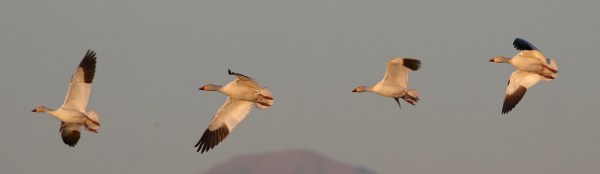
Snow Geese (Joyce Waterman 2-10-18)

Rough-winged Swallow, Carey Road seed mill (Joyce Waterman 2-10-18)
We arrived at the Carey Road seed mill (between Hwy #86 and Dogwood Road) several miles south of Brawley about a half hour before sundown, giving us plenty of time to watch 79 Sandhill Cranes stalk the seed and chaff-covered ground. Cranes arrived and left, ululating to our delight, while other small groups flew by to land a mile away, east of Dogwood Road. We relocated to roadside Dogwood, listening, watching, talking. Flocks large and small passed overhead: Snow Geese, White-faced Ibis, Cattle Egrets, heading to their night roosts as the setting sun painted the sky in traditional California colors of pink and blue.
Dinner at the Brawley Inn restaurant was quite nice, consisting of mostly Italian food (mine a scorching ziti), with draft beer and wines on hand. Our total bird list for the day was a reasonable but not spectacular seventy birds.

Long-billed Curlews (Joyce Waterman 2-10-18)
Next morning after breakfast, we arrived at the Carter & Fites brush & trash patch about 6:45 AM, ready to find the Crissal Thrasher, for which the spot is noted. The less said about this effort, the better. We found a few singing Phainopeplas, and Ruby-crowned Kinglets and Blue-gray Gnatcatchers bounced through the brush and vines, but little else appeared.
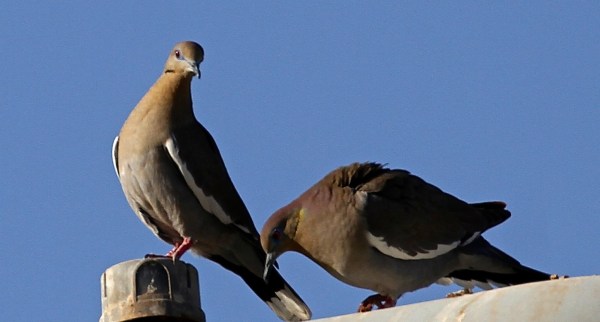
White-winged Doves, Cattle Call Park (Joyce Waterman 2-11-18)
Birding was better across the New River at Cattle Call Park. Gila Woodpeckers in the park and local neighborhood, White-winged Doves, Juncos and Abert’s Towhees on the lawn, tricky Anna’s Hummingbirds, several Ground Doves, Gambel’s Quail, Yellow-rumped and Nashville Warblers. Joyce found a Red-naped Sapsucker – certainly unexpected for this area – and a Northern Flicker. A distant and calling Cactus Wren was a life bird for some. For most birders, this was the end of the trip.
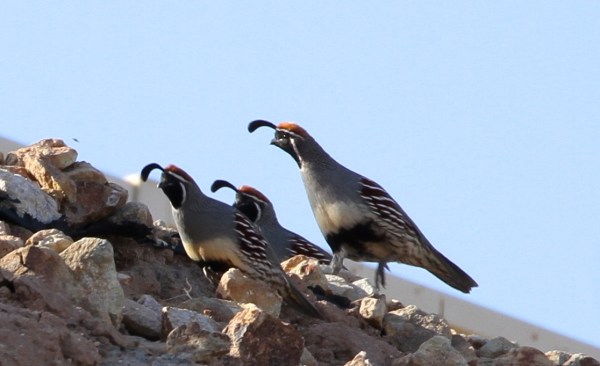
Gambel’s Quail trio, Cattle Call Park (Joyce Waterman 2-11-18)
After passing through Westmoreland and heading home up Hwy 86, Lillian and I stopped at Poe Road, a spot new to us, which entailed a mile drive on dirt and caliche down to the edge of the sea. (Do NOT drive on caliche when wet!) Here we found an enormous number of shorebirds and ducks – primarily Least/Western Sandpipers and Northern Shovelers – plus more Black-necked Stilts than I’ve ever seen before, all at scope-distance. It’s cheating a bit to add these to the trip list, but we did it anyway – so Snowy & Black-bellied Plovers, Willet, Dunlin, Western and Stilt Sandpipers made it onto the trip list. Total species for 2 PM Friday through noon Sunday was 92 species.
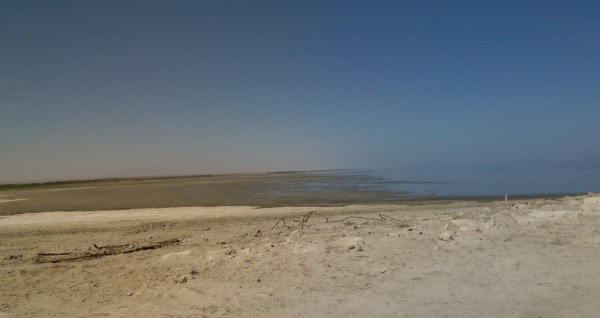
Salton Sea at end of Poe Road – It’s hard to believe there’s over 10,000 birds in this picture (L. Johnson 2-11-18)
Here’s a plug for two local businesses.
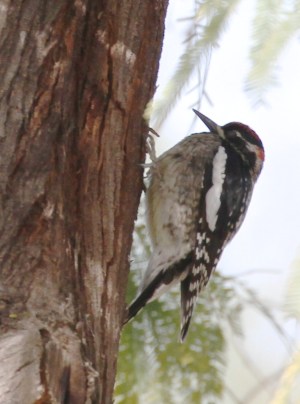
Red-naped Sapsucker female, Cattle Call Park (Joyce Waterman 2-11-18)
Brawley Inn: Their manager must have seen our trip announcement which mentioned four area motels including his. He emailed me an offering of $82 special price for trip participants, which most of us utilized. The rooms, water and soundproofing were fine, as was their restaurant and the included breakfast, but at least one participant had to exert extra diligence to make sure they actually received the promised price.
Oasis Date Gardens (59-111 Grapefruit Blvd., Thermal): The new Highway #86 bypassed their store full of great date shakes, sandwiches, special lunches, and about ten varieties of delicious dates year-round. We always stop – both coming and going – to get date shakes and a couple of pounds of dates. Heading south on Hwy #86, turn right (west) at Airport Blvd. (equivalent of Avenue 56). A new overpass crosses over the railroad and Grapefruit Blvd. As the overpass descends, take the first right which curves around to Grapefruit. Then three miles south (right) to the Oasis store on your right. To continue south, stay on #111 to travel the sea’s east side to Nyland. For Brawley or further south, get back on #86 when you see the signs.
When coming north, I recommend exiting #86 at Hwy #195 (equivalent of Avenue 66), drive east towards Mecca, turn north (left) onto Hwy #111 and drive seven miles north to the store. If you’re driving up #111, just continue past Mecca to the garden.

American Kestrel pair, shortly after mating, Cattle Call Park (Chuck Bragg 2-10-18)
You can get onto Hwy #86 at Airport Blvd three miles north of the store. The highway design people didn’t do any favors for the Oasis owners, and the turns and roads are irritatingly poorly marked. But it’s well worth the effort.
Link to Google Map.
Celebratory date shakes all around.
Recommended Reading:
Finding Birds at the Salton Sea and in Imperial County, California Henry Detwiler & Bob Miller, 2012, $18.00
From ButeoBooks
Southwest Birders Web Site
Prior Field Trip Reports: Feb 2015 Feb 2012 Feb 2010
| Salton Sea & Imperial Valley | 2018 | 2015 | 2012 | 2010 |
| Name (See key at bottom) |
Feb. 9-11 | Feb. 7-8 | Feb. 11-12 | Feb. 6-7 |
| Greater White-fronted Goose | 1 | |||
| Snow Goose | 3000+ | 1000+ | 1000+ | 6000+ |
| Ross’s Goose | 200+ | 300+ | 500+ | |
| Gadwall | 30 | 50 | 40 | 10 |
| Eurasian Wigeon | 1 | |||
| American Wigeon | 100 | 200 | 30 | |
| Mallard | 30 | 30 | 100 | 60 |
| Blue-winged Teal | 2 | |||
| Cinnamon Teal | 50 | 4 | 25 | 4 |
| Northern Shoveler | 3000+ | 1000+ | 1000+ | 1000+ |
| Northern Pintail | 300 | 1000+ | 1000+ | 1000+ |
| Green-winged Teal | 50 | 200 | 400 | 30 |
| Redhead | 1 | 60 | 4 | |
| Lesser Scaup | 1 | 3 | 100 | |
| Bufflehead | 40 | 10 | 5 | |
| Common Goldeneye | 6 | |||
| Ruddy Duck | 50 | 70 | 80 | 300 |
| Gambel’s Quail | 20 | 40 | 30 | 16 |
| Pied-billed Grebe | 5 | 4 | 5 | |
| Horned Grebe | 1 | |||
| Eared Grebe | 3 | 80 | 50 | |
| Western Grebe | 5 | 3 | 2 | |
| Clark’s Grebe | 1 | |||
| Neotropic Cormorant | 4 | |||
| Double-crested Cormorant | 200 | 1000+ | 200 | 200 |
| American White Pelican | 50 | 100 | 1000+ | 300 |
| Brown Pelican | 50 | 100 | 20 | |
| Great Blue Heron | 15 | 15 | 30 | 10 |
| Great Egret | 20 | 60 | 20 | 20 |
| Snowy Egret | 10 | 5 | 50 | 4 |
| Cattle Egret | 1000+ | 1000+ | 1000+ | 1000+ |
| Green Heron | 1 | |||
| Black-crowned Night-Heron | 10 | 1 | 20 | 1 |
| White-faced Ibis | 1000+ | 1000+ | 1000+ | 400 |
| Roseate Spoonbill | 1 | |||
| Turkey Vulture | 20 | 15 | 20 | 15 |
| Osprey | 1 a | 1 | 1 | |
| White-tailed Kite | 1 | 5 | 1 | |
| Northern Harrier | 30 | 25 | 30 | 20 |
| Sharp-shinned Hawk | 1 | |||
| Cooper’s Hawk | 1 | 1 | 1 | |
| Zone-tailed Hawk | 1 | 1 | ||
| Red-tailed Hawk | 10 | 40 | 40 | 25 |
| Ridgway’s Rail | 1 H | |||
| Sora | 1H | 1H | 1 | |
| Common Gallinule | 1 | |||
| American Coot | 200 | 100 | 50 | 500 |
| Sandhill Crane | 200 | 400+ | 300 | 185 |
| Black-necked Stilt | 500 | 50 | 400 | 100 |
| American Avocet | 200 | 100 | 500 | 30 |
| Black-bellied Plover | 10 c | 10 | 10 | |
| Snowy Plover | 1 c | 0 | ||
| Killdeer | 30 | 100 | 100 | 100 |
| Mountain Plover | 60 | |||
| Spotted Sandpiper | 1 | 5 | 1 | |
| Greater Yellowlegs | 6 | 4 | 4 | 2 |
| Willet | 100 c | |||
| Lesser Yellowlegs | 1 | |||
| Long-billed Curlew | 700 | 50 | 75 | 500 |
| Marbled Godwit | 30 | 30 | 40 | |
| Stilt Sandpiper | 10 c | |||
| Dunlin | 5 c | |||
| Least Sandpiper | 1000+ | 70 | 20 | 50 |
| Western Sandpiper | 200+ c | |||
| Long-billed Dowitcher | 300 | 20 | 100 | 200 |
| Ring-billed Gull | 3000+ | 3000+ | 1000+ | 5000+ |
| Yellow-footed Gull | 1 | 4 | ||
| California Gull | 1000+ | 1000+ | 500 | |
| Herring Gull | 20 | 10 | ||
| Lesser Black-backed Gull | 1 | |||
| Glaucous-winged Gull | 2 | |||
| Caspian Tern | 2 | 5 | 60 | 30 |
| Forster’s Tern | 1 | 1 | ||
| Black Skimmer | 1 | |||
| Rock Pigeon | 500 | 60 | 50 | 10 |
| Eurasian Collared-Dove | 100+ | 100 | 70 | 60 |
| Inca Dove | 1 | 2 | 2 | |
| Common Ground-Dove | 10 | 20 | 12 | 20 |
| White-winged Dove | 6 b | 6 | 2 | 4 |
| Mourning Dove | 40 | 60 | 50 | 300 |
| Greater Roadrunner | 3 | 2 | 4 | 1 |
| Burrowing Owl | 4 | 3 | 1 | 9 |
| Anna’s Hummingbird | 4 | 3 | 2 | 2 |
| Costa’s Hummingbird | 5 | 1 | ||
| Belted Kingfisher | 1 a | 1 | 2 | 1 |
| Gila Woodpecker | 4 b | 6 | 4 | 2 |
| Red-naped Sapsucker | 1 b | |||
| Ladder-backed Woodpecker | 2 | |||
| Northern Flicker | 1 b | 10 | 4 | 1 |
| American Kestrel | 20 | 20 | 20 | 20 |
| Peregrine Falcon | 1 | 1 | 1 | |
| Prairie Falcon | 1 | |||
| Black Phoebe | 30 | 35 | 12 | 10 |
| Say’s Phoebe | 5 | 10 | 6 | 3 |
| Vermilion Flycatcher | 1 | |||
| Western Kingbird | 2 | |||
| Loggerhead Shrike | 2 | 6 | 2 | |
| Common Raven | 10 | 25 | 200 | 20 |
| Horned Lark | 100 | |||
| Northern Rough-winged Swallow | 1 | 10 | ||
| Tree Swallow | 10 a | 50 | 60 | 20 |
| Barn Swallow | 40 | 200 | ||
| Cliff Swallow | 80 | |||
| Verdin | 10 | 10 | 9 | 3 |
| Marsh Wren | 2 H20 | 2 H20 | 4 H | 3 |
| Bewick’s Wren | 1 | |||
| Cactus Wren | 1 b | 2 | ||
| Blue-gray Gnatcatcher | 4 | 3 | 2 | |
| Black-tailed Gnatcatcher | 2 | |||
| Ruby-crowned Kinglet | 20 | 8 | 2 | |
| Mountain Bluebird | 2 | |||
| American Robin | 2 | 20 | ||
| Northern Mockingbird | 8 | 30 | 25 | 2 |
| European Starling | 80 | 150 | 100 | 50 |
| American Pipit | 1 | 30 | 40 | 100 |
| Cedar Waxwing | 5 | |||
| Phainopepla | 6 b | 2 | ||
| Lapland Longspur | 1 | |||
| Orange-crowned Warbler | 2 | 3 | ||
| Nashville Warbler | 1 b | |||
| Common Yellowthroat | 2 | |||
| American Redstart | 1 | |||
| Yellow-rumped Warbler | 40 | 40 | 31 | 20 |
| Wilson’s Warbler | 1 | |||
| California Towhee | 2 | |||
| Abert’s Towhee | 15 | 20 | 10 | 12 |
| Chipping Sparrow | 1 | |||
| Savannah Sparrow | 20 a | 1 | 4 | |
| Song Sparrow | 6 | 2 | 4 | 4 |
| White-crowned Sparrow | 80 | 50 | 60 | 50 |
| Dark-eyed Junco | 6 b | |||
| Red-winged Blackbird | 200 | 200 | 1000+ | 10,000+ |
| Tricolored Blackbird | 1 | |||
| Western Meadowlark | 20 | 20 | 60 | 200 |
| Yellow-headed Blackbird | 5 | 30 | ||
| Brewer’s Blackbird | 10 | 40 | 40 | 200 |
| Great-tailed Grackle | 200 | 60 | 50 | 40 |
| Brown-headed Cowbird | 6 | 30 | 20 | |
| House Finch | 30 | 30 | 100 | 30 |
| Lesser Goldfinch | 10 | 4 | ||
| American Goldfinch | 7 | |||
| House Sparrow | 50 | 30 | 100 | 30 |
| Total Species – 142 | 93 | 101 | 103 | 93 |
| Key | ||||
| a – Friday only 2/9/18 | ||||
| b – Cattle Call Park only 2/11/18 | ||||
| c – Poe Road only 2/11/18 | ||||
| Bold – Special interest species |
Curling the Birds
Even bird mavens may not know this.
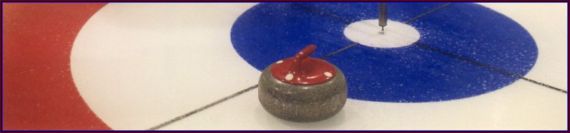
The rock, the house, the island, the birds (CurlingStone.com)
Americans love sports, especially winter sports, and above all, Americans love the winter sport of curling.
Didn’t know that, did you?
Who can not love the sound of the rock gliding houseward o’er the pebbled sheet, the sound of the sweepers brushing madly, like the guilty scrubbing blood from their clothes as police pound on the door – “Open up! We hear you in there!” The curler screaming invective at the sweepers. Ah, the soft camaraderie of teammates, bands of brothers and sisters in this gentle sport.

Well, maybe.
But this story is about those stones. These pucks weight 38 to 44 pounds each, and the World Curling Federation uses only stones made of blue hone granite, cut from the small island of Alisa Craig, found off the coast of Scotland. Why, of course it had to be Scotland, origin of many odd, yet beloved, ways to waste one’s time. Scotch and golf are two such pastimes.

Atlantic Puffin on Machias Seal Island, New Brunswick
(Judy Gallagher, Wikimedia Commons)
But the Atlantic Puffins disappeared from the island by the 1990s, their eggs eaten by rats introduced (accidentally, one hopes) by the stone miners. The government stepped in, the rats eliminated and the terrifically cute puffins (inspiration for the “porgs” in The Last Jedi) returned to nest. The RSBP now manages the island as a bird reserve, and Kays of Scotland – the company who owns the rights to blast loose the granite – is forbidden from doing so. They say they have enough granite in stock to last “a long time.”

The unutterably cute porgs, apparently in their positions for the bowling tournament about to begin. (LucasFilms The Last Jedi – from Dark Side of the Force Blog)
And there’s more. Much more. Read all about it here.
Be warned. A single stone can cost up to $1400. A set of 16 competition quality stones will run around $4000. How much the shipping costs on over 700 pounds of granite, no man can say. [Chuck Almdale]
At first look, manucodes appear almost normal compared to other birds-of-paradise. Males and females look alike, live in pairs, and males help raise the young. But on the inside manucodes have an exotic secret, and you can hear it in their voices. Males have a greatly lengthened windpipe that works like a wind instrument, creating a long, mellow, fluting song. Filmed and photographed by Tim Laman.
There are currently seventy-two short films in the entire Birds-of-Paradise Project playlist, ranging from 26 seconds to 8:29. In the upcoming weeks, we will present some of our favorites.
A film from the Cornell Lab of Ornithology. If no film or link appears in this email, go to the blog to view it by clicking on the blog title above. If the film stops & starts in an annoying manner, press pause (lower left double bars ||) to let it buffer and get ahead of you. [Chuck Almdale]
Dumb-Sounding Birds Of North America | Skunk Bear
Blogging birder Nick Lund shared some of his favorite ridiculous bird songs with Skunk Bear.
This is an installment of the NPR – Skunk Bear series. If no film or link appears in this email, go to the blog to view it by clicking on the blog title above. If the film stops & starts in an annoying manner, press pause (lower left double bars ||) to let it buffer and get ahead of you. [Chuck Almdale]
New anti-drone technology in France
Where Eagles Dare: French military using winged warriors to hunt down rogue drones.
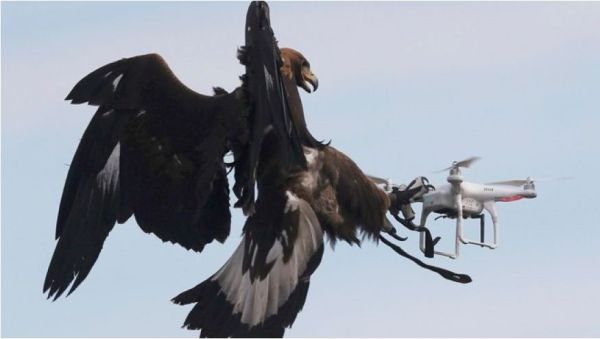
A golden eagle grabs a flying drone during a military training exercise at Mont-de-Marsan French Air Force base, Southwestern France.
Following incidents of drones flying over the presidential palace and restricted military sites — along with the deadly 2015 Paris terror attacks — the French Air Force has trained four golden eagles to intercept and destroy the rogue aircraft.
Aptly named d’Artagnan, Athos, Porthos and Aramis – an homage to Alexandre Dumas’ “The Three Musketeers” – the four birds of prey have been honing their attack skills at Mont-de-Marsan since mid-2016.
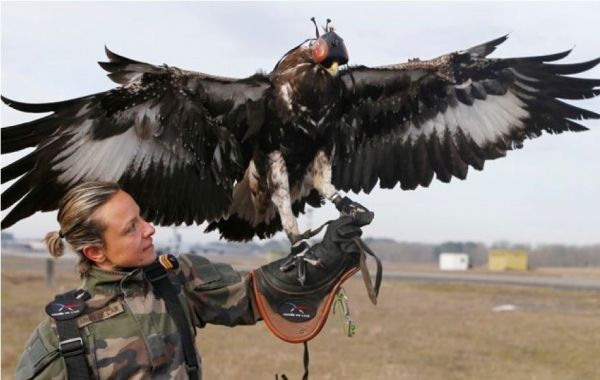
“A drone means food for these birds,” Gerald Machoukow, the military base’s falconer, told FRANCE 24. “Now they automatically go after them.”
The use of hunting birds — normally falcons and northern goshawks — by military organizations around the globe is common practice in the fight to scare other critters away from runways and so cut the risk of accidents during takeoff or landing. But it wasn’t until 2015 when the Dutch started using bald eagles to intercept drones that other military outfits started to see the benefit of these winged warriors.
The French bred the four golden eagles — three males and one female — using artificial insemination since eagles are a protected species and harvesting wild eggs is strictly forbidden. They chose the golden eagle because of the birds hooked beak and sharp eyesight.
Watch the Video
You’ll need to click through to watch it on APF / YouTube
Also weighing in around 11 pounds, the birds are in a similar weight class as the drones they’re sent to destroy and clocking in at a top air speed of 50 miles per hour, with the capability of spotting its target from over a mile away, the eagles are deft hunters.
To protect the eagles from drone blades and any explosive device that might be attached to them, the French military designed mittens of leather and Kevlar (an anti-blast material), to protect the bird’s talons.

A golden eagle carries a flying drone
“I love these birds,” Machoukow told Agence France-Presse. “I don’t want to send them to their death.”
The birds are first taught to attack in a straight line before graduating to diving from heights. Soon they’ll be patrolling the skies over the Pyrenees Mountains in southern France and could possibly be deployed at airports and special events, such as political summits and soccer tournaments.
The French air force already expects four more eagles to join the fleet.
[Submitted by Chris Lord who received it from Don Sterba]
Frankly, I’ve wondered if a spear gun with an attachment line – or even a hose squirting water – might not work well for the drone hovering over your swimming pool.
[Posted by Chuck Almdale]



 SANTA MONICA BAY AUDUBON SOCIETY BLOG