Free email delivery
Please sign up for email delivery in the subscription area to the right.
No salesman will call, at least not from us. Maybe from someone else.
Total Super Blue-Blood Eclipse of the Moon! 4:51-6:07 AM PST 1-31-18
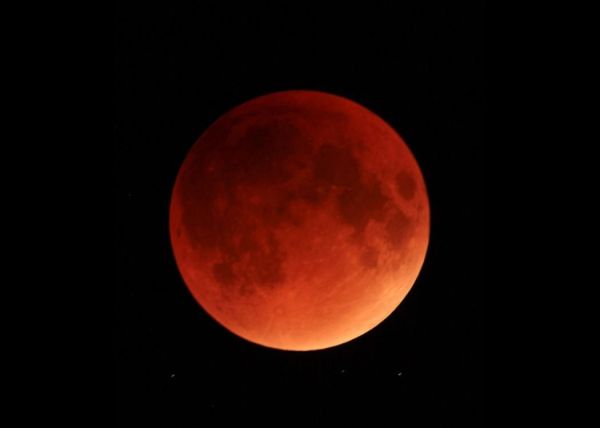
Blood Moon of October 2015 (Deanne Fortnam – TimeandDate.com)
OK. Hit it!
Bom ba ba bom ba bom ba bom bom
Ba ba bom ba ba bom dang a dang dang
Ding a dong ding
Blue moon!
You could not be a teenager, or anywhere close to being a teenager, in 1961 America, and not hear this song. Radio-blasting from homes, apartments, passing cars, drive-ins and – if you were lucky enough to own one – one of those new pocket-sized transistor radios. It was everywhere.
The lyrics, or at least half of them, were deathlessly simple. Certainly worth repeating, which the backup singers, especially bass vocal Fred Johnson, did – relentlessly – throughout the song. Feel free to push the red button-arrow below and sing along with the Marcels’ original version. We know that you already know it.
Blue moon, moon, moon, moon, moon
Dit Di Dit Di Dit
Moon, moon, moon, blue moon
Dit Di Dit Di Dit
Moon, moon, moon, blue moon
Dit Di Dit Di Dit
Bom ba ba bom ba bom ba bom bom
Ba ba bom ba ba bom dang a dang dang
Ding a dong ding
Blue moon!
Goofy, funny, ridiculous, infectious; pathos and loneliness morphing into redemption – who could ask for more in a song? Besides – it had a beat. You could dance to it. I’d give it a 94. Maybe a 96.

The Marcels: Fred Johnson, Gene Bricker, Ron Mundy, and Richard Knauss surround lead Cornelius Harp.
The Marcels formed their do0-wop group in 1959 in Pittsburgh, PA. It took two years for someone – probably a combination of the Marcels and their producers immortalized as “Stu and Danny” – to take this romantic ballad standard of the American Songbook and turn it into an unforgettable pop hit. The Marcels – more or less a “one-hit wonder,” a common phenomena of the era – were very uncommon in that they were a mixed black-and-white group. Doo-wop groups were ubiquitous; biracial pop, rock ‘n’ roll, doo-wop, blues, or rhythm & blues groups were not.
Richard Rogers and Lorenz Hart wrote the original Blue Moon in 1933 for the movie “Hollywood Party.” It didn’t make it onto the screen then, nor did the second version make it into “Manhattan Melodrama” (1934), but a third version did appear in that film. It was not a hit. MGM asked for a fourth lyric rewrite and published that version, then licensed it to radio program “Hollywood Hotel” to use as their theme music. Connie Bosworth recorded it in January 1935, and it later appeared in at least seven MGM films including the Marx Brothers At the Circus and Viva Las Vegas. Billy Eckstine recorded a swing version and hit the Juke Box chart in March 1949. Mel “the Velvet Fog” Torme almost immediately recorded his own version which peaked on the Best Seller chart at 20 in April 1949.
Twelve years passed before the Marcels appeared with their version of this classic, completely reworked for a new generation, none of whom knew that it had been recorded and re-recorded for over twenty-five years.
Blue Moon, you saw me standing alone
Without a dream in my heart
Without a love of my own
Blue Moon, you knew just what I was there for
You heard me saying a prayer for
Someone I really could care for
do wah wah wah
And then there suddenly appeared before me
The only one my arms will ever hold
I heard somebody whisper, “Please adore me”
And when I looked, the moon had turned to gold
Oooooooooooooooooooooohhhhhhhhhhh
Blue Moon, now I’m no longer alone
Without a dream in my heart
Without a love of my own
Aaaaaaaaaaaaaaaaaaaaaaaahhhhhhhhhh
Bom ba ba bom ba bom ba bom bom
Ba ba bom ba ba bom dang a dang dang
Ding a dong ding
Blue moon!
All of which segues quite naturally and logically into our celestial phenomenon of the week, the Total Super Blue–Blood Eclipse of the Moon! Right? (Cue the resounding chorus of agreements.)
OK, what is it?, you ask. Thanks for asking.
Total Eclipse of the Moon
Just as the moon can completely cover the sun during a total solar eclipse, the shadow of the earth can completely encompass and darken the moon during the total lunar eclipse. Because the size of the earth, and therefore its shadow, relative to the size of the sun when seen from the moon, is much larger than the size of the moon relative to the size of the sun when seen from the earth, the lunar eclipse can last much longer than the solar. For example, the period of totality for this lunar eclipse will last 77 minutes, almost thirty times longer than the period of totality for the total solar eclipse of 8-21-17, which maxed out at 2:35. That’s two minutes and 35 seconds, about average for a total solar eclipse.
Supermoon
The moon’s orbit is not a circle, but an ellipse, with an average distance of 238,000 miles. The farthest point is the apogee, the closest is the perigee. At perigee it appears 7% larger and 16% brighter than the average moon and 14% larger and 30% brighter than the micromoon (at apogee). When a total lunar eclipse occurs during perigee, it is called a supermoon, a phrase coined in 1979 by astrologer Richard Nolle, who defined it as when the moon is within 90% of perigee. The technical name is the perigee-syzygy of the Earth-Moon-Sun system. Ocean tides are higher during supermoons, lower during micromoons. Perigee occurs monthly, but they do not often coincide with a full moon which – in case you forgot – also occur monthly.
Blue Moon
Two Definitions of Blue Moon
Seasonal Blue Moon – The third Full Moon in an astronomical season (spring, summer, etc.) with four full moons (versus the usual three).
Monthly Blue Moon – The second Full Moon in a month with two Full Moons.
The reason the second definition of Blue Moon exits is due to an error originally made by amateur astronomer James Hugh Pruett (1886–1955). He misunderstood the basis for calculating the seasonal Blue Moon and wrote that a Blue Moon was the second Full Moon in a month in an article published in Sky & Telescope magazine in 1946. This erroneous definition spread, particularly after it was quoted in a popular radio program called StarDate in 1980 and then appeared as an answer in a 1986 version of the board game Trivial Pursuit. Today, it is considered a second definition rather than a mistake.
A Full Moon Without a Name
The seasonal Blue Moon originally came about as a kind of placeholder name for a Full Moon which doesn’t have a proper Full Moon name, such as Harvest Moon or Paschal Moon. This way, when there are 13 Full Moons in a year instead of the usual 12, the other 12 can keep their rightful place in relation to the solstices and equinoxes.
How Rare Is a Blue Moon?
The term once in a Blue Moon means that something is rare. Blue Moons happen once every two or three years. In the 1100 years between 1550 and 2650 (UTC), there are 408 seasonal Blue Moons and 456 monthly Blue Moons.
Double Blue Moons happen only about 3 to 5 times in a century. The next year that has two months with two Full Moons each will be 2037, while the last time, was in 1999.
Other combinations of Blue Moons also exist. Between 1550 and 2650 there are 20 years which have one seasonal and one Monthly Blue Moon. The next time is in 2048 while the last time was in 1934. Triple Blue Moons, a combination of one seasonal and two monthly Blue Moons in the same calendar year, happens 21 times in the same time span. The next is in 2143, while the last time was in 1961.
There can never be a double seasonal Blue Moon, as that would require 14 Full Moons in the same year, which is not possible because the time between two Full Moons is approximately 29.5 days.
The Rarest Blue Moon
A Moon that actually looks blue, however, is a very rare sight. The Moon, full or any other phase, can appear blue when the atmosphere is filled with dust or smoke particles of a certain size; slightly wider than 0.7 micron. The particles scatter the red light, making the Moon appear blue. This is known as Mie scattering, and can happen for instance after a dust storm, a forest fire, or a volcanic eruption.
Eruptions like the ones on Mt. Krakatoa, in Indonesia (1883), El Chichon, Mexico (1983), on Mt. St. Helens (1980) and Mount Pinatubo (1991) are all known to have made the moon look blue. Some people even suggest that the term once in a Blue Moon is based on these rare occasions, rather than the Full Moon definitions.
Blood Moon
The rusty-red color of the eclipsed moon is often called “blood on the moon,” but there is another, more esoteric definition.
The term Blood Moon is also sometimes used to refer to four total lunar eclipses that happen in the span of two years, a phenomenon astronomers call a lunar tetrad. The eclipses in a tetrad occur about six months apart with at least six uneclipsed Full Moons between them.
Usually, only about one in three lunar eclipses are total, and about four to five total eclipses can be seen from any single location on Earth in a decade. This means that lunar tetrads are rare occurrences, leading some to attach special, even religious, significance to these events.
The 2014–2015 lunar tetrad (15 April 2014, 8 October 2014, 4 April 2015 and 27 September 2015) gathered a lot of attention because of claims by some religious organizations that the eclipses in the tetrad were a sign of the end times. Some even called the eclipses Blood Moons after a statement in the Book of Joel in the Hebrew Bible, that referred to the Sun turning dark and the Moon turning red before the second coming of Jesus.
As usual, the human penchant for finding personal meaning within environmental events having nothing to do with them is fully operational, and many people see all sorts of religious, mystical and apocalyptic meanings in this sequence of events. This tetrad (in the order given above) coincides with Jewish holidays: Passover, Sukkot, Passover and Sukkot. That the Jewish calendar, including its holidays, is lunisolar – primarily lunar but corrected for actual year length by periodically adding days – seems to be overlooked. Important holidays tied to seasons and moon cycles will of course regularly fall on full moons and lunar eclipses.
Nevertheless, sages find meaning here. “Not only does God’s name have four letters, but it was on the fourth day of creation that God created the sun and the moon, establishing them as signs to mark sacred times, such as the Festival of Passover,” usefully explains Gidon Ariel of Root Source (quoted in Washington Post). Mark Blitz of El Shaddai Ministries says this tetrad of blood moons were partially meant as divine warnings to President Obama about his Middle East policy. “The moons are like flashing red warning lights at a heavenly intersection saying to Israel as well as the nations they will be crossing heavenly red lines, and if they do, they will understand as Pharaoh did on Passover night 3,500 years ago that the Creator backs up what He says.” And thank you for sharing that.
There will be seven more tetrads in the 21st century. Previous lunar tetrads occurred in 1967, 1949, and 1493; there were none at all from 1600 to 1900. No doubt events of unbelievable cataclysmic proportion occurred (but apparently no one bothered to record them) – and will occur – at those times. [Chuck Almdale – freely cribbed from TimeandDate.com]
Should You Eat Every Day? | PBS Science Video
An intermittent fasting diet is one of the hippest new nutrition and fitness philosophies, based around the idea that going hungry can be good for your health. Some think it’s a weight loss secret that calls upon our ancient evolutionary programming. We look at the science behind intermittent fasting.
This is an installment of the PBS – It’s OK to be Smart series. If no film or link appears in this email, go to the blog to view it by clicking on the blog title above. If the film stops & starts in an annoying manner, press pause (lower left double bars ||) to let it buffer and get ahead of you. [Chuck Almdale]
When you see a Superb Bird-of-Paradise displaying, it doesn’t look like a bird at all. The change is so complete that females just see a jet-black disk with an electric-blue “smiley face” pattern. A close look at the transformation reveals how modified feathers on the head, back, and flank combine in an unexpected way to create a spectacular effect. Filmed and photographed by Tim Laman and Ed Scholes.
There are currently seventy-two short films in the entire Birds-of-Paradise Project playlist, ranging from 26 seconds to 8:29. In the upcoming weeks, we will present some of our favorites.
A film from the Cornell Lab of Ornithology. If no film or link appears in this email, go to the blog to view it by clicking on the blog title above. If the film stops & starts in an annoying manner, press pause (lower left double bars ||) to let it buffer and get ahead of you. [Chuck Almdale]
Finding The Speed Of Light With Peeps | Skunk Bear
There’s a new use for those stale Easter marshmallows you have lying around – calculating a constant that governs the universe.
This is an installment of the NPR – Skunk Bear series. If you liked it, let us know. We’re experimenting. If no film or link appears in this email, go to the blog to view it by clicking on the blog title above. If the film stops & starts in an annoying manner, press pause (lower left double bars ||) to let it buffer and get ahead of you. [Chuck Almdale]
Antelope Valley Raptor Search Trip Report, 01/13/2018
Antelope Valley Raptor Trip Report
Saturday, 13 January 2018
It was sunny, cold and calm when we arrived in the Antelope Valley on Saturday morning. We drove to a convenient location on Palmdale Blvd where the group assembled before we set out for the day.
We drove east on Palmdale Blvd. and turned north on 10th St. E. We had only gone a short distance when we stopped to look at some Mourning Doves that were perched in a tree. While we were looking at them, we noticed a Cooper’s Hawk perched nearby. The hawk was back-lit so the view was poor but we were able to identify it by its long, broadly-banded tail, short wings and large head. We looked at it we looked around for a moment in the hope of finding other birds nearby. When we looked back, the hawk was gone.
From there, we crossed Rancho Sierra Vista (Ave. P) and stopped to scan the scrub land on either side of the road. Initially, we were disappointed because it was very quiet. The only birds we saw were a couple of Red-tailed Hawks that were perched on distant power poles. After several minutes, however, a Cactus Wren flew up and perched atop a Joshua Tree. It was back-lit so we could not see the subtle details of its plumage but we were easily able to see the stout, slightly down-curved bill and long tail. The only other birds we saw were a few White-crowned Sparrows so we returned to Ave. P and drove east. We tried to keep an eye on the Joshua Tree where the Cactus Wren had been perched in the hope that the view would be better from the shoulder of Ave. P but it disappeared into the scrub so we did not stop.
When we reached the Desert Aire Golf Club we pulled off and parked on the shoulder. We scanned the parts of the Club grounds that can be seen from the road but saw very few birds. There were some European Starlings, Brewer’s Blackbirds and House Sparrows but little else so we crossed the road to check the scrub land. It looked very quiet at first but then we we saw 2 Loggerhead Shrikes foraging together. They stayed close to one another as they moved through the scrub, dropping to the ground, flying up and perching and dropping to the ground again.
When we left the Golf Club, we went north on 40th St. E. We saw very few birds as we drove so we didn’t stop until just after we went around the corner where 40th St. E turns right and becomes Ave. N. In past years, there have been large flocks of birds on the sod fields on the south side of Ave. N. Not so this year. All we saw were a few birds in the distance. We had better luck when we turned our attention to the scrub land across the road. We saw a small flock of House Finches and some distant Western Meadowlarks. The best bird was a Horned Lark that was just across the road from us. It was quiet, moving little and “posing” several times thereby giving us ample time for good scope views and photographs.
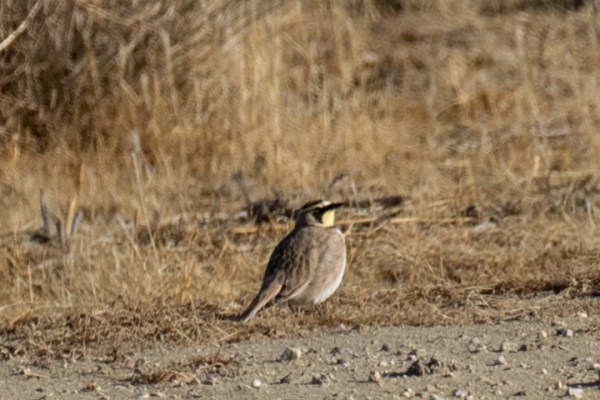
Horned Lark, Randy Ehler, 01/13/2018
Just as we were getting ready to leave, one observer spotted a male Northern Harrier. We immediately got out of our cars and watched the handsome gray and white bird as it flew slowly over the scrub land. A second Northern Harrier, probably a female or juvenile, was flying in the distance. It was far enough away that only a few of us saw it before it disappeared from sight.
From there we drove to the next intersection and went north on 50th St. E. We turned left onto Ave. M and right onto 40th St. E. Since traffic is usually light on 40th St., we planned to drive slowly and stop when we found some birds. As we turned the corner, however, we were disappointed to find poor habitat. There is a large solar farm on the west side of the road and the farm field on the east side was fallow. We saw a few birds as we slowly drove north toward Ave. L. There were some House Finches and several Western Meadowlarks but we did not see any raptors other then red-tails perched on the power poles.
The farmland near the corner of Ave. L was under cultivation so we turned right, pulled off the road and birded from our cars. There were birds around the houses to our left, in the fields to our right and on the wires along the road. We saw a Black Phoebe, 2 Say’s Phoebes that were sparring with one another and a Loggerhead Shrike.

Loggerhead Shrike, Randy Ehler, 01/13/2018
There were many Common Ravens and some Savannah Sparrows in one of the fields. We heard some Yellow-rumped Warblers and saw 3 Red-winged Blackbirds near one of the houses. A large flock of blackbirds flew toward us and perched on the wires. Most were European Starlings but there were some Brewer’s Blackbirds among them. An enormous cloud of black birds wheeled about in the sky in the distance but the flock was too far away for us to identify those birds.
As we drove farther east on Ave. L we spotted a Prairie Falcon perched on a power pole in front of us. It suddenly flew from the pole and plunged to the ground in the middle of one of the fields. At first, we were able to see its head above the grass but, although we watched for a time, we did not get a good look at it. There were a few Red-tailed Hawks in the area and many Western Meadowlarks in the fields.
We continued along Ave. L and crossed 50th St. E. In past years, the quiet, dead-end portion of Ave. L east of 50th St. has been productive. This year it was not. We saw very few birds and no raptors so we decided to leave this part of the valley and drive to an area that has been a reliable wintering site for Ferruginous Hawks in the past.
Our destination was a farm between Ave. J and Ave. I east of 110th St. E. We did not stop during the drive because we did not see many birds. There were no large flocks of passerines along the road though we did see a few small groups of sparrows and finches as well as some Red-tailed Hawks and numerous Common Ravens.
We were on Ave. J as we approached the farm so we decided to stay on Ave. J and check the power poles along the road and scan the fields from the south. There were numerous Red-tailed Hawks perched or in flight.
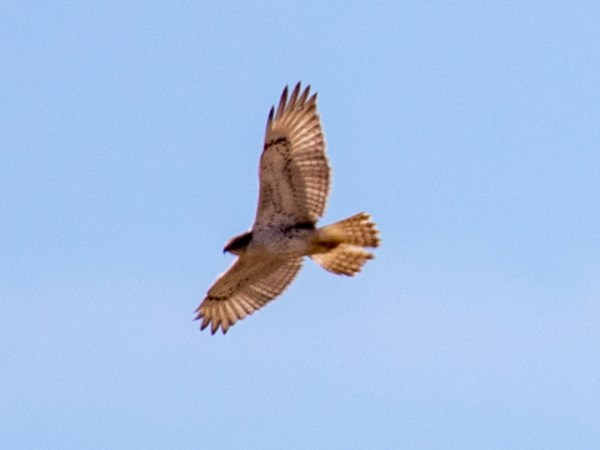
Red-tailed Hawk, Randy Ehler, 01/13/2018
Best of all, there were several Ferruginous Hawks perched on the ground or on the irrigation pipes. Unfortunately, none were close to the road. One was visible in the distance, alternately flying and perching but it was too far away to be seen well, even with the scope.
Ave. J is a main thoroughfare where traffic moves at high speed so we decided to move to a better location. We turned around, went back to 110th St. E, went 1 block north and turned onto Ave. I. Ave. I is a quiet road with farm fields on both sides. We pulled off, got out of our cars and scanned the area. We were able to count at least 6 Ferruginous Hawks but, unfortunately, most were some distance away. We had good views of one that soared overhead before slowly drifting off but the others were too far away for us to see the fine details of the plumage of these handsome birds.
It seemed as if there were fewer passerines in the fields than in past years. We saw 2 large flocks of Horned Larks in one field but we only saw a few American Pipits, Savannah Sparrows and House Finches, though there may have been birds hidden in the grasses.
Since it was nearly noon we decided to make our way to Apollo Park for our lunch break. As we left the farm, we turned right on 110th St. E and drove north. At first, we saw only Red-tailed Hawks on the power poles but we soon noticed a buteo that was perched with its back to us. At a distance, its proportions looked different from those of a Red-tailed Hawk; it appeared to be less “broad-shouldered” and longer-bodied than a red-tail.
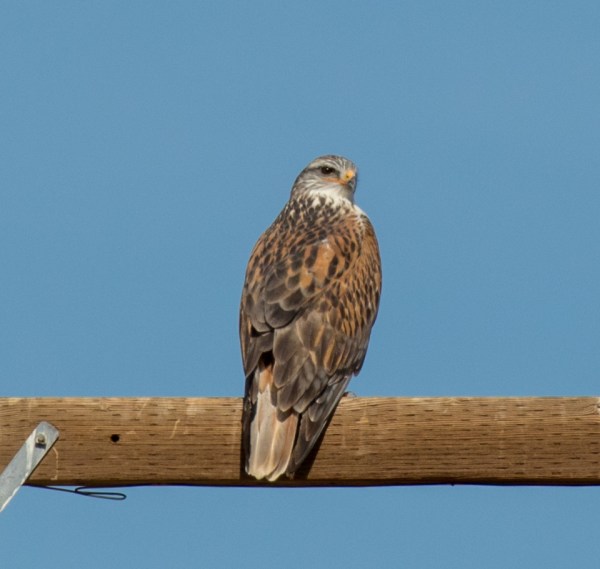
Ferruginous Hawk, Randy Ehler, 01/13/2018
As we got close enough to see its plumage, we recognized that it was a Ferruginous Hawk. We stopped and quietly got out of our cars. It turned its head and looked toward us but did not flush so we had time to use our binoculars to look at the pale tail, rufous-tinged plumage, large bill and long gape. We got excellent scope views and photos.

Ferruginous Hawk, Randy Ehler, 01/13/2018
Although the hawk watched us, it did not seem alarmed by our presence. After several minutes, it stirred, slowly flew from the pole and landed on a pole a bit farther away. This time it perched facing us. We moved a bit closer and took our time enjoying binocular and scope views of its throat, breast and feathered legs. We couldn’t have asked for a better way to wrap up the morning’s birding.
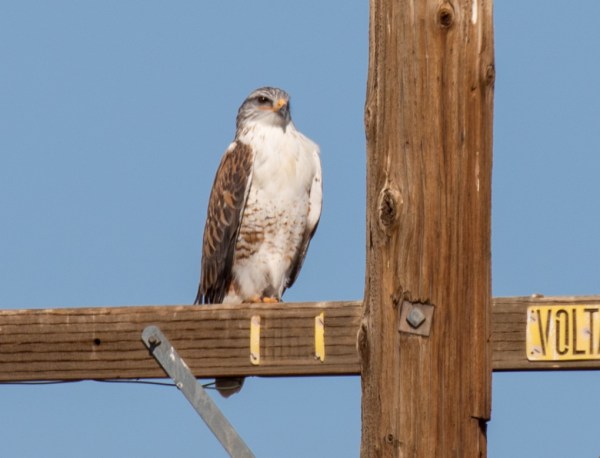
Ferruginous Hawk, Randy Ehler, 01/13/2018
Once everyone was ready, we resumed the drive to Apollo Park. We didn’t stop along the way because we didn’t see many birds other than Red-tailed Hawks and Common Ravens. A few of us got a glimpse of a female or immature Northern Harrier that was flying over a field but it was moving away so we kept going. After passing over the section of Ave. G that is called the Musical Road, we turned into the park.
Just after we parked we saw the only Turkey Vulture of the day. It was soaring overhead and being mobbed by 3 Common Ravens. Although we did not “bird” the park, we kept an eye on the birds while we had lunch. We saw fewer species and fewer individuals of the species that were present than in past years. The only ducks we saw were either Mallards or probable Mallard hybrids. We saw the usual assortment of Canada Geese and exotic geese, a few Double-crested Cormorants and numerous American Coots. The most impressive birds on or around the pond were American White Pelicans. We saw few passerines other than a small flock of Dark-eyed Juncos, some Brewer’s Blackbirds and House Sparrows. As we prepared to leave, one person spotted a Great Blue Heron on the scrub land outside the fence that encloses the park.
After lunch, the group split up. One family went home and the rest of us resumed birding. When we left the park, we went west and turned north on 60th St. W. The habitat quality in this area has declined during the recent drought and conditions this year were not good. Most of the agricultural land was fallow and the scrub land looked very dry. We saw a few birds, including a Northern Mockingbird, a flock of Yellow-rumped Warblers, some Red-tailed Hawks, 2 American Kestrels and a stunning Prairie Falcon.
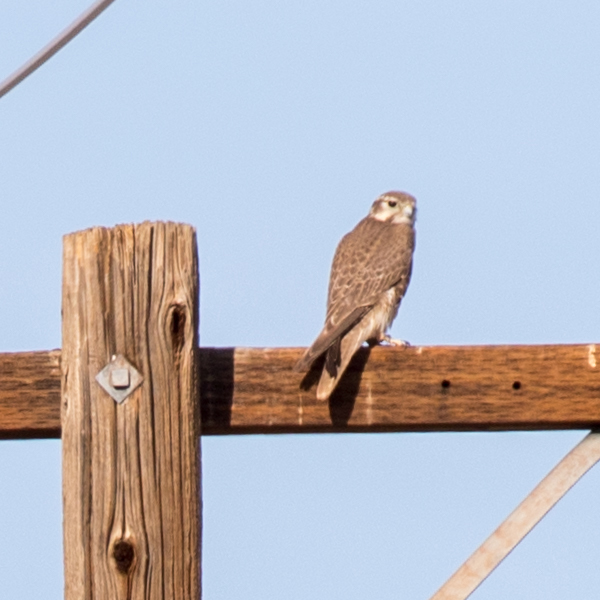
Prairie Falcon, Randy Ehler, 01/13/2018
Unlike the Ferruginous Hawk we saw just after we left the farm, the Prairie Falcon flew from its perch as soon as we slowed down and pulled off the road. It flew farther along the road and perched on a more distant pole. We drove toward it, stopping some distance from it. To avoid spooking it, we stayed in our cars while we watched it. It seemed wary and vigilant though it remained on its perch for a short time before flushing and flying rapidly away.

Prairie Falcon, Randy Ehler, 01/13/2018
We continued north and turned left onto Gaskell Ave. Since there is rarely any traffic along this road we were able to drive slowly and watch for birds. One of the first birds we saw was a Loggerhead Shrike that was perched on a wire beside the road. As we drove, we saw more Common Ravens and Savannah Sparrows. As we passed a house we heard bird vocalizations so we stopped a short distance away and got out of our cars. The birds we had heard turned out to be European Starlings but we soon noticed other birds in the scrub land. There were at least 20 Mountain Bluebirds moving around in one of the fields. The sun was behind us so the bluebirds looked gorgeous in the afternoon light. There were some Savannah Sparrows, White-crowned Sparrows and House Finches in the same area.
As we neared the corner of 100th St. W & Gaskell Ave. a keen-eyed spotter called out “Roadrunner”. We stopped, got out of our cars and looked for it. By then, it had disappeared at the back of the fencing that surrounds a small, unmanned service building. We walked around the outside of the fence but did not see it again. We got into our cars and drove across 100th St with the intention of resuming our drive along Gaskell. We had just crossed the street when our spotter called out “Roadrunner”. We stopped immediately and got out in time to see the bird disappear into the trees beside the road. We waited but it did not reappear so we got back into our cars. As we drove farther along Gaskell, we were a bit surprised by the sight of about 30 Western Meadowlarks walking through an orchard.
When we reached the end of Gaskell, we turned around and started back. We were pleased to see yet another Northern Harrier cruising over the scrub land but the best was yet to come. As we approached the trees at the intersection with 100th St. W, our spotter called out “Roadrunner” for the third time. We stopped and got out of our cars in time to see it go into the trees. It went through the trees and across the road toward the area where we had initially seen it. Everyone had all seen it well and we did not disturb it again so we did not follow it.
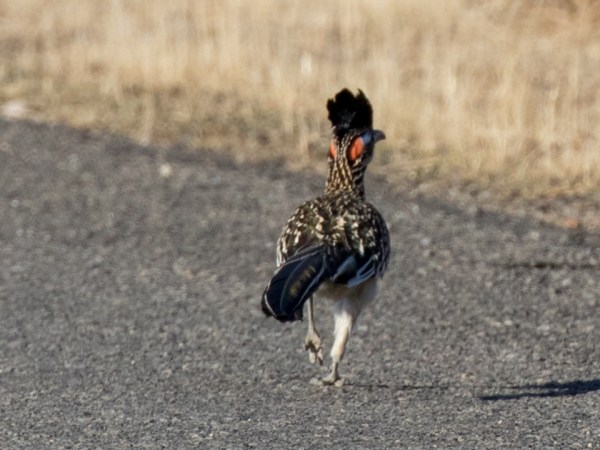
Greater Roadrunner, Randy Ehler, 01/13/2018
With that, we decided to call it a day and return to LA. Although we thought we’d finished birding, the birds weren’t quite finished with us. As we drove south on 100th St. we were treated to the sight of a flock of Mountain Bluebirds beautifully illuminated by the sun. As we were nearing Hwy. 14 we saw a male Northern Harrier flying low over the scrub land. It seems fitting that a raptor should be the final bird of a memorable day. Many thanks to everyone who came on the trip and to Randy for sharing his photographs.
| SMBAS, Antelope Valley | 1/13/2018 | |
| # | location | |
| Canada Goose | 40 | Apollo Pk |
| Mallard | 25 | Apollo Pk |
| Rock Pigeon [I] | 35 | Palmdale & several sites |
| Eurasian Collared-Dove [I] | 1 | Desert Aire Gold Club |
| Mourning Dove | 2 | 10th St. E, Palmdale |
| Greater Roadrunner | 1 | Gaskell x 100th St W |
| American Coot | 25 | Apollo Pk |
| California Gull | 10+ | Palmdale |
| Double-crested Cormorant | 6 | Apollo Pk |
| American White Pelican | 25 | Apollo Pk |
| Great Blue Heron | 1 | Apollo Pk |
| Turkey Vulture | 1 | Apollo Pk |
| Northern Harrier | 6 | scattered sites |
| Cooper’s Hawk | 1 | 10th St E north of Ave Q |
| Red-tailed Hawk | 50 | widespread |
| Ferruginous Hawk | 7 | Ave J, L & 110th St. E & environs |
| American Kestrel | 2 | scattered sites |
| Prairie Falcon | 3 | Ave L x 50th St. E; Gaskell Ave |
| Black Phoebe | 2 | Palmdale; Ave L x 50th St E |
| Say’s Phoebe | 10 | scattered sites |
| Loggerhead Shrike | 12 | scattered sites |
| Common Raven | 100+ | widespread |
| Horned Lark | 150+ | Ave N east of 50th St E; Ave I east of 110th St E |
| Cactus Wren | 1 | 10th St E north of Ave. P |
| Mountain Bluebird | 35 | Gaskell Ave; 100th St W south of Gaskell |
| Northern Mockingbird | 1 | 60th St W |
| European Starling [I] | 150 | Ave L x 40th St. E; Gaskell Ave |
| House Sparrow [I] | 30 | Palmdale; Desert Aire Gof Club; Apollo Pk |
| American Pipit | 30 | Ave I east of 110 St E |
| House Finch | 60+ | several sites |
| Savannah Sparrow | 30+ | scattered sites |
| White-crowned Sparrow | 30+ | scattered sites |
| Dark-eyed Junco | 30 | Apollo Pk |
| Western Meadowlark | 100+ | several sites |
| Red-winged Blackbird | 3 | Ave L east of 40th St E |
| Brewer’s Blackbird | 40+ | several sites |
| Yellow-rumped Warbler | 20 | several sites |



 SANTA MONICA BAY AUDUBON SOCIETY BLOG