Free email delivery
Please sign up for email delivery in the subscription area to the right.
No salesman will call, at least not from us. Maybe from someone else.
Westie hooked!
New Year’s Day, 9 am, cold and windy weather, the beach inundated with high tide, waves washing over the sand into the lagoon, the lagoon emptying just as quickly through the breach to the sea.

Lagoon flowing through the beach breach (L. Loeher 12-02-17)
A few birders annually gather for early birding on New Year’s morning to begin their birding year with a bang. Malibu Lagoon is reliable for at least sixty species. You can’t predict the weather, but you can expect very few people on the beach.
Up ahead, near where we expected to find the Snowy Plover winter roosting colony, we spotted a small knot of people of widely varied ages gathered together, staring down at something. As we neared, checking lagoon-edge shorebirds for plovers and peeps, we saw a large gull on the sand at their feet. One of them ran over to us and said: “It’s got a big fishhook in it. Can you do anything?”
As Lu Plauzoles and I approached the bird, it – now alone – startled, leapt into the air and flew towards the surf zone. It got about ten feet before tumbling forward into a breaking wave. Now upside down, it washed up at my feet and I grabbed it, folding its wings close to the body. It did not resist.
It was a sub-adult Western Gull, probably a third-winter bird, with a black mantle and yellow bill tipped with an irregular black ring and the beginning of a red gonys spot on the lower mandible. A fishing lure was hooked into his left nostril. (I prefer “him” to “it,” although you can’t tell sexes in gulls without a very close and highly personal examination.
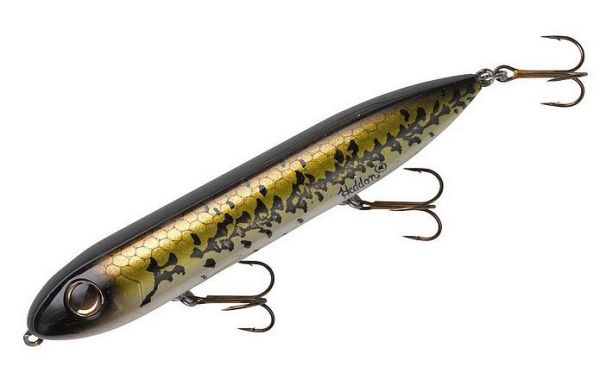
Heddon Super Spook – Baby Bass color
Imagine you’ve got the end-hook of one of these suckers stuck in your face, and the other two treble-hooks snagged into your belly.
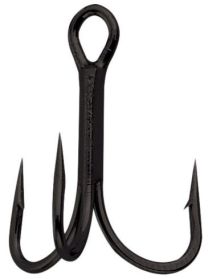
Gamakatsu treble hook
Further examination showed that he was hooked in two other locations, both on the belly a bit forward of his left leg. The lure was perhaps 4″ long with three treble-hooks. One hook of each treble-hook had snagged him, with the rear-end treble hook being the one in his nostril. Hooked in this manner, his head was twisted so far to the left that it was unable to fly any distance, explaining why he tumbled into the surf.
I wriggled the nostril-hook around but could not dislodge it. We needed to separate the hooks from the lure. The small scissors on Lu’s scout knife proved unequal to the task, and all we accomplished was my snagging the gloves of both hands on the exposed hooks.
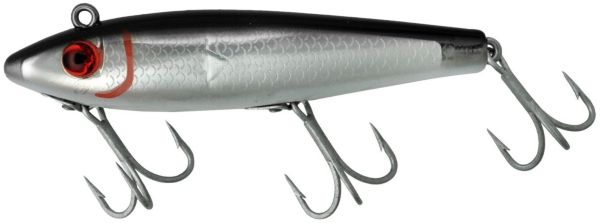
MirrOlure Classic Series 52M Sinking Twitchbait
My professional fly-fishing brother-in-law loathes treble-hooks, and chooses to exert his skill with barbless hooks.
Meanwhile, the family of the bird’s discoverers tried to calm their young daughter-granddaughter, who was somewhere between eight and fifteen (I’m better at aging birds than humans) and was sobbing nearly uncontrollably, distraught by the bird’s plight. We decided to take the bird back to the parking lot where Lu had a Leatherman tool (with wirecutter) in his car. Lea – the distraught girl’s grandmother – offered her windbreaker as a wrapping for the bird. Nicely wrapped (see photo), the extremely calm bird accompanied us to the car, a ten-minute walk. Along the way we talked, and I discovered that Lea was a very long-term Malibu resident and had been the unofficial local animal rehabber for many years. Her quick action and willingness to sacrifice her windbreaker in order to comfort and protect Westie proved the point.

Westie in Lea’s arms and windbreaker.
(Joyce Waterman 1-1-18)
Separating the hooks from the body of the lure with the Leatherman’s pliers-wirecutter tool proved difficult. Lu and Lea steadied him – now “Westie” – on the trunk of my car while I struggled to snip the hooks from the lure. It may not be saying much, but it took all my strength to snip through the metal. This was really not the right tool for the job. I then snipped off the exposed barbs from the treble-hooks. I still could not get the hook out of the nostril. Throughout the entire procedure Westie did not struggle and I often saw him looking me in the eye. I felt as if he trusted us to do him minimal harm, and I chose to believe that, but the reality may have been that he was in shock and frozen with fear.

Westie bill closeups: every time he opened his bill, it made the hook wriggle around, so we band-aided it shut (& removed before release). Black fuzz around hook is fabric from my gloves. (Photo: Lucien Plauzoles 1-1-18)

Leatherman Sidekick
Don’t get me wrong; I like versatile tools like Leatherman and Swiss Army knife. I own several. But – generally speaking – the more versatile a tool, the more poorly it performs any particular task. Trying to snip very hard steel in very restricted quarters with the wirecutter (see photo) part of the long-nosed pliers was nearly impossible. We did it anyway.
We decided to leave Westie with what remained of the hooks still embedded in his body as Lea had volunteered to rush him up to the California Wildlife Center not far away. I left the now de-barbed portions of the treble-hooks intact to make it easier for the wildlife people to locate them. We all then set off in our various directions.
I learned later that Westie – once he realized that his bill was no longer painfully attached to his belly – became very “restive” as Lea described it, and started thrashing around in their car. They decided to return him to the portion of the beach where they found him.
We all hope Westie survived his ordeal, and is still living on the beach, despite the hooks embedded in his body.
Relative to the disasters of fire and flood recently experienced by the people of Southern California, Westie’s trauma may not seem to amount to much. But disasters and traumas come both large and small, and it’s difficult to judge whether the suffering of one person – or bird – is greater for that individual, than the suffering of another is for themselves. Over the course of a lifetime I have concluded that many – perhaps all – of the “lower” animals have feelings of pain and pleasure just as we humans do. It is our common animal heritage. The ability to experience both pain and pleasure have obvious survival value to the individual organism, and if the mechanism of natural selection does anything, it selects for characteristics which increase the probability of survival and procreation and selects against characteristics which don’t.
This is my best guess at how Westie became entangled. I suspect that he spotted the lure on the water and – thinking it was food – lunged at it with his bill, but instead got hooked in the left nostril. Lacking hands, he tried to dislodge the lure with his left foot, but instead managed to hook himself on the belly. Additional struggles only managed to embed the hooks further. When we found him, the lure had no leader line attached. If a fisherman had hooked him and cut the leader to free the bird, rather than attempt to either dislodge the hooks or take the bird to the animal rescuers, we’ll never know. With the proper tools, de-hooking a bird can be relatively easy. See the instructions below.

Channel Lock 436 6″ diagonal cutter

Channel Lock 6-inch Long Nose Pliers
It may not be much of a take-away lesson, but I decided to buy some more appropriate hook-removal tools and carry them with my field guide from now on. Channel Lock makes highly-rated tools, and I bought one of their 6″ diagonal cutter pliers. A larger cutter would cut bigger, tougher hooks but, knowing myself, I probably wouldn’t carry it because of the size and weight. I also got a cheap pair of long-nosed pliers, as their function in hook-removal is less critically-dependent on craftsmanship.
I used to fish when I was young. A sloppily-casting friend once hooked me in the shoulder with a treble-hook, and an hour of whacking away at my shoulder with a knife and razor blade taught me that the best way to extract a hook is to snip everything off except some of the shaft, then use long-nosed pliers to push the hook forward in an arc until the barb emerges through the skin, then pull it out by the barb-end. This is more unpleasant to experience than it sounds, but it’s better than yanking the hook backwards or trying to cut through flesh down to it. Believe me, I know. [Chuck Almdale]
Read the information below for expert advice on how to de-hook a bird.
DON’T CUT THE LINE! Reel. Remove. Release.

Follow these steps to rescue a hooked bird: Reel in the bird. Remove the hook. Release the bird.
From Florida Fish & Wildlife Conservation Commission
Watch the video demonstrating how to safely handle and unhook a bird.
-
-
- Enlist others for assistance if possible.
- REEL the bird in slowly and evenly. Don’t try to shake the bird loose by jerking the line – it will inflict additional injury to the bird.
- If fishing from a pier, make sure that the bird remains on the water until a net, such as a hoop net, can be used to lift it onto the pier. Birds reeled up onto piers can be seriously injured, or can potentially damage fishing equipment.
- Wear sunglasses to protect your eyes. Take extra care to protect yourself when handling long-billed wading birds and hooked-billed cormorants.

When handling a pelican, keep the beak slightly open so the bird can breathe. (Photo: George Veazey)
- Firmly grasp the bird’s head behind the eyes. Then fold the wings up gently but firmly against the bird’s body so that it can’t flap its wings, and hold the legs. Hold firmly but don’t strangle the bird. If it is a pelican, you can hold the beak but keep the beak slightly open so the bird can breathe.
- Cover the bird’s head with a towel, hat, shirt, or other cloth. This will calm the bird and make it easier for you to remove the line and/or hook.
- REMOVE the hook by cutting the barb and backing the hook out. If the barb is imbedded in the bird’s flesh, push the hook through until the barb emerges from the skin and then clip the barb.
- If the bird is entangled in line, use scissors, clippers or a knife to gently cut the line. Place the cut line in a monofilament recycling bin, or cut the line into small (<3- inch pieces) and place in a lidded trashcan.
- Carefully check the bird over for other hooks or line and remove them too.
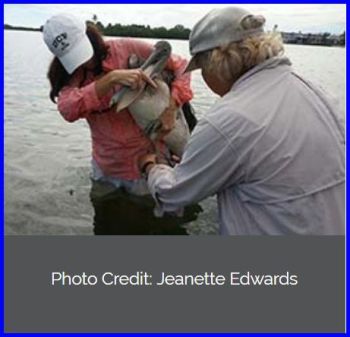
Use scissors, clippers or a knife to gently cut fishing line and remove hooks. (Photo: Jeanette Edwards)
- If the bird is feisty, it is likely healthy enough to RELEASE. Point its head towards the water and step back while you release the bird. Let the bird take off on its own. Sometimes birds shake their feathers out, assess the situation, and then are ready to fly. Other times, they just take off. Either way, this represents a successful release.
- If the bird has swallowed the hook, or is severely injured, take it to a local rehabilitator.
-
Hayden the Metro Mammoth with Dr. Emily Lindsey | Natural History Museum’s Curiosity Show
Chris visits Dr. Emily Lindsey at the La Brea Tar Pits to meet Hayden, a juvenile mammoth that was discovered during a dig for the Metro train along Wilshire Blvd. Hayden lived in Los Angeles but didn’t die in the Tar Pits, so his bones aren’t the typical “La Brea brown” color of those we find in the Pits. He’s also still got small tusks and some of his baby teeth. Remains of Ice Age megafauna are found all around under Los Angeles, revealing what the landscape was like thousands of years before urbanization.
This comes from the Natural History Museum of Los Angeles County. If no film or link appears in this email, go to the blog to view it by clicking on the blog title above. If the film stops & starts in an annoying manner, press pause (lower left double bars ||) to let it buffer and get ahead of you. [Chuck Almdale]
Your Climate Change Conscience – feat. Al Gore | PBS Science Video
“An Inconvenient Sequel” is former Vice President Al Gore’s newest film 🌎🎥
News about climate change is often full of doom, guilt, and anxiety. This can make many people reluctant to pay attention to or discuss it. We asked former Vice President Al Gore to help us find a different way to talk about climate change.
This is an installment of the PBS – It’s OK to be Smart series. If no film or link appears in this email, go to the blog to view it by clicking on the blog title above. If the film stops & starts in an annoying manner, press pause (lower left double bars ||) to let it buffer and get ahead of you. [Chuck Almdale]
Black Sicklebills are elegant, slender birds with long bills and tails. But that all changes when a female comes by. The male transforms into a horizontal comet shape on his display perch. He doesn’t use his wings to do this; he uses flank feathers. The comet shape is accentuated by a narrow blue band of iridescence created when those flank feathers line up precisely. Filmed and photographed by Tim Laman and Eric Liner.
There are currently seventy-two short films in the entire Birds-of-Paradise Project playlist, ranging from 26 seconds to 8:29. In the upcoming weeks, we will present some of our favorites.
A film from the Cornell Lab of Ornithology. If no film or link appears in this email, go to the blog to view it by clicking on the blog title above. If the film stops & starts in an annoying manner, press pause (lower left double bars ||) to let it buffer and get ahead of you. [Chuck Almdale]
Laurel Hoctor Jones – Outspoken Champion of Birds
Laurel Hoctor Jones joined the board of Santa Monica Bay Audubon Society in May, 2014. She immediately jumped right in, taking on the task of Education Chair, doing communication and outreach with local schools and various levels of government. She became avidly involved in our Snowy Plover protection efforts, censusing the birds at several locations and attending annual range-wide Snowy Plover conferences. This led to her becoming Conservation Co-chair, after which she represented us at several state and national Audubon conferences. She wrote blogs on Snowy Plovers, egrets and herons. She was very energetic and willing to share her opinions. Yet she was also a private person, and outside of her activities for the chapter, we didn’t know much about her personal life.
Over the months and years we gradually learned that her health was not good, but she rarely spoke of it to most of us and we assumed the problems would be resolved. The one thing we knew, she never let her illness slow her down.
So it was with surprise and dismay that on December 9, 2017, we received this message from two board members, Grace Murayama and Larry Loeher:
Fellow SMBAS Board members,
(in case you hadn’t already received this sad news)
Last night I received some devastating news from Laurel’s husband, Kevin.
This to let you know that Laurel died yesterday, a heart attack resulting from her long-term health problems. There’ll be some sort of commemoration but nothing’s set yet.This is so sad, awful, and and just plain unfair. Take care, Grace & Larry
We all were stunned. A great many messages quickly passed; some are included below. We asked Kevin, her husband, if he would write a few words we could share with our chapter members and readers.

Laurel & Kevin Hoctor-Jones
A native Californian, Laurel received a BA in theatre from UCLA School of Theatre, Film and Television and a masters in English Literature from the University of Glasgow in Scotland, where she was a Rotary Foundation scholar. While in Scotland she married Kevin.
She worked in the entertainment industry, variously as assistant to Hollywood agent Arnold Sank, as a reader/editor for Yorkshire TV in England and Universal studios in Hollywood, and in administration for the MPAA. She worked for 8 years as a writer/editor for the Shoah Foundation, Steven Spielberg’s Holocaust archive and documentary project, which she considered her most rewarding job. She also worked extensively as a freelance editor for screenplays and novels.
She had a love of the ocean and the wilderness dating from childhood vacations in Yosemite, Yellowstone, Colorado, Washington State’s Olympic Peninsula and California’s Central Coast. As a child she loved to get up before dawn to explore tide-pools. She was involved with various environmental groups over the years, including the American Oceans Campaign, the California Wildlife Center and the Audubon Society. Lately she worked extensively on shorebird monitoring and preservation programs. — Kevin Jones
It’s odd but true that we in the Audubon Society, who are so involved in our passion for birds, often know very little about the personal lives and histories of those with whom we share our passion. [Chuck Almdale]
Here are some of our thoughts and emotional reactions which ensued.
This is very sad news. Laurel had often discussed her medical situation with me although I never gave her my thoughts on its severity but I am sure she knew. When we get details of the memorial we should do something as a Board to recognize her contributions. She will be very much missed. — Adrian Douglas, M.D.

Laurel loved the egret colony across the street from the lagoon, and fought to save it. (From “Summer of Heron Love Part II,” Laurel Hoctor Jones, 9/14/14, Malibu)
(The next comment came from young birder Charlotte Maddela, whom SMBAS helped to start a Young Birder’s Club. After the club was formed, Laurel often worked with them at the beach.)
I appreciated the time that Laurel spent with me. She taught me a lot about Plovers and Laurel was the first person to inform me about the Snowy Plover citizen science program with Audubon. I enjoyed the time she spent with me at Malibu Lagoon, not only seeking out plovers, but also identifying all kinds of species. Laurel often told me that she didn’t only look at birds. She liked looking at everything! Laurel cared about the environment and conservation, and so do I. Since her Snow Plover training, I’ve been involved with volunteering for the citizen science program for the last three years. I’m glad she was able to pass her knowledge on to me. — Charlotte Maddela
Wow, that is shocking news. We agree with Adrian we should do something to recognize her contributions to the board and conservation in general. Grace and Larry, thanks for letting us know. — Lillian Johnson and Chuck Almdale
Very upsetting. She was truly committed to the cause of bird conservation. We could consider a Laurel Hoctor Jones Memorial Fund, for specific causes that she championed. — Liz Galton
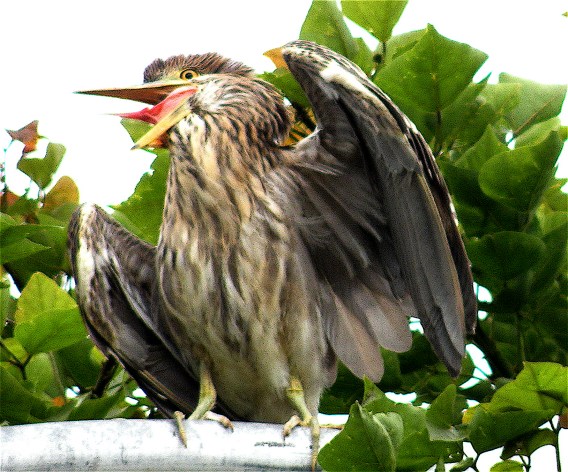
Juvenile Black-crowned Night-Heron in the egret-heron colony in Malibu (From “A Summer of Heron Love Draws to a Close,” Laurel Hoctor Jones, Malibu, 9/12/14)
WOW. Whenever I drove her to meetings, we talked quite a bit about her on-going health issues, but she seemed to be doing much better after recovering from her surgery. I’m so, so sorry to hear this. 😦 — Kirsten Wahlquist
Shocking and sad news. Although we did not know Laurel well, what we did know of her was that she was a fighter for that which she believed would better serve and benefit the birds, and wildlife. We were impressed by her passion, her tenacity. Doug and I are in favor of recognizing her contributions in some way as well. — Joyce and Doug Waterman
Very sad to hear this. Laurel found and worked with so many people and projects away from those of our immediate chapter. This terrible event makes us see her active schedule, work and dedication as even more admirable. A year and a half or so ago she recommended Rachel Carson’s “Under The Sea Wind.” If you read this you probably won’t be disappointed. It also speaks to Laurel’s love of the tough, beautiful and complex ocean and beach environment, and her dedicated work to help preserve it. — Chris Lord
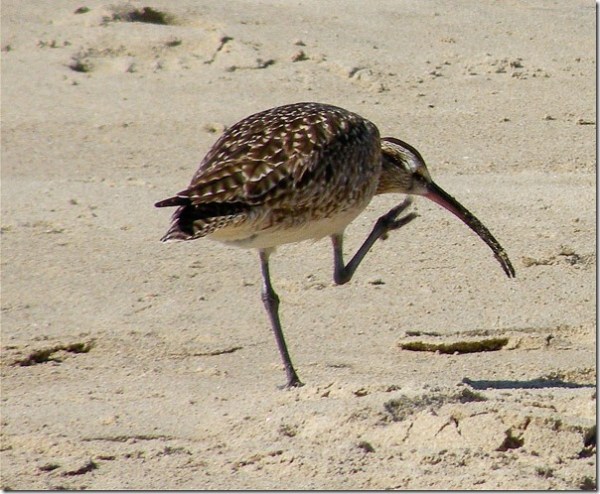
Whimbrel with an itch (From “Malibu Lagoon, April 27, 2014,” Laurel Hoctor Jones, 4/27/14)
Laurel’s very heavy schedule on behalf of the environment and our chapter gave me no indication of the depth of her health issues. Many of us are retired but Laurel also had a “real” job which made her efforts even more remarkable. I will miss her wide-ranging and educational reports at our board meetings. I will also miss our more prickly exchanges – Laurel had ideas and was not shy about expressing them. In short, she was the kind of truth-teller and friend we all hope to have. Ave atque vale, Laurel. — Chuck Bragg
I agree with all of you that losing Laurel is heart-breaking, especially for Laurel’s husband. I think we are all lucky to have known her and benefited from her passion for environmental education and advocacy. I think a Memorial Fund in her name would be an excellent way to honor her. — Cindy Schotte
We are laden with sorrow for one of our most active board members who, despite long-term physical handicaps, was constantly reaching outside our own little circle to find support for the birds and natural habitats in our area. I could not tell that Laurel was in any impending difficulty just a week ago when we last met at the Snowy Plover volunteer brunch. I looked forward to fighting the good fight with her for many seasons to come as we attempt to improve the fate of our shorebirds. A voice extinguished should not lessen our resolve, and we will remember Laurel with warmth and admiration as we continue the struggle for nature’s own. — Lu Plauzoles

Young & joyous Double-crested Cormorants (from “Creature from the Black Lagoon: Halloween Edition,” (Laurel Hoctor Jones 10/31/14)



 SANTA MONICA BAY AUDUBON SOCIETY BLOG