Free email delivery
Please sign up for email delivery in the subscription area to the right.
No salesman will call, at least not from us. Maybe from someone else.
Lessons learned from the oldest Snowy Plover
Lessons learned from the oldest Snowy Plover
From: Wader Study 124(2): 00–00. doi:10.18194/ws.00071 – Short Communication
Mark A. Colwell1*, Elizabeth J. Feucht1, Sean E. McAllister2 & Amber N. Transou3
1Wildlife Department, Humboldt State University, Arcata, CA 95521, USA
2Sean E. McAllister & Associates, Eureka, CA 95503, USA
3California State Parks, North Coast Redwoods District, Eureka, CA 95503, USA
*Corresponding author: mac3@humboldt.edu
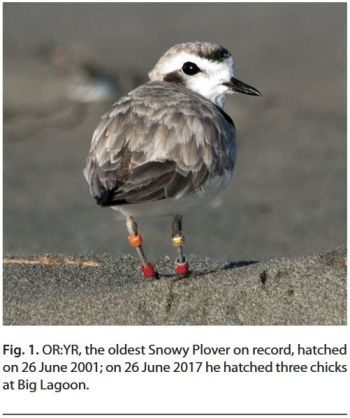
Ornithologists and conservationists are well aware of the valuable insights provided by long-term studies of populations of individually marked animals (Clutton-Brock 1988, Newton 1998). In particular, estimates of survivorship and reproductive success derived from annual records of uniquely marked birds inform management practices that attempt to increase population size, which is especially important for threatened and endangered taxa (e.g., Pakanen 2016). Recently, we summarized population growth (Colwell et al. 2017), lifetime reproductive success (Herman & Colwell 2015), and annual variation in survivorship (Mullin et al. 2010, Colwell et al. 2013) for the Snowy Plover Charadrius nivosus. Here, we submit observations of a male Snowy Plover (Fig. 1) who, at 16 years of age, continues to offer insight into the conservation challenges faced by the species.
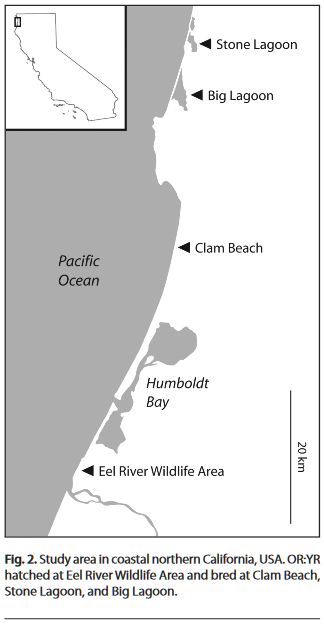
Longevity – On 26 June 2001, we banded a newly hatched Snowy Plover at Eel River Wildlife Area in Humboldt County, California, USA (Fig. 2). One year later (3 August 2002), we recaptured him as a breeding adult at Clam Beach and uniquely marked him OR:YR. In 2017, this 16-year-old male continued to breed and winter locally; observers detected him most recently in July 2017. His age represents a longevity record for the species (L.E. Stenzel & D.J. Lauten pers. comm.) and, quite possibly, for >the 34 species of Charadrius worldwide (Dinsmore in press). For the clade, however, multiple Wrybills Anarhynchus frontalis far surpass this longevity record, with two birds reaching 22 years (A.C. Riegen pers. comm.).
Dispersal – The distance (~38 km) between OR:YR’s natal nest and his first breeding attempt was comparable to other philopatric plovers in our population (Colwell et al. 2007, Pearson & Colwell 2013), with the largest percentage of males (38%) and females (54%) first breeding 10–100 km from their natal site. In his first seven years (2002–2008), OR:YR bred and wintered exclusively on Clam Beach, a site characterized by high activity of Common Ravens Corvus corax, an important egg predator in our study area (Burrell & Colwell 2012). To increase nest survival, we routinely protected clutches with predator exclosures erected around nests (i.e., 122 nests over 2002–2006; Hardy & Colwell 2008). In 2009, OR:YR first bred on Clam Beach before he and his mate disappeared; observers later found him ~45 km north at Stone Lagoon, tending 10-day-old chicks. In the subsequent years (2010–2016) he increasingly bred at Stone Lagoon. In winter, we regularly observed OR:YR on Clam Beach, although he occasionally occupied other sites (Big Lagoon; Nov 2016–Jul 2017). In our study population, males typically disperse shorter distances than females. Furthermore, males tend to be more site-faithful after successfully hatching chicks (median: 0.7 km; range: 0.2–1.4) compared with failed nests (median: 1.3 km; range: 0.4–3.0); similar patterns obtain in comparisons of movements between years (Pearson & Colwell 2013).
Reproductive success – Dispersal is often associated with reproductive success (Oring & Lank 1984). Along the Pacific coast, Snowy Plovers initiate nests from early March until late July, with multiple opportunities to replace failed clutches (Warriner et al. 1986). During his first five years, we protected 11 of OR:YR’s 17 nests using exclosures. As a 2-year-old, he successfully hatched four chicks from his first two exclosed nests; none of these chicks fledged. Additionally, seven (64%) of his exclosed nests failed to hatch eggs and only one produced fledglings. In 2006, we stopped using exclosures because six to eight incubating adults (~20% of breeding adults at the site) disappeared. We presumed that an unknown vertebrate predator had consumed these individuals as evidenced by at least one deceased adult and the absence of others when they should have been incubating (Hardy & Colwell 2008, Mullin et al. 2010). We did not protect his subsequent nests on Clam Beach. In 2007, OR:YR initiated 10 nests with a female (WW:YG) who laid 22 eggs over the breeding season; they did not hatch offspring that year. OR:YR’s attachment to Clam Beach may have stemmed from his early success at hatching eggs in nests that we protected with exclosures; however, mate fidelity also may have played a role (Pearson & Colwell 2013). Over his 15-yr breeding history, OR:YR averaged 1.7 (range: 1–4) mates annually; in 47% of years, he bred with a single female for the entire breeding season.
Lifetime reproductive success of plovers has a strong pattern of unequal progeny production (Koenig 1988). In a sample of 195 Snowy Plovers, 13% of individuals (12 males; 14 females) produced 50% of fledged young (Herman & Colwell 2015). Over his lifetime, OR:YR tended 148 eggs in 58 nests, and hatched 31 chicks, of which 13 fledged (i.e., reached 28 days of age). His fledging success makes him the second most prolific breeder in our population, in which males averaged 2.2 ± 3.0 fledged young over their lifetimes (Herman & Colwell 2015). However, given his age, OR:YR was well below the reproductive output expected for an individual who has bred for 16 years. Most (9 of 13) of his fledglings originated from Stone Lagoon in the second half of his life. We estimated breeding efficiency as the ratio of chicks fledged to eggs tended; briefly, a perfectly efficient breeder produces a fledged chick for every egg tended (1.0) compared with one that never produces offspring (0.0). At Clam Beach, OR:YR produced 0.03 fledglings per egg, whereas at Stone Lagoon he was ten times more efficient (0.30 fledglings per egg).
Conservation implications – The longevity, dispersal and reproductive success exhibited by OR:YR highlight the impacts of commonly used management practices aimed at recovering the population size of this threatened taxon (USFWS 2007). For example, we used non-lethal predator management (i.e., nest exclosures) to increase reproductive success at the site where OR:YR bred early in his life. We suspect that his success as a young breeder affected his decision to be site-faithful to Clam Beach (Oring & Lank 1984). Furthermore, differences in reproductive success between sites correlate with activity of predators. For example, nest predation rate correlates positively with Common Raven presence and abundance across our study area (Burrell & Colwell 2012). Clam Beach ranks among sites with highest raven activity (1.43 ± 0.51 ravens detected on 40% of point counts averaged across 10 years) compared with Stone Lagoon (0.56 ± 1.54 ravens detected on 17% of point counts). Increased management to reduce the negative impacts of predators on plover reproductive success is warranted. Finally, the population of Snowy Plovers in coastal northern California is small (19–74 breeding adults annually; Colwell et al. 2017), though connected by dispersal to populations elsewhere along the Pacific coast (Stenzel et al. 1994, Colwell et al. 2007, 2017, Pearson & Colwell 2013). Consequently, the effective population size is likely equivalent to the entire listed population segment (i.e., ~2200 adults in 2016; https://www.fws.gov/Arcata/es/birds/WSP/plover.html). We occasionally observe instances of inbreeding locally (Colwell & Pearson 2011), and the genes of individuals that live as long as OR:YR may be disproportionately represented in the population. If so, this may require additional study regarding the role of inbreeding in isolated populations of the Snowy Plover.
We thank the many field assistants who have worked on this project over the past 17 years. Support for our research came from the California Department of Fish and Wildlife, California Department of Parks and Recreation, U.S. Bureau of Land Management, U.S. Fish and Wildlife Service, and California Department of Fish and Game’s Oil Spill Response Trust Fund through the Oiled Wildlife Care Network at the Wildlife Health Center, School of Veterinary Medicine, University of California, Davis.
Link to original FWS.gov article.
[Suggested by Larry Loeher; Posted by Chuck Almdale]
Extreme Mammals, with Xiaoming Wang, Emily Lindsey, and Miguel Ordeñana | Natural History Museum’s Curiosity Show
We tour the NHM’s special exhibit Extreme Mammals in this episode, and find out that extremism and extinction are linked across evolutionary time. Meet NHM scientists Dr. Xiaoming Wang, Dr. Emily Lindsey, and Miguel Ordeñana as they show off some exhibit highlights including the giant rhino relative Indricotherium and all five giant cats known from the La Brea Tar Pits. Learn how mountain lions survived the Ice Age, and how one extreme survivor made it all the way across Los Angeles to make a home in Griffith Park.
This comes from the Natural History Museum of Los Angeles County. If no film or link appears in this email, go to the blog to view it by clicking on the blog title above. If the film stops & starts in an annoying manner, press pause (lower left double bars ||) to let it buffer and get ahead of you. [Chuck Almdale]
These Whispering, Walking Bats Are Onto Something | Deep Look Video
Bats have a brilliant way to find prey in the dark: echolocation. But to many of the moths they eat, that natural sonar is as loud as a jet engine. So some bats have hit on a sneakier, scrappier way to hunt.
This is another installment of the PBS Deep Look series. If no film or link appears in this email, go to the blog to view it by clicking on the blog title above. If the film stops & starts in an annoying manner, press pause (lower left double bars ||) to let it buffer and get ahead of you. [Chuck Almdale]
Raptors & Shorebirds: Seal Beach National Wildlife Refuge, Nov. 18, 2017
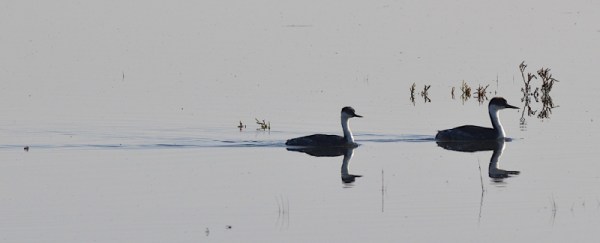
Western Grebes (Larry Loeher 11-18-17)
The final trip list remained full up to the last minute, but at check-in time at 8 a.m. at the Seal Beach Naval Weapons Station outer parking lot, we were missing a couple of people. That was unfortunate for those who missed out on this very birdy trip! Moments after we were driven through the security gate, we got a great view of a big, beautiful Red-tailed hawk perched in a bare tree.
At the first stop, directly across the road from the Seal Beach National Wildlife Refuge’s Nature Center, hundreds of shorebirds were roosting: Black-bellied Plovers, Long-billed Curlews, Western and Least Sandpipers, Marbled Godwits, Red Knots, Ruddy Turnstones, Short/Long-billed Dowitchers (*see end note), Western Grebes on the water, and we were treated to the unique dance of a Reddish Egret. In small bushes just a few feet in front of us were the first of many Savannah Sparrows, Black and Say’s Phoebes, and a friendly Blue-Gray Gnatcatcher.
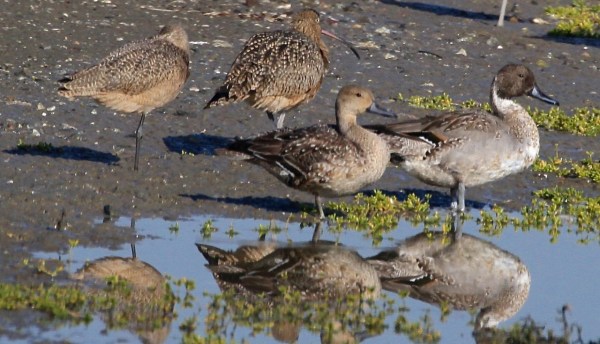
One pair each of Northern Pintail and Long-billed Curlew (Joyce Waterman 11-18-17)
Trying to time our best views with high tide, we headed towards Hog Island in search of Nelson’s Sparrow, but along the drive, there were just too many other birds to pass by: Osprey, Belted Kingfisher, Peregrine Falcon, and majestic Great Blue Herons at every turn.
And we made quite a few turns: by best count five rights, three lefts, four straights, and many pauses and stops, until we came to the Burrowing Owl stop.
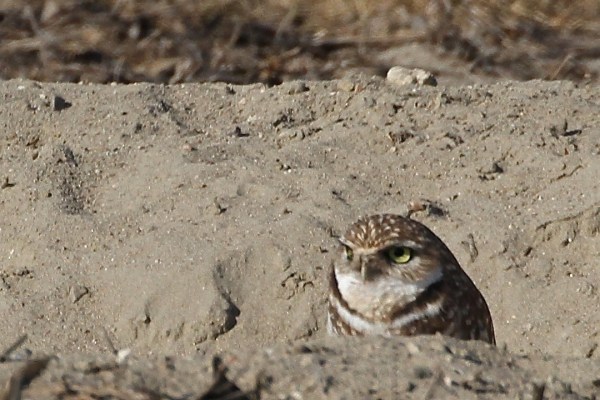
Burrowing Owl crouches in his tiny bomb crater (Joyce Waterman 11-18-17)
We found the Burrowing Owl in what looked like a tiny bomb crater – a ground squirrel “blowout hole” we were told – and discovered how difficult it is to help people find an owl sitting on the nearly-barren ground only two or three car lengths away. Estimates of distance to the bird varied: 20 feet, 40 feet and 70 feet were among those offered. The owl was quite pale, bleached by the sun. Some were surprised to see an owl out and about in the daytime. “Why isn’t it sleeping in its burrow?” It’s a diurnal owl; it feeds in the day and sleeps at night. Like us.
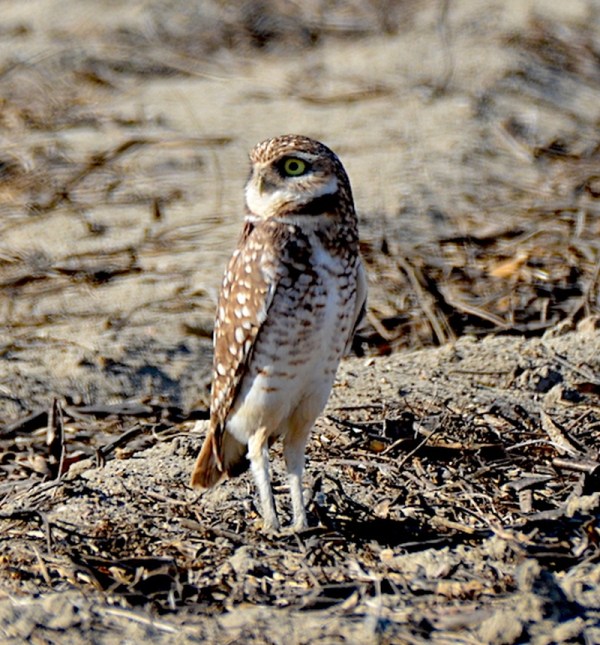
Burrowing Owl steps out and looks around (Larry Loeher 11-18-17)
Almost immediately thereafter, a small flock of Western Meadowlarks were spotted as we crossed over a set of rusty railroad tracks. We again had difficulty arriving a an appropriate description of location and distance, and in the process several birders happened upon a Rock Wren doing “squat jumps” on the tracks before moving to a post.
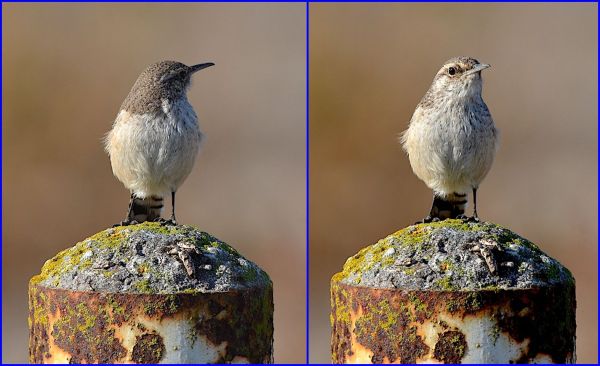
Rock Wren, with faint peach wash on flanks (Larry Loeher 11-18-17)
They do this, some believe, to create better depth perception. By superimposing a slightly different view of the scenery – from the bottom of the “squat” – upon the slightly earlier view, they create the illusion of depth, much as humans do with simultaneous views from our wider-set eyes. Other species create the same effect with tail wagging, butt-bobbing, head tilting, or – as with pigeons – head bobbing.
After a few more stops for Kestrels and Peregrine Falcons, we arrived at Hog Island, a First American shell midden. In early EuroAmerican settler days, it was used for a while as a pig pen. Pigs don’t (we were told) like to swim, so they’d gather on the island when the tide rose, making it easy to round them up.
We couldn’t find the Nelson’s (Sharp-tailed) Sparrows which often winter here, but found plenty of Savannah Sparrows of Belding’s and the little-known Large-billed subspecies, plus Common Yellowthroats and Marsh Wrens. Among the distant ducks were Surf Scoters and Buffleheads.
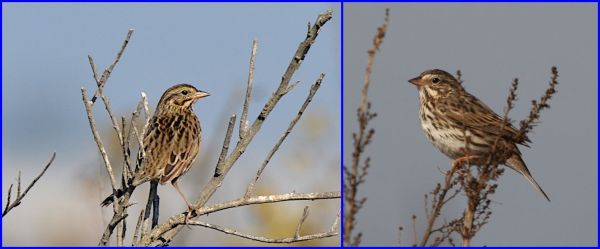
Savannah Sparrows: left – beldingi left (L. Loeher) right – beldingi or nevadensis
Both 11/18/17 Seal Beach NWR (Left – L. Loeher; right – J. Waterman)
Chuck felt that both the above birds were Belding’s Savannah Sparrow, with the right bird possibly a young bird. Local ornithologist Kimball Garrett agreed, but added that the right bird might be the nevadensis subspecies of the common Savannah Sparrow.
According to a paper by Garrett in Studies of Western Birds (2008):
On the coast, [the Large-Billed Savannah Sparrow Passerculus sandwichensis rostratus] formerly occurred rarely north to Santa Cruz; historical status along the lower Colorado River of California is uncertain. In the mid 20th century, overall numbers declined sharply and the range retracted along the coast and at the Salton Sea; since the 1980s, numbers have increased somewhat and much of the former range has been reoccupied.
Breeding habitat of rostratus is specialized. It is nearly limited to open, low salt marsh vegetation, including grasses (Spartina, Distichlis), pickleweed (Salicornia spp.), and iodine bush (Allenrolfea spp.), around the mouth of the Colorado River and adjacent coastlines of the uppermost Gulf of California; less typical breeding habitat is Frankenia-dominated scrub on the inland borders of beaches. Rostratus nests mainly in March and April in Sonora, but nest building there has been noted as late as 20 June.
Rostratus is almost entirely restricted to shorelines within its California nonbreeding range. Accounts of wintering birds in coastal southern California from days of former abundance emphasized use of salt marshes, beaches, kelp wracks, wharves, docks, and city streets. There are few coastal records away from salt marshes or the immediate shoreline.
For the subspecies/potential split aficionado, read this America Birding Association article, The Many Savannah Sparrows, by James D. Rising (November 2010).

Green sea turtle in the San Gabriel River (KCET Photo: Eric Austin Yee)
Retracing our route we looked in a couple of ponds for Green Sea Turtles; we spotted one, swimming along, then it went under. Then it surfaced again. You could see its shell back, and its head popping up, and even its hind flippers. The naturalists told us they frequent the nearby San Gabriel River where a power plant warms the water. Our Local ocean waters are too cold for these normally tropical and subtropical turtles. Interesting fact: green refers to the color of the turtle’s fat, not its skin or shell.
In another pond was a Brant, a dark goose with a partial white neck-ring, all by itself.
More turns: left, right, pause, straight.
Then we saw a very fast Prairie Falcon. When it landed on a pole we got out of the vehicles to get a better look. It was definitely a Prairie Falcon.
While searching for a flock of geese we found a Ferruginous Hawk. Plus a large flock of Brown-headed Cowbirds, all feeding on the ground with their tails sticking up at a 45-degree angle.
Eventually passed our starting point, we drove through a security check-point, under Pacific Coast Highway and down towards the harbor. Because no ships were loading/unloading, we could drive around the wharf area to look for the Lapland Longspur reportedly hanging out with a Horned Lark flock. In the roadside grass and reddish-tinged ice plant we found hundreds of Killdeer sitting quietly, doing nothing.
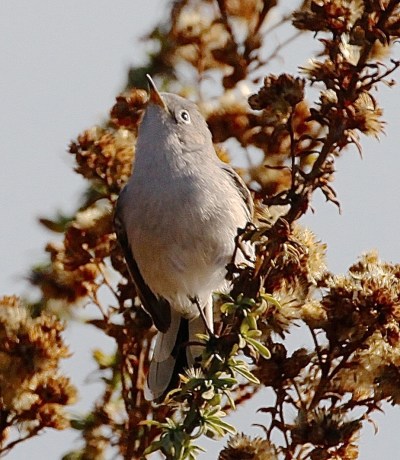
Blue-gray Gnatcatcher bounces through the brush
(Joyce Waterman 11-18-17)
We finally found the Horned Larks, cryptic and feeding on the ground. But no longspurs.
Back through the security checkpoint and to the Park HQ where we checked out the “shellacked” Green Sea Turtle, sorted through the few remaining shorebirds across the road (the tide had gone far, far out, taking the shorebirds with it) and ate lunch.
Our very special thanks to Rick Nye (Seal Beach National Wildlife Refuge Manager), Carolyn Vance (volunteer and bird expert at the Refuge), and John Fitch (volunteer and bird expert extraordinaire at the Refuge), for making our trip possible, and 100% enjoyable.
You can visit the Refuge on your own! Guided tours are held the last Saturday of every month except in December. [Grace Murayama & Chuck Almdale]
*END NOTE Our views of the Dowitchers were poor: into the sun, at a distance, birds resting with heads tucked. Lacking important criteria such as bill shape and eye-to-bill relationship, I drew upon my imperfect recollection of Garrett & Dunn’s Birds of Southern California: Status and Distribution (1981) which, I thought, stated that Short-billed Dowitchers (SBDO) were uncommon on the California coast in fall and winter, while Long-billed (LBDO) are common, which was the opposite of what the Refuge’s check list stated. The truth is more complex.
After re-reading the dowitcher passages and checking with co-author Kimball Garrett, I stand corrected. SBDO is common to abundant in fall and winter and may outnumber LBDO in large coastal estuaries such as: San Diego Bay (and some lesser-known estuaries in San Diego County), Upper Newport Bay, Bolsa Chica, Seal Beach, Mugu Lagoon, possibly Morro Bay. Outside of these specific large estuaries, SBDO is uncommon and LBDO is common in fall and winter.
You learn something new every day. [Chuck Almdale]

Seal Beach NWR wetland, looking west towards the Pacific
| Code | No. of Sightings | ||
| Seal Beach | 1 | 1-10 | |
| National Wildlife Refuge | 2 | 11-25 | |
| November 18, 2017 | 3 | 26-50 | |
| 4 | 51-100 | ||
| 5 | 100+ | ||
| Brant | 1 | Turkey Vulture | 2 |
| Canada Goose | 2 | Osprey | 1 |
| American Wigeon | 3 | White-tailed Kite | 1 |
| Mallard | 3 | Northern Harrier | 1 |
| Northern Pintail | 3 | Red-tailed Hawk | 2 |
| Surf Scoter | 1 | Ferruginous Hawk | 1 |
| Bufflehead | 3 | Burrowing Owl | 1 |
| Pied-billed Grebe | 1 | Belted Kingfisher | 2 |
| Eared Grebe | 1 | American Kestrel | 2 |
| Western Grebe | 3 | Peregrine Falcon | 1 |
| Rock Pigeon | 5 | Prairie Falcon | 1 |
| Mourning Dove | 5 | Black Phoebe | 2 |
| Anna’s Hummingbird | 1 | Say’s Phoebe | 2 |
| American Coot | 3 | Cassin’s Kingbird | 1 |
| American Avocet | 1 | Loggerhead Shrike | 1 |
| Black-bellied Plover | 4 | American Crow | 2 |
| Killdeer | 5 | Common Raven | 1 |
| Long-billed Curlew | 4 | Horned Lark | 3 |
| Marbled Godwit | 4 | Rock Wren | 1 |
| Ruddy Turnstone | 2 | House Wren | H |
| Red Knot | 2 | Marsh Wren | 1 |
| Dunlin | 1 | Blue-gray Gnatcatcher | 1 |
| Least Sandpiper | 2 | Northern Mockingbird | 1 |
| Western Sandpiper | 2 | European Starling | 3 |
| Short-billed Dowitcher | 3 | American Pipit | 2 |
| Willet | 4 | House Finch | 3 |
| Greater Yellowlegs | 1 | California Towhee | 1 |
| Western Gull | 3 | Savannah Sparrow | 4 |
| Caspian Tern | 1 | White-crowned Sparrow | 1 |
| Forster’s Tern | 3 | Dark-eyed Junco | 1 |
| Double-crested Cormorant | 2 | Western Meadowlark | 2 |
| Brown Pelican | 1 | Brown-headed Cowbird | 3 |
| Great Blue Heron | 3 | Brewer’s Blackbird | 2 |
| Great Egret | 3 | Common Yellowthroat | 2 |
| Snowy Egret | 2 | Yellow-rumped Warbler | 1 |
| Reddish Egret | 1 | Totals | 71 |
Fact vs. Theory vs. Hypothesis vs. Law… EXPLAINED! | PBS Science Video
Think you know the difference?
Some people try to attack things like evolution by natural selection and man-made climate change by saying “Oh, that’s just a THEORY!”
Yes, they are both theories. Stop saying it like it’s a bad thing! It’s time we learn the difference between a fact, a theory, a hypothesis, and a scientific law.
This is an installment of the PBS – It’s OK to be Smart series. If no film or link appears in this email, go to the blog to view it by clicking on the blog title above. If the film stops & starts in an annoying manner, press pause (lower left double bars ||) to let it buffer and get ahead of you. [Chuck Almdale]



 SANTA MONICA BAY AUDUBON SOCIETY BLOG