Free email delivery
Please sign up for email delivery in the subscription area to the right.
No salesman will call, at least not from us. Maybe from someone else.
ЩΉӨ BЦIᄂƬ ƬΉΣ PYЯΛMIDƧ | PBS Science Video
Who built the pyramids? The colossal geometric monuments found at Giza and elsewhere in Egypt are some of Earth’s most impressive constructions. Pyramids are truly wonders of the ancient and modern world.
But when the pyramids were built, the ancient Egyptians hadn’t invented the wheel, developed bronze tools, or discovered pi. How were they able to stack two million stone blocks, each weighing more than two tons, into precise geometric alignments that would survive more than 4,000 years and capture the imaginations of explorers throughout history? They did it the same way we always have: by trial and error. The true history of the pyramids is one of experimentation and science, not magic… or aliens.
This is an installment of the PBS – It’s OK to be Smart series. If no film or link appears in this email, go to the blog to view it by clicking on the blog title above. If the film stops & starts in an annoying manner, press pause (lower left double bars ||) to let it buffer and get ahead of you. [Chuck Almdale]
The Peruvian Amazon is a dangerous place when you’re small. So the young Inga tree hires ants as bodyguards to protect its vulnerable leaves. Their pay: delicious nectar served up in tiny ant-sized dishes. But will the ants keep up their end of the bargain?
This is another installment of the PBS Deep Look series. If no film or link appears in this email, go to the blog to view it by clicking on the blog title above. If the film stops & starts in an annoying manner, press pause (lower left double bars ||) to let it buffer and get ahead of you. [Chuck Almdale]
Lizards of Los Angeles: the Native and the New with Dr. Greg Pauly | Natural History Museum’s Curiosity Show
Everyone knows that the huge reptiles depicted in such documentaries as The Giant Gila Monster and One Million, BC were found in Los Angeles. But that’s history, Hollywood-style. Time to get up to date!
This comes from the Natural History Museum of Los Angeles County. If no film or link appears in this email, go to the blog to view it by clicking on the blog title above. If the film stops & starts in an annoying manner, press pause (lower left double bars ||) to let it buffer and get ahead of you. [Chuck Almdale]
Malibu Morning with Plovers and Terns

Tern Least nesting area & Snowy Plover foraging area, Malibu
(Chuck Almdale 6-17-17)
Stacey Vigallon, the tern and plover maven, put out a request for Snowy Plover monitors for Malibu Lagoon for the weekend. I was otherwise unscheduled for Saturday morning, June 17, and signed up.

Snowy Plover on remaining unhatched egg, Malibu (Sarah Ngo 6-3-17)
If you’ve never spent a couple of hours watching a particular bird, or group of birds, this will give you a sense of how it goes. It’s similar to a breeding bird atlas project; you watch the birds and occasionally something noteworthy happens. All times below are rounded to the nearest quarter-hour.

Adult Snowy Plover has found a tiny sand crab, Malibu
(Grace Murayama 6-9-17)
0840: I arrive at the breeding area. Least Terns (LETE) are constantly squawking, flying out to sea, returning with small fish, sitting on the ground, or standing – fish in bill – near a sitting bird. No Snowy Plovers (SNPL) are visible. A flock of about 100 gulls rests about 50 yards from the LETE nesting area, and a mixed flock of 18 Brown Pelicans and 7 Double-crested Cormorants are 50 yards further across a lagoon shallow. Two Black-bellied Plovers forage near the gulls, six adult Killdeer are scattered around the lagoon edge and vegetated sand. 19 of the gulls are Heermann’s, 1 sub-adult and the rest post-breeding adults; two are Ring-billed, the rest are Western Gull.

Heermann’s and Western Gulls, Malibu (Lillian Johnson 6-23-13)
0845: The adult male Snowy Plover (SNPL) flies from the seashore edge where it had probably been feeding on the wet sand or seaweed wrack. He lands near the chick, and I watched them both off-and-on, mostly on, for the next 75 minutes. The adult does nearly nothing but watch the chick, who walks around poking at the ground, apparently searching for food and paying little-to-no attention to the adult. The adult stays within approximately three-to-twenty feet about 95% of the time. It did not show the chick how to do anything nor finds any food for it, and it did not approach the chick to warm or protect it in any way. This chick was born (best estimate) between 3 June 10:55am and 4 June 1pm (times per Grace Murayama and Pam Prichard), making it now 14 days old).

RR:BB, Malibu; 1 of 2 chicks banded at Oceano Dunes, Spring 2016
Mother of the three chicks hatched on Malibu Beach, only eight months old in this photo (Grace Murayama 2-26-17)
0900: Six Royal Terns have joined the gull flock. While watching the SNPLs I begin counting LETEs. Every count is different: 15 birds, 18 birds, 9 “nesting” birds (the ones “well-planted” to their spots) and 6 others, 12 nesting and 12 non-nesting. The last sounds reasonable as mate-not-on-nest should equal mate-on-nest.

The Sanderling (foreground, in basic ‘non-breeding’ plumage) is often mistaken for a Snowy Plover, their winter roost-mate (Joyce Waterman 1-25-15)
0945: A breeding plumage Sanderling arrived a short while ago. The adult SNPL becomes suddenly very aggressive towards it, running and flying at it and driving it into flight. The Sanderling soon returns, but stays farther away from the SNPLs. The adult SNPL is not aggressive towards the Sanderling nor any other bird the rest of the morning.

Male Great-tailed Grackle, Malibu (Randy Ehler 9-27-15)
1000: The two SNPLs have disappeared into the small vegetated hillocks of sand. Five minutes later all the LETEs rise and fly around for several minutes. I count 28 birds, then scrutinize the ground to see if any LETE remains. None are visible. Thereafter I see no evidence that more than 28 birds are present. A few minutes later a male Great-tailed Grackle appears. The LETEs begin taking turns diving on this bird from behind, soon driving it away. It’s possible that the earlier rise of the LETE flock had something to do with the grackle, visible to them but not to me.

Long-billed Curlew, Malibu (Randy Ehler 2-22-15)
1015: A Long-billed Curlew appears, probing the underwater mud in the lagoon. They are not common at the lagoon and rarely stay long. Three Elegant Terns appear alongside the six Royal Terns.

Royal Tern (left) with non-breeding crest, three Elegant Terns with breeding crest. Royal is noticeably bulkier. Elegant with neck fully extended looks as tall as Royal. Malibu (Jim Kenney 6-12-15)
1030: All the terns, now numbering 26 Elegant and 6 Royal take flight as a group and head west. Barn Swallows in increasing numbers have been cruising the beach surface since I arrived. One picks up a molted downy feather and flies away with it. The numbers of gulls, pelicans and cormorants has not changed.

House Finch male (Joyce Waterman 11-27-16)
1045: In the scattered beach plants (which I think are pickleweed**), a male House Finch seems to be
nibbling the stem-tips. This is where pickleweed stores salt. I suddenly realized that all the fish I’d seen brought in by the LETEs were rather large – as long or slightly longer than bill+head length. This is, I believe, too large for a chick to eat, and I wonder if the LETEs will be able to find suitably-sized fish for the chicks. In prior years, some nestings have failed, nestlings abandoned by parents because of this problem.

Least Tern pair mating; note fish size, Malibu (Grace Murayama 6-9-17)
1100: Two Gadwall and one Red-breasted Merganser are preening at lagoon’s edge near the gulls. Numerous Mallard, mostly juvenile, swim on the lagoon. Four Black-bellied Plovers fly in to rest near the gulls.

Red-breasted Merganser on alert (Joyce Waterman 7-27-14)
1115: A Western Gull leaves the flock and flies towards the sea, passing low over the LETE nesting area. Most of the LETEs rise and chase the gull, diving on him from behind. A few minutes later the male Great-tailed Grackle reappears. The LETEs soon begin diving on him one at a time from behind, as they did before, and in 1-2 minutes he rises and flies off to land beyond the pelican-cormorant flock, the LETEs pursuing him and diving on him. The two SNPLs reappear after an 80-minute absence. The Long-billed Curlew flies off to the west and disappears.
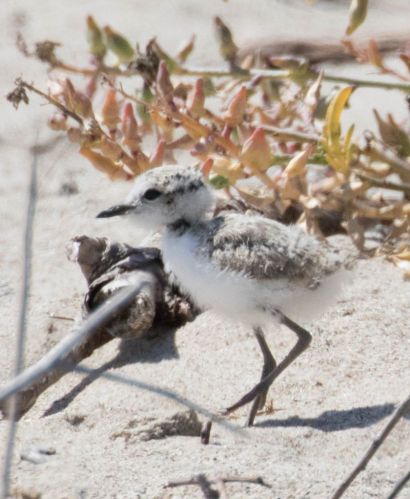
Snowy Plover chick, probable age – 15 days, Malibu (Chris Tosdevin 6-18-17)
1130: The two SNPLs have disappeared again. Six juvenile and one adult Mallard are preening on the lagoon edge near the LETE nesting area. Many LETEs take to the air and dive on the juveniles, soon driving them into the lagoon and away. The adult Mallard remains. A helicopter passes offshore heading west. None of the birds are alarmed. It passes by five minutes later, heading east; again no birds are alarmed. I finally see one LETE with a very small fish, about as long as the bird’s bill, or slightly smaller. Perhaps tiny fish will be available for the chicks.
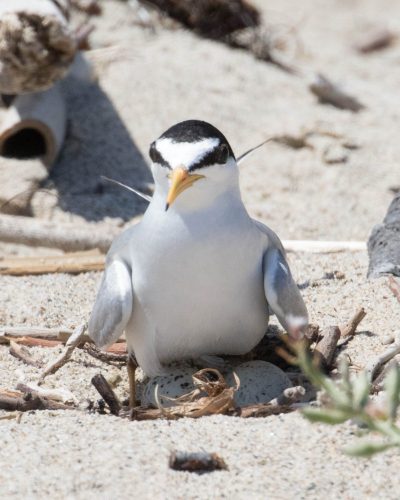
Least Tern on two eggs, Malibu
(Chris Tosdevin 6-18-17)
1145: Sarah Ngo (with whom I have corresponded but never met) and friend have appeared to visit the flock and take pictures. We talk until I leave at noon. A helicopter passes by inland of the lagoon, heading west. The gulls rise, perhaps alarmed by the inland helicopter. They soon alight, but take flight again a few minutes later, most flying off to sea.
1200: The adult male SNPL has just flown from near the lagoon down to the damp seaside sand where he begins to pick and probe. Sarah and friend follow to photograph him. Time for me to leave.
It was a very pleasant morning, starting cool with overcast and a bit of fog. Most clouds cleared and the fog burned away by 1100, but the temperature hadn’t yet passed 80°. I’d brought several magazines to read in case I got bored, but there was too much activity for me to ever open them.
Many thanks to all our photographers: Randy Ehler, Lillian Johnson, Jim Kenney, Grace Murayama, Sarah Ngo, Chris Tosdevin, Joyce Waterman
[Chuck Almdale]
**Note: After this was posted, I was informed by Grace Murayama that the so-called “pickleweed” is most likely Sea Rocket Cakile maritima, an European invasive widespread on ungroomed American beaches. She adds:
Pickleweed (Salicornia pacifica) is a leafless succulent and a California native plant, with teeny tiny flowers at upper joints. It’s also found at the lagoon, along the walkways and at the brackish or salty water’s edge.
Sea Rocket has an interesting seed dispersal system, which helps it thrive and extend its range. The fruit is a swollen 2-jointed pod. “The upper part has a single seed inside a corky outer covering which breaks off when ripe. This capsule is impervious to salt water and floats off in the current to new locations. The lower half of the fruit also contains a seed which remains attached to the parent plant and produces a new Sea Rocket on its already proven favorable home ground…” (Nancy Dale’s Flowering Plants…)
I like both Sea Rocket and Pickleweed and think the beach and lagoon look better with either or both than without them, even if that opinion makes me a native plant heretic.
Summer Solstice 20 June, 2017, 9:24 PM, PDT
This year we report on that other large object in the sky,
known as the sun.

Not a rotting peach, but our Sun – 860,000 miles in diameter, 8 light-minutes away (Alan Friedman ~ 4/22/14, on NASA site)
The second solar event of this calendar year is the Summer Solstice, scheduled in Los Angeles for June 20, 2017 at 9:24 PM PDT (or 21 June 0424 UTC – Universal Time Coordinated, if you prefer; also known as Greenwich Meridian Time in Ye Merrie Olde Angleland). The sun rises at 5:42 AM at 16° north of due east, daylight will last 14 hours, 25 minutes, 20 seconds (14:25:20); the sun sets at 8:08 PM at 29° north of due west, and combined nighttime (pre-dawn + post-sunset) is 9 hours, 34 minutes, 40 seconds (9:34:40).
Daylight on June 20 is two seconds longer than on June 19, and less than one second shorter than on June 21. Anywhere within the Arctic Circle on June solstice day, the sun is above the horizon continuously for 24 hours. This is the longest day of the year and the first day of Summer in the northern hemisphere; conversely in the southern hemisphere it is the shortest day of the year and the first day of Winter. That’s not an accident. Our seasons are due entirely to the tilt of the earth’s axis.
UPCOMING TOTAL SOLAR ECLIPSE AUGUST 21, 2017
Our final comment on this eclipse. See the total eclipse if you can. Get yourself onto ‘centerline’ to maximize the viewing time. Northern Oregon is the area closest to Southern California. If you’re planning on settling for a partial eclipse, don’t bother. The difference between even 99% partial and 100% total is – literally and metaphorically – the difference between night and day. The human eye is the only instrument that can simultaneously capture all the visible effects, and no photograph can duplicate the beauty and awe of the experience. That’s all, folks.
Why does the Earth Tilt? Opinions vary, no one knows for sure. Take your own best guess. Here are some conjectures. When the solar system condensed out of a gaseous nebula, condensation occurred unevenly. During the early phase, solid bodies were both growing in size and moving less orderly than today; collisions resulted. The tilt may have resulted from a large collision, an event which may have simultaneously created our moon. Other conjectures: No-longer-existing planet Thea whacked the earth, creating the moon and tilting the earth. Unbalanced gnawing on the earth’s core by large blind mole rats caused it to wobble. The earth doesn’t tilt – the rest of the universe is off-kilter.

Tilt of earth at northern summer solstice (Timeanddate.com)
Distance From the Sun
As described above, it’s the Earth’s axial tilt that causes our winter and summer, not the Earth’s distance from the sun. In face, the earth reaches Aphelion – it’s farthest point from the sun – on July 3rd. Perhelion – it’s closest point to the sun – is six months later, on January 2nd, 2018.
Definition of the terms (from Online Etymology Dictionary.com)
Summer: “hot season of the year,” Old English sumor “summer,” from Proto-Germanic *sumur- (source also of Old Saxon, Old Norse, Old High German sumar, Old Frisian sumur, Middle Dutch somer, Dutch zomer, German sommer), from Proto-Indo-European (PIE) root *sem- (2) “summer” (source also of Sanskrit sama “season, half-year,” Avestan hama “in summer,” Armenian amarn “summer,” Old Irish sam, Old Welsh ham, Welsh haf “summer”).
Solstice: Mid-13th century., from Old French solstice, from Latin solstitium “point at which the sun seems to stand still,” especially the summer solstice, from sol “the sun” (from PIE root *sawel- “the sun”) + past participle stem of sistere “stand still, take a stand; to set, place, cause to stand,” from PIE root *si-st-, reduplicated form of root *sta- “to stand, make or be firm.” In early use, Englished as sunstead (late Old English sunstede). First used in English around 1250.
Seasonal Fluctuation
The atmosphere, land and oceans all buffer the earth’s temperature, thus the coldest and warmest times follow the winter and summer solstices, respectively, rather than falling on those days. Just as with people coming from a frigid lake or hot bath, it takes time for solid bodies to warm up or cool down.
Eastern Sunrise, Western Sunset
Throughout the northern winter and spring, the points of sunrise and sunset move farther and farther north. The extremes are the Winter Solstice (around December 21), when the sun rises and sets farthest to the south, and the Summer Solstice (around June 21) when they are farthest to the north. The equinoxes mark the halfway point, when sunrise and sunset are exactly east and west.
Summer Festivals
The farther one lives from the equator, the more noticeable are seasonal variations in daylight and warmth, and the more important seasonal events such as midsummer festivals become. Most summer festivals are linked to recognition of the growing length of day.
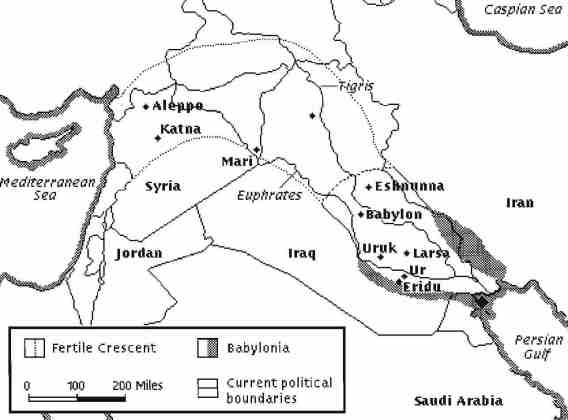
Mesopotamia and Babylonian area (arhat media.com)
Who First Figured This Out?
Setting aside China, India and the Americas for this discussion, it was in the Middle East, in what is now Syria, Iraq and Persia, that humans began to systematically study movements of stars, planets and seasonal changes. Not only for curiosity’s sake, but to determine times of rainfall, planting, harvesting and cold, they began gathering real data: where the sun rose and set, that sunrise and sunset points move, that such points periodically slow in their movement and reverse course. The easiest way to do this was to create a large circle, mark regular divisions on the circle, as closely spaced as possible, and lay it down where you can see the entire horizon. This essentially is what the Celts did with huge stones at Stonehenge.
Sumerian Astronomy
I think the Sumerians figured it out as follows: 1) Build a platform from which you can see the entire horizon (not too difficult in a flat desert) and build a low, circular wall on it. 2) Find the exact center of the circle, then lay out two marks on the wall-top opposite each other. 3) Continue halving the wall-top space to get circle-quarters, then circle-eighths, etc. 4) You may eventually arrive at 360 as a nice workable total for such evenly spaced marks; lots of marks but not too closely-spaced to be practical. 5) Sit on your stool at the exact center of the circle with you eye level with the wall-top and watch the distant horizon. 6) When the sun rises and sets, put a little pebble at that mark on the top of the wall. 7) At some point, days or months later, there will be too many pebbles, so you’ll have to number your marks somehow so you can remove the pebbles. 8) To number them you’ll have to select one mark as a logical starting point. 9) By now you should have noticed that everything in the sky continually moves except for one particular star (which we currently call Polaris or the north star). 10) Use the mark on the wall that lines up with that unmoving star as your starting point, and number all the other marks from there around the circle. Does it matter in which direction you number? Probably not. You now have a working device for determining sunrises and sunsets and so on; all you need do is write your data down on something. In a few years, you’ve got it pretty well figured out: length of year, solstices, equinoxes, months. Add some star groups as signposts through which move the sun and planets (Greek planasthai for “to wander”), and you have the zodiacal constellations (Aries, Taurus, etc.).

An astrolabe. Enlarge it, lay it down flat, and you get an idea of how to locate sunrises. (iWeb.TNtech.edu)
Festival Lag Time
It takes a few days to confirm that a solstice has indeed occurred. According to this chart, by four days after the solstice the daylight period has grown by only 17 seconds. This is about the minimum difference one could detect with primitive instruments. So the early Mesopotamian scientists (astronomers, or at that time, astrologers) would notify their people that the solstice had occurred, the day had indeed begun to shorten, the great darkness will indeed return (“Winter is coming!”) and the folk must gird their loins and prepare themselves. This was a Necessary Thing to Know, and a cause for celebration. Thus, solstice festivals didn’t necessarily fall on the solstice itself, but often on the day one could surely detect that the solstice had successfully re-occurred. Western European Christmas celebration – four days after the winter solstice – is the best-known example.
Summer Festivals
The farther one lives from the equator, the more noticeable are seasonal variations in daylight and warmth, and the more important seasonal events such as midsummer festivals become. Most summer festivals are linked to recognition of the growing length of day.
Stonehenge
Some historians point to the Stonehenge, a prehistoric monument in Wiltshire, England as evidence of the fact that ancient humans used the June Solstice as a way to organize their calendars. Some believe that Stonehenge’s unique stone circle was erected around 2500 BCE in order to establish the date of the Summer Solstice. Viewed from its center, the Sun rises at a particular point on the horizon on day of the June Solstice. Thousands of people, including modern-day druids and pagans, usually gather at Stonehenge for this occasion.
North America
Some Native American tribes held ritual dances to honor the sun. The Sioux were known to hold one of the most spectacular rituals. Preparations for the event included cutting and raising a tree that would be considered a visible connection between the heavens and Earth, and setting up teepees in a circle to represent the cosmos. Participants abstained from food and drink during the dance itself. Their bodies were decorated in the symbolic colors of red (sunset), blue (sky), yellow (lightning), white (light), and black (night).
China
In ancient China, the summer solstice was observed by a ceremony to celebrate the Earth, femininity, and the “yin” forces. It complemented the Winter Solstice that celebrated the heavens, masculinity and “yang” forces. According to Chinese tradition, the shortest shadow is found on the day of the Summer Solstice.
Western Europe
In ancient Gaul, which encompasses modern-day France and some parts of its neighboring countries, the Midsummer celebration was called Feast of Epona. The celebration was named after a mare goddess who personified fertility and protected horses. In ancient Germanic, Slav and Celtic tribes, pagans celebrated Midsummer with bonfires. After Christianity spread in Europe and other parts of the world, many pagan customs were incorporated into the Christian religion. In parts of Scandinavia, the Midsummer celebration continued but was observed around the time of St John’s Day, on June 24, to honor St John the Baptist instead of the pagan gods.
Northern European Midsummer Celebrations
In northern European countries like Sweden, Denmark, Norway and Finland, Midsummer is a festive celebration. When the summer days are at their longest, and in the far north it is the time of the Midnight Sun, festivals generally celebrate the summer and the fertility of the Earth. In Sweden and many parts of Finland people dance around Maypoles. Bonfires are lit and homes are decorated with flower garlands, greenery, and tree branches.
[Chuck Almdale]
Interesting Links
TimeandDate.com – June Solstice
TimeandDate.com – Los Angeles sunrise, sunset & day length for June 2017
TimeandDate.com – Perihelion, Aphelion and the Solstices
Heliophysics – A Universal Science
Los Angeles Equinoxes and solstices from 2010–2020



 SANTA MONICA BAY AUDUBON SOCIETY BLOG