Free email delivery
Please sign up for email delivery in the subscription area to the right.
No salesman will call, at least not from us. Maybe from someone else.
Ballona Wetlands 2017 Report

Wetlands introduction session
Ballona Wetland 2016/17 Summary
Ballona Wetlands Education has had another full year of bringing 4th and 5th graders out to the wetlands for a morning of nature study. We have received the year end summary from Cindy Hardin, who is the lead person for this program.
Every year SMBAS funds 10 buses to bring students to the wetlands. This amounts to $3500 plus, but it is money well spent.
If you are interested in volunteering, training starts after Labor Day. You can reach Cindy at “Cindy Hardin” <cindyhardin[AT]laaudubon.org>.
SMBAS congratulates Cindy and all her docents for the wonderful job they do each and every year.
Below is the email we received from Cindy that contained the summary.
**************************************

Kids arrive on the bus
Hello All,
If you are receiving this summary it means that you have had a hand in making Los Angeles Audubon’s education program at Ballona the fabulous experience that it is for visitors of all ages.
We had a great year with our elementary school children, and Open Wetlands has become a well-established monthly happening, thanks to the efforts of all of you wonderful volunteers. We literally could not do it without you.
Please take a moment to pat yourself on the back for all the good work! And a special shout-out to Santa Monica Bay Audubon Society for their consistent encouragement and support. (highlight added)
A huge thank you from the bottom of my heart,
Cindy
**************************************

The main wetland channel looking south towards Culver Blvd. (Leslie Davidson ’08)
BALLONA SUMMARY 2016-2017
It was another fantastic year at Ballona. We had 42 tours in all, and were visited by 25 different schools. A total of 2356 students were able to experience Ballona during the 2016-2017 school year. These numbers are impressive, especially in light of the fact that the drought busting winter rains caused several tour re-schedules.
Each teacher that visits receives a questionnaire about their trip. What follows is a summary of responses from the surveys that were returned. Numbers next to the comments indicate the number of teachers that had that same response.
What would you tell another teacher who asked you what you did on this trip?
- Saw plant and animal species and their habitats (10)
- Learned how to use binoculars and microscopes (9)
- Learned about the importance of saving wetlands/migration (6)
- Created a deep understanding of species present (2)
- Covers NGSS standards appropriate to grade level (4)
- Explored/viewed beautiful wetland habitat (7)
- Informative/fun (2)
- “I would advise any teacher to take the opportunity to visit Ballona. The program is so well run and 100% valuable.”
What interested your students the most about the trip?
- Bird watching (19)
- Learning about the different plants (2)
- Binoculars/magnifying glasses (6)
- Migration
- Microscopes
- Being away from the city
- Having the students outdoors was awesome (3)
- Everything! (2)
Was your tour guide helpful, knowledgeable and informative? Please comment.
- The docent was awesome (3)
- Yes! (10)
- Knew how to handle the kids
- Always engaging
- She made the experience a million times better (2)
- Our docent kept the students focused and interested
- All guides were terrific (2)
- Understanding and positive
What could be done to improve the program?
- Perfect (14)
- Keep the Magnification Station
- Video via the internet
- Ask a few “focus questions” when the students arrive in order to get them thinking about what they will see as they tour the wetlands. Then follow up with a “de-briefing” that addresses those questions.
- Give students a better understanding of what is needed to preserve what is left of the wetlands.
- Prep teachers on what will be the focus of the tour in order for them to be aware of what facets of life science to cover prior to the trip.
- More time on the wetlands (5)
- Water/snack break
THE PRE-SITE VISIT AND MATERIALS
Every school that participates in our program receives a visit to their school prior to the field trip from one of our Los Angeles Audubon staff or volunteers. This component of the program is unique; most other environmental education groups do not offer this service.
This is a valuable preparation tool for students, teachers and our team. Teachers learn what to expect, students get excited about their field trip, and we get a general idea of the tone and behavior habits at each school. In addition to a PowerPoint presentation and exhibit of taxidermied birds, bones and feathers, the teachers receive a packet of wetland themed activities to do with their class. Also, each student receives a Birds of Ballona Booklet of their very own. These are some of the comments teachers made about the materials provided, and how they were utilized.
- Bird Books were used to make research cards
- Bird Books were a huge hit with the children (3)
- We used the line drawings of birds contained in packet to color after researching the appearance of the birds
- The poster was a great visual aid to have in the classroom
- Crossword and Word Search helped with vocabulary (3)
And the visit itself:
- The pre-site was an EXCELLENT experience. I appreciate all that was done to give exposure to the animals and plants and also science concepts/importance of wetlands
- Piqued the students’ interest and laid a great foundation for trip
- Our presenter was so enthusiastic . . . after her presentation they were dying to get out and explore
But:
- Possibly have kids explore the tables halfway through, so they are not sitting for so long
- Maybe a little shorter for the younger grades
A deep and heartfelt thanks to all for a great year. You are all superstars of environmental education!
[Submitted by Lillian Johnson]
Termites cause billions of dollars in damage annually – but they need help to do it. So they carry tiny organisms around with them in their gut. Together, termites and microorganisms can turn the wood in your house into a palace of poop.
This is another installment of the PBS Deep Look series. If no film or link appears in this email, go to the blog to view it by clicking on the blog title above. If the film stops & starts in an annoying manner, press pause (lower left double bars ||) to let it buffer and get ahead of you. [Chuck Almdale]
Mt. Piños with Lawrence’s Goldfinches: 10-11 June 2017

Northeastern view of Mt. Piños; 109 miles to horizon
(Shuttle Radar Topography Mission 2-16-00)
8843 feet high, Mt. Piños lies just across the Kern County line. Decades ago it was the best spot to sit and scan the skies for free-flying California Condors. The birds would soar by to the west and north, gliding at up to 60 MPH on rising thermals, rarely flapping except to flex their flight muscles.
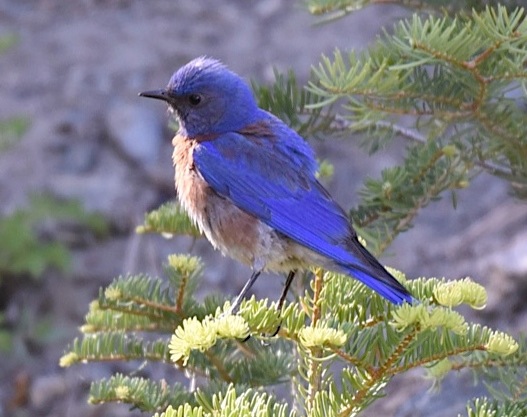
Western Bluebird male watching for flies (D. Waterman 6-10-17)
Condors are again nesting (Devil’s Gate Condor Cam) in the Sespe wilderness about twenty miles to the south, but you might wait a very long time for one to fly by. Thirty-five years ago, I saw five condors in one day, driving along Mil Potrero Rd. west of Mt. Abel. Those days are gone.

California Quail, sentry for the flock below (J. Waterman 6-10-17)
Our birding group met at the “triangle” – a dirt parking lot at the intersection of Cuddy Valley Rd. and Mt. Piños Rd. – at 5500 ft. elevation. Altitude matters around here. We birded this area for a while – both chaparral brush and conifer forest – and found a few mid-altitude birds, including: California Quail, Western Wood-Pewee, Western Bluebird, Chipping Sparrow and the first of what proved to be a relatively huge number of Lawrence’s Goldfinch. Raven, Band-tailed Pigeon and Mourning Dove frequently passed over the parking area. A Bullock’s Oriole pair harassed three Ravens perched in a bare tree, finally driving them away. Bright yellow Wallflower bloomed on the forest fringe.

Yellow-faced Bumblebee on a Wax currant flower (Ribes cereum) (J. Waterman 6-10-17)
As you ascend Mt. Piños, bird speciation changes. Scrub Jay disappears, Steller’s Jay appears, and at the highest levels, Clark’s Nutcrackers make themselves known by their loud raucous calls. Crows are replaced by Ravens. House Finch disappears and Cassin’s Finch appears, often in company with Purple Finch, which utilizes a middle range overlapping both House & Cassin’s. White-breasted Nuthatch – which can be found down close to sea level – are joined by both the noisily peeping Pygmy Nuthatch which typically forages in family flocks, and the more solitary Red-breasted Nuthatch. At higher levels, it is possible (or at least used to be) to find Calliope Hummingbird, feeding at the tiny flowers of currant bushes and other low flowering plants. Although many of the currants were in flower and were loaded with bees, only one female Anna’s Hummingbird was seen.

Dark-eyed Junco juvenile (J. Waterman 6-10-17)
Moving upward, we passed by McGill Campground (elev. 7500 ft.) to visit a stream overlook and nearby trail. Water appears here only where underlying rock strata

Mountain Pink Currant, Ribes nevadense Mt. Piños 7600 ft.
(L. Johnson 6-10-17 10:23am)
forces it to the surface, and at one such spot we found many birds coming to drink and bathe. An Olive-sided Flycatcher stopped his tree-top singing long enough to drink. Steller’s Jay, Mountain Chickadee, Orange-crowned Warbler, Chipping Sparrow and Lazuli Bunting all came by. Juvenile Dark-eyed Juncos, Purple

Lawrence’s Goldfinch male (J. Waterman 6-11-17)
Finches and Lawrence’s Goldfinches bathed. Pygmy Nuthatchs and Violet-green Swallows were both nesting – or at least investigating nest holes – in a large dead tree. We were baffled when we saw a Pygmy Nuthatch go in and out of a nest hole, then a few minutes later a Violet-green Swallow went in out of the same hole. Back by the car we found a Hairy Woodpecker and a Brown Creeper working the conifers.
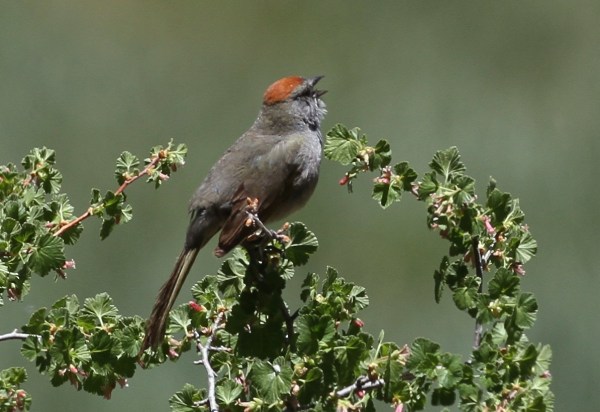
Green-tailed Towhee, singing loudly (J. Waterman 6-10-17)
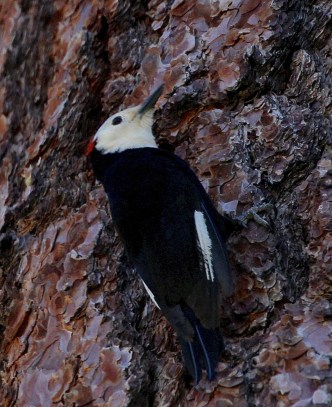
White-headed Woodpecker male
(J. Waterman 6-10-17)
Iris Meadow (8300 ft,) lies just
past the parking lot at the top of the road. Fox Sparrows and Green-tailed Towhees both sang as we searched in vain the numerous patches of flowering currant bush for Calliope Hummingbird. The Fox and Green-tailed are both excellent – and annoyingly similar – singers, with burblely varied songs, and we never get tired of hearing them. At lunchtime under the pines, we heard a rapid drumming in the distance, which proved to be a male White-headed Woodpecker banging on a dead tree.

Pussy Paws Calyptridium umbellatum; Mt. Piños summit
(J. Waterman 6-10-17)

Acmon Blue, a tiny butterfly on the upper Mt. Piños meadow (J. Waterman 6-10-17)
A few of us hiked an addition mile and several hundred feet in altitude up to the next meadow where we saw more Fox Sparrows, Green-tailed Towhees, a singing Rock Wren on his crag and many Ravens overhead, but no Clark’s Nutcrackers. The single “perp” of a male Mountain Quail was heard in the distance. The flowers here are mostly low, or small, or both, but were frequented by insects.
After awakening around 6am next morning, we hit the road by 8 and drove over to Mt. Abel to visit “Shirley’s Seep,” a small but permanent source of water about halfway up the road to the top of Mt. Abel. For an hour we watched birds come and go, and were amazed at the (relative) abundance

Lawrence’s Goldfinch pair at the water seep (D. Waterman 6-11-17)
of Lawrence’s Goldfinch. This species is usually in small numbers and difficult to find, but we’d seen them everywhere on this trip. Violet-green Swallows constantly sailed by, sometimes low to scoop up a beakful of water on the fly. Various finches and juncos took baths and preened themselves dry while perched on twigs.

Grinnell’s Beardtongue Penstemon grinnellii, Shirley’s Seep, Mt. Abel
(L. Johnson 06-11-17)
After a short drive to the chilly top of Mt. Abel to search again, without success, for Clark’s Nutcracker, we returned to the seep for a last look at the bathing birds.

View from Shirley’s Seep, Mt. Abel (L. Johnson 06-11-17)
The flowering and nesting at Mt. Piños should continue into early July. The irises of Iris Meadow will be blooming soon, and perhaps the Calliope Hummingbirds will eventually appear.

Fox Sparrow (Large-billed form)
(D. Waterman 6-10-17)
It’s a great place to camp and uncloudy moonless nights are great for star gazing & satellite spotting. Call the local ranger station for information at 661-245-3731 ext 0; camping information is 805-434-1996, but frankly, the campgrounds were so empty you could probably just show up. [Chuck Almdale]
Mt. Pinos ranger district
McGill Campground
Mt. Piños Campground
| Trip List 2017 |
All | Triangle | Overlook | Iris | Shirley’s | McGill |
| 10-11 June | Areas | Area | & Stream | Meadow | Seep | Camp |
| Mountain Quail | 2 | 1H | 1H | |||
| California Quail | 2 | 10 | 2 | |||
| Red-tailed Hawk | 2 | 1 | 1 | |||
| Band-tailed Pigeon | 3 | 8 | 2 | 6 | ||
| Mourning Dove | 3 | 2 | 4 | 2 | ||
| Anna’s Hummingbird | 1 | 1 | ||||
| Downy Woodpecker | 1 | 1 | ||||
| Hairy Woodpecker | 1 | 1 | ||||
| White-headed Woodpecker | 1 | 1 | ||||
| Northern Flicker | 1 | 1 | ||||
| Olive-sided Flycatcher | 2 | 1H | 1 | |||
| Western Wood-Pewee | 5 | 1+2H | 2 | 2 | 1 | 1 |
| Steller’s Jay | 4 | 2 | 3 | 8 | 3 | |
| Western Scrub-Jay | 1 | 3 | ||||
| Common Raven | 4 | 10 | 30 | 4 | 3 | |
| Violet-green Swallow | 5 | 10 | 12 | 6 | 42 | 8 |
| Mountain Chickadee | 4 | 5 | 10 | 8 | 4 | |
| Red-breasted Nuthatch | 2 | 1 | 1 | |||
| Pygmy Nuthatch | 3 | 2 | 2 | 3 | ||
| Brown Creeper | 1 | 1 | ||||
| House Wren | 1 | 1H | ||||
| Western Bluebird | 5 | 4 | 2 | 4 | 9 | 6 |
| American Robin | 5 | 5 | 2H | 2 | 2 | 1H |
| Orange-crowned Warbler | 1 | 2 | ||||
| Yellow-rumped Warbler | 1 | 1 | ||||
| Green-tailed Towhee | 2 | 2+2H | 1+2H | |||
| Chipping Sparrow | 3 | 4 | 2 | 4 | ||
| Fox Sparrow | 3 | 2H | 4+2H | 2+2H | ||
| Dark-eyed Junco | 4 | 4 | 2 | 3 | 6 | |
| Lazuli Bunting | 2 | 2 | 1 | |||
| Brown-headed Cowbird | 1 | 1 | ||||
| Bullock’s Oriole | 1 | 2 | ||||
| House Finch | 1 | 1 | ||||
| Purple Finch | 1 | 2 | ||||
| Cassin’s Finch | 3 | 2 | 4 | 2 | ||
| Lawrence’s Goldfinch | 2 | 2 | 30 | |||
| Total | 36 | 16 | 16 | 18 | 18 | 16 |
| H = Heard | ||||||
| Triangle = Area around intersection of Cuddy Valley Rd. & Mt. Piños Rd. | ||||||
| Overlook = Streamside area & trail between McGill & Mt. Piños campgrounds | ||||||
| Iris Meadow = Area around meadow at top of Mt. Piños Rd. & 1-mile walk to next meadow above @ 9300-9600 ft. | ||||||
| Shirley’s Seep = Roadside seep 1/2 way up Cerro Noroeste Rd. & Mt. Abel campground at top | ||||||
| McGill Campground = Campground 1/2 up Mt. Piños Rd. @ 7500 ft. | ||||||
The Superb Owl | PBS Science Video
As we get ready to watch that big football game that my lawyers tell me I’m not allowed to say the name of, let’s celebrate a champion of the bird world: Stealthy and silent owls! Learn how owls fly so silently, how they see in the dark, and how owls’ incredible hearing makes them such superb aerial hunters.
This is an installment of the PBS – It’s OK to be Smart series. If no film or link appears in this email, go to the blog to view it by clicking on the blog title above. If the film stops & starts in an annoying manner, press pause (lower left double bars ||) to let it buffer and get ahead of you. [Chuck Almdale]
This is what it’s all about!

Lu Plauzoles with Korinna Domingo, at SMC Scholarship event. June11, 2017
I spent part of the afternoon with Korinna Domingo, our latest Santa Monica College recipient of the SMBAS Norma Foster Scholarship. As a result, I have come away even more impressed with the community college system. Korinna, a number of years from high school, is transferring to Humboldt State University to study Wildlife Management and Conservation. It has not been an easy path for her as a first-gen college student and she has strong dedication to her major, having experienced the arduous field work of a conservation biologist in tracking felines in the Verdugo Hills. If you, as I do, feel we should add to her scholarship for September, please feel free to click the little donate button to the right of this post or go to her GoFundMe site:(copy and paste this link) HTTP://TINYURL.COM/GT6CNHX
Lu Plauzoles



 SANTA MONICA BAY AUDUBON SOCIETY BLOG