Free email delivery
Please sign up for email delivery in the subscription area to the right.
No salesman will call, at least not from us. Maybe from someone else.
These Lizards Have Been Playing Rock-Paper-Scissors for 15 Million Years | Deep Look Video
Male side-blotched lizards have more than one way to get the girl. Orange males are bullies. Yellows are sneaks. Blues team up with a buddy to protect their territories. Who wins? It depends – on a genetic game of roshambo.
This is another installment of the PBS Deep Look series. If no film or link appears in this email, go to the blog to view it by clicking on the blog title above. If the film stops & starts in an annoying manner, press pause (lower left double bars ||) to let it buffer and get ahead of you. [Chuck Almdale]
Joyas Voladoras
Something to think about before our April 4 show
on Andean hummingbirds

Anna’s Hummingbird female (Jim Kenney 8/14/12)
Joyas Voladoras
by Brian Doyle
From: The American Scholar
Consider the hummingbird for a long moment. A hummingbird’s heart beats ten times a second. A hummingbird’s heart is the size of a pencil eraser. A hummingbird’s heart is a lot of the hummingbird. Joyas voladoras, flying jewels, the first white explorers in the Americas called them, and the white men had never seen such creatures, for hummingbirds came into the world only in the Americas, nowhere else in the universe, more than three hundred species of them whirring and zooming and nectaring in hummer time zones nine times removed from ours, their hearts hammering faster than we could clearly hear if we pressed our elephantine ears to their infinitesimal chests.
Link to the rest of the essay.
Thanks to Joyce for the suggestion.
I don’t want to describe what happens. You’ll be amazed.
If no film or link appears in this email, go to the blog to view it by clicking on the blog title above. If the film stops & starts in an annoying manner, press pause (lower left double bars ||) to let it buffer and get ahead of you. [Chuck Almdale]
This Pulsating Slime Mold Comes in Peace | Deep Look Video
Flip over a rotting log and chances are you’ll see a goopy streak stuck to the wood. If you were to film this goop and play the video back in high speed, you’d see something that might remind you of the 1950s sci-fi classic “The Blob:” a jelly-like creature pulsating in a strange way, a little bit forward, a little bit back, spreading and searching for something to devour.
This is another installment of the PBS Deep Look series; this installment is adapted from the “It’s OK to be Smart” series. If no film or link appears in this email, go to the blog to view it by clicking on the blog title above. If the film stops & starts in an annoying manner, press pause (lower left double bars ||) to let it buffer and get ahead of you.
After viewing this video, follow the new link which will appear over to “It’s OK to be Smart” for even more fascinating information on slime molds. [Chuck Almdale]
Black Skimmer: Malibu Lagoon, 26 March, 2017
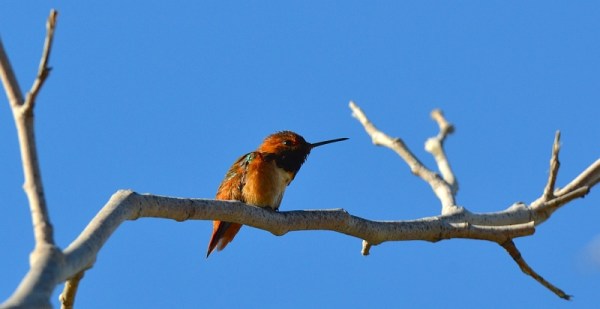
Male Allen’s Hummingbird (Grace Murayama 3-26-17)
As seems usual this year, the weather turned out to be surprisingly unpredictable, or is that unpredictably surprising? We were told to expect rain. No rain. We were told to expect cool temperatures in the 45-60° range. I birded in my T-shirt. Both San Fernando Valley and the Santa Monica Mountains were fog-filled and gray with clouds. The beach was sunny and windless. So it goes.

Killdeer foursome making a heckova racket (Grace Murayama 3-26-17)
Despite the fine weather, or perhaps because of it, we had few birds and a low species count. Fifty-eight total count for gulls and terns seemed extraordinarily low, so I checked when I got home, and found: 2012 – 53 birds, 2013 – 94, 2014 – 643, 2015 – 107, 2016 – 219. So…OK, low, but not supernaturally low. So much for the accuracy of one’s unsubstantiated impressions of history.
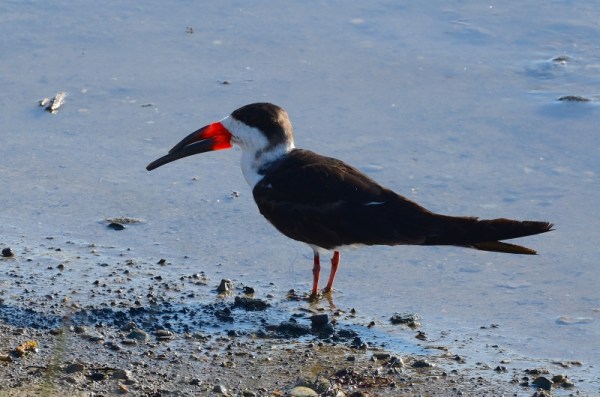
Black Skimmer with the giant schnozz (Grace Murayama 3-26-17)
Our best bird of the day was the single breeding-plumage Black Skimmer. This bird looks like an oversized tern, with a huge red and black bill, lower bill longer than the upper bill. Aptly named, this largely black bird feeds by skimming just above the calm waters of lagoons and inshore waters, lower bill-tip slightly immersed in the water as it flies. When it encounters something edible – SNAP! goes the bill. I always expect them to hit a hidden stick and go flying head over heels, summersaulting across the water, but I’ve never seen this happen. Over the past 38 years, we’ve recorded Black Skimmer at the lagoon on only 23 occasions, for a total of 220 birds. They show up Dec-Mar and May-Aug. On only three appearances did their numbers rise above single digits: 30 on 1/29/09, 35 on 7/25/10 and a whopping 103 the following month on 8/22/10.
Skimmers are one of those groups whose classification is regularly bounced around, and they’ve been in and out of the Tern family of Sternidae (when terns were in a family separate from gulls), or their own family of Rynchopidae. Gulls, Terns and Skimmers are currently all classified into the single family of Laridae. The Black Skimmer is fairly common on ponds, rivers, lagoons and calm waters from the southern U.S. to northern Argentina. The African Skimmer is common in similar habitat throughout sub-Saharan Africa. The third species, Indian Skimmer, is far less common on lakes and rivers of the Indian subcontinent and the delta of the Mekong River. For ‘World Birders,’ it’s a big deal to see one. And that’s it; only three species of skimmer.
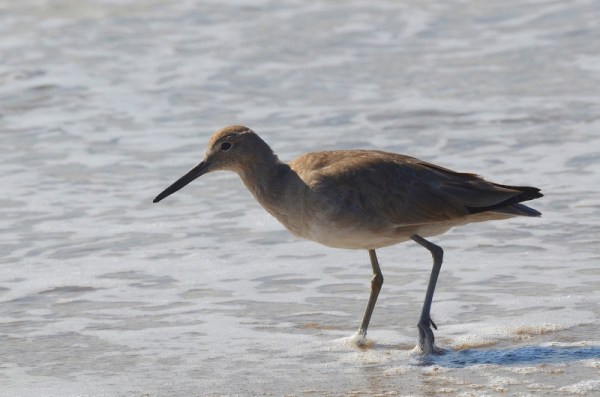
Willet (Grace Murayama 3-26-17)
No Glaucous-winged Gulls this month, but a fine example of a winter (probably 3rd winter) Herring Gull. On the Atlantic Coast, where they are far more common, people want to rename them the Dump Gull, as they feast and thrive on America’s most abundant product – garbage, to the detriment of many of the terns who have to contend with harassment from this large and aggressive gull.

El muerte Brown Pelican (Grace Murayama 3-26-17)
The Black-bellied Plovers were beginning to molt from their winter gray uniforms into their patterned breeding plumage. The warblers – save for the resident breeder Common Yellowthroat – and most of the sparrows seem to have fled, and the spring migrants aren’t yet arriving, so our passerine count was quite low.

Osprey before his escapade with the mullet (Grace Murayama 3-26-17)
The ‘parents and kids bird walk’ participants were greatly entertained by the misfortunes of our Osprey. The bird had snagged a large mullet and then was mobbed by several gulls while still aloft. After the Osprey landed and dropped the fish on the shore, a Great Blue Heron landed a yard away, which startled the Osprey off the fish. A Western Gull then jumped on the fish, but couldn’t make a dent in it before the Osprey returned to reclaim his prize. This altercation attracted the heron, which then flew over and took a swipe at the Osprey. Imagine a fight between a knife-wielder and a swordsman. Not much of a match, and the Osprey left. The heron dragged the fish over to the water, gave it a good rinse, and then seemed to try to swallow the fish sideways. That failed and the fish was finally oriented properly – head down – and the heron slowly forced it down it’s gullet. The mullet was larger in diameter than the heron’s head, but herons have a flexible gape and throat, and eventually the fish disappeared down the gullet. Herons weigh about 5 ½ pounds fully grown, and I’d guess the fish was 2 pounds. Imagine a 150-pound man swallowing a fifty-pound beef roast. I didn’t see the bird fly away and I wonder if it could get off the ground.
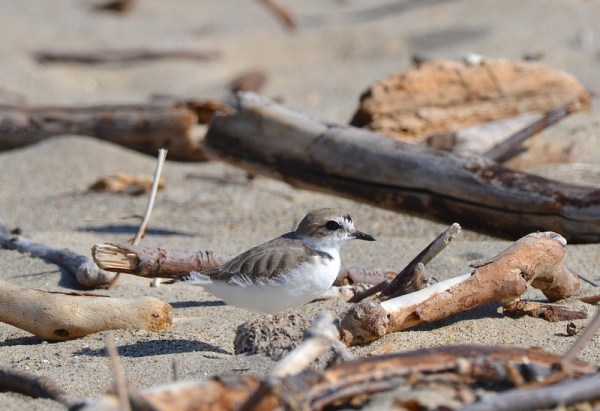
Snowy Plover in the wrack (Grace Murayama 3-26-17)
The Snowy Plovers were still on the beach, scattered through the wrack on the sandy berm, divided into three groups of two, four and two. They seemed to be pairing up into male and female. None had bands.
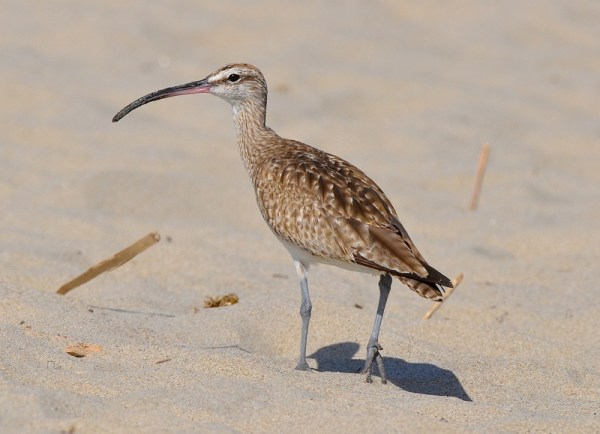
Whimbrel with the decurved bill (Grace Murayama 3-26-17)
Birds new for the season were: Canada Goose, Black-vented Shearwater, Western Sandpiper, Caspian Tern, Black Skimmer, Common Raven, Barn Swallow.

The Lone Killdeer (Grace Murayama 3-26-17)
Many thanks to our photographer: Grace Murayama
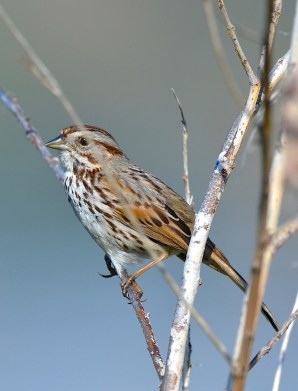
Song Sparrows sing all year around
(Grace Murayama 3-26-17)
Our next three scheduled field trips: Rancho Sierra Vista, 8 Apr., 8am; Malibu Lagoon 8:30 & 10am, 23 Apr.; Butterbredt Spring Campout Sat/Sun 29-30 Apr. 8:30am.
Our next program: Finding and Photographing Birds in the Andes with Chuck Bragg, Tuesday, 4 Apr., 7:30 pm; Chris Reed Park, 1133 7th St., NE corner of 7th and Wilshire Blvd. in Santa Monica.
NOTE: Our 10 a.m. Parent’s & Kids Birdwalk meets at the shaded viewpoint just south of the parking area. Watch for Willie the Weasel. He’ll be watching for you and your big floppy feet.
Links: Unusual birds at Malibu Lagoon
9/23/02 Aerial photo of Malibu Lagoon
Prior checklists:
2016: Jan-June, July-Dec 2015: Jan-May, July-Dec
2014: Jan-July, July-Dec 2013: Jan-June, July-Dec
2012: Jan-June, July -Dec 2011: Jan-June, July-Dec
2010: Jan-June, July-Dec 2009: Jan-June, July-Dec.
The 10-year comparison summaries created during the project period, despite numerous complaints, remain available on our Lagoon Project Bird Census Page. Very briefly summarized, the results unexpectedly indicate that avian species diversification and numbers improved slightly during the period Jun’12-June’14. [Chuck Almdale]

Surf log (C. Bragg 2-26-17)
| Malibu Census 2016-17 | 9/25 | 10/23 | 11/27 | 12/25 | 2/26 | 3/26 |
| Temperature | 70-96 | 63-70 | 53-58 | 48-54 | 46-52 | 55-68 |
| Tide Lo/Hi Height | H+4.39 | L+2.63 | H+5.79 | H+5.49 | H+5.6 | H+5.21 |
| Tide Time | 0708 | 1108 | 0729 | 0634 | 0845 | 0851 |
| Brant | 1 | 1 | ||||
| Canada Goose | 2 | |||||
| Gadwall | 6 | 6 | 4 | 18 | 10 | 12 |
| American Wigeon | 1 | 10 | 7 | 30 | 6 | 18 |
| Mallard | 35 | 23 | 22 | 14 | 24 | 14 |
| Northern Shoveler | 6 | 2 | 1 | |||
| Northern Pintail | 4 | 3 | 1 | |||
| Green-winged Teal | 2 | 6 | 12 | 2 | ||
| Ring-necked Duck | 1 | |||||
| Surf Scoter | 8 | 30 | ||||
| Bufflehead | 4 | 6 | 1 | |||
| Hooded Merganser | 1 | 5 | 2 | |||
| Red-brstd Merganser | 5 | 4 | 1 | |||
| Ruddy Duck | 7 | 26 | 30 | 10 | ||
| Red-throated Loon | 1 | |||||
| Pacific Loon | 1 | 2 | ||||
| Pied-billed Grebe | 15 | 18 | 8 | 1 | ||
| Horned Grebe | 1 | |||||
| Eared Grebe | 3 | 6 | 10 | 1 | ||
| Western Grebe | 10 | 10 | 50 | 3 | 1 | |
| Clark’s Grebe | 2 | 1 | ||||
| Blk-vented Shearwater | 50 | |||||
| Brandt’s Cormorant | 3 | 2 | ||||
| Dble-crstd Cormorant | 38 | 37 | 23 | 32 | 42 | 41 |
| Pelagic Cormorant | 1 | 2 | 6 | 1 | ||
| Brown Pelican | 1 | 30 | 37 | 24 | 30 | 8 |
| Great Blue Heron | 6 | 3 | 3 | 2 | 4 | 2 |
| Great Egret | 1 | 2 | 1 | 2 | 3 | 1 |
| Snowy Egret | 8 | 8 | 5 | 12 | 9 | 5 |
| Turkey Vulture | 1 | |||||
| Osprey | 2 | 2 | 1 | 1 | ||
| Red-tailed Hawk | 1 | |||||
| Sora | 1 | |||||
| American Coot | 95 | 280 | 240 | 210 | 85 | 32 |
| Blk-bellied Plover | 75 | 75 | 73 | 22 | 35 | 14 |
| Snowy Plover | 35 | 29 | 12 | 32 | 8 | 8 |
| Semipalmated Plover | 5 | |||||
| Killdeer | 29 | 1 | 2 | 1 | 4 | 8 |
| Mountain Plover | 1 | |||||
| Spotted Sandpiper | 2 | 1 | ||||
| Willet | 10 | 20 | 3 | 15 | 12 | 13 |
| Whimbrel | 1 | 2 | 2 | 1 | 5 | 4 |
| Marbled Godwit | 4 | 7 | 10 | 5 | 8 | 23 |
| Ruddy Turnstone | 3 | 7 | 14 | 12 | 10 | 1 |
| Sanderling | 22 | 72 | 45 | |||
| Dunlin | 1 | |||||
| Least Sandpiper | 4 | 12 | 4 | 2 | ||
| Western Sandpiper | 3 | 3 | ||||
| Long-billed Dowitcher | 1 | |||||
| Bonaparte’s Gull | 1 | 1 | ||||
| Heermann’s Gull | 6 | 15 | 12 | 11 | 3 | 1 |
| Mew Gull | 1 | |||||
| Ring-billed Gull | 5 | 35 | 30 | 2 | ||
| Western Gull | 45 | 48 | 85 | 90 | 45 | 39 |
| California Gull | 27 | 1200 | 940 | 1350 | 6 | |
| Herring Gull | 1 | 1 | 1 | 1 | ||
| Glaucous-wingd Gull | 2 | |||||
| Caspian Tern | 2 | |||||
| Forster’s Tern | 2 | 1 | ||||
| Royal Tern | 1 | 19 | 16 | 45 | 14 | 5 |
| Elegant Tern | 2 | 5 | 1 | |||
| Black Skimmer | 1 | |||||
| Rock Pigeon | 17 | 15 | 5 | 5 | 10 | 6 |
| Mourning Dove | 2 | 1 | 4 | 1 | 1 | |
| Anna’s Hummingbird | 1 | 1 | 1 | |||
| Allen’s Hummingbird | 1 | 1 | 1 | 2 | 2 | 2 |
| Belted Kingfisher | 2 | 1 | 1 | 1 | 1 | |
| American Kestrel | 1 | |||||
| Merlin | 1 | |||||
| Peregrine Falcon | 1 | |||||
| Nanday Parakeet | 3 | 30 | ||||
| Pac.-slope Flycatcher | 1 | |||||
| Black Phoebe | 9 | 5 | 5 | 3 | 2 | 6 |
| Say’s Phoebe | 2 | 1 | 1 | |||
| Cassin’s Kingbird | 1 | |||||
| California Scrub-Jay | 2 | 2 | 4 | 1 | 1 | |
| American Crow | 7 | 7 | 4 | 5 | 4 | 3 |
| Common Raven | 1 | |||||
| Tree Swallow | 12 | |||||
| Rough-wingd Swallow | 20 | |||||
| Barn Swallow | 1 | 5 | ||||
| Bushtit | 27 | 30 | 35 | 10 | 8 | 3 |
| House Wren | 1 | 2 | 1 | 1 | ||
| Marsh Wren | 1 | 1 | ||||
| Bewick’s Wren | 1 | |||||
| Ruby-crowned Kinglet | 2 | 8 | 1 | |||
| Western Bluebird | 2 | |||||
| Hermit Thrush | 1 | 1 | ||||
| Northern Mockingbird | 3 | 1 | 3 | 1 | 2 | |
| European Starling | 17 | 45 | 30 | 1 | 1 | |
| Ornge-crwnd Warbler | 3 | 4 | 2 | |||
| Common Yellowthroat | 6 | 5 | 5 | 3 | 3 | 4 |
| Yellow-rumpd Warbler | 10 | 28 | 3 | 8 | ||
| Wilson’s Warbler | 1 | |||||
| Spotted Towhee | 1 | 1 | 1 | |||
| California Towhee | 2 | 1 | 1 | |||
| Savannah Sparrow | 2 | 4 | 1 | |||
| Song Sparrow | 6 | 4 | 8 | 6 | 8 | 8 |
| Lincoln’s Sparrow | 1 | |||||
| White-crwnd Sparrow | 2 | 25 | 45 | 15 | 20 | 10 |
| Red-winged Blackbird | 1 | 1 | ||||
| Western Meadowlark | 16 | 3 | 2 | 1 | ||
| Great-tailed Grackle | 2 | 17 | 5 | 3 | 2 | 3 |
| Brwn-headed Cowbird | 3 | |||||
| House Finch | 30 | 18 | 9 | 17 | 10 | 6 |
| Lesser Goldfinch | 2 | |||||
| Totals by Type | Sep | Oct | Nov | Dec | Jan | Feb |
| Waterfowl | 55 | 50 | 70 | 114 | 75 | 80 |
| Water Birds – Other | 149 | 382 | 332 | 335 | 165 | 132 |
| Herons, Egrets & Ibis | 15 | 13 | 9 | 16 | 16 | 8 |
| Quail & Raptors | 4 | 1 | 1 | 2 | 2 | 1 |
| Shorebirds | 195 | 215 | 161 | 100 | 86 | 76 |
| Gulls & Terns | 54 | 118 | 1321 | 1122 | 1445 | 58 |
| Doves | 19 | 16 | 5 | 9 | 11 | 7 |
| Other Non-Passerines | 4 | 6 | 3 | 33 | 3 | 2 |
| Passerines | 140 | 183 | 186 | 107 | 94 | 53 |
| Totals Birds | 635 | 984 | 2088 | 1838 | 1897 | 417 |
| Total Species | Sep | Oct | Nov | Dec | Jan | Feb |
| Waterfowl | 7 | 6 | 8 | 9 | 9 | 8 |
| Water Birds – Other | 4 | 9 | 11 | 8 | 8 | 5 |
| Herons, Egrets & Ibis | 3 | 3 | 3 | 3 | 3 | 3 |
| Quail & Raptors | 3 | 1 | 1 | 1 | 2 | 1 |
| Shorebirds | 14 | 10 | 8 | 8 | 8 | 9 |
| Gulls & Terns | 4 | 8 | 8 | 6 | 7 | 9 |
| Doves | 2 | 2 | 1 | 2 | 2 | 2 |
| Other Non-Passerines | 3 | 4 | 3 | 3 | 2 | 1 |
| Passerines | 21 | 21 | 21 | 18 | 18 | 13 |
| Totals Species | 61 | 64 | 64 | 58 | 59 | 51 |



