Free email delivery
Please sign up for email delivery in the subscription area to the right.
No salesman will call, at least not from us. Maybe from someone else.
Don’t Eat That Bird! — Sunday Morning Bible Bird Study VIII
This Week’s Lesson – Don’t Eat That Bird!
Don’t miss the entire series all on one page
We now begin a look at the birds considered unclean and not to be eaten by the children of Israel.
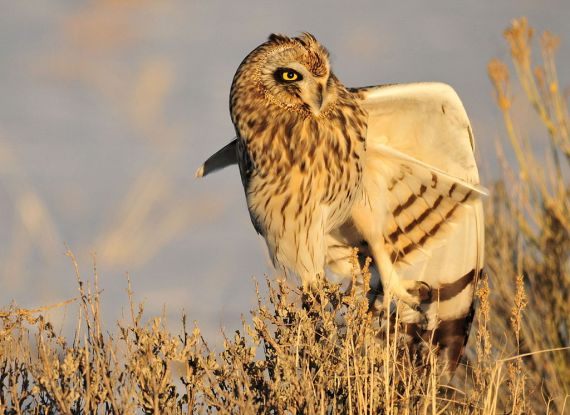
Short-eared Owl Asio flammeus – Seedskadee NWR, WY
(Tom Koerner – Wikimedia Commons)
These are the birds that you shall regard as vermin, and for this reason they shall not be eaten: the griffon-vulture, the black vulture, and the bearded vulture; the kite and every kind of falcon; every kind of crow, the desert-owl, the short-eared owl, the long-eared owl, and every kind of hawk; the tawny owl, the fisher-owl, and the screech-owl; the little owl, the horned owl, the osprey, the stork, every kind of cormorant, the hoopoe, and the bat.
Leviticus 11:13-19 New English Bible

Bearded Vulture (or Lammergeier) Gypaetus barbatus scarfs down a big bone (Francesco Veronesi, Italy – Wikimedia Commons)
My first impression of this list is that I wouldn’t want to eat any of these birds myself. Some of their dietary habits are rather repugnant. If you are what you eat, I don’t want to eat them! Others I am quite fond of and – as with most people – I refrain from eating my friends. While the rationale, if any, behind these biblical dietary injunctions is not really well understood, and theologians and scholars have argued about them for millennia, it seems that these bird’s choices in cuisine are as good a reason as any for putting them off-limits. If something eats garbage, dung, or dead and rotting insect-infested meat, you might be wise to leave it alone.
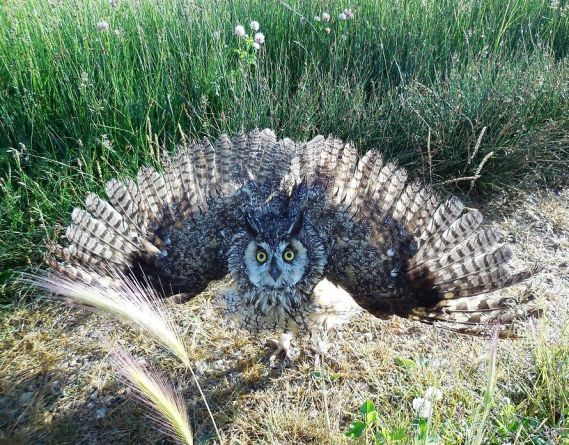
Long-eared Owl Asio otus, USFWS Mountain-Prairie
(Nicole Hornslein – Wikimedia Commons)
The second thing that strikes me about this list of forbidden flying food, is what an odd assortment of birds it is. In total, twenty species or families are named. The bat, of course, is not a bird (so we’ll ignore it.) It’s not that the infinite deity, or even
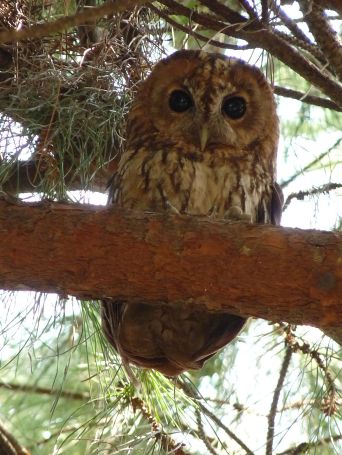
Tawny Owl Strix aluco; Beldibi, Marmaris Mugla, Turkey (Nottsexminer – Wikimedia Commons)
the ancient Israelites, goofed up and mistook it for a bird – no feathers, for starters – but that their word עוֹף oph meant “flying creatures,” excepting insects which were pestiferous and plentiful enough to warrant their own names.
Of the nineteen remaining named birds, eight are owls. As of October 1, 2016, there are 10,514 avian species in the world, of which 228 are owls, or 2.2% of the total. Yet owls comprise 42% of the deity’s Do Not Eat list. This seems peculiar. I can’t think of any owl I’d wish to eat; their eating habits are all pretty much the same; why didn’t the deity just say “every kind of owl” and be done with it, as was done with falcons, hawks and cormorants? Does this mean it’s OK to eat those owls not named? That doesn’t seem reasonable.
Ten owl species live in our target area of Israel and environs. In current phylogenetic order they are: Barn Owl Tyto tyto; European Scops-Owl Otus scops; Pallid Scops-Owl Otus brucei; Eurasian Eagle-Owl Bubo bubo; Brown Fish-Owl Ketupa zeylonensis; Little Owl Athene noctua; Tawny Owl Strix aluco; Desert Owl Strix hadorami; Long-eared Owl Asio otus; and Short-eared Owl Asio flammeus. Our Unclean Birds list totals eight. Assuming that the English names given in my bible translation are valid – a very big assumption – the Little, Tawny, Long-eared and Short-eared Owls match. Of seven species of Fish-Owl, the Brown is the only one in the area. The “horned” owl has to be Eagle Owl; it has large horns and is the largest owl in the area, impossible to overlook. The “screech” owl is likely the Scops-Owl, a small widespread owl closely related to screech owls; the European O. scops is widespread and common, whereas the range of the Pallid O. brucei is farther east, only occasionally reaching Israel. They are very similar in appearance.
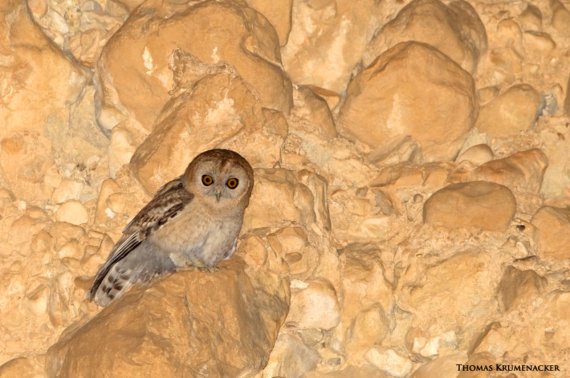
Desert Owl Strix hadorami, Israel
AKA Desert Tawny Owl, formerly known as Hume’s Owl, Strix butleri
(Thomas Krumenacker – Science News)
The “desert owl” is problematic, although there actually is a Desert Owl Strix hadorami, also called Desert Tawny Owl. Its predecessor species, Hume’s Owl Strix butleri, was split in 2015 when the widespread form was recognized as different from the Omani Owl, endemic to Oman. The widespread form became S. hadorami, the Omani form became Omani Owl, retaining S. butleri. However, because Desert Owl closely resembles Tawny Owl S. aluco, it’s likely the ancient Israelites saw them as the same bird. This leaves Barn Owl Tyto tyto – a scattered and widespread resident throughout the region – as the possible “desert” owl.
Barn Owls are relatively large, often noisy, nest and roost in both trees and human-build structures, and delight in devouring small rodents noxious to humans and their crops. It seems unlikely they would not be noticed.

If we accept the above analysis – taking Barn Owl as “desert” owl, and eliminating the Pallid Scops-Owl and Desert Owl as too similar, respectively, to European Scops-Owl and Tawny Owl, for ancient Israelites – who lacked binoculars – to distinguish, we are left with a total of eight owls in the area. Eight owls available, eight owls individually labeled “unclean.” Which returns us to the unanswerable question: why not just say “every kind of owl” and be done with it? The deity works in mysterious ways, apparently without an editor.
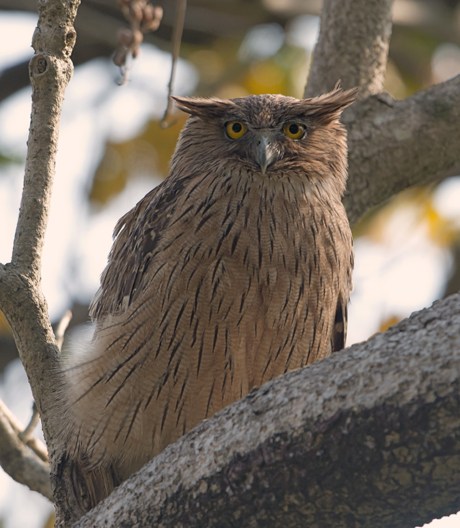
Brown Fish Owl Ketupa zeylonensis;
Corbett National Park, Uttarakhand, India
Their feet are specially adapted to catching slippery fish
(Koshy Kosny – Wikimedia Commons)
To single out owls like this as unclean is a bit unfair. This worldwide family of birds has a lot of charisma – even many non-birders admire and appreciate owls, and owls are very useful to humans. Except for the seven Old-World species of fishing-owls, they feed primarily on small rodents and large insects which in turn prey on our crops, infest our buildings, and carry diseases like bubonic plague. Because their extremely large night-adapted eyes are fixed immovably in the skull, they need to move their head to look around. As a result, they evolved the ability to rotate their head as much as 270 degrees to either side, for a total rotation of 540°. Barn Owls can hear a mouse rustling in the grass over 100 yards away. Because one ear hole is slightly higher on the skull than the other, Barn Owls can locate such faint sounds in three dimensions, and can find and seize that mouse in absolute pitch darkness. (Humans are good at locating sounds to either side (horizontal axis), but locate sounds on the vertical axis only with difficulty.) From thirty yards away, the Great Gray Owls of the far north can hear the movement of voles beneath two feet of snow. These are abilities unique in the world of birds.

Brown Fish Owl Ketupa zeylonensis; Tamil Nadu, India
The “fisher” owl (D Momaya – Wikimedia Commons)
On the other hand, divine removal from humanity’s menu was, for Owls, fortuitous. It obviates the typical fate befalling animals we find edible: either eaten into extinction or enslaved to feed humanity. Perhaps the deity was really protecting a wonderful family of birds, rather than saving humans from possible illness. Now there’s a thought!
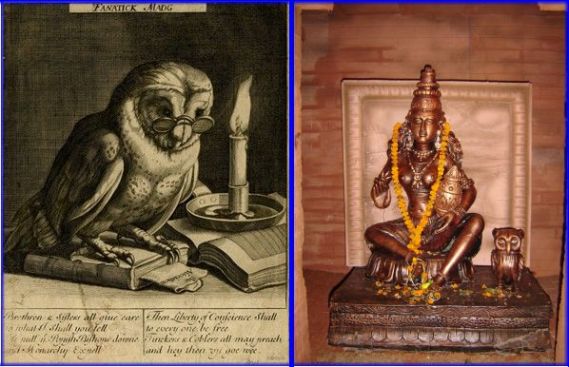
Fanatick Madg (British Museum) &
Hindu Goddess of fortune Lakshmi with her owl (Wikipedia)
Because most owls are nocturnal, they are often feared. Night is the time of evil spirits in many cultures, when ghosts, demons, and “things that go bump in the night” roam about, killing and devouring us, or infesting our bodies with their evil
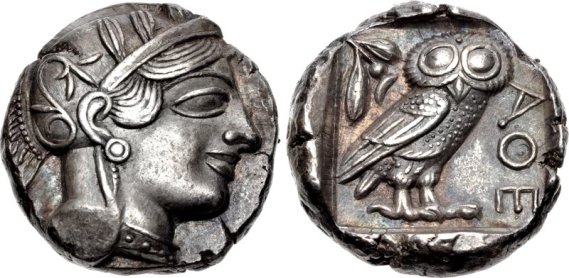
Athenian tetradrachm, 454-404 BCE; goddess Athena and her wisdom-owl who sees into the darkness of men’s souls
(Wikipedia – Classical Numismatic Group)
powers. Owls have been thought to be a witch’s demonic “familiar”, abettors in their nefarious deeds. Even today, there are people in America who believe a “hoot-owl” call to be an omen of death. Out in the country, particularly in the south, there is an owl calling
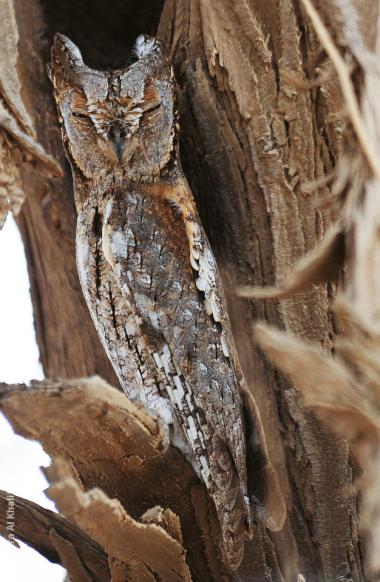
Eurasian Scops Owl Otus scops; Kuwait
The “screech” owl (Samera Al Kalifah – Kuwait Birds.org)
within earshot just about everywhere, throughout the year. Owls call, people die, but assuming that one causes or predicts the other is an example of the common logical fallacy post hoc ergo propter hoc (Latin – “after this, therefore because of this”).
God’s injunction against owls reminds me of a famous and mostly-true story about JBS Haldane, British biologist of the middle 20th century, which goes something like this:
Reverend Whoozit: Will you tell me, Professor Haldane, what your study of nature has taught you about the mind of God?
Dr. Haldane: Certainly. God is inordinately fond of beetles.
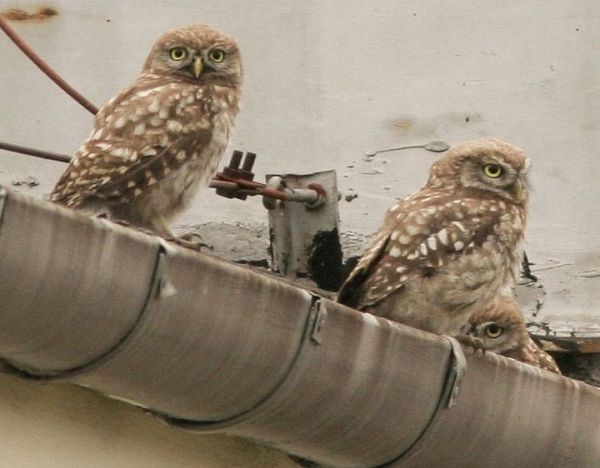
Three Little Owls Athene noctua, in a rain gutter; Warsaw, Poland
(Artur Mikolajewski – Wikimedia Commons)
Scientists now estimate that perhaps half of all the 10-30 million species of animal life on earth are beetles, so Haldane was by no means merely being flippant. Consider for a moment: if variety is the spice of life, and repetition is boring, what are we to make of 5-15 million members of the beetle family versus 10,500 of birds and less than 5000 species of mammals. Perhaps we can modify Haldane’s observation with the deity’s injunction, and say:
God is inordinately fond of beetles and abhorrent of owls.
But perhaps I’m overstating the case. It’s food for thought.
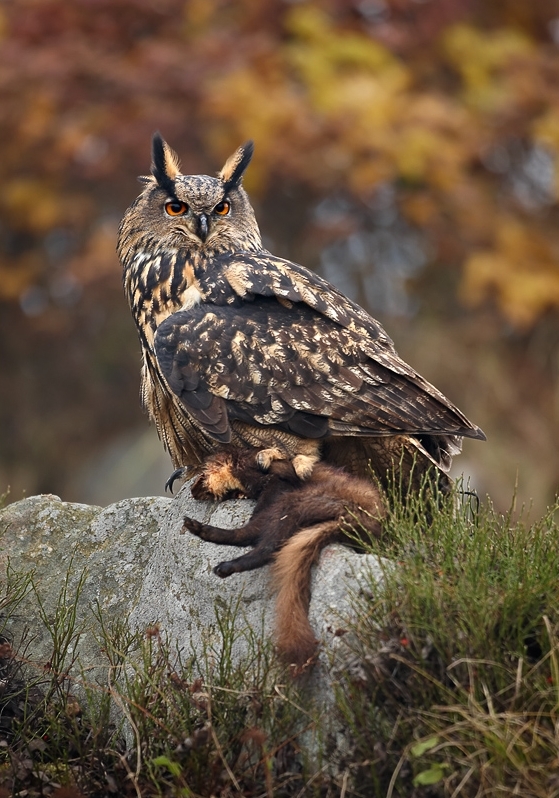
Eurasian Eagle Owl Bubo bubo – The “horned” owl
Zdarsle vrchy, Czechoslovakia
(Martin Mecnarowski – Wikimedia Commons)
Bible Factoid #8: Of “Of”
“Of” is another of those irritating prepositions with numerous senses. The Oxford English Dictionary (OED) entry for “of” covers six pages, with sixty-two senses grouped into seventeen branches. Although the phrase annoys a great many sincere and devout Christians, it is currently fashionable to speak of the Bible (combined Jewish and Christian scriptures) as the “Word of God,” as if God himself hoisted His mighty pen and inscribed the words in eternal ink. But with sixty-two possibilities, what does “of” really mean?
The phrase “word of God” appears forty-eight times in the Jewish and Christian scriptures. None of the authors of the eighty-one books comprising the Christian Bible would have used this phrase to refer to their own writings or those by another, or to a not-yet-existing collection of such works. At least, none did. They wrote about God, or what they felt God was saying to them, but lacked the impudence to suggest that God actually wrote the words they penned. Those who feel inspired by God – witness the mystics of all major religions – always insist how ineffable is the experience, how meager their ability to express it. Their writings are God-inspired, perhaps; God-written, no.
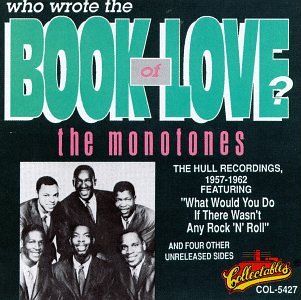
Two eternal questions: Who wrote the Bible or the Book of Love (The Monotones wrote #2:
Lyrics – Photo: Grub.ws)
In their various usages, “Word of God” refers to something spoken by a human about their deity, or a spiritual word “spoken” or “thought” by that deity, most often when it has entered into someone’s mind. For example:
But the word of God came unto Shemaiah the man of God, saying… 1 Kings 12:22
…as the people pressed upon him to hear the word of God… Luke 5:1
…and they spake the word of God with boldness… Acts 4:30
But the word of God grew and multiplied… Acts 12:24
Now when the apostles…heard that Samaria had received the word of God… Acts 8:14
…and his name is called The Word of God. Revelation 19:13
If “of” in “Word of God” carried the same sense as in “John of London” or “Duke of Earl,” then we would mean the “word” from “God” or the “word” that lives or resides in “God.” But consider this.
The King James Version of the Christian Bible was published in 1611, when English usage was significantly different than it is today. Then it was common to say something like, “You are returned from London. Have you brought any word of my brother?” In this sense, “of” means “concerning” or “about.”
The appropriate OED sense for this usage is:
Branch VIII: Indicating the subject-matter of thought, feeling or action, i.e. that about which it is exercised.
26. In sense: Concerning, about, with regard to, in reference to.
Some examples:
1542 Udall – Of these games is afore mentioned.
1590 Spenser – To sing of knights and ladies gentle.
1697 Dryden – The learned Leaches…shake their Head, desponding of their Art.
1859 Dickens – A Tale of Two Cities
2010 The Economist – Recession…[has] put paid to most thoughts of further EU enlargement.
The proper interpretation of “reading the word of God” is “reading about God,” or “reading words about God,” without the implication that God somehow wrote the words you are reading. Again: Inspired by, perhaps; written by, no.
Part I – What About That Dove? & The Flood of the Gilgamesh
Part II – Sandgrouse or Quail? & YHVH [יְהוָ֖ה] [Yahweh]
Part III – Junglefowl in Judea! & New Testament Koine Greek
Part IV – Birds that Sow, Reap and Store & Whence Jesus (Ἰησοῦς)
Part V – The Friendly Ravens & The Bar-Abbas Mystery
Part VI – The Humble Hoopoe & Catching “Forty” Winks
Part VII – The Wise Hoopoe & On “On”
Part IX – Don’t Eat that Bird! Part 2 & Seeing “Red”
Part X – Don’t Eat that Bird! The Last Bite & The Problems of Translation
Next installment: More on birds too nasty to eat, when the ground shifts beneath our feet.
[Chuck Almdale]
Additional Sources:
1. Audubon Society Encyclopedia of North American Birds. Terres, John K. (1980) Alfred A. Knopf, New York. Pgs 664-673.
2. Birds of Europe. Mullarney, K., Svensson, L., Zetterström, D., Grant, P.J. (1999) Princeton University Press, Princeton, N.J. – Owls, Pgs 206-214.
3. New English Bible with the Apocrypha, The, Oxford Study Edition. Sandmel, Samuel, Suggs, M. Jack, Tkacik, Arnold J.; eds. (1976) Oxford University Press, New York
4. Oxford English Dictionary. (1971) Oxford University Press, New York
Links With Notes:
Tree of Life To navigate Tree Of Life, click binoculars icon in upper right corner, enter bird name and press “next hit” until you get to your bird.
Cornel Lab of Ornithology Clements Downloadable Checklist of Birds of the World, updated August, 2016.
BibleHub.com An invaluable tool. Almost a “one-stop-shopping” research site for the bible. Watch out for the occasional fundamentalist bias.
The Wise Hoopoe: Sunday Morning Quran Bird Study VII
King Solomon, Queen Sheba, and the Hoopoe
Link to entire 10-blog Birds in the Bible series on one page
Once upon a time, says the Quran, a Hoopoe was King Solomon’s personal messenger.
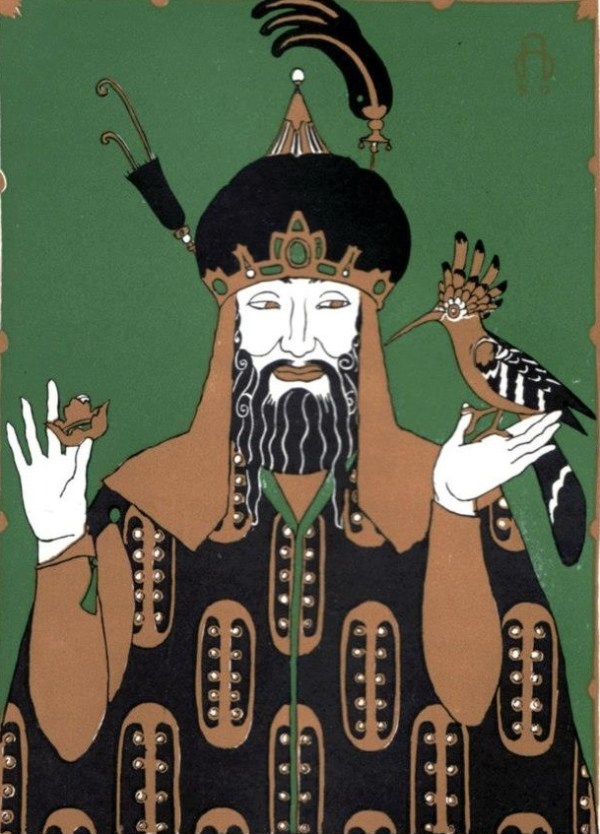
The Hoopoe – explorer, spy & messenger all rolled into one – sits on King Solomon’s hand (Google – Pinterest)
“And [Solomon] reviewed the birds, and he said, ‘Why do I not see the hoopoe (الْهُدْهُدَ), or is he of those absent? I shall surely punish him severely or slay him, or he must come to me with a clear excuse.’ But [the hoopoe] was not long in coming, and it said, ‘I have found out what you have not apprehended, and I come to you from Sheba with tidings!’ (Quran 27:20-22).” The bird reported that Sheba was ruled by a powerful and wealthy Queen who had a magnificent throne. But they worshipped the sun, which disturbed Solomon. Solomon sent the hoopoe back to the Queen with a letter, inviting her and her people to the worship of the one true God. Ultimately, Queen Sheba renounced idolatry and joined Solomon in worshiping God.
Solomon seems to have been a little testy with his employees. Other sources report that Solomon and the Queen got up to a lot more than the “worship of God,” but I doubt the Hoopoe was involved so we won’t dwell on it.
In researching the Hoopoe in the Bible, I ran across this story from the Quran. It is interesting in its own right, it gives us a chance to take a brief look at this culturally foundational text, and it’s illuminating to compare these two books with respect to how they present material.
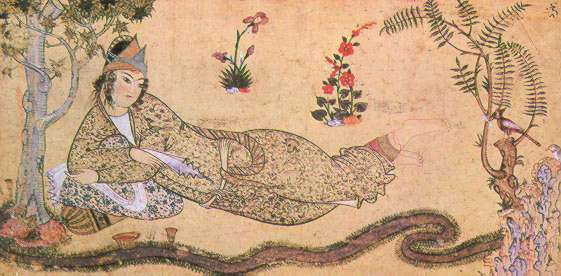
Bilquis, Queen of Sheba, gets a letter from King Solomon by means of his trusty Hoopoe. c. 1595, artist unknown, falsely attributed to Bihzad Iran, Safavid, Qazvin (Wikipedia)
The land of Sheba, depending on your source, was in Arabia, Ethiopia, Egypt, Nigeria, Iran, somewhere north of Assyria (whence the name Syria), or nowhere at all. Sheba could have been Saba in what is now Yemen. Take your pick. This sort of uncertainty of “facts,” or of incompatible certainties, brings us to something interesting about humans as a species.
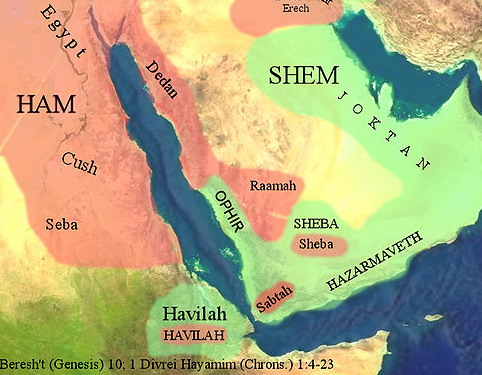
Map showing two of the many lands of Sheba or Seba. (Britam.org)
When we previously considered the problems presented by the stories of the two Bar-Abbas, and Elijah and his “friendly ravens,” we were doing a simple form of text analysis; we looked at alternative interpretations of the texts and reasons why they might have been written as they were. Writers write for human reasons. Their reasons may proliferate into the hundreds, yet we, as fellow humans, may sometimes ferret out something interesting by looking at what they wrote. We did this with Christian and Jewish scriptures; it’s only fair that we look at this Quranic story as well.
I couldn’t determine from the source link which translation from Arabic Quran they used. Its English is more modern (“surely“, not “verily“; “not apprehended“, not “apprehendest not“) than in my 1930 version, but otherwise equivalent.
The official Islamic view is “every single letter and word in the Koran comes directly from God” [Shadi Hamid, Los Angeles Times] [1], a view which out-fundamentalizes any Christian fundamentalist. Pew Research [2] has surveyed religious views, including Islamic, world-wide. In sub-Saharan Africa, the only region where respondents were asked whether they consider the Quran to be the word of God, they found “more than nine-in-ten Muslims say the Quran is the word of God, and solid majorities say it should be taken literally, word for word.” They did not ask that exact question of American Muslims, but found that 37% believe that there is only one true way [3] to interpret the teachings of Islam (28% of U.S. Christians believe that about Christianity). So we’ll take this viewpoint into consideration.
We’re going to look at this Surah (chapter) no. 27, given the title “The Ant,” which belongs to what’s known as the “middle group of Meccan surahs.” If you’ve never read any of the Quran (Koran, Q’ran), now’s your chance to be able to honestly say you’ve read some of it. Two good (it seems to me) translations are Clear Quran and Noble Quran. This surah has 93 verses and can be read in five minutes.
Very roughly, this surah is a sequential and rapid list of events in Jewish biblical history, which pauses only when arriving at King Solomon. Verses 1-15 consists of promises to unbelievers (unpleasant) and believers (pleasant), mixed with Allah’s frequent self-references – beneficent, merciful, mighty, wise, lord of the worlds, etc. Verses 16-44 pertain to Solomon, the Hoopoe and Queen Sheba. Verses 45-93 continue the rapid historical recitation, promises pleasant and unpleasant, and self-descriptions.

Gina Lollobrigida looks neither Ethiopian nor Yemeni. Note absence of the Hoopoe. (FFFMoviePosters.com)
Solomon is not a likable character. He is setting about to conquer whatever remains unconquered and is mustering his troops – avian, djinn (genies – intelligent spirits lower than angels) and human – and fulminating at the Hoopoe’s absence. The Hoopoe returns, tells his tale, and after delivering Solomon’s message to Sheba, vanishes from the story. Perhaps he wisely decided he’d had his fill of servitude under Solomon, a terrible boss, whatever his religious predilections might be. Sheba does not look forward to meeting Solomon and she tries to buy him off with expensive gifts. He then steals her beautiful throne and tells her it’s a replica when he later shows it to her. Somehow this and the shiny marble floor of Solomon’s palace convince Sheba to accept Solomon’s monotheism. After this, the surah takes a sharp left turn and Solomon and Sheba vanish as well.
[INTERJECTED NOTE: On 11 October, 2019, I received the following note from “Tuppence” <twopennyposts@gmail.com> (a “tuppence” is an almost-archaic Britishism for a two-penny coin), which I reproduce here in its entirety.
Hello Mr. Almdale,
It’s been a few years now since you did that Bible Birds series. I stumbled across your post about the Quran’s story of Solomon and the Hoopoe. It was very entertaining. I’ve been doing a Quran series myself and just studied this surah. Something that would help you understand the story a little more is to know that it is copying a document known as “The Colloquy of Sheba.” The manuscript we have does post-date the Quran, but Solomon-Sheba fanfics* are pretty old and I’d say by reading it that the Quran was referencing an older work.
https://en.wikisource.org/wiki/Translation:Colloquy_of_the_Queen_of_Sheba#cite_ref-18
The Quran is toning down the bizarreness of the story for the most part, while simultaneously assuming its audience knew the story enough to fill in gaps in the details. Or at least, that’s how I made sense of it. Anyhow, trivia on a post I’m sure is long dead in your concern. But thanks for posting! – Tuppence
Link to Tuppence posting on Quran Surah 27 “The Ant”
*“Fanfics” is a neologistic portmanteau for “fan fiction,” defined as “any kind of work that is inspired by books, films, TV shows, music, and celebrities. It’s created and published by fans of the original work.” Tuppence’s comment does not make me want to change anything I’ve written in this article but it does raise a question. As “Colloquy of the Queen of Sheba and King Solomon” (title on the linked document) is dated to circa 800 C.E., and Muhammad died in 632 C.E., it makes things awkward. Perhaps he wrote this from beyond the grave, or the document is based on the surah, or both document and surah are based on an earlier version of the story. Whatever happened, it doesn’t lend much support towards the belief that every letter, or even every word, in the Quran comes directly from God. END OF NOTE.]
There are several problems with this story and its presentation. If this is literally from the mouth of a deity, as most Moslems maintain, it’s a very odd story, especially as it’s tucked into a litany of that deity’s own marvelous deeds and qualities. Solomon may be a powerful and religious king, but otherwise he seems poorly socialized. Sheba appears too easily persuaded by his thievery; more likely she’s stroking his masculine ego in order to avoid his laying waste to her land (27:34) with his army. Why is a deity telling us this story and in this form? Are we supposed to believe that these events actually happened as described, or is it a divine illustration of what submission to that deity’s will should look like and the wonderful things that befalls those who submit?
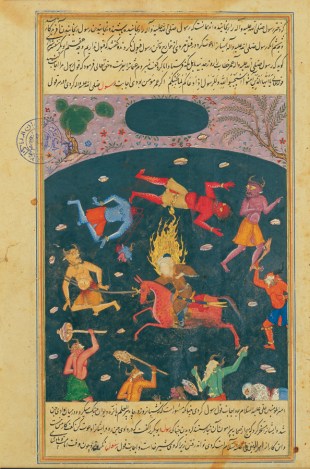
Imam Ali and the Jinn, 1568, Unknown Artist, Ahsan-ol-Kobar, Golestan Palace (Wikipedia)
First, we’ll assume the details are literally true. Are we supposed to believe that Solomon really had birds he could understand, knew the language of the ants, had genies in his army? Without flogging this assumption too much, it seems unacceptable that an infinite creator deity, lord of the worlds, would actually want and expect us to believe this story to be literally true. The content and form of the surah seems well below the capabilities of such a deity.
Second, we’ll assume this is a divine metaphor. If so, it’s a strange metaphor. We’re supposed to admire or emulate this depiction of Solomon? He is not a good person, and the depiction seems more degrading than exalting. Perhaps we’re supposed to understand that the deity will reward anyone who properly submits, even this greedy liar. I have more respect for wily survivor Sheba, and admiration for my hero of the tale, the Hoopoe. He got out. He probably lived out his days in Ethiopia, feeding fat grubs to his lovely children and bill-rubbing with his lady friend, far from the dangerous company of unworthy men. That is, of course, assuming that any of this entire story actually happened.
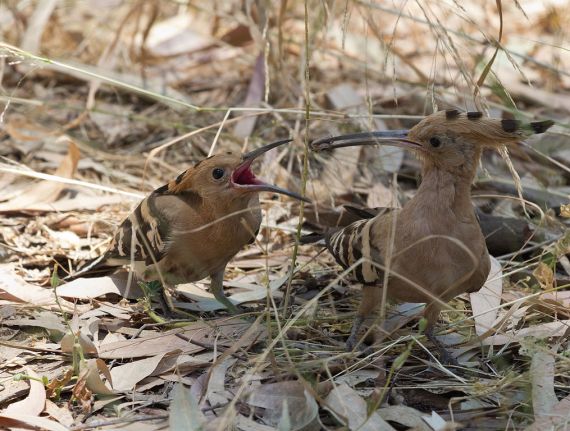
Hoopoe feeds the young one, Israel
(Artemy Voikhansky – Wiki Commons)

Magyar Posta (Hungary) 2010 stamp, Aladdin and the Jinn (Wikipedia)
The last possibility is that both assumptions above are false. This story is human-made, for human purposes. As this view does not ascribe peculiar qualities – especially with respect to the storytelling ability or self-absorption of an infinite creator deity – it seems the most acceptable view. A human or humans wrote it. Why did they write it in this peculiar, disjointed, episodic form?
I’m not the first reader to have a problem with this text. The translator of my Quran copy, Mohammed Marmaduke Pickthall, (and here) prefaced this surah:
Some commentators, objecting to the miraculous, seek to explain the ants, in the story of Solomon, as an old Arab tribe, the birds as cavalry, Hudhud (the hoopoe) as a man’s name, and the Jinn as foreign troops.
Aristotle wrote in his “Poetics” (Part IX):
Of all plots and actions the episodic are the worst. I call a plot ‘episodic’ in which the episodes or acts succeed one another without probable or necessary sequence. Bad poets compose such pieces by their own fault…
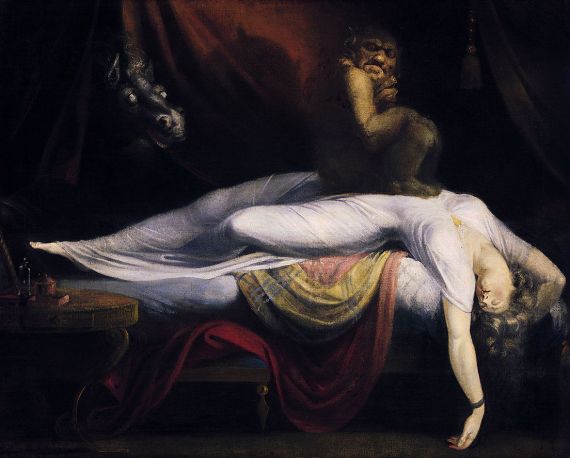
The Nightmare by John Henry Fuseli, 1781
(Detroit Museum of Art via Wikipedia)
I suggest that the form of this surah reflects its origin in a dream. Dreams often abruptly introduce characters and events; these may suddenly morph into other characters and events; people fly, animals and inanimate objects talk, angels or spirits of the dead appear and vanish; scenes evaporate and new scenes appear; people encounter gods and demons, and it all seems perfectly normal and true until the dreamer awakes.

Le Cauchemar – Eugene Thivier, 1894. In centuries past, hypnagogic dreams often included the sensation of an evil demon sitting on one’s torso.
(The Atlantic – Sleep Paralysis)
The hypnagogic dream – occurring between true dreaming sleep and true wakefulness – may contain any of the above, but with a critical added factor: the dreamer believes they are awake. Not just believes, but knows for certain they are awake and the dream is marvelously – or horribly – true. Even after the dreamer truly wakes and the hypnagogic state ends, this feeling of conviction of the dream’s truth continues – for hours, days, weeks, years, sometimes for a lifetime.

Modern hypnagogic dreams often manifest as abduction from your bed by extraterrestrials (EducatingHumanity.com)
(See also 72 Possible Signs of Alien Abduction)
As with any human trait, ability or defect, some people express, utilize or suffer with it more than others. This surah’s form – a rambling episodic narration abruptly morphing into a strange story with magical characters and peculiar illogical events, then equally abruptly reverting to the rambling narration – is dreamlike in every respect. I suggest that this surah originated in a hypnagogic dream and, as is characteristic of such dreams, the dreamer emerged from the dream convinced of the absolute reality of the dream. That they likely remained forever so convinced is demonstrated by the fact that the story exists at all. Most dreams are forgotten shortly after the dreamer awakes. Only dreams remarkable for content, clarity or emotional impact are retained in memory, related to others, perhaps even written down for posterity. The following famous story of Chuang Tzu, perhaps the greatest Taoist philosopher after Lao Tzu, illustrates this state of simultaneous certainty of two incompatible interpretations of reality, a state commonly engendered by the hypnagogic dream.
I, Chuang Tzu, dreamed I was a butterfly, flitting about happily enjoying myself. I didn’t know I was Chuang Tzu. Suddenly I awoke, and now I no longer know whether I am Chuang Tzu, who dreamed I was a butterfly, or whether I am a butterfly now dreaming that I am Chuang Tzu.
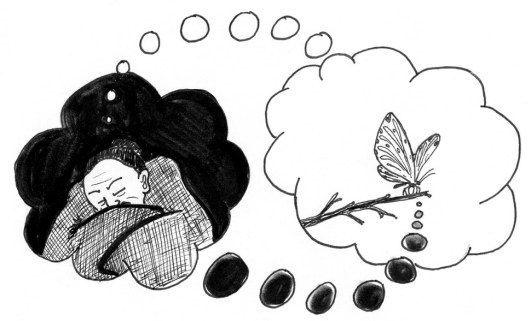
Dream within a dream?: Butterfly and Chang Zhu each dream they are the other (LikeSuccess)
Bible Factoid #7 – On “On”
Somewhere between three and six in the morning, seeing them laboring at the oars against a head-wind, he came towards them, walking on the lake. He was going to pass them by: but when they saw him walking on the lake, they thought it was a ghost and cried out: for they all saw him and were terrified. But at once he spoke to them: ‘Take heart! It is I; do not be afraid.’ Mark 6:48-50 New English Bible
Let’s compare that to a facsimile (PDF File, facsimile pg 1263) of the original 1611 King James Bible.
And he saw them toiling in rowing (for the wind was contrary unto them:) and about the fourth watch of the night, he commeth unto them, walking upon the Sea, and would have passed by them. But when they saw him walking upon the Sea, they supposed it had bene a spirit, and cried out. (For they all saw him, and were troubled) and immediately he talked with them, and saith unto them, Be of good cheer, It is I, be not afraid. Mark 6:48-49
The English used is obviously separated by centuries, but otherwise differences are minor. If you look at the linked PDF, facsimile pg 1263 facsimile, you’ll see that the small letter “s” looks like “f”, just as in facsimiles of the American Declaration of Independence.

2000 year-old fishing boat found at Sea of Galilee 1986 (drblyisrael15)
The Greek word for “on” (ἐπὶ “epi”) occurs 669 times in the New Testament. This preposition locates something in time or space, and is translated in the New Testament from Koine Greek into these English words: about, above, against, after, along, among, over, at, because, before, being, by, during, for, from, in, into, in the time, on, out onto, over, throughout, to, together, toward, upon, up against, wherefore.
Biblical “literalists” read this as saying Jesus could and did walk “on” the water; he was the Son of God and therefore above mere laws of nature. [That choosing “on” for one’s “literal” translation is a misleading misnomer, when the New Testament itself uses twenty-eight ways of translating ἐπὶ “epi.”] Albert Schweitzer differed, holding that the disciples saw Jesus walking on the seashore, but high winds, waves and darkness hid the low-lying shore from them. Theologian David Friedrich Strauss saw it as a metaphorical myth: the storm is the vicissitudes of life, above which only Jesus can rise.

Sea of Galilee in New Testament times (GodsWordFirst)
Mark wrote Jesus “was going to pass them by.” This detail was omitted in Matthew 14:24-26 and John 6:18-20, written later, using Mark as a source. This is a strange detail, making the story more dreamlike, as with the Koranic tale of the Hoopoe and Solomon discussed above. Jesus just happens to be walking on the surface of the Sea of Galilee and would walk right on by a boat filled with his friends while they struggle with the waves and wind, yet say nothing to them? Some commentators hold that Matthew and John intentionally edited that out because it made no sense.
The simplest solution is that the Greek preposition ἐπὶ – “epi” is mistranslated in this story. It should not be “on;” but “by,” “around,” “near,” or “along.” If Jesus didn’t notice them it was because he was busily picking his way down the storm-tossed beach, likely deep in thought. Some writers suggest that someone, somewhere, some when (opinions differ) chose “on” because it added to a desired presentation of Jesus as more than human.
Part I – What About That Dove? & The Flood of the Gilgamesh
Part II – Sandgrouse or Quail? & YHVH [יְהוָ֖ה] [Yahweh]
Part III – Junglefowl in Judea! & New Testament Koine Greek
Part IV – Birds that Sow, Reap and Store & Whence Jesus (Ἰησοῦς)
Part V – The Friendly Raven & The Bar-Abbas Mystery
Part VI – The Humble Hoopoe & Catching “Forty” Winks
Part VIII –Don’t Eat That Bird! Part 1 & Of “Of”
Part IX – Don’t Eat that Bird! Part 2 & Seeing “Red”
Part X – Don’t Eat that Bird! The Last Bite & The Problems of Translation
[Chuck Almdale]
Additional Sources:
1. Meaning of the Glorious Koran, The. Tickthall, Mohammed Marmaduke. (No date) Mentor/New American Library, New York.
2. New English Bible with the Apocrypha, The, Oxford Study Edition. Sandmel, Samuel, Suggs, M. Jack, Tkacik, Arnold J.; eds. (1972) Oxford University Press, New York
3. Random House Dictionary of the English Language. Stein, Jess, Ed. (1967) Random House, New York
Sources with Links
[1] “Why Islam isn’t like other faiths,” Shadi Hamid. Los Angeles Times, 9-15-16. Author is a senior fellow at the Brookings Institution and the author of “Islamic Exceptionalism: How the Struggle Over Islam is Reshaping the World.”
[2] Pew Forum Research, “The World’s Muslims: Unity and Diversity.” Aug 8, 2012. Section “Core Beliefs,” paragraph two and graph “Quran is God’s Word,” based on research 2008-09 “Tolerance and Tension: Islam and Christianity in Sub-Saharan Africa.”
[3] Pew Forum Research, “Muslim Americans: No Signs of Growth in Alienation or Support for Extremism.” Aug 30, 2011. Section “Religious but not Dogmatic,” paragraph three and graph “American Muslims & Christians.”
Hot! Malibu Lagoon, September 25, 2016
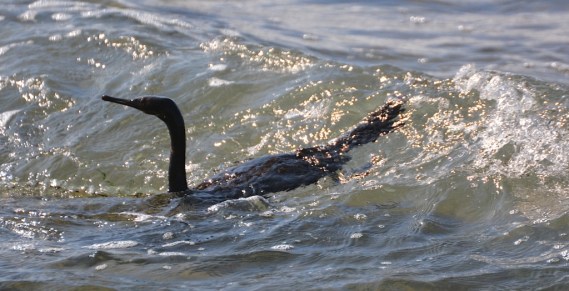
Pelagic Cormorant shows them how to surf (G. Murayama 9-11-16)
Clear and sunny t’was the morn, but by 11:30 am, it was 96°F (35.6°C elsewhere). That’s hot, especially for the breezy shores of Malibu. Birders were dropping out before we reached the beach. I carried water and needed it. Hey! Global warming deniers! This is the future, and it’s your grandkids who will be suffering. I don’t have any. Did I say it was hot?
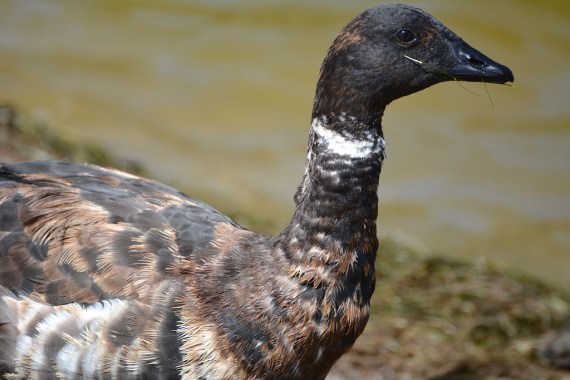
Brant (G. Murayama 9-11-16)
More birds and more species appear as we inch into the fall, with sixteen species we haven’t seen in three or more months. The Brant continues – present seven out of the last eight months. We hadn’t seen Anna’s Hummingbird since June, which is
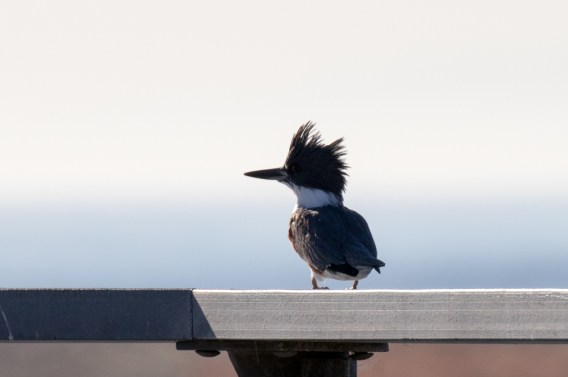
Belted Kingfisher on PCH Bridge (R Ehler 9-25-16)
very strange, as they are permanent residents. Anna’s local populations have declined (it seems to me) while the sedentarius subspecies of Allen’s Hummingbird, continues to increase. Over at Adamson House I found a Pacific-slope Flycatcher, busily flicking his tail and shagging flies from a twiggy brush under a large palm overhanging the easternmost baylet of the lagoon.
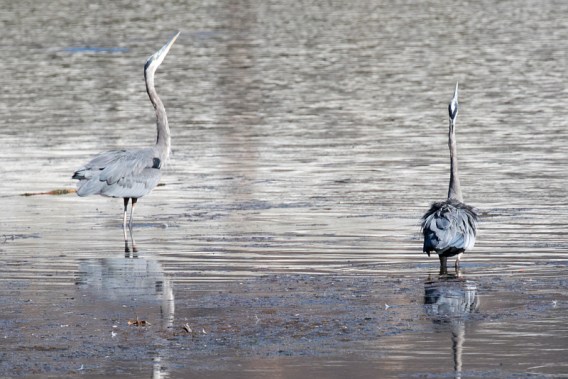
Great Blue Herons danced their way from the island down to the lagoon
(R Ehler 9-25-16)
Gull, tern and pelican numbers were low; September is often a low month for these species, but it was lower than usual, with one Brown Pelican and a mere 54 gulls and terns, consisting mostly of Western Gulls. We had seen a Marsh Wren in the reeds by the pavilion a week ago during the coastal cleanup, but missed it today.
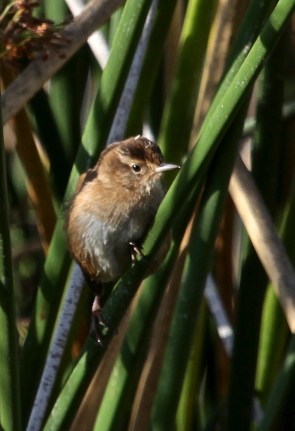
Marsh Wren visits again
(J. Waterman 9-17-16)
The Snowy Plover roosting colony continues to grow: 35 birds (per Chris Lord) with banded bird AA:BL continuing from last month. Grace Murayama has also reported sightings of GA:OY and newcomer RR:BB – banded at Oceano Dunes, Summer 2016 – from 9-22-16. We don’t have banding information on RR:BB yet. Continuing to grow is our word-in-progress slide show of banded Snowy Plovers sighted in Los Angeles. Look for it here.
Los Angeles Times/US higher education writer, Teresa Watanabe joined our walk, and stuck it out to the last Snowy Plover on the beach, despite the heat. I don’t know what she learned, but come againm Teresa – the weather will cool, I promise (knock on MDF particle board wood).
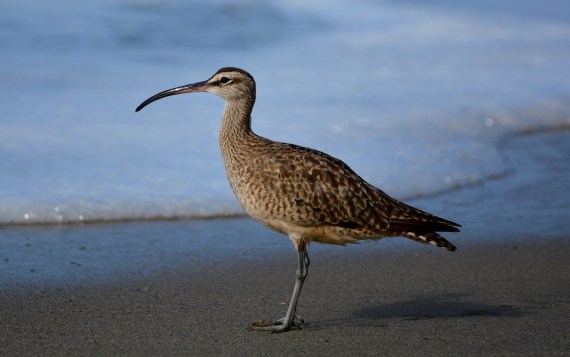
Whimbrel (G. Murayama 9-11-16)
Slightly farther afield, I stopped by Zuma beach after leaving the lagoon to see if any Snowy Plovers were at their old stomping grounds near lifeguard station #10. Since the mid-90’s, when we began censusing the local Snowy population on behalf of Pt. Reyes Bird Observatory (now Point Blue), this has traditionally been the largest winter roosting colony in Los Angeles. I was alarmed when I recently heard
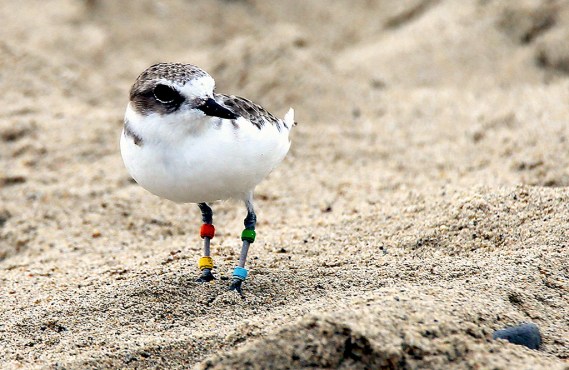
Snowy Plover GA:OY on Surfrider Beach (B. Crowe 9-20-16)
that the Snowy population on Zuma had fallen drastically. When Frances at Point Blue advised me that local birder Bill Crowe had reported 22 birds on 9-20-16 from that location, I decided to take a look. I found only 9, but it was about noon on this very hot day, and the location swarmed with people. Pavilions with smoking barbeques, roasting weenies and simmering sunbathers were everywhere. Three groups of people lay on towels within ten yards of the poor plovers. There’s only about 2500 Western Snowy Plovers left in existence, and it’s heartbreaking to see them so beleaguered and ignored. We really need to get some area here roped off. It need not be huge: 100 yards would be good, 200 would be better. That’s insignificant on a beach that is miles long.
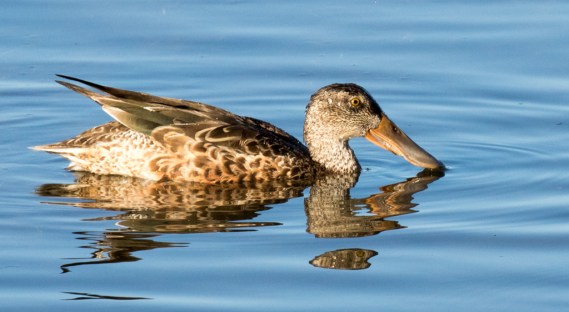
Northern Shoveler female (R Ehler 9-25-16)
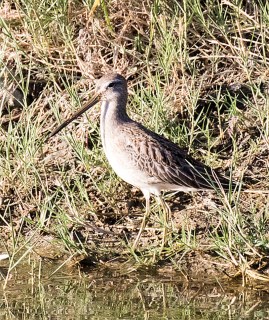
Long-billed Dowitcher
(R Ehler 9-25-16)
Birds new for the season were: American Wigeon, Northern Shoveler, Northern Pintail, Green-winged Teal, Dunlin, Long-billed Dowitcher, Anna’s Hummingbird, Peregrine Falcon, Pacific-slope Flycatcher, Say’s Phoebe, Bewick’s Wren, Wilson’s Warbler, Savannah Sparrow, White-crowned Sparrow, Western Meadowlark, Lesser Goldfinch.
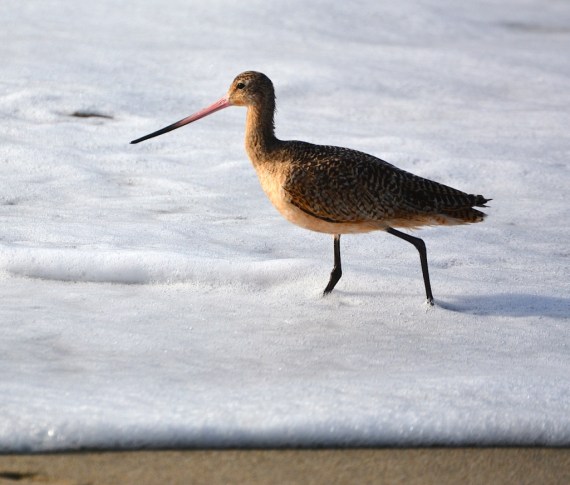
Marbled Godwit (G. Murayama 9-11-16)
As always, many thanks to our photographers: Chuck Bragg, Bill Crowe, Jeffrey Davidson, Randy Ehler, Larry Loeher, Grace Murayama, and Joyce Waterman.
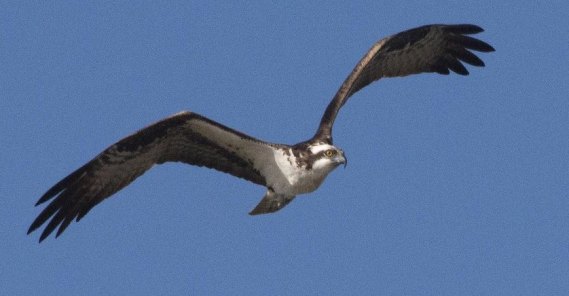
Osprey searches for fish (J. Davidson 9-25-16)

Common Yellowthroat singing
(Chuck Bragg 2-28-16)
Our next three scheduled field trips: Bolsa Chica, 8 Oct 8:30am; Malibu Lagoon 8:30 & 10am, 23 Oct; Ballona Creek, 19 Nov 8:30am.
Our next program: Roadrunners with Mark Mendelsohn, Tuesday, 4 Oct, 7:30 pm; Chris Reed Park, 1133 7th St., NE corner of 7th and Wilshire Blvd. in Santa Monica.
NOTE: Our 10 a.m. Parent’s & Kids Birdwalk meets at the shaded viewpoint just south of the parking area. Watch for Willie the Weasel. He’ll be watching for you and your big floppy feet.
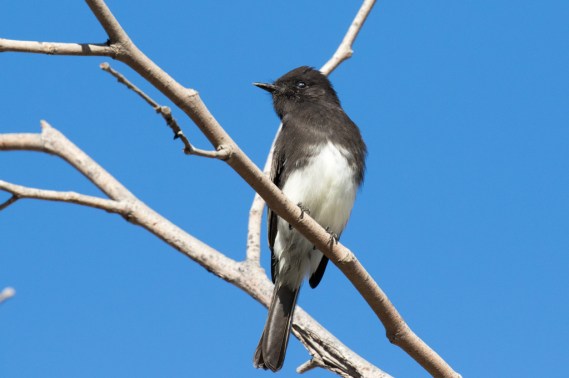
Black Phoebe scouts for a fly (R Ehler 9-25-16)
Links: Unusual birds at Malibu Lagoon
9/23/02 Aerial photo of Malibu Lagoon
Prior checklists:
2016: Jan-June 2015: Jan-May, July-Dec
2014: Jan-July, July-Dec 2013: Jan-June, July-Dec
2012: Jan-June, July-Dec 2011: Jan-June, July-Dec
2010: Jan-June, July-Dec 2009: Jan-June, July-Dec
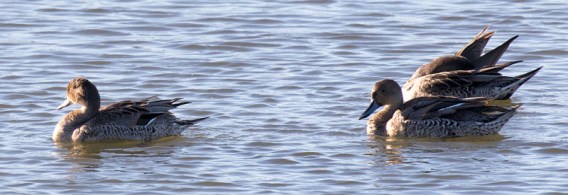
Northern Pintail trio (R Ehler 9-25-16)
The 10-year comparison summaries created during the project period, despite numerous complaints, remain available on our Lagoon Project Bird Census Page. Very briefly summarized, the results unexpectedly indicate that avian species diversification and numbers improved slightly during the period Jun’12-June’14. [Chuck Almdale]
| Malibu Census 2016 | 4/24 | 5/22 | 6/26 | 7/24 | 8/28 | 9/25 |
| Temperature | 60-67 | 61-66 | 68-72 | 68-76 | 65-73 | 70-96 |
| Tide Lo/Hi Height | H+3.63 | H+3.69 | L+0.32 | L+0.20 | H+4.28 | H+4.39 |
| Tide Time | 1143 | 1101 | 0831 | 0707 | 0810 | 0708 |
| Brant | 1 | 2 | 1 | 1 | 1 | |
| Gadwall | 4 | 8 | 18 | 10 | 6 | |
| American Wigeon | 1 | |||||
| Mallard | 18 | 4 | 30 | 25 | 24 | 35 |
| Northern Shoveler | 6 | |||||
| Northern Pintail | 4 | |||||
| Green-winged Teal | 2 | |||||
| Red-brstd Merganser | 1 | 1 | ||||
| Pied-billed Grebe | 1 | 2 | 4 | 15 | ||
| Western Grebe | 1 | |||||
| Blk-vented Shearwater | 200 | |||||
| Brandt’s Cormorant | 2 | 3 | ||||
| Dble-crstd Cormorant | 23 | 7 | 35 | 18 | 34 | 38 |
| Pelagic Cormorant | 2 | |||||
| Brown Pelican | 77 | 14 | 94 | 39 | 9 | 1 |
| Great Blue Heron | 2 | 3 | 3 | 3 | 6 | |
| Great Egret | 2 | 1 | 7 | 4 | 1 | 1 |
| Snowy Egret | 4 | 2 | 6 | 8 | 3 | 8 |
| Blk-crwnd N-Heron | 2 | |||||
| Turkey Vulture | 2 | |||||
| Osprey | 1 | 1 | 2 | 1 | 2 | |
| Cooper’s Hawk | 2 | |||||
| Red-tailed Hawk | 1 | |||||
| American Coot | 4 | 2 | 10 | 95 | ||
| Black-necked Stilt | 19 | |||||
| Blk-bellied Plover | 20 | 6 | 6 | 60 | 70 | 75 |
| Snowy Plover | 12 | 24 | 35 | |||
| Semipalmated Plover | 8 | 4 | 8 | 5 | ||
| Killdeer | 2 | 6 | 8 | 6 | 9 | 29 |
| Spotted Sandpiper | 1 | 3 | 5 | 2 | ||
| Greater Yellowlegs | 1 | |||||
| Willet | 10 | 16 | 11 | 30 | 2 | 10 |
| Whimbrel | 2 | 16 | 2 | 1 | ||
| Marbled Godwit | 6 | 1 | 4 | |||
| Ruddy Turnstone | 5 | 9 | 3 | |||
| Sanderling | 5 | 22 | ||||
| Dunlin | 1 | |||||
| Baird’s Sandpiper | 5 | |||||
| Least Sandpiper | 7 | 15 | 2 | 4 | ||
| Western Sandpiper | 1 | 1 | 7 | 6 | 3 | |
| Long-billed Dowitcher | 1 | |||||
| Common Murre | 3 | |||||
| Bonaparte’s Gull | 3 | |||||
| Heermann’s Gull | 8 | 130 | 12 | 4 | 6 | |
| Ring-billed Gull | 1 | 26 | 1 | |||
| Western Gull | 60 | 23 | 120 | 45 | 118 | 45 |
| California Gull | 15 | 3 | 3 | 1 | ||
| Glaucous-wingd Gull | 1 | |||||
| Least Tern | 2 | |||||
| Caspian Tern | 19 | 9 | 11 | 2 | 2 | |
| Common Tern | 1 | |||||
| Forster’s Tern | 1 | 3 | ||||
| Royal Tern | 2 | 48 | 5 | 3 | 10 | 1 |
| Elegant Tern | 1800 | 10 | 110 | 10 | 67 | 2 |
| Rock Pigeon | 6 | 1 | 23 | 4 | 8 | 17 |
| Mourning Dove | 1 | 2 | 2 | 2 | 2 | |
| Anna’s Hummingbird | 3 | 1 | ||||
| Allen’s Hummingbird | 4 | 2 | 1 | 5 | 5 | 1 |
| Belted Kingfisher | 1 | 2 | 2 | |||
| American Kestrel | 1 | 1 | 1 | |||
| Peregrine Falcon | 1 | |||||
| Pac.-slope Flycatcher | 1 | |||||
| Black Phoebe | 4 | 1 | 2 | 7 | 3 | 9 |
| Say’s Phoebe | 2 | |||||
| Ash-throated Flycatcher | 2 | |||||
| Western Kingbird | 1 | |||||
| California Scrub-Jay | 2 | 1 | 1 | 3 | 2 | |
| American Crow | 4 | 4 | 6 | 3 | 5 | 7 |
| Common Raven | 1 | |||||
| Violet-green Swallow | 1 | |||||
| Rough-wingd Swallow | 10 | 6 | 6 | 4 | 4 | |
| Cliff Swallow | 6 | 4 | 7 | 15 | 4 | |
| Barn Swallow | 4 | 4 | 20 | 20 | 20 | |
| Oak Titmouse | 1 | |||||
| Bushtit | 4 | 2 | 15 | 5 | 27 | |
| Bewick’s Wren | 1 | 1 | ||||
| American Robin | 1 | 1 | ||||
| Northern Mockingbird | 6 | 2 | 2 | 2 | 2 | 3 |
| European Starling | 2 | 2 | 10 | 40 | 20 | 17 |
| Ornge-crwnd Warbler | 1 | |||||
| Common Yellowthroat | 1 | 1 | 4 | 3 | 6 | |
| Wilson’s Warbler | 1 | |||||
| Spotted Towhee | 1 | 1 | ||||
| California Towhee | 3 | 1 | 2 | |||
| Savannah Sparrow | 2 | |||||
| Song Sparrow | 14 | 2 | 3 | 3 | 2 | 6 |
| White-crwnd Sparrow | 2 | |||||
| Black-headed Grosbeak | 1 | |||||
| Red-winged Blackbird | 5 | 4 | 15 | 12 | 30 | 1 |
| Western Meadowlark | 2 | 16 | ||||
| Brewer’s Blackbird | 6 | 12 | ||||
| Great-tailed Grackle | 3 | 3 | 4 | 20 | 3 | 2 |
| Brwn-headed Cowbird | 2 | |||||
| Hooded Oriole | 3 | |||||
| Bullock’s Oriole | 2 | 1 | ||||
| House Finch | 16 | 7 | 6 | 25 | 6 | 30 |
| Lesser Goldfinch | 2 | |||||
| House Sparrow | 3 | |||||
| Totals by Type | Apr | May | Jun | Jul | Aug | Sep |
| Waterfowl | 22 | 14 | 33 | 44 | 35 | 55 |
| Water Birds – Other | 106 | 22 | 129 | 262 | 62 | 149 |
| Herons, Egrets & Ibis | 6 | 5 | 18 | 15 | 7 | 15 |
| Quail & Raptors | 1 | 1 | 3 | 5 | 2 | 4 |
| Shorebirds | 76 | 28 | 26 | 158 | 149 | 195 |
| Gulls & Terns | 1903 | 127 | 382 | 74 | 206 | 54 |
| Doves | 7 | 3 | 23 | 6 | 10 | 19 |
| Other Non-Passerines | 5 | 2 | 4 | 5 | 7 | 4 |
| Passerines | 95 | 60 | 86 | 174 | 118 | 140 |
| Totals Birds | 2221 | 262 | 704 | 743 | 596 | 635 |
| Total Species | Apr | May | Jun | Jul | 118 | Sep |
| Waterfowl | 2 | 4 | 3 | 3 | 3 | 7 |
| Water Birds – Other | 4 | 3 | 2 | 6 | 6 | 4 |
| Herons, Egrets & Ibis | 2 | 3 | 4 | 3 | 3 | 3 |
| Quail & Raptors | 1 | 1 | 2 | 3 | 2 | 3 |
| Shorebirds | 10 | 3 | 4 | 10 | 14 | 14 |
| Gulls & Terns | 8 | 7 | 9 | 6 | 8 | 4 |
| Doves | 2 | 2 | 1 | 2 | 2 | 2 |
| Other Non-Passerines | 2 | 1 | 2 | 1 | 2 | 3 |
| Passerines | 20 | 17 | 15 | 17 | 19 | 21 |
| Totals Species-98 | 51 | 41 | 42 | 51 | 59 | 61 |
The Humble Hoopoe: Sunday Morning Bible Bird Study VI
This Week’s Lesson – The Humble Hoopoe
Link to entire 10-blog Birds in the Bible series on one page
The Hoopoe is another member of the list of twenty Unclean Birds whom we’re not supposed to eat. This list comes in numerous versions due to the problems of translating ancient and rare Hebrew words, but that’s a topic for a later lesson. For now, we’ll stay with the Hoopoe, a bird common in Eurasia and Africa, yet most uncommon in ways we shall see.
And these ye shall have in detestation among the fowls; they shall not be eaten, they are a detestable thing….the hoopoe… (הַדּוּכִיפַ֖ת – had·dū·ḵî·p̄aṯ “the hoopoe”)*
Lev 11:13-19 Holy Scriptures accor4ding to the Masoretic Text (HSMT)
Of all clean birds ye may eat, but these are they of which ye shall not eat….and the hoopoe… (וְהַדּוּכִיפַ֖ת – wə·had·dū·ḵî·p̄aṯ “and the hoople”)* Deut 14:11-18 HSMT

Eurasian Hoopoe pair – Upupa epops (Henry E. Hooper)
Slightly larger than an American Robin, a Hoopoe is 11-12″ long, including its slender and slightly decurved 2″ bill. It weighs only 1½ -3 ounces, the same as your quarter-pound hamburger after cooking. The head, neck, breast and belly colors varies from rufous to cinnamon to tawny; the wings and tail are black with irregular white bands; the bill, eyes and legs are black; the long crest feathers are tipped in black. It is an attractive, lively and inquisitive bird. Its name is unlikely to be forgotten or mistaken because for most people who know it, the name is echoic of its call, which varies from hoop-hoop to oo-poo-poo. [Video & call link]
The scientific name is Upupa epops (Latin name upupam + Greek name έποπα). Some other common names are: Arabic hud-hud, Dutch hoppe, French Huppe, Italian upupa, Maltese Daqquqa tat-toppu, Polish Dudek, Portuguese poupa, Spanish Abubilla, Turkish ibibik.
They are distantly related to the kingfishers. On their “birds of prey” branch of the Tree of Life, they split from Owls 75.9 million years ago (MYA), from Trogons 72.1 MYA, from Kingfishers & Bee-eaters 69.6 MYA, from Hornbills 55.3 MYA and from Woodhoopoes & Scimitarbills 35.2 MYA. [Don’t rely on the permanence of these dates. Research continues.]

Range of the Hoopoe: Orange-breeding, Light & Dark Green-resident all year; Blue-winter; Brown – Madagascar species (Wikipedia)
Their nesting begins as early as mid-April around the Mediterranean; in Northern Europe as late as early June. Nesting behavior of non-migratory resident birds cycles around the rainy seasons. Nest are in tree cavities, walls, cliffs, earth banks or termite mounds. The female incubates 4-6 (sometimes as many as 12) blue, gray, green, yellow or brown eggs for about 18 days. The male brings her food, but no water, as they are not known to drink. They don’t remove the eggshells or fecal sacs of their young, unlike most other cavity-nesting birds. The young – helpless with sparse down when hatched – fledge (leave the nest) in 3 to 4 weeks,

Feeding the young on the fly (Cowboy54 – From The Grapevine)
and may stay with their parents until nesting season returns. They feed on the ground and use trees for safety and night roosting. Their typical flight is slow, undulating and a bit haphazard, belying their impressive speed and maneuverability should a falcon take pursuit. Their long crests – normally held flat – may be raised in excitement or alarm. They can be found alone or in small bands which are probably family units, but they are not gregarious. Hoopoes can be tamed; one became accustomed to eating a boiled egg for breakfast.
Shorebirds and waders often have chunky bodies and long slender bills, but they usually stay close to water, when not actually in it. In the Hoopoe’s preferred dry, park-like habitat, only Lapwings remotely resemble them.

Northern Lapwing – Vanellus vanellus
(John Sheppard – Sulgrave, GB)
Until recently the Hoopoe was classified into ten subspecies, but one was split off as Madagascar Hoopoe Upupa marginata (a decision lacking universal scientific agreement), leaving the rest of the Hoopoes stuck with the less euphonious name, Eurasian Hoopoe.
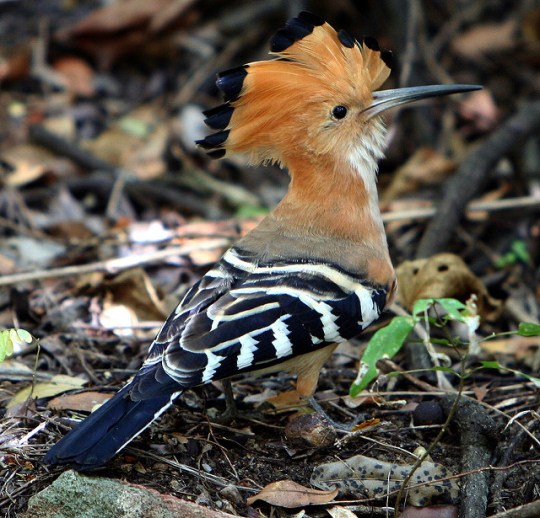
Madagascar Hoopoe -Upupa marginata
(Matthew Golding – Flickr photo)
Hoopoes have been admired for millennia and are well-represented in our art. Bartolo’s often reproduced painting, St. Francis Preaching to the Birds, depicts a pheasant, a quacking duck, several small birds in a tree and a Hoopoe in the foreground on the ground, all paying rapt attention to the words of this,

St. Francis Preaching to the Birds – find the Hoopoe, Taddio di Bartolo, 1362-1422 (Jean Louis Mazieres – Flickriver)
presumably their favorite saint. There are two stories of Francis involving preaching and birds. The first is that Francis and friends were walking through the Spoleto Valley of Italy when he spotted a flock of birds and ran over to them. “Beloved birds,” he greeted, expecting them to fly away. They stayed, and he preached while they silently listened. The second is that Francis, preaching to a crowd from a balcony in Alviano, had to contend with swallows building nests nearby and chattering noisily. Francis finally called to them, “My sisters, swallows, it’s my turn to speak now, because you’ve already said enough. Listen to the word of God. Stay still and be quiet until it’s over.” Reportedly the swallows fell silent until Francis finished. Francis seems to have loved everyone and everything. Would that today’s Italians felt as friendly towards their birds, rather than eating them all, large and small.
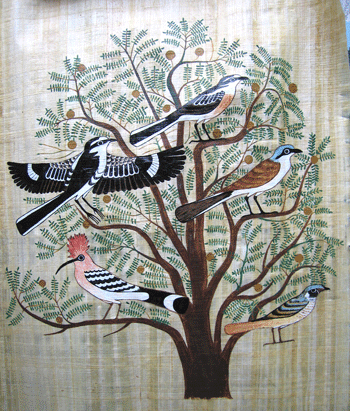
Bird tree with Hoopoe, Tomb of Khnun-Hotep, Middle Kingdom, Beni Hasan, Egypt (Timetrips.com)
Wall paintings in the Egyptian tomb of Khnum-hotep II, dated to 1950-1900 BCE, clearly shows a Hoopoe and many other birds.
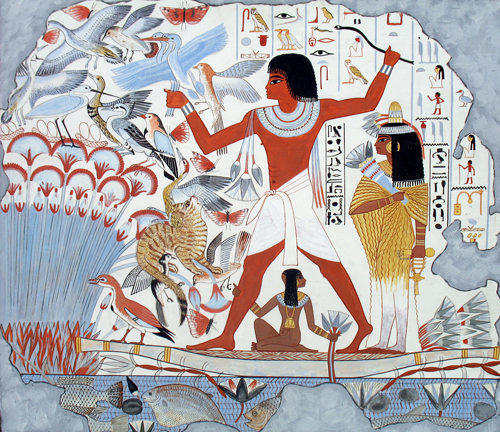
Neb-amun hunting birds in the marshes, Tomb of Khnun-hotep, Middle Kingdom, Beni Hasan, Egypt. No Hoopoes in the marshes. (Timetrips.com)
Many scientists say the Hoopoe is the sole species in their evolutionary family, Upupidae. Humans are similarly alone; our cousin Homo species are long extinct, probably at our hand. The Old World range of the Hoopoe virtually replicates ours at the end of the last ice age. They dislike large bodies of water and never made it to Australia, most of Japan or the New World, although they occasionally stray across the channel to England.

Hoopoe on Bamboo, Zhao Mengfu 1254-1332 (Wikipedia – Shangai Museum)
Ever since Homo erectus, our predecessor species, left Africa and wandered to the far reaches of Eurasia, our ancestors have found Hoopoes close at hand. Throughout our shared range we find them in savannas, open woodlands, forest clearings, cultivated ground and gardens, probing the ground with their long slender bills. As we adapted to life as herdsmen and farmers, Hoopoes remained nearby, gleaning our pastures and fields. The snails, spiders, centipedes, ant-lions, and lizards which they gleaned from our gardens and fields and ate within our easy eyesight, is what branded them an Unclean Bird. [Snails were definitely a no-no.] Divine taboos were not placed on tiny forest birds unnoticed by human eye, no matter how loathsome and lethal to humanity their choices in cuisine might be. Hoopoes gave us their lively beauty and ate our pests. Sometimes our landscape changes suited them; sometimes not. Mostly, we coexisted.
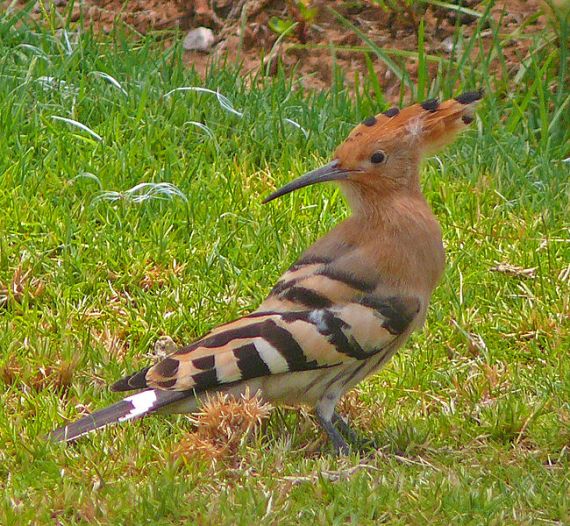
Israel’s National Bird in Ramat Gan (Zachi Evenor 5-22-10, on Wikipedia)
Hoopoes and Humanity: Fellow Passengers on Spaceship Earth
Hoopoes and humans are orphans; solitary species within our respective families. The large mammals preserved in La Brea pits were probably hunted into extinction by humans. Australian species vanished when Aborigines burned the landscape to suit their own needs. The aurochs, cave bears, elephants and rhinos of Europe are gone. Half of Hawaii’s bird species disappeared during the millennia between the arrivals of Polynesians and Euro-Americans. Humans are a dangerous species and the future of any creature that gets in our path is not promising. Our only successful adversaries are those who avoid confrontation and, like water, seek the low road, remaining obscure, like bacteria, rats and cockroaches. But through all the changes and depredations of human history, Hoopoes held their noble visibility, sharing our lands and lives, yet staying at arm’s length, neither dangerous nor useful to us.
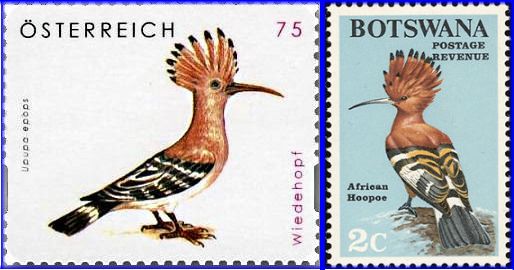
Humans typically exhibit an anthropocentric view of nature – “What does it do for me?” This attitude may muster economic forces to protect species or habitat, because, “Maybe we’ll find a cure for cancer!” We make much ado about the value of an individual’s life and freedom, yet rarely extend concern and courtesy to our fellow passengers on our earthly ark. Their lives have value for them as ours do for us, whatever one thinks of the other. If we understood that “dumb animals” participate as richly in their own lives as we do in ours, we might not act as we do towards them. What may we learn from them?

Explorer Speke, 1st European to see and map Lake Victoria, July 1858 (Central African Republic stamp)
Hoopoes are a good example of how the meek may yet inherit the earth. Better yet, perhaps they unintentionally do what Jesus, much later, told his disciples when he sent them out to preach:
“Behold, I send you out as sheep in the midst of wolves. Therefore be wise as serpents and harmless as doves. Matthew 10:16 New King James
Bible Factoid #6 – Catching Forty Winks
One way to do textual analysis and gain a glimpse into a writer’s mind is to find their favorite words and determine just how much they like them. All following citations are from the King James Version.
I will cause it to rain upon the earth forty days and forty nights… Genesis 7:4
…and Moses was in the mount forty days and forty nights…. Exodus 24:18
And forty sockets of silver he made under the twenty boards… Exodus 36:24
…the LORD thy God led thee these forty years in the wilderness… Deuteronomy 2:7
Being forty days tempted of the devil. And in those days he did eat nothing… Luke 4:2
To whom also he shewed himself…being seen of them forty days… Acts 1:3
As in modern parlance, “Forty? What’s up with that?”
What with all the armies and ages and apostles, numbers are very common in both Jewish and Christian scriptures. We even find an important Jewish scripture, fourth book in the Torah (Pentateuch) entitled “Numbers” in the Christian version. [The Jewish version is more appropriately titled “In the Wilderness.”] So let’s look at some numbers.
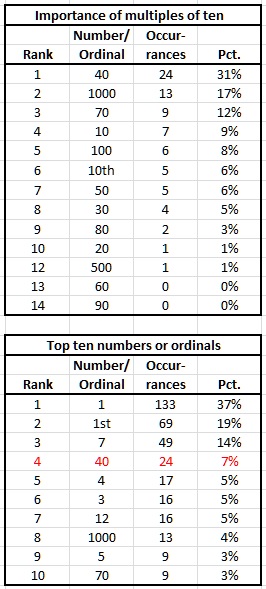
I combed through my bible concordance, counting citations for all numbers (one, two, etc.) and ordinals (first, second, etc.). It didn’t give all citations – just significant ones. I discovered that “forty” was by far the most common of multiples of ten between ten and one hundred (first chart). Among all numbers (second chart) it was fourth, surpassing 1000, 100 and even 10 itself.
BibleStudyTools, a great online site for biblical nit-picking, lists 145 occurrences for the word “forty.” Here “forty” rates only sixteenth, but this list includes all citations of the word, such as:
Those that were numbered of them, even of the tribe of Gad, were forty and five thousand six hundred and fifty.
Numbers 1:25
The verse above counts as one citation each for: forty, five, thousand, five thousand, six, hundred, six hundred, and fifty. These sorts of biblical citations are innumerable (pun intended). There are fourteen citations like this one, every one beginning with “forty and xxx thousand…” Although this exceeds the limits of randomness, I did not include citations such as these in my two charts.
Thirty-nine citations referred to counts of various sorts: “So all the cities which ye shall give to the Levites shall be forty and eight cities…” (Numbers 35:7) Seven citations referred to ages: “Then said the Jews, Forty and six years was this temple in building…” (John 2:20) I didn’t included these either.

Six citations referred to the flood, twenty to Moses on his various mountains, ten for Israelites wandering in the Sinai desert, four for Jesus meditating in the desert. Such clusters were counted as one citation each.
After subtracting 121 citations of low or no significance, twenty-four remained. I examined sixty different numbers; three had greater frequency than “forty.” Not unexpectedly, they were “one,” “first” and “seven” (second chart) “One” and “first” need no explanation of significance; “seven” is a magical number in many cultures and religions, and its high frequency was expected. For the same reason, I expected “three” to be higher than its 6th place rating. At the bottom, “sixty” and “ninety” were never used meaningfully (symbolically).
So, again…what’s up with forty?
The most common opinion is that forty symbolizes trial, testing or judgment.
And the rain was upon the earth forty days and forty nights. Genesis 7:12
And the children of Israel did eat manna forty years… Exodus 16.35
And [Moses] was there with the LORD forty days and forty nights… Exodus 34:28
…the LORD delivered them into the hand of the Philistines forty years. Judges 13:1
And Jonah…said, Yet forty days, and Nineveh shall be overthrown. Jonah 3:4
And [Jesus] was there in the wilderness forty days, tempted of Satan… Mark 1:13
There is also the legal limit on lashes, which can certainly be considered a “trial.”
Forty stripes he may give him, and not exceed… Deuteronomy 25:3
Another explanation is that forty symbolizes a “generation of man.”
And Esau was forty years old when he took to wife Judith… Genesis 26:34
And your children shall wander in the wilderness forty years, and bear your whoredoms, until your carcases be wasted in the wilderness. Numbers 14:33
And the land had rest forty years. And Othniel the son of Kenaz died. Judges 3:11
To whom also he shewed himself alive after his passion by many infallible proofs, being seen of them forty days, and speaking of the things pertaining to the kingdom of God. Acts 1:3

Versions Nos. 1 – 39
didn’t work so well
(Wikipedia)
One source claims:
According to saint Augustin, forty expresses the perfection ‘because the Law was given in ten commandments, then it is through the whole world that the Law has been preached, and the whole world is composed of four parts, Orient and Occident, South and North; therefore, by multiplying ten by four, we obtain forty.’
I didn’t know that St. Augustine had enough imagination to come up with that doozy.
But the two popular explanations don’t cover the many dozens of non-random appearances of “forty.” I have the suspicion that it was also used as we use “dozens,” “bazillion” or “many” – an indefinite large number that simply sounds good to our ears.
Those that were numbered of them, even of the tribe of Reuben, were forty and six thousand and five hundred. Numbers 1:21
About forty thousand prepared for war…to the plains of Jericho. Joshua 4:13
…and David slew the men of seven hundred chariots of the Syrians, and forty thousand horsemen… 2 Samuel 10:18
And Solomon had forty thousand stalls of horses for his chariots… 1 Kings 4:26
Then made he ten lavers of brass: one laver contained forty baths… 1 Kings 7:38
In the four corners of the court there were courts joined of forty cubits long and thirty broad… Ezekiel 46:22
The writers of the bible didn’t do that with “sixty” or “ninety.” That’s something to think about while you’re trying to catch forty winks.
Part I – What About That Dove? & The Flood of the Gilgamesh
Part II – Sandgrouse or Quail? & YHVH [יְהוָ֖ה] [Yahweh]
Part III – Junglefowl in Judea! & New Testament Koine Greek
Part IV – Birds that Sow, Reap and Store & Whence Jesus (Ἰησοῦς)
Part V – The Friendly Raven & The Bar-Abbas Mystery
Part VII – The Wise Hoopoe & On “On”
Part VIII –Don’t Eat That Bird! Part 1 & Of “Of”
Part IX – Don’t Eat that Bird! Part 2 & Seeing “Red”
Part X – Don’t Eat that Bird! The Last Bite & The Problems of Translation
[Chuck Almdale]
*The word “hoopoe” comes in two forms in the bible.
הַדּוּכִיפַ֖ת (had·dū·ḵî·p̄aṯ) “the hoopoe” 1 occurrence Lev 11:19
וְהַדּוּכִיפַ֖ת (wə·had·dū·ḵî·p̄aṯ) “and the hoopoe” 1 occurrence Deut 14:18
The root word דּוּכִיפַת (dū·ḵî·p̄aṯ) does not actually occur in the bible.
Additional Sources:
Tree of Life To navigate Tree Of Life, click binoculars icon in upper right corner, enter bird name and press “next hit” until you get to your bird.
BibleHub.com An invaluable tool. Almost a “one-stop-shopping” research site for the bible.
BibleStudyTools.com A very useful site.
1. Birds of Europe. Mullarney, K., Svensson, L., Zetterström, D., Grant, P.J. (1999) Princeton University Press, Princeton, N.J. – Pg 220.
2. Dictionary of Birds. Campbell, Bruce. (1974) Peerage Books, London. – Pgs 22-23, 347.
3. Handbook of Birds of the World (HBW), Vol. 6. del Hoyo, J., Elliott, A. & Sargatal, J. eds. (2009) Lynx Edicions, Barcelona. Hoopoes – Pgs 396-411.
4. Holy Scriptures: According to the Masoretic Text. (1955) The Jewish Publication Society of America. Philadelphia.
5. Nelson’s Comfort Print Bible Concordance. Youngblood, Robert F. (1995) Thomas Nelson Publishers, Nashville, TN
6. New English Bible with the Apocrypha, The, Oxford Study Edition. Sandmel, Samuel, Suggs, M. Jack, Tkacik, Arnold J.; eds. (1972) Oxford University Press, New York
Coastal Cleanup at Malibu Lagoon: 17 September, 2016

Trash buckets stand at attention (Photo: Kirsten Wahlquist 9-17-16)
Once again we volunteered to run the 2016
coastal cleanup at Malibu Lagoon!

Photo: Kirsten Wahlquist 9-17-16
Special thanks to all the volunteers who took their trash to the dumpster after it was weighed. We also want to congratulate the growing number of people who brought their own cleanup supplies. There was only one mishap: the gloves we were supplied turned out to be dried and crystallized, breaking into little pieces when pulled apart. Next time when we get the supplies from Heal the Bay, we promise to immediately open the boxes of gloves and check them out. Fortunately, people could use trash bags and large pieces of paper to pick up items.

Photo: Kirsten Wahlquist 9-17-16
Unusual Items: One shopping cart, a mattress, one cinder block and the carcasses of dead birds were found. The most trash was around the river’s edge near the bridge. As usual there were always innumerable cigarette butts and other trash around the parking lot. We encouraged people to concentrate on tiny pieces of plastic with the visual aid of an Audubon photograph showing the contents found in the stomach of one albatross. People really responded to the request after seeing the picture.

Photo: Kirsten Wahlquist 9-17-16

Photo: Kirsten Wahlquist 9-17-16
We had 220 volunteers, which is about the best number for this site. Many were individual people and families, but several organized groups showed up:
Pepperdine University
Aetna Insurance Company
Moorepark Junior College (Outdoors Club)
California Lutheran University (Oceans Outreach)
Alpha Phi Sorority of California State University at Northridge

A line of trash-pickers heads towards the beach (L. Johnson 9/20/14)
Seven Santa Monica Bay Audubon Society volunteers ran the whole thing:
Captain Jean; Co-Captain Ellen; Weighmaster Chris; Masters of Waivers Lillian & Chuck B.; photographer Kirsten; and Trashmaster Chuck A., Scourge of the Brush.
Some statistics:
Total weight of trash = 334.5 lbs.
Total Bags = 105
Volunteers = 220
We still found many hundreds, if not thousands, of cigarette butts!
For Los Angeles County, Heal the Bay reports for 2016:
9,500 Volunteers
29,600 lbs. of debris
42.5 miles of coastline and river edge covered.
[Jean Garrett]



 SANTA MONICA BAY AUDUBON SOCIETY BLOG