Free email delivery
Please sign up for email delivery in the subscription area to the right.
No salesman will call, at least not from us. Maybe from someone else.
WHO WILL SAVE THE OCEANS?
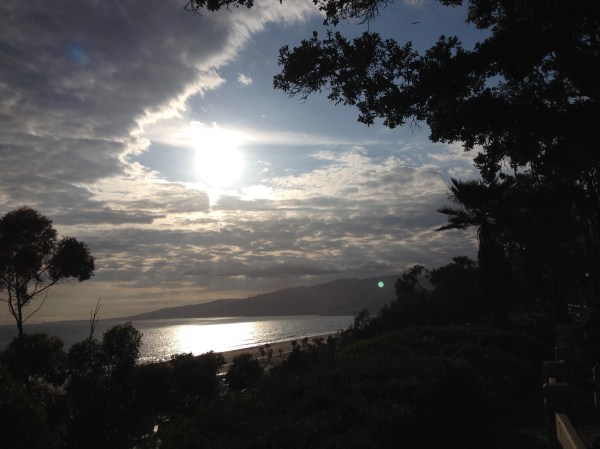 SANTA MONICA BAY Photo by Laurel Jones
The birds on Santa Monica Bay depend on a healthy ocean to survive. Who is working to make that happen and how can you become a meaningful part of the effort?
Meet Zack Gold—a Ph.D student at the LaKretz Center for California Conservation Science at UCLA; an avid surfer and scuba diver who grew up in Santa Monica and served as a lifeguard, as well, as helping to support the establishment of local Marine Protected Areas. In his own words:
During my undergraduate research at Stanford I became really interested in human impacts on marine ecosystems as well as using genetics techniques to study marine life. While there I was introduced to environmental DNA and became really interested in being able to use this tool to study how humans are impacting marine ecosystems and what management tools like MPAs are effective in restoring marine biodiversity and ecosystem health. So I came to UCLA under Professor Paul Barber to use eDNA techniques in the Santa Monica Bay and Channel Islands to study the the effects of MPA size and design on improving our local marine biodiversity, fish abundance, and ecosystem health. I am currently studying the biodiversity of marine protected areas in LA County using a new metagenomic tool called environmental DNA. In order to help my research, I am looking for helpful citizen science volunteers to help me collect seawater samples for this project.
This project is really exciting because it will allow us to compare the health of our marine ecosystems right in our backyard and give us insights into how the MPAs are working 5 years after they have been established.
If you want to learn more about the details of the research and project please check out my website here or follow this web address: http://www.zackgold.org/citizen-science.html
Now meet Emily Ryznar, another Ph.D student at the LaKretz Center for California Conservation Science at UCLA If you love tidepools (and who doesn’t?) then her project will be of interest to you. As she explains it:
I am attempting to quantify invertebrate diversity in CA kelp forests associated with crustose coralline algae (CCA), a very abundant algae in marine ecosystems that influences many marine invertebrates to live on or by it.
How you can help–identify invertebrates and other species growing on CCA in the field and from photographs using CPCe (Coral Point Count with Excel Extension), a specialized computer program used to quantify marine diversity from photos. Interested participants will be trained in common kelp forest species identification and use of the program. You may help as much or as little as you want, there is no hard time-commitment. Why is this important–CCA is very vulnerable to ocean acidification, which is predicted to increase in the future. CCA is required habitat for critically endangered invertebrates like abalone and coral. If CCA decreases due to ocean acidification, important invertebrates associated with CCA may also decline! CCA ecology is also relatively understudied in kelp forest ecosystems. You can reach Emily at EmilyRyznar@gmail.com
So many times we are hit with a wall of bad news about the environment and the oceans and are left feeling helpless to be able to make a difference. Now, you can. Contact Zack or Emily for further information as listed above.
It’s for the birds.
Full Harvest Moon Update – September 16, 12:05 PM PDT
Here’s another update from SMBAS Blog on that large, disc-like, shining object which has frequently and mysteriously appeared in our nighttime sky this year (spoken of in hushed whispers by the Illuminati as the moon).
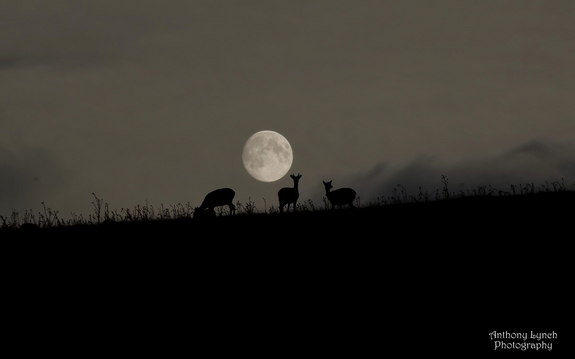
Irish harvest moon & deer (Anthony Lynch 9/19/13 from Space.com)
Sept. 16, 12:05 p.m. PDT — Full Harvest Moon. Traditionally, this designation goes to the full moon that occurs closest to the Autumnal (Fall) Equinox. This year’s version comes only five days early. At the peak of the harvest, farmers can work into the night by the light of this moon. Usually the moon rises an average of 50 minutes later each night, but for the few nights around the Harvest Moon, the moon seems to rise at nearly the same time each night: just 25 to 30 minutes later across the U.S., and only 10 to 20 minutes later for much of Canada and Europe. Corn, pumpkins, squash, beans and wild rice — the chief Indian staples — are now ready for gathering.
Full moon names from other cultures Courtesy of Keith Cooley):
Chinese: Chrysanthemum Moon; English Medieval: Barley Moon
Celtic: Singing Moon; Dakotah Sioux: Moon When The Calves Grow Hair
Interesting & useful factoids on moon averages:
Apparent width of the moon (full or otherwise): 1 /2 degree.
Time one full moon to next full moon: 29.5 days
Angle moon moves in 24 hours: 12.2 degrees
Time for moon to move it’s own width (1/2 degree): 59 minutes
Thus, on average, the moon takes just under an hour to move it’s own width. When trying to estimate the size of something, compare it to the moon, a known quantity.
MoonPhases.info – A handy site for slightly under a googolplex of moon facts.
The Old Farmer’s Almanac has a page for each full moon. A September tip: best days for fishing: 1-16th, 30th. Now you know, so you have no excuse.
The next significant full moon will occur on Oct. 15, 9:23 p.m. PDT. Keep an eye on this spot for additional late-breaking news on this unprecedented event.
The information on moon name comes to you courtesy of: http://www.space.com/31699-full-moon-names-2016-explained.html
written by Joe Rao. Joe Rao serves as an instructor and guest lecturer at New York’s Hayden Planetarium. He writes about astronomy for Natural History magazine, the Farmer’s Almanac and other publications, and he is also an on-camera meteorologist for News 12 Westchester, N.Y.
But that’s waaay too long to type in, and besides, you don’t need to go there because SMBAS has done the work for you!
[Chuck Almdale]
What a Fish Knows – Jonathan Balcombe

That’s a pufferfish looking at you.
BOOK REVIEW
What a Fish Knows: The Inner Lives of Our Underwater Cousins.
Jonathan Balcombe
Scientific American/Farrar, Straus and Giroux, New York, 2016, 304 pgs, $16-27.
We rarely recommend books, but this is a book that should interest everyone, whether you have pet fish, love catching fish, enjoy photographing fish, wonder what life would be like if you were a fish, contemplate your own fishy ancestors 500 million years ago, or simply like to see them on your plate and put them in your mouth.
Natural History Magazine’s Sept’16 issue featured an article by Dr. Jonathan Balcombe, drawn from this book. If this blog doesn’t convince you to buy the book, read the article. It will forever change your view of fish, and give you a new perspective the next time you see the Mullet jumping above the surface of Malibu Lagoon.
A few fishy facts:
- There are more than thirty thousand species of fish―more than all mammals, birds, reptiles, and amphibians combined.
- They can plan, hunt cooperatively, use tools, curry favor, deceive one another, and punish wrongdoers. Sound like anyone you know?
- Their courtship rituals are elaborate; they develop lifelong bonds with their neighbors.
- Their sexual arrangements vary widely: promiscuity, polygamy, monogamy, mating-for-life. Males may keep harems, defend a territory, spawn in groups, perform sneak copulations, be a “satellite male” or a “sexual pirate.” Males may become females or females become males as the opportunity arises. There are simultaneous hermaphrodites and sequential hermaphrodites. Some males parasitize the female, embedding themselves permanently into her flesh.
A few of the issues it addresses:
Can fish think? Can they recognize the humans looking back at them in their pools and aquariums? How do they learn to navigate their pools, rivers, reefs and oceans – and find their way home?
Dr. Balcombe relates a wonderful story:
During a dive off the southern tip of Japan, veteran diver and photographer Yoji Ookata was surprised to see, at a depth of about eighty feet, a six-foot-wide symmetrical circular pattern in the sand. The mural featured two concentric rings of ripples radiating outward from a center disk. Ookata returned some days later with a film crew, and the mystery of what might have created this exquisite curiosity was soon solved. The geometric “crop circles” were created by a small, quite ordinary-looking male puffer fish (Tetraodontidae). Swimming on his side, while fluttering a pectoral fin, the five-inch puffer spends hours making his masterpiece. He inspects it as he goes, decorating his mural with bits of small shells that he cracks in his mouth before sprinkling them into the central grooves.

Pufferfish in his sand ‘bower’ (Kimiaki Ito, National Geographic)
Link to Yoji Ookata YouTube series of still photos of the pufferfish ‘mandala.’
Link to Aysel Güler YouTube action video of pufferfish maintaining his mandala.
Mandalas found since show that no two are the same, they attract female puffers who lay their eggs in the inner circle, the furrows help prevent eggs from being carried away by currents, the crushed shells provide camouflage for the eggs, and the more elaborate the circle, the greater the mating success of the male. Birders familiar with Australia’s Bowerbirds will recognize the similarity of intent and result.
I thought I knew a lot about fish. Then I read What a Fish Knows. And now I know a lot about fish! Stunning in the way it reveals so many astonishing things about the fish who populate planet Earth in their trillions, this book is sure to “deepen” your appreciation for our fin-bearing co-voyagers, the bright strangers whose world we share.
— Carl Safina, author of Beyond Words: What Animals Think and Feel; named one of Audubon’s 100 Most Influential Conservationists of the 20th Century
Balcombe offers a picture of these underwater creatures as complex and sentient beings. Not only do they have acute senses of sight, hearing, and smell, but they also have the capacity to feel pleasure as well as pain….Balcombe never met a fish pun he didn’t like….This is a lively and surprising work that makes a strong argument for sport and food fishing reform.
— Lisa Peet, Library Journal
We rarely consider how individual fishes think, feel, and behave, but their lives are often as rich and complex as our own. Here’s your chance to discover the details.
[Chuck Almdale]
The Friendly Ravens: Sunday Morning Bible Bird Study V
This Week’s Lesson – The Friendly Ravens
Link to entire 10-blog Birds in the Bible series on one page
Ravens weren’t discussed extensively in the bible – no bird was, for that matter – but they do appear in unexpected locations for interesting reasons. We begin with the citation from Genesis, briefly mentioned in Lesson I.
After forty days Noah opened the trap-door that he had made in the ark, and released a raven (הָֽעֹרֵ֑ב – ha-oreb “a raven” ) to see whether the water had subsided, but the bird continued flying to and fro until the water on the earth had dried up.
Genesis 8:6-7 New English Bible (NEB)
As previously mentioned, that’s all that Genesis says about this raven [עֹרֵ֖ב – oreb], not even whether it ever returned. It probably didn’t, preferring to follow its own agenda rather than Noah’s. Bible Factoid #1 noted that the precursor to this story – found in the much older Epic of Gilgamesh, written circa 2100 BCE – Utnapishtim (the “Noah” of the Gilgamesh) released a raven as the third bird, which found food and flew around and did not return.

Common Raven, Santa Rosa (James Kenney, 11-24-12)
The raven was almost certainly the Common Raven (Corvus corax), the species we find today across North America and Eurasia. Their current range includes all of Europe and Asia Minor, northern Syria and Iraq, and nearly all of the southern and eastern edges of the Mediterranean Sea. Back then, forests in the Near East were more extensive and dense, attractive to our raven. Corvid family members are among the most intelligent and resourceful of birds, and the raven may be the brightest of the bunch, a good choice for any task requiring smarts. So smart, in fact, that they may well decide to skip your task and go do what they want to do. The tale of Noah, perhaps inadvertently, reflects this characteristic.

Hooded Crow on sheep’s head
(Jamie MacArthur, DeviantArt.com)
There are other dark corvids living in the vicinity. Hooded Crow (Corvus corone), about 25% smaller than the raven, is resident from Asia Minor down the Mediterranean eastern shore and the Nile River valley. Jackdaw (Corvus monedula) shares this area, but is largely grey and half the size of the raven. Brown-necked Raven (Corvus ruficollis) is a bird of desert and dry steppes. Their range currently stops south of the Mediterranean southern shore, but includes eastern Israel, Jordan, etc. Their range likely stopped even farther south in biblical times, as it was three millennia closer to the ice age.
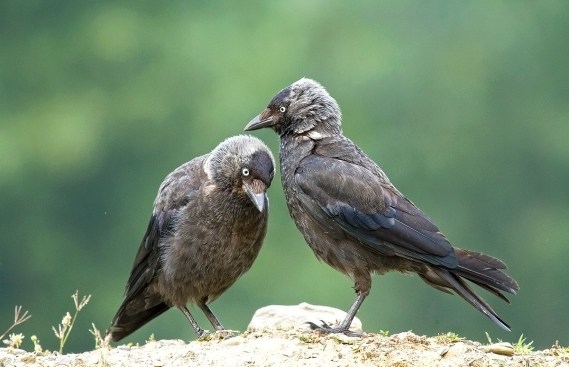
Jackdaws, India (Wikia)
Hebrew had only one word עֹרֵב – oreb for raven or crow; bible translators used both at different times, but Common Raven is likely our bird. Incidentally, Hebrew uses positional case-marking on nouns. Notice the progressive increase in Hebrew word length: “raven” עֹרֵב – oreb, “a raven” הָֽעֹרֵ֑ב – ha-oreb, “the ravens” הָעֹרְבִ֣ים – ha-oreb-im, and “and the ravens” וְהָעֹרְבִ֗ים – we-ha-oreb-im.
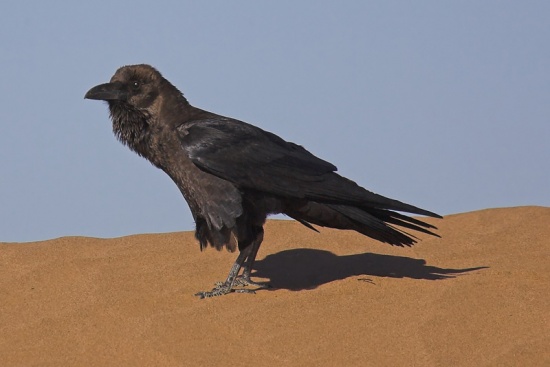
Brown-necked Raven, Hamada du Draa, Morocco
(Momo, February 2007)
Benjamin the Ravin
Our next citation is actually a red herring.
…Benjamin shall raven (יִטְרָ֔ף – ytrp, “yitrap”) as a wolf: in the morning he shall devour the prey, and at night he shall divide the spoil… Gen. 49:27 1599 Geneva Bible
Many words in the Jewish Hebrew and Christian Greek bibles occur only once*; יִטְרָ֔ף (“ytrp” or “yitrap”) is one of them. Such words usually create arguments because determining their meaning is little more than guesswork. The first KJV edition had “ravin”, later changed to “raven,” creating additional confusion. This obsolete word meant “to take away (goods) by force; to seize or divide as spoil.” Oxford English Dictionary’s last citation in this sense dates from 1625, fourteen years after the KJV was published. Nowadays we say ravening or ravenous. * See list at bottom
“Benjamin is a ravening wolf: in the morning he devours the prey, in the evening he snatches a share of the spoil.” Gen. 49:27 NEB
Inedible Ravens
Ravens next appear as members of two equivalent – but not identical – lists of twenty unclean birds.
“These are the birds you shall regard as vermin, and for this reason they shall not be eaten….every kind of crow [or raven] ( עֹרֵ֖ב – oreb )…” Lev 11:13-14 NEB
“These are the birds you may not eat…every kind of crow [or raven] ( עֹרֵ֖ב – oreb)…” Deut 14:12-14 NEB
This list will be covered in a later lesson. Nearly all twenty birds are birds we wouldn’t want to eat today, consumers of dead animals lying on the ground: cormorants, raptors, vultures, gulls. Most – if not all – corvids fall into that category, and the phrase “any kind of raven (or crow)” makes good sense. Four of the forbidden twenty are cited as “every kind of…;” the other sixteen birds are individually named.
The Friendly Ravens
Then the word of the Lord came to him [Elijah the Tishbite]: ‘Leave this place and turn eastwards; and go into hiding in the ravine of Kerith [Cherith] east of the Jordan [River]. You shall drink from the stream, and I have commanded the ravens (הָעֹרְבִ֣ים – haorebim “the ravens”) to feed you there.’ He did as the Lord had told him: he went and stayed in the ravine of Kerith east of the Jordan, and the ravens (וְהָעֹרְבִ֗ים – wehaorebim “and the ravens”) brought him bread and meat morning and evening and he drank from the stream.
1 Kings 17:2-6 NEB

The Prophet Elijah fed by the ravens, Paulwels Frank, 1590 (Alterpersanium.com)
When Israel’s King Ahab didn’t fully appreciate Elijah’s prophesy, Elijah suddenly felt that the deity was telling him to make himself scarce, hide in the wilderness, and live off the land. The “ravens” would help him survive.
As always, commentaries and disagreements abound.
Matthew Henry: God could have sent angels, yet chose lowly ravens because even they would do what he asked.
Barnes: Most ancient versions translate as “ravens;” others translate as “Arabians” or “merchants” (ma-arab). Jerome [Latin Vulgate translator] took it as “Orbites“as does the Arabic Version.
Jamieson-Fausset-Brown: Sending unclean birds to feed Elijah is so bizarre that many choose “Orebim,” meaning merchants, or Arabians (we-ha-ar-bim), or citizens of Arabah, near Beth-shan (ha-a-ra-bah ). But “ravens” is preferable.
Cambridge Bible: The Septuagint says “ravens.” Jerome’s biography of Paul the Hermit says a raven supplied the hermit’s wants. Observers say large birds like ravens commonly carry home large quantities of food.
Pulpit Commentary: Some say הָעֹרְבִ֣ים (ha-o-ra-bim “the ravens”) must be ravens; men – smarter and lazier – would leave enough food for several days. But if Elijah were among kinsmen, friends, or Arab Bedouin following the law of hospitality, they might visit regularly such an honored guest. Visits might be made at twilight to avoid the day’s heat or discovery by authorities. The “orabim” are not ravens but men: kinsmen, friends, Bedouins or inhabitants of Orbo near Beth-shan.
Pulpit Commentary 1 Kings 17:4, comment 4. Both a rock named Oreb and a town named Orbo were in the area. Ha-o-ra-bim “Orbites” refers to inhabitants near the rock or of the town.
Clarke’s Commentary: Bereshith Rabba, an ancient Rabbinical comment on Genesis, says [Hebrew omitted] “Air hia betachom Beithshan, veshemo Orbo.” “There is a town in the vicinity of Bethshan (Scythopolis), and its name is Orbo.”
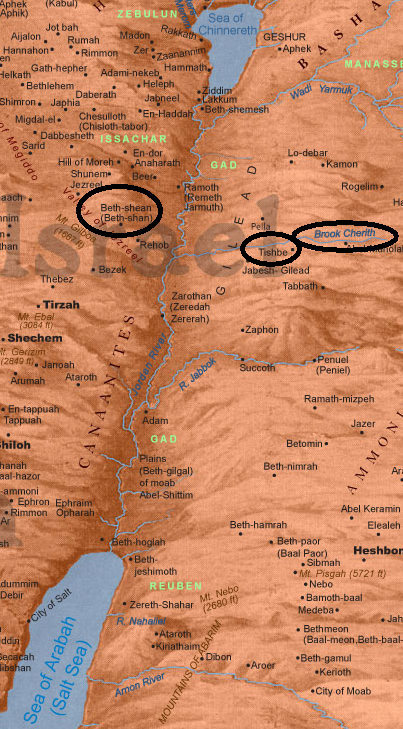
Old Testament Israel: circled Beth-Shan, Tishbe, & Brook Cherith
(Bible-history.com)
When even professional biblical scholars, believing these passages are Holy Scripture, can’t agree whether “ravens” are really ravens, we neophytes might do best by using probability. What’s the likelihood of being fed morning and evening for a year by wild ravens, versus being fed by friendly humans, perhaps one’s own relatives? Consider what the map shows: Tishbe – the home of Elijah “the Tishbite” – lies just south of Brook Cherith in Giliad, and about twenty-three miles “as the raven flies” across the Jordan River from Beth-Shan (Orbo is in Beth-Shan’s “vicinity.”) It’s pretty clear that Elijah was hiding out in his old stomping grounds, among friends and family, no birds needed. But we report – you decide.
Other Biblical Uses for Ravens
The raven is one in a litany of reasons why Job should stop complaining about the way God treats him.
Who provideth for the raven his prey, when his young ones cry unto God, and wander for lack of food? Job 38:41 Holy Scriptures according to the Masoretic Text (HSMT)
A similar metaphor is included in a litany of God’s good acts.
He giveth to the beast his food, and to the young ravens which cry.
Psalms 147:9 HSMT
Ravens will punish a wicked child.
The eye that mocketh at his father, and despiseth to obey his mother, the ravens of the valley shall pick it out, and the young vultures shall eat it. Proverbs 30:17 (HSMT)
The black color of the raven is used as a simile:
His head is as the most fine gold, his locks are curled, and black as a raven. Song of Solomon 5:11 (HSMT)
Our final raven is a parallel to last week’s citation from Matt 6:25-27, about anxiety, but this writer specifies ravens rather than the generic “birds of the air.”
Think of the ravens; they neither sow nor reap; they have no storehouse or barn; yet God feeds them. You are worth more than the birds! Is there a man among you who by anxious thought can add a foot to his height? If, then, you cannot do even a very little thing, why are you anxious about the rest? Luke 12:24-26 NEB
The bible mentions ravens eleven times. Beyond the facts that they are black, have young which cry and are fed, experience no anxiety, enjoy pecking at eyeballs, may be mistaken for one’s friends, and are unreliable errand-runners, the bible has little to say about this very intelligent, successful and admirable bird.
Bible Factoid #5 – The Bar-Abbas Mystery
Even among true believers, this is among the most debated of New Testament stories. Previously we learned: “Bar” means “son of” in Aramaic; the gospels cite Jesus – when speaking of God the Father – as saying “abba,” an Aramaic intimate word for “father;” “papa” or “daddy” is an English equivalent. “Bar-Abbas” means “son of Papa;” the “-s” ending is the Greek masculine addition. Mama, papa, baba, dada, abba – in any language, these nouns derive from baby talk, the first sounds a human infant can utter.
At the festival season it was the Governor’s custom to release one prisoner chosen by the people. There was then in custody a man of some notoriety, called Jesus Bar-Abbas (Βαραββᾶν – Barabban**). When they were assembled Pilate said to them, ‘Which would you like me to release to you – Jesus Bar-Abbas, or Jesus called Messiah?’….they said, ‘Bar-Abbas’. ‘Then what am I to do with Jesus called Messiah? Asked Pilate; and with one voice they answered ‘Crucify him!’….He then released Bar-Abbas to them; but he had Jesus flogged, and handed him over to be crucified. Matt 27:15-26 NEB
**Greek uses the -s ending when the noun is subject (nominative case), -n when noun is object (accusative case).

Barabbas mini-series poster (Crossmap.com , 2016)
There are several problems with this story. First, no written record exists anywhere – not Jewish, not Roman, not Christian – beyond this paragraph in each of the four gospels (the other three gospels borrowed from Mark) of the existence of any custom of releasing one prisoner upon request during Passover season or at any other time. Scholars not wedded to a belief in biblical literal truth and who appreciate supporting evidence doubt this story’s veracity.
Second, Jesus frequently referred to himself and others as sons or children of God the “Father” – fifty times in the four gospels. By the time he was hauled before Caiaphas the High Priest, Herod the King and Pilate the Roman Governor, this usage of “Abba” and “Father” was well known and they asked Jesus about it. Our story is saying that we now have two men called Yeshua (Jesus) Bar-Abba (Barabbas, “son-of-[intimate form of] father”). Two men called Yeshua bar-Abba – one a criminal, one a preacher.
Scholars and mystery-lovers ask: When the crowd called for Bar-Abba to be released – whom did they want, whom did they get? When they called for Yeshua to be crucified – whom did they want, whom did they get? Some scholars, including Hyam Maccoby, maintain that Jesus was commonly known as “bar-Abba” for his custom of addressing God as ‘Abba’ in prayer, and for referring to God as ‘Abba’ in his preaching. When the crowd told Pontius Pilate to “free Bar-Abba!” they meant preacher Jesus. There was no criminal Jesus present.
If we assume the story of setting one bar-Abba free is false, as many scholars maintain, why does the story exist at all? What purpose does it serve? To place blame on the Jews, many say; to make Christianity acceptable to Roman authorities. By the time the Gospels were written, Roman anti-Judaism had begun (c. 40 CE), the Jewish rebellion collapsed (66-73 CE, Jerusalem and the Second Temple were destroyed (70 AD), Masada had fallen (74 CE), the Diaspora quickened, Jews had lost favored status to practice monotheism rather than worship Roman Gods and the Emperor, and pretending to be a Jewish sect no longer protected Christians from oppression. What better way to disconnect from Judaism and curry favor with Roman authorities than to place blame for Jesus’ death onto the Jews. Thus many scholars view the gospels as partially polemic and apology, saying in effect to the Romans, “We don’t blame you, we blame the Jews. We’re no threat to you. We’re good Roman subjects. We ‘render unto Caesar what is Caesar’s…’”
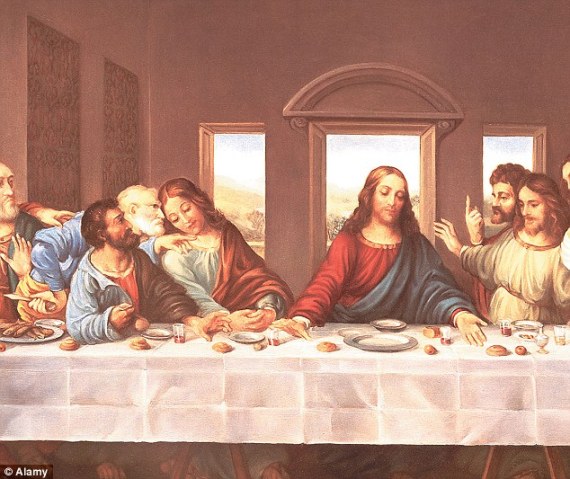
The “disciple whom Jesus loved”- John 19:26 (James, John or Mary Magdalene?) sits at Jesus’ right hand, detail of Da Vinci’s Last Supper (Daily Mail)
Proffered explanations of the Bar-Abba story are legion. Here’s a sampling.
1. Two men: Yeshua crucified, Bar-Abba set free, as the Gospels say.
2. Two men: Bar-Abba crucified, Yeshua set free.
2a. Yeshua survived, met his followers afterwards, inspired them to carry on, the story ends.
2b. Yeshua went to France with or without one of the Mariams (Mary), settled down, had kids.***
3. One man Yeshua “bar-Abba:” religious preacher and insurrectionist, executed.
4. One man Yeshua “bar-Abba:” rebel insurrectionist, executed.
5. One man Yeshua “bar-Abba:” entire“bar-Abba” story invented to shift blame from Romans to Jewish leaders for bribing the crowd to call for the other “bar-Abba.” Pilate could release anyone, anytime without approval or permission, and had done so previously.
6. One man Yeshua “bar-Abba:” Mark invented parable of Yeshua as the innocent “scapegoat” and “bar-Abba” symbolizes all sinners redeemed, set free by Yeshua’s willing sacrifice.
7. One man Yeshua “bar-Abba:” Greek-speaking “Mark,” utilizing story of crowd calling “bar-Abba” when asking for Yeshua’s release, invented Barbbas to explain misunderstood apparent presence of a second man.
8. One man Yeshua “bar-Abba:” Pilate (typically described as hard and iron-fisted) taunts the crowd. When they called for “son of papa” to be released, Pilate crucified him anyway.
9. The gospels are fiction: based on the life of otherwise unknown itinerant preacher.
10. The gospels are fiction: based on the life of otherwise unknown failed revolutionary.
11. The gospels are fiction: inspired by and stolen from the pre-Zorastrian religion of Mithras.
12. The gospels are fiction: “Jesus” is a corruption of name of Greek God “Zeus.”
13. And on and on and on.
***2b. This is the route followed by Holy Blood, Holy Grail (Baigent, M., Leigh, R. & Lincoln, H.), the 1982 “non-fiction” book upon which Dan Brown relied for the “factual” superstructure of his bestseller The Da Vinci Code.
Lacking adequate information, opinions proliferate and grow ever more fanciful.
Part I – What About That Dove? & The Flood of the Gilgamesh
Part II – Sandgrouse or Quail? & YHVH [יְהוָ֖ה] [Yahweh]
Part III – Junglefowl in Judea! & New Testament Koine Greek
Part IV – Birds that Sow, Reap and Store & Whence Jesus (Ἰησοῦς)
Part VI – The Humble Hoopoe & Catching “Forty” Winks
Part VII – The Wise Hoopoe & On “On”
Part VIII –Don’t Eat That Bird! Part 1 & Of “Of”
Part IX – Don’t Eat that Bird! Part 2 & Seeing “Red”
Part X – Don’t Eat that Bird! The Last Bite & The Problems of Translation
[Chuck Almdale]
*A Sampling of Rare Biblical Words
Raven or ravin (יִטְרָ֔ף – ytrp, “yitrap”) 1 occurrence
Crow or raven ( עֹרֵ֖ב – oreb ) 3 occurrences
A raven (הָֽעֹרֵ֑ב – ha-oreb) 1 occurrence
The ravens (הָעֹרְבִ֣ים – haorebim) 1 occurrence
And the ravens (וְהָעֹרְבִ֗ים – wehaorebim) 1 occurrence
Merchandise (מַעֲרָב– ma-arab) 9 occurrences
Citizens of Arabah (or Oreb) (הָעֲרָבָ֑ה – ha-a-ra-bah) 3 occurrences
[Chuck Almdale]
Additional Sources:
Handbook of Birds of the World (HBW), Vol. 14. del Hoyo, J., Elliott, A. & Christie, D.A. eds. (2009) Lynx Edicions, Barcelona. Corvids – Pgs 617, 630-631, 637-639.
Holy Scriptures: According to the Masoretic Text. (1955) The Jewish Publication Society of America. Philadelphia, Pa.
New English Bible with the Apocrypha, The, Oxford Study Edition. Sandmel, Samuel, Suggs, M. Jack, Tkacik, Arnold J.; eds. (1972) Oxford University Press, New York
News keeps pouring in…
| The LA times keeps us up to date on major bird life developments this week. | ||
| In today’s (Sunday 4 Sept.) paper the California section has an article on bird deaths and prevention efforts at the Ivanpah solar power station.
http://www.latimes.com/local/california/la-me-solar-bird-deaths-20160831-snap-story.html |
||
| In section 1 there are two bird stories: “Cormorants to die for salmon” relating a court decision to allow the Army Corps of Engineers to continue killing Double-crested Cormorant near the mouth of the Columbia River in order to save outgoing salmon. http://www.pressreader.com/usa/los-angeles-times/20160904/281685434285099 | ||
| Also of note on page 8, an AP story by Dan Elliott “New guidelines to protect Sage Grouse”. http://bigstory.ap.org/article/885712770a9c4ef8981006aa11d8ffc0/us-takes-key-step-implement-sage-grouse-conservation-plan | ||
| Enjoy the attention the LA Times is giving birds? Tell the editors: letters@latimes.com |



 SANTA MONICA BAY AUDUBON SOCIETY BLOG