Free email delivery
Please sign up for email delivery in the subscription area to the right.
No salesman will call, at least not from us. Maybe from someone else.
Full Sturgeon Moon Update – August 18, 2:26 AM PDT
Here’s another update from SMBAS Blog on that large, disc-like, shining object which has frequently and mysteriously appeared in our nighttime sky this year (some call it the moon).
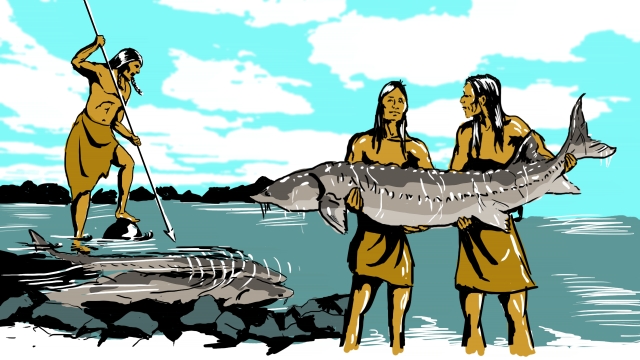
Sturgeon fishing in days of old (google images)
Aug. 18, 2:26 a.m. PDT — Full Sturgeon Moon, when this large fish of the Great Lakes and other major bodies of water, such as Lake Champlain, is most readily caught. Other variations include the Green Corn Moon or Grain Moon. No supermoon this year: the moon arrives at perigee — its closest approach to Earth — on Aug. 22, 9:22 AM PDT. Sturgeon, by the way, are very ancient and very cool fish. Hiawatha, that pestiferous egomaniac, called him the “King of Fishes,” but his treatment of Nahma the sturgeon was unsuitably disloyal.
August Moon Names from other cultures Courtesy of Keith Cooley):
Chinese: Harvest Moon; Celtic: Dispute Moon; English Medieval: Corn Moon

A dizzying monthly lunation cycle
(Antonio Cidadfo, apod.NASA.gov)
The annual performance of the Perseid meteor shower was on the 12th-13th, but you probably missed it.
Speaking of moons, you must certainly know that Jupiter has a new man-made moon, Juno. Appropriately named for the wife of Jupiter, king of the Roman pantheon of gods (Hera and Zeus are the equivalent Greek goddess and god), Juno will make it’s first close pass around Jupiter on August 27. The successful orbit insertion on July 4 sent it into the first of two planned 53-day-long loops around Jupiter, but on this close loop around the gas giant, it will have all instruments turned on as it passes more closely than human instruments have ever been. Juno will loop down over the planet’s north pole and back up over the south pole, entering and exiting through the “doughnut hole” of Jupiter’s enormous magnetic field, 20,000 times stronger than the earth’s. Scientists hope that the 1-cm-thick casing of titanium will protect the electronics from the field’s radiation, which over the 14-month course of the mission is estimated to be equivalent to 20 million dental X-rays, but they won’t know until after this pass the accuracy of their calculations. The whole thing may get fried.
Back to earth’s moon (cue crackle of space static):
The Old Farmer’s Almanac has a page for each full moon. One tip for September: Best days for harvesting belowground crops are 19th, 20th. 28th or 29th. Now you know, so you have no excuse.
The next significant full moon will occur on Sept. 16, 12:05 p.m. PDT. Keep an eye on this spot for additional late-breaking news on this unprecedented event.
The moon name information comes to you courtesy of: http://www.space.com/31699-full-moon-names-2016-explained.html
written by Joe Rao. Joe Rao serves as an instructor and guest lecturer at New York’s Hayden Planetarium. He writes about astronomy for Natural History magazine, the Farmer’s Almanac and other publications, and he is also an on-camera meteorologist for News 12, Westchester, N.Y.
But that’s waaay too long to type in, and besides, you don’t need to go there because SMBAS has done the work for you!
[Chuck Almdale]
Quick, let’s raise awareness…
…for the Snowy Plover. What a magnificent opportunity Steve Lopez has given us. On the front page of the California section (Sun. Aug. 14,’16) he dedicates his column on the conflict at Sand City near Monterey where plovers are threatened by adjacent big-time development. This is a good opportunity to post on your Facebook, instagram, twitter and say “thank you, Steve Lopez”. steve.lopez@latimes.com

Western Snowy Plovers on Santa Monica Beach. L.Plauzoles 2014
While he talks about scurrying little plovers at Sand City, I was surveying the Santa Monica site where the City had erected a fence for the past 13 years…and there wasn’t a single plover in sight! However, I found fresh dog tracks and tire tracks…Your post will help educate a few more people, and hopefully they will respect the beach as habitat at least for the rest of this summer.
What About That Dove? – Sunday Morning Bible Bird Study I
This Week’s Lesson – What About That Dove?
Link to entire 10-blog Birds in the Bible series on one page
Whatever one may think of the bible, it was unarguably written long ago by humans not significantly different than us, who wrote about what they knew and what they imagined, just as we do today. Any mention of a bird means – at a minimum – the writers had noticed them, however little they might have to say about them, or however accurate it might be. In this series, we begin with what the bible says about birds, to which we add what we’ve learned over the centuries since then, to see if we can uncover anything new and interesting. Each essay begins with a citation; we start in the beginning, with Genesis, the first book of the bible.
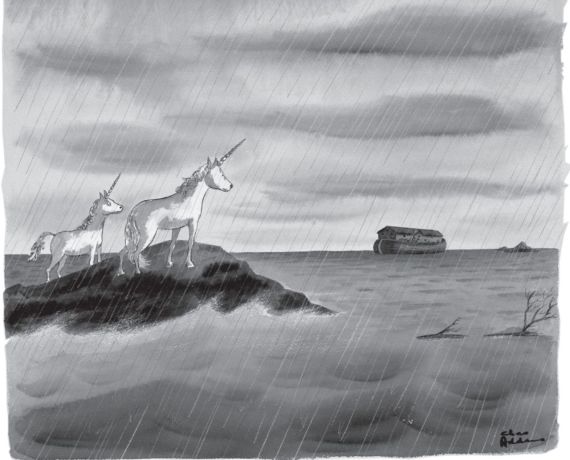
Cartoon by Charles Addams
“After forty days Noah opened the trap-door that he had made in the ark, and released a raven to see whether the water had subsided, but the bird continued flying to and fro until the water on the earth had dried up. ”
Genesis 8:6-7 New English Bible
Little is said about this raven [עֹרֵב – oreb], not even whether it ever returned. One suspects it didn’t. Ravens usually have their own agenda. The raven in question was almost certainly the Common Raven (Corvus corax), the same species we find today across North America and Eurasia. We’ll revisit ravens in general, and this citation in particular, in a later episode and move on to the more useful – to Noah, and to humanity by extension – dove.
“Noah waited for seven days, and then he released a dove (יוֹנִים – yonah) from the ark to see whether the water on the earth had subsided further. But the dove could find no place to settle, and so she came back to him in the ark, because there was water over the whole surface of the earth. Noah stretched out his hand, caught her and took her into the ark. He waited another seven days and again released the dove from the ark. She came back to him towards evening with a newly plucked olive leaf in her beak…He waited yet another seven days and released the dove, but she never came back.” Genesis 8:8-12 New English Bible
Why would Noah choose to send out a dove, of all birds, and what kind of dove was it? Ornithologists currently recognize 330 species of pigeons and doves grouped into 45 genera, so deciding which dove it was could be daunting. [All 330 species were presumably on the ark, along with the rest of the 10,000+ avian species.] Our story describes Noah’s ark as eventually coming to rest on Mt. Ararat, 16,945 feet high, 14,000-15,000 feet above the surrounding Armenian plain of eastern Turkey. We’ll assume the writer was an ordinary human who used his own experience to fill in details of his story; we’ll also assume that a bird noted was a bird familiar to the writer, and were then extant in the general region of the Middle East. In that region two dove or pigeon species predominate: the Rock Pigeon (Columba livia), also known as park pigeon, homing pigeon, or carrier pigeon, and the European (or Common) Turtle-Dove (Streptopelia turtur). Biblical Hebrew uses two words for these two species: tor (תֹּר), translated as dove or turtledove, and yonah (יוֹנִים), usually translated as pigeon, but also as dove. Occasionally these words occur together, as when Leviticus 5:7 suggests using “two turtle doves or two young pigeons” as sin-offerings. Our cited passage states yonah, so Noah’s “dove” could be of either species.
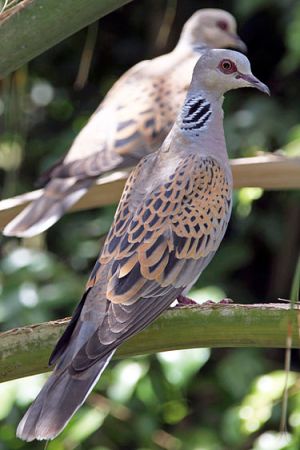
European Turtle-Dove (Wikipedia)
Of the seventeen species in the Streptopelia genus, the European Turtle-Dove is the most widespread and common, found from the Azores Islands in the west, across northern Africa, Europe, the Mid-East and western Asia to Iran and far-western China. They are widely domesticated by humans, used as food and as caged companions. The “turtle” part of their name – as may also the Hebrew “tor” – refers to their cooing call, which sounds to human ears like the word “turtle.” This widespread impression is recognized in their name in many languages: French – Tourterelle des bois, Dutch – Tortelduif, German – Turteltaube, Swedish – Turturduva, and in the scientific species name, turtur. However, many people refer to this much-admired bird as simply “Turtle“, as did the British when the King James version of the bible was published in 1611. In recent years, and in regions which do not host turtle-doves, bible readers are often mystified by the following passage:
“For lo, the winter is past, the rain is over and gone; the flowers appear on the earth; the time of the singing of birds is come, and the voice of the turtle is heard in our land…” Song of Solomon 2:11-12 King James Version
Since when does one ever hear a turtle say anything? One doesn’t, and recent translations and updated versions have re-translated the Hebrew tor in this passage from “turtle” to “turtle-dove.”
Why send out a Dove? All pigeons and doves build nests of twigs. Not very well, I should add. They may be so loosely constructed that one can see the eggs through the bottom of the nest. After a mated pair locate a suitable nest site, frequently a fork in a tree limb, they (sometimes only one) fly off to find twigs to bring back; these may be dead and broken, but living twigs may be preferred for their flexibility. One of the pair may stay to guard the site and suitably arrange returned twigs until the nest is complete. All pigeons and doves are strong and swift flyers, able to quickly cover a lot of area without needing to land. Many species can also find their way home through vast featureless areas.

Rock Pigeon at Malibu Lagoon
(Jim Kenney 2-19-10)
The Rock Pigeon, whom the Israelites called yonah, has been domesticated for millennia for food, feathers, fun, and not least for its ability to reliably carry messages to its home roost from any distance or direction, despite adverse conditions of weather and light. Historians report that the use of “carrier pigeons” probably began in ancient Persia, and dates to at least 1000 BCE. Phoenician merchants at sea used the pigeon post to send messages home; the Greeks used them to announce results of the Olympic games. Such an instinctive “homing” pigeon, one who seeks and gathers twigs with which to build its nest, would be the perfect animal to recruit for the task of finding and returning living vegetable matter, to indicate the end of a flood and the reemergence of land and vegetation. It could fly for hours, cover a huge area, and reliably return, bringing a live twig if it could find one, or a dead twig if that’s all it could find. Genesis says (in translation) that Noah sent out a “dove,” but in all likelihood, it was not the European Turtle-Dove but the Rock Pigeon, whose biblical Hebrew name yonah, used in this passage, is translated as either pigeon or dove.

Rock Pigeons on cliff in Israel (Igor Svobodin)
The Rock Pigeon nests on barren cliffs, often in arid, confusingly-configured regions, and often had to travel wide and far to find food, water, and nesting material. This constellation of characteristics suggests that they may be the reason the species evolved such a remarkable homing ability.
The selection of the Rock Pigeon for this role in this story, demonstrates that the writer was aware of four things: First, the mere fact of this species’ existence; Second, the bird’s ability to fly fast and far; Third, its natural desire to seek and

Peace dove with Olive Branch (Google)
bring back twigs for the purpose of nest-building; Fourth, its remarkable ability to recall the location of its home roost in the vastness of an unfamiliar and potentially featureless region. The earliest use of the Rock Pigeon as “carrier” pigeon is probably unrecorded, but here we see a suggestion that it was known, at the time of this story, in the Middle East. Because of this biblical passage, doves are now symbols of peace (or the forgiveness of an angry deity) and the olive branch is a symbolic peace-offering.
Linguistic confusion between pigeon and dove remains common today. There is no set rule as to which is which. Typically, larger birds are pigeons, smaller birds are doves. Each of the 45 genera in Columbiformes – with one exception – consists (in English) entirely of pigeons or entirely of doves, never a mixture. The sole exception is the genus Columba (which includes our Rock Pigeon) comprising 36 species, of which three are called “dove,” the rest are “pigeons.” The continuing drive for English avian nomenclatural consistency, including the goal of calling all species in the Columba genus by the name of “pigeon” brought, in 2003, the change from Rock Dove to Rock Pigeon. By it’s size it should be called a pigeon. All it’s closest relatives are called pigeons. The bible (except Noah) calls it a pigeon, park statues everywhere call it a pigeon, messenger services call it a pigeon. But speakers of English long branded it a dove, and, in biblical translation ever since, it has remained a dove.
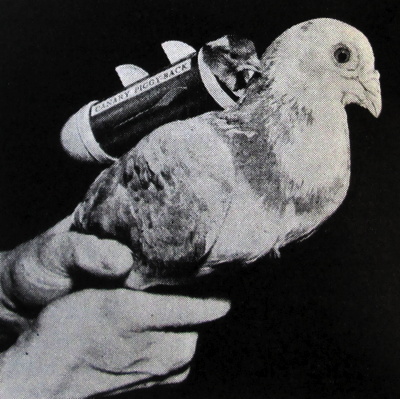
Carrier Pigeon carries a canary (WeirdUniverse)
The native range of Rock Pigeon is obscured by domestication. For millennia they have accompanied humans, and the descendants of escaped and released birds number into the many millions, if not billions, world-wide. They do not migrate. Their original range probably extended from the mountains of Morocco in the west to the eastern Indian Himalayas. They nest on ledges and in holes of rocky cliffs, hence the name Rock Pigeon. They have survived and spread exceedingly well throughout the modern world because humans have considerately constructed ledge-filled artificial cliffs for them, which we call buildings and bridges, and freely fed them sumptuous feasts, which we call trash.
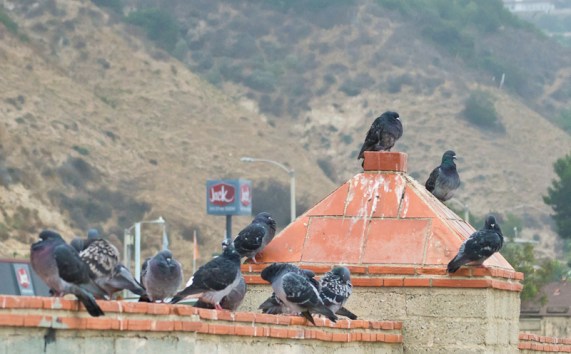
Rock Pigeons relaxing on man-made cliffs (Chuck Bragg 9-25-11)
Incidentally, Genesis 8:12 misrepresents this faithful and vigorous bird when saying it did not return to the ark. Very little will keep a Rock Pigeon from returning to its home roost. They do not often become lost. Only accidents, predation, or (unlikely) a new mate would keep it away from its home, its nest, and its mate. As all animals except our pigeon (or dove) were supposedly still parked on the ark at this time, there would be no predators or potential mates to keep it away. The disappearance of our pigeon is almost certainly a metaphor, a case of the biblical writer taking literary license to send a signal to the alert reader. After its scouring, the damp, new earth has received our pigeon – and all her living creatures by extension, including wayward humans – back into her fruitful arms.
Bible Factoid #1: Noah,the Flood, and the Epic of Gilgamesh
The biblical story of Noah and the flood is greatly predated by the flood story in the Epic of Gilgamesh. First discovered in Nineveh in 1853 and translated in 1870, the epic – considered by many scholars to be the first written work of literature in the world – dates to about 2100 BCE and relates the adventures of Gilgamesh, king of the city of Uruk in southeastern Mesopotamia. It was a popular story of that age
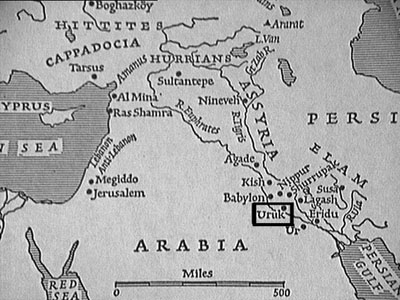
Mesopotamia & location of Uruk, city of Gilgamesh (nkerns.com)
and region, and parts of it have been found in excavations of other ancient cities. The description of the flood occurs near the epic’s end when Gilgamesh travels far to the northwest to find Utnapishtim, the then-immortal survivor of an ancient
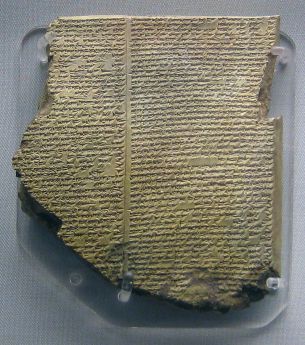
Deluge Tablet of the Gilgamesh Epic in Akkadian script (Wikipedia)
flood. In Utnapishtim’s narration, the rains lasted six days and nights; the boat then grounded on Mt. Nisir, a hatch was opened and the mountain could be seen; the boat rested for 6 days and nights; Utnapishtim then released a dove, which returned; a sparrow was released which also returned; a raven was released which found food, flew around and did not return. Utnapishtim then left the boat and made a sacrifice on the mountaintop. It is illuminating to compare these details to those found in Genesis 6-9.
This story is now near-universally accepted by biblical scholars as the origin of the flood story found in Genesis, but before its complete translation in 1870, no one knew that the story of Noah’s flood was not original with Genesis, but was based on a far earlier story.
Part II – Sandgrouse or Quail? & YHVH [יְהוָ֖ה] [Yahweh]
Part III – Junglefowl in Judea! & New Testament Koine Greek
Part IV – Birds that Sow, Reap and Store & Whence Jesus (Ἰησοῦς)
Part V – The Friendly Raven & The Bar-Abbas Mystery
Part VI – The Humble Hoopoe & Catching “Forty” Winks
Part VII – The Wise Hoopoe & On “On”
Part VIII –Don’t Eat That Bird! Part 1 & Of “Of”
Part IX – Don’t Eat that Bird! Part 2 & Seeing “Red”
Part X – Don’t Eat that Bird! The Last Bite & The Problems of Translation
[Chuck Almdale]
[This is the first in a series]
Additional Sources:
1. The Epic of Gilgamesh, translation and introduction by N.K. Sandars, 1964, Penguin Books, Baltimore. Pgs 7-16, 105-110.
2. New English Bible with the Apocrypha, The, Oxford Study Edition. Sandmel, Samuel, Suggs, M. Jack, Tkacik, Arnold J.; eds. (1972) Oxford University Press, New York
Pterosaur Exhibit & special Tours at Natural History Museum

Pterosaurs at L.A. Co. Museum of Natural History
If you haven’t seen this exhibit, don’t wait. If you like flying things, you’ll love this. The 125 known species of pterosaurs are not ancestors of birds, but they had the same evolutionary problems to solve.
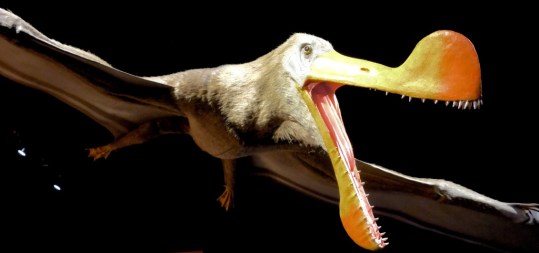
A hungry Anhanguera blittersdorffi in flight (Doug Waterman 8-10-16)
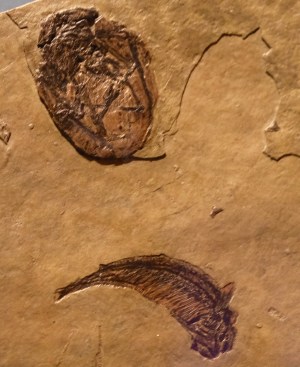
Pterosaur egg (top) & fish fossils
(Doug Waterman 8-10-16)
It’s fascinating to see how they did it and to contemplate the close similarities and vast differences which exist between these two evolutionary lines. Exhibit ends October 2.
Read all about it.
Go here to get your tickets or to become a museum member.
Daily Museum Tours for Everyone, free with paid ticket!
Link to Museum Calendar for complete details, including the items below:
The Museum presents four free tours daily.
1PM – Gallery Exploration Tour** – Meet at dueling dinosaurs at entrance.
In NHM’s award-winning tour, a Gallery Interpreter takes you on a journey featuring an intriguing new topic each day.
2PM – Gallery Highlights Tour – Meet at dueling dinosaurs at entrance.
Join a Gallery Interpreter to explore fascinating highlights of the Museum, including the Dinosaur Hall.
3PM – Meet a Live Animal – Level G Nature Lab
Greet a menagerie of animals, from snakes to tortoises to bugs.
4PM – Nature Walk – Level G Nature Lab
Walk through the Nature Gardens to explore the amazing biodiversity of life that also calls L.A. home.
Plus:
The Butterfly Garden will return September 16 – October 16, opening daily at 11AM.
Other events changing daily, including Dinosaur Encounters.
**Our 1PM Gallery Highlights Tour, led by Jessie, a very nice and knowledgeable young woman, was titled Mythology Unraveled: By looking at mythical creatures we are able to grasp humanity’s drive to understand the natural world. Through discussion of mythical creatures and seeing their real-life counterparts in the museum, we’ll explore the importance of tangible evidence, interpretation and that imaginative curiosity.
[Chuck Almdale]
Bird Checklist Updates – World, California, Los Angeles County
Since The Clements Checklist of Birds of the World, 6th. Edition was published in June, 2007, the Cornell Lab of Ornithology has updated it annually. Every August, they provide links to the updated checklist and the changes since the last checklist. This list is used by the American Birding Association and most North American birding groups for checklist and phylogenetic purposes.
Click for all updates, downloadable August 2018 checklist and general list information.
The California Bird Records Committee updates their California checklist every August, and includes taxonomic changes accepted by the American Ornithological Union.
We also have on our blogsite a PDF copy of the Field List of the Birds of Los Angeles County, most recently updated in July, 2014 by Kimball Garrett of the Los Angeles County Museum of Natural History. On the Birding Info. Pages, scroll down until you find “Los Angeles County Bird List Scientific Sequence.” There are also links to more recent checklists and sequences lists (non-checklist format).
[Chuck Almdale]



 SANTA MONICA BAY AUDUBON SOCIETY BLOG