Free email delivery
Please sign up for email delivery in the subscription area to the right.
No salesman will call, at least not from us. Maybe from someone else.
Caddis Fly Larva Video
Here’s an interesting film from Deep Look of a caddis fly larva building and hauling around his pebble home underwater. The home is built with something humans have not yet developed: “tape” that stays sticky underwater.
If no film or link appears in this email, go to the blog to view it by clicking on the blog title above.
If the film stops & starts in an annoying manner, press pause (lower left double bars ||) to let it buffer and get ahead of you.
[Chuck Almdale]
Rain-a-fallin’ at Malibu Lagoon, November 27, 2016
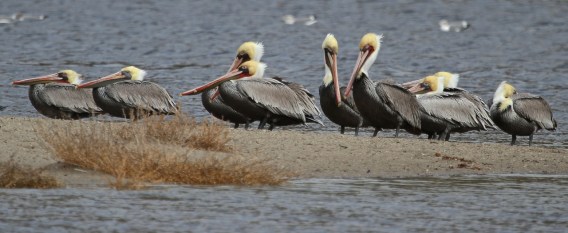
A panoramic panoply of pelicans (J. Waterman 11-27-16)
Despite the predicted sixteen percent probability of rain in Malibu, several showers insisted on falling. Raincoats or umbrellas were definitely needed. Scopes and binoculars got wet and I kept expecting my tiny paper checklist to dissolve from the damp. Despite this, We few! We hardy few! We band of birders! had a good morning of birding. More winter migrants have arrived (see list below) and, for excitement, we had an especially tricky time with two particular birds.

Adult White-crowned Sparrow with pink bill and black-and-white crown. Juveniles have brown two-toned caps. (J. Waterman 11-27-16)
First up was a scaup-type duck, one of the Aythya diving ducks. It had the annoying behavior of spending about two seconds on the surface for every twenty-to-thirty seconds of diving, so just when you re-found it, it dove again. After one or two dozen observations, each lasting a second or less, we generally agreed on a sopping wet Ring-necked Duck.

Ring-necked Duck, Aythya collaris (J. Waterman 11-27-16)
In Joyce’s photos it looks like it might be a male in eclipse plumage, but some on-line research indicates that little molting takes place between wing-molts of August and mid-winter molts. I considered the possibility of Redhead, partially due to this bird’s lack of a bump at the back of the crown, white streak behind the eye or white edging to the bill, but the curved demarcation between back and flanks and the large white bill-ring brought me back to Ring-necked.
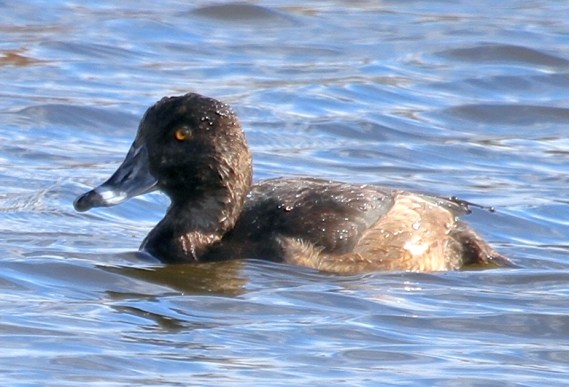
Ring-necked Duck (J. Waterman 11-27-16)
Much of the beach had disappeared from the recent storm and was about 25 yards wide at its narrowest. Water level in the lagoon was very high, with probably less than six inches of sand elevation left before it breaks through the berm and empties into the ocean. Between showers a few mullet jumped, but it was nothing like last month’s popcorn-like display.

Cormorants: Brandt’s (L) & Double-crested (R). Note gular pouch color difference, beige in the Brandt’s and yellow-orange in the Double-crested.
(J. Waterman 11-27-16)

Brown Pelican with leg bands. Blue band appears to read “N25” (J. Waterman 11-27-16)
The gull flock – over 90% California Gull – was ever-shifting between lagoon waters and the sandy beach. I counted 1,300 gulls but there could easily have been 1,000 more, as large flocks continually lifted off the sand and water and flew away before we drew close enough to count them.

Great Egret at full stretch, 39″ bill-tip to toe-tip
(J. Waterman 11-27-16)
East of the ever-changing gull flock was a small group of terns – all Royal Tern except for two smaller birds, one a Forster’s and the other…well, that was a problem. From a distance, with the birds pointing absolutely directly at us, and no view of their backs or sides or even the bill other than the tip, the two small birds looked very similar. Eventually the “other” bent his head down and we could see that the feathers fringing the crown were the same dark black from eye to eye around the nape. I thought there might be a carpel bar on the wing – or was that just a shadow caused by feather overlapping?

Elegant Tern through the telescope (Chris Tosdevin and his tiny phone 11-27-16)
We finally got past the gulls and studied the bird from the side and back, at which point it became obviously an Elegant with a very pale bill, no carpel bar, and a lot of white on its crown. Elegants become scarce to absent in SoCal winters – only 0.17% of all 10,000 Elegant Tern sightings at the lagoon have been in November. April, in contrast, has 66% of sightings.
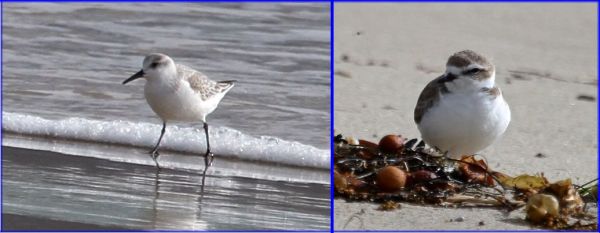
Sanderlings (L) and Snowy Plovers (R) get along well, frequently sharing roosting sites (J. Waterman 11-27-16)
We don’t get many Tree Swallows at the lagoon: 279 total birds on 24 visits over 35 years, with two prior November visits by single birds, so when a dozen of them cruised back and forth over the lagoon, we were surprised. It’s very difficult to photograph any small bird in flight; Joyce’s photo, capturing the blue-green glossy back, is quite remarkable.

Tree Swallow with back showing green gloss and dark around the eye
(J. Waterman 11-27-16)
We searched through the horde of Gulls for anything unusual, and found at least one Herring Gull with an extremely bright light eye. [Eye color is an important field mark in gulls who are annoyingly similar despite their numerous plumage changes.] There may have been a few other Herrings, but we kept losing them in the ever-shifting crowd.
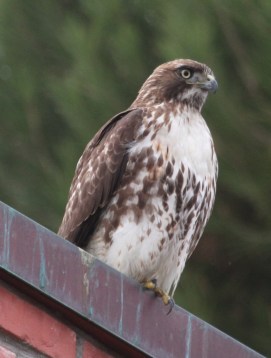
Red-tailed Hawk, juvenile ssp calurus
(J. Waterman 11-27-16)
A few of us continued on to Adamson House where we saw a few more passerines here and there, plus about a hundred coots and ducks hiding in the little inlet by the boathouse, sheltering from the blustery wind. The Red-tailed Hawk we’d earlier seen on the wall, atop the cypress and above the lagoon seemed to have captured a male Great-tailed Grackle and was flying around with it clutched in its talons. We then realized it was a large piece of black plastic stuck to one of his feet. Lu Plauzoles thought it might be “sticky plastic,” something people put out to trap unsuspecting mice. Whatever it was, he (the hawk) couldn’t get it off his feet, despite his frequent landing and brushing against limbs, fence lines and brush. If any of our readers lay out such devices, you might reconsider, seeing how much trouble it can cause to raptors who are quite willing to catch and eat your pesky mice for you, a service they will provide free-of-charge to our members and loyal readers.
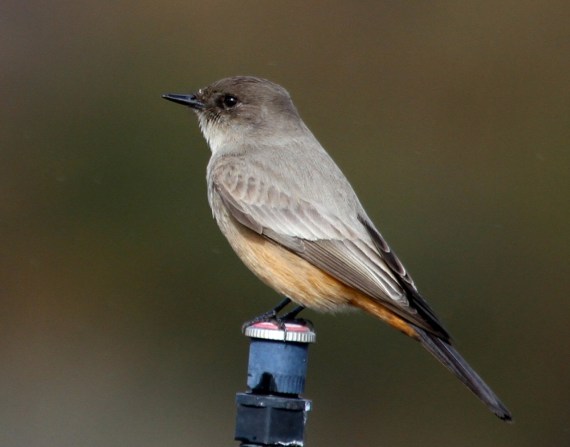
Winter visitor Say’s Phoebe: bird on a rainbird in the rain (J. Waterman 11-27-16)
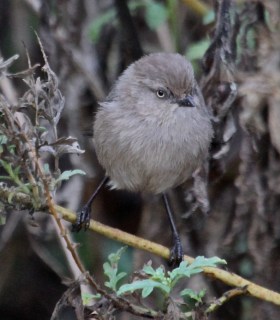
Female Bushtit has a yellow eye
(J. Waterman 11-27-16)
Birds new for the season were: Ring-necked Duck, Bufflehead, Red-breasted Merganser, Red-throated Loon, Horned Grebe, Brandt’s Cormorant, Red-tailed Hawk, Ring-billed Gull, Tree Swallow, Marsh Wren, Western Bluebird, Lincoln’s Sparrow, Brown-headed Cowbird.

House Finch male
(J. Waterman 11-27-16)
As always, many thanks to our photographers: Chris Tosdevin and Joyce Waterman.
Our next three scheduled field trips: Madrona Marsh, 10 Dec. 8:30am; Butterbredt Spring Christmas Count 17 Dec 8:30am; Malibu Lagoon 8:30 & 10am, 25 Dec.
Our next program: Can you be both a Bird Photographer and a Birder? with Randy Ehler, Tuesday, 6 Dec, 7:30 pm; Chris Reed Park, 1133 7th St., NE corner of 7th and Wilshire Blvd. in Santa Monica.

Ruddy Turnstones in winter, probing the wrack (J. Waterman 11-27-16)
NOTE: Our 10 a.m. Parent’s & Kids Birdwalk meets at the shaded viewpoint just south of the parking area. Watch for Willie the Weasel. He’ll be watching for you and your big floppy feet.
NOTE: Our 10 a.m. Parent’s & Kids Birdwalk meets at the shaded viewpoint just south of the parking area. Watch for Willie the Weasel. He’ll be watching for you and your big floppy feet.
Links: Unusual birds at Malibu Lagoon
9/23/02 Aerial photo of Malibu Lagoon
Prior checklists:
2016: Jan-June 2015: Jan-May, July-Dec
2014: Jan-July, July-Dec 2013: Jan-June, July-Dec
2012: Jan-June, July-Dec 2011: Jan-June, July-Dec
2010: Jan-June, July-Dec 2009: Jan-June, July-Dec
The 10-year comparison summaries created during the project period, despite numerous complaints, remain available on our Lagoon Project Bird Census Page. Very briefly summarized, the results unexpectedly indicate that avian species diversification and numbers improved slightly during the period Jun’12-June’14. [Chuck Almdale]
| Malibu Census 2016 | 6/26 | 7/24 | 8/28 | 9/25 | 10/23 | 11/27 |
| Temperature | 68-72 | 68-76 | 65-73 | 70-96 | 63-70 | 53-58 |
| Tide Lo/Hi Height | L+0.32 | L+0.20 | H+4.28 | H+4.39 | L+2.63 | H+5.79 |
| Tide Time | 0831 | 0707 | 0810 | 0708 | 1108 | 0729 |
| Brant | 2 | 1 | 1 | 1 | 1 | |
| Gadwall | 18 | 10 | 6 | 6 | 4 | |
| American Wigeon | 1 | 10 | 7 | |||
| Mallard | 30 | 25 | 24 | 35 | 23 | 22 |
| Northern Shoveler | 6 | |||||
| Northern Pintail | 4 | 3 | ||||
| Green-winged Teal | 2 | |||||
| Ring-necked Duck | 1 | |||||
| Bufflehead | 4 | |||||
| Red-brstd Merganser | 1 | 5 | ||||
| Ruddy Duck | 7 | 26 | ||||
| Red-throated Loon | 1 | |||||
| Pied-billed Grebe | 2 | 4 | 15 | 18 | 8 | |
| Horned Grebe | 1 | |||||
| Eared Grebe | 3 | 6 | ||||
| Western Grebe | 1 | 10 | 10 | |||
| Clark’s Grebe | 2 | 1 | ||||
| Blk-vented Shearwater | 200 | |||||
| Brandt’s Cormorant | 3 | 3 | ||||
| Dble-crstd Cormorant | 35 | 18 | 34 | 38 | 37 | 23 |
| Pelagic Cormorant | 2 | 1 | 2 | |||
| Brown Pelican | 94 | 39 | 9 | 1 | 30 | 37 |
| Great Blue Heron | 3 | 3 | 3 | 6 | 3 | 3 |
| Great Egret | 7 | 4 | 1 | 1 | 2 | 1 |
| Snowy Egret | 6 | 8 | 3 | 8 | 8 | 5 |
| Blk-crwnd N-Heron | 2 | |||||
| Turkey Vulture | 2 | |||||
| Osprey | 2 | 1 | 2 | |||
| Cooper’s Hawk | 2 | |||||
| Red-tailed Hawk | 1 | 1 | ||||
| Sora | 1 | |||||
| American Coot | 2 | 10 | 95 | 280 | 240 | |
| Blk-bellied Plover | 6 | 60 | 70 | 75 | 75 | 73 |
| Snowy Plover | 12 | 24 | 35 | 29 | 12 | |
| Semipalmated Plover | 4 | 8 | 5 | |||
| Killdeer | 8 | 6 | 9 | 29 | 1 | 2 |
| Mountain Plover | 1 | |||||
| Spotted Sandpiper | 3 | 5 | 2 | 1 | ||
| Greater Yellowlegs | 1 | |||||
| Willet | 11 | 30 | 2 | 10 | 20 | 3 |
| Whimbrel | 16 | 2 | 1 | 2 | 2 | |
| Marbled Godwit | 1 | 4 | 7 | 10 | ||
| Ruddy Turnstone | 5 | 9 | 3 | 7 | 14 | |
| Sanderling | 5 | 22 | 72 | 45 | ||
| Dunlin | 1 | |||||
| Baird’s Sandpiper | 5 | |||||
| Least Sandpiper | 15 | 2 | 4 | |||
| Western Sandpiper | 1 | 7 | 6 | 3 | ||
| Long-billed Dowitcher | 1 | |||||
| Heermann’s Gull | 130 | 12 | 4 | 6 | 15 | 12 |
| Mew Gull | 1 | |||||
| Ring-billed Gull | 1 | 5 | ||||
| Western Gull | 120 | 45 | 118 | 45 | 48 | 85 |
| California Gull | 3 | 1 | 27 | 1200 | ||
| Herring Gull | 1 | 1 | ||||
| Glaucous-wingd Gull | 1 | |||||
| Least Tern | 2 | |||||
| Caspian Tern | 11 | 2 | 2 | |||
| Common Tern | 1 | |||||
| Forster’s Tern | 1 | 3 | 2 | 1 | ||
| Royal Tern | 5 | 3 | 10 | 1 | 19 | 16 |
| Elegant Tern | 110 | 10 | 67 | 2 | 5 | 1 |
| Rock Pigeon | 23 | 4 | 8 | 17 | 15 | 5 |
| Mourning Dove | 2 | 2 | 2 | 1 | ||
| Anna’s Hummingbird | 3 | 1 | 1 | 1 | ||
| Allen’s Hummingbird | 1 | 5 | 5 | 1 | 1 | 1 |
| Belted Kingfisher | 2 | 2 | 1 | 1 | ||
| American Kestrel | 1 | 1 | 1 | |||
| Merlin | 1 | |||||
| Peregrine Falcon | 1 | |||||
| Nanday Parakeet | 3 | |||||
| Pac.-slope Flycatcher | 1 | |||||
| Black Phoebe | 2 | 7 | 3 | 9 | 5 | 5 |
| Say’s Phoebe | 2 | 1 | 1 | |||
| Ash-throated Flycatcher | 2 | |||||
| Western Kingbird | 1 | |||||
| California Scrub-Jay | 1 | 1 | 3 | 2 | 2 | 4 |
| American Crow | 6 | 3 | 5 | 7 | 7 | 4 |
| Tree Swallow | 12 | |||||
| Rough-wingd Swallow | 6 | 4 | 4 | |||
| Cliff Swallow | 7 | 15 | 4 | |||
| Barn Swallow | 20 | 20 | 20 | 1 | ||
| Oak Titmouse | 1 | |||||
| Bushtit | 15 | 5 | 27 | 30 | 35 | |
| House Wren | 1 | 2 | ||||
| Marsh Wren | 1 | |||||
| Bewick’s Wren | 1 | |||||
| Ruby-crowned Kinglet | 2 | 8 | ||||
| Western Bluebird | 2 | |||||
| Hermit Thrush | 1 | |||||
| American Robin | 1 | |||||
| Northern Mockingbird | 2 | 2 | 2 | 3 | 1 | 3 |
| European Starling | 10 | 40 | 20 | 17 | 45 | |
| Ornge-crwnd Warbler | 1 | 3 | 4 | |||
| Common Yellowthroat | 1 | 4 | 3 | 6 | 5 | 5 |
| Yellow-rumpd Warbler | 10 | 28 | ||||
| Wilson’s Warbler | 1 | |||||
| Spotted Towhee | 1 | 1 | 1 | |||
| California Towhee | 1 | 2 | 1 | |||
| Savannah Sparrow | 2 | |||||
| Song Sparrow | 3 | 3 | 2 | 6 | 4 | 8 |
| Lincoln’s Sparrow | 1 | |||||
| White-crwnd Sparrow | 2 | 25 | 45 | |||
| Red-winged Blackbird | 15 | 12 | 30 | 1 | 1 | |
| Western Meadowlark | 16 | 3 | ||||
| Great-tailed Grackle | 4 | 20 | 3 | 2 | 17 | 5 |
| Brwn-headed Cowbird | 3 | |||||
| Hooded Oriole | 3 | |||||
| Bullock’s Oriole | 2 | 1 | ||||
| House Finch | 6 | 25 | 6 | 30 | 18 | 9 |
| Lesser Goldfinch | 2 | |||||
| Totals by Type | Jun | Jul | Aug | Sep | Oct | Nov |
| Waterfowl | 33 | 44 | 35 | 55 | 50 | 69 |
| Water Birds – Other | 129 | 262 | 62 | 149 | 382 | 332 |
| Herons, Egrets & Ibis | 18 | 15 | 7 | 15 | 13 | 9 |
| Quail & Raptors | 3 | 5 | 2 | 4 | 1 | 1 |
| Shorebirds | 26 | 158 | 149 | 195 | 215 | 161 |
| Gulls & Terns | 382 | 74 | 206 | 54 | 118 | 1321 |
| Doves | 23 | 6 | 10 | 19 | 16 | 5 |
| Other Non-Passerines | 4 | 5 | 7 | 4 | 6 | 3 |
| Passerines | 86 | 174 | 118 | 140 | 183 | 186 |
| Totals Birds | 704 | 743 | 596 | 635 | 984 | 2087 |
| Total Species | Jun | Jul | 118 | Sep | Oct | Nov |
| Waterfowl | 3 | 3 | 3 | 7 | 6 | 7 |
| Water Birds – Other | 2 | 6 | 6 | 4 | 9 | 11 |
| Herons, Egrets & Ibis | 4 | 3 | 3 | 3 | 3 | 3 |
| Quail & Raptors | 2 | 3 | 2 | 3 | 1 | 1 |
| Shorebirds | 4 | 10 | 14 | 14 | 10 | 8 |
| Gulls & Terns | 9 | 6 | 8 | 4 | 8 | 8 |
| Doves | 1 | 2 | 2 | 2 | 2 | 1 |
| Other Non-Passerines | 2 | 1 | 2 | 3 | 4 | 3 |
| Passerines | 15 | 17 | 19 | 21 | 21 | 21 |
| Totals Species-111 | 42 | 51 | 59 | 61 | 64 | 63 |
Ballona Bird Walk Nov. 19, 2016: Field Trip Report
There has been a growing pressure on all active birders to post results as reports on eBird, the Cornell University citizen-science project. You will see that I am following that lead.
There are advantages and disadvantages to this practice, however, as my little tale will tell. We start our Ballona walk traditionally at the del Rey Lagoon, a City park with a remnant wetland that is linked to Ballona Creek with a mechanical tidal gate. Since this is a hotspot on the eBird map, I made a separate listing of the species observed.
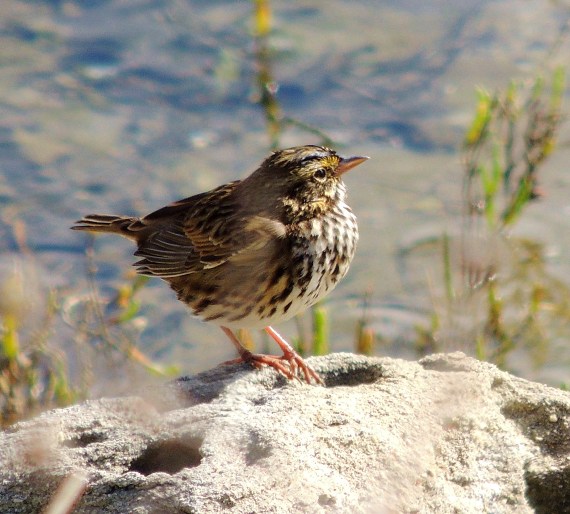
Belding’s Savannah Sparrow, Ballona Lagoon 11/19/16 Nancy Conner
Del Rey Lagoon Park
Comments: SMBAS field trip, continued to Ballona Creek/Marina Channel spit. Return to lagoon for 10 minutes additional observation at 11:15. 25 species
American Wigeon (Anas americana) 31
Mallard (Anas platyrhynchos) 6
Bufflehead (Bucephala albeola) 4
Western Grebe (Aechmophorus occidentalis) 1
American Coot (Fulica americana) 11
Whimbrel (Numenius phaeopus) 1
Marbled Godwit (Limosa fedoa) 1
Willet (Tringa semipalmata) 1
Bonaparte’s Gull (Chroicocephalus philadelphia) 17
Heermann’s Gull (Larus heermanni) 1
Ring-billed Gull (Larus delawarensis) 6
Western Gull (Larus occidentalis) 14
Rock Pigeon (Feral Pigeon) (Columba livia (Feral Pigeon)) 40
Mourning Dove (Zenaida macroura) 1
American Crow (Corvus brachyrhynchos) 3
Hermit Thrush (Catharus guttatus) 1
European Starling (Sturnus vulgaris) 12
Orange-crowned Warbler (Oreothlypis celata) 1
Yellow-rumped Warbler (Setophaga coronata) 30
White-crowned Sparrow (Zonotrichia leucophrys) 18
Song Sparrow (Melospiza melodia) 2
Lincoln’s Sparrow (Melospiza lincolnii) 1
Brewer’s Blackbird (Euphagus cyanocephalus) 1
House Finch (Haemorhous mexicanus) 14
House Sparrow (Passer domesticus) 2
However, in walking just 200 yards north, we entered another location, according to eBird. Therefore, a new list is required by eBird! The Ballona Creek spit and adjacent areas. This is where we find the pro and the con of electronic reporting. First, the con: many species are duplicated and after 3 hours of birding, I can only hope that my memory of the numbers seen of any of those species is accurate.
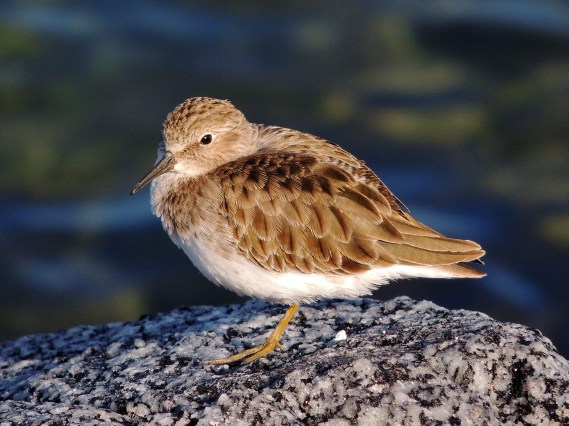
Least Sandpiper Ballona Lagoon 11/19/16 Nancy Conner
Another problem. Most serious birders who frequent that area are focused entirely on the relative rarities or firsts-of-season sightings, in the creek, and often neglect to report relatively “ordinary” passerines. Therefore the database for this hotspot is rather slim. I was forced by the program to justify such “rare” or exceptional species and quantities as Black and Says Phoebe, Least Sandpiper, Great Egret, etc. You will see the notes below, adjacent to each of these species.
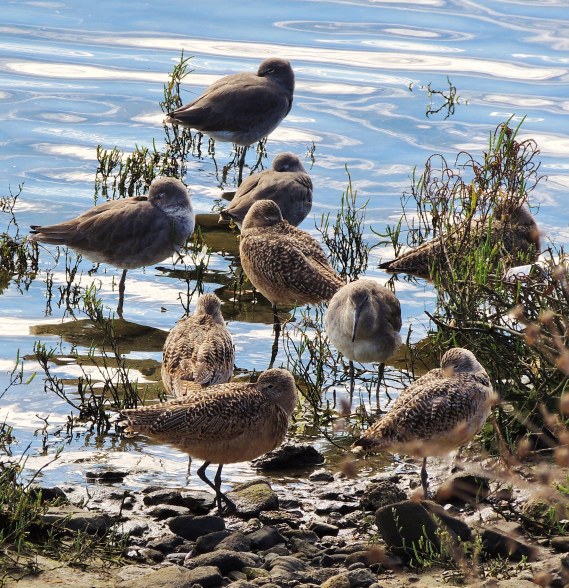
Marbled Godwits, Willets, Ballona Lagoon 11/19/16 Nancy Conner
The advantage of eBird however: the record will show that a number of expected species were not present, such as Surfbird, Ruddy Turnstone, Pelagic Cormorant…
As far as this birder was concerned, the close up view of the Pacific Loon’s rarely-seen collar was thrill enough for the trip. And the semi-resident Peregrine Falcon stayed on his perch for at least an hour, enabling photographers to get close.
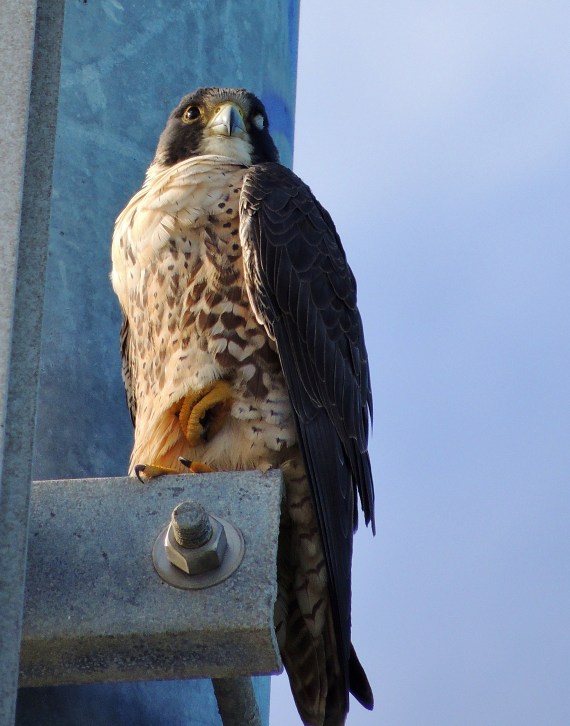
Peregrine Falcon Ballona Lagoon 11/19/16 Nancy Conner
Ballona Creek–Creek mouth, jetties & breakwater Nov 19, 2016 9:15 AM – 11:00 AM
Comments: Continuation of SMBAS field trip. See Del Rey Lagoon same day.
28 species
Bufflehead (Bucephala albeola) 6 4 M, 2 F below and app. 100 yds upstream from bridge.
Pacific Loon (Gavia pacifica) 1
Common Loon (Gavia immer) 1
Pied-billed Grebe (Podilymbus podiceps) 1 In Ballona Crk, just upstream from bridge.
Horned Grebe (Podiceps auritus) 1
Eared Grebe (Podiceps nigricollis) 2
Western Grebe (Aechmophorus occidentalis) 6
Brandt’s Cormorant (Phalacrocorax penicillatus) 10
Double-crested Cormorant (Phalacrocorax auritus) 13 2 in flight up creek, balance on breakwater (scoped).
Brown Pelican (Pelecanus occidentalis) 20
Great Blue Heron (Ardea herodias) 1
Great Egret (Ardea alba) 3
Snowy Egret (Egretta thula) 3
Whimbrel (Numenius phaeopus) 6
Marbled Godwit (Limosa fedoa) 20
Black Turnstone (Arenaria melanocephala) 2
Sanderling (Calidris alba) 12
Least Sandpiper (Calidris minutilla) 30 approx. 300 yds upstream from bridge on exposed rock and pickle weed bank, north side, with Black-bellied Plovers.
Willet (Tringa semipalmata) 18
Heermann’s Gull (Larus heermanni) 4
Ring-billed Gull (Larus delawarensis) 2
California Gull (Larus californicus) 1
Western Gull (hybrid) (Larus occidentalis) 15
Elegant Tern (Thalasseus elegans) 1
Rock Pigeon (Feral Pigeon) (Columba livia (Feral Pigeon)) 150 Numerous groups/flocks up to 40, flying over marina, creek and channel, as well as roosting on breakwater.
Peregrine Falcon (Falco peregrinus) 1 Perched 10 feet down from top of foghorn tower on end of spit. Perched for over one hour.
Black Phoebe (Sayornis nigricans) 4 On low tide exposed banks and rocks of creek.
Say’s Phoebe (Sayornis saya) 2 One on Dockweiler/creek spit, one 1/4 mile upstream on wetland fence.
European Starling (Sturnus vulgaris) 11 In Washingtonia Robusta, adjacent to apartments.
Weather partly cloudy to sunny. 64-75° F.
[Lucien Plauzoles]
SMBAS field class in Bird Identification
SMBAS will offer a short field course in bird identification in the spring of 2017. The course is intended to help new or novice birders improve their birding skills while learning how to identify some of the species commonly found in the Los Angeles basin.
The course will consist of 6 Saturday morning sessions, each of which will be held in a local park or natural area. Sessions will begin in mid-February, 2017.
Enrollment is limited to 8. A donation of $60 per SMBAS member or $90 per non-member will be requested.
For more information, send an e-mail to smbaudubon [AT] gmail.com and put “Bird Class” in the subject line or call 310-617-8904 and leave a message that includes your name and phone number.
Do Mother Hummingbirds Sleep?
Hummingbirds have voracious appetites, eating the human equivalent of an entire refrigerator full of food every day. Even sleeping hummingbirds have huge metabolic demands that must be met to survive the night. They conserve energy by going into nightly torpor, drastically lowering their metabolic rate and body temperature. The hummingbird behavior shown here is torpor, and is no cause for alarm.

Photo: Julie Kennedy
But can nesting females incubate their eggs well using torpor? A group of researchers, including LMU’s Center for Urban Resilience, aim to find out by using remote thermal sensing technology to run a comparative analysis between multiple nests in different micro environments. Hummingbirds provide an optimal species for study of the physiological mechanisms animals use to cope with extreme limitations. And a better understanding of these mechanisms may have broader application in medical technology.
If you wish to help, the project leaders are crowd-sourcing the purchase of equipment needed for the study, with a goal of $4900. [Jane Beseda]



