Free email delivery
Please sign up for email delivery in the subscription area to the right.
No salesman will call, at least not from us. Maybe from someone else.
Water-conserving rain barrels, nearly free!
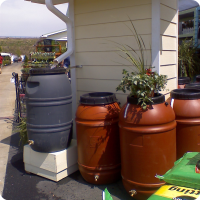
Typical Rain Barrels Int’l products
The winter’s not over; it still might rain.
Seriously, if you’re want to save water for your garden or lawn, this is a great deal. You buy rain barrels at a reduced rate, you install them at your house. Often a local official comes to check that you’ve actually installed them and aren’t trying to rip them off. In some towns such as Santa Monica, you must annually confirm your continued use of the barrels.
The really good part is that after you have installed the barrels, you get reimbursed the cost up to $75/barrel, 4 barrels maximum, for your expense! We installed four barrels last year and have collected many hundreds of gallons, much of which we’ve already used. Our barrels were $85 each and SoCal Water Smart paid for the entire amount (in 2015 they paid up to $100 per barrel).
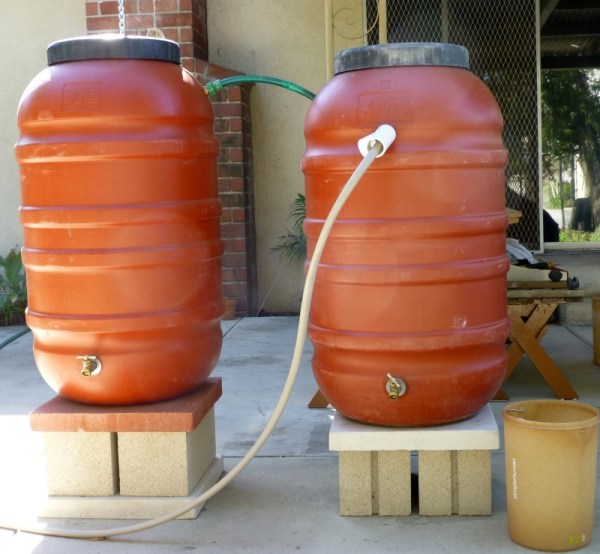
Rain barrel pair (C. Almdale 2-25-16)
You will probably have to do a little modification on some of your roof /gutter downspouts, but I bet you’ll be surprised how much fog drip you will also collect in the non-rainy season.
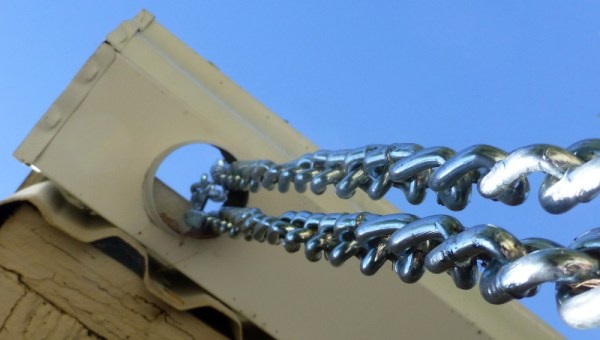
Chain, no downspout (C. Almdale 2-25-16)
The barrels cost $94-139 if bought from their website, the same price range as nearly every other rain barrel outlet. But you can pre-order and pre-pay $85 each for them and pick them up at one of their “events.” This must be done no later than the Wednesday prior to the event you’d like to attend. If they have extra barrels on hand, they bring them to the event. The event gives you all the information you need to start saving water.
Here is the link to their events:
Rain Barrels Int’l: http://www.rainbarrelsintl.com/events.asp
Their next event in the Santa Monica area is Sat., 2/27/16, 12-1:30 PM, at the Tree People HQ, 12601 Mulholland Dr., on the valley side (north) of Mulholland at Franklin Canyon Drive. If you want to get some rain barrels at this event, you must prepay no later than Weds. 2/24. They do this again, same time, same location, on 3/19. Directions!
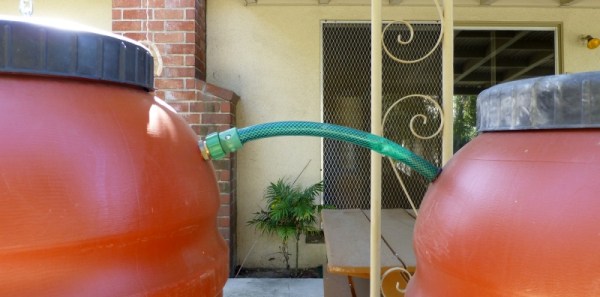
Ex-garden hose piece connects barrels
(C. Almdale 2-25-16)
[NOTE from Chuck Almdale] We picked up our 4 terra-cotta colored 58-gallon rain barrels on 10/24/15 at the Tree People “event.”
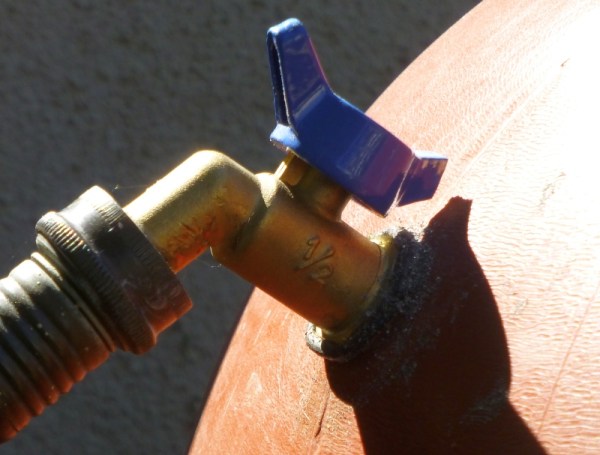
Replaced overflow spigot (C. Almdale 2-25-16)
They distributed the barrels, gave out some informative fliers and off we went. Four barrels fit easily into our VW bus; we might have been able to fit in eight barrels. There was no slide-show presentation. I modified the outlet spigots so they didn’t point slightly upward.
Rain Barrels Int’l describes their barrels as follows:
All of the barrels we use are recycled food grade barrels we purchase before they are disposed of into landfills. It is a WIN – WIN situation all the way around. Please help our environment by not only saving water, but by keeping these barrels out of landfills.
Specifications
- Dimensions vary slightly – approximately 40″ tall with 23″ diameter
- 55 + gallon capacity (some barrels slightly larger)
- Brass ¾” spigot for garden hose attachment
- Screen on top to prevent mosquitoes from accessing water
- Side brass overflow where a hose can be attached
- Made from recycled plastic food grade barrels
- Barrels retail in stores for $94.00 to $139.00
Thank you to Grace M. for the alert
[Lu Plauzoles & Chuck Almdale]
Dan Cooper to discuss status of CA Gnatcatcher, Cactus Wren in our local mountains
On Saturday, the 19th of March, Dan Cooper will give a class on the California Gnatcatcher and (coastal) Cactus Wren in the Santa Monica Mountains/Simi Hills. The Theodore Payne Foundation, Sun Valley is hosting the event.
Details are available at < https://www.eventbrite.com/e/new-the-california-gnatcatcher-and-coastal-cactus-wren-in-the-santa-monica-mountainssimi-hills-two-tickets-19665920297>
Full Snow Moon Update – February 22, 2016, 10:19 a.m. PST
Here’s another update from SMBAS Blog on that large, disc-like, shining object which has frequently and mysteriously appeared in our nighttime sky this year (referred to in hushed whispers as the moon).

Refuge Moonrise (T. Hinnebusch 2/14/14)
Feb. 22, 10:19 a.m. PST — Full Snow Moon. Usually the heaviest snowfalls occur during this month. Hunting becomes very difficult, and so to some tribes, this was the Full Hunger Moon. Storm Moon, Hunger Moon, Little Famine Moon, and Full Bony Moon are other traditional names for February’s full moon. [Infographic: Moon Phases & Lunar Cycles]
Note: Pacific Daylight Time starts on Sunday, March 13, 2016 at 2 AM (becoming 3 AM) and ends Sunday, November 6, 2016 at 2 AM (becoming 1 AM).
The Old Farmer’s Almanac has a page for each full moon. One tip: set your eggs on the 16th, 17th, 24th or 25th. Now you know, so you have no excuse.
The next significant full moon will occur on March 23, 5:00 a.m. PDT. Keep an eye on this spot for additional late-breaking news on this unprecedented event.
This information comes to you courtesy of: http://www.space.com/24262-weird-full-moon-names-2014-explained.html
written by Joe Rao. Joe Rao serves as an instructor and guest lecturer at New York’s Hayden Planetarium. He writes about astronomy for Natural History magazine, the Farmer’s Almanac and other publications, and he is also an on-camera meteorologist for News 12 Westchester, N.Y.
But that’s waaay too long to type in, and besides, you don’t need to go there because SMBAS has done the work for you!
[Chuck Almdale]
Hot Day at Sepulveda Wildlife Area
I think nearly everyone in SoCal will agree that someone else is getting our El Niño, and we’d like it back, thank you very much. Our total rainfall so far is lower than last year’s, which hardly seems possible, and record high temperatures were set all over SoCal this past week. Van Nuys Airport, a few blocks north of our field trip site, hit 82° today – not as bad as last year’s 88° for this date, but still far above the mean high of 63°. Enough! Time for rain and cooler weather. Bring it on!
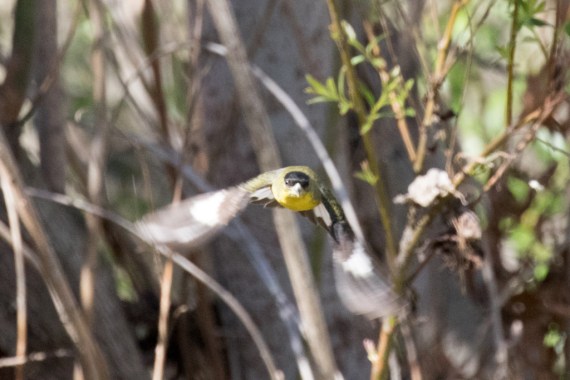
Lesser Goldfinch comin’ right at’cha (R. Ehler 2-13-16)
That said, it was a nice day and there were some lovely birds on hand for the throng of birders on hand. Considering the predicted temperatures, we should have started a half-hour earlier, but such foresight, unlike birders, failed to appear.
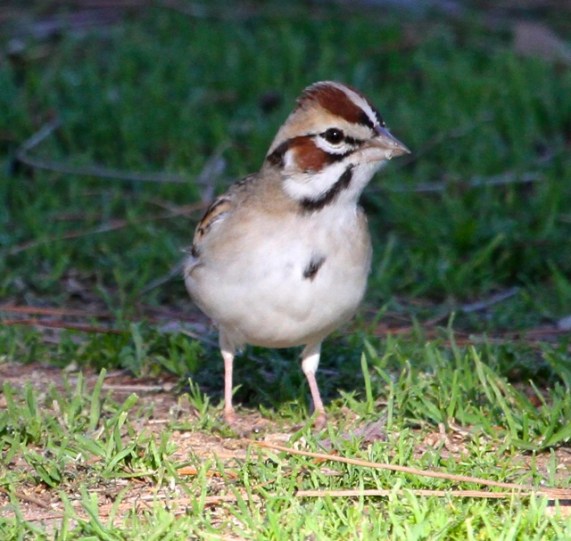
The elegant Lark Sparrow wearing his stickpin (J. Waterman 2-13-16)
We wandered around for a while, slowly wending our way over to the nesting Great Horned Owls, spotting various sparrows – Savannah, White-crowned, Lark, Song, Chipping and California Towhees – feeding on the grass. Every now and then a juvenile
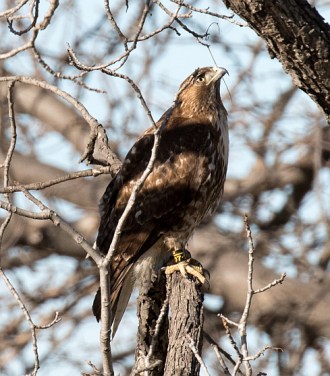
Juvenile Red-tailed Hawk (R. Ehler 2-13-16)
Red-tailed Hawk with a large ring on his right leg (black band with a yellow “07-50” visible) would come zooming by. It didn’t take long for

Closeup of #07-50 on hawk’s legband (R. Ehler 2-13-16)
the many Turkey Vultures to soar high on the thermals, waiting for something or someone to drop dead. After a few hours, I thought it might be me.
Lesser and American Goldfinches worked the seed-heads, Western Bluebirds, Cassin’s Kingbirds, Black Phoebes and an Ash-throated Flycatcher snagged flies, a
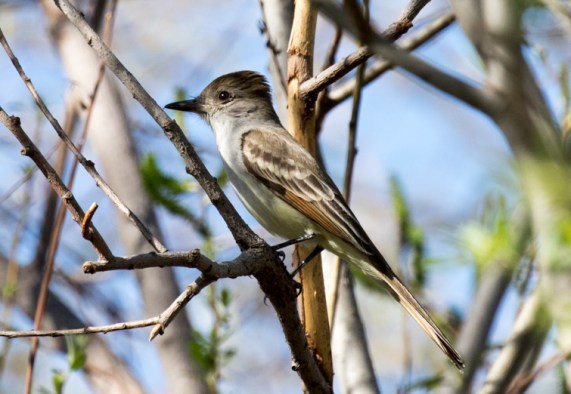
Ash-throated Flycatcher (R. Ehler 2-13-16)
half-dozen Yellow-chevroned Parakeets dropped into a treetop, the occasional woodpecker and sapsucker flailed away at tree trunks – no wonder it took us quite a while to get over to the owls.

Great Horned Owl mate stands guard (R. Ehler 2-13-16)
More than a few park users wandered over to see what some 30 birders were looking at up in that tree, and they were usually blown away by the view in the scope: one on the nest and one in a nearby tree, no visible owlets as yet. We found a few smashed up fur and bone- containing regurgitated owl pellets on the ground, but no one needed them for soup stock.

Great Horned Owl on the nest (R. Ehler 2-13-16)
Mallards and Pied-billed Grebes dominated the pond, sparking a discussion as to whether Pied-bills actually eat pies, about which we could not agree. Two Hooded Mergansers briefly swam, then ducked into the island bushes among the Canada Geese, Double-crested Cormorants, Black-crowned Night-Herons and three Egyptian Geese who had somehow slipped into the country past our Border Patrol. Around the reedy edges we found the usual suspects, including at least five Green Heron, a species we don’t always see there.

Green Heron, one of many (J. Waterman 2-13-16)
Warbler species were few: all we saw were a load of wintering Yellow-rumped in the grass and trees, and a handful of Common Yellowthroats around the pond and river.

Male Selasphorus – Allen’s or Rufous
(J. Waterman 2-13-16)
Anna’s and Allen’s Hummingbirds, plus one possible Rufous Hummingbird were perched on every bare twig. We examined them all. Most
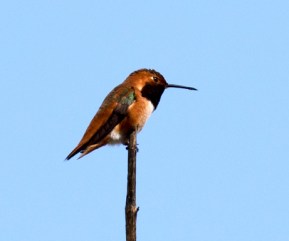
Very few green flecks on the back of this Selasporus hummer (R. Ehler 2-13-16)
were males, gorgets afire, apparently feeling their oats and ready to display to any female that passed by. They weren’t the only ones: California Thrashers, usually skulky shrub-hiders, were boldly singing their burbly songs with just a hint of mockery. Won’t they be surprised when the hot spell evaporates and winter returns.

Hooded Merganser pair displaying (R. Ehler 2-13-16)
It was 11:30 am by the time we reached the south end of the pond. I, for one, was tired and overly-hot, so the festivities were halted and we birded our way back to the cars. Chris and

Female Belted Kingfisher – look for the cinnamon (J. Waterman 2-13-16)
Liz – perhaps others – ambitiously continued to the Los Angeles River. There they found a few more ducks (see list annotations below) and a complete dearth of reeds. Apparently the Army Corp of Engineers, or some other bulldozer-wielding outfit, thought they ought to remove the reed beds between Balboa Blvd. and the retaining dam before the mighty rains of El Niño washed them all out, clogging up the the dam and backing up flood waters over half the San Fernando Valley. That’s my guess, anyway. So the usual reed-birds had moved to parts unknown, probably further upstream.
Many thanks to Randy Ehler & Joyce Waterman for all the great photos. A second thanks to Randy for sharing his trip list with me, as I was too busy talking to take decent notes. Thanks to Chris Lord for his input on the L.A. River.
I’m including sighting information for our last three Sepulveda Wildlife Area birdwalks below, just for the sake of comparison.
Previous Sepulveda Area trips: Dec. 2015 Oct 2013
Note: For 2/13/16, R = L.A. River; this count is included in the total count for each species.
Thus: Mallard 40 10R = total 40 Mallards includes 10 seen at the L.A. River
| Sepulveda Wildlife Area | 11/9/13 | 12/12/15 | 2/13/16 |
| Canada Goose | 7 | 45 | 16 |
| Egyptian Goose | 2 | ||
| Wood Duck | 2 | ||
| Gadwall | 2 | 8 | 6R |
| American Wigeon | 8 | 60 | 100R |
| Mallard | 50 | 50 | 40 10R |
| Ring-necked Duck | 1 | ||
| Bufflehead | 4 | ||
| Hooded Merganser | 2 | ||
| Pied-billed Grebe | 20 | 18 | 20 |
| Eared Grebe | 6 | ||
| Western Grebe | 1 | ||
| Double-crested Cormorant | 30 | 35 | 40 |
| American White Pelican | 12 | 28 | |
| Great Blue Heron | 4 | 3 | 3 |
| Great Egret | 4 | 3 | 3 |
| Snowy Egret | 2 | 2 | 1 |
| Green Heron | 3 | 5 | |
| Black-crowned Night-Heron | 5 | 5 | 7 |
| White-faced Ibis | 2 | ||
| Turkey Vulture | 8 | 12 | 20 |
| Osprey | 2 | 1 | 1 |
| Cooper’s Hawk | 1 | 1 | |
| Red-tailed Hawk | 2 | 4 | 5 1R |
| American Coot | 10 | 35 | 30 10R |
| Killdeer | 3 | ||
| Spotted Sandpiper | 2 | 2 | 1R |
| Greater Yellowlegs | 2 | ||
| Least Sandpiper | 15 | 40 | |
| Western Gull | 4 | 3 | |
| California Gull | 10 | 4 | |
| Rock Pigeon | 15 | 10 | |
| Mourning Dove | 8 | 30 | 20 |
| Great Horned Owl | 2 | ||
| White-throated Swift | 2 | ||
| Anna’s Hummingbird | 3 | 2 | 5 |
| Allen’s Hummingbird | 10 | 3 | 6 |
| Belted Kingfisher | 1 | 2 | 1 |
| Red-breasted Sapsucker | 1 | ||
| Nuttall’s Woodpecker | 2 | 1 | |
| Downy Woodpecker | 1 | ||
| Northern Flicker | 4 | 1 | 1 |
| Merlin | 1 | 1 | |
| Yellow-chevroned Parakeet | 8 | 6 | |
| Black Phoebe | 20 | 18 | 6 1R |
| Say’s Phoebe | 4 | 2 | |
| Ash-throated Flycatcher | 1 | ||
| Cassin’s Kingbird | 3 | 3 | |
| Western Scrub-Jay | 2 | 1 | |
| American Crow | 10 | ||
| No. Rough-winged Swallow | 24 | ||
| Barn Swallow | 6 | ||
| Bushtit | 8 | ||
| Bewick’s Wren | 1 | 4 2R | |
| Blue-gray Gnatcatcher | 2 | 10 | |
| Ruby-crowned Kinglet | 6 | 15 | 3 |
| Western Bluebird | 3 | ||
| Hermit Thrush | 1 | ||
| American Robin | 1 | ||
| California Thrasher | 1 | 1 | 5 |
| Northern Mockingbird | 5 | 2 | |
| European Starling | 30 | ||
| American Pipit | 12 | 4 | 1R |
| Common Yellowthroat | 6 | 4 | 5 2R |
| Yellow-rumped Warbler | 40 | 35 | 20 |
| Chipping Sparrow | 10 | 8 | |
| Lark Sparrow | 5 | 6 | 15 |
| Dark-eyed Junco | 8 | ||
| White-crowned Sparrow | 30 | 50 | 60 |
| Savannah Sparrow | 10 | 2 | 15 |
| Song Sparrow | 10 | 5 | 4 |
| California Towhee | 8 | 15 | 10 |
| Spotted Towhee | 2 | 2 | 1 |
| Red-winged Blackbird | 4 | 8 | |
| Western Meadowlark | 15 | 40 | |
| House Finch | 30 | 15 | 25 |
| Lesser Goldfinch | 4 | 30 | |
| American Goldfinch | 30 | 25 | 5 |
| House Sparrow | 6 | ||
| TOTAL SPECIES – 77 | 62 | 50 | 55 |
Police Dinosaurs Chase Flying Robots
In the category of Reality Is Where You Find It, this link takes you to an article and video about Dutch police training eagles to attack drones (in emergency situations only, regrettably).



 SANTA MONICA BAY AUDUBON SOCIETY BLOG