Free email delivery
Please sign up for email delivery in the subscription area to the right.
No salesman will call, at least not from us. Maybe from someone else.
A Chilly Sepulveda Basin Trip: 12 December, 2015
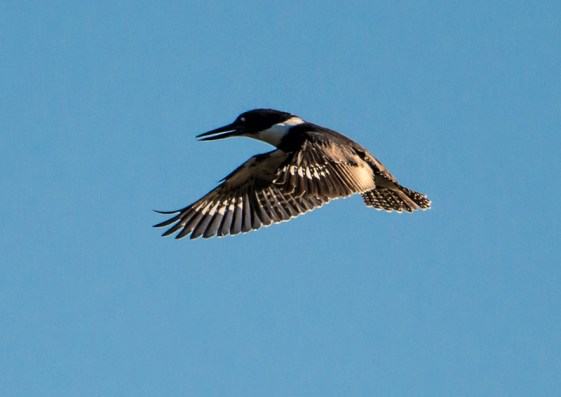
Both male & female Belted Kingfishers were present (Ray Juncosa 12/12/15)
Some newcomers showed up for this hastily organized field trip, which replaced the Carrizo Plain trip canceled late yesterday: Austin – fairly new to birding but quickly catching on – is a chapter member, and Wayne, who is not a member, but is a blog reader, and who escapes the Halifax, Nova Scotia winters for five months every year by staying in L.A. and looking at birds.
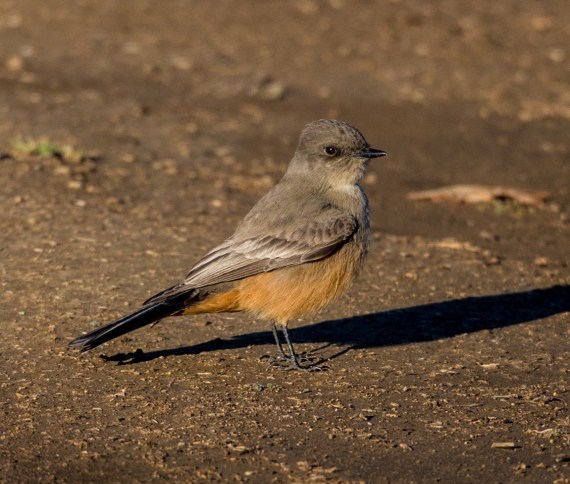
Say’s Phoebe busily flycatching by the fence (Ray Juncosa 12/12/15)
While waiting for potential late arrivals, we checked the lawn & trees near the parking lot, turning up a variety of Sparrows – Chipping, Lark, Savannah, and White-crowned. Near the south fence bordering the nature reserve we happened on a large flock of Western Meadowlarks, most of them out in the field, who flushed and re-lit farther away. A Merlin then flew by in the distance. On our way to the reserve entrance we found

California Towhee (Ray Juncosa 12/12/15)
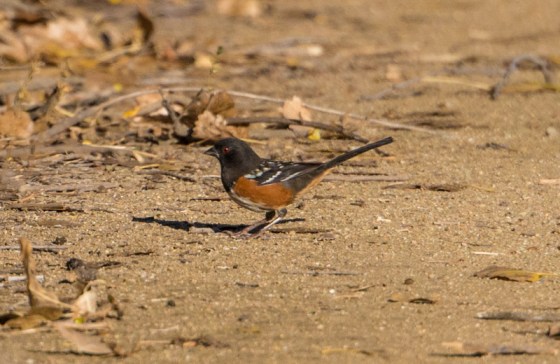
Spotted Towhee (Ray Juncosa 12/12/15)
California & Spotted Towhees, Black & Say’s Phoebes, a Song Sparrow, the first of many Ruby-crowned Kinglets, American Goldfinches, House Finches and some of the ever-present wintering Yellow-rumped Warblers hopping through the foliage and shagging flies from the canopy.
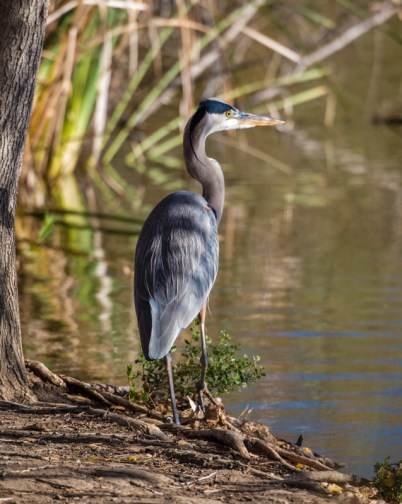
This Great Blue Heron almost picked our pockets
(Ray Juncosa 12/12/15)
We made it all of 20 ft. into the reserve before hitting a low wall of sparrows – more of the same as earlier – who worked the pathway before us, joined by a California Thrasher. I haven’t read of any problems in the thrasher population, but I don’t see nearly as many Cal Thrashers as I did decades ago. Anna’s and Allen’s hummers shot in to perch on twig ends above us. A Downy Woodpecker popped in and out of a Cottonwood tree.
The pond was populated by the usual suspects: various ducks, grebes, coots, pelicans, cormorants and egrets (see the list below for their exact names). The Black-crowned Night-Herons hid among the reeds, occasionally flying across the pond. An
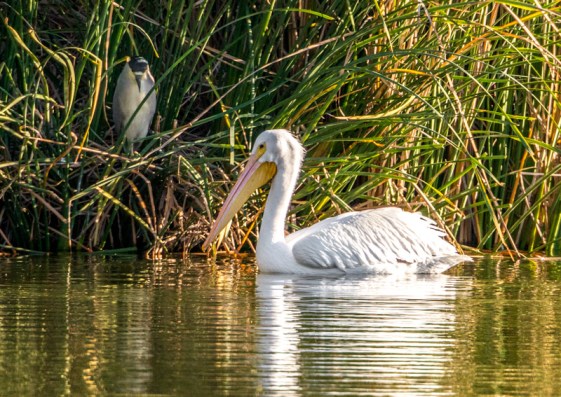
American White Pelican & Black-crowned Night-Heron (Ray Juncosa 12/12/15)
Osprey flew past in the distance, and a small group of Turkey Vultures roused themselves on this chilly morning from the leafy dark of the island floor. It turned out, oddly enough, to be a very good day for both Turkey Vultures and California Towhees.

This juvenile Red-tailed Hawk is likely the same bird pictured below, sitting in the tree.
(Ray Juncosa 12/12/15)
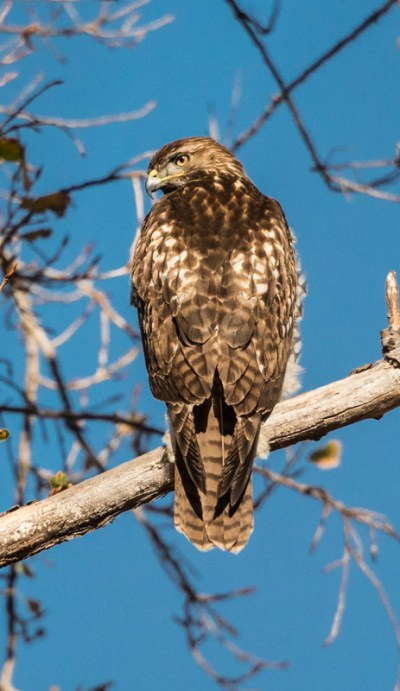
A Red-tailed Hawk’s mottled back (Ray Juncosa 12/12/15)
As said, it was rather chilly, with temperatures in the low 50’s (F) – my apologies to those of you currently suffering in cold climes, who would gladly snap off a frozen arm to be here now. Gloves felt good. I’ve read that in Norway this time of year the locals make great sport of catching scoters – called scoter-fanger, I believe – swimming through the ice-strewn fjord, wearing only swim fins, breath-holding for extraordinary lengths of time, rising under an unsuspecting scoter as it paddles past icy gray rock walls, catching the bird’s feet with their teeth and yanking them underwater. But we don’t do that here. The closest we come is downing an iced cola and hot dog drowned in chili sauce while reclining at the movies.
We spotted a very dark Red-tailed Hawk sitting in a tree, and later saw one soaring: dark brown head and belly with dark reddish brown chest. It was nearly a dead ringer of a bird photo’d two years ago at the same location. Unfortunately we did not see the immature Bald Eagle reported a few days ago.

This adult Dark Red-tail Hawk from two years ago was a dead ringer for one we saw today. (T. Hinnebusch 11/9/13)
We encountered many more kinglets, gnatcatchers, sparrows and finches south of Burbank Blvd. on our way to the Los Angeles River, along with a lovely Black-throated Gray Warbler. The vegetation, mostly willows and cottonwoods, is beginning to recover from the
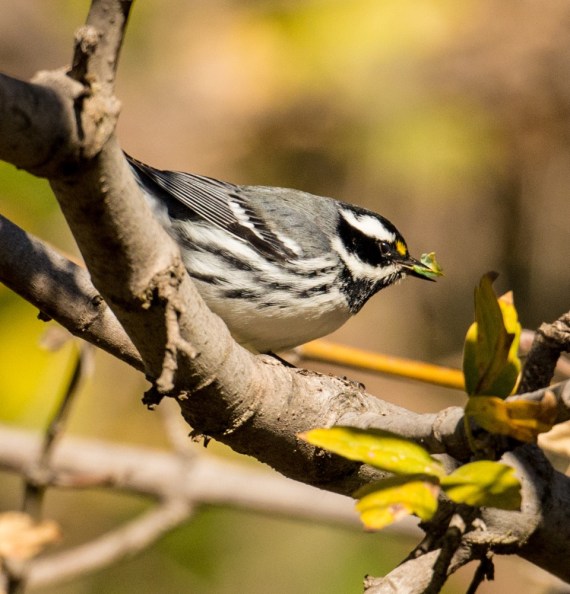
Black-throated Gray Warbler seizes a vermiform (Ray Juncosa 12/12/15)
havoc wreaked several years ago by the U.S. Army Corps of Engineers when they decided to remove most of the trees, failing to notify anyone of their intentions. (“We don’t have to,” they said, in a remarkable impersonation of Lily Tomlin’s telephone operator character, “we’re the Army Corp of Engineers.”)
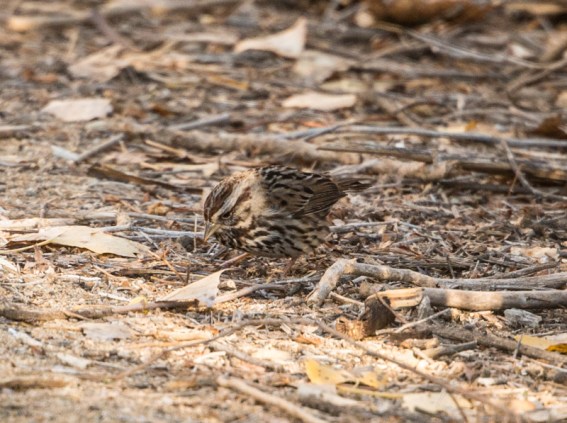
Song Sparrow (Ray Juncosa 12/12/15)
More ducks, mostly American Wigeons, the ubiquitous Mallards, and a few Bufflehead. A pair of Greater Yellowlegs worked one stream edge, some Spotted Sandpipers the other, a few American Pipits the stony stream-islands between. A flock of Least Sandpipers then flew in and began eagerly foraging at the water’s edge. We searched the reeds and grasses for Orange Bishops, but saw none.
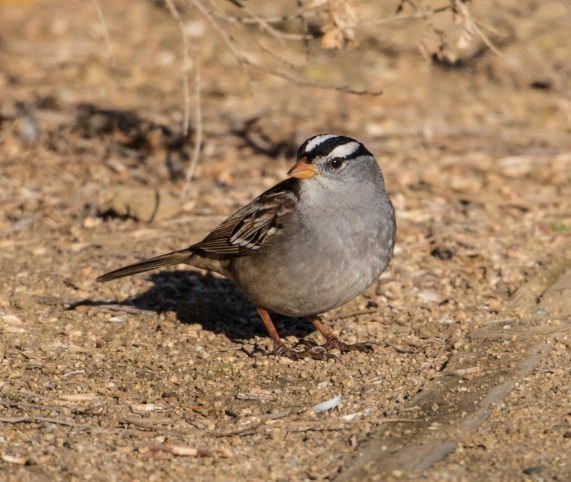
White-crowned Sparrows were common (Ray Juncosa 12/12/15)
On the way back to our cars we saw a few more Red-tailed Hawks and many Turkey Vultures soaring on the thermals. By the time we finished, it was nearly warm enough to support human life.
Many thanks to Ray Juncosa for his photographs. [Chuck Almdale]
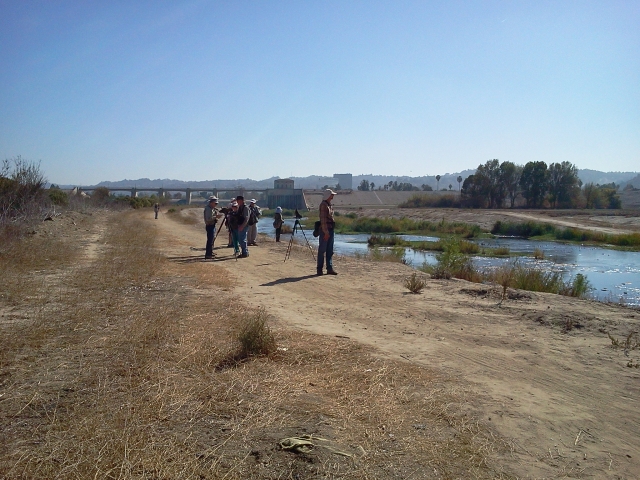
Los Angeles River looking southeast towards Sepulveda flood control dam (L. Johnson 11/9/13)
| Trip Lists Sepulveda Basin – Ponds & L.A. River areas | |||
| Name | Scientific Name | 11/9/13 | 12/12/15 |
| Canada Goose | Branta canadensis | 7 | 45 |
| Wood Duck | Aix sponsa | 2 | |
| Gadwall | Anas strepera | 2 | 8 |
| American Wigeon | Anas americana | 8 | 60 |
| Mallard | Anas platyrhynchos | 50 | 50 |
| Ring-necked Duck | Aythya collaris | 1 | |
| Bufflehead | Bucephala albeola | 4 | |
| Pied-billed Grebe | Podilymbus podiceps | 20 | 18 |
| Eared Grebe | Podiceps nigricollis | 6 | |
| Western Grebe | Aechmophorus occidentalis | 1 | |
| Double-crested Cormorant | Phalacrocorax auritus | 30 | 35 |
| American White Pelican | Pelecanus erythrorhynchos | 12 | 28 |
| Great Blue Heron | Ardea herodias | 4 | 3 |
| Great Egret | Ardea alba | 4 | 3 |
| Snowy Egret | Egretta thula | 2 | 2 |
| Green Heron | Butorides virescens | 3 | |
| Black-crowned Night-Heron | Nycticorax nycticorax | 5 | 5 |
| White-faced Ibis | Plegadis chihi | 2 | |
| Turkey Vulture | Cathartes aura | 8 | 12 |
| Osprey | Pandion haliaetus | 2 | 1 |
| Cooper’s Hawk | Accipiter cooperii | 1 | |
| Red-tailed Hawk | Buteo jamaicensis | 2 | 4 |
| American Coot | Fulica americana | 10 | 35 |
| Killdeer | Charadrius vociferus | 3 | |
| Spotted Sandpiper | Actitis macularius | 2 | 2 |
| Greater Yellowlegs | Tringa melanoleuca | 2 | |
| Least Sandpiper | Calidris minutilla | 15 | 40 |
| Western Gull | Larus occidentalis | 4 | |
| California Gull | Larus californicus | 10 | 4 |
| Rock Pigeon | Columba livia | 15 | 10 |
| Mourning Dove | Zenaida macroura | 8 | 30 |
| Anna’s Hummingbird | Calypte anna | 3 | 2 |
| Allen’s Hummingbird | Selasphorus sasin | 10 | 3 |
| Belted Kingfisher | Megaceryle alcyon | 1 | 2 |
| Nuttall’s Woodpecker | Picoides nuttallii | 2 | |
| Downy Woodpecker | Picoides pubescens | 1 | |
| Northern Flicker | Colaptes auratus | 4 | 1 |
| Merlin | Falco columbarius | 1 | 1 |
| Yellow-chevroned Parakeet | Brotogeris chiriri | 8 | |
| Black Phoebe | Sayornis nigricans | 20 | 18 |
| Say’s Phoebe | Sayornis saya | 4 | 2 |
| Cassin’s Kingbird | Tyrannus vociferans | 3 | |
| Western Scrub-Jay | Aphelocoma californica | 2 | |
| American Crow | Corvus brachyrhynchos | 10 | |
| Northern Rough-winged Swallow | Stelgidopteryx serripennis | 24 | |
| Barn Swallow | Hirundo rustica | 6 | |
| Bushtit | Psaltriparus minimus | 8 | |
| Bewick’s Wren | Thryomanes bewickii | 1 | |
| Blue-gray Gnatcatcher | Polioptila caerulea | 2 | 10 |
| Ruby-crowned Kinglet | Regulus calendula | 6 | 15 |
| American Robin | Turdus migratorius | 1 | |
| California Thrasher | Toxostoma redivivum | 1 | 1 |
| Northern Mockingbird | Mimus polyglottos | 5 | |
| American Pipit | Anthus rubescens | 12 | 4 |
| Common Yellowthroat | Geothlypis trichas | 6 | 4 |
| Yellow-rumped Warbler | Setophaga coronata | 40 | 35 |
| Chipping Sparrow | Spizella passerina | 10 | |
| Lark Sparrow | Chondestes grammacus | 5 | 6 |
| Dark-eyed Junco | Junco hyemalis | 8 | |
| White-crowned Sparrow | Zonotrichia leucophrys | 30 | 50 |
| Savannah Sparrow | Passerculus sandwichensis | 10 | 2 |
| Song Sparrow | Melospiza melodia | 10 | 5 |
| California Towhee | Melozone crissalis | 8 | 15 |
| Spotted Towhee | Pipilo maculatus | 2 | 2 |
| Red-winged Blackbird | Agelaius phoeniceus | 4 | |
| Western Meadowlark | Sturnella neglecta | 15 | 40 |
| House Finch | Haemorhous mexicanus | 30 | 15 |
| Lesser Goldfinch | Spinus psaltria | 4 | |
| American Goldfinch | Spinus tristis | 30 | 25 |
| House Sparrow | Passer domesticus | 6 | |
| TOTAL SPECIES – 70 | 61 | 50 | |
Great Bird Movie, limited release
Our friends in surrounding Audubon chapters have shared this with us.

The Messenger, a carefully-crafted documentary about the decline of songbirds in the world will be playing for one week at the Laemmle ROYAL Theater 11523 Santa Monica Blvd. 90025 starting December 11th but only through the 17th.
A look at the trailers at http://www.songbirdsos.com/videos/will certainly persuade you that this is the best piece of movie-making about birds to have been released since Winged Migration. Stunning visuals, solid scientific content, and reasoned advocacy make for a landmark film. There will be a panel discussion immediately following the evening showing on the 11th.
Weird-looking Animals
All real. For 34 more animals, go to The Dodo: Strange-looking animals you had no idea existed.
I’ve seen six of these, and knew of another eleven. What about you?
For example:

Orange Tortoise Spider (from Imgur)

Narrow-headed Softshell Turtle (from Imgur)

Glass Frog (from Imgur)

Coconut Crab (from Imgur)
I’ve seen what coconut crabs do to coconuts, and long wondered just how big these things must be to crack coconuts with their claws. Now I know. As the old song says: “Don’t sleep under the coconut tree with anything else but me, anything else but me, anything else but me, no no no…”
(Chuck Almdale)
Malibu Lagoon Trip Report: 22 November, 2015

Hooded Merganser pair (R. Ehler 11/22/15)
The tide was descending to the 12:41 pm low, so we didn’t need to dodge waves. The beach looked no smaller than last month. However, reports continue of waves washing across the beach into the lagoon, and the expected “king tides” may well gobble up what beach remains. It should be an exciting winter, probably too exciting for those living in beach houses.

Sora calling (R. Ehler 11/22/15)
Sometimes it’s nice to be wrong. In September I wrote, “I will not be shocked to see Sora appear sometime in 2016…” Much to our surprise, a Sora appeared, flying and swimming between the several small reed patches. Perhaps a Virginia Rail isn’t far behind. And at least one Marsh Wren has been present since September.

Sora flying between reed patches (R. Ehler 11/22/15)
Snowy Plovers – nowhere to be found at 8:30 am – scurried about the beach by 10 am. We found 28, including banded bird GA:OY. This bird was fledged up the coast at Oceano Dunes

Snowy Plover GA:UY (J. Waterman 11/22/15)
in Summer’14, and previously seen at the lagoon at least five times. Snowy Plovers usually avoid the surf zone, their food found in the high tide wrack line, but today a few were down at
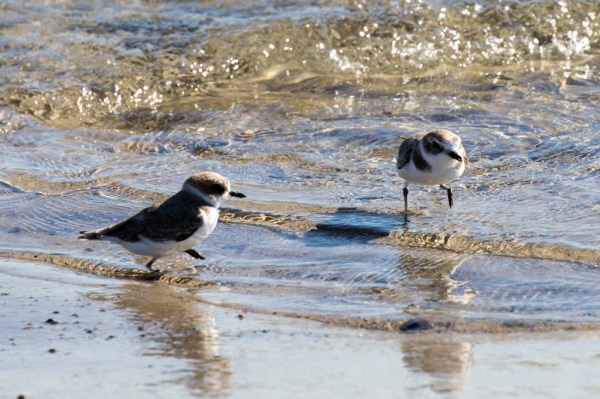
Snowy Plovers at sea’s edge for a change (R. Ehler 11/22/15)
the ocean’s edge (see photo), perhaps because the waves were quite small. It would be very interesting to know where they go when – as occurred last month – they’re not near their winter roosting area. During their winter roosting season of July – April, they customarily stay near their roosts, straying no more than 200 yards, and stay usually much closer.
If any Malibu area readers see them elsewhere in Malibu (except Zuma Beach), send us a message. Where they go when not at their roost area has long been a mystery.

Sanderling – often confused with Snowy Plover (R. Ehler 11/22/15)
The swans are gone, probably never to return. But a pair of Hooded Merganser appeared, hiding among the numerous Ruddy Ducks. An infrequent visitor, this is only their 18th visit out of 312 census dates, with a total of 48 birds. In recent history we’ve seen two pair on 12/28/14 and one pair on 12/24/95. But back in the old days, before the year of the Blue Snow (who could forget that), they’d appear and stay for a while: a pair in Jan’90 – Mar’90, another pair in Nov’80 – Mar’81, and 3 to 5 birds in Nov’79 – Jan’80. At that time they nearly always stayed in the deep pool area just inland of the PCH bridge, surrounded by Ruddy Ducks, of course.
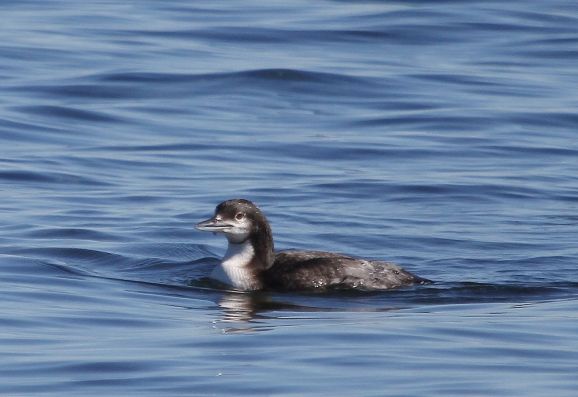
Pacific Loon – note chinstrap, slender bill, unpatterned back, sharp division between front and back of neck (J. Waterman 11/22/15)
All three species of winter loons appeared: Red-throated and Pacific Loons close to the surf zone, and Common Loons both in the surf zone and in the lagoon. Look closely for the Pacific’s “chinstrap” in the photo. Before the Pacific was split from the Arctic Loon some decades ago, it was understood that at least 80% of Arctic Loons had this chinstrap. After the split, the Eurasian area Arctic Loons were bereft of straps, as this characteristic had been peculiar to the Pacific Loon all along.
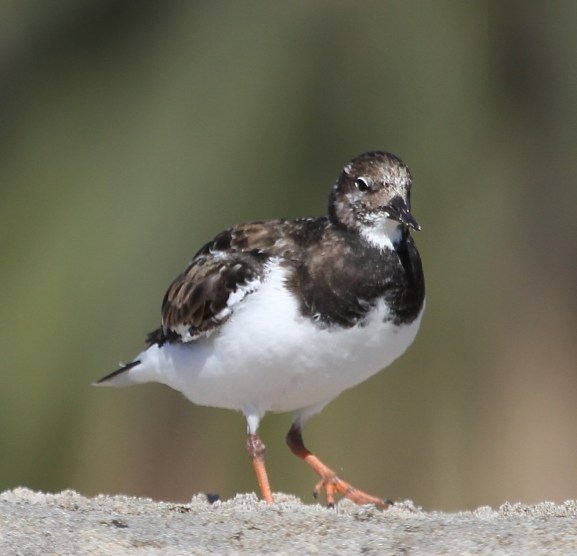
Mystery Bird (J. Waterman 11/22/15)
Finally, we end with a mystery shorebird we found on the beach near the Snowy Plover roost. I sent these photos off to a local expert (to be named at a later date), who pronounced it, “A very interesting looking bird,” and sent it off to shorebird experts elsewhere. We await the results. Take a look, dig out your field guides, and make your best guess.
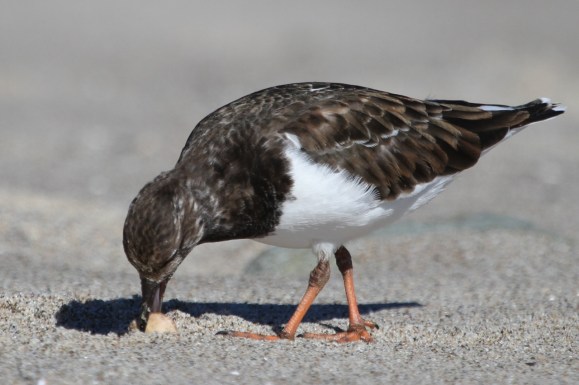
Mystery Bird (J. Waterman 11/22/15)
Birds new for the season were: Canada Goose, American Wigeon, Surf Scoter, Bufflehead, Hooded & Red-breasted Mergansers, Red-throated, Pacific & Common Loons, Osprey, Sora, Glaucous-winged Gull, American Kestrel.
As always, many thanks to the photographers: Randy Ehler and Joyce Waterman.

Blue-gray Gnatcatcher (J. Waterman 11/22/15)
Our next four scheduled field trips: Carrizo Plain, 12 Dec. 9:00am (sign up required); Butterbredt Christmas Count, 19 Dec. 8:30am; Annenberg Beach Club walk, 20 Dec. 9am; Malibu Lagoon 8:30 & 10am, 27 December.
Our next program: Pine Siskin Migration Research with Heather Watts on Tuesday, 1 December, 7:30 pm, at [note location change] Chris Reed Park, 1133 7th St., NE corner of 7th and Wilshire Blvd. in Santa Monica.
NOTE: Our 10 a.m. Parent’s & Kids Birdwalk meets at the shaded viewing area. Watch for Willie the Weasel. He’ll be watching for you and your big floppy feet.

American Kestrel female in flight (R. Ehler 11/22/15)
Links: Unusual birds at Malibu Lagoon
9/23/02 Aerial photo of Malibu Lagoon
Prior checklists:
2015: Jan-May
2014: Jan-July, July-Dec 2013: Jan-June, July-Dec
2012: Jan-June, July-Dec 2011: Jan-June, July-Dec
2010: Jan-June, July-Dec 2009: Jan-June, July-Dec
The 10-year comparison summaries created during the project period, despite numerous complaints, remain available on our Lagoon Project Bird Census Page. Very briefly summarized, the results unexpectedly indicate that avian species diversification and numbers improved slightly during the period Jun’12-June’14. [Chuck Almdale]
| Malibu Census 2015 | 5/24 | 7/26 | 8/23 | 9/27 | 10/24 | 11/22 |
| Temperature | 59-70 | 70-82 | 70-77 | 68-77 | 64-75 | 64-76 |
| Tide Lo/Hi Height | L+0.54 | L+2.37 | L+2.80 | H+5.94 | H+5.93 | L+0.24 |
| Tide Time | 0927 | 1143 | 0944 | 0918 | 0810 | 1241 |
| Brant | 7 | 1 | ||||
| Canada Goose | 11 | |||||
| Mute Swan | 2 | 2 | ||||
| Gadwall | 22 | 5 | 8 | 54 | 15 | 4 |
| American Wigeon | 2 | |||||
| Mallard | 8 | 55 | 35 | 34 | 30 | 25 |
| Northern Shoveler | 6 | 8 | ||||
| Green-winged Teal | 4 | 10 | ||||
| Surf Scoter | 1 | |||||
| Bufflehead | 4 | |||||
| Hooded Merganser | 2 | |||||
| Red-breastd Merganser | 1 | 1 | 2 | |||
| Ruddy Duck | 5 | 68 | 110 | |||
| Red-throated Loon | 1 | |||||
| Pacific Loon | 1 | 2 | ||||
| Common Loon | 2 | |||||
| Pied-billed Grebe | 1 | 3 | 2 | 3 | 3 | |
| Horned Grebe | 2 | |||||
| Eared Grebe | 8 | 10 | 10 | |||
| Western Grebe | 1 | 3 | 15 | |||
| Brandt’s Cormorant | 1 | 2 | 1 | |||
| Dble-crestd Cormorant | 55 | 34 | 43 | 36 | 29 | 45 |
| Pelagic Cormorant | 4 | 2 | 1 | 2 | ||
| Brown Pelican | 70 | 17 | 3 | 6 | 42 | 11 |
| Great Blue Heron | 2 | 4 | 8 | 4 | 4 | 3 |
| Great Egret | 5 | 4 | 6 | 3 | 5 | 1 |
| Snowy Egret | 4 | 6 | 22 | 18 | 12 | 8 |
| Blck-crwnd N-Heron | 2 | 3 | 3 | 3 | 1 | |
| Osprey | 1 | |||||
| Cooper’s Hawk | 1 | |||||
| Red-tailed Hawk | 1 | |||||
| Sora | 1 | |||||
| American Coot | 1 | 1 | 4 | 75 | 55 | 60 |
| Black-bellied Plover | 27 | 75 | 84 | 62 | 33 | |
| Snowy Plover | 16 | 21 | 32 | 28 | ||
| Semipalmated Plover | 1 | 5 | 2 | |||
| Killdeer | 6 | 4 | 6 | 10 | 15 | 4 |
| Spotted Sandpiper | 1 | 3 | 10 | 2 | ||
| Willet | 1 | 6 | 8 | 15 | 35 | 18 |
| Whimbrel | 1 | 13 | 10 | 4 | 2 | 5 |
| Marbled Godwit | 8 | 8 | 8 | |||
| Ruddy Turnstone | 3 | 12 | 15 | 18 | 9 | |
| Black Turnstone | 1 | |||||
| Sanderling | 2 | 23 | 6 | |||
| Least Sandpiper | 8 | 3 | 6 | |||
| Western Sandpiper | 1 | 14 | 15 | 1 | ||
| Short-billed Dowitcher | 6 | |||||
| Long-billed Dowitcher | 1 | 4 | ||||
| Wilson’s Phalarope | 1 | |||||
| Bonaparte’s Gull | 1 | 1 | 1 | |||
| Heermann’s Gull | 45 | 14 | 11 | 25 | 11 | 11 |
| Ring-billed Gull | 8 | 2 | 95 | |||
| Western Gull | 135 | 40 | 40 | 110 | 90 | 140 |
| California Gull | 6 | 2 | 1 | 8 | 4 | 1430 |
| Glaucous-wingd Gull | 1 | 1 | ||||
| Caspian Tern | 11 | 1 | 6 | 1 | ||
| Common Tern | 1 | |||||
| Forster’s Tern | 2 | 3 | ||||
| Royal Tern | 2 | 3 | 9 | 15 | 2 | 23 |
| Elegant Tern | 85 | 45 | 12 | 6 | 4 | |
| Black Skimmer | 1 | |||||
| Rock Pigeon | 9 | 4 | 6 | 12 | 10 | 20 |
| Eur. Collared-Dove | 1 | 1 | ||||
| Mourning Dove | 2 | 7 | 7 | 4 | 2 | 1 |
| Vaux’s Swift | 45 | |||||
| Anna’s Hummingbird | 2 | 1 | 3 | 4 | 2 | 2 |
| Allen’s Hummingbird | 6 | 3 | 10 | 5 | 8 | 5 |
| Belted Kingfisher | 1 | 1 | ||||
| Red-brstd Sapsucker | 1 | |||||
| Nuttall’s Woodpecker | 1 | |||||
| Northern Flicker | 1 | |||||
| American Kestrel | 1 | |||||
| Merlin | 1 | |||||
| Nanday Parakeet | 6 | |||||
| Black Phoebe | 2 | 4 | 6 | 20 | 10 | 10 |
| Say’s Phoebe | 4 | 3 | 1 | |||
| Warbling Vireo | 6 | 1 | ||||
| Western Scrub-Jay | 1 | |||||
| American Crow | 5 | 4 | 4 | 20 | 10 | 3 |
| Rough-winged Swallow | 6 | 3 | 8 | |||
| Tree Swallow | 10 | 10 | ||||
| Barn Swallow | 12 | 12 | 12 | |||
| Cliff Swallow | 10 | 12 | 3 | |||
| Oak Titmouse | 1 | |||||
| Bushtit | 2 | 2 | 20 | 4 | 28 | |
| House Wren | 1 | 4 | 1 | |||
| Marsh Wren | 1 | 2 | 1 | |||
| Bewick’s Wren | 1 | 1 | ||||
| Blue-gray Gnatcatcher | 3 | 4 | 9 | |||
| Ruby-crowned Kinglet | 4 | 10 | ||||
| Hermit Thrush | 1 | |||||
| American Robin | 1 | |||||
| Northern Mockingbird | 3 | 4 | 4 | 4 | 6 | 6 |
| European Starling | 3 | 25 | 25 | 35 | 10 | 21 |
| Ornge-crwned Warbler | 2 | 4 | 5 | |||
| Nashville Warbler | 3 | |||||
| Common Yellowthroat | 5 | 5 | 8 | 8 | 7 | |
| Yellow Warbler | 1 | 1 | ||||
| Palm Warbler | 1 | |||||
| Yellow-rumpd Warbler | 3 | 35 | 40 | |||
| Blk-throated G. Warbler | 3 | |||||
| Townsend’s Warbler | 1 | 1 | ||||
| Spotted Towhee | 1 | 2 | ||||
| California Towhee | 2 | 4 | 6 | 2 | 3 | 1 |
| Savannah Sparrow | 2 | 3 | ||||
| Song Sparrow | 9 | 5 | 8 | 3 | 3 | 3 |
| White-crwned Sparrow | 2 | 25 | 4 | |||
| Red-winged Blackbird | 2 | 40 | 15 | 15 | ||
| Western Meadowlark | 4 | 4 | 5 | |||
| Brewer’s Blackbird | 2 | |||||
| Great-tailed Grackle | 3 | 3 | 5 | 12 | 10 | 4 |
| Brwn-headed Cowbird | 2 | |||||
| Hooded Oriole | 3 | |||||
| House Finch | 20 | 2 | 12 | 25 | 9 | 4 |
| Lesser Goldfinch | 3 | 3 | ||||
| House Sparrow | 1 | |||||
| Totals by Type | May | Jul | Aug | Sep | Oct | Nov |
| Waterfowl | 37 | 62 | 46 | 99 | 129 | 169 |
| Water Birds – Other | 134 | 57 | 54 | 126 | 145 | 152 |
| Herons, Egrets & Ibis | 11 | 16 | 39 | 28 | 24 | 13 |
| Quail & Raptors | 1 | 0 | 0 | 1 | 1 | 2 |
| Shorebirds | 8 | 71 | 170 | 215 | 161 | 113 |
| Gulls & Terns | 294 | 105 | 80 | 169 | 114 | 1703 |
| Doves | 11 | 11 | 13 | 17 | 13 | 21 |
| Other Non-Passerines | 8 | 4 | 13 | 55 | 20 | 7 |
| Passerines | 86 | 85 | 149 | 213 | 191 | 164 |
| Totals Birds | 590 | 411 | 564 | 923 | 798 | 2344 |
| Total Species | May | Jul | Aug | Sep | Oct | Nov |
| Waterfowl | 3 | 4 | 4 | 5 | 5 | 10 |
| Water Birds – Other | 8 | 5 | 5 | 5 | 8 | 11 |
| Herons, Egrets & Ibis | 3 | 4 | 4 | 4 | 4 | 4 |
| Quail & Raptors | 1 | 0 | 0 | 1 | 1 | 2 |
| Shorebirds | 3 | 8 | 14 | 13 | 10 | 9 |
| Gulls & Terns | 9 | 6 | 7 | 9 | 7 | 7 |
| Doves | 2 | 2 | 2 | 3 | 3 | 2 |
| Other Non-Passerines | 2 | 2 | 2 | 4 | 7 | 2 |
| Passerines | 17 | 13 | 15 | 26 | 33 | 20 |
| Totals Species | 48 | 44 | 53 | 70 | 78 | 67 |
Ballona Birding trip report Nov. 21,2015
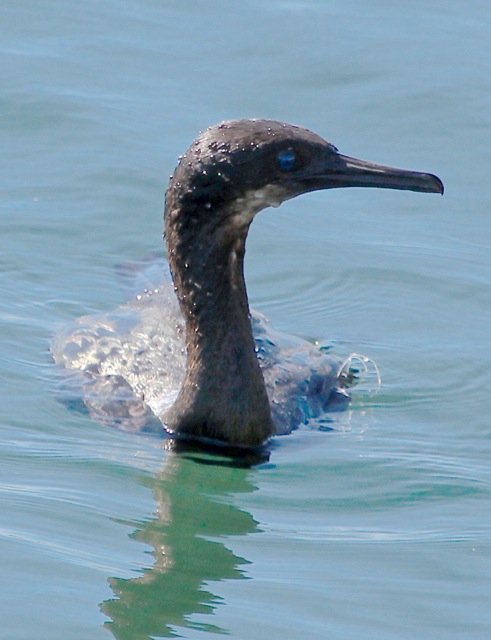
Brandt’s Cormorant J. Waterman Marina del Rey 11/21/15
The Santa Ana winds, typical of this season, had just started sweeping into the region and we enjoyed warm, dry weather on the coast. However, this was not ideal birding weather. Our low-tide planning and the two rarities (Long-tailed Duck and Common Murre) did not make an appearance, but we still reach the 60-species mark with a short walk at the Freshwater Marsh where two atypical species (Fox Sparrow and Common Gallinule) were present on the busy Lincoln Blvd. side of the marsh. Surprising bird of the day: a Canada Goose seen in the distance off Dockweiler Beach, well beyond the surf. Also a not-so-typical dominance of Brandt’s Cormorants over the usually more numerous Double-crested.
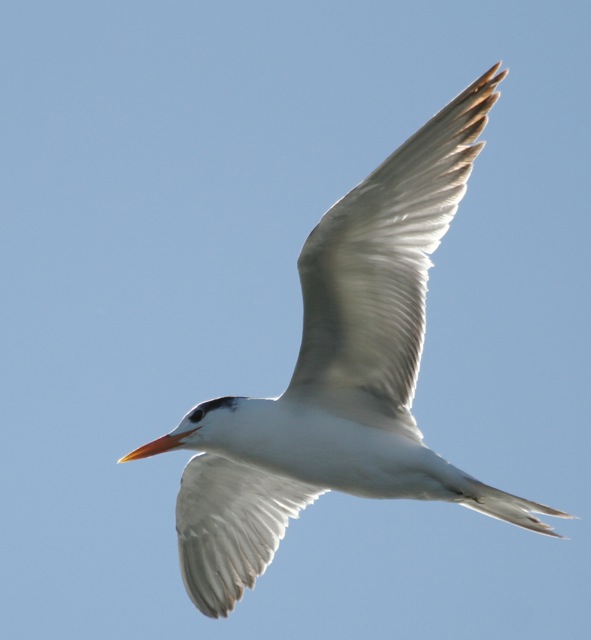
Royal Tern J. Waterman 11/21/15 Ballona Creek
Canada Goose 10
Gadwall 6
American Wigeon 8
Mallard 40
Cinnamon Teal 2
Northern Shoveler 13
Lesser Scaup 4
Surf Scoter 35
Bufflehead 8
Red-breasted Merganser 1
Ruddy Duck 5
Common Loon 3
Pied-billed Grebe 5
Horned Grebe 2
Eared Grebe 7
Western Grebe 20
Brandt’s Cormorant 350
Double-crested Cormorant 20
Pelagic Cormorant 2
Brown Pelican 40
Great Egret 1
Snowy Egret 4
Osprey 1
Red-tailed Hawk 1
Common Gallinule 1
American Coot 40
Black-bellied Plover 12
Killdeer 1
Black Oystercatcher 1
Willet 3
Whimbrel 1
Marbled Godwit 3
Ruddy Turnstone 2
Black Turnstone 3
Surfbird 2
Sanderling 25
Least Sandpiper 7
Bonaparte’s Gull 1
Heermann’s Gull 3
Ring-billed Gull 1
Western Gull 8
Herring Gull 1
Royal Tern 2
Rock Pigeon 18
Mourning Dove 1
Allen’s Hummingbird 1
Anna’s Hummingbird 2
Belted Kingfisher 1
Black Phoebe 1
Say’s Phoebe 1
Cassin’s Kingbird 2
American Crow 4
Bushtit 20
Blue-gray Gnatcatcher 3
Northern Mockingbird 1
American Pipit 1
Orange-crowned Warbler 3
Common Yellowthroat 1
Yellow-rumped Warbler 30
Savannah Sparrow 1
Fox Sparrow 1
White-crowned Sparrow 22
House Finch 2
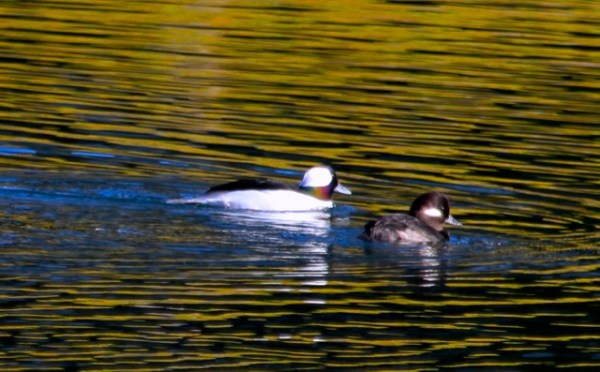
Iridescent male Bufflehead J. Waterman 11/21/15 del Rey Lagoon



 SANTA MONICA BAY AUDUBON SOCIETY BLOG