Free email delivery
Please sign up for email delivery in the subscription area to the right.
No salesman will call, at least not from us. Maybe from someone else.
World Shorebirds Day Reminder: 4 – 6 September, 2015

Red Knot – World Shorebirds Day Bird of the Year
Photographer: Mario Suárez Porras, Spain
Here’s a message from one of our farther-flung SMBAS Blog readers,
Gyorgy Szimuly, from his home in Milton Keynes, United Kingdom.
********************************************************
Gyorgy Szimuly
Milton Keynes, United Kingdom
https://worldshorebirdsday.wordpress.com
**************************************************
More details about the Global Shorebird Counting Program and how to register a location can be found here:
The map with more than 340 already registered locations can be viewed here:
https://www.google.com/maps/d/viewer?hl=en&authuser=0&mid=zqWymiAbzzII.kbC9emdidNTw
As of Sunday noon, Aug. 30, the map showed ONE registered site in Los Angeles County: Malibu Lagoon, claimed by Laurel Jones, SMBAS’s Education Chairwoman. Way to go, Laurel! That leaves open potentially dozens of sites such as: Point Dume, Topanga Beach, Santa Monica, Venice, Ballona, Dockweiler Beach, Redondo Beach, Long Beach and various points along the Los Angeles River. I registered for Lower Los Angeles River last year, but am unable to do so this year. I discovered then that if you decide at the last minute to count a location, you can register for it after-the-fact. [Chuck Almdale]
Focus on Five Cuban Species
Dr. Larry Wan invites members of Santa Monica Bay Audubon to a presentation on Sunday September 27th, 3 to6 PM at the Santa Monica Mountains Conservancy’s King Gilette Ranch. Admission is free.
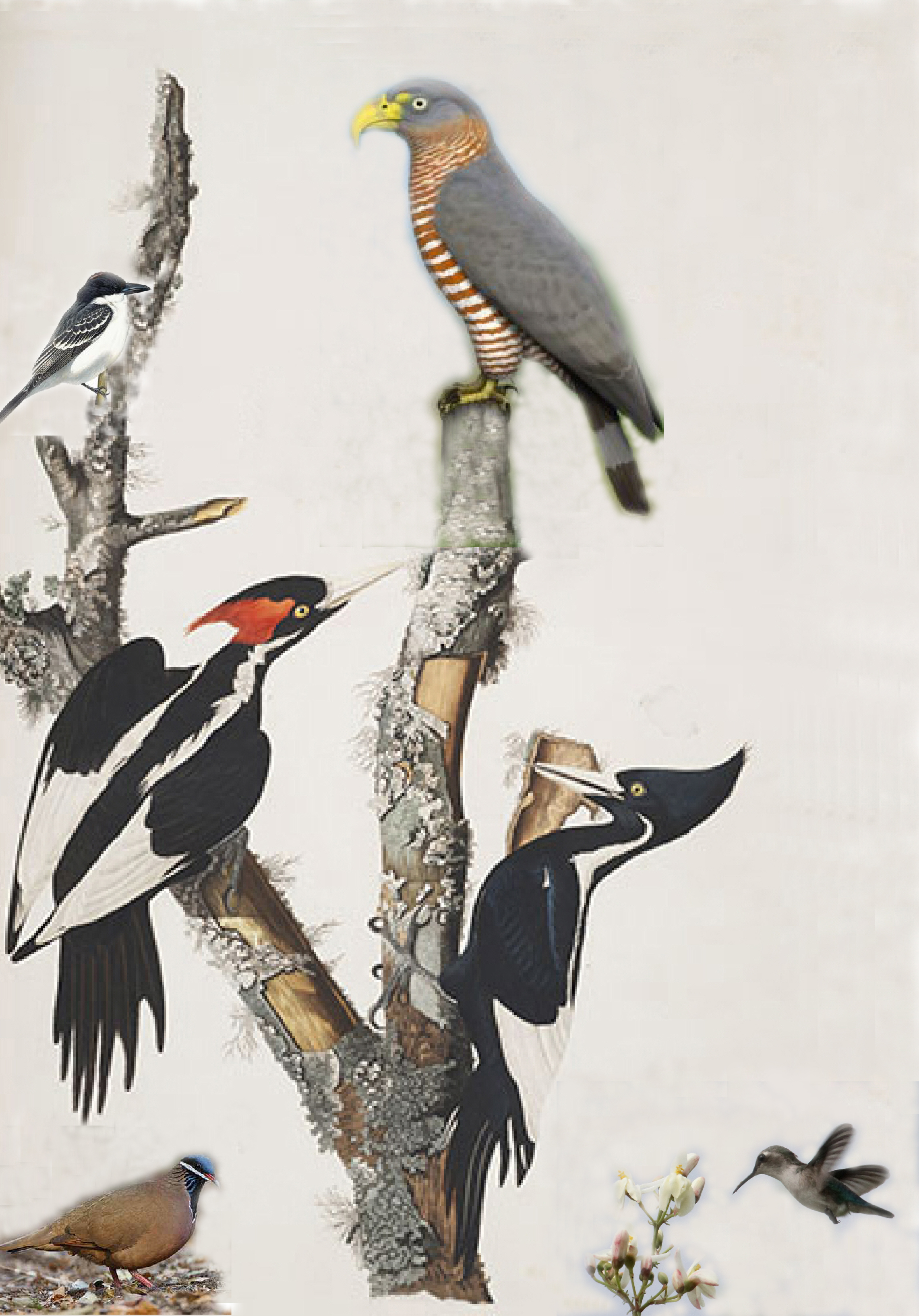
The Ivory-billed Woodpecker, has been considered extinct in the U.S. since 1938. The IBW also lived in Cuba but there it was last seen as recently as 2009, making its continued existence in Cuba more probable. In May 2012, the Western Alliance for Nature sponsored an initial exploration of an area in eastern Cuba where it was last seen. Come hear about the quite promising results and why we have been inspired to launch a series of full scale scientific expeditions. Our expeditions will also seek to gather data on the following globally threatened birds, all of which are known to occur in the localities that we plan to survey: the Critically Endangered Cuban Kite, the Endangered Giant Kingbird and the Blue-headed Quail-Dove and the Near Threatened Bee Hummingbird.
Please come for a Sunday in the park and be part of history. Enjoy complimentary wine and hors d’oeuvres. RSVP to receive free parking (the park usually charges $7) to: wanlarry719@gmail.com by September 19th or call 310.999.5477.
Illustrated presentations by Dr. Larry Wan, Western Alliance for Nature on the search for the Ivory-bill, and Dr. Tom Smith on the Cuban Kite.
Bird Quiz Again, Again – Identified
Brown-headed Cowbird, immature male molting into 1st basic plumage.
Got a photo you think will make a good quiz?
Send the photo (the clearer, the better), along with location, date, whom to credit and…uh, this is important…what it is. Email it to: webinfo493 [AT] verizon [DOT] net
[Chuck Almdale]
****************************************************************************

Quiz Bird – Randy Ehler 8/6/15
Bird Quiz – Identified
Here you go! Another installment in our never-ending series of bird identification quizzes. This bird – possibly the same individual, possibly not – was spotted this August at Malibu by two of our perspicacious photographers. Get out your field guides and go to it. Fame and fortune will doubtfully accrue to the swiftest. [Chuck Almdale]
Post Quiz comments 8/29/15:
Birds in molt are tricky, and I claim no expertise in this matter. Passerines are generally altricial when born and may have only a few downy feathers, unlike precocial birds like ducks which are covered in down and can run around within a few hours. They soon undergo a complete prejuvenal molt, the juvenal plumage appears and they become able to fly. Northern hemisphere juvenile birds then have a 1st prebasic molt July – Sept., just after breeding season, which is a partial molt (wing and tail feathers often not replaced). Adult birds have a complete prebasic molt at this time. Molts in grackles can take over 110 days. The springtime molt is the prealternate, resulting in the alternate (often called breeding) plumage. Not all birds – American Robins and woodpeckers for example – have a prealternate molt, but breed in their basic plumage which may appear different through wear, as do the European Starlings, whose Autumn “stars” have mostly worn off. Thus “breeding” and “alternate” plumages are not perfectly synonymous.
Here’s lots of information on aging, sexing and molts from the Universities of Illinois.

Quiz bird view 1 Great-tailed Grackle in molt – Randy Ehler 8/6/15
So what do we have with these two August birds? They are certainly molting Great-tailed Grackles. Bird #1 (top or first bird) has a light eye, fully-developed bill, breast feathers are ruffled – they may be streaked but don’t really look like it. Tail and wing feathers look fully-developed except secondaries which are uneven, probably still growing in. Females of our western subspecies nelsoni are smaller and paler than subspecies elsewhere. I think it’s a molting adult female.
****************************************************************************
Bird #2 looks different. Eye iris is a dark amber, as a juvenile should have. R.K Selander in The Condor (Nov. 1958, prior to split of Great-tailed from Boat-tailed) notes:
There was a wide range of variation in iris color in first-year birds in August, September, and October. The average condition was “pale yellow,” with extremes described as “pale whitish or grayish yellow” and “flat yellow of moderate intensity.” Intensity of yellow continued to increase through November, and by December some individuals had irides that were adult in color.
Head and neck feathers in our bird seem quite undeveloped. According to Selander, male postjuvenal molt began Jun 19 – Jul 17, ending Oct 6 – Nov 28, averaging 105 – 110 days. Female postjuvenal molt began later and was shorter: Jul 19 – Aug 10, ending Sep 24 – Nov 16, averaging 80 – 90 days. Prebasic molt begins with primary 1 (innermost); in a few days it is 1/3rd grown and all the secondary flight feathers fall out. While primary 7 is developing, the head feathers begin to be replaced, starting at the back of the head and spreading forward. When primary 9 is dropped all the tail feathers fall out and the bird is tailless for about two weeks. This seems weird, but there it is.
I think our bird #2 is a juvenile female, going through its 1st prebasic molt into its 1st basic plumage. The red breast is mostly in, tail feathers are quite straggly, and I don’t think all the primaries are in. Head and neck feathers are not all in. It’s possible that this bird is not entirely healthy. Sickness or an inadequate diet can slow or subvert a molt. Examples of this are our local male House Finches, usually red but often orange or yellow; this is the result of either sickness or lack of carotenoids in their diet, probably from living in smoggy L.A.
****************************************************************************
Additional Post Quiz comment 8/30, following on discussion of eye color.
Adult male (picture A below) in basic plumage below shows a very pale white or pale yellow eye.
Adult male (picture B below) in basic plumage below shows a very pale eye with a contracted iris, looking paler than bird A.
Adult female (picture C below) in basic plumage shows a somewhat less pale (therefore darker) amber or brownish eye with some what larger iris than adult male #1.
Note that the larger the pupil, the smaller the area of iris, making eye appear darker. The female’s pupil appears larger, than is the male’s pupil. This may well make the iris appear darker than otherwise.
The eye of Quiz bird female #2, while not black, is darker than female bird C below.

A. Great-tailed Grackle adult male basic plumage 12/22/23

B. Great-tailed Grackle male basic plumage small pupil (Randy Ehler 9/28/14)

C. Great-tailed Grackle adult female basic plumage 11/27/07
Here’s a link to a nice collection of Great-tailed Grackle photos by the Birding Dutchman, showing various stages of plumage.

Quiz bird view 2 Great-tailed Grackle in molt – Joyce Waterman 8/23/15
Blog News
This blog recently passed a milestone – over 100,000 hits – so I thought I’d give you a peek at SMBAS Blog World Headquarters history.
Miscellaneous blog tidbits:
First Posting: 3/29/09
Current total posts: 382 – Event announcements are deleted following the event
Total Hits: 100,400
Subscribers – 315: Email – 268 WordPress Members – 47
All-Time Page Views (did you know we have 19 pages?):
1. 30,855 Home Page
2. 11,874 Los Angeles County Birding Spots 7-page set
3. 2,849 California Bird Festivals
4. 2,809 Bird & Marine Mammal Rescue
5. 1,967 Malibu Lagoon Restoration Project 2012-13 4-page set
6. 1,965 Printable Calendar & Checklist
7. 1,119 Bird Locating – “It’s right there…in the green tree!”
8. 774 Western Snowy Plovers
9. 401 Birding Info. Pages
10. 297 Unusual Birds at Malibu Lagoon
All-Time Top Ten Postings:
1. 3,482 New Hummingbird Species Discovered in L.A. County
2. 1,931 The First Americans of Ballona (3-part series)
3. 1,768 Snowy Plover Likely to be Split from Kentish Plover
4. 1,411 “It’s Right There in the Green Tree!” Getting others onto that bird
5. 1,152 California Bird Festivals 2010-11
6. 1,133 Birders Take Their Lumps with their Splits
7. 1,091 Canyonland Roadrunner Captured on Film
8. 1,070 Full Pink Moon Update for April 15, 2014
9. 1,012 Kestrel Photoshow
10. 754 Western Roof-Owl: Bird of Mystery
Best Day Ever:
4/1/11 – 1,486 hits (April Fool’s Day post on New Hummingbird Species)
Links: Fifty interesting & useful websites – Look to the right > > >
Countries – Hits for 2015 – 70 Countries:
Over 10,000 hits: USA
100 – 200: UK, Canada
40 – 60: Germany, Australia, Taiwan
20 – 39: Netherlands, France, Sweden, India
10 – 19: Italy, Mexico, New Zealand, Brazil, Euro. Union, Finland, Denmark, Spain, Ukraine, Russia, Singapore
1 – 9: Sri Lanka, Poland, Thailand, Japan, Czech Republic, UAE, Hong Kong, Norway, Kenya, Senegal, Bulgaria, Maldives, Macedonia, Pakistan, 36 others
Some 2014 Statistics:
Over 25,000 views
463 pictures presented (thanks to you photographers!)
People linked in through: Facebook, Audubon.org, CA.Audubon.org, SMBAS.atspace.com, WordPress
103 countries represented, including far-flung places like Azerbaijan, Burkina Faso, Fiji, Guyana, and Papua New Guinea.
For the Future:
The plan is to decentralize postings: trip leaders writing their own trip reports, program chairs writing their announcements, other chairs writing reports about what they’re up to, and contributions from YOU! our reader. {Chuck Almdale}



 SANTA MONICA BAY AUDUBON SOCIETY BLOG