Free email delivery
Please sign up for email delivery in the subscription area to the right.
No salesman will call, at least not from us. Maybe from someone else.
Water-conserving rain barrels, nearly free!
If you have a garden in which you’ve been trying to save water, this is the great deal that comes up every once in a while. You buy rain barrels at a reduced rate, you install them at your house. Often a local official comes to check that you have installed them. In some towns such as Santa Monica, you have to confirm your continued use of the barrels annually.
The really good part is that a week or two after you have installed the barrels, you get reimbursed for your expense! I installed three barrels three years ago and I haven’t used the municipal water for my numerous potted plants since. It also provides enough water for my compost box most years.
You will probably have to do a little modification on some of your roof /gutter downspouts, but I bet you’ll be surprised how much fog drip you will also collect in the non-rainy season.
Here is the link to follow: Note you must pre-order and pre-pay no later than the Wednesday prior to the event you’d like to attend. If they have extra barrels on hand, they bring them to the event. http://www.rainbarrelsintl.com/events-order.asp?id=76
Thank you to Grace M. for the alert
Malibu Lagoon Trip Report: 28 Dec. 2014 & July-Dec 2014 trip lists
Chilly, but nice. That’s my story and I’m stickin’ to it! Actually, it was better than nice. Loads of birds, low tide, little wind, beautiful clouds in the sky, and two banded Snowy Plovers. Over thirty birders showed up: I suspect some had found new binoculars under their Christmas tree.
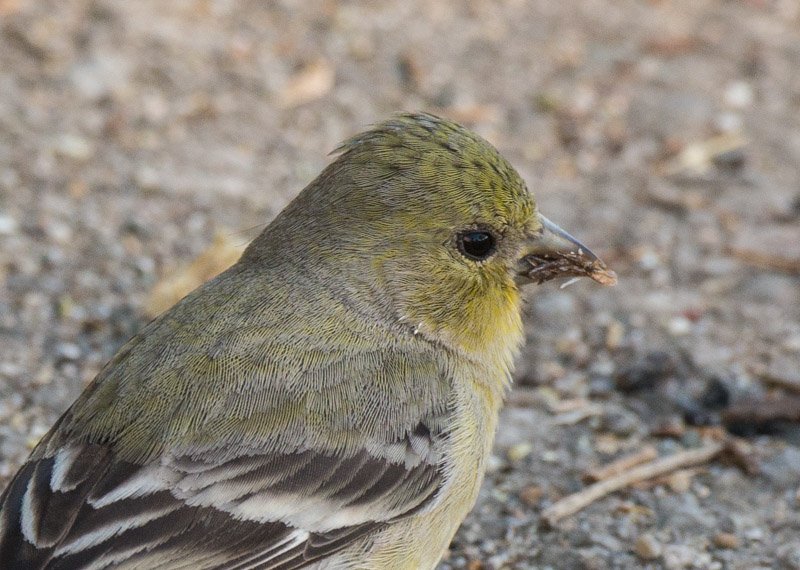
Lesser Goldfinch (Ray Juncosa 12/28/14)
Duck species doubled from November’s four, including four beautiful Hooded Mergansers, a species recorded 17 times previously (of 301 lagoon field trips), but last seen 12/24/95. They spent two winters, 1981 and 1990, paddling around with the Ruddy Ducks under the PCH bridge from January through March.
We had a near record number of 6 Spotted Sandpipers, a species that does not congregate with other sandpipers in the winter, preferring to wander the lagoon edges alone. We’ve seen eight ‘spotties’ twice before, both times in August.
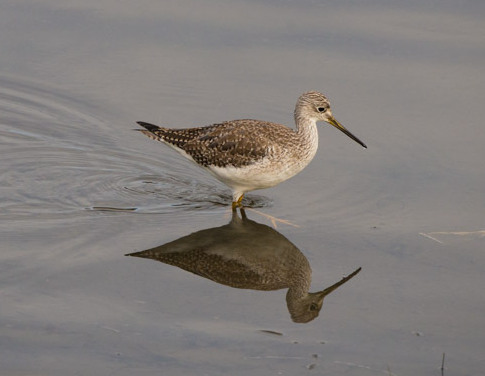
Greater Yellowlegs (Ray Juncosa 12/28/14)

Willet (Ray Juncosa 12/28/14)
I must have walked right past the Greater Yellowlegs, as I glimpsed him behind me out of the corner of my eye. They show up on only 16% of visits, most often in December and never in May. A nearby Willet provided a good comparison: The Yellowlegs is 1” smaller, slimmer with a longer, slightly upcurved bill, more white & black & speckled than plain gray-brown, and a more active feeder.
A record number of cormorants were present: well over 200 adorned the offshore rocks with dozens more floating in the sea, for lack of rock-perching room. Oddly, there was not a single Pelagic Cormorant among them; even more oddly, the 130 Brandt’s outnumbered the Double-crested, which we’ve never seen before. Brandt’s are present only 50% of the time, whereas the Double-crested are very rarely absent. Factoid: Brandt’s and Pelagic Cormorant’s really dislike being far from the sea; even the lagoon is too far inland for them, and we rarely see them there, whereas we regularly find them paddling around in the nearshore waters or resting on the rocks.
Lots of loons in the surf zone, most disguising themselves as Red-breasted Mergansers, trolling for fish with their heads submerged, and lots of grebes in the lagoon. But the gulls had really massed (see list below). Not a great variety – six gull species plus Royal Terns – but large numbers. Even five raptors species appeared, albeit only one of each: Osprey, White-tailed Kite, Red-shouldered & Red-tailed Hawks, and a Peregrine Falcon resting on the east end of the beach. Back home, I was surprised to learn that Kites appeared only ten times previously, including three months in a row in April-June 2013.
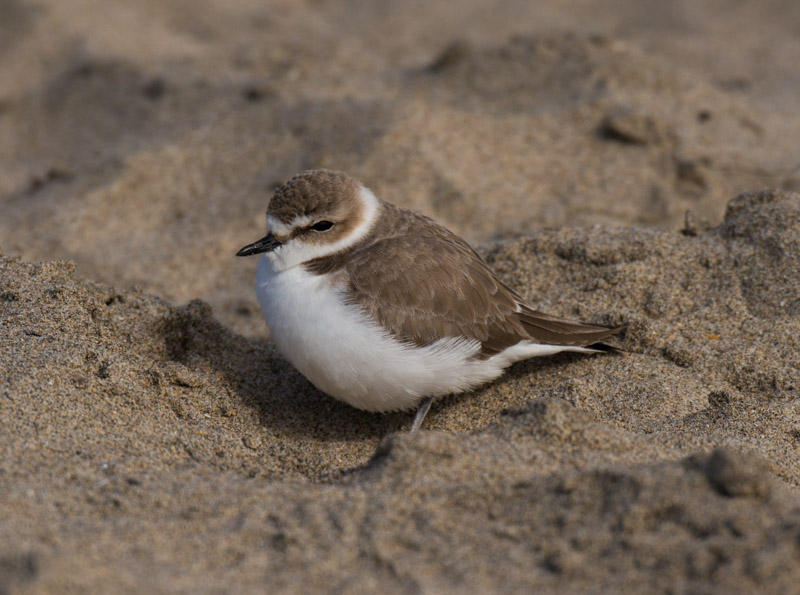
Snowy Plover relaxing in a footprint (Ray Juncosa 12/28/14)
I counted only 25 Snowy Plovers on the beach – there may have been more across the breach channel – but they included two ringed birds: GA:OY and GG:AR. GA:OY was ringed this summer at Oceano Dunes; GG:AR is an old friend with many lagoon appearances, ringed in Summer’11, also at Oceano Dunes.
Birds new for the season were: Gadwall, American Wigeon, Northern Shoveler, Bufflehead, Hooded Merganser, Red-throated, Pacific & Common Loons, White-tailed Kite, Red-shouldered Hawk, Peregrine Falcon, Greater Yellowlegs, California Gull, Glaucous-winged Gull, Royal Tern, Savannah Sparrow.
Our next three scheduled field trips: Antelope Valley Raptors, 10 Jan, 8am-2pm; Malibu Lagoon, 25 Jan, 8:30 & 10am; Salton Sea weekend, Feb 7-8, 9am.
Our next program: Tuesday, 3 Feb., 7:30 pm. The Santa Monica Mountains Conservancy, presented by Melina Watts. PLEASE NOTE THAT OUR MONTHLY MEETING PLACE HAS CHANGED; INFORMATION TO COME.
NOTE: Our 10 a.m. Parent’s & Kids Birdwalk meets at the shaded viewing area. Watch for Willie the Weasel.
Links: Unusual birds at Malibu Lagoon
Aerial photo of Malibu Lagoon from 9/23/02.
Prior checklists:
2014: Jan-July
2013: Jan-June, July-Dec.
2012: Jan-June, July -Dec.
2011: Jan-June, July-Dec.
2010: Jan-June, July-Dec.
2009: Jan-June, July-Dec.
The 10-year comparison summaries created during the project period remain available on our Lagoon Project Bird Census Page. Very briefly summarized, the results unexpectedly indicate that avian species diversification and numbers improved slightly during the period Jun’12-June’14. [Chuck Almdale]
| Malibu Census 2014 | 7/27 | 8/25 | 9/28 | 10/26 | 11/23 | 12/28 |
| Temperature | 66-72 | 72-80 | 68-75 | 62-72 | 60-70 | 39-61 |
| Tide Lo/Hi Height | H+4.21 | H+4.52 | H+5.35 | H+5.93 | H+6.41 | L+1.70 |
| Tide Time | 1100 | 0954 | 1149 | 1044 | 0849 | 0903 |
| Gadwall | 2 | 3 | 26 | |||
| American Wigeon | 10 | |||||
| Mallard | 55 | 12 | 23 | 3 | 2 | 10 |
| Northern Shoveler | 4 | |||||
| Green-winged Teal | 1 | 12 | ||||
| Bufflehead | 8 | |||||
| Hooded Merganser | 4 | |||||
| Red-breasted Merganser | 3 | 2 | 25 | 25 | ||
| Ruddy Duck | 2 | 36 | 42 | |||
| Red-throated Loon | 3 | |||||
| Pacific Loon | 6 | |||||
| Common Loon | 1 | |||||
| Pied-billed Grebe | 6 | 6 | 11 | 3 | 1 | 8 |
| Horned Grebe | 2 | 2 | 4 | |||
| Eared Grebe | 6 | 18 | 8 | 12 | ||
| Western Grebe | 1 | 6 | 12 | 2 | ||
| Brandt’s Cormorant | 4 | 2 | 1 | 2 | 130 | |
| Double-crested Cormorant | 35 | 58 | 45 | 26 | 9 | 120 |
| Pelagic Cormorant | 1 | 1 | 3 | 1 | ||
| Brown Pelican | 78 | 29 | 42 | 26 | 32 | 95 |
| Great Blue Heron | 4 | 4 | 1 | 2 | 4 | 3 |
| Great Egret | 4 | 3 | 3 | 4 | 4 | 4 |
| Snowy Egret | 22 | 12 | 15 | 20 | 20 | 18 |
| Little Blue Egret | 1 | |||||
| Black-crowned Night-Heron | 1 | 4 | 1 | |||
| Turkey Vulture | 1 | |||||
| Osprey | 1 | 1 | 1 | 1 | 1 | |
| White-tailed Kite | 1 | |||||
| Sharp-shinned Hawk | 1 | |||||
| Cooper’s Hawk | 1 | |||||
| Red-shouldered Hawk | 1 | 1 | ||||
| Red-tailed Hawk | 3 | 1 | 1 | |||
| American Kestrel | 1 | 1 | 1 | |||
| Peregrine Falcon | 1 | |||||
| American Coot | 14 | 9 | 85 | 20 | 100 | 135 |
| Blk-bellied Plover | 25 | 93 | 95 | 40 | 45 | 38 |
| Snowy Plover | 16 | 39 | 40 | 34 | 40 | 25 |
| Semipalmated Plover | 1 | 3 | ||||
| Killdeer | 8 | 5 | 18 | 1 | 1 | 17 |
| Spotted Sandpiper | 1 | 5 | 5 | 4 | 2 | 6 |
| Greater Yellowlegs | 1 | |||||
| Willet | 5 | 14 | 45 | 6 | 4 | 10 |
| Whimbrel | 28 | 17 | 9 | 1 | 1 | 1 |
| Marbled Godwit | 1 | 4 | 5 | 3 | 12 | |
| Ruddy Turnstone | 2 | 9 | 12 | 4 | 6 | 6 |
| Black Turnstone | 3 | |||||
| Sanderling | 2 | 10 | 32 | 32 | 28 | |
| Western Sandpiper | 1 | 1 | ||||
| Least Sandpiper | 3 | 6 | 2 | 1 | ||
| Boneparte’s Gull | 2 | 2 | 1 | |||
| Heermann’s Gull | 8 | 10 | 4 | 5 | 1 | 18 |
| Ring-billed Gull | 3 | 60 | 65 | |||
| Western Gull | 71 | 89 | 95 | 40 | 81 | 230 |
| California Gull | 1 | 1500 | ||||
| Glaucous-winged Gull | 3 | |||||
| Least Tern | 3 | 2 | ||||
| Forster’s Tern | 2 | 3 | ||||
| Royal Tern | 11 | 6 | 8 | 22 | ||
| Elegant Tern | 127 | 4 | 18 | 17 | 4 | |
| Rock Pigeon | 16 | 5 | 15 | 6 | 6 | |
| Mourning Dove | 2 | 1 | ||||
| Yel-chevroned Parakeet | 2 | |||||
| Vaux’s Swift | 3 | |||||
| Anna’s Hummingbird | 2 | 1 | 1 | |||
| Allen’s Hummingbird | 3 | 4 | 6 | 3 | 4 | |
| Belted Kingfisher | 1 | |||||
| Nuttall’s Woodpecker | 1 | |||||
| Willow Flycatcher | 1 | |||||
| Pac.Slope Flycatcher | 1 | |||||
| Black Phoebe | 11 | 9 | 12 | 2 | 1 | 2 |
| Say’s Phoebe | 3 | 2 | 2 | |||
| Cassin’s Kingbird | 1 | |||||
| Warbling Vireo | 2 | |||||
| Western Scrub-Jay | 1 | |||||
| American Crow | 4 | 4 | 6 | 7 | 8 | |
| Rough-winged Swallow | 7 | 15 | 3 | |||
| Barn Swallow | 35 | 45 | 1 | |||
| Cliff Swallow | 7 | 3 | ||||
| Bushtit | 7 | |||||
| House Wren | 1 | |||||
| Ruby-crowned Kinglet | 1 | 2 | ||||
| American Robin | 2 | |||||
| Wrentit | 1 | |||||
| Northern Mockingbird | 6 | 9 | 3 | 2 | 2 | |
| European Starling | 22 | 55 | 115 | 60 | 60 | 25 |
| Cedar Waxwing | 2 | |||||
| Orange-crowned Warbler | 3 | |||||
| Nashville Warbler | 2 | |||||
| Yellow Warbler | 3 | 1 | ||||
| Yellow-rumped Warbler | 40 | 2 | 15 | |||
| Common Yellowthroat | 1 | 3 | 9 | 4 | 2 | 4 |
| Spotted Towhee | 2 | 1 | ||||
| California Towhee | 3 | 3 | 4 | 1 | ||
| Savannah Sparrow | 3 | |||||
| Song Sparrow | 11 | 8 | 7 | 2 | 3 | |
| White-crowned Sparrow | 15 | 15 | 35 | |||
| Bobolink | 1 | |||||
| Red-winged Blackbird | 8 | |||||
| Western Meadowlark | 6 | 6 | 7 | 14 | ||
| Great-tailed Grackle | 16 | 6 | 3 | 1 | ||
| Hooded Oriole | 1 | |||||
| House Finch | 14 | 8 | 22 | |||
| Lesser Goldfinch | 4 | 6 | 15 | 3 | 1 | |
| Totals by Type | July | Aug | Sep | Oct | Nov | Dec |
| Waterfowl | 58 | 16 | 26 | 5 | 64 | 141 |
| Water Birds-Other | 138 | 106 | 193 | 102 | 166 | 516 |
| Herons, Egrets | 32 | 23 | 20 | 26 | 28 | 25 |
| Raptors | 1 | 1 | 7 | 4 | 2 | 5 |
| Shorebirds | 90 | 198 | 240 | 127 | 135 | 144 |
| Gulls & Terns | 221 | 111 | 128 | 66 | 151 | 1839 |
| Doves | 18 | 6 | 15 | 6 | 0 | 6 |
| Other Non-Passerine | 5 | 5 | 13 | 3 | 1 | 4 |
| Passerines | 161 | 172 | 241 | 150 | 76 | 114 |
| Totals Birds | 724 | 638 | 883 | 489 | 623 | 2794 |
| Total Species | July | Aug | Sep | Oct | Nov | Dec |
| Waterfowl | 2 | 3 | 2 | 2 | 4 | 9 |
| Water Birds-Other | 6 | 7 | 7 | 8 | 8 | 11 |
| Herons, Egrets | 5 | 4 | 4 | 3 | 3 | 3 |
| Raptors | 1 | 1 | 5 | 4 | 2 | 5 |
| Shorebirds | 10 | 13 | 10 | 9 | 10 | 10 |
| Gulls & Terns | 6 | 5 | 5 | 5 | 6 | 7 |
| Doves | 2 | 2 | 1 | 1 | 0 | 1 |
| Other Non-Pass. | 2 | 2 | 5 | 1 | 1 | 1 |
| Passerines | 18 | 13 | 26 | 15 | 8 | 12 |
| Totals Species – 103 | 52 | 50 | 65 | 48 | 42 | 59 |
Carrizo Plain Trip Report: 20 December, 2014
The Carrizo Plain has certainly not escaped California’s drought of recent years. Other than grass, the southern plain south of Soda Lake is almost devoid of plants, and we saw very few birds south of KCL Campground. Some Russian Thistle (aka tumbleweed) has returned, scattered amid the sage.
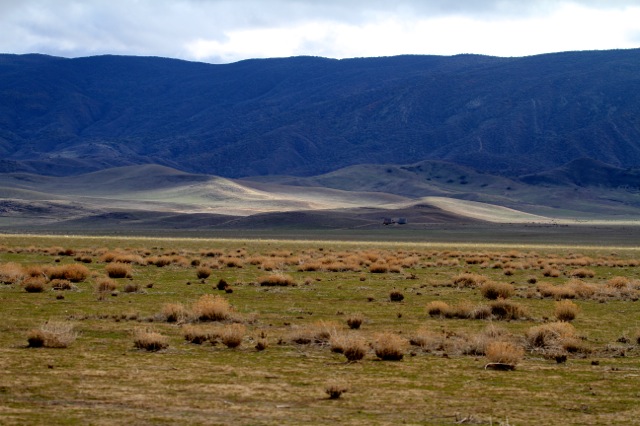
Carrizo blue mountains (Joyce Waterman 12/20/14)
A Golden Eagle, perched far away in the company of two Common Ravens, was a significant exception. Almost 3″ of rain earlier in the week made driving a bit ‘iffy’ on the side roads, but it didn’t make new plants spring forth from the ground.
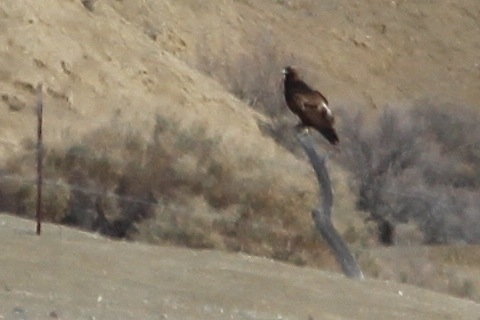
Golden Eagle at great distance, sub-adult (J. Waterman 12/20/14)
The ground squirrel colony near the south end of Soda Lake Rd. had neither Burrowing Owls nor squirrels, as far as we could tell. As we drove north we found several Loggerhead Shrikes perched on barb wire fences,a few Western Meadowlarks in song, Say’s Phoebes flycatching from the fenceposts and the usual House Finches near anything vaguely house-like. Beyond that, birding was sparse.
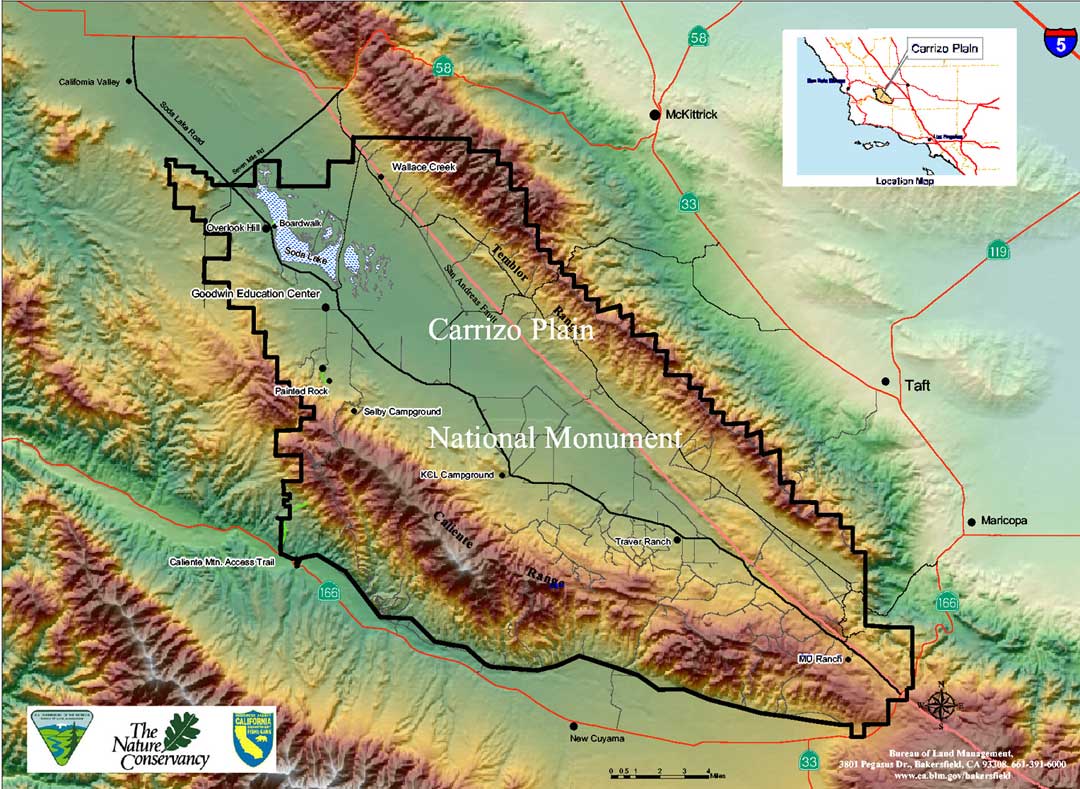
The Carrizo Plain
Van Metre Ranch, unmarked on most maps, is about 2 miles NNW of Traver Ranch. About 1 mile E of Traver Ranch a small road cuts off to the north, loops past Van Metre (3 miles), and loops back to Soda Lake Rd. about 1 mile NW of Traver Ranch.
The day stayed cool and quiet. The 3 miles of side road to Van Metre Ranch were fine, save one muddy spot, and we explored the various buildings and ancient equipment at the ranch.
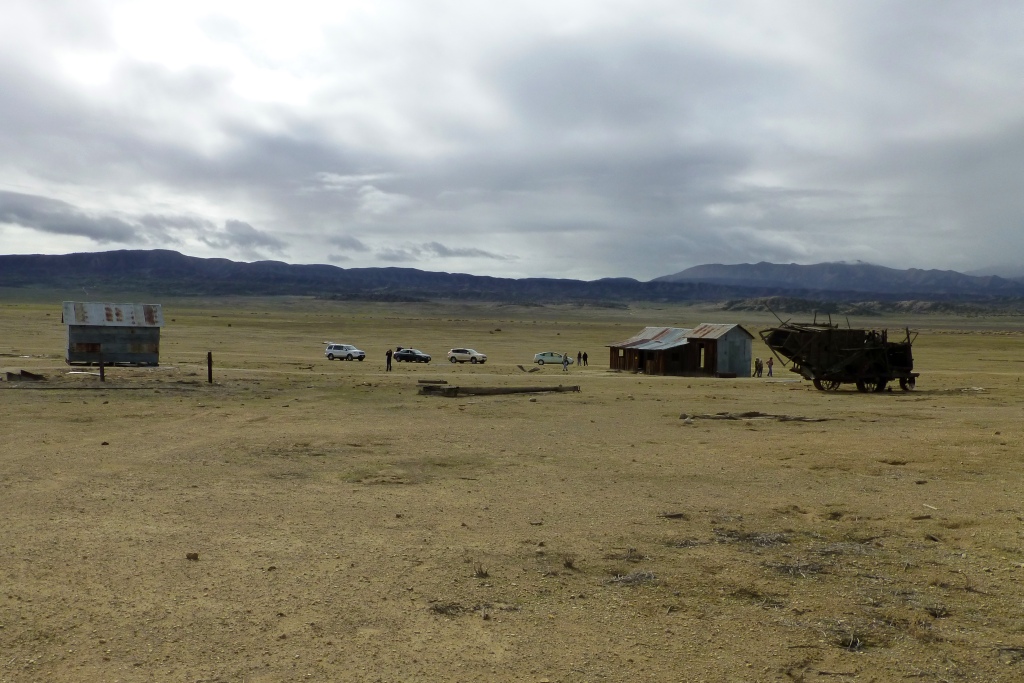
View to south across Van Metre Ranch Ranch (C. Almdale 12/20/14)
Just past the ranch was a large muddy spot: I knew the muddiest area was still a mile away, so we retraced our route back to Soda Lake Rd. We then proceeded to Traver Ranch and its interesting display of farm equipment next to a bathroom, and – after watching a flock of bright blue Mountain Bluebirds flycatching – onward to KCL Campground where we had a very nice lunch with lots of cookies. Thanks Grace!
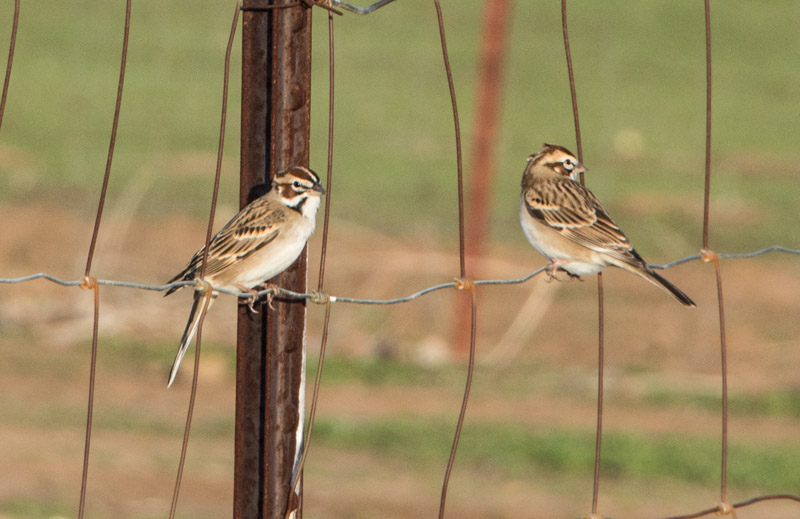
Lark Sparrows (Ray Juncosa 12/20/14)
One car headed back home after lunch, and the birding picked up (no connection, I’m sure), starting with a large flock of Mountain Plovers, which we very cleverly discovered by nearly plowing into them when they wheeled across the road.
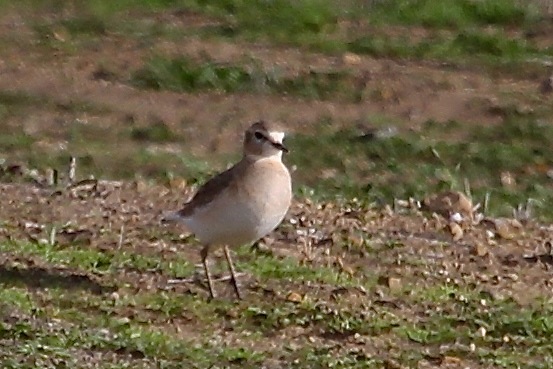
Mountain Plover near Panorama & Soda Lake Rds. (J. Waterman 12/20/14)
Nearby, a flock of Long-billed Curlews wheeled around and around. I decided to skip both Panorama Rd., which cuts north across the plain, and Simmler Rd. at the south end of the lake. It was a Very Good Thing we did, as I learned shortly thereafter at the Goodwin Education Center: a young man, far too confident of his SUV and his driving prowess, had become seriously bogged on Simmler the previous day. Long after dark, after hours of walking and waiting and fretting, his vehicle was finally extracted from the mud, to the tune of $700. “There but for fortune, go you or I…” goes the song.
Near the Center, grazing on a rare patch of relative lush grass, was a scattered herd of about 150 Tule Elk. Alas, they were too far to photograph. Soda Lake held a lot of soda, as usual, and a bit of water, not so usual, but no Sandhill Cranes. Between the rarity of water in the lake and the absence of grain to glean in nearby fields, there has been little to attract or hold cranes in recent years. Tule Lake, beyond the Temblor Range to the north and into the southern San Joachin Valley, has become a far more reliable nighttime roost for the cranes.
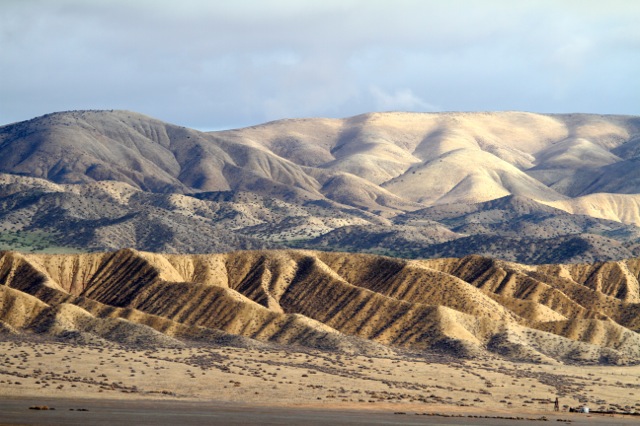
The Temblor Range (J. Waterman 12/20/14)
We found the unpaved roads within the small community of California Valley to be safe to drive, and the vegetation attracted birds, including a large roost of Eurasian Collared-Doves and a Merlin. The latter pretended to be a Prairie Falcon for a few moments, but getting a better, closer look and then watching him fly revealed his true colors.
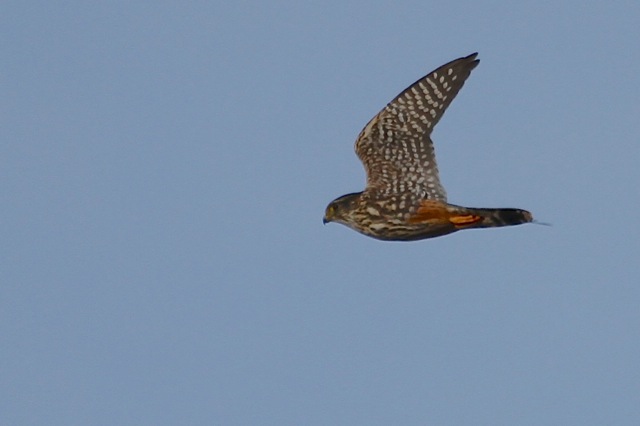
Merlin in flight (J. Waterman 12/20/14)
The road to the San Andreas Earthquake Fault observation site was likely to be boggy, and none of us like the twisty and vomitous Hwy 58 route to McKittrick, so we headed home back down Soda Lake Rd. About half-way back to Hwy 166, we dimly saw two roadside figures, frantically waving their arms in our headlights. Skidding to a halt, we discovered them to be two young men whose car had died up a side road, well into the hills. Fortunately for them we had both room in our cars and inclination – despite their admitted hobby of hunting quail and dove – to give them a ride into Maricopa. Otherwise, they faced a 25-mile walk in pitch darkness and freezing temperatures. At Apu’s Kwiki-Mart they phoned their father, who volunteered – quite delighted, I’m sure – to drive over from Carpinteria, haul them home, and return the next day to fix their car.
In the Carrizo, every day is an adventure.
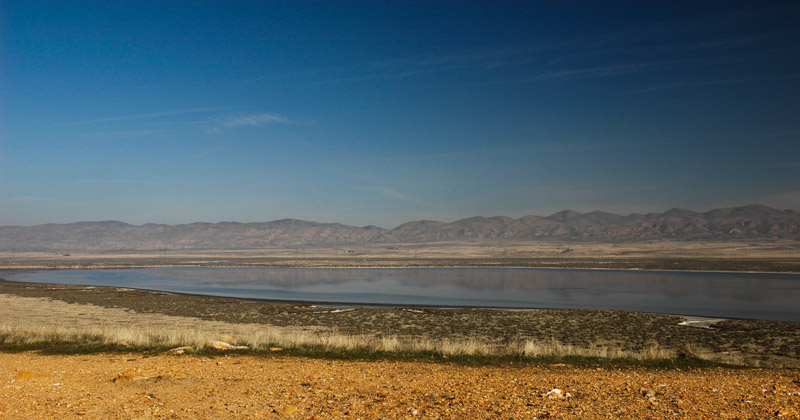
Soda Lake with water (R. Juncosa, date ukn)
For those wishing to explore the Carrizo Plains, Morro Coast County Audubon now has an excellent 20-page birding guide.
The Goodwin Education Center is open Thurs – Sun, Dec. 1 to May 31, 9am – 4pm. I highly recommend calling them to inquire about road conditions, birding highlights, permits to visit Painted Rock, and guided tours. 805-475-2131
http://www.blm.gov/ca/st/en/fo/bakersfield/Programs/carrizo/goodwin.html
[Chuck Almdale]
| Carrizo Plains Trips | Date | Date | Date |
| Name | 12/20/14 | 12/8/12 | 12/10/11 |
| Northern Harrier | 3 | 1 | 1 |
| Red-tailed Hawk | 3 | 15 | 20 |
| Ferruginous Hawk | 2 | 2 | |
| Rough-legged Hawk | 3 | ||
| Golden Eagle | 1 | ||
| Killdeer | 1 | ||
| Mountain Plover | 70 | 2 | |
| Long-billed Curlew | 32 | ||
| Eurasian Collared-Dove | 50 | ||
| Mourning Dove | 4 | 6 | |
| Great Horned Owl | 1 | ||
| Burrowing Owl | 1 | ||
| Swift species | 6 | ||
| American Kestrel | 2 | 9 | 9 |
| Merlin | 1 | 1 | |
| Prairie Falcon | 5 | 2 | |
| Black Phoebe | 2 | ||
| Say’s Phoebe | 10 | 8 | 3 |
| Loggerhead Shrike | 5 | 13 | 12 |
| American Crow | 3 | ||
| Common Raven | 40 | 20 | 40 |
| Horned Lark | 260 | 240 | 200 |
| Rock Wren | 2 | ||
| Bewick’s Wren | 1 | ||
| Ruby-crowned Kinglet | 3 | 2 | |
| Mountain Bluebird | 25 | 56 | 30 |
| Northern Mockingbird | 1 | ||
| California Thrasher | 1 | ||
| Le Conte’s Thrasher | 4 | 1 | |
| European Starling | 15 | 33 | |
| American Pipit | 1 | 1 | |
| Yellow-rumped Warbler | 3 | 6 | 100 |
| California Towhee | 3 | ||
| Brewer’s Sparrow | 15 | ||
| Vesper Sparrow | 2 | ||
| Lark Sparrow | 62 | 120 | 25 |
| Sage Sparrow | 40 | 25 | |
| Savannah Sparrow | 1 | 20 | 55 |
| White-crowned Sparrow | 180 | 350 | 100 |
| Golden-crowned Sparrow | 2 | ||
| Western Meadowlark | 10 | 25 | 27 |
| Brewer’s Blackbird | 30 | ||
| House Finch | 150 | 140 | 500 |
| Total Species – 43 | 25 | 27 | 29 |
Birder’s Holiday Reading
“When you see a herd of pigs soaring above this marsh, Mr. Senior, that’s the day I’ll become a birder.”
Think of a satisfying mystery on a winter’s evening, when it’s too late to go birding, unless of course you love owling in the dark of night. You don’t have to leave your cozy world of birding this season, thanks to Steve Burrows’ new mystery A SIEGE OF BITTERNS. This is not just a typical mystery built on a background of birding. It is a whodunit entirely based on observations of birds and habitat. You’ll get the notes of local (Norwich) species identification as well as some of the best quotes I’ve found in a wealth of documentation that makes only the most clever reader able to predict the ultimate outcome. Domenic Jejeune is a young, believable, boy-wonder detective who should reappear in many episodes to come. A native of Canada, he’d rather be birding than policing (his profession) in Britain. Like most good protagonists, he is an unpredictable bundle of bravado and self-doubt as the story line carries him on the bumpy ride of his new assignment. However, you’ll also recognize a number of other typical birder and conservation types as the story winds its way through the shoreline habitats. (isbn 978 1 4597 0843 3 ppb) Available at the Santa Monica Public Library.
A trivia question: Who is Juliana de Berniers? And why does she get mention in this book?
LucienP
Full Cold Moon Update – 6 December, 2014, 4:27 AM PST
Here’s another update from SMBAS Blog on that large, disc-like, shining object which has frequently and mysteriously appeared in our nighttime sky this year (known to many as the moon).
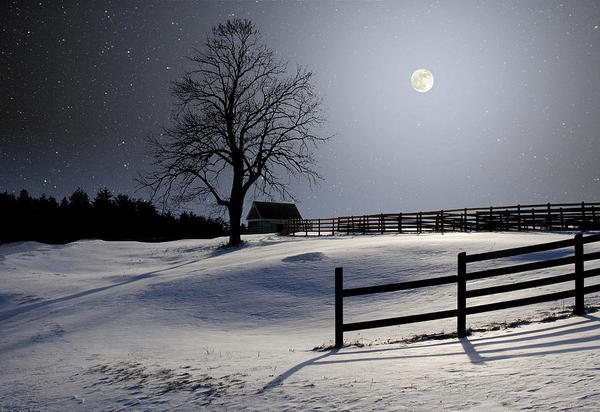
Full Cold Moon
(Revolutionary Raw Vegan Culinary Creators at meetup.com)
Dec. 6, 4:27 a.m. PST — Full Cold Moon. December is usually considered the month that the winter cold begins to fasten its grip. It is also called the Full Long Night Moon since nights are at their longest and darkest. The term “Long Night Moon” is a doubly appropriate name because the mid-winter night is indeed long and the moon hangs above the horizon for a long time. The mid-winter full moon takes a high trajectory across the sky because it is opposite to the low sun. This moon was also occasionally called the Moon before Yule. This particular full moon makes its highest arc across the sky because it’s diametrically opposite to the low sun. [Video: Full Moon: Why Does It Happen? How Does It Affect Us?]
Here’s a reminder of Bob Gurfield’s comments from last June:
The latest (and earliest) sunrises do not occur on the solstices. Earliest sunset in Los Angeles for 2013-14 was 4:43 pm on 4 Dec, 2013. It then gets later every day until 7 July, 2014 at 8:08 pm PST. The latest sunrise of 6:59 am occurred on 14 Jan, 2014. It then gets earlier until 17 June, 2014 at 5:41 am PDT. See table below.
http://www.timeanddate.com/sun/usa/los-angeles?month=12&year=2014
As we go further north the latest sunrise and sunset as well as the earliest sunrise and sunset, still don’t occur on the solstices. Check the table above for Anchorage, AK. The reason for this is that the earth’s axis is not aligned with the minor axis of the earth’s orbit around the sun. Over time the earth’s ecliptic precesses a tiny bit each year so that every ~134,000 years the orbit makes a complete rotation with respect to the positions of the stars [This is not the same as the ‘precession of the equinoxes.’] http://en.wikipedia.org/wiki/Apsidal_precession
The Old Farmer’s Almanac has a page for each full moon. One tip: set your eggs on the 5th, 6th or 14th. Now you know, so you have no excuse.
The next significant full moon – if all goes well – will occur in January, 2015. However, we will be taking a break from full moon announcements for 2015. Replacement suggestions welcome.
This information comes to you courtesy of: http://www.space.com/24262-weird-full-moon-names-2014-explained.html
written by Joe Rao. Joe Rao serves as an instructor and guest lecturer at New York’s Hayden Planetarium. He writes about astronomy for Natural History magazine, the Farmer’s Almanac and other publications, and he is also an on-camera meteorologist for News 12 Westchester, N.Y.
But that’s waaay too long to type in, and besides, you don’t need to go there because SMBAS has done the work for you!
[Chuck Almdale]



 SANTA MONICA BAY AUDUBON SOCIETY BLOG