Free email delivery
Please sign up for email delivery in the subscription area to the right.
No salesman will call, at least not from us. Maybe from someone else.
Apps Anyone?
For those who have a smartphone or a pad, I recommend you quickly go to the Nature Share page of the iTunes store or Google Play. Four of the best Audubon apps are available for $1.99 each through the 4th of July weekend. These are photo guides and I find the apps far superior to the book version of the same title. I was especially surprised at the number of bird vocalizations on my California Birds app.
I only look at the butterflies app occasionally but it’s great having it in my pocket for those occasions. Check carefully. Not all apps are available both for iPad AND Android.
Malibu Lagoon Trip Report: 22 June, 2014
June seems to be when many people decide that birding looks like fun. When they show up at the lagoon I always feel both sad and hopeful – sad they selected SoCal’s slowest month for birds; hopeful they won’t be discouraged and quit.

Two Whimbrels (Laurel Jones 6/22/14)
I always let them know that after June the birding can only get better. We had 465 total birds in 43 species – typical for June; compare that to Oct’13 (1671 & 75 species, or Feb’14 (1564 & 59 species). SoCal hosts a lot of migrant and wintering birds; breeding bird populations seem sparse in comparison. Of course, if we ever see the long-awaited publishing of L.A. County’s breeding bird atlas, we’ll know what’s what.
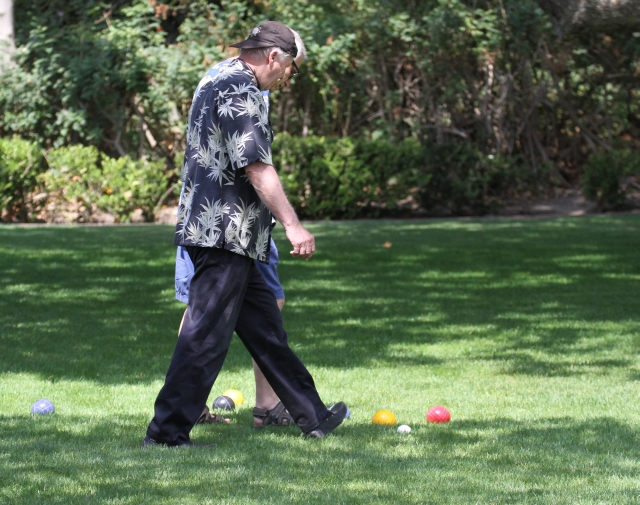
Civilizations rise and fall, yet bocce ball remains. (R. Ehler 6/22/14)
After wandering around the perimeter of the channel, out to the beach and on to Adamson House, we found two old men (I’m old, so I’m able to call others old) playing bocce ball on the lawn. The slope of the lawn towards the beach caused their bowls to significantly curve, a fact to which they had not yet adjusted, so we – or maybe it was just I – gave them a hard time about it, as a form of encouragement of course, of course. It looked like fun, and it struck me that it could easily be one of the most primitive forms of game known to humankind, the ancestor of countless other games and sports. What could be simpler than tossing or rolling objects, trying to hit a target? Acorns or pebbles serve as well as perfect spheres; you don’t even need an opposable thumb, as one player pointed out. I’ve seen monkeys in trees pelt humans below with – ahem – stuff, a practice at which they are acknowledged to be very unpleasantly skilled. [Note: Wikipedia says you can toss or bowl the bocce ball; the game goes back at least to Ancient Rome and Greece, and probably Egypt before that.]

Juvenile (left) & adult (right) American Crows.
Note juvenile bill size. (R. Ehler 6/22/14)
With the exception of a Phainopepla – a new lagoon record for me – perched in a tree near Adamson House, we had no new birds for the season. Instead we had various breeding birds busily gathering food or shepherding their young: Gadwalls, Mallards, Killdeer, Black Phoebes, American Crows, Barn Swallows, Mockingbirds, Song Sparrows and House Finches, among others.

Young Barn Swallows prefer a perch that sways (R. Ehler 6/22/14)
After the birdwalk we held our annual picnic at our favorite site in Tapia Park, a few miles up Malibu Canyon. It was very quiet, except for Mockingbirds, California Thrashers and California Towhees tootling away, and very pleasant in the live oak shade. After eating some great food we played “Bird Bingo,” which works much like regular bingo except, as one might guess, with bird pictures instead of letters. The birds were from all around the world, so you might find a Shoebill next to a Song Sparrow, an unlikely event in the real world. Winners won bars from Ellen’s cornucopia of world chocolate.

Mallard duckling – looking for mom, perhaps?
(R. Ehler 6/22/14)
Our next three scheduled field trips: Malibu Lagoon, 27 July, 8:30 & 10am; Lower Los Angeles River, Aug, or early Sept 7:30am; Malibu Lagoon, 24 August, 8:30 & 10am;.
Our next program: Tuesday, 7 Oct., 7:30 pm. To Be Announced.
NOTE: Our 10 a.m. Parent’s & Kids Birdwalk meets at the shaded viewing area. Watch for Willie the Weasel.
Links: Unusual birds at Malibu Lagoon
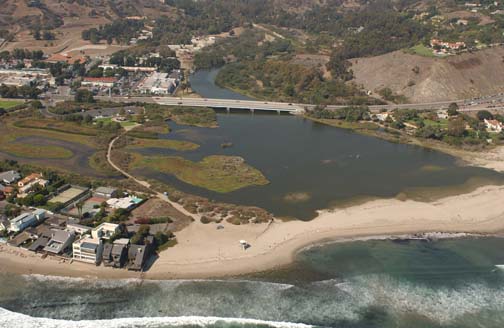
Aerial photo of Malibu Lagoon from 9/23/02.
Prior checklists: July-Dec’11, Jan-June’11, July-Dec ’10, Jan-June ’10, Jul-Dec ‘09, and Jan-June ‘09.
Comments on Bird Lists Below
Total Birds: June 2014 total birds of 465 is 15% below the 6-year June average of 549.
Summary of total birds from the 6-year average: Jun’12 +36%, Jul’12 -9%, Aug’12 -9%, Sep’12 +12%, Oct’12 +3%, Nov’12 -5%, Dec’12 +30%, Jan’13 -20%, Feb’13 -29%, Mar’13 -30%, Apr’13 -34%, May’13 -37%, Jun’13 -24%, Jul’13 +83%, Aug’13 +37%, Sep’13 +23%, Oct’13 +41%, Nov’13 -58%, Dec’13 -49%, Jan’14 -62%, Feb’14 -28%, Mar’14 +51%, May’14 -14%, June’14 -15%.
Species Diversity: June 2014 with 43 species was fractionally higher that the 6-year May average of 42.5.
Summary of species diversity from the 6-year average: Jun’12 -10%, Jul’12 +10%, Aug’12. -6%, Sep’12 -20%, Oct’12 +5%, Nov’12 +2%, Dec’12 -4%, Jan’13 +2%, Feb’13 -8%, Mar’13 +9%, Apr’13 -2%, May’13 +3%, Jun’13 +13%, Jul’13 0%, Aug’13 +11%, Sep’13 -14%, Oct’13 +19%, Nov’13 -3%, Dec’13 -6%, Jan’14 -2% Feb’14 +9%, Mar’14 +6%, May’14 +20%, June’14 +1%.
10-year comparison summaries are available on our Lagoon Project Bird Census Page. [Chuck Almdale]
Note: Beginning July, we will return to our pre-project form of bird list, which will report most recent 6-month periods. Two years of tracking census data in this format has amply demonstrated that the project, even during its messiest days, had no ill effects on bird life, despite the claims of the few, but very vocal, complainers.
| Malibu Census | 2009 | 2010 | 2011 | 2012 | 2013 | 2014 | |
| June 2009-2014 | 6/28 | 6/27 | 6/26 | 6/24 | 6/23 | 6/22 | |
| Temperature | 68-75 | 65-75 | 68-76 | 70-76 | 62-75 | 68-74 | |
| Tide Lo/Hi Height | L+0.4 | H+3.81 | H+3.0 | L+0.07 | H+4.22 | H+3.48 | Ave. |
| Tide Time | 0838 | 1139 | 0754 | 0714 | 1037 | 0712 | Birds |
| Brant | 1 | 11 | 2.0 | ||||
| Gadwall | 15 | 4 | 5 | 2 | 2 | 21 | 8.2 |
| Mallard | 25 | 40 | 41 | 24 | 59 | 32 | 36.8 |
| Red-brstd Merganser | 2 | 0.3 | |||||
| Ruddy Duck | 7 | 1.2 | |||||
| Pied-billed Grebe | 2 | 2 | 3 | 4 | 8 | 1 | 3.3 |
| Brandt’s Cormorant | 2 | 1 | 0.5 | ||||
| Dble-crstd Cormorant | 22 | 5 | 54 | 17 | 17 | 37 | 25.3 |
| Pelagic Cormorant | 3 | 0.5 | |||||
| Brown Pelican | 71 | 205 | 28 | 340 | 52 | 63 | 126.5 |
| Great Blue Heron | 8 | 6 | 4 | 1 | 2 | 2 | 3.8 |
| Great Egret | 3 | 2 | 5 | 2 | 2 | 2.3 | |
| Snowy Egret | 14 | 14 | 8 | 4 | 8 | 10 | 9.7 |
| Green Heron | 1 | 0.2 | |||||
| Blk-crwnd N-Heron | 3 | 6 | 1 | 2 | 1 | 2.2 | |
| Osprey | 1 | 1 | 0.3 | ||||
| White-tailed Kite | 1 | 1 | 0.3 | ||||
| Cooper’s Hawk | 1 | 0.2 | |||||
| Red-shouldered Hawk | 1 | 0.2 | |||||
| Red-tailed Hawk | 1 | 2 | 2 | 1 | 1.0 | ||
| Peregrine Falcon | 1 | 0.2 | |||||
| American Coot | 22 | 5 | 12 | 4 | 6 | 4 | 8.8 |
| Blk-bellied Plover | 15 | 2.5 | |||||
| Killdeer | 2 | 5 | 1 | 4 | 10 | 3.7 | |
| Black Oystercatcher | 1 | 0.2 | |||||
| Willet | 3 | 1 | 1 | 0.8 | |||
| Whimbrel | 5 | 8 | 5 | 3.0 | |||
| Long-billed Curlew | 2 | 0.3 | |||||
| Western Sandpiper | 1 | 2 | 0.5 | ||||
| Short-billd Dowitcher | 2 | 0.3 | |||||
| Heermann’s Gull | 48 | 17 | 15 | 44 | 18 | 4 | 24.3 |
| Ring-billed Gull | 7 | 1.2 | |||||
| Western Gull | 72 | 61 | 68 | 84 | 62 | 57 | 67.3 |
| California Gull | 1 | 1 | 1 | 1 | 0.7 | ||
| Caspian Tern | 3 | 9 | 10 | 1 | 6 | 3 | 5.3 |
| Royal Tern | 2 | 1 | 4 | 3 | 18 | 4.7 | |
| Elegant Tern | 15 | 4 | 240 | 14 | 23 | 49.3 | |
| Black Skimmer | 5 | 1 | 1.0 | ||||
| Rock Pigeon | 6 | 4 | 4 | 3 | 9 | 6 | 5.3 |
| Band-tailed Pigeon | 5 | 0.8 | |||||
| Mourning Dove | 4 | 4 | 5 | 1 | 2 | 2 | 3.0 |
| White-throated Swift | 1 | 0.2 | |||||
| Anna’s Hummingbird | 2 | 2 | 1 | 3 | 2 | 2 | 2.0 |
| Allen’s Hummingbird | 4 | 1 | 8 | 10 | 4 | 4.5 | |
| Belted Kingfisher | 1 | 0.2 | |||||
| Downy Woodpecker | 1 | 0.2 | |||||
| Black Phoebe | 15 | 2 | 10 | 5 | 12 | 3 | 7.8 |
| Cassin’s Kingbird | 1 | 1 | 0.3 | ||||
| Western Scrub-Jay | 1 | 1 | 0.3 | ||||
| American Crow | 12 | 4 | 4 | 4 | 8 | 9 | 6.8 |
| Rough-wingd Swallow | 6 | 6 | 1 | 8 | 3.5 | ||
| Barn Swallow | 8 | 40 | 25 | 4 | 23 | 40 | 23.3 |
| Cliff Swallow | 7 | 30 | 15 | 4 | 2 | 10 | 11.3 |
| Oak Titmouse | 1 | 1 | 0.3 | ||||
| Bushtit | 4 | 8 | 1 | 2 | 2.5 | ||
| Marsh Wren | 1 | 0.2 | |||||
| American Robin | 1 | 0.2 | |||||
| Wrentit | 1 | 0.2 | |||||
| Northern Mockingbird | 2 | 2 | 3 | 6 | 6 | 3 | 3.7 |
| European Starling | 20 | 65 | 21 | 5 | 65 | 12 | 31.3 |
| Phainopepla | 1 | 0.2 | |||||
| Common Yellowthroat | 1 | 1 | 1 | 2 | 0.8 | ||
| California Towhee | 1 | 4 | 1 | 6 | 3 | 2.5 | |
| Song Sparrow | 6 | 3 | 3 | 6 | 15 | 10 | 7.2 |
| Red-winged Blackbird | 1 | 55 | 2 | 30 | 14.7 | ||
| Great-tailed Grackle | 3 | 2 | 4 | 4 | 2.2 | ||
| Brwn-headed Cowbird | 1 | 2 | 1 | 3 | 2 | 1.5 | |
| Hooded Oriole | 4 | 1 | 1 | 2 | 1.3 | ||
| Bullock’s Oriole | 1 | 2 | 0.5 | ||||
| House Finch | 6 | 4 | 14 | 8 | 14 | 11 | 9.5 |
| Lesser Goldfinch | 2 | 4 | 2 | 2 | 1.7 | ||
| House Sparrow | 2 | 0.3 | |||||
| Totals by Type | 6/28 | 6/27 | 6/26 | 6/24 | 6/23 | 6/22 | |
| Waterfowl | 41 | 62 | 46 | 26 | 61 | 55 | 49 |
| Water Birds-Other | 117 | 217 | 97 | 368 | 85 | 106 | 165 |
| Herons, Egrets | 28 | 28 | 19 | 5 | 14 | 15 | 18 |
| Raptors | 3 | 1 | 4 | 1 | 3 | 1 | 2 |
| Shorebirds | 9 | 2 | 7 | 25 | 9 | 16 | 11 |
| Gulls & Terns | 139 | 105 | 96 | 373 | 104 | 106 | 154 |
| Doves | 10 | 8 | 9 | 4 | 16 | 8 | 9 |
| Other Non-Pass. | 6 | 3 | 2 | 12 | 13 | 6 | 7 |
| Passerines | 93 | 220 | 122 | 49 | 169 | 152 | 134 |
| Totals Birds | 446 | 646 | 402 | 863 | 474 | 465 | 549 |
| 2009 | 2010 | 2011 | 2012 | 2013 | 2014 | ||
| Total Species | 6/28 | 6/27 | 6/26 | 6/24 | 6/23 | 6/22 | |
| Waterfowl | 3 | 4 | 2 | 2 | 2 | 3 | 2.7 |
| Water Birds-Other | 4 | 4 | 4 | 5 | 5 | 5 | 4.5 |
| Herons, Egrets | 4 | 4 | 5 | 2 | 4 | 4 | 3.8 |
| Raptors | 3 | 1 | 3 | 1 | 2 | 1 | 1.8 |
| Shorebirds | 3 | 1 | 2 | 4 | 4 | 3 | 2.8 |
| Gulls & Terns | 5 | 7 | 6 | 5 | 6 | 6 | 5.8 |
| Doves | 2 | 2 | 2 | 2 | 3 | 2 | 2.2 |
| Other Non-Pass. | 2 | 2 | 2 | 3 | 3 | 2 | 2.3 |
| Passerines | 16 | 15 | 19 | 13 | 19 | 17 | 16.5 |
| Totals Species | 42 | 40 | 45 | 37 | 48 | 43 | 43 |
Full Strawberry Moon Update – 12 June, 2014, 9:11 PM PDT
Here’s another update from SMBAS Blog on that large, disc-shaped, shining object which has frequently and mysteriously appeared in our nighttime sky this year (known to many as the moon).
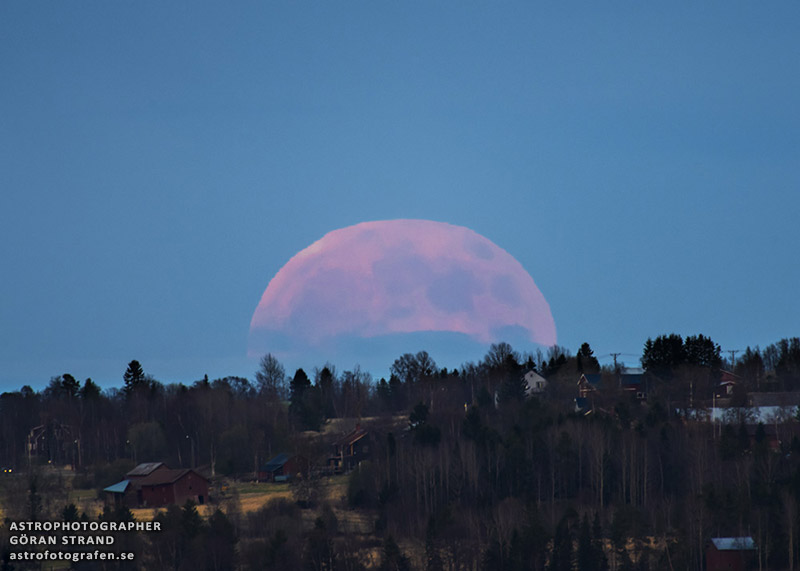
Full Strawberry Moon (by permission of Göran Strand 6/23/13 www.astrofotografen.se/ reproduced on apod.NASA.gov)
[Note: I found the above beautiful photo, by professional astrophotographer Göran Strand, on the NASA website. See many other of Göran’s astonishing photos at http://www.astrofotografen.se. On Friday the 13th, strangely enough, the moon rising over our Mt. Piños campsite was the same lovely rose-pink color.]
June 12, 9:11 p.m. PDT — Full Strawberry Moon. Known to every Algonquin tribe; strawberry picking peaks during this month. Europeans called it the Rose Moon. [Top 10 Amazing Moon Facts]

Santa Monica’s Summer Solstice Sunset over the Santa Monica Mountains (Bob Gurfield 6/21/14)
Long-time SMBAS member, prominent kayaker and alert reader, Bob Gurfield, reminded us of the fact that “Those of us who rise when the sun comes up should know that the latest (and earliest) sunrises do not occur on the solstices. ”

Santa Monica’s Winter Solstice Sunset over the ocean (Bob Gurfield 12/21/13)
With use of information from this site we constructed the following chart detailing sunrises & sunsets for three locales – Los Angeles, Anchorage and Bogota (Colombia). Note that the “earliest’ time (either sunrise or sunset) always precedes the solstice. The closer you are to the equator, the longer the period of this earliest-to-latest date spread. For example, around the summer solstice, Bogota, Colombia has 57 days between its earliest sunrise and latest sunset, Los Angeles has 16 days, Anchorage has only 3 days. Also note that the longest-to-shortest-day spread is very small near the equator; the difference for Bogota is only 32 minutes, 5 seconds. This is why in the tropics winter & summer are replaced by wet and dry seasons.
| Sunrises & | Los Angeles | Anchorage | Bogota |
| Sunsets | California | Alaska | Colombia |
| Latitude | 34° 3′ 8” N | 61° 13′ 5″ N | 4° 36′ 0″ N |
| Earliest Sunset | 12/04/13 – 1643 | 12/16/13 – 1540 | 11/09/13 – 1738 |
| Winter Solstice | 12/21/13 – 0911 | 12/21/13 – 0811 | 12/21/13 – 1211 |
| Latest Sunrise | 1/07/14 – 0659 | 12/25/13 – 1015 | 2/03/14 – 0612 |
| Earliest Sunrise | 6/12/14 – 0541 | 6/19/14 – 0420 | 5/22/14 – 0542 |
| Summer Solstice | 6/21/14 – 0351 | 6/21/14 – 0251 | 6/21/14 – 0551 |
| Latest Sunset | 6/28/14 – 2008 | 6/22/14 – 2342 | 7/18/14 – 1813 |
| Earliest Sunset | 12/04/14 – 1643 | 12/16/14 – 1540 | 11/10/14 – 1748 |
| Winter Solstice | 12/21/14 – 1503 | 12/21/14 – 1403 | 12/21/14 – 1803 |
| Latest Sunrise | 1/07/14 – 0659 | 12/26/14 – 1015 | 2/03/15 – 0612 |
| Longest Day | |||
| 6/21/2014 | 14h 25m 34s | 19h 21m 31s | 12h 23m 29s |
| Shortest Day | |||
| 12/21/2014 | 9h 53m 03s | 5h 27m 41s | 11h 51m 24s |
| Difference longest to shortest day |
4h 32m 31s | 13h 53m 50s | 0h 32m 05s |
Nowhere do the latest sunrise and sunset or earliest sunrise and sunset occur on the solstices (except perhaps exactly at the North or South Pole). The reason for this is that the earth’s axis is not aligned with the minor axis of the earth’s orbit around the sun. Over time the earth’s ecliptic precesses a tiny bit each year so that every 134,000 years the orbit makes a complete rotation with respect to the positions of the stars. [This is not the same as the ‘precession of the equinoxes.’] http://en.wikipedia.org/wiki/Apsidal_precession
The next significant full moon will occur on July 12, 4:25 a.m. PDT. Keep an eye on this spot for additional late-breaking news on this unprecedented event.
This months moon information comes to you courtesy of: http://www.space.com/24262-weird-full-moon-names-2014-explained.html
written by Joe Rao. Joe Rao serves as an instructor and guest lecturer at New York’s Hayden Planetarium. He writes about astronomy for Natural History magazine, the Farmer’s Almanac and other publications, and he is also an on-camera meteorologist for News 12 Westchester, N.Y.
But that’s waaay too long to type in, and besides, you don’t need to go there because SMBAS has done the work for you!
[Chuck Almdale]
Malibu Lagoon Trip Report: 25 May, 2014
Summer approaches: days grow warmer, sunbathers arrive, surfers blanket the waves, birds begin to leave. Still we found a record-high (for May) species count, while total birds was below average. Nesting season is well along: Killdeer chicks have been spotted, hummingbirds sat on nests, Red-winged Blackbirds
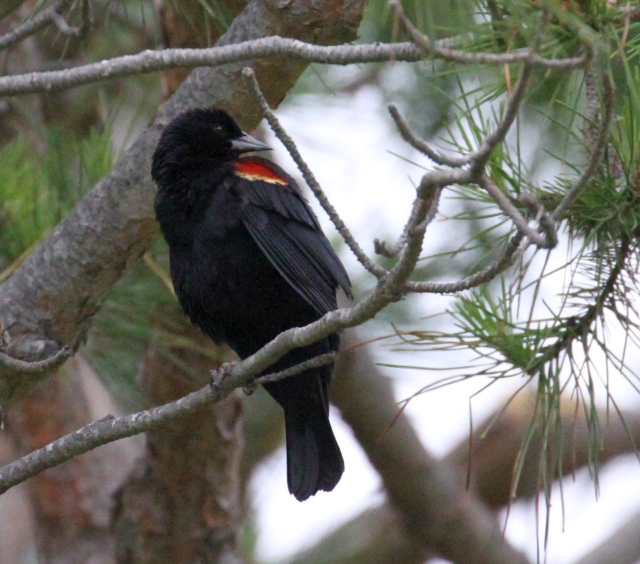
Red-winged Blackbird checks out the situation (R. Ehler 5/25/14)
displayed their epaulets, Black Phoebes collected flies, and Mockingbirds and Song Sparrows sang from nearly every bush.
Present since November, the Osprey apparently has been able to find sufficient large fish to stay satisfied. Many of us saw one (or more, as the location kept changing) such fish jumping high out of the water, and someone wise to the ways of fish identified it as a Steelhead (trout), a species endangered and long absent from the lagoon. I recall several meetings of the lagoon

Neither Kite nor Eagle, but an Osprey (R. Ehler 5/25/14)
task force, decades ago, at which a representative of Trout Unlimited spoke of the steelhead and his organization’s hope that the lagoon and creek could again be a home for them. It didn’t seem likely to me at the time, but now…things are looking up! The steelhead’s presence in the lagoon, first noted on 5/15/14 by fish monitors, was soon reported elsewhere (KPCC, Malibu Patch, KCET). The local anti-lagoon-reconfiguration diehards immediately scoffed, of course. Personally, I’ve often seen Mullet – another large fish – in the lagoon, but can’t recall ever seeing one jump. I have seen several species of trout elsewhere (Oregon, Michigan, Great Lakes) and they are definitely jumpers, exciting to watch. While we’re on the topic of fish, the Tidewater Gobies are reportedly doing very well indeed, as their habitat was greatly increased by the lagoon channel reconfiguration.
[Comment inserted 6/6/14
According to an article in the Malibu Patch, “An adult steelhead trout, approximately 20 inches in length, was discovered on May 15 during post-construction fish monitoring by the Resource Conservation District-Santa Monica Mountains, California State Parks and The Bay Foundation.” ON 6/6/14 I received an email from Mark Abramson: “The jumpers are almost always striped mullet. However Rosi and her fish team saw a 20-inch steelhead in the back of the channel when they were there doing fish surveys.”
So it seems that the fish we saw jumping on May 25 were actually Striped Mullet, and not the steelhead. Link to slide show of jumping Striped Mullet on EcoMalibu. Malibu Patch has a picture of the steelhead. End of inserted comment]
Also reported from the lagoon were numbers of dead Brown Pelicans (we saw three) as well as unusual numbers of adult pelicans. They should be nesting on offshore islands – Anacapa, for example – rather than lounging at Malibu Lagoon. It turns out that Brown Pelican nesting failures have been reported throughout California and Baja. One Baja colony, which would normally have over 10,000 nestlings by now, has produced well under 100. Failure of the nests is due to the lack of suitable prey fish, which in turn is the result of a change in ocean currents, which is believed to be linked to the ENSO (El Nino – Southern Oscillation) phenomenon. This, in addition to other factors, is leading scientists to predict El Nino for next winter. Stay tuned! [Link to reports: KPCC blog & audio report featuring Dan Cooper, Kimball Garrett & Kathy Molina; partial transcript of audio report.]
Connection to a Vimeo film on Steelhead, 19:25 minutes. Vimeo runs poorly on my computer; perhaps it works on yours.

Caspian Tern with a gift for his mate (R. Ehler 5/25/14)
Birds new for the season were: White-tailed Kite, a single Bonaparte’s Gull, a very *uncommon and unexpected Common Tern, Mourning Dove (which are always close by, I don’t know where they’ve been hiding), Western Wood-Pewee, Pacific-slope Flycatcher, and American Robin.
*Out of the lagoon 207 visits for which censusing was done, Common Tern was present 12 times (5.8%) with a total of 49 birds.
Our next three scheduled field trips: Mt. Piños Birds & Butterflies, 14-15 June, 8am; Malibu Lagoon, 22 June, 8:30 & 10am; Malibu Lagoon, 27 July, 8:30 & 10am.
Our next program: Tuesday, 7 Oct., 7:30 pm. To Be Announced.
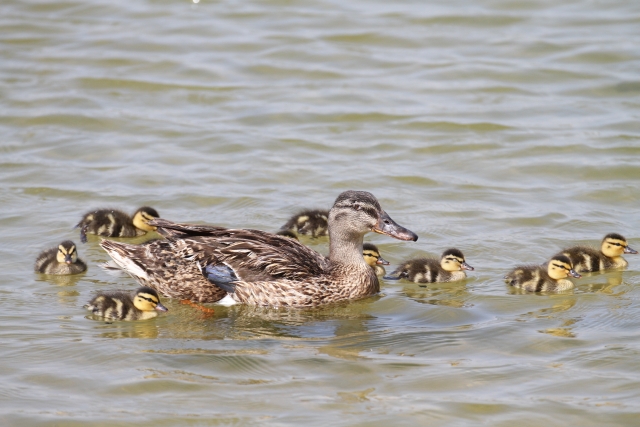
Despite cries from “those of little faith,” the Mallards are doing quite well, thank you. (R. Ehler 5/25/14)
NOTE: Our 10 a.m. Parent’s & Kids Birdwalk meets at the shaded viewing area. Look for Willie the Weasel.
Links: Unusual birds at Malibu Lagoon
Aerial photo of Malibu Lagoon from 9/23/02.
Prior checklists: July-Dec’11, Jan-June’11, July-Dec ’10, Jan-June ’10, Jul-Dec ‘09, and Jan-June ‘09.
Comments on Bird Lists Below
Total Birds: May total birds of 410 is 14% below the 6-year May average of 474.
Summary of total birds from the 6-year average so far: Jun’12 +36%, Jul’12 -9%, Aug’12 -9%, Sep’12 +12%, Oct’12 +3%, Nov’12 -5%, Dec’12 +30%, Jan’13 -20%, Feb’13 -29%, Mar’13 -30%, Apr’13 -34%, May’13 -37%, Jun’13 -24%, Jul’13 +83%, Aug’13 +37%, Sep’13 +23%, Oct’13 +41%, Nov’13 -58%, Dec’13 -49%, Jan’14 -62%, Feb’14 -28%, Mar’14 +51%, May -14%.
Species Diversity: May 2014 with 55 species, a 10-year high, was 20% above the 6-year May average of 46.
Summary of species diversity from the 6-year average so far: Jun’12 -10%, Jul’12 +10%, Aug’12. -6%, Sep’12 -20%, Oct’12 +5%, Nov’12 +2%, Dec’12 -4%, Jan’13 +2%, Feb’13 -8%, Mar’13 +9%, Apr’13 -2%, May’13 +3%, Jun’13 +13%, Jul’13 0%, Aug’13 +11%, Sep’13 -14%, Oct’13 +19%, Nov’13 -3%, Dec’13 -6%, Jan’14 -2% Feb’14 +9%, Mar’14 +6%, May +20%. Up, down, up, down, etc., etc.
10-year comparison summaries are available on our Lagoon Project Bird Census Page. [Chuck Almdale]
Note: Beginning July, we will return to our pre-project form of bird list, which will report the most recent 6-month periods.
| Malibu Census | 2009 | 2010 | 2011 | 2012 | 2013 | 2014 | |
| May 2009-2014 | 5/24 | 5/23 | 5/22 | 5/27 | 5/26 | 5/25 | |
| Temperature | 59-64 | 54-62 | 58-63 | 68-72 | 63-64 | 64-69 | |
| Tide Lo/Hi Height | H+3.7 | H+3.76 | L-0.13 | L+0.38 | H+4.08 | H+3.94 | Ave. |
| Tide Time | 1042 | 0638 | 0816 | 0844 | 1138 | 0810 | Birds |
| Brant | 4 | 7 | 1 | 2.0 | |||
| Gadwall | 12 | 12 | 3 | 5 | 2 | 12 | 7.7 |
| American Wigeon | 2 | 0.3 | |||||
| Mallard | 20 | 18 | 48 | 32 | 5 | 26 | 24.8 |
| Northern Shoveler | 1 | 0.2 | |||||
| Red-brstd Merganser | 2 | 3 | 0.8 | ||||
| Ruddy Duck | 2 | 3 | 6 | 1.8 | |||
| Pacific Loon | 1 | 5 | 1 | 1.2 | |||
| Common Loon | 1 | 0.2 | |||||
| Pied-billed Grebe | 2 | 3 | 3 | 2 | 1.7 | ||
| Western Grebe | 1 | 0.2 | |||||
| Brandt’s Cormorant | 1 | 2 | 0.5 | ||||
| Dble-crstd Cormorant | 28 | 7 | 46 | 15 | 9 | 31 | 22.7 |
| Pelagic Cormorant | 1 | 1 | 0.3 | ||||
| Brown Pelican | 70 | 124 | 81 | 265 | 7 | 37 | 97.3 |
| Great Blue Heron | 1 | 2 | 1 | 3 | 2 | 4 | 2.2 |
| Great Egret | 4 | 2 | 3 | 3 | 2 | 2.3 | |
| Snowy Egret | 7 | 12 | 3 | 14 | 3 | 12 | 8.5 |
| Green Heron | 1 | 0.2 | |||||
| Blk-crwnd N-Heron | 2 | 3 | 1 | 2 | 1.3 | ||
| Osprey | 1 | 1 | 1 | 0.5 | |||
| White-tailed Kite | 1 | 1 | 0.3 | ||||
| Cooper’s Hawk | 1 | 0.2 | |||||
| Red-tailed Hawk | 1 | 1 | 1 | 0.5 | |||
| Peregrine Falcon | 1 | 0.2 | |||||
| American Coot | 32 | 8 | 25 | 30 | 1 | 2 | 16.3 |
| Blk-bellied Plover | 3 | 22 | 4.2 | ||||
| Snowy Plover | 1 | 0.2 | |||||
| Semipalmated Plover | 2 | 0.3 | |||||
| Killdeer | 1 | 4 | 2 | 3 | 6 | 4 | 3.3 |
| Spotted Sandpiper | 3 | 0.5 | |||||
| Willet | 4 | 0.7 | |||||
| Whimbrel | 4 | 1 | 20 | 1 | 4 | 5.0 | |
| Marbled Godwit | 1 | 0.2 | |||||
| Black Turnstone | 1 | 0.2 | |||||
| Boneparte’s Gull | 1 | 1 | 1 | 0.5 | |||
| Heermann’s Gull | 20 | 17 | 15 | 35 | 2 | 14.8 | |
| Ring-billed Gull | 1 | 2 | 16 | 1 | 3.3 | ||
| Western Gull | 65 | 68 | 10 | 85 | 22 | 64 | 52.3 |
| California Gull | 95 | 8 | 4 | 1 | 18.0 | ||
| Glaucous-wingd Gull | 1 | 0.2 | |||||
| Caspian Tern | 15 | 25 | 4 | 6 | 2 | 17 | 11.5 |
| Common Tern | 1 | 0.2 | |||||
| Forster’s Tern | 2 | 0.3 | |||||
| Royal Tern | 2 | 5 | 5 | 8 | 3.3 | ||
| Elegant Tern | 40 | 9 | 12 | 35 | 121 | 37 | 42.3 |
| Black Skimmer | 2 | 0.3 | |||||
| Rock Pigeon | 6 | 6 | 8 | 2 | 6 | 4.7 | |
| Eur. Collared-Dove | 1 | 0.2 | |||||
| Mourning Dove | 4 | 6 | 1 | 2 | 5 | 2 | 3.3 |
| Anna’s Hummingbird | 2 | 1 | 1 | 2 | 1 | 1 | 1.3 |
| Allen’s Hummingbird | 8 | 6 | 4 | 5 | 1 | 5 | 4.8 |
| Belted Kingfisher | 1 | 0.2 | |||||
| Western Wood-Pewee | 1 | 0.2 | |||||
| Pac.Slope Flycatcher | 1 | 1 | 0.3 | ||||
| Black Phoebe | 12 | 10 | 4 | 13 | 2 | 6 | 7.8 |
| Say’s Phoebe | 1 | 0.2 | |||||
| American Crow | 6 | 4 | 3 | 5 | 3 | 6 | 4.5 |
| Common Raven | 2 | 0.3 | |||||
| Rough-wingd Swallow | 10 | 1 | 2 | 1 | 2 | 2.7 | |
| Violet-green Swallow | 1 | 1 | 0.3 | ||||
| Barn Swallow | 1 | 8 | 8 | 2 | 6 | 19 | 7.3 |
| Cliff Swallow | 12 | 12 | 31 | 12 | 14 | 6 | 14.5 |
| Oak Titmouse | 1 | 0.2 | |||||
| Bushtit | 4 | 4 | 10 | 8 | 4.3 | ||
| Bewick’s Wren | 1 | 0.2 | |||||
| American Robin | 1 | 0.2 | |||||
| Wrentit | 1 | 0.2 | |||||
| Northern Mockingbird | 6 | 4 | 2 | 6 | 3 | 3 | 4.0 |
| European Starling | 2 | 3 | 40 | 45 | 3 | 8 | 16.8 |
| Cedar Waxwing | 32 | 5.3 | |||||
| Ornge-crwnd Warbler | 1 | 0.2 | |||||
| Common Yellowthroat | 2 | 3 | 3 | 1.3 | |||
| Spotted Towhee | 2 | 0.3 | |||||
| California Towhee | 5 | 1 | 1 | 1 | 3 | 1.8 | |
| Song Sparrow | 8 | 10 | 4 | 12 | 8 | 11 | 8.8 |
| Red-winged Blackbird | 4 | 2 | 10 | 9 | 6 | 5.2 | |
| Brewer’s Blackbird | 2 | 0.3 | |||||
| Great-tailed Grackle | 16 | 2 | 4 | 2 | 4.0 | ||
| Brwn-headed Cowbird | 2 | 1 | 3 | 1 | 2 | 1.5 | |
| Hooded Oriole | 1 | 1 | 0.3 | ||||
| Bullock’s Oriole | 2 | 1 | 1 | 0.7 | |||
| House Finch | 8 | 6 | 8 | 8 | 3 | 13 | 7.7 |
| Lesser Goldfinch | 1 | 2 | 4 | 2 | 1.5 | ||
| House Sparrow | 5 | 0.8 | |||||
| Totals by Type | 5/24 | 5/23 | 5/22 | 5/27 | 5/26 | 5/25 | |
| Waterfowl | 38 | 37 | 51 | 42 | 9 | 49 | 38 |
| Water Birds-Other | 132 | 148 | 152 | 313 | 20 | 77 | 140 |
| Herons, Egrets | 13 | 16 | 6 | 23 | 9 | 20 | 15 |
| Raptors | 1 | 1 | 3 | 0 | 2 | 3 | 2 |
| Shorebirds | 5 | 5 | 5 | 51 | 10 | 11 | 15 |
| Gulls & Terns | 144 | 216 | 51 | 151 | 189 | 132 | 147 |
| Doves | 10 | 12 | 9 | 5 | 5 | 8 | 8 |
| Other Non-Pass. | 10 | 7 | 5 | 8 | 2 | 6 | 6 |
| Passerines | 79 | 106 | 131 | 127 | 76 | 104 | 104 |
| Totals Birds | 432 | 548 | 413 | 720 | 322 | 410 | 474 |
| 2009 | 2010 | 2011 | 2012 | 2013 | 2014 | ||
| Total Species | 5/24 | 5/23 | 5/22 | 5/27 | 5/26 | 5/25 | |
| Waterfowl | 4 | 3 | 2 | 4 | 4 | 5 | 3.7 |
| Water Birds-Other | 5 | 7 | 3 | 4 | 4 | 8 | 5.2 |
| Herons, Egrets | 4 | 3 | 3 | 4 | 4 | 4 | 3.7 |
| Raptors | 1 | 1 | 3 | 0 | 2 | 3 | 1.7 |
| Shorebirds | 2 | 2 | 2 | 6 | 4 | 3 | 3.2 |
| Gulls & Terns | 7 | 6 | 6 | 7 | 8 | 8 | 7.0 |
| Doves | 2 | 2 | 2 | 3 | 1 | 2 | 2.0 |
| Other Non-Pass. | 2 | 2 | 2 | 3 | 2 | 2 | 2.2 |
| Passerines | 16 | 19 | 16 | 16 | 17 | 20 | 17.3 |
| Totals Species – 85 | 43 | 45 | 39 | 47 | 46 | 55 | 46 |
For you of little faith…
If you think you saw something that was NOT a carp jumping in Malibu Lagoon on Sunday’s SMBAS birds+ walk… KPCC just broadcast a piece featuring Suzanne Goode about the health of the reconfigured lagoon,…and stating that steelhead (a salmonid native fish) has been spotted in Malibu Lagoon! Welcome back fish! Welcome back lagoon!
Comment added 6/6/14
According to an article in the Malibu Patch, “An adult steelhead trout, approximately 20 inches in length, was discovered on May 15 during post-construction fish monitoring by the Resource Conservation District-Santa Monica Mountains, California State Parks and The Bay Foundation.” ON 6/6/14 I received an email from Mark Abramson: “The jumpers are almost always striped mullet. However Rosi and her fish team saw a 20-inch steelhead in the back of the channel when they were there doing fish surveys.”
So it seems that the fish we saw jumping on May 25 were actually Striped Mullet, and not the steelhead.
Link to slide show of jumping Striped Mullet on EcoMalibu.
Links: KPCC, KCET, Malibu Patch (has picture of the steelhead)
[Chuck Almdale]
LucienP, Conservation Chair



 SANTA MONICA BAY AUDUBON SOCIETY BLOG