Free email delivery
Please sign up for email delivery in the subscription area to the right.
No salesman will call, at least not from us. Maybe from someone else.
Full Buck Moon Update – 12 July, 2014, 4:25 AM PDT
Here’s another update from SMBAS Blog on that large, disc-like, shining object which has frequently and mysteriously appeared in our nighttime sky this year (known to many as the moon).

Montage of moon in eclipse (Sebastien Gauthier 5/14/14; NASA website)
July 12, 4:25 a.m. PDT — Full Buck Moon. This is the season when the new antlers of buck deer push out from their foreheads in coatings of velvety fur. It was also often called the Full Thunder Moon, thunderstorms being most frequent at this time. Sometimes this is also called the Full Hay Moon.
Barroom bet question: How long is the mean average period of daylight (sunrise to sunset) at exactly the North or the South geographic pole? For purposes of this question, mean average = total hours of daylight / number of periods of daylight in a year.
a. 8 hours
b. 11 hours, 58 minutes
c. 12 hours
d. 16 hours
e. 182.625 days
No peeking!
Tick, tock
Tick, tock
The answer is e, which is 1/2 year. At the North Pole the sun begins to appear above the horizon on March 21, rises slowly until June 21, then slowly sinks until disappearing below the horizon on Sept. 21. The converse happens at the South Pole. Thus there is ONLY ONE period of daylight per (non-calendar) year. With only one period of daylight, average and actual lengths are equal.
The next significant full moon will occur on August 10, 11:09 a.m August 10, 11:09 a.m. PDT. Keep an eye on this spot for additional late-breaking news on this unprecedented event.
This information comes to you courtesy of: http://www.space.com/24262-weird-full-moon-names-2014-explained.html
written by Joe Rao. Joe Rao serves as an instructor and guest lecturer at New York’s Hayden Planetarium. He writes about astronomy for Natural History magazine, the Farmer’s Almanac and other publications, and he is also an on-camera meteorologist for News 12 Westchester, N.Y.
But that’s waaay too long to type in, and besides, you don’t need to go there because SMBAS has done the work for you!
[Chuck Almdale]
Malibu Lagoon Fish Life

Striped Mullet (Wikipedia)
According to Wikipedia, Striped Mullet goes by many names, including: Black mullet (Cuba, US), Bully mullet (Australia, Vietnam), Callifaver mullet (Cuba, Netherlands Antilles, US), Common grey mullet (UK), Common mullet (Cuba, Netherlands Antilles, US), Flathead grey mullet (India, Philippines, UK), Flathead mullet (Europe, FAO, UN), Grey mullet (Thailand, Turkey, Australia, Taiwan, Cuba, Fiji, Hong Kong, Mauritius, Netherlands Antilles, New Zealand, Spain, Tonga, UK, US, Mediterranean, Egypt), Hardgut mullet (Australia), Mangrove mullet (Australia), and Sea mullet (Australia, Fiji, Papua New Guinea, UK).
Decades ago, British and American bird mavens decided to agree on English names for all the world’s birds. They’ve made much progress, with some exceptions such as when the bird Americans knew as Common Gallinule was renamed Common Moorhen to satisfy British intransigence (recently rectified), whereupon some American birders pointed out that we don’t have moors, they’re not all hens, and they’re not all that common. LAAS’s Western Tanager newsletter, highlighting this problem of multiple nomenclature once ran an article, by Garrett & Dunn, I believe, detailing how to differentiate between three then-widespread egrets: Common, Great and American. [It was an April issue in I forget which year.]
Fish lovers have made no such progress, as any piscivore should know. Surely you are aware that Chilean sea bass was previously known as Patagonian toothfish; the name change was a marketing decision – sea bass sounded far more scrumptious than toothfish, and anyway, no real American knows where Patagonia is. [The good sales people at REI will gladly point you in the right direction.]
Which brings us around to the mullet many have seen leaping friskily from Malibu Lagoon in recent months. The New England Aquarium says they are also called jumping mullet or jumping jack (take that, Wikipedia!) because of this behavior. I couldn’t find out if this is a courting display, a feeding behavior, an attempt to shake off parasites or a recreational activity. [Anyone out there know?]
If you haven’t personally witnessed this phenomenon, check out the Dance of the Striped Mullet slideshow on Bob Purvey’s EcoMalibu website.
EcoMalibu also has a video page of over 20 different films pertaining to the lagoon and the reconfiguration project. The following is a list of short underwater films taken near the water monitoring stations (those posts with vertical depth gauges) ; you’ll be surprised at how much life is swimming around down there. This list, along with many other delights, is on our permanent Malibu Lagoon Project page. [Chuck Almdale]
1. Aug. 7, 2013 Length 1:48 minutes “Life Below the Surface”
2. Aug. 12, 2013 Length 9:20 minutes “Malibu Lagoon Aquarium”
3. Aug. 26, 2013 Length 3:53 minutes “Malibu Lagoon Aquarium II”
4. Sep. 9, 2013 Length 4:55 minutes “Malibu Lagoon Aquarium III”
5. Sep. 30, 2013 Length 1:47 minutes “Shrimpfest”
6. Oct. 2, 2013 Length 2:42 minutes “Malibu Lagoon Aquarium IV”
7. Oct. 22, 2013 Length 8:31 minutes “Fish, Fish, Fish”
8. Nov. 4, 2013 Length 0:57 minutes “The Big Fish”
9. Apr. 30, 2014 Length 3:36 minutes “Lagoon Crustaceans”
10. Jun. 18, 2014 Length 3:49 minutes “Aquarium & Aviary”
11. Jun. 25, 2014 Length 2:21 minutes “Got Fish? Malibu Lagoon Does”
12. Jun. 25, 2014 Length 2:08 minutes “Shrimpfest II”
13. May-June, 2014 Slide Show “Dance of the Striped Mullet”
14. Jul. 7, 2014 Length 1:56 minutes “Mullet Adult School”
More to Come
Sharpen those pencils…for the gnatcatcher!
Please read the article on page one of LATEXTRA in this morning’s L.A. Times. Another assault based on dubious science by the Pacific Legal Foundation, the organization that believes that developers have a constitutional right to build wherever and whatever they wish, no matter what the damage caused to nature or other people.
A comment period will be announced by the US Fish and Wildlife Service and I hope each of us delivers a letter or postcard supporting the protection of the few California Gnatcatchers that survive to this day. Stay tuned for updates.
http://www.latimes.com/science/la-me-gnatcatcher-20140630-story.html
My new binoculars
I just got a replacement pair of binoculars for my old Zeiss “Diafun’s” and I went to my stack of unread or un-acted-upon items that seems to permanently decorate my desk. There I found a copy of the Cornell Ornithology Lab’s Fall 2013 article on the birding binocular evaluation that Steven Zax generously handed me in November.
Cornell doesn’t go through the process of evaluating binos very often. The last bank of test was five years earlier, and as pointed out in the article, there have been many changes in equipment and prices since 2008. So, if you are in the market to replace your current pair, or to know what you would get in case of a loss or accident, the articles are worth reading, and Cornell generously puts them on line for you at no fee.
A few notes about their conclusions.
1. You can spend nearly $3,000 including sales tax for the best of the best nowadays.
2. Their basic advice (Jessie Barry and Ken Rosenberg are the authors of the main article) is to buy the best you can afford. I disagree, or put it differently. I would say the best you can afford to lose or break.
3. There are a lot of good binoculars available under $700 now.
4. There are no under-$100 binoculars that will satisfy a serious birder.
To read all the information, go to http://www.birds.cornell.edu/Page.aspx?pid=1642&q=best%20binoculars
[If the above link is broken try: https://www.allaboutbirds.org/news/the-cornell-lab-review-affordable-full-size-8×42-binoculars/]
You will find a whole lineup of links to the binocular review including the main article, Ken Rosenberg’s explanation of how to make a good buying decision, and the results of the evaluation in a table version.
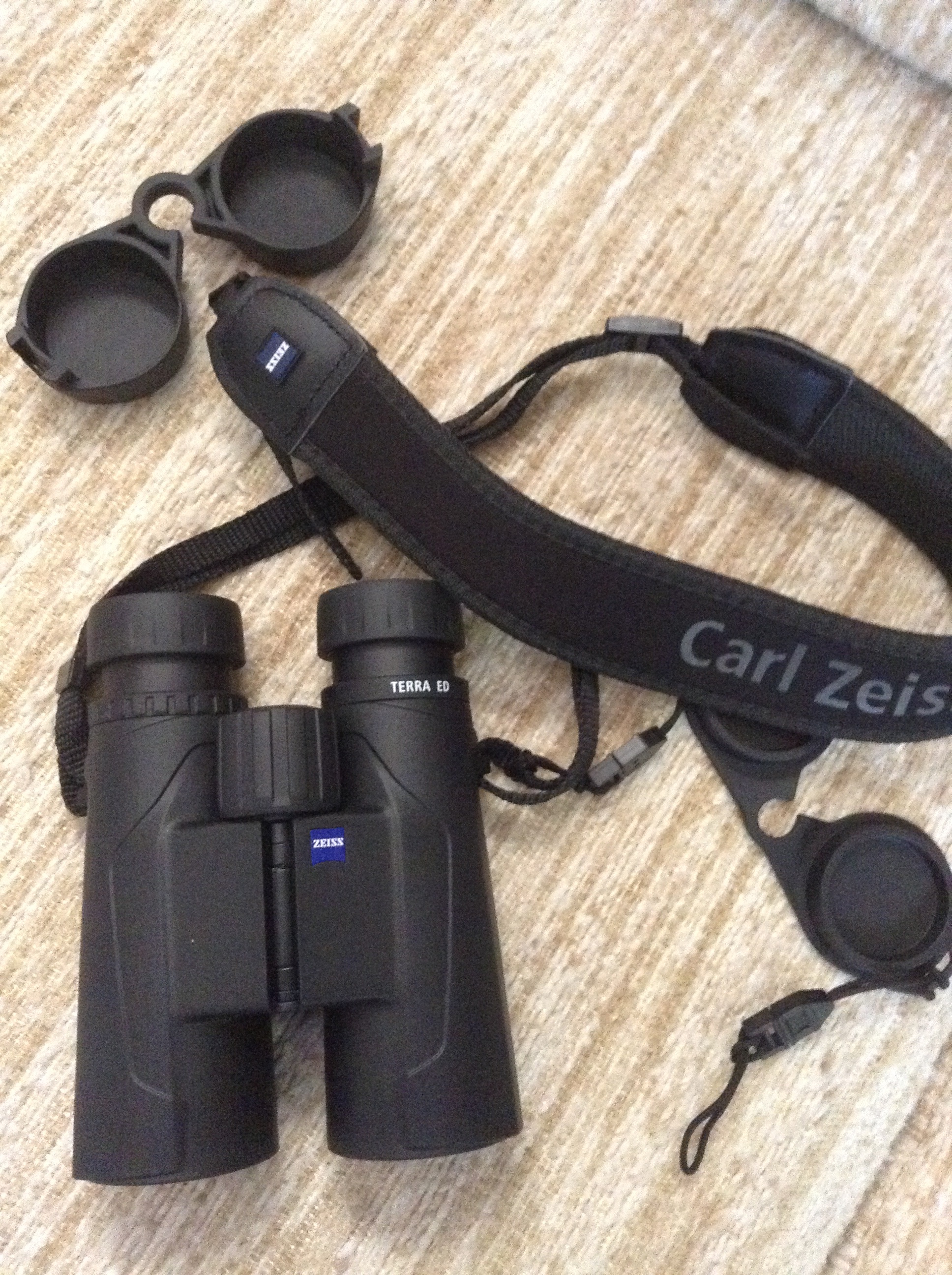
It turns out for me that the replacement for my Diafun’s is a pair of Zeiss “Terra ED’s”, slightly heavier, brighter, and amazingly sharp edge to edge.
Happy birding! Feedback welcome.
Lu Plauzoles
Apps Anyone?
For those who have a smartphone or a pad, I recommend you quickly go to the Nature Share page of the iTunes store or Google Play. Four of the best Audubon apps are available for $1.99 each through the 4th of July weekend. These are photo guides and I find the apps far superior to the book version of the same title. I was especially surprised at the number of bird vocalizations on my California Birds app.
I only look at the butterflies app occasionally but it’s great having it in my pocket for those occasions. Check carefully. Not all apps are available both for iPad AND Android.



 SANTA MONICA BAY AUDUBON SOCIETY BLOG