Free email delivery
Please sign up for email delivery in the subscription area to the right.
No salesman will call, at least not from us. Maybe from someone else.
For you of little faith…
If you think you saw something that was NOT a carp jumping in Malibu Lagoon on Sunday’s SMBAS birds+ walk… KPCC just broadcast a piece featuring Suzanne Goode about the health of the reconfigured lagoon,…and stating that steelhead (a salmonid native fish) has been spotted in Malibu Lagoon! Welcome back fish! Welcome back lagoon!
Comment added 6/6/14
According to an article in the Malibu Patch, “An adult steelhead trout, approximately 20 inches in length, was discovered on May 15 during post-construction fish monitoring by the Resource Conservation District-Santa Monica Mountains, California State Parks and The Bay Foundation.” ON 6/6/14 I received an email from Mark Abramson: “The jumpers are almost always striped mullet. However Rosi and her fish team saw a 20-inch steelhead in the back of the channel when they were there doing fish surveys.”
So it seems that the fish we saw jumping on May 25 were actually Striped Mullet, and not the steelhead.
Link to slide show of jumping Striped Mullet on EcoMalibu.
Links: KPCC, KCET, Malibu Patch (has picture of the steelhead)
[Chuck Almdale]
LucienP, Conservation Chair
Update on Beach Parking for Seniors
For those of us who have reached age 62, and like to bird at the beach, please note! According to Supervisor Zev Yaroslavsky’s blog, the Beaches and Harbors Department will be considering a $25 fee for the Seniors Beach Parking Pass. Act now to avoid the higher fee. See my March 6th entry on Senior Parking Passes by clicking on the “select month” link on the right hand side of the page.
Full Flower Moon Update – 14 May, 2014, 12:16 PM PDT
Here’s another update from SMBAS Blog on that large, disc-like, shining object which has frequently and mysteriously appeared in our nighttime sky this year (known to many as the moon).

Refuge Moonrise (T. Hinnebusch 2/14/14)
May 14, 12:16 p.m. PDT — Full Flower Moon. Flowers are abundant everywhere at this time. May’s full moon was also known as the Full Corn Planting Moon or the Milk Moon. [Gallery: The Fantastic Full Moon]
The next significant full moon will occur on June 12, 9:11 p.m. PDT. Keep an eye on this spot for additional late-breaking news on this unprecedented event.
This information comes to you courtesy of: http://www.space.com/24262-weird-full-moon-names-2014-explained.html
written by Joe Rao. Joe Rao serves as an instructor and guest lecturer at New York’s Hayden Planetarium. He writes about astronomy for Natural History magazine, the Farmer’s Almanac and other publications, and he is also an on-camera meteorologist for News 12 Westchester, N.Y.
But that’s waaay too long to type in, and besides, you don’t need to go there because SMBAS has done the work for you!
[Chuck Almdale]
Malibu Lagoon, April 27, 2014
We had great weather, just beating the recent heat wave by one day. The water level at the lagoon was the highest we have seen since the renovation; it may have reduced the number of birds because there was no mud exposed and only a couple of small islands to perch on safely. On the other hand, we saw many Killdeer chicks close to the pathways, and that is not at all expected. One of our group saw a dozen chicks before they were called off a pathway by their parents.

Killdeer chick; photo by Adrian Douglas
There were several reports of large fish jumping and we had one Osprey fly over; no reports yet of a nest so we assume this was merely a visitor. Another unusual set of visitors were some Vaux’s Swifts flying low, mixed in with the Barn, Cliff, Rough-winged and Violet-green swallows. It was a good opportunity to observe the different flight characteristics of swallows and swifts.
For whatever reason, we saw virtually no warblers – only two of the resident Common Yellowthroats. Migration and breeding season did give us a good look at Spotted Sandpipers with real spots on them, not in their plain winter plumage.

Spotted Sandpiper; photo by Adrian Douglas
The Elegant Terns were all clustered together on one of the small islands and the Urge to Merge ran rampant among them. And yes, there was one Royal Tern among them, standing out with its larger size, bald forehead and slightly stronger bill. We also had six of the Big Boys, Caspian Terns.

Caspian Terns; photo by Laurel Jones
Maybe it was the high water (few waders) or the change in the weather (lots of good birds found the same weekend at Butterbredt on their way north for the summer) the lagoon lacked variety for a May trip. We still saw a lot: results below.

Whimbrel; photo by Laurel Jones
| Pied-billed Grebe | 1 |
| Double-crested Cormorant | 24 |
| Brown Pelican | 105 |
| Red-breasted Merganser | 1 |
| Snowy Egret | 12 |
| Black-crowned Night-Heron | 1 |
| Osprey | 1 |
| American Coot | 20 |
| Marbled Godwit | 25 |
| Whimbrel | 7 |
| Spotted Sandpiper | 3 |
| Western Sandpiper | 5 |
| Least Sandpiper | 1 |
| Killdeer | 22 |
| Heermann’s Gull | 27 |
| California Gull | 3 |
| Western Gull | 27 |
| Caspian Tern | 6 |
| Royal Tern | 1 |
| Elegant Tern | 63 |
| Rock Pigeon | 5 |
| Allen’s Hummingbird | 3 |
| Black Phoebe | 5 |
| Western Scrub-Jay | 1 |
| American Crow | 8 |
| Northern Mockingbird | 4 |
| European Starling | 6 |
| Bushtit | 6 |
| Violet-green Swallow | 6 |
| Northern Rough-winged Swallow | 4 |
| Barn Swallow | 20 |
| Cliff Swallow | 5 |
| House Finch | 6 |
| Common Yellowthroat | 2 |
| Song Sparrow | 12 |
| California Towhee | 4 |
| Brown-headed Cowbird | 1 |
To guide or app?
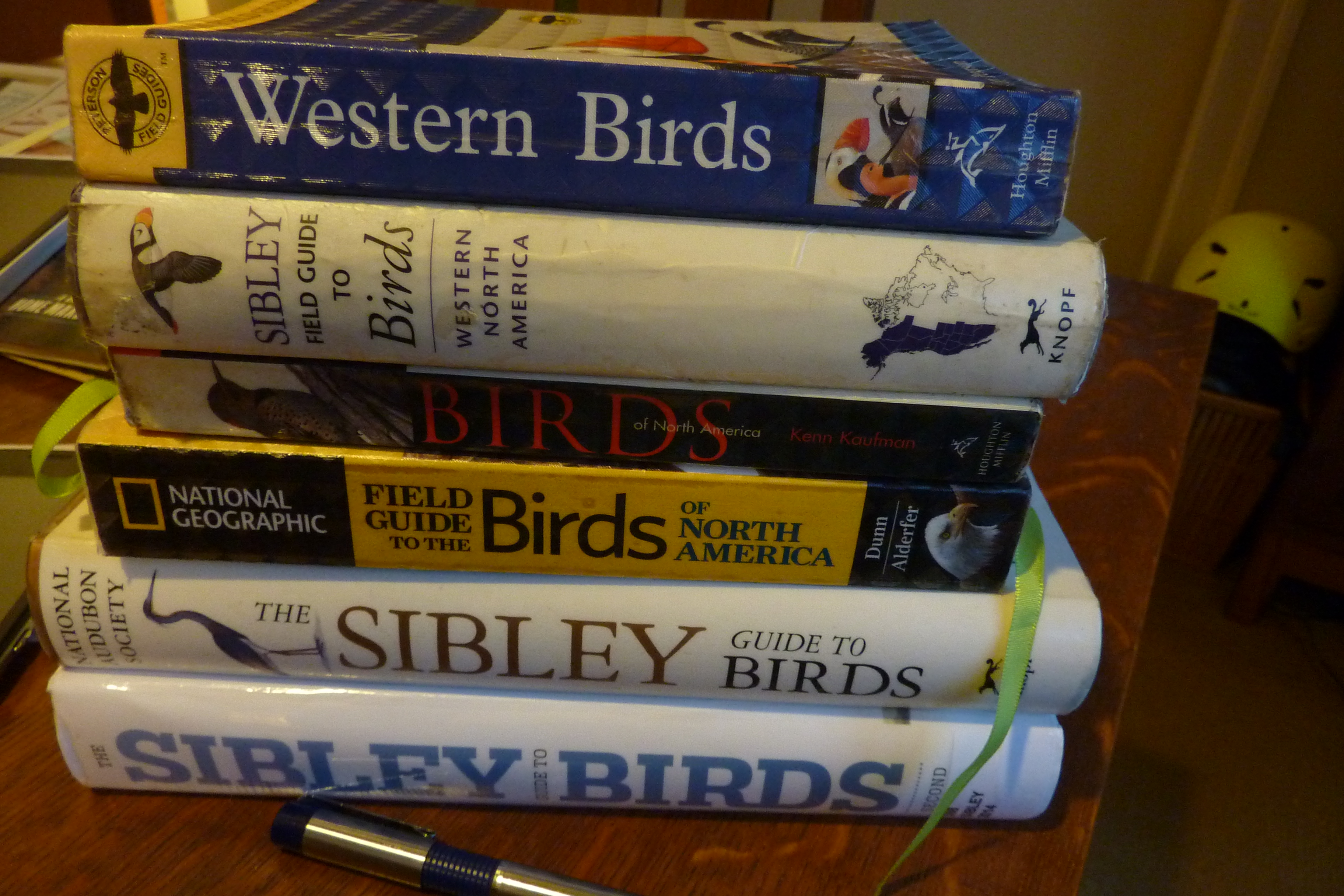
This doesn’t include the 4 apps on my iPod Touch!
I was recently trying to answer questions from an intellectually curious beginning birder seeking information on our local birds. And it was fairly obvious that for those who are not accustomed to spending hours on the web, we have not recently put out much information on our “secret sources” to bird identification.
Far from having secret arcane knowledge about birds, we are citizen scientists and nature enthusiasts awash in a corpus of popular reference books and phone/pad apps. Here are a few ideas for a first-time visitor on one of our monthly Malibu Lagoon walks.
Try the library first! Just like choosing binoculars, find out what you like by reading and using a field guide first.
I think there is value in starting with a local guide that makes it easier to focus on what is likely to be seen in our area. Kimball Garrett’s BIRDS OF THE LOS ANGELES REGION is a compact (4×6”) photo guide that will get you started. Kimball is the local authority on bird sightings in the L.A. region and he often opines on the Yahoo group “LACounty birds”. He certainly can’t answer every query, but he is quite generous in his online opinions.
Another good photo guide is Kenn Kauffman’s FIELD GUIDE TO THE BIRDS OF NORTH AMERICA although it includes a lot more species. I have not seen much change in this guide since its inception in 2000, however, it has merit for “starting serious” birders. It is also one of the lightest books to carry at app. 17oz in the ppb edition.
After a year of birding you will probably want to start using one of the more complete guides that present multiple illustrations (usually paintings) of birds. That is because artists can highlight specific field marks or characteristics that are used to identify birds. The most widely used guides are the series painted by David Allen Sibley. He has published guides to all the North American birds, to Eastern and to Western species in more portable format, and iPhone/iPad “apps” that can be used in the field. The iPad app even allows two species to be compared on the same screen, side by side. (works on the iPad Mini also)
The big news in the guide world today is the March 2014 publishing of Sibley’s second edition—the first since its original 2000 printing. In short, it is a knockout, especially for advanced birders who will relish its new verbal detail. It is 45 pages thicker and therefore heavier. Only the truly dedicated will want to carry a three pound 6 x 10” $40 tome into the field.
The National Geographic GUIDE TO THE BIRDS OF NORTH AMERICA, currently in its sixth edition, covers all of the US and is also widely used by many advanced birders who want to have a reference to migrating strays. Like the large Sibley above, it is packed with notes & maps about sub-species , and the more detail in the book, the heavier it is to carry in the field. (5.5×8”, 2 lbs.)
Many good birders still use the Peterson Guides, which were the first to use field marks, because of their careful illustrations and handy format. Granted there is less information here than we’ve seen in the recent bigger volumes , but the 4.5 x 7.25” fits easily in a jacket pocket. (18oz. for my 10-year-old printing)
You will eventually find that your choice of guides will be made on the basis of illustration clarity, weight of the field guide, and indices that make reference faster in the field. (i.e. before the bird flies away.)
Learning about the behavior of species often helps in learning to identify birds and field guides get boring as evening reading. That’s why so many teachers have written learning tomes on birds over the years. These are not textbooks! Consider them naturalists’ field lectures put into written form. My favorites are the UC Press Natural History Guides No. 83 and 84 INTRODUCTION TO CALIFORNIA BIRDLIFE, and INTRODUCTION TO THE BIRDS OF THE SOUTHERN CALIFORNIA COAST. Both are written in a pleasant informal manner and are well illustrated. I often use them as a brush-up before going to an area with birds I haven’t seen in a while.
If you want just one (substantial) reference book about bird behavior, I vote for the SIBLEY GUIDE TO BIRD LIFE AND BEHAVIOR.
I hope many of you feel free to respond to this posting with your favorites. A stream of comments about the new Sibley guide would be especially à propos.
I will follow this posting in a week with some “discovery” comments following my visit to the Santa Monica Public Library. I was shocked by the discoveries!
LucienP



 SANTA MONICA BAY AUDUBON SOCIETY BLOG